
Note: This article contains affiliate links. If you click on these links and make a purchase, we may earn a small commission at no extra cost to you. This helps support our research and content. Read our full affiliate disclosure here.
If your well water leaves reddish stains, metallic taste, or clogs fixtures, a dedicated water filter for well water with iron can make a big difference in home comfort and appliance longevity. Choosing the right system affects water clarity, plumbing performance, and how often you need maintenance. This guide shortlists the top-performing filters tailored to iron-bearing well water and explains the evaluation criteria used to pick them. Expect options suited to different iron levels, flow needs, and installation preferences. Read on to match the right type of iron-removal solution to your household.
Top Picks at a Glance
| Best Overall The best all-around choice for most situations | Express Water WH300SCKS Whole House System |  |
| Best Quality Built to a higher standard if you want something more solid | iSpring WGB32BM 3-Stage Whole House Filter |  |
| Best Value The sweet spot between price and what you get | PUREPLUS 2-Stage Whole House Filter |  |
| Best Budget The cheapest option that still gets the job done reliably | PUREPLUS 1-Stage Whole House Filter |  |
| Top Rated A top-rated pick with lots of positive feedback | iSpring WGB21BM Whole House Filter | 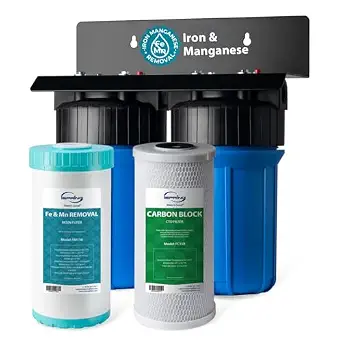 |
| Most Popular A crowd favorite that many people choose with confidence | Membrane Solutions String Wound Filter 5µ |  |
| Best Seller A high-volume bestseller chosen again and again | SimPure DB10P 10" Filter Housing |  |
Express Water WH300SCKS Whole House System

| Purification Method | Sediment, KDF, Activated Carbon Block |
|---|---|
| Maximum Flow Rate | 17 gpm |
| Operating Pressure Range | 20-80 psi |
| Supported Water TDS Level Maximum (PPM) | 800 |
| Filter Life Cycle | 6 months |
The Express Water 3-stage whole house system is built to filter all incoming water at the point of entry so every faucet and appliance receives clearer, better-tasting water. It combines a sediment prefilter, KDF media for heavy-metal reduction via redox, and an activated carbon block to remove chlorine, taste, and odor. The unit ships on a stainless steel freestanding frame with pressure gauges and pressure-release buttons to simplify monitoring and filter replacement. It is designed for high flow and reports no noticeable pressure loss while delivering up to 0.25 gallons per second and handling up to 800 ppm TDS and temperatures up to 100°F. Filters are user-replaceable and are expected to last roughly 6 months under typical conditions, which keeps maintenance predictable but means ongoing filter purchases. The system does not reduce total dissolved solids so it will not address dissolved iron or hardness by itself, and homeowners seeking TDS reduction should pair it with an RO or targeted iron removal solution. For households wanting robust heavy-metal and chlorine control at the main line, this is a practical whole-home option with straightforward serviceability.
Best for: Homeowners who want comprehensive whole-house reduction of heavy metals, chlorine, sediment, and bad tastes across every tap while prioritizing easy maintenance and high flow performance.
Less Ideal for: Homes that need specific dissolved iron removal or TDS reduction as a primary goal should consider an iron-targeted system or add an RO solution instead.
- Three-stage filtration (sediment, KDF, activated carbon) targets heavy metals, chlorine, sediment, and odors
- Stainless steel freestanding bracket with pressure gauges and release buttons for easier installation and servicing
- High flow design with minimal pressure loss to supply whole-home water needs
- NSF certified filters for independent verification of filtration performance
- Does not reduce total dissolved solids so it will not remove dissolved iron or lower TDS
- Filters typically require replacement every 6 months, creating recurring maintenance costs
Verdict: Choose this Express Water 3-stage system if you need reliable whole-home removal of heavy metals, sediment, chlorine, and bad tastes with minimal pressure loss and easy servicing.
iSpring WGB32BM 3-Stage Whole House Filter
| Maximum Flow Rate | 15 gpm |
|---|---|
| Operating Pressure Range | 25 – 80 psi |
| Operating Temperature | 40 – 100 °F |
| Inlet / Outlet | 1 inch NPT |
| Capacity | 100000 gallons |
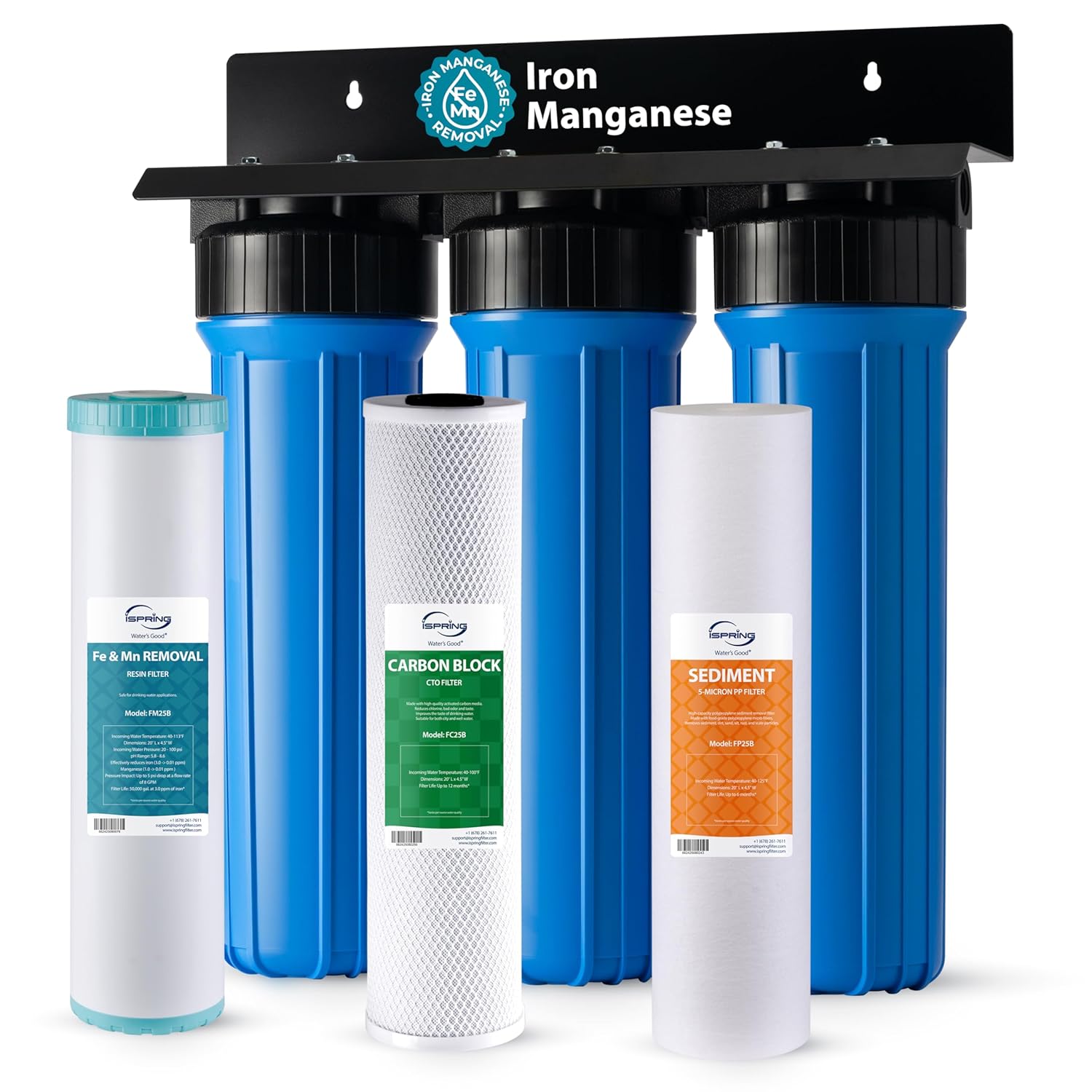
The iSpring WGB32BM is a tankless, 3-stage whole house filter designed for homes on well water that need iron and manganese removal without thinning water hardness. It uses a big-blue polypropylene sediment stage, a coconut-shell carbon block, and a catalytic iron/manganese stage to cut iron (to about 0.01 ppm from up to 3 ppm) and manganese (to about 0.01 ppm from up to 1 ppm) while removing chlorine, rust, and visible particulates. The system supports up to 15 gpm peak flow and is installed inline at the main supply with 1-inch NPT fittings, so it can serve high-demand households with minimal pressure loss. Filters are rated up to 100,000 gallons or roughly 12 months for the carbon and sediment stages, with the iron stage rated for 50,000 gallons at specified iron levels. Practical strengths include high capacity cartridges, tested carbon media, and DIY-friendly installation with online support; limitations are that it will not reduce water hardness or treat iron/manganese above the specified maximums, and outdoor installation needs weatherproofing. For performance-minded buyers dealing with moderate iron and manganese in well water, this system delivers large-capacity filtration while keeping household flow rates intact.
Best for: Homeowners with well water who prioritize high-capacity, high-flow filtration to remove iron, manganese, sediment, and chlorine while preserving household water pressure.
Less Ideal for: Homes with very high iron or manganese levels above the stated limits, or buyers seeking a system that also softens water or reduces TDS.
- Dedicated catalytic stage that reduces iron (up to 3.0 ppm) and manganese (up to 1.0 ppm) to trace levels
- High flow capacity rated up to 15 gallons per minute to support whole-house demand
- Large-capacity cartridges (up to 100,000 gallons / 12 months for sediment and carbon) reduce replacement frequency
- Third-party tested coconut shell carbon block for improved taste, odor, and chlorination byproducts
- DIY installation-friendly with 1-inch NPT connections and available online support and manuals
- Does not reduce water hardness or lower total dissolved solids (TDS)
- Iron and manganese removal is limited to the specified maximum inlet concentrations and may require a different system for heavier contamination
Verdict: Choose this system if you need a high-flow, high-capacity whole-house filter that specifically reduces moderate iron and manganese while preserving household water pressure.
PUREPLUS 2-Stage Whole House Filter

| Capacity | 30000 gallons |
|---|---|
| Power Source | Inline |
| Purification Method | Polypropylene, Iron Removal, Natural Activated Carbon Block |
| Supported Water TDS Level Maximum (PPM) | 1000 |
| Upper Temperature Rating | 100 °F |
The PUREPLUS 2-stage whole-house filter pairs a dual-function composite cartridge (polypropylene plus iron-removal media) with a coconut-activated carbon block to tackle sediment, iron/manganese and chlorine taste and odor throughout the house. It is installed inline at the main supply and is sized for standard 10"x4.5" housings so it fits most residential setups; included pressure gauges make it easy to monitor when flow is dropping and cartridges need replacing. The system is aimed at well-water issues, offering iron reduction up front and carbon polishing to improve water smell and flavor for faucets, laundry and appliances. Practical buyers will appreciate the clear housing option for visual checks and the fact replacement cartridges follow common 10" standards. Limitations include the basic inline design—there is no powered backwash or advanced iron oxidation step—so very high iron concentrations or dissolved iron might require a specialized oxidizing or catalytic media system for best results.
Best for: Homeowners with moderately iron-stained well water who want a compact, easy-to-install whole-house prefilter that improves taste and protects fixtures and appliances.
Less Ideal for: Homes with very high dissolved iron levels, heavy iron bacteria, or complex water chemistry that require catalytic oxidizing systems or professional pretreatment.
- Two-stage approach targets both sediment/iron and chlorine/odor
- Uses a dual-function polypropylene plus iron-removal cartridge for well water issues
- Coconut activated carbon block improves taste and removes chlorine and organic odors
- Standard 10"x4.5" housing and included pressure gauges simplify installation and maintenance
- Clear housing option allows quick visual inspection of cartridges
- Not a powered or backwashing iron removal system so very high dissolved iron may not be fully treated
- No mention of NSF certification in the listing
Verdict: A practical, easy-to-install two-stage whole-house filter that combines iron reduction and carbon polishing to noticeably improve well water taste and protect household plumbing.
PUREPLUS 1-Stage Whole House Filter
| Installation Type | Whole-House System |
|---|---|
| Purification Method | Sedimentation, Iron Removal |
| Upper Temperature Rating | 100 °F |
| Supported Water TDS Level Maximum (PPM) | 500 |
| Material Type | Food-grade Polypropylene, Iron Removal Media |
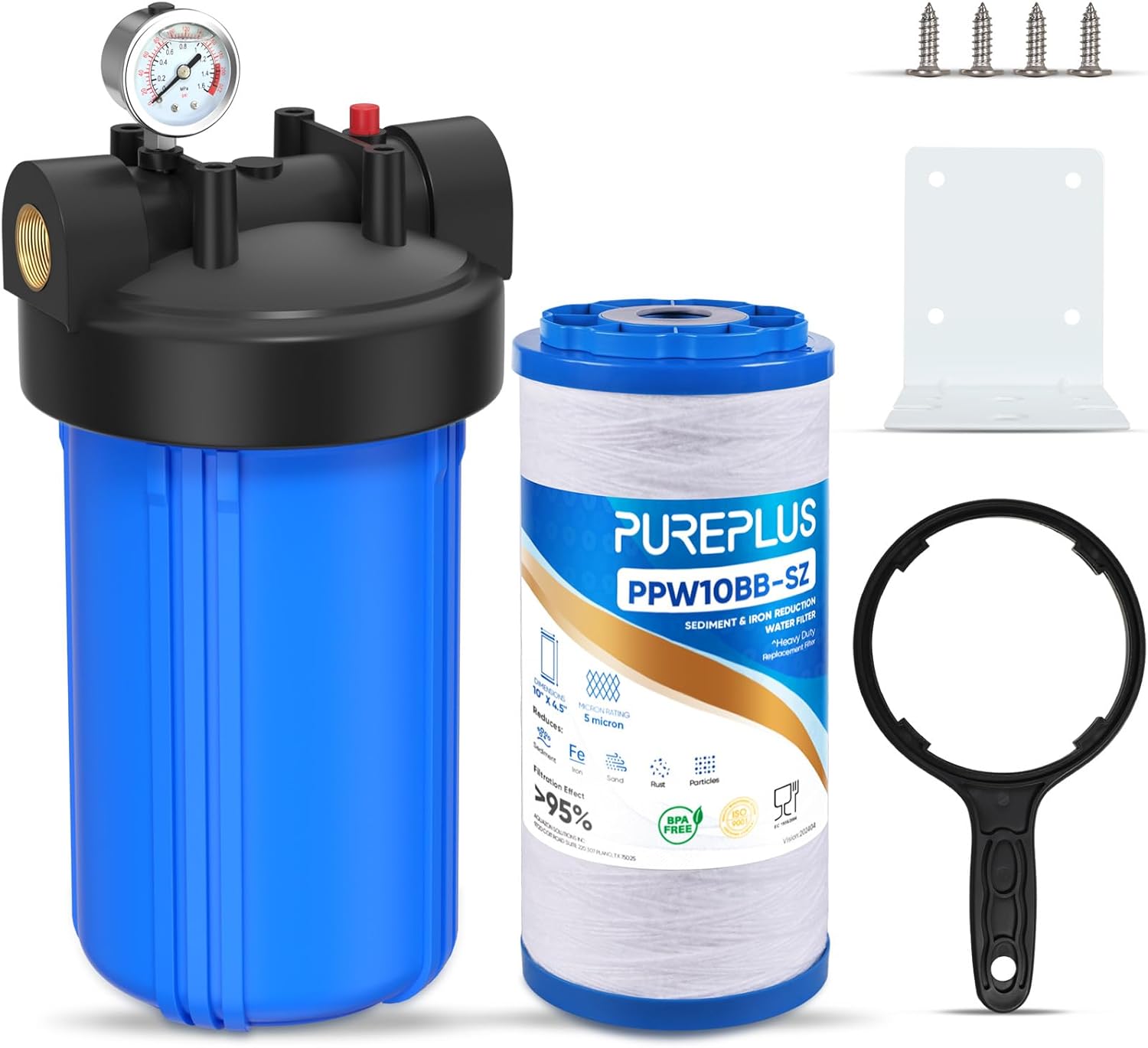
The PUREPLUS 1-Stage Whole House Filter is a straightforward pre-filtration housing and composite cartridge intended for well-water use where sediment and iron are the main concerns. It accepts standard 10"x4.5" filter cartridges and ships with the tools and mounting bracket needed for a basic installation, plus a pressure-relief valve and wrench to simplify cartridge changes. The included iron-reducing media targets iron and manganese while the polypropylene element handles sediment, which helps protect downstream appliances and plumbing from rust and particulates. Its design prioritizes flow so household pressure is maintained during showers or laundry, and the housing material is described as durable for long-term use. Limitations are that this is a single-stage system so it will not address dissolved contaminants like bacteria or very fine dissolved iron without specialized cartridges, and replacement cartridges will determine how much chlorine, taste, or finer particulate reduction you get. For buyers on a budget who need basic whole-house sediment and iron control, it is a practical entry-level option.
Best for: Homeowners looking for an affordable whole-house pre-filter that reduces sediment and iron from well water and who prefer an easy DIY install with standard, low-cost replacement cartridges.
Less Ideal for: Homes needing comprehensive treatment for dissolved iron, bacteria, or chemical contaminants should choose a multi-stage system or specialized treatment instead.
- Designed for well water with iron-reducing media built into the composite cartridge
- Fits standard 10"x4.5" cartridges for easy replacement and cartridge choice
- Includes installation hardware, mounting bracket, wrench, and pressure-relief valve
- High flow design helps maintain household water pressure during normal use
- Single-stage configuration cannot remove dissolved contaminants or microbes on its own
- Effectiveness depends on the specific replacement cartridge chosen for particular contaminants
Verdict: A budget-friendly, easy-to-install single-stage whole-house filter that gives practical sediment and iron reduction for well water using standard 10"x4.5" cartridges.
iSpring WGB21BM Whole House Filter

| Maximum Flow Rate | 15 gpm |
|---|---|
| Capacity | 50000 gallons |
| Filter Life Cycle | 1 years |
| Inlet / Outlet | 1 inch Female NPT |
| Operating Temperature | 40-100 ºF |
The iSpring WGB21BM is a 2-stage point-of-entry system built to remove chlorine, taste and odor with a coconut shell carbon block and to notably reduce iron and manganese with a catalytic iron-reducing second stage. It mounts at the main water line and is preassembled on a bracket for straightforward DIY installation, with a filter wrench and step-by-step video/manuals to guide homeowners. The system supports up to 15 gpm so it has minimal impact on household flow, and the manufacturer rates the filter life at roughly one year or up to 50,000 gallons depending on contaminants. Practical benefits include clearer water, improved appliance longevity, and reduced staining from iron and manganese. Limits to expect are that it does not lower TDS and very high well iron may require a customized or additional treatment; occasional cartridge changes are required to maintain performance. For well water with moderate iron and manganese, the WGB21BM is a robust, serviceable whole-house option.
Best for: Homeowners with well water seeking a reliable, entry-point system to reduce chlorine, odors and moderate iron or manganese while keeping installation and maintenance manageable.
Less Ideal for: Homes that need aggressive TDS reduction or have very high iron/manganese levels; those users should consider specialized iron removal systems or an RO solution for TDS.
- Two-stage design specifically targets chlorine/taste plus iron and manganese reduction
- Preassembled bracket and included wrench simplify DIY installation
- Rated flow up to 15 gpm preserves household water pressure
- High-capacity carbon and catalytic media extend cartridge life up to the stated gallons
- Documented support with manuals and installation videos for troubleshooting
- Does not reduce total dissolved solids (TDS)
- May be insufficient alone for very high iron or manganese concentrations without added treatment
Verdict: Choose the WGB21BM when you want a dependable whole-house filter that specifically reduces chlorine plus iron and manganese with easy DIY installation and strong flow performance.
Membrane Solutions String Wound Filter 5µ

| Material Type | Polypropylene (PP) |
|---|---|
| Micron Rating | 5 Micron |
| Product Height | 10 in. |
| Included Components | 6 x 10"x2.5" cartridges |
| External Testing Certification | NSF |
This 6-pack of 5-micron string-wound cartridges is a straightforward sediment prefilter for well-water systems and under-sink housings that accept 10 x 2.5-inch cartridges. Constructed from food-grade polypropylene, the depth-wound design traps larger particles near the outside and finer sediment toward the core, which increases dirt-holding capacity and extends service life compared with simple melt-blown cartridges. Typical use is as a first-stage filter ahead of carbon blocks or reverse-osmosis membranes to protect downstream components from sand, rust, silt, and other particulates. Practical benefits include long rated life (manufacturer cites up to 15,000 gallons depending on water quality), broad compatibility with many standard housings, and NSF material certification. Limitations are that this is strictly a sediment filter so it will not reduce dissolved iron, hardness, or taste and odor issues, and actual life depends heavily on well-water sediment load so monitoring pressure drop is needed to avoid fouling downstream filters.
Best for: Buyers who want a proven, high-capacity sediment prefilter to protect downstream filters and appliances in a well-water system and who prioritize documented performance and user reviews.
Less Ideal for: People looking to reduce dissolved iron, color, or taste issues from well water should choose an iron-specific or adsorptive filter instead, as this cartridge only captures particulate matter.
- Depth-wound polypropylene construction increases dirt-holding capacity compared with simple spun filters
- 5-micron rating effectively captures sand, rust, silt and larger particulates
- Fits most standard 10 x 2.5-inch filter housings for easy replacement
- Sold as a 6-pack so replacements are on hand for routine maintenance
- NSF tested for material safety
- Does not remove dissolved iron, hardness, chlorine, or tastes and odors
- Filter life varies widely with sediment load so replacement intervals must be monitored
Verdict: Choose this string-wound 5-micron 10×2.5 cartridge when you need a reliable, high-capacity sediment prefilter to protect downstream equipment on a well-water system.
SimPure DB10P 10" Filter Housing

| Maximum Flow Rate | 20 gpm |
|---|---|
| Inlet/Outlet | 1" NPT Brass Port |
| Compatible Filter Dimensions | 10" x 4.5" |
| Working Water Pressure Range | 15-90 PSI |
| Applicable Water Temperature | 5-38 ℃ (41-100 ℉) |
The SimPure DB10P is a single-stage whole-house filter housing designed to hold standard 10" x 4.5" cartridges for sediment or carbon pre-filtration. It mounts on a wall or pipe run and connects via 1" NPT brass inlet and outlet ports to handle high flow demands up to 20 gpm, making it suitable as the first stage on well or municipal supplies. The reinforced polypropylene body and brass thread fittings aim to reduce leakage, and the included wrench, heavy-duty mounting bracket, and screws simplify installation. A red pressure-relief button lets you relieve pressure before changing cartridges, which helps with safe, straightforward maintenance. The housing accepts common sediment and carbon cartridges so you can tailor filtration to iron and particulate problems, but the unit itself does not remove dissolved iron or require specialized media — you must choose appropriate cartridges or follow with additional treatment. Also note the housing is a component only; cartridges, push fittings, and any iron-specific media are sold separately and space must be allowed for cartridge changes.
Best for: Buyers who prioritize a reliable, easy-to-install prefilter to protect plumbing and appliances from sediment and particulate iron in well water and who plan to pair the housing with appropriate cartridges or downstream iron treatment.
Less Ideal for: People seeking a standalone solution for dissolved iron, manganese, or bacterial contamination should consider dedicated iron removal systems or multi-stage treatment instead of this single housing.
- Fits standard 10" x 4.5" cartridges so filters are widely available
- 1" NPT brass inlet/outlet supports higher flow and provides a durable threaded connection
- Reinforced polypropylene body rated for household use and NSF-tested materials
- Built-in pressure-relief button and included wrench make cartridge changes safer and easier
- Comes with heavy-duty mounting bracket and screws for stable installation
- Housing is only a mechanical component and does not include filter cartridges or iron-specific media
- Not designed to remove dissolved iron without properly selected cartridges or downstream treatment
Verdict: A sturdy, easy-to-service 10" housing that provides dependable prefiltration for well water when combined with the right sediment or carbon cartridges.
Choosing the Right Water Filter for Well Water with Iron: Key Factors to Consider
Type and Concentration of Iron
Different iron species behave differently in water and each requires a different treatment strategy. Dissolved ferrous iron is typically clear in water but oxidizes to form reddish particles after exposure to air, while ferric iron appears as visible rust particles. Knowing whether iron is dissolved or particulate, and its concentration in parts per million, determines whether you need oxidation and filtration, media-based iron removal, or a chemical dosing step.
Accurate test results guide whether a simple sediment-plus-media approach is sufficient or whether you should plan for more aggressive oxidation and backwash-capable systems. Treating high concentrations without appropriate equipment can cause frequent clogging and poor performance, so match capacity to measured iron levels.
Flow Rate Needs and Pressure Considerations
Whole-house systems must deliver adequate flow to feed showers, appliances, and outdoor use without a noticeable drop in pressure. Evaluate the peak flow rate your household requires and choose a filter rated to maintain that flow under normal differential pressure. Filters with low maximum flow ratings can cause reduced pressure or force you to run multiple smaller units in parallel.
Also consider how backwash cycles or regeneration events temporarily affect available flow. Systems that regenerate automatically may divert water during that time, so placement and schedule matter for households that need continuous supply.
Maintenance, Media Life, and Operating Costs
Maintenance frequency depends on iron load, system type, and media capacity. Media-based filters and oxidizing filters require periodic backwashing or media replacement; catalytic or manganese greensand media may need regeneration or replenishment. More frequent maintenance increases hands-on time and operational expense, while longer-life media can reduce total cost of ownership.
Look for systems with clear service intervals and easy access to components for cleaning or replacement. If you prefer low-maintenance solutions, prioritize higher-capacity media or systems with automated regeneration tied to measured water usage.
Pre- and Post-Treatment Compatibility
Iron removal often works best as part of a multi-stage approach. Sediment pre-filters protect downstream iron-removal media from premature fouling by sand or silt. Similarly, post-treatment carbon or polishing filters improve taste and remove any residual oxidant or volatile compounds introduced during treatment. Compatibility with common pre- and post-treatment stages lets you build a tailored train to handle hardness, manganese, or sulfur alongside iron.
Ensure the main iron-removal unit provides appropriate ports and plumbing arrangements for integrating sediment filters, water softeners, or UV systems as needed.
Installation and Space Requirements
Whole-house iron filters vary in physical footprint and installation complexity. Some systems are tank-based and require sufficient floor space and vertical clearance for service. Others are inline cartridges that mount under-sink or in utility spaces. Consider access to power and drain lines for systems that need automatic backwash or chemical feed.
If you plan a DIY install, look for simpler plumbing connections and clear instructions. For complex systems, factor in professional installation to ensure correct plumbing, electrical hookups, and safe chemical handling if oxidizers or regenerants are used.
Water Chemistry Interactions
Iron treatment must account for the broader chemistry of your well water. pH, dissolved oxygen, hardness, and the presence of manganese or hydrogen sulfide affect which iron-removal technologies will be effective. For example, low pH can reduce the efficiency of some oxidation media, while high manganese levels may require specialized media or additional stages.
Obtain a full water analysis to identify potential interfering constituents. Choosing a system that tolerates the range of water chemistry in your well reduces the risk of premature media exhaustion or ineffective treatment.
Common Iron-Removal Technologies
Several proven methods remove iron from well water, each with tradeoffs in complexity and maintenance. Oxidation-plus-filtration converts dissolved iron into particles that can be trapped by media or sediment filters. Media-based filters use materials that catalyze oxidation and capture iron particles during backwashable cycles. Chemical oxidation uses a dosing pump to add an oxidant before filtration, which is effective at higher iron concentrations.
When selecting a technology, balance removal effectiveness against installation demands. Some methods require an air supply or chemical feed and an appropriate drain for backwash, while simpler cartridge or spin-down sediment filters work only when iron is already particulate.
- Oxidation then filtration for dissolved iron
- Backwashable media tanks for continuous service
- Chemical dosing for high iron loads
- Sediment and cartridge filters for particulate iron
Testing Your Well Before Buying
Start with a comprehensive water test that reports iron species and concentration, pH, hardness, manganese, and bacteria presence. Accurate testing prevents buying an underspecified system and helps you plan pretreatment.
If you detect iron intermittently or after aeration, sample both raw well water and water after a holding period to understand how iron behaves. Keep test results available when consulting professionals or comparing system specifications.
- Measure ferrous and ferric iron separately when possible
- Include pH and manganese in the analysis
- Test during different seasons if your well shows variability
Installation Tips and Placement
Locate whole-house iron filters where they are easy to service, near the main water line and with room for tank removal or media access. Ensure there is a nearby drain for backwash and access to electricity if the system requires a pump or controller.
Consider installing a sediment pre-filter upstream to protect the main iron-removal media. Position any final polishing filters after the iron stage to address taste and chlorine or oxidant residuals without prematurely fouling the main iron media.
- Leave clearance for media replacement or head removal
- Plan for drain lines and access to power
- Install pre-filter to extend media life
Maintenance Checklist
Create a simple schedule that tracks backwash frequency, media replacements, and filter cartridge changes. Check pressure differentials across the system to detect clogging early. Keep spare O-rings, replacement cartridges, and any regeneration chemicals on hand to minimize downtime.
Document any changes in water color, taste, or flow and adjust maintenance intervals accordingly. Systems handling higher iron loads usually require more frequent attention, so plan for that when evaluating total operating effort.
- Monitor pressure drop to time service
- Record backwash and regeneration events
- Keep spare parts and media on hand
When to Call a Professional
Seek professional help if you have very high iron concentrations, complex water chemistry, or concerns about bacterial contamination. Professionals can size systems appropriately, handle chemical feeds safely, and verify that plumbing and electrical requirements are met.
A pro is also useful when integrating multiple treatment stages, such as combining softening, iron removal, and UV disinfection, to ensure each stage operates correctly without compromising downstream performance.
- High iron levels or multiple contaminants
- Complex multi-stage systems
- Uncertain water chemistry or contamination issues
How We Chose the Best Water Filter for Well Water with Iron
We focused on systems and components proven to address iron in well water while preserving household flow and minimizing maintenance. Our selection criteria emphasized measurable removal capability for ferrous and ferric iron forms, system flow rate and pressure retention, media life and maintenance intervals, ease of installation and serviceability, and the range of compatible pre- and post-treatment options such as sediment or carbon stages. We also considered backup features that protect downstream plumbing and appliances, such as sediment trapping and automatic regeneration where applicable. Products were excluded if they lacked clear iron-removal specifications, were intended only for municipal chlorine treatment, or offered incompatible flow rates for typical whole-house use. The final choices prioritize systems that demonstrate iron handling, realistic service intervals, and straightforward maintenance for homeowners dealing with well water iron issues.
Our full evaluation process is outlined in our review methodology.
FAQ
How do I know if my well water iron is dissolved or particulate?
Collect a clear sample and let it sit exposed to air for a few hours. Dissolved ferrous iron often oxidizes and forms reddish particles over time. A lab test that reports ferrous versus ferric iron will give a definitive answer.
Will an ordinary sediment filter remove iron?
Sediment filters can trap particulate iron but do not remove dissolved iron. If most of your iron is dissolved, you will need an oxidation step or media designed for dissolved iron removal.
How often will I need to service an iron filter?
Service frequency depends on iron concentration and system capacity. Some media tanks need backwashing weekly under heavy loads, while larger systems with automated regeneration may run maintenance cycles every few weeks to months. Monitor pressure drop and water clarity to determine the right schedule.
Can iron removal damage my plumbing or appliances?
Untreated iron can cause staining and clog aerators or valves over time. A properly sized and maintained iron-removal system protects plumbing and appliances by reducing particulate iron and preventing buildup. Incorrectly specified systems that clog frequently could cause pressure issues, so proper sizing is important.
Do I need a water softener along with an iron filter?
Sometimes. If your well water is also hard, a water softener can improve appliance life and scale issues. In some setups, iron removal should precede softening to prevent iron fouling of the softener media. Check your water report to decide whether both stages are beneficial.
Final Verdict
Prioritize a system that matches your measured iron type and concentration, provides adequate flow for your household, and fits the maintenance level you are willing to manage. Consider upstream sediment protection and downstream polishing to get the best long-term results. With proper testing and a system sized for your iron load, you can reduce staining, protect appliances, and maintain reliable household water flow.