
Note: This article contains affiliate links. If you click on these links and make a purchase, we may earn a small commission at no extra cost to you. This helps support our research and content. Read our full affiliate disclosure here.
If your home uses well water, choosing the right water filter can protect your plumbing, improve taste, and reduce health risks from common well contaminants. You need systems that remove the specific impurities found in groundwater without choking household water pressure or requiring constant maintenance. This guide highlights seven shortlisted water filters for well water selected for their contaminant removal capabilities, flow capacity, and serviceability. Below you will find concise evaluations of each top pick plus guidance on what matters when sizing, installing, and maintaining a well-water filtration system. Use the evaluation criteria to match a system to your well's test results and household water use.
Top Picks at a Glance
| Best Overall The best all-around choice for most situations | iSpring WGB32BM 3-Stage Whole House Filter |  |
| Best Quality Built to a higher standard if you want something more solid | Big Berkey Gravity-Fed 2.25 Gal |  |
| Best Value The sweet spot between price and what you get | PUREPLUS PP10BB-CC 5 Micron Cartridge |  |
| Best Budget The cheapest option that still gets the job done reliably | A. O. Smith 20‑Micron Sediment Filter |  |
| Top Rated A top-rated pick with lots of positive feedback | PUREPLUS 5-Micron 10×4.5 Filter |  |
| Most Popular A crowd favorite that many people choose with confidence | ZeroWater 5-Stage Replacement Filter 2-Pack |  |
| Best Seller A high-volume bestseller chosen again and again | Camco Tastepure RV Water Filter |  |
iSpring WGB32BM 3-Stage Whole House Filter
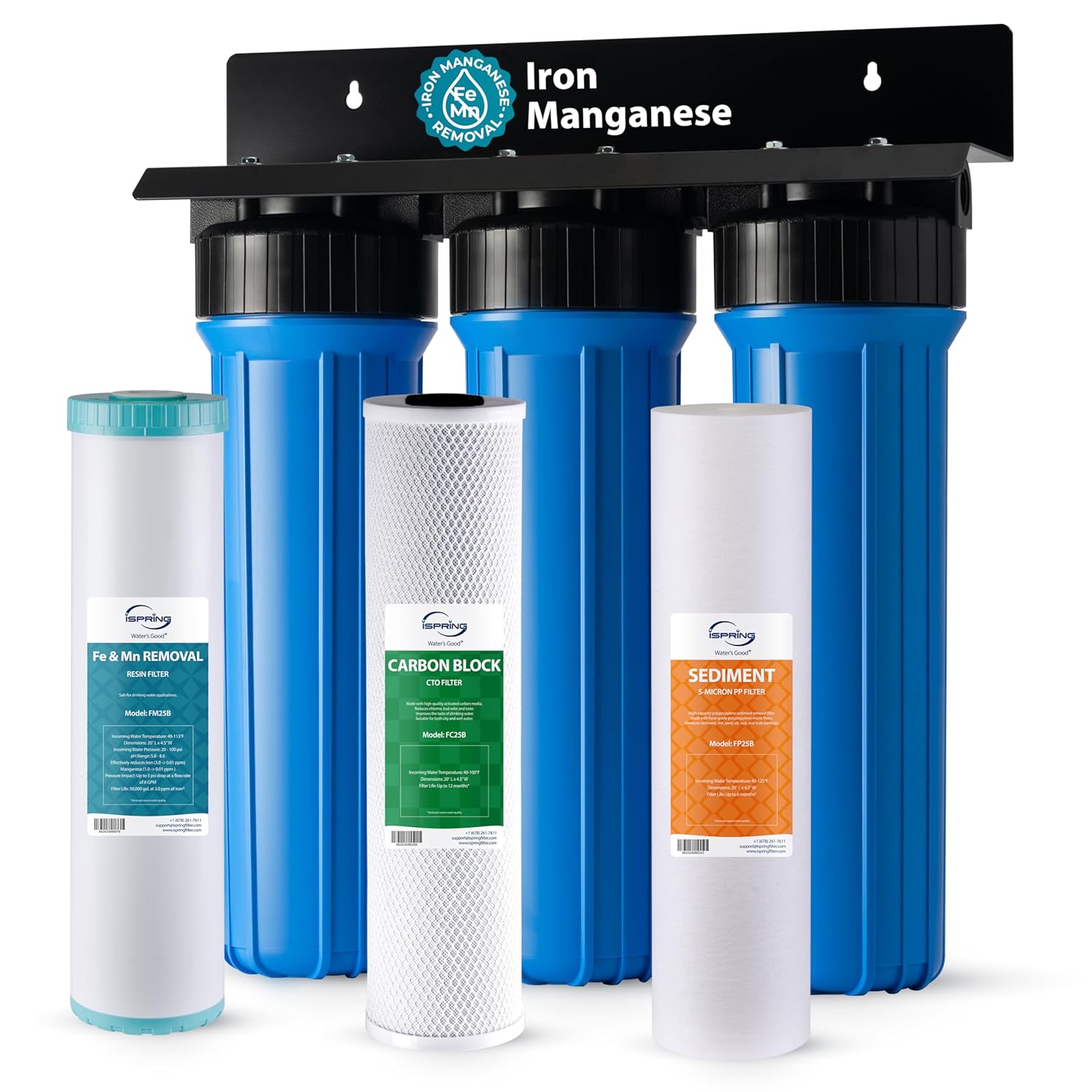
| Maximum Flow Rate | 15 gpm |
|---|---|
| Operating Pressure Range | 25 – 80 psi |
| Operating Temperature | 40 – 100 °F |
| Inlet / Outlet | 1 inch NPT |
| Capacity | 100000 gallons |
The iSpring WGB32BM is a tankless, 3-stage whole house filter designed to sit at your main water line and treat water for the whole home. Water first passes through a big-blue PP sediment cartridge to catch sand, rust and large particles, then a coconut-shell carbon block for chlorine, taste and odor, and finally a catalytic media stage that reduces iron and manganese to low levels (specified up to 3.0 ppm iron and 1.0 ppm manganese). It supports up to 15 gpm peak flow so it can handle multi-fixture demand with minimal pressure loss, and cartridges are rated for high capacity—up to 100,000 gallons or about 12 months for the sediment and carbon stages. The system is intended for indoor installation, offers DIY-friendly mounting and standard 1-inch NPT plumbing connections, and iSpring provides documentation and US-based tech support. Limitations include no reduction in water hardness or dissolved solids, and the iron/manganese stage has clear maximum input levels above which a different system is recommended.
Best for: Homeowners on well water who need a robust, whole-house solution to remove sediment, chlorine taste and low-to-moderate iron or manganese while maintaining household water pressure.
Less Ideal for: Homes with very hard water or well water testing above the stated iron or manganese limits should consider adding a softener or a higher-capacity iron treatment system instead.
- Three-stage filtration targeting sediment, chlorine/taste/odor, and iron/manganese.
- High flow capacity up to 15 gpm suitable for whole-house use.
- Long cartridge life rated up to 100,000 gallons or about 12 months for primary stages.
- Uses coconut shell carbon and catalytic media for effective contaminant reduction.
- DIY-install-friendly with 1-inch NPT connections and included wrench.
- Does not reduce water hardness or total dissolved solids.
- Iron and manganese removal is limited to specified maximum inlet concentrations (3.0 ppm iron, 1.0 ppm manganese).
Verdict: Choose the iSpring WGB32BM when you want a high-flow, three-stage whole-house filter that removes sediment, chlorine, and low-to-moderate iron and manganese for well-water households.
Big Berkey Gravity-Fed 2.25 Gal

| Capacity | 8.5 liters |
|---|---|
| Purification Method | Black Berkey proprietary filter media |
| Power Source | Gravity |
| Maximum Flow Rate | 0.03 gpm |
| Material Type | Stainless Steel |
The Big Berkey 2.25-gallon gravity-fed system is a countertop purifier built from polished AISI 304 stainless steel that uses two Black Berkey BB9-2 filter elements to reduce over 200 common contaminants. You fill the upper chamber and water flows through the proprietary media into the lower chamber, delivering drinkable water from tap or well sources without electricity, tools, or installation. The included Black Berkey elements are third-party tested and rated for long life—each pair is rated up to 6,000 gallons—so operating cost is low and element replacement is infrequent for typical household use. Its compact footprint and 2.25-gallon capacity suit small to medium households and make it portable for travel or off-grid situations. Limitations include a low maximum flow rate, so filling pitchers or large pots is slow, and the system does not specifically target fluoride or arsenic without optional PF-2 elements sold separately. For well-water use you may still need upstream testing and pre-treatment if you have very high TDS, iron, or bacterial contamination.
Best for: Buyers who prioritize contaminant reduction performance and long-lasting filter life and want a rugged, electricity-free solution for producing drinking water from well or municipal sources.
Less Ideal for: People who need fast high-volume dispensing, integrated fluoride/arsenic removal without additional parts, or those with heavily contaminated well water that requires pre-treatment for iron or bacteria.
- Gravity-powered operation requires no electricity or plumbing
- Durable AISI 304 stainless steel construction for long service life
- Black Berkey BB9-2 elements are third-party tested and rated up to 6,000 gallons per pair
- Compact 2.25-gallon capacity fits countertops and is portable for travel
- Low maximum flow rate (0.03 gpm) makes dispensing large volumes slow
- Does not include specialized fluoride or arsenic reduction elements by default
Verdict: Choose this Berkey when you want a durable, electricity-free countertop system with proven, long-life filter elements for reliable contaminant reduction.
PUREPLUS PP10BB-CC 5 Micron Cartridge

| Micron rating | 5 Micron |
|---|---|
| Material type | Coconut Shell Carbon, Polypropylene (PP) |
| Compatible size | 10" x 4.5" |
| Certification | NSF 42 |
This PUREPLUS cartridge pairs a polypropylene sediment core with coconut-shell activated carbon to remove chlorine, sediment, VOCs and improve taste and odor in standard 10" x 4.5" housings. In everyday use you install it the same way as other drop-in 10" cartridges, flush it for several minutes to condition the media, and expect clearer, better-tasting tap water for household uses. The multi-layer density design aims to catch particulate progressively while the carbon layer adsorbs chlorine and organic contaminants, which helps extend service life compared with single-layer filters. It carries NSF 42 certification for aesthetic contaminants and is compatible with many GE and common whole-house housings. Important practical limits: the cartridge is optimized for municipal or treated tap water and the listing cautions it may not handle heavy loads typical of raw well water, so iron, heavy sediment, or microbial concerns may require a different dedicated well-water filter or pre-treatment. Replacement interval depends on water quality but the maker recommends changing every 3 to 6 months under normal conditions.
Best for: A practical buyer who wants an affordable, drop-in replacement to improve taste and remove sediment and chlorine from treated or municipal feed lines and who values straightforward installation and predictable maintenance.
Less Ideal for: Homes with untreated well sources that have heavy iron, sulfur, very high sediment loads, or biological contamination should choose a filter system specifically designed for well-water pretreatment instead.
- Standard 10" x 4.5" form factor fits common housings
- Combination PP sediment and coconut-shell carbon removes sediment, chlorine, VOCs and improves taste
- Multi-layer density construction for targeted capture and longer life than basic single-layer cartridges
- NSF 42 certification for reduction of aesthetic impurities
- Not formulated for heavy well-water problems like high iron, hydrogen sulfide, or bacterial contamination
- Manufacturer guidance recommends flushing and regular replacement which adds ongoing maintenance
Verdict: Choose this cartridge if you need a cost-effective 5-micron drop-in replacement to improve taste and reduce sediment and chlorine in treated or municipal water systems.
A. O. Smith 20‑Micron Sediment Filter

| Micron rating | 20-Micron |
|---|---|
| Material Type | Polypropylene (PP) |
| Unit Count | 2 Count |
| External Testing Certification | NSF 42 – Reduces aesthetic impurities |
These replacement sediment cartridges are basic, no-frills filters meant to trap visible and near-visible particulates before water reaches household plumbing. They fit A. O. Smith AO-WH-PRE/AO-WH-PREV housings and several common branded whole-house systems, so use is simple: shut off water, swap the 2.5"x10" cartridge, and resume service. The 20-micron rating reduces turbidity and sediment that can cloud water and shorten appliance life, and polypropylene construction is standard for sediment service. The two-pack and three-month recommended change interval make maintenance predictable for small households. Limitations: a 20-micron sediment element will not remove dissolved contaminants, chemicals, or bacteria, so it should be paired with additional carbon or specialty stages for well-water concerns like iron or pathogens. Also the filter is a standard throwaway cartridge rather than a washable or backflushable media, so you'll replace rather than clean it.
Best for: Buyers looking for an inexpensive, straightforward sediment replacement to keep a whole-house prefilter working and protect downstream appliances on a budget.
Less Ideal for: Homes with serious well-water chemistry problems such as high iron, hydrogen sulfide, or suspected bacterial contamination should choose specialized iron, carbon, or disinfection stages instead.
- Direct fit for A. O. Smith AO-WH-PRE/AO-WH-PREV and several common housings
- Two-pack covers two service intervals for typical small households
- NSF 42 certification for reducing aesthetic impurities
- Polypropylene construction resists common sediment and is chemically stable
- 20-micron rating does not address dissolved contaminants or microbiological risks
Verdict: A low-cost, NSF-certified 20-micron replacement that keeps whole-house sediment prefilters doing their job without fuss.
PUREPLUS 5-Micron 10×4.5 Filter

| Micron rating | 5 Micron |
|---|---|
| Quantity | 2 Count |
| Material Type | Polypropylene (PP) |
| Compatible models | GE GNWH38F, GXWH30C, GXWH35F, GXWH40L |
This PUREPLUS two-pack provides string-wound sediment filtration intended for whole-house use on well water. The 5-micron density and a dense-inside, sparse-outside winding structure capture sand, rust, and particulate while preserving flow; the listing claims up to 2.5 GPM and a service life up to 30,000 gallons depending on water quality. Installation is straightforward in any standard 10 x 4.5" heavy-duty housing and the soft end caps mean gaskets are usually not required. Practical benefits include strong dirt-holding capacity, ANSI external testing certification, and simple maintenance — flush a new cartridge for five minutes and replace on a 3–6 month schedule or when flow or taste degrades. Limits to expect are typical for sediment-only filters: it does not remove dissolved chemicals or heavy metals and longevity will vary widely with turbidity and sediment load, so very silty wells may need prefiltration or more frequent swaps. For users seeking a dependable, easy-to-fit sediment cartridge, this is a sensible, no-frills option.
Best for: Buyers who prioritize a reliable, easy-to-install sediment cartridge for well water and want a factory-style replacement that maintains household water flow with predictable maintenance.
Less Ideal for: Those needing chemical, microbial, or heavy-metal removal should choose a carbon, KDF, or specialty treatment stage instead of this sediment-only cartridge.
- 5-micron string-wound construction captures sand, rust, and sediment effectively
- Designed to fit standard 10 x 4.5" housings for broad compatibility
- High dirt-holding capacity and claimed long service life (up to 30,000 gallons depending on water quality)
- Easy installation with soft end caps that usually eliminate the need for separate gaskets
- Sediment-only filter does not reduce dissolved contaminants, chlorine, or heavy metals
- Actual lifespan and flow rate depend heavily on well water quality and may be shorter in very dirty systems
Verdict: A straightforward, reliable 5-micron whole-house sediment cartridge that fits standard 10 x 4.5" housings and keeps well-water particulate under control.
ZeroWater 5-Stage Replacement Filter 2-Pack

| Unit Count | 2 Count |
|---|---|
| Model Number | ZR-017 |
| Material Type | Plastic |
| External Testing Certification | IAPMO, ANSI |
| Product Benefits | Reduces Chlorine, TDS, Lead, PFAS |
These two ZeroWater 5-stage replacement filters are made for pour-through pitcher systems and use ion-exchange plus multiple filtration stages to remove virtually all total dissolved solids for noticeably cleaner-tasting water. Typical use is swapping a spent cartridge into a compatible ZeroWater pitcher and monitoring the included TDS meter to know when to replace—each filter is estimated to treat about 15 gallons depending on local water quality. The practical benefits are clear for well-water households: IAPMO certification for reduction of PFOA/PFOS, lead and mercury, and a design focused on lowering TDS rather than just masking taste. Filters are BPA-free plastic and come in a two-count pack so you can keep one on hand while using the other. Important limitations are filter life and flow rate—high TDS well water will shorten lifespan and filtering is slower than faucet or whole-house systems, so this is best for drinking and cooking water rather than whole-house treatment.
Best for: Buyers who prioritize independently certified contaminant reduction and measurable TDS results for drinking water from a pitcher-style setup, especially those concerned about well-water contaminants and wanting social-proofed performance.
Less Ideal for: Households needing whole-home treatment or fast high-volume filtering should choose a dedicated whole-house or point-of-entry system instead.
- IAPMO-certified reduction of PFOA/PFOS, lead and mercury
- 5-stage ion-exchange filtration that lowers total dissolved solids for better taste
- BPA-free construction and two filters included to maintain continuous use
- Compatible with many ZeroWater pitcher models and includes TDS-driven replacement guidance
- Estimated 15-gallon life per filter can be much shorter with high-TDS well water
- Slower pour-through flow compared with inline or whole-house systems
Verdict: For well-water users who want verified reduction of PFAS and heavy metals in drinking water from a pitcher, this ZeroWater 5-stage two-pack delivers measurable TDS reduction and reliable contaminant removal.
Camco Tastepure RV Water Filter

| Material Type | Polypropylene (PP) |
|---|---|
| Included Components | Adapter |
| External Testing Certification | NSF/ANSI 42, NSF/ANSI 53, NSF/ANSI 372 |
| Model Number | 40043 |
The Camco Tastepure RV Water Filter is an inline hose filter meant for RVs, boats, and outdoor use to provide cleaner, better-tasting water from campsite or city hookups. It uses a multi-stage design combining granular activated carbon and KDF media plus a 20-micron sediment layer to cut chlorine, bad tastes, odors and reduce bacteria and sediment before water enters your freshwater system. The wide-body, high-flow housing and included flexible hose protector help maintain good water pressure and prevent kinks at the connection. Certified to NSF/ANSI 42, 53, and 372 and made in the USA, it suits cautious buyers who prefer tested components and clear performance claims. Limitations include its focus on taste, chlorine and sediment control rather than heavy metals removal beyond listed NSF reductions, and it is sized for hose inline use rather than whole-house or deep-well primary filtration. Replacement schedule and long-term capacity depend on local water quality and usage, so plan on periodic cartridge changes for reliable performance.
Best for: Buyers who prioritize independently certified, easy-to-install inline filtration for drinking water on RVs, boats, or outdoor hookups and want a straightforward, tested solution to improve taste and reduce chlorine.
Less Ideal for: Homes needing primary well-water treatment for heavy metals, high sediment loads, or microbial contamination should consider dedicated well or whole-house systems instead.
- Multi-stage GAC and KDF media reduce chlorine, taste, and odor
- NSF/ANSI 42, 53 and 372 certifications provide independent validation
- High-flow wide-body design maintains good water pressure for inline hose use
- Includes flexible hose protector to prevent kinks and reduce strain at connections
- Not a whole-house or point-of-entry well filter for heavy metal or microbial contamination control
- Service life varies with source water quality so filters must be replaced on a schedule
Verdict: A certified, high-flow inline RV hose filter that gives risk-averse buyers a tested, easy way to improve campground and outdoor drinking water quality.
Choosing the Right Water Filter for Well Water: Key Factors to Consider
Contaminant Profile of Your Well
Testing your well water is the first step because the right filter depends entirely on which contaminants are present and at what concentrations. A basic report should include sediment levels, iron and manganese, hardness, pH, hydrogen sulfide, nitrate, and coliform bacteria. Different contaminants need different media and technologies — for example, carbon media is useful for taste and organic compounds, oxidation media or greensand is better for iron and manganese, and UV or chlorination addresses microbial risks.
Match the system to measured contaminants, not just common well issues. Over-filtering or choosing the wrong media is wasteful and may not fix the real problem.
Flow Rate and Household Demand
Well systems must deliver adequate flow for simultaneous household uses such as showers, washing machines, and faucets. Filters with restrictive media or undersized tanks can cause noticeable pressure drops when demand spikes. Calculate peak flow needs by adding likely concurrent fixtures and choose a filter or prefilter arrangement with a certified flow rate that matches or exceeds that demand.
Also consider peak-cycle performance for appliances like irrigation or filling a hot-water heater. Some systems perform well at low continuous flow but struggle at short high-flow bursts. Look for published flow rates and tank capacities that reflect your household patterns.
Filter Type and Technology
Different technologies target different problems. Mechanical sediment filters remove particulates but do not address dissolved iron or bacteria. Catalytic carbon or specialization media handle sulfur and organic compounds, while oxidation-filtration and ion exchange address iron and hardness. Ultraviolet disinfection or chemical treatment is required to handle microbial contamination.
Decide whether a single-stage system is enough or whether a staged approach is better: sediment prefiltration, followed by contaminant-specific media, with optional post-treatment polishing or disinfection. Staged systems reduce premature media fouling and extend service life.
Installation and Plumbing Considerations
Whole-house systems typically connect at the pressure tank or where municipal supply would enter the home, and some require space, bypass valves, and proper drain access for backwashing units. Assess available space, the orientation of existing plumbing, and whether you can shut off and bypass the system during service.
Also plan for power needs if the system uses pumps, backwashing cycles, or UV lamps. Some installations require certified plumbers; others are designed for DIY with basic tools. Ensure local codes and well regulations are followed.
Maintenance Requirements and Ongoing Costs
Different media require different service intervals. Sediment cartridges may need replacing every 1 to 6 months, while specialized media or resin beds might last years but require periodic regeneration or backwashing. UV lamps and certain cartridges have predictable lifespans and must be replaced on schedule to maintain effectiveness.
Estimate annual maintenance costs, including replacement media, lamp replacements, and any salt or regenerant. Also consider the labor or professional servicing costs if the system is complex.
Material Durability and Corrosion Resistance
Well water can be corrosive or carry high mineral loads, so component materials matter. Look for corrosion-resistant housings, stainless steel fasteners, and sealed electronics where applicable. Poor materials shorten service life and can introduce contaminants through leaching.
Durability affects long-term value and reliability, especially in remote or seasonal properties where frequent service is impractical.
Common Well Water Contaminants and How Filters Address Them
Well water commonly carries suspended sediment, iron and manganese, hardness minerals, organic compounds, hydrogen sulfide, nitrates, and occasionally microbial contaminants. Each of these requires a different treatment approach. Sediment filters protect downstream equipment and improve clarity but do not alter dissolved minerals. Oxidation followed by filtration is the standard approach for iron and manganese removal. Ion exchange softeners reduce hardness. Activated carbon improves taste and reduces organic compounds. UV and chemical disinfection are the primary defenses against bacteria and viruses.
- Sediment: mechanical cartridges or spin-down prefilters
- Iron and manganese: oxidation media with filtration or ion exchange
- Hardness: water softeners using ion exchange resin
- Hydrogen sulfide: catalytic carbon or oxidation followed by filtration
- Microbial: UV disinfection or chemical feed systems
Sizing a System for Peak Flow and Storage
Sizing must reflect peak simultaneous demand and typical daily usage. For whole-house systems, confirm the maximum flow rate the media can handle without significant pressure loss. If you have high peak draws, consider systems with larger tank volumes or parallel staging to preserve pressure. Storage tanks may smooth peaks and reduce cycling for regeneration systems.
- Calculate peak flow from fixtures running at once
- Check manufacturer flow rates and backwash requirements
- Consider storage or parallel units for high-demand homes
Prefiltration to Extend Media Life
A sediment prefilter protects more expensive specialty media from clogging and significantly extends service intervals. Installing a coarse spin-down or cartridge filter ahead of carbon, resin, or oxidation beds reduces particulate loading and improves overall system reliability. Prefiltration also makes maintenance easier because disposable cartridges are simple to change and inexpensive relative to specialized media.
- Use a coarse prefilter for high-sediment wells
- Replace prefilters on a predictable schedule to avoid media fouling
- Prefiltration reduces replacement costs of downstream media
Treatment Sequence for Typical Well Issues
A staged treatment train is often the most effective arrangement. Start with sediment removal to protect downstream media. Next, address iron, manganese, or sulfur with appropriate oxidation media or catalytic carbon. Follow with softening if hardness is a concern, and finish with carbon polishing for taste and volatile organics. Add UV or chemical disinfection at the end of the train if microbial contamination is present. This sequence reduces media cross-contamination and allows each stage to work within its design parameters.
- Stage 1: Sediment prefilter
- Stage 2: Iron/sulfur media or oxidation filter
- Stage 3: Softener or ion-exchange if needed
- Stage 4: Carbon polishing and optional disinfection
Maintenance Checklist and Typical Service Tasks
Establish a maintenance schedule when you install the system. Common tasks include replacing sediment cartridges, monitoring and replacing specialized media as specified, checking and replacing UV lamps on schedule, inspecting seals and housings for leaks, and testing water periodically to confirm contaminant levels are controlled. Keep readily accessible shutoff valves and a bypass for quick servicing without disrupting water to the house.
- Monthly or quarterly cartridge checks depending on sediment load
- Annual or multi-year media replacement based on usage and reported capacity
- UV lamp replacement on timed intervals, typically annually
How We Chose the Best Water Filter for Well Water
We focused on systems that address the practical realities of treating private well water. Our selection criteria prioritized measurable contaminant reduction, sustained flow rates suitable for typical household demand, and durability under varied well conditions. We also weighed installation type and serviceability because many well owners prefer systems that can be maintained without frequent professional visits. Materials and certifications were considered when available to ensure systems use appropriate filter media and corrosion-resistant components. We excluded point-of-use devices that only treat a single tap and products meant solely for municipal chlorine-treated supplies. Instead we prioritized whole-house sediment and contaminant systems as well as point-of-entry combinations that work with groundwater. Filters were also filtered out if they could not be matched to common well issues such as sediment, iron, hardness, hydrogen sulfide, or microbial risk. The final list balances removal performance, flow capacity, maintenance frequency, and compatibility with typical residential well plumbing.
Our full evaluation process is outlined in our review methodology.
FAQ
How often should I test my well water after installing a filter?
Test at least annually for the core parameters such as bacteria, nitrates, and common minerals. If you notice changes in taste, color, or pressure, or after heavy storms, test sooner because conditions in shallow wells can change rapidly.
Can a single filter handle sediment, iron, and bacteria?
Rarely. Most single-stage filters target one class of contaminant. Effective well-water treatment usually requires a staged approach so that each medium addresses a specific problem without premature fouling of downstream stages.
Will a water softener remove iron from well water?
Ion exchange softeners can remove low levels of dissolved iron but are not effective for high iron concentrations or particulate iron. Iron-specific oxidation and filtration methods are usually required when iron is above trace levels.
Do UV systems need maintenance beyond lamp changes?
UV systems require periodic lamp replacement and cleaning of the quartz sleeve, plus occasional ballast checks. They also require the water to be free of turbidity and sediment, so prefiltration is essential for reliable UV performance.
Is backwashing necessary for all whole-house systems?
Not for all systems. Backwashing is necessary for media that trap contaminants internally, such as greensand or multimedia beds. Cartridge-based filters typically use replacement rather than backwashing. Choose a system whose maintenance cycle you can support.
Final Verdict
Choosing the right water filter for well water depends on matching treatment technology to the contaminants shown in your water test and on sizing the system for your household flow demands. Prioritize a staged approach that protects specialized media with sediment prefiltration and allows for disinfection if bacteria are a concern. Balance upfront complexity against maintenance capacity and ongoing replacement costs. With a proper test, correct sizing, and scheduled upkeep, you can secure reliable, clear, and better-tasting water from a well system that fits your home and routine.