
Note: This article contains affiliate links. If you click on these links and make a purchase, we may earn a small commission at no extra cost to you. This helps support our research and content. Read our full affiliate disclosure here.
Installing the right under-sink reverse osmosis water filter makes a noticeable difference in the quality and taste of your household drinking water. You want dependable contaminant reduction without sacrificing sink pressure or creating an onerous maintenance schedule. This guide shortlists seven top-performing under-sink reverse osmosis water filters that balance filtration efficiency, flow rate, and ease of upkeep for typical home kitchens. We evaluate each pick on specific technical and practical criteria so you can choose the system that fits your water source, daily usage, and maintenance willingness. Read on for the priorities that matter and which systems suit different household scenarios.
Top Picks at a Glance
| Best Overall The best all-around choice for most situations | FRIZZLIFE PD600 Tankless RO |  |
| Best Quality Built to a higher standard if you want something more solid | Home Master Artesian TMAFC-ERP |  |
| Best Value The sweet spot between price and what you get | Express Water ROALK5D 50 GPD |  |
| Best Budget The cheapest option that still gets the job done reliably | FS-TFC 5-Stage RO System |  |
| Top Rated A top-rated pick with lots of positive feedback | iSpring RCC7-BN 5-Stage RO |  |
| Most Popular A crowd favorite that many people choose with confidence | APEC Water ROES-50 |  |
| Best Seller A high-volume bestseller chosen again and again | Waterdrop G3P600 Tankless RO |  |
FRIZZLIFE PD600 Tankless RO

| Flow rate | 600 GPD |
|---|---|
| Purification method | Reverse Osmosis, Alkaline/Remineralize |
| Installation type | Under Sink |
| Power source | Corded Electric |
| Pure to drain ratio | 2:1 |
The FRIZZLIFE PD600 is a tankless under-sink reverse osmosis system that filters water through a 600 GPD RO membrane, then remineralizes and raises pH with an alkaline stage for better taste and healthier drinking water. It installs under the sink and uses a corded electric power source, with a dedicated stainless steel faucet included. The system's smart LED shows real-time TDS and filter life so you can monitor water quality and know when to replace cartridges, while the quick-change design makes servicing straightforward. Tankless construction saves under-sink space and reduces the chance of secondary contamination from a storage tank, and the manufacturer quotes a low 2:1 pure-to-drain ratio to minimize wastewater compared with traditional RO units. Practical limits: it requires an electrical connection and periodic filter and membrane replacements, and the alkaline stage and displayed TDS are useful but do not replace full lab testing for specific contaminants. For buyers wanting high flow, compact footprint, and on-demand remineralized water, the PD600 is a solid option.
Best for: Buyers who want a compact, high-flow RO system that delivers remineralized alkaline water on demand and who value real-time monitoring of TDS and filter life.
Less Ideal for: People who need a passive, non-electric filtration solution or those who prefer a large pressurized storage tank for high-volume intermittent use.
- Tankless design saves under-sink space and eliminates a storage tank as a contamination source.
- High 600 GPD production for fast on-demand water and quick faucet filling.
- Built-in TDS and filter-lifespan display for continuous water-quality monitoring.
- Alkaline remineralization stage restores minerals and raises pH for better taste.
- Low 2:1 pure-to-drain ratio to reduce wastewater versus many conventional RO systems.
- Requires electrical power to operate, so it will not function during outages without backup power.
- Still requires regular filter and membrane replacements to maintain performance.
Verdict: Choose the PD600 if you want a compact, tankless under-sink RO that delivers fast, remineralized alkaline water with live TDS monitoring.
Home Master Artesian TMAFC-ERP

| Purification Method | Alkaline, Reverse Osmosis |
|---|---|
| Maximum Flow Rate | 1 gpm |
| Operating Pressure Range | 40-95 psi |
| Supported Water TDS Level Maximum (PPM) | 500 |
| Capacity | 2000 gallons |
The Home Master Artesian Full Contact TMAFC-ERP is an under-sink reverse osmosis system designed for homeowners who want high-performance purified water with improved taste. It uses a seven-stage filtration path including catalytic carbon and a DOW RO membrane, then a patented two-pass remineralization to return calcium and magnesium for a less acidic, better-tasting result. A built-in non-electric permeate pump raises production while cutting wastewater and the Fast Flo kit and larger tubing produce a rapid 4.5 second eight-ounce fill rate at the faucet. The modular, canister-style filters are easy to service without wrenches and annual change intervals (or about 2,000 gallons) keep maintenance predictable. Practical benefits include strong chloramine removal from catalytic carbon, higher throughput than many RO setups, and NSF-compliant components. Limits to consider are the under-sink footprint and the need to fit the included tank and plumbing in your cabinet, and the system still requires occasional filter and membrane replacements and correct water pressure to hit peak performance.
Best for: Buyers who prioritize high throughput, strong contaminant removal, and better-tasting mineralized water from an under-sink RO system while accepting regular maintenance.
Less Ideal for: People with very small or crowded under-sink cabinets or those who want a completely maintenance-free, point-of-use pitcher-style option.
- Non-electric permeate pump increases water production and lowers wastewater to about a 1:1 ratio
- Patented two-pass remineralization adds calcium and magnesium for improved taste and less acidic water
- Fast Flo fittings and larger tubing deliver a rapid faucet fill rate (4.5 seconds per 8 oz)
- Catalytic carbon media for effective chloramine and chemical removal
- Modular canister design with easy, wrench-free annual filter changes
- Under-sink footprint requires sufficient cabinet space for the tank and assembled unit
- Still requires periodic filter and membrane replacements to maintain performance
Verdict: Choose this system if you want a high-performance under-sink RO that raises output and reduces waste while delivering remineralized, better-tasting water.
Express Water ROALK5D 50 GPD

| Purification Method | Alkaline, Reverse Osmosis |
|---|---|
| Capacity | 50 gallons_per_day |
| Maximum Flow Rate | 0.8 gpm |
| Operating Pressure Range | 40-80 psi |
| Supported Water TDS Level Maximum (PPM) | 2000 |
The Express Water ROALK5D is a 10-stage under-sink reverse osmosis system designed to deliver alkaline, mineralized drinking water at up to 50 gallons per day. It installs under a kitchen sink or in a nearby cabinet and comes with a 4 gallon storage tank and a chrome faucet for direct dispensing. Key user-facing features include multi-stage RO filtration that the listing says removes up to 99.99% of common contaminants, an alkaline remineralization stage, quick-connect tubing for faster setup, and a 0.8 gpm faucet flow rate. Practical benefits are noticeably cleaner-tasting water for cooking and beverages, included filters for initial use, and a compact footprint that fits typical cabinets. Important limitations to expect are the wastewater ratio common to RO systems (roughly 1 to 3 gallons discharged per gallon produced) and the need for adequate incoming water pressure or an optional booster pump for low-pressure homes. Replacement filters and periodic maintenance are required to keep output quality high.
Best for: Buyers who want a compact, do-it-yourself under-sink RO system that delivers highly filtered, mineralized drinking water for everyday kitchen use and value straightforward installation and included starter filters.
Less Ideal for: People who cannot accommodate RO wastewater disposal, have very low household water pressure without adding a booster, or need a no-maintenance pitcher-style solution.
- 10-stage filtration with alkaline remineralization for improved taste and added minerals
- Includes storage tank and chrome faucet for under-sink dispensing
- Quick connect tubing and included filter set simplify DIY installation
- Certified to NSF standard 58 for reverse osmosis performance
- Produces wastewater at a typical RO ratio of about 1–3 gallons discharged per gallon produced
- Requires 40–80 psi water pressure and may need a booster pump in low-pressure situations
Verdict: Choose this system if you want a compact, NSF-tested under-sink RO that adds minerals back to the water and is geared for DIY installation.
FS-TFC 5-Stage RO System

| Purification Method | Reverse Osmosis |
|---|---|
| Installation Type | Under Sink |
| Maximum Flow Rate | 18 liters per hour |
| Supported Water TDS Level Maximum (PPM) | 500 |
| Capacity | 100 gallons |
This FS-TFC 5-stage under-sink RO system is a compact purifier intended for household drinking and cooking water. It uses five filtration stages and reverse osmosis membrane to remove many contaminants including chlorine, heavy metals, fluoride and VOCs, and is claimed to achieve very high removal rates. Installation is designed to be tool-free and DIY-friendly with a supplied faucet, tank, feed adapter and clear instructions so most owners can fit it under a standard kitchen sink in roughly 10 minutes. The unit operates without electricity and offers an 18 L/hour (about 100 GPD) flow rate at typical pressure, plus a low 1:1 drain ratio that limits wastewater compared with many RO units. The system ships with four extra replacement filters that cover about a year of use and the manufacturer provides a 2-year warranty and lifetime technical support. Expect periodic filter and membrane changes and account for the storage tank when planning under-sink space; some users may also want TDS testing to confirm performance in high-TDS supply water.
Best for: Buyers who prioritize clean, bottled-quality drinking water on a tight budget and want a compact, DIY-friendly under-sink solution that minimizes ongoing costs.
Less Ideal for: Homes with very high incoming TDS or complex water chemistry that need professional water testing or a specialized commercial-grade system.
- Five-stage RO filtration removes a broad range of contaminants for improved taste and safety
- Compact under-sink footprint fits most standard sinks and RVs
- Tool-free DIY installation with included faucet, tank and adapters
- Runs without electricity and claims a low 1:1 drain ratio to reduce waste water
- Includes four replacement filters to lower first-year operating cost and simplify maintenance
- Filter life listed as one year requires periodic replacement and ongoing cost
- Claims of 99.999% removal apply to many but not all contaminants and benefit from independent verification
- Storage tank occupies under-sink space and can limit clearances
Verdict: A budget-focused, compact under-sink RO that delivers broad contaminant removal, easy DIY installation, and low first-year operating cost thanks to included extra filters.
iSpring RCC7-BN 5-Stage RO

| Purification Method | Reverse Osmosis, Activated Carbon, Carbon block |
|---|---|
| Capacity | 75 gallons |
| Maximum Flow Rate | 3.4 liters per minute |
| Supported Water TDS Level Maximum (PPM) | 750 |
| Power Source | No Power Needed |
The iSpring RCC7-BN is a five-stage under-sink reverse osmosis system built to deliver bottled-quality drinking water at home. It uses three pre-filters (sediment, granular activated carbon, carbon block), a high-rejection RO membrane and a post-carbon polishing filter to remove a broad range of contaminants down to 0.0001 microns, and the unit is NSF/ANSI 58 certified. The system stores treated water in a tank and includes a brushed nickel lead-free faucet and push-to-connect fittings to simplify a DIY installation and reduce leak risk. Practical benefits include high daily capacity rated at 75 gallons, no electrical hookup, clear first-stage housing for visual checks, and online support resources for maintenance. Limitations are that it is intended for municipal tap water rather than untreated well water, it requires periodic filter and membrane replacement, and the under-sink tank and housings take up cabinet space and add weight when installed.
Best for: Buyers who prioritize a dependable, tested under-sink system that reliably produces high-quality drinking water and are comfortable with periodic DIY maintenance.
Less Ideal for: Households using untreated well water without additional whole-house pretreatment or users who need a tankless or extremely compact countertop solution.
- NSF/ANSI 58 certified for reverse osmosis performance
- Five-stage filtration removes over 1,000 contaminants and polishes taste
- No power required and includes a dedicated lead-free faucet
- Transparent first-stage housing for quick visual filter checks
- Push-to-connect fittings and included components simplify installation
- Not designed for untreated well water without pre-treatment
- Requires regular filter and membrane replacements to maintain performance
- Under-sink tank and housings occupy significant cabinet space
Verdict: Choose the iSpring RCC7-BN if you want a certified, no-power under-sink RO system that reliably delivers high-capacity, bottled-quality drinking water.
APEC Water ROES-50

| Filtration Stages | 5-Stage |
|---|---|
| Daily Output | 50 GPD |
| Operating Pressure Range | 40-85 psi |
| Supported Water TDS Level Maximum (PPM) | 2000 |
| Filter Life Cycle | 6 months |
The APEC Water ROES-50 is a 5-stage under-sink reverse osmosis system designed to remove a wide range of contaminants and deliver up to 50 gallons per day of drinking water. It installs under the sink and includes quick-connect fittings, colored tubing, a storage tank and a dedicated faucet so you can run filtered water to the kitchen tap. The five filtration stages combine sediment and carbon prefilters with an RO membrane and post-filter to reduce chlorine, lead, arsenic, fluoride, PFAs and microplastics, producing noticeably cleaner taste and odor. Filters are large-capacity parts intended to protect the membrane and typically need changing between 6 and 24 months depending on water quality. The unit is DIY-friendly for homeowners comfortable with basic plumbing, but it requires under-sink space and occasional filter replacement and maintenance. If your incoming water has very high TDS or you need faster flow, consider a higher-capacity or boosted-output model, otherwise this system offers dependable, certified contaminant reduction for most household uses.
Best for: Buyers who prioritize proven contaminant reduction and want a complete under-sink RO system backed by extensive customer feedback and certifications.
Less Ideal for: People who need the fastest possible dispensing rate, have very limited under-sink space, or prefer a tankless countertop solution.
- 5-stage filtration removes a broad range of contaminants including heavy metals, chlorine, fluoride, and PFAs
- Produces up to 50 gallons per day, sufficient for typical household drinking and cooking needs
- Includes storage tank, faucet, installation kit, and Filter-Max replacement set for a complete system
- DIY-friendly quick-connect fittings and colored tubing make installation and servicing straightforward
- Maximum flow rate and delivery depend on water pressure so output can be slow without adequate household pressure
- Requires under-sink space and periodic filter and membrane replacements
Verdict: A reliable, WQA-certified 5-stage under-sink RO that delivers hospital-grade contaminant reduction and a complete installation kit for homeowners who want proven performance.
Waterdrop G3P600 Tankless RO
| Filtration stages | 8-stage |
|---|---|
| Flow rate | 600 GPD |
| Pure to drain ratio | 2:1 |
| Purification method | Reverse Osmosis, Carbon Block |
| Power source | Corded Electric |
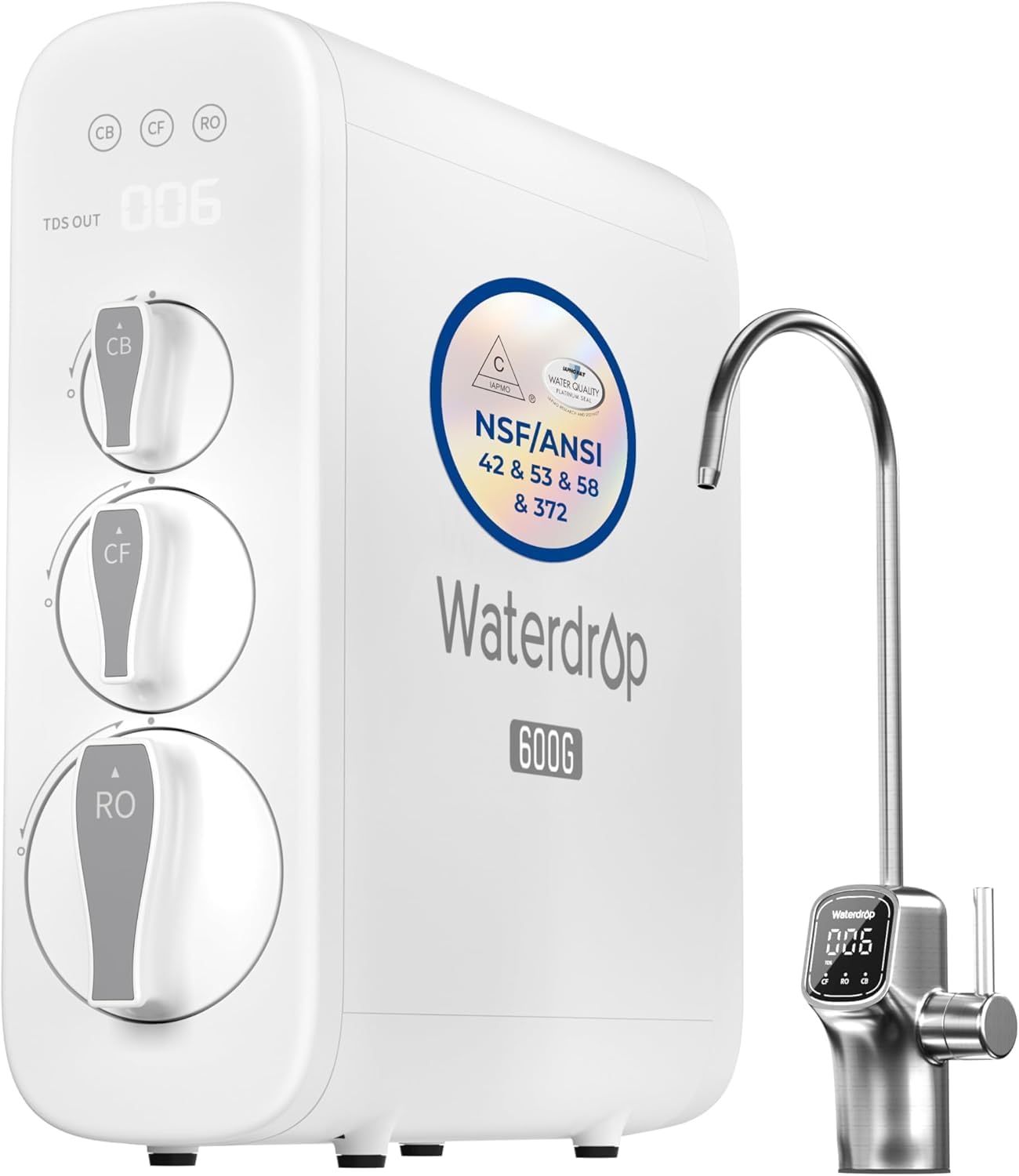
The Waterdrop G3P600 is a tankless under-sink reverse osmosis system designed to provide high-capacity, drinking-quality water without a storage tank. It uses an 8-stage filtration train including RO membrane and carbon blocks to reduce TDS, chlorine, heavy metals and contaminants such as PFAS, and its 600 GPD output and quick flow rate mean an 8 oz cup in about 8 seconds, useful for drinking and rinsing produce. The system includes a smart LED faucet that displays TDS and filter life so you can monitor water quality and replacement needs, and the tankless design frees under-sink space while offering tool-free twist-and-replace filters. It runs from mains power and features automatic flushing to help maintain membrane cleanliness. Important limits are the need for an under-sink electrical plug and the requirement to drill mounting holes for faucet and drain connections, and while the 2:1 pure-to-drain ratio is better than many RO units, it still produces some wastewater. Installation and cabinet fit should be checked against the listed dimensions before purchase.
Best for: Buyers who prioritize proven contaminant reduction and easy in-use monitoring and who want a high-flow, space-saving under-sink RO for daily drinking water.
Less Ideal for: People without access to an under-sink electrical outlet, those unwilling to drill for installation, or households that cannot accommodate the unit's under-sink footprint.
- High daily output up to 600 GPD for fast dispensing
- 8-stage filtration that targets TDS, chlorine, heavy metals and PFAS
- Smart faucet with TDS and filter-life display for easy monitoring
- Tankless design saves under-sink space and uses twist-to-replace filters
- Lower 2:1 pure-to-drain ratio than many RO units, reducing water waste
- Requires an under-sink electrical outlet to operate
- Installation requires drilling holes and verifying cabinet clearance
Verdict: A high-capacity, tankless under-sink RO with 8-stage filtration and a smart TDS-display faucet for buyers who want fast, monitored, space-saving purified water.
Choosing the Right Under-Sink Reverse Osmosis Water Filter: Key Factors to Consider
Filtration Effectiveness
This measures how well the RO system reduces target contaminants such as dissolved solids, lead, chlorine, and other common municipal or well-water impurities. Check for third-party test data or manufacturer lab sheets that list percent reductions for total dissolved solids (TDS) and specific contaminants. Higher rejection rates matter when your incoming water has known issues, while moderate reduction may be acceptable for already-treated municipal supplies.
Understanding filtration effectiveness helps set expectations for taste, odor, and safety. It also informs whether you need additional post-filters for taste or mineralization stages to improve flavor after RO treatment.
Flow Rate and Recovery Efficiency
Flow rate is the volume of purified water available at the faucet per minute, and recovery efficiency is the percentage of feed water converted to usable permeate versus waste water. Faster flow and higher recovery reduce wait times and water waste during daily use. Consider whether the system includes a pressurized storage tank and the tank capacity relative to household demand.
Households with higher daily usage or point-of-use expectations benefit from systems engineered for faster permeate production and better recovery. If your incoming water pressure is low, factor that into expected flow performance.
Filter Life and Ongoing Maintenance
Filter life determines how often you must replace pre-filters, RO membranes, and post-filters. Longer service intervals lower recurring maintenance time and cost. Look for clear replacement schedules and accessible cartridge changes that do not require tools or professional service.
Maintenance also includes periodic sanitization, checking fittings for leaks, and replacing membranes as their performance declines. Realistic maintenance planning avoids degraded water quality and unexpected system downtime.
Installation Complexity and Plumbing Requirements
Under-sink RO systems vary in how invasive their installation is. Some units use simple quick-connect fittings and a standard cold-water saddle valve, while others need additional shutoff valves, drain connections, or dedicated space for a booster pump. Assess the system's installation instructions against your cabinet layout and plumbing competence.
If you are uncomfortable with DIY plumbing, look for systems with straightforward fittings or consider professional installation. Also confirm whether the unit requires minimum inlet pressure or a booster pump to meet performance claims.
Cabinet Footprint and Tank Size
Under-sink real estate is limited. Evaluate the physical dimensions of the RO assembly and storage tank to ensure they fit below your sink alongside garbage disposals, water heaters, or plumbing traps. Compact modular designs are easier to tuck away but may sacrifice tank capacity or serviceability.
Tank size affects on-demand availability of purified water. Larger tanks reduce wait times between uses but need more cabinet space. Balance tank volume with typical household drinking and cooking needs.
Warranty, Parts Availability, and Leak Control
A reliable warranty and easy access to replacement parts and fittings reduce lifecycle risk. Check for clear warranty terms and whether common seals or cartridges are easy to source. Robust leak-control features such as automatic shutoff valves, reinforced tubing, or integrated drain adapters lower the chance of water damage from component failure.
Good documentation and replacement-part availability make long-term ownership simpler and less expensive.
How Reverse Osmosis Works Under the Sink
An under-sink reverse osmosis system forces water through a semipermeable membrane to separate dissolved solids and many contaminants from the permeate stream. The process starts with sediment and carbon pre-filters that protect the membrane and remove chlorine and particulates that would otherwise degrade performance. Treated water is either stored in a small pressurized tank or delivered directly through a dedicated faucet.
Understanding the process clarifies tradeoffs. The membrane is the primary contaminant barrier, but pre- and post-filters shape taste and membrane longevity. Systems also divert a portion of feed water as reject water, which is an expected part of RO operation.
- Pre-filters: remove sediment and chlorine to protect the membrane
- RO membrane: rejects dissolved solids and heavy metals
- Post-filter: polishes taste and reduces any residual odors
- Storage tank: provides on-demand water and smooths flow
- Drain connection: disposes of the concentrated reject stream
Testing Your Source Water Before Choosing
Start with a basic water test to identify hardness, TDS, pH, and specific contaminants like lead or nitrates. Municipal water quality reports and do-it-yourself test strips provide a good initial picture, while lab analysis is useful for well water or suspected contamination.
Knowing what is present in your feed water helps you pick the level of RO system you need. High dissolved solids or specific toxins favor higher-rejection membranes and more frequent maintenance checks.
- Use a TDS meter to measure dissolved solids baseline
- Check annual consumer confidence reports for municipal supplies
- Consider lab testing for well water or unusual tastes and odors
Installation Tips for Under-Sink RO Systems
Plan the layout before you start. Ensure there is room for the RO assembly, the tank, and clear access to the drain and cold-water feed. Label shutoff points and prepare the cabinet by clearing space and protecting surfaces from potential drips during installation.
Follow torque and fitting recommendations closely and use thread seal tape where specified. Tighten fittings evenly and test for leaks at low pressure before finishing the job. If inlet pressure is below the system minimum, a booster pump can improve both flow and recovery.
- Keep the membrane and filter cartridges accessible for future replacements
- Install the dedicated faucet at a comfortable distance from the sink edge
- Use a drill guide or template when creating a faucet hole to avoid chipping
Maintenance Schedule and What to Expect
Typical maintenance includes replacing sediment and carbon pre-filters every 6 to 12 months, changing the RO membrane every 2 to 5 years depending on feed-water quality, and swapping post-filters annually. Some systems bundle multiple stages into quick-change cartridges to simplify upkeep.
Regularly check fittings and tubing for any signs of wear or seepage. Flushing new membranes per manufacturer guidance and sanitizing the system annually will keep water quality consistent and extend component life.
- Set calendar reminders for filter and membrane changes
- Keep an extra set of replacement filters on hand for uninterrupted service
- Record TDS readings periodically to detect membrane decline
Improving Taste Without Over-Filtering
Reverse osmosis produces very low-mineral water, which some people find flat-tasting. Adding a post-stage carbon filter or a remineralization cartridge can restore mouthfeel and balance pH without compromising contaminant reduction. These stages are optional and depend on personal taste preferences.
If you prefer a bit of minerality, choose a system that offers an optional remineralizer or allows for a simple add-on. That gives you more control over flavor while preserving the core benefits of RO filtration.
- Carbon polishing filters improve odor and taste
- Remineralization adds back healthy minerals for flavor
- Adjustable configurations let you prioritize taste or absolute purity
How We Chose the Best Under-Sink Reverse Osmosis Water Filter
We focused on systems that deliver reliable reverse osmosis filtration while remaining practical for in-cabinet installation and everyday household use. Key evaluation criteria included filtration effectiveness against common contaminants, permeate flow rate and recovery efficiency, filter life and maintenance frequency, under-sink footprint and installation complexity, and build quality for long-term leak resistance. We prioritized units with clear specification sheets and accessible replacement parts, and we checked that systems used standard filter sizes or commonly available replacement cartridges. We excluded specialty units intended for industrial or laboratory use, countertop RO products, and systems that require extensive dedicated plumbing beyond typical residential sink connections. Systems without clear contaminant reduction data or with unusually high maintenance burdens were also filtered out. The result is a shortlist of practical under-sink reverse osmosis water filters that balance measurable performance, user maintenance, and straightforward installation.
Our full evaluation process is outlined in our review methodology.
FAQ
How often should I replace the RO membrane?
Membrane life depends on feed-water quality and usage but typically ranges from two to five years. Higher TDS or poor pre-treatment shortens membrane life, so check TDS readings and follow the system's recommended schedule.
Will an under-sink RO system lower my water pressure?
You may notice slightly slower faucet flow when the storage tank is empty because RO membranes produce permeate at a limited rate. A pressurized storage tank and a quality feed pressure help maintain acceptable tap flow for most household tasks.
Can I install an under-sink RO system myself?
Many units are designed for DIY installation using quick-connect fittings and basic tools. However, installations that require drilling, complex drain hookups, or a booster pump may benefit from professional assistance.
How much water does reverse osmosis waste?
Waste varies by system design and inlet pressure. Typical residential units produce between one part permeate to two- to four-parts reject, while higher-efficiency systems and booster pumps can improve recovery. Evaluate recovery ratios if water waste is a concern.
Do RO systems remove beneficial minerals from water?
Yes, reverse osmosis reduces dissolved minerals along with contaminants. If you prefer mineralized drinking water, consider a remineralization stage or supplemental mineral sources in your diet.
Final Verdict
Choosing an under-sink reverse osmosis water filter is a matter of balancing contaminant reduction, flow expectations, and ongoing maintenance. Prioritize filtration effectiveness and membrane quality if your source water has known issues, and favor higher flow and tank capacity if you need immediate access to larger volumes. Consider cabinet space and installation complexity when narrowing options, and plan for realistic replacement intervals to keep performance consistent. Focus on the factors that matter most to your household and pick a system that aligns with your water quality, daily usage, and comfort with maintenance. With the right priorities, you can get reliable, great-tasting water from an under-sink RO system for years to come.