
Note: This article contains affiliate links. If you click on these links and make a purchase, we may earn a small commission at no extra cost to you. This helps support our research and content. Read our full affiliate disclosure here.
Choosing a water filter with a stainless steel tank matters if you want durable storage and cleaner-tasting water without plastic contact. For many households a steel tank reduces off-flavors, resists corrosion, and lasts longer than polymer alternatives, which is especially useful when you rely on filtered water for cooking and drinking. This guide covers six shortlisted options that represent the best balance of filtration performance, build quality, and ongoing maintenance needs. We focused on metrics that matter in daily use, including contaminant reduction, tank longevity, and ease of upkeep. Read on to see the evaluation approach and practical tips to choose the right unit for your home.
Top Picks at a Glance
| Best Overall The best all-around choice for most situations | Waterdrop King Tank WD-TK |  |
| Best Quality Built to a higher standard if you want something more solid | Culligan MaxClear MCS702B |  |
| Best Value The sweet spot between price and what you get | IceJoy 3.0 Gallon Gravity Filter |  |
| Best Budget The cheapest option that still gets the job done reliably | IceJoy Ultra-Filtration 2.25G |  |
| Top Rated A top-rated pick with lots of positive feedback | Big Berkey 2.25-Gallon |  |
| Most Popular A crowd favorite that many people choose with confidence | Waterdrop King Tank WD-TK-FS |  |
Waterdrop King Tank WD-TK

| Capacity | 2.25 gallons |
|---|---|
| Material Type | Stainless Steel |
| Certification | NSF/ANSI 42 & NSF/ANSI 372 |
| Filter Lifespan | Up to 6,000 gallons (two cartridges) |
The Waterdrop King Tank is a stainless-steel gravity-fed countertop filter designed to deliver drinking water without electricity or plumbing. You fill the top 2.25-gallon chamber and purified water collects in the lower tank, dispensed through a metallic sight-glass spigot for easy monitoring and pouring. Filtration is provided by two coconut-activated carbon cartridges certified to NSF/ANSI 42 (and the housing meets NSF/ANSI 372 for lead-free construction) and the listing claims the pair can treat up to 6,000 gallons, which translates to long intervals between replacements. The unit is straightforward to set up and portable for use at home, travel, or emergency situations, and the 304 food-grade stainless body looks durable and resists staining. Limitations to note are the gravity flow rate, which is slower than pump or pressure systems, and the design does not lower TDS substantially or replace an RO system when mineral removal is required. If you want an easy, chemical-free countertop solution that emphasizes longevity and stainless-steel durability, the King Tank is a solid pick.
Best for: Buyers who want a durable, low-maintenance stainless-steel countertop filter that delivers chemical-free, better-tasting water for everyday household use and occasional travel or emergencies.
Less Ideal for: People who need fast, high-volume dispensing or who require significant mineral or TDS reduction should consider pressurized or RO systems instead.
- Stainless-steel 304 housing for durability and food-safe contact
- NSF/ANSI 42 certification for chlorine, taste and odor reduction and NSF/ANSI 372 lead-free compliance
- Large 2.25-gallon capacity suitable for family use or short-term travel
- Two carbon cartridges rated up to 6,000 gallons for long filter life and lower replacement frequency
- No electricity or plumbing required, simple countertop setup
- Gravity-fed flow is slower than pressurized or electric systems
- Does not substantially reduce total dissolved solids or replace reverse osmosis for mineral removal
Verdict: Choose the King Tank if you want a sturdy, stainless-steel countertop gravity filter that delivers long-lasting carbon filtration without electricity.
Culligan MaxClear MCS702B
| Capacity | 2.25 gallons |
|---|---|
| Purification Method | Ceramic, Granular Activated Carbon |
| Filter Life Cycle | 6 months |
| Supported Water TDS Level Maximum (PPM) | 500 |
| Power Source | Gravity |
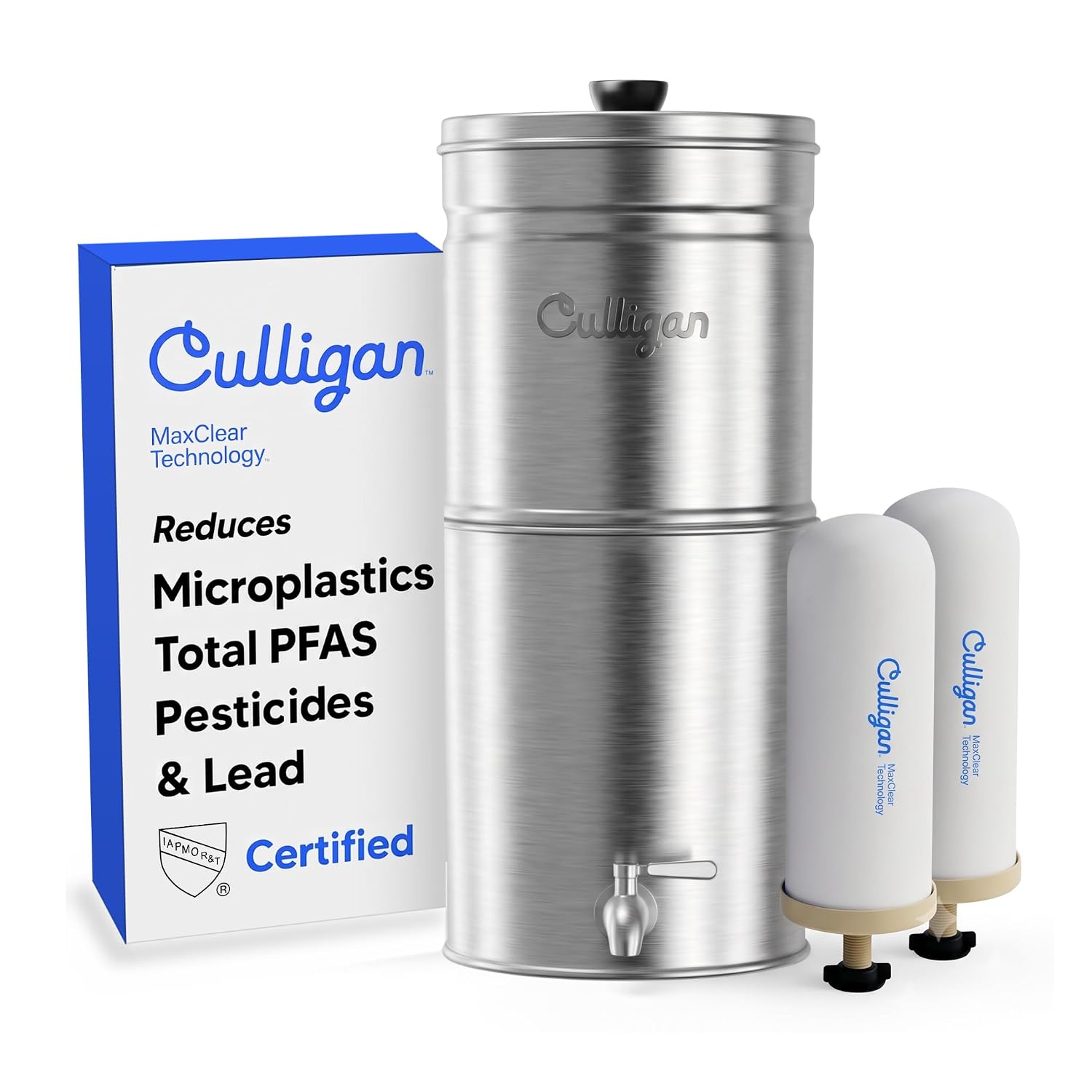
The Culligan MaxClear MCS702B is a countertop gravity-filter dispenser built around a brushed stainless steel tank and a pair of ceramic-plus-carbon filter elements that target microplastics, lead, and total PFAS. It sits on a small stand, nests down for storage, and requires no power or plumbing, so you fill the upper chamber and gravity pulls water through the ceramic shell and carbon media into the lower reservoir. The included filters are rated up to six months each and the system accepts common gravity filter replacements, which makes maintenance straightforward for someone who wants long-lived elements. The stainless construction is durable and looks at home on a kitchen counter, while the ergonomic spigot and larger 2.25 gallon capacity reduce refills for families or light emergency use. Limitations are the relatively slow gravity flow compared with powered systems and the need to replace filters on schedule to maintain contaminant reduction, so this is best where countertop placement and certified contaminant reduction matter more than instant throughput.
Best for: Buyers who prioritize certified contaminant reduction and a durable stainless countertop system for daily household drinking water or emergency storage without relying on power.
Less Ideal for: People who need rapid high-volume dispensing or whole-house filtration should consider powered or plumbed alternatives instead.
- NSF/ANSI 42 certified reduction for microplastics, lead, and total PFAS
- Durable brushed stainless steel tank that nests for compact storage
- Uses ceramic shell plus carbon media for up to six months filter life
- Compatible with common gravity replacement filters for easy servicing
- Gravity filtration is slower than pump or electric systems
- Requires routine filter replacement to retain certified contaminant reduction
Verdict: Choose the Culligan MaxClear if you want a stylish stainless steel countertop gravity filter that is certified to reduce microplastics, lead, and PFAS while using long-life ceramic and carbon elements.
IceJoy 3.0 Gallon Gravity Filter

| Purification Method | Gravity-fed Water Filter System |
|---|---|
| Capacity | 3 gallons |
| Material Type | Stainless Steel |
| Supported Water TDS Level Maximum (PPM) | 600 |
| Filter Life Cycle | 6 months |
The IceJoy gravity filter is a freestanding stainless steel countertop purifier that uses an eight-stage filter stack to remove chlorine, sediment, rust, organic compounds, and many heavy metals without electricity or plumbing. You fill the upper chamber and gravity pushes water through carbon rods, KDF55, ion exchange resin, PP cotton and other media into the lower 3.0 gallon tank, making it handy for kitchens, offices, camping, or emergency preparedness. The 304 food-grade stainless steel body is durable, corrosion-resistant, and easy to wipe clean, while the sight-glass spigot lets you monitor water level without opening the unit. Filters are replaceable and rated for substantial throughput (manufacturer lists up to 3,000 gallons for the carbon element), but the system does not reduce TDS and filter replacement intervals depend on feed-water quality, typically around six months. It is large and deliberately low-tech, so expect slower flow compared with pressurized or electric systems and plan space for the footprint on a counter or table.
Best for: Buyers wanting a durable, low-maintenance stainless steel countertop purifier that works without electricity and supplies a family or small group with filtered water in diverse settings.
Less Ideal for: People who need fast, on-demand high flow or systems that lower TDS significantly should consider pressurized or reverse-osmosis options instead.
- Durable food-grade 304 stainless steel construction resists rust and is easy to clean.
- Energy-free gravity operation needs no power or plumbing for flexible placement.
- Comprehensive 8-stage media targets chlorine, sediment, rust, organic compounds and many heavy metals.
- Large 3.0 gallon capacity reduces refills for family or group use.
- Sight-glass spigot makes it simple to see lower-tank water level without opening lid.
- Gravity filtration yields a slower flow rate than pressurized or electric systems.
- Does not reduce total dissolved solids (TDS).
- Filter replacement frequency depends on water quality and can be frequent in poor feed-water conditions.
Verdict: Choose the IceJoy stainless steel gravity filter when you want a rugged, electricity-free countertop purifier that delivers broad contaminant reduction for family-scale daily use.
IceJoy Ultra-Filtration 2.25G

| Purification Method | gravity |
|---|---|
| Filter Life Cycle | 6 months |
| Supported Water TDS Level Maximum (PPM) | 300 |
| Material Type | Stainless Steel |
| Capacity | 2.25 gallons |
The IceJoy Ultra-Filtration countertop system is a stainless steel, gravity-powered purifier that uses a composite filter (hollow fiber UF membrane, silver-ion layer, and activated carbon block) to remove very small contaminants without electricity or plumbing. It is filled from the top chamber and lets water pass through the 0.01 μm membrane into the lower tank, delivering clearer-tasting water while retaining beneficial minerals because it does not lower TDS. The stainless 304 construction and leak-proof design make it durable for home, office, or outdoor use, and the sight-glass spigot helps you monitor remaining water without opening the unit. Filters are replaceable and the listed lifecycle is about six months per filter set depending on water quality, with each carbon filter rated to treat up to 3,000 gallons. Limitations include a slower, gravity-limited flow rate compared with powered systems and no reduction in dissolved solids, so it will not soften very hard water or lower TDS-related mineral content.
Best for: Buyers who want a long-lasting stainless steel countertop purifier that removes microscopic contaminants without plumbing or power and prefer preserving beneficial minerals while keeping upfront and operating complexity low.
Less Ideal for: People who need rapid filtered water output, want a system that lowers TDS or softens very hard water, or require under-sink integration with existing plumbing.
- Very fine 0.01 μm ultrafiltration membrane removes bacteria, microplastics, chlorine, and many contaminants
- Durable food-grade 304 stainless steel construction resists rust and impact
- Gravity operation requires no electricity or plumbing and works anywhere
- Sight-glass spigot makes it easy to see lower-tank water level without opening the unit
- Gravity-fed flow is slower than electric or plumbed filters
- Does not reduce TDS, so it will not remove dissolved minerals or soften hard water
Verdict: A durable, stainless steel countertop gravity filter that delivers very fine ultrafiltration without power, ideal for budget-conscious buyers who want low-maintenance, mineral-retaining drinking water.
Big Berkey 2.25-Gallon

| Capacity | 8.5 liters |
|---|---|
| Purification Method | Black Berkey proprietary filter media |
| Power Source | Gravity |
| Maximum Flow Rate | 0.03 gpm |
| Filter Life (pair) | 6,000 gallons |
The Big Berkey 2.25-gallon gravity-fed system is a countertop stainless steel water filter built for simple, dependable everyday use. You fill the upper chamber with tap water, gravity pulls it through two Black Berkey BB9-2 elements, and filtered water collects in the lower chamber ready to dispense from the included spigot. The system is notable for its stainless steel construction, independent lab-backed filter media that the brand says removes 200+ contaminants, and a long element life rated to about 6,000 gallons per pair. Because it needs no electricity, installation or plumbing, it works in kitchens, offices, or on the go and supplies drinking and cooking water at a steady, low flow rate. The practical downsides are the modest 2.25-gallon capacity and slow maximum flow, so it is better suited to small households rather than high-demand situations, and filters may need earlier replacement if source water is heavily contaminated. For buyers who prioritize a durable, low-maintenance stainless steel gravity system, the Big Berkey delivers reliable filtration day to day.
Best for: Buyers who want a durable, low-maintenance countertop filter that reliably produces drinking water without electricity or plumbing and prefer long-lived, independently tested filter elements.
Less Ideal for: Those needing fast dispensing or large-volume filtration for big families or heavy daily use should consider higher-capacity or plumbed systems.
- Durable AISI 304 stainless steel chambers resist corrosion and look polished on a countertop
- Black Berkey BB9-2 elements are third-party tested for broad contaminant reduction
- Operates without electricity, tools, or plumbing for simple, portable use
- Long filter lifespan rated up to 6,000 gallons per pair, lowering ongoing cost
- Low 2.25-gallon capacity and slow flow rate limit usefulness for larger households or frequent refills
Verdict: A rugged, electricity-free stainless steel countertop filter that reliably delivers long-lasting, lab-backed contaminant reduction for small households.
Waterdrop King Tank WD-TK-FS

| Capacity | 2.25 gallons |
|---|---|
| Material Type | Stainless Steel |
| Purification Method | Activated Carbon |
| Power Source | Gravity-fed |
| Supported Water TDS Level Maximum (PPM) | 500 |
The Waterdrop King Tank WD-TK-FS is a countertop, gravity-fed stainless-steel filtration system designed for households that want filtered drinking water without plumbing connections. It holds 2.25 gallons in a durable 304 food-grade stainless-steel tank and uses a combination of two carbon filters and two fluoride filters to cut chlorine, heavy metals and tastes or odors while the sight-glass spigot makes level monitoring straightforward. Setup is simple since it requires no electricity or under-sink installation and the included stand and metallic spigot give it a stable, leak-resistant feel on a counter or table. Filters are rated for long service life (up to 6,000 gallons for the carbon elements and 1,000 for fluoride in the king configuration), which keeps running costs relatively low. Limitations include the system's finite 2.25-gallon capacity for larger households and the need to replace multiple filter types as they age, and it is less convenient if you need instant hot water or inline flow to a faucet. For buyers seeking a high-capacity stainless-steel gravity system with NSF/ANSI 372 certification and solid contaminant reduction, this is a dependable choice.
Best for: Buyers who want a proven, low-maintenance stainless-steel countertop filter that delivers measurable contaminant reduction without plumbing or electricity and who value third-party certification and social proof when choosing filtration.
Less Ideal for: People who need a continuously plumbed under-sink solution, immediate hot water, or very high daily filtered-volume output should consider other systems.
- Stainless-steel 304 tank offers durable, food-grade construction
- Gravity-fed design requires no electricity or plumbing to operate
- Multi-stage filters (carbon and fluoride) reduce chlorine, lead, and odors
- Sight-glass spigot and included stand simplify monitoring and pouring
- Long filter lifespans reduce frequency of replacements (carbon up to 6,000 gal)
- 2.25-gallon capacity may be small for large families or heavy use
- Requires multiple filter types and periodic replacements to maintain performance
Verdict: Choose this stainless-steel gravity filter if you want a countertop, certified system that delivers long-lasting carbon and fluoride filtration without plumbing or power.
Choosing the Right Water Filter with Stainless Steel Tank: Key Factors to Consider
Filtration Effectiveness
Look for systems that specify the contaminants they reduce and the technology used, such as activated carbon, sediment prefilters, or certified multi-stage cartridges. Different media target different problems: carbon excels at removing chlorine, taste and odor, while specialty media are needed for lead, arsenic, or nitrates.
Understanding which contaminants are most important in your water source helps you choose a system with effective media and documented reduction rates. If your water supply has specific issues, select a filter rated for those contaminants rather than relying on general-purpose claims.
Tank Construction and Longevity
Stainless steel tanks vary by alloy, finish, and internal welding. A high-quality stainless steel tank resists rust and physical damage, which prolongs service life and prevents metallic off-flavors. Check whether seams are welded and whether interior surfaces are finished to prevent crevice corrosion.
A more robust tank also withstands regular cleaning and household handling. Durability matters when a system sits in a utility area or is moved occasionally, because dents or compromised welds can shorten the tank's lifetime and introduce maintenance headaches.
Flow Rate and Usable Capacity
Assess the flow rate and working capacity to match household consumption patterns. A larger family or frequent cooking needs demand higher flow and more storage so the filter does not become a bottleneck. Consider peak usage times and whether the system can deliver enough filtered water without long waits.
Usable capacity is the amount available before refill or filtering pauses. Systems with higher throughput media or parallel flow paths recover faster after heavy use. If you plan to connect to a dedicated faucet or dispenser, verify that the system maintains consistent flow at that outlet.
Maintenance and Filter Replacement
Maintenance frequency affects total ownership effort and operating cost. Check recommended filter change intervals and how easy it is to swap cartridges. Systems with cartridge locks, clear replacement indicators, or tool-free access reduce user error and downtime.
Also confirm availability of replacement cartridges and the clarity of maintenance instructions. A system that requires infrequent, simple swaps is more likely to stay properly maintained, which in turn preserves filtration performance and tank hygiene.
Materials That Contact Stored Water
Even with a stainless steel tank, other components may contact water, including gaskets, fittings, and internal lines. Choose systems that specify food-grade materials for any part touching water, such as food-safe elastomers and lead-free fittings.
Nonmetal components can still impart taste or degrade over time. Prioritizing systems with minimal plastic contact, or with high-grade polymers designed for potable water, reduces the risk of off-flavors and extends overall system cleanliness.
Why Choose a Stainless Steel Tank
Stainless steel tanks offer distinct advantages over plastic storage in water filtration setups. They resist staining, do not leach plasticizers, and are mechanically tougher, which is beneficial if the system is stored in a utility area or subject to occasional impacts.
In practice, a steel tank helps preserve water taste and reduces long-term degradation that can occur with some plastics. The material's durability also reduces the chance of unseen micro-cracks that harbor bacteria, provided the internal finish and welds are properly executed.
- Better resistance to dents and physical wear
- Less risk of plastic-derived off-flavors
- Longer expected service life with proper care
Installation Options and Location
Plan where the filter and tank will sit to accommodate weight and access. Stainless tanks are heavier than plastic equivalents, especially when full, so a stable shelf or countertop is important. Leave clearance for filter changes and any valves that need to be operated.
Consider proximity to a drain or sink if the system has backwash or periodic flushing needs. If the unit connects to a dedicated faucet, make sure routing the supply line is feasible without long runs that could reduce pressure.
- Allow space for maintenance and cartridge swaps
- Place near frequent water use points to minimize tubing length
- Ensure surface supports full weight of a filled tank
Maintenance Best Practices
Regular maintenance preserves filter performance and tank hygiene. Follow the manufacturer's recommended replacement schedule, and use only approved replacement media. When changing cartridges, flush the new media as recommended to clear trapped carbon fines or loose particles.
Periodically inspect tank fittings, valves, and gaskets for wear or seepage. If you need to clean the tank interior, use non-abrasive cleaners compatible with stainless steel and rinse thoroughly before returning the tank to service.
- Keep an easily followed replacement log
- Flush new cartridges before first use
- Use stainless-safe cleaners for occasional tank cleaning
Matching Capacity to Household Use
Estimate daily filtered water needs for drinking, cooking, and small appliances to choose an appropriate tank size. A household of two might be fine with a modest-capacity system, while a family of four or more often benefits from larger storage and higher flow rates.
Also factor in single-event needs such as filling pots or hosting guests. Choosing a slightly larger capacity than your minimum need reduces stress on the filter system and keeps filtered water available at demand peaks.
- Calculate average daily use and add margin for peak demand
- Consider multiple dispensing points or a larger single-tank system
- Higher capacity can reduce filter cycling and extend cartridge life
Common Performance Tradeoffs
There are tradeoffs between the thoroughness of filtration and flow rate. Very fine media can reduce contaminants more effectively but may slow throughput and require more frequent replacement. Balance contaminant goals with the flow and capacity that suit your household.
Similarly, higher-grade stainless construction can increase initial system weight and cost of components, but it improves longevity and reduces maintenance related to material degradation. Prioritize the attributes that address your highest risks, whether that is specific contaminant removal or long-term durability.
- Finer media often equals slower flow and more frequent changes
- Heavier-duty tanks increase longevity but add installation considerations
- Choose tradeoffs based on contaminant priorities and usage patterns
How We Chose the Best Water Filter with Stainless Steel Tank
We focused on factors that matter for long-term water quality and system reliability. Primary evaluation criteria included the filter's contaminant removal capability using certified media or multi-stage approaches, the stainless steel tank construction and corrosion resistance, flow rate and usable capacity for typical household needs, and maintenance factors such as filter life and ease of replacement. We also considered build quality and materials that contact stored water to avoid taste or leaching issues, plus installation flexibility for common home setups. Where applicable, we looked at user serviceability and documented maintenance intervals to estimate ongoing upkeep. Units that relied on unverified or unspecified media, used mixed plastic/metal tanks where the internal liner could affect water contact, or whose maintenance requirements were impractical for most homeowners were excluded. The shortlist emphasizes systems that pair proven filtration stages with robust stainless steel storage, clear maintenance guidance, and reliable flow capacity. Exclusions included units without clear contaminant claims, systems lacking accessible replacement parts, or those that required specialized installation beyond basic home plumbing skills.
Our full evaluation process is outlined in our review methodology.
FAQ
How often should I replace the filter cartridges?
Replacement intervals usually depend on water quality and usage and often range from three to twelve months. Check the manufacturer's recommended service life and watch for reduced flow or taste changes as signs a change is needed.
Can I sanitize a stainless steel tank myself?
Yes. Use a mild, non-abrasive disinfectant or diluted bleach solution following safe dilution guidance, rinse thoroughly, and let the tank fully drain before returning it to service. Avoid harsh abrasives that can damage the interior finish.
Do stainless steel tanks affect water taste?
High-quality stainless steel usually does not impart taste if the interior is properly finished and fittings use food-grade materials. Any off-flavor is more commonly caused by media that needs flushing or by nonmetal components contacting the water.
Are stainless steel tanks safe for hot water?
Most filtered water systems are designed for cold potable water only. Exposing filter media or tanks to hot water can damage media and reduce effectiveness. Confirm the system's temperature rating before any hot-water use.
What maintenance should I do between cartridge changes?
Inspect fittings and gaskets for leaks, wipe external surfaces to remove dust, and periodically run a short flush if the system design allows. Keeping an eye on flow rate and taste will help you catch issues early.
Final Verdict
When choosing a water filter with a stainless steel tank, prioritize proven contaminant removal for your specific water issues and a tank built to resist corrosion and wear. Balance filtration thoroughness with the flow and capacity your household needs, and favor systems with clear, accessible maintenance steps. Focus on long-term serviceability: easy cartridge replacement, food-grade materials in contact with water, and a tank construction that will hold up to routine use. That approach helps you pick a system that delivers safe, better-tasting water with manageable upkeep and reliable longevity.