
Note: This article contains affiliate links. If you click on these links and make a purchase, we may earn a small commission at no extra cost to you. This helps support our research and content. Read our full affiliate disclosure here.
If your home relies on a private well, the water you use for drinking, cooking, and washing can vary widely in clarity and safety. Choosing the right well water filter for home use matters because a mismatched system will either fail to remove the contaminants you care about or create unnecessary maintenance work. This guide shortlists seven top-rated well water filters for home use and explains the practical tradeoffs between filtration levels, flow rate, and ongoing upkeep. We evaluated options across the most common household concerns so you can match a filter to your water quality, household size, and DIY comfort level. Read on to see how each shortlisted solution handles sediment, common chemical contaminants, and maintenance demands before the product list below.
Top Picks at a Glance
| Best Overall The best all-around choice for most situations | iSpring WGB32BM 3-Stage Whole House Filter |  |
| Best Quality Built to a higher standard if you want something more solid | Aquasana Rhino Well Water WH-WELL-CT-UVS |  |
| Best Value The sweet spot between price and what you get | PUREPLUS 2-Stage Whole House Filter |  |
| Best Budget The cheapest option that still gets the job done reliably | Max Water 2-Stage Whole House Filter |  |
| Top Rated A top-rated pick with lots of positive feedback | iSpring WGB21B 2-Stage Whole House Filter |  |
| Most Popular A crowd favorite that many people choose with confidence | Culligan WH-HD200-C Whole House Filter |  |
| Best Seller A high-volume bestseller chosen again and again | SimPure DB10P 10" Filter Housing |  |
iSpring WGB32BM 3-Stage Whole House Filter
| Maximum Flow Rate | 15 gpm |
|---|---|
| Operating Pressure Range | 25 – 80 psi |
| Operating Temperature | 40 – 100 °F |
| Inlet / Outlet | 1 inch NPT |
| Filter Life Cycle | 1 years |
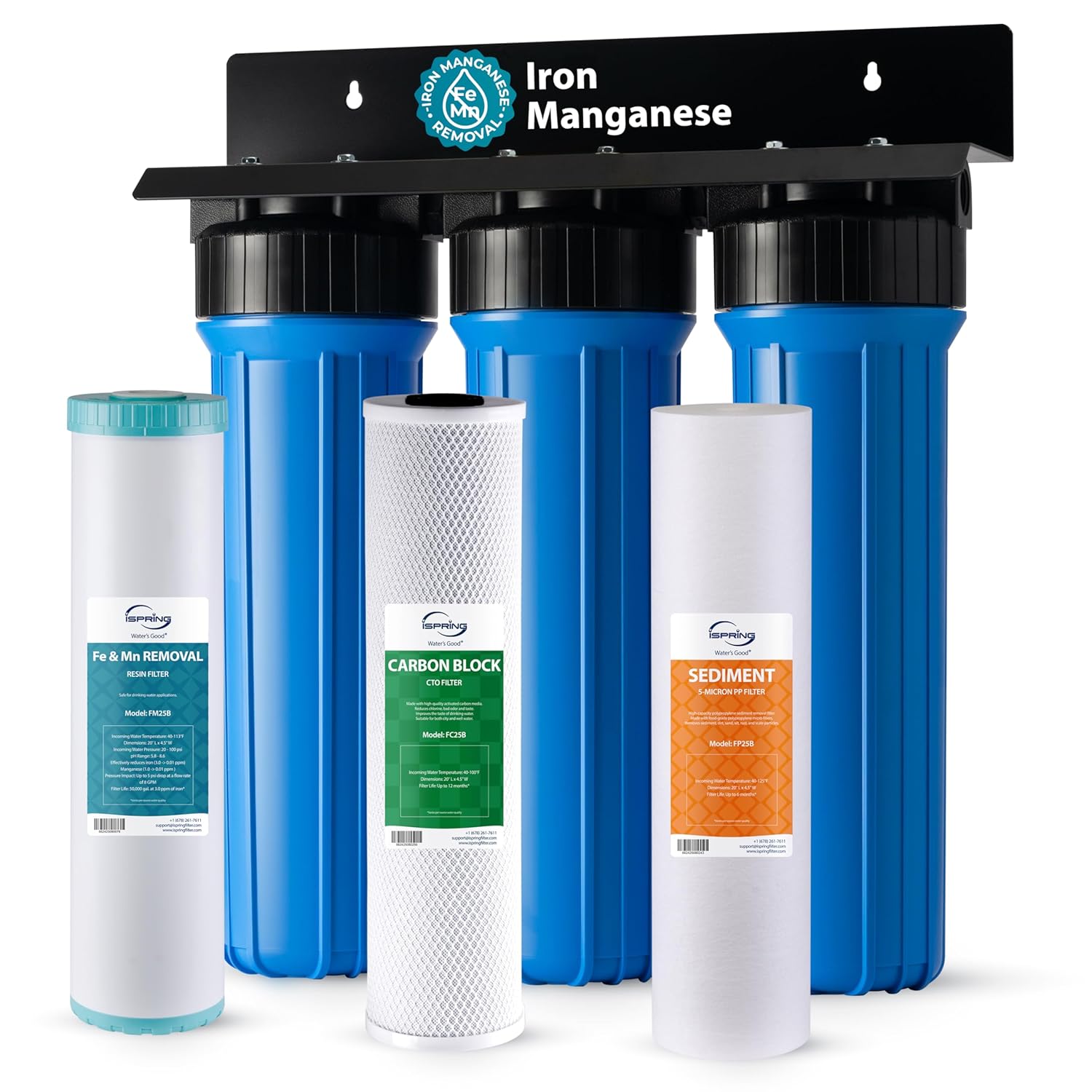
The iSpring WGB32BM is a tankless, three-stage whole-house filter designed to sit on your main water line and treat water for an entire home. Water first passes through a big-blue polypropylene sediment cartridge to trap sand, rust, and particulate, then through a coconut-shell carbon block to reduce chlorine, taste, and odor, and finally through a catalytic iron and manganese stage that lowers iron and manganese to near 0.01 ppm within its rated limits. It supports high flow applications up to 15 gallons per minute and works in typical household pressures between 25 and 80 psi, so it can handle most well-water feeds without noticeable pressure loss. Filters are sized for long life (up to 100,000 gallons or about 12 months for the carbon stages, 50,000 gallons at higher iron levels for the iron media), and the system is set up for DIY installation with 1-inch NPT plumbing and included wrench. Important limitations: it does not soften water or remove total dissolved solids, and it is intended for indoor installation or protected outdoor locations where frost and sun are managed.
Best for: Homeowners who want a high-capacity, low-maintenance whole-house filter that improves taste, removes sediment, and significantly lowers moderate iron and manganese levels for general household use.
Less Ideal for: Homes with very hard water or iron/manganese concentrations above the system limits should consider adding a dedicated softener or higher-capacity iron treatment instead.
- Three-stage filtration that targets sediment, chlorine/taste/odor, and iron/manganese for broad contaminant reduction
- High flow capacity up to 15 gpm suitable for whole-house supply without major pressure drop
- Long filter life ratings (up to 100,000 gallons or ~12 months for carbon stages) reduce maintenance frequency
- Includes necessary cartridges and a wrench and uses common 1-inch NPT plumbing for straightforward DIY installation
- Catalytic iron media reduces iron and manganese effectively within specified concentration limits
- Does not reduce water hardness or total dissolved solids so a separate water softener is needed for hard water
- Not rated for iron or manganese above the stated maximums (3.0 ppm iron, 1.0 ppm manganese)
- Recommended for indoor or protected installation; outdoor use requires additional weatherproofing
Verdict: Choose the iSpring WGB32BM if you want a high-flow, long-life whole-house filter that cuts sediment, chlorine, and moderate iron and manganese for clean water throughout the home.
Aquasana Rhino Well Water WH-WELL-CT-UVS

| Maximum Flow Rate | 14.7 gpm |
|---|---|
| Operating Pressure Range | 20-100 psi |
| Supported Water TDS Level Maximum (PPM) | 1000 |
| Filter Life Cycle | 5 years |
| Power Source | Corded Electric |
The Aquasana Rhino Well Water system is a whole-house filtration setup built specifically for well water that pairs multi-stage carbon and KDF media with a salt-free conditioner and an inline UV purifier. It is installed on the main line to treat water for drinking, cooking, bathing and appliances and comes with pre- and post-filters plus an installation kit for 3/4 or 1 inch lines. The combined media targets chlorine, common organic contaminants, and scale while the UV stage reduces bacteria and viruses, so you get noticeably better tasting water and less mineral buildup without ion-exchange softening. The system is sized for long service life—rated for 500,000 gallons or five years—which lowers maintenance frequency but means replacement parts are larger and less frequent. It requires corded power for the UV unit and room for the tank, and it does not soften water or remove dissolved minerals the way a salt-based softener would, so very hard water or high iron may need complementary treatment. For homes on well water seeking high-capacity contaminant reduction and microbial protection, this is a robust factory-quality option.
Best for: Homeowners on well water who prioritize high-capacity contaminant reduction and microbial protection and want a low-maintenance, long-lasting whole-house solution.
Less Ideal for: Homes that need true water softening or have very high iron or hardness levels without first addressing those specific issues should consider dedicated softening or iron-removal systems instead.
- Multi-stage filtration (carbon + copper-zinc KDF) plus UV for chemical and microbial reduction
- Salt-free scale control protects pipes and appliances without adding salt or backwashing
- Long service life rated for 500,000 gallons or five years reduces replacement frequency
- Includes pre- and post-filters and an installation kit for 3/4 or 1 inch main lines
- Does not soften water or remove dissolved minerals, so very hard water may still cause scaling
- Requires electrical power for the UV purifier and space for the large tank
Verdict: A high-capacity, factory-quality whole-house well water system that combines carbon/KDF media with UV and salt-free scale control for long-lasting contaminant and microbial protection.
PUREPLUS 2-Stage Whole House Filter

| Purification Method | Polypropylene, Iron Removal, Natural Activated Carbon Block |
|---|---|
| Supported Water TDS Level Maximum (PPM) | 1000 |
| Capacity | 30000 gallons |
| Included Components | Filtration System, Cartridges, Wrench, Pressure Gauge |
The PUREPLUS 2-stage whole-house filter is a compact, standard 10"x4.5" system designed to pre-filter well water and deliver cleaner water to every faucet. It uses a dual-function composite first cartridge combining polypropylene sediment filtration with iron-removal media, followed by a natural coconut shell carbon block to cut chlorine, odors and organic tastes. The system includes a wrench and pressure gauge so you can monitor flow pressure and know when cartridges are nearing replacement, and the clear housing makes visual checks easy. It is intended for inline installation on a single supply line and handles higher TDS up to 1000 ppm and a long nominal capacity rating. Expect straightforward maintenance: periodic cartridge swaps and watching the pressure gauge; the compact footprint fits tight utility spaces. This package does not include a multi-stage softening or dedicated iron-oxide backwash system, so very heavy iron loads or extremely high sediment may require a more specialized well treatment setup.
Best for: Buyers who want a practical, space-efficient whole-house prefilter that improves taste and removes common well contaminants while keeping installation and maintenance simple.
Less Ideal for: Homes with very high iron concentrations, heavy sediment loads, or those needing water softening or filtration beyond carbon polishing should consider more robust multi-stage or regeneration systems.
- Two-stage design combines sediment/iron reduction with carbon polishing for better taste and odor
- Includes pressure gauge and wrench for easy monitoring and service
- Standard 10"x4.5" housings use widely available replacement cartridges
- Clear housing allows visual inspection of cartridge condition
- Food-grade polypropylene and coconut carbon media specified for safe water contact
- Not a full iron-removal/backwash system for heavy iron wells
- Capacity and lifespan depend on local water quality and may require frequent cartridge changes in high-sediment wells
Verdict: A compact, easy-to-service two-stage whole-house filter that gives well-water households reliable sediment and taste improvement without complicated installation.
Max Water 2-Stage Whole House Filter

| Purification Method | Carbon Block |
|---|---|
| Operating Pressure Range | 40-100 psi |
| Upper Temperature Rating | 125 °F |
| Installation Type | user-installed |
| Container Type | Cartridge |
This 10-inch, two-stage Max Water system pairs a sediment cartridge with a carbon block to protect plumbing and improve water taste throughout a home. It installs with 3/4-inch plumbing and is manually operated, so homeowners can fit it to a well or municipal supply without electrical connections. The carbon block removes chlorine and odor while the sediment stage captures particulates that can clog fixtures and appliances, making it useful as an upfront prefilter. The unit is compact and user-installed, and it ships with inlet and outlet hoses for a straightforward hook-up. Limitations include no reduction of dissolved solids and a modest flow capacity compared with larger whole-house systems, so it is best used as a point-of-entry prefilter on low-to-moderate demand homes or ahead of more advanced treatment. For a buyer focused on an affordable, easy-to-fit solution this system delivers basic whole-house filtration and maintenance simplicity.
Best for: Homeowners on a tight budget who need an inexpensive, easy-to-install whole-house prefilter to reduce sediment, chlorine taste, and odor before faucets and appliances.
Less Ideal for: Homes requiring heavy mineral or TDS reduction, very high flow whole-house demands, or buyers who need a certified multi-contaminant treatment should look at more advanced systems.
- Two-stage filtration (sediment plus carbon block) improves taste, odor, and removes particulates
- Compact 10-inch housing fits easily in tight spaces and is user-installable
- Includes inlet and outlet hoses for simpler installation
- Manually operated design requires no electricity
- Does not reduce total dissolved solids or function as a reverse osmosis system
Verdict: A budget-friendly, compact two-stage prefilter that improves taste and protects plumbing for low-to-moderate demand homes.
iSpring WGB21B 2-Stage Whole House Filter
| Filter Life Cycle | 12 months |
|---|---|
| Capacity | 50,000 gallons |
| Maximum Flow Rate | 15 gpm |
| Operating Temperature | 40-100 °F |
| Inlet / Outlet | 1 inch Female NPT |
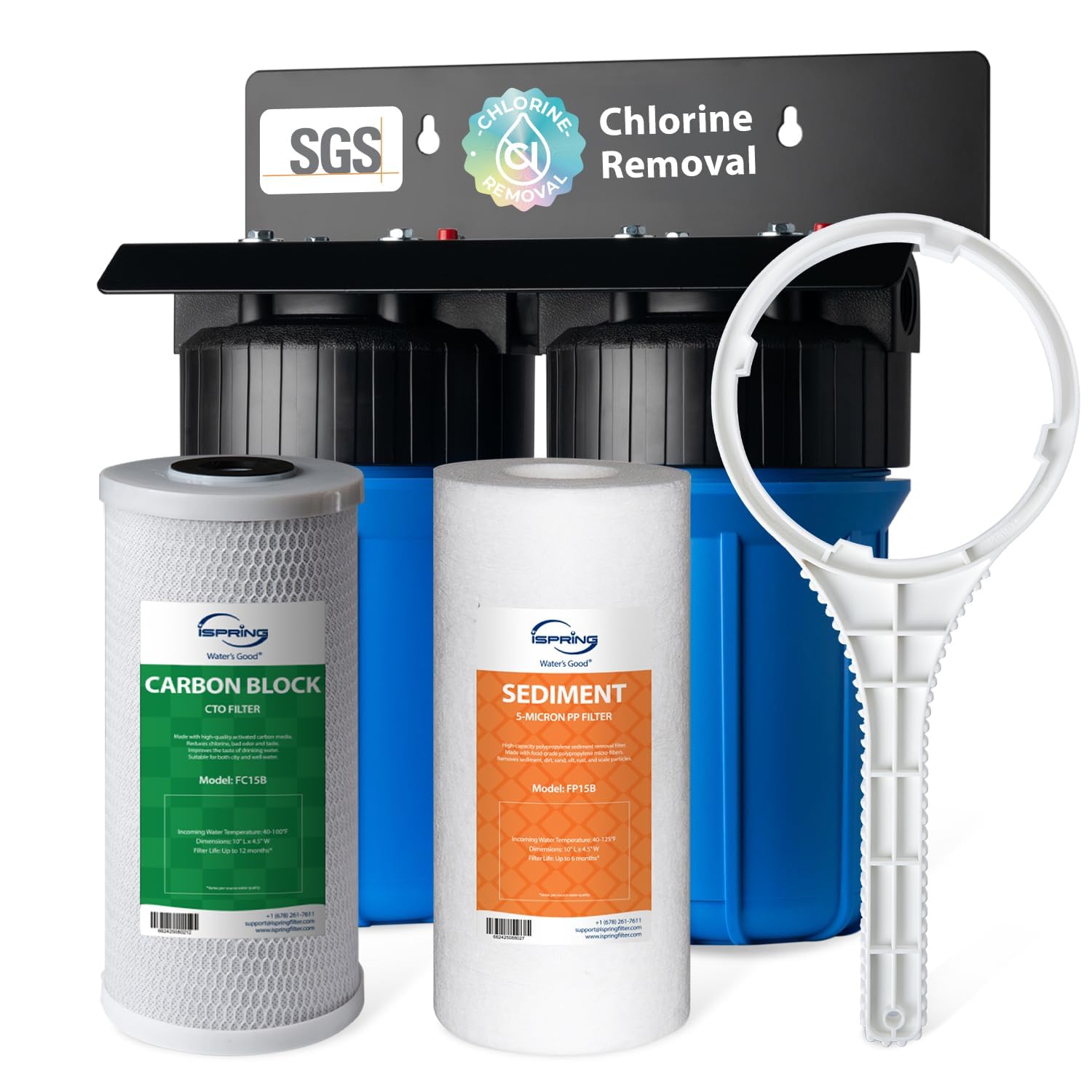
The iSpring WGB21B is a point-of-entry two-stage filter built for reliable, everyday whole-house use. It pairs a 5-micron polypropylene sediment cartridge with a coconut-shell carbon CTO block to capture dirt, rust and most chlorine and VOCs before water reaches faucets and appliances. The unit mounts preassembled on a bracket, includes a filter wrench and a pressure release valve to simplify DIY installation and routine cartridge changes. With 1-inch inlet/outlet ports and a rated capacity up to 50,000 gallons (about a year for a typical family), it supports high flow without large pressure loss and helps protect plumbing and water-using equipment. The housings are made from sturdy materials and the system needs no power. Limitations are that it does not reduce TDS or perform reverse-osmosis-grade purification, and effectiveness depends on timely filter replacement and inlet water quality; for dissolved minerals or heavy contaminants you will need an additional RO or specialized treatment stage.
Best for: Buyers who prioritize a dependable, low-maintenance whole-house filter to remove sediment and chlorine and to protect plumbing and appliances in a well water or municipal supply setup.
Less Ideal for: Homes that need dissolved-solids reduction, heavy metal removal, or microbiological disinfection should choose an RO system or additional specialized treatment instead.
- Two-stage filtration that removes sediment and over 90% of chlorine to improve taste and protect appliances
- High-capacity filters rated up to 50,000 gallons, reducing replacement frequency for typical households
- Preassembled bracket, included wrench and pressure release valve make DIY installation and cartridge changes straightforward
- 1-inch inlet/outlet and 15 gpm maximum flow rating support strong household water demand
- No electricity required and durable housings suitable for long-term point-of-entry installation
- Does not reduce total dissolved solids so it will not remove salts or dissolved minerals
- Not designed to remove all contaminants such as heavy metals or require additional stages for RO-level purification
Verdict: A straightforward, high-capacity two-stage whole-house filter that reliably removes sediment and chlorine to protect plumbing and improve water taste for most homes.
Culligan WH-HD200-C Whole House Filter

| Maximum Flow Rate | 10 gpm |
|---|---|
| Supported Water TDS Level Maximum (PPM) | 600 |
| Capacity | 16000 gallons |
| Material Type | Stainless Steel |
The Culligan WH-HD200-C is a heavy-duty whole-home filter housing meant to be installed at the point of entry on a 1-inch water main and used with a compatible filter cartridge (sold separately). Its stainless steel cap, built-in bypass and shut-off valves, integrated mounting bracket, and pressure relief make installation, service, and cartridge changes straightforward for a competent DIYer or a plumber. The clear sump lets you visually monitor collected sediment without disassembly, while the unit supports up to a 10 gpm flow rate and is rated for water up to about 600 ppm TDS. It does not include filtration media, so you must buy the correct cartridge for sediment, rust, or taste issues. The housing is robust and intended to protect appliances and plumbing from coarse particles and scale, but performance depends entirely on cartridge choice and proper sizing for your household flow and well water characteristics.
Best for: Homeowners on well water or those who want to protect plumbing and appliances with a serviceable whole-house housing and who prefer a visible sump to monitor sediment.
Less Ideal for: Buyers looking for an all-in-one filtration system with included cartridges or those who need chemical or microbial treatment without selecting compatible media.
- Durable stainless steel cap and heavy-duty housing for long-term use
- Built-in shut-off, bypass and pressure relief valves simplify servicing
- Clear sump provides visual inspection of sediment without removing the unit
- Universal 1-inch inlet/outlet design fits standard whole-home mains
- Supports up to 10 gallons per minute suitable for many household systems
- Filter cartridge sold separately so additional purchase required
- Not a complete filtration solution by itself since media type and effectiveness depend on chosen cartridge
Verdict: Choose the Culligan WH-HD200-C if you want a durable, serviceable whole-house filter housing that makes monitoring and cartridge changes easy while protecting your plumbing.
SimPure DB10P 10" Filter Housing

| Maximum Flow Rate | 20 gpm |
|---|---|
| Installation Type | Mounted/Fixed |
| Purification Method | Granular Activated Carbon, Sedimentation |
| Supported Water TDS Level Maximum (PPM) | 500 |
| Upper Temperature Rating | 40 °C |
The SimPure DB10P is a single-stage 10" x 4.5" whole-house filter housing intended as a pre-filter for well or municipal water. It accepts standard 10" cartridges (sediment, granular activated carbon, pleated, etc.) and installs inline using 1" NPT brass inlet and outlet ports. Built from reinforced, food-grade polypropylene with a brass-threaded head, the housing is rated for up to 20 gpm and includes a mounting bracket, wrench, screws and a built-in red pressure-relief button to make cartridge changes easier. In practice it serves as a straightforward way to keep sand, silt and chlorine-related tastes and odors out of water heaters, washers and downstream filters, reducing maintenance on those appliances. The unit is manual to operate and requires buyers to pick compatible cartridges; it is not a complete filtration system on its own. It performs best where simple sediment or carbon pre-filtration is needed, but buyers should check space for the unit and plan for cartridge replacements over time.
Best for: Homeowners who want a simple, factory-quality pre-filter to protect appliances and plumbing from sediment and chlorine without buying a multi-stage system.
Less Ideal for: People seeking a complete filtration solution with built-in gauges, automatic flushing, or multi-stage contaminant removal should consider full systems instead of a single housing.
- Accepts standard 10" x 4.5" cartridges for easy replacement and wide cartridge choice
- 1" NPT brass inlet/outlet provides robust, leak-resistant plumbing connections
- Reinforced food-grade polypropylene body rated up to 20 gpm for whole-house pre-filtration
- Includes necessary mounting hardware, wrench and a pressure-relief button for simpler service
- Compatible with both well and municipal water as a pre-filter to protect downstream equipment
- Filter cartridges sold separately so additional purchase and selection are required
- Manual operation with no integrated monitoring means you must track replacement intervals yourself
Verdict: A durable, easy-to-service 10" housing that provides reliable pre-filtration for well or municipal water and protects downstream appliances.
Choosing the Right Well Water Filter for Home Use: Key Factors to Consider
Contaminant Profile and Testing
Start with a current comprehensive water test from your well to know which contaminants are present and their concentrations. Test results determine whether you need sediment prefilters, iron removal, activated carbon for organics, or specialized media for hardness and manganese. A system selected without test data may address the wrong issues, leaving health or nuisance contaminants untreated.
Different systems are rated for specific contaminants and reduction levels. Compare the filter's certified or manufacturer-stated removal rates against your test numbers and plan for seasonal variations that can change well chemistry.
Filter Type and Technology
Well water treatment can involve point-of-entry whole-house filters, sediment traps, backwashing media tanks, chemical oxidation followed by filtration, or point-of-use units for drinking water. Each technology has tradeoffs: simple sediment cartridges are cheap and easy to replace but will not remove dissolved iron or bacteria. Backwashing systems handle high sediment loads and iron fouling better but need space and periodic servicing.
Choose a technology that matches the contaminants you need to remove and your willingness to perform maintenance. Consider modular systems that let you combine a sediment prefilter, an iron removal stage, and carbon polishing for the most flexible long-term solution.
Flow Rate and Household Demand
Match the filter's rated flow capacity to your household peak demand. Whole-house systems list a maximum continuous flow rate; undersized systems will noticeably reduce water pressure when multiple fixtures run. Consider family size, irrigation or well pump duty cycles, and simultaneous appliance use when evaluating capacity.
Also check the system's peak surge handling for things like washing machines or showers starting at the same time. A small point-of-use or low-flow-rated option may be fine for a single tap but inadequate as a whole-home filter.
Maintenance Intervals and Consumables
Understand how often cartridges or media need replacement and the cost and availability of those parts. Some media tanks can run for years between major services but still require periodic backwashing or chemical regeneration. Cartridge-based systems often need quarterly or annual changes depending on load.
Maintenance frequency affects the total cost of ownership and the effort required to keep the system performing. Look for clear documentation on filter life, recommended service procedures, and whether standard plumbing skills are sufficient for routine changes.
Compatibility With Well Pumps and Plumbing
Confirm that the filter's pressure drop at expected flow rates will not cause your pump to cycle or lose prime. Some filters introduce significant resistance that can trigger a pressure switch to pump more often or reduce output. Check inlet and outlet connection sizes and mounting options to ensure the unit fits your mechanical room or well house layout.
If your well has low yield or variable pressure, choose a low-resistance option or consult a plumber to avoid undesired pump behavior. Proper bypass valves and pressure gauges make future troubleshooting easier.
Local Water Conditions and Regulatory Concerns
Local geology often determines common well issues like high iron, sulfur, or naturally occurring minerals. Consider seasonal changes, nearby land use that might introduce nitrates or agricultural chemicals, and whether you need treatment certified for microbial concerns.
In some areas, certain contaminants have regulated limits and specific testing requirements. Factor in local guidelines when choosing a filtration approach and plan for periodic retesting after installation to confirm system performance.
Sediment Pretreatment: Why It Matters
Sediment and particulate matter are the most common nuisance issues in well water and can quickly clog finer filters downstream. Adding a sediment prefilter extends the life of more expensive cartridges or media and reduces service frequency for the entire system.
Choose a graded approach: a coarse cartridge to remove large grit, followed by finer micron-rated cartridges or a media tank. This staged filtration prevents premature fouling of carbon or specialized media.
- Typical sediment sizes and when to use 20, 5, or 1 micron cartridges
- Backwashing sediment tanks for high-sand wells
- Signs your prefilter needs replacement: pressure drop or visible discoloration
Dealing With Iron and Manganese
Dissolved iron and manganese require different strategies than particulate iron. Options include oxidation followed by filtration, greensand or catalyzed media, or sequestration with polyphosphate blends. The correct method depends on whether iron is ferrous (dissolved) or ferric (particulate) and the total iron concentration.
Systems designed for iron removal often need a consistent regeneration regimen or periodic maintenance to maintain media performance. Be realistic about the labor and space requirements for these setups.
- Testing to distinguish dissolved versus particulate iron
- Regeneration cycles and chemical needs for media-based systems
- Impact of high iron on fixtures, appliances, and clothes
Activated Carbon and Chemical Contaminants
Activated carbon is effective for reducing taste, odor, volatile organic compounds, and some pesticides. It is not a catch-all for minerals or microbial issues but is an important polishing stage for drinking water quality.
Carbon cartridges or tanks need replacement or reactivation at defined intervals based on load. Overloaded carbon can pass contaminants through, so pair it with a sediment stage and monitor change intervals.
- When carbon is sufficient and when you need advanced oxidation or specialized media
- Signs carbon is spent: return of tastes or odors
- Matching carbon type to target contaminants: granular vs block carbon
Installation Considerations for Homeowners
Some well water filters are designed for DIY installation with standard fittings and clear instructions. Others require professional plumbing, especially when integrating with pressure tanks, backwashing lines, or chemical feed systems. Assess your comfort with shutoff valves, soldered or glued fittings, and electrical connections if a control head is present.
Plan the physical layout so filters are accessible for service and have room for cartridge changes or media removal. Include bypass valves to maintain water service while performing maintenance.
- Necessary tools and common installation steps for cartridge systems
- Space and clearance recommendations for media tanks and control heads
- Why a bypass valve and pressure gauge simplify future servicing
Testing After Installation and Ongoing Monitoring
Retest your water after installation to confirm the system achieves the expected contaminant reductions. Initial tests establish baseline performance and reveal whether fine-tuning or additional stages are needed.
Set a schedule for periodic testing, especially if your well is influenced by seasonal runoff or nearby land-use changes. Keep records of filter changes, backwashing cycles, and test results to spot declining performance early.
- Recommended retest timeline: initial, 3 months, then annual
- What to measure to ensure long-term effectiveness
- How to interpret rising contaminant levels and when to service
How We Chose the Best Well Water Filter for Home Use
We focused on systems designed specifically for private well connections and evaluated each candidate using measurable, practical criteria. Key filters included lab-rated contaminant reduction where available, rated flow capacity, and the ability to handle typical well contaminant profiles such as sediment, iron, sulfur, and microbial risk. We also prioritized systems with clearly documented filter life, replacement-part availability, and straightforward installation or serviceability for homeowners. Exclusions: We excluded equipment intended only for municipally treated water or for point-of-use counter appliances. Devices without clear specification data on contaminant reduction, flow ratings, or maintenance intervals were also excluded. Concrete evaluation criteria: tested/claimed contaminant removal (what the system removes and to what standard), rated flow rate and peak household capacity, service interval and filter replacement ease, and materials/resistance to well-specific issues like iron fouling. We also considered mounting and connection options to ensure compatibility with common residential well plumbing. These dimensions guided selections and align with the scoring metrics used in each product block.
Our full evaluation process is outlined in our review methodology.
FAQ
How often should I test my well water after installing a filter?
Retest shortly after installation to verify performance, then again at three months and annually thereafter. Test more frequently if you notice taste or odor changes, discoloration, or after heavy rains.
Can a single filter stage handle both sediment and dissolved contaminants?
Rarely. Sediment and dissolved contaminants typically require different media or stages. A prefilter for sediment plus a polishing stage such as activated carbon or a specialized media is the common approach.
Will a whole-house filter affect my water pressure?
Some systems introduce measurable pressure drop, especially at higher flow rates. Choose a unit with a rated flow capacity above your household peak demand and include pressure gauges or bypass options to manage any impact.
Are backwashing systems better for sandy wells?
Backwashing tanks are preferable for wells with high sand or particulate loads because they automatically flush trapped solids and reduce manual cartridge changes. They do require space, periodic maintenance, and sometimes a drain for the backwash.
Do carbon filters remove iron or bacteria?
Activated carbon is effective for taste and many organic compounds but does not reliably remove dissolved iron or kill bacteria. Use dedicated iron-removal methods or disinfection systems for those concerns.
What maintenance should I expect with media-based systems?
Media-based systems may need periodic regeneration, backwashing, or complete media replacement over multi-year intervals. Expect scheduled service tasks and occasional chemical handling depending on the media type.
Final Verdict
Choosing the right well water filter for home use comes down to matching the system to your water test results, household flow needs, and willingness to perform maintenance. Prioritize solving the highest-risk contaminants first, then add polishing stages for taste and odor. Be realistic about tradeoffs: higher-capacity or media-based systems often require more space and service but reduce frequent cartridge swaps. With your priorities and local water conditions in mind, you can select a system that balances performance and upkeep for reliable home water quality.