
Note: This article contains affiliate links. If you click on these links and make a purchase, we may earn a small commission at no extra cost to you. This helps support our research and content. Read our full affiliate disclosure here.
If your household well water shows orange staining, metallic taste, or discoloration, picking the right well water filter for iron matters. The wrong system can leave lingering stains, reduce water pressure, or require frequent media changes. This guide covers six top shortlisted options that are appropriate for homes dealing primarily with dissolved and particulate iron. We evaluated systems on iron removal effectiveness, impact on household flow rates, maintenance burden, and long-term reliability. Read on to see which system types and installation styles match your water chemistry and household needs before the product summaries.
Top Picks at a Glance
| Best Overall The best all-around choice for most situations | iSpring WGB32BM 3-Stage Whole House Filter |  |
| Best Quality Built to a higher standard if you want something more solid | DuraWater Air Injection Iron Eater 1.0 cu ft |  |
| Best Value The sweet spot between price and what you get | Waterdrop Whole House Filter WD-WHF21-FG |  |
| Best Budget The cheapest option that still gets the job done reliably | PUREPLUS Pleated Sediment Filter 10" |  |
| Top Rated A top-rated pick with lots of positive feedback | Membrane Solutions String Wound Filter 5µ |  |
| Best Seller A high-volume bestseller chosen again and again | iSpring FM25B Iron Filter |  |
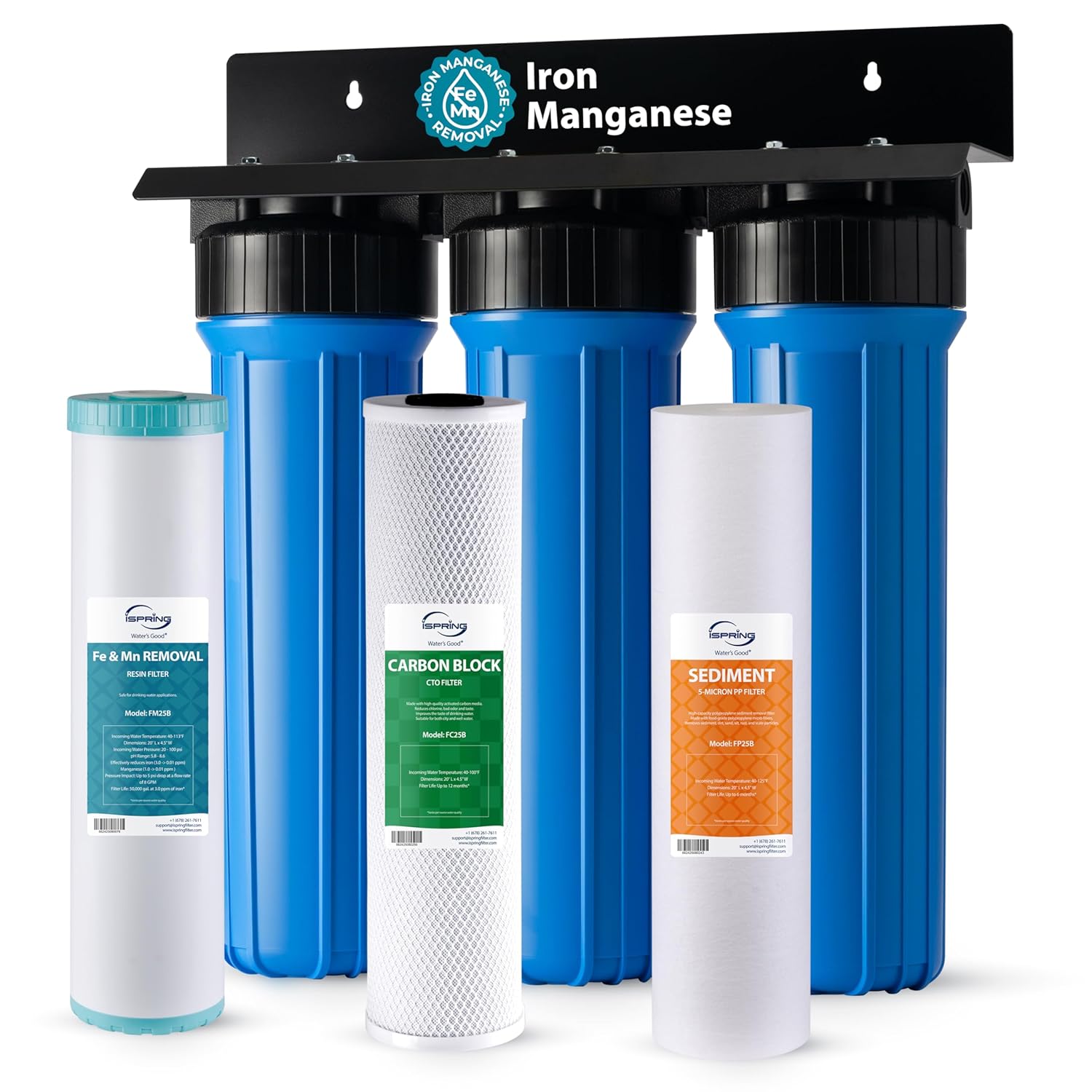
iSpring WGB32BM 3-Stage Whole House Filter
| Maximum Flow Rate | 15 gpm |
|---|---|
| Operating Pressure Range | 25 – 80 psi |
| Operating Temperature | 40 – 100 °F |
| Inlet / Outlet | 1 inch NPT |
| Filter Life Cycle | 1 years |
The iSpring WGB32BM is a three-stage whole house filter designed to sit at the main water line and treat water for an entire home. It uses a big-blue polypropylene sediment cartridge first to catch sand, rust, and large particles, a coconut-shell carbon block second to cut chlorine, taste, and odor, and a catalytic iron/manganese stage that significantly lowers iron and manganese when levels are within the specified range. With a 1 inch NPT inlet/outlet and up to 15 gpm peak flow, it supports typical household flow without noticeable pressure loss. Cartridges are rated up to 100,000 gallons or about 12 months for the sediment and carbon stages and the iron stage has a separate 50,000-gallon rating at 3 ppm iron. The system is intended for indoor installation, offers DIY-friendly setup with a wrench included, and is backed by local tech support. Key limitations are that it will not soften water or remove dissolved solids, and it is not recommended when iron or manganese exceed the stated maximums without upgrading to a different model.
Best for: Buyers who want an all-purpose whole-home filter that reduces sediment, chlorine, and moderate iron or manganese levels while keeping maintenance infrequent and installation approachable.
Less Ideal for: Homes with very hard water or with iron/manganese levels above the system limits should consider a water softener or higher-capacity iron removal system instead.
- Three-stage filtration targeting sediment, chlorine, and iron/manganese for broad contaminant reduction
- High-capacity cartridges rated up to 100,000 gallons for long service intervals
- Supports high household flow with up to 15 gallons per minute peak flow
- Includes necessary cartridges and wrench for DIY installation and basic maintenance
- Catalytic media iron stage reduces iron and manganese to very low levels at specified inlet concentrations
- Does not reduce water hardness or total dissolved solids
- Not suitable if iron or manganese exceed the specified maximum concentrations
- Recommended for indoor installation and needs protection if installed outdoors
Verdict: A durable, high-capacity whole-house filter that is a practical choice for homeowners needing reliable sediment, chlorine, and moderate iron/manganese reduction without complex maintenance.
DuraWater Air Injection Iron Eater 1.0 cu ft

| Filter media volume | 1.0 cu ft |
|---|---|
| Tank size | 10 x 54 inches |
| Bypass size | 1 inch |
| Included components | complete system |
| Control | digital control valve |
This DuraWater Air Injection Iron Eater is a packaged well-water filtration system that uses air injection and 1.0 cubic foot of filter media to oxidize and capture iron, manganese, and H2S. The kit ships as a complete assembly with a 10×54 mineral tank, digital control valve and a 1-inch plastic bypass so you can install it as a single-point treatment for a home well. In use the air pocket created by the control valve promotes oxidation, which helps the media convert dissolved contaminants into solids the filter holds back; that makes it a fit for typical household flow rates and routine backwashing maintenance. Practical benefits include a digital valve for scheduled backwashes and a full tank/media package so you do not need to source components separately. Limitations are that it requires basic plumbing skills for DIY installation, the listed size and media volume suit point-of-entry home systems rather than large commercial flows, and filter life and actual removal efficiency will depend on local water chemistry and maintenance frequency.
Best for: Buyers who prioritize strong contaminant removal and consistent performance for a residential well will appreciate a packaged air-injection system that is ready to install and tuned for iron and sulfur control.
Less Ideal for: Those needing high-capacity or commercial-scale treatment or installers who prefer pre-plumbed drop-in cartridges should consider larger or different system types.
- Complete kit with tank, digital control valve and 1.0 cu ft of media included
- Air injection oxidation improves removal of dissolved iron, manganese and hydrogen sulfide
- Digital control valve enables scheduled backwash cycles for easier maintenance
- Requires plumbing know-how for correct installation and setup
- Sized for residential point-of-entry use and not intended for large commercial flows
Verdict: A ready-to-install air-injection well filter that delivers strong iron, manganese and H2S control for performance-focused residential well owners.
Waterdrop Whole House Filter WD-WHF21-FG

| Purification Method | Granular Activated Carbon |
|---|---|
| Maximum Flow Rate | 15 gpm |
| Filter Life Cycle | 6 months |
| Supported Water TDS Level Maximum (PPM) | 1000 |
| Capacity | 50000 gallons |
The Waterdrop WD-WHF21-FG is a 2-stage whole house filtration system that pairs an iron and manganese reduction cartridge with a granular activated carbon stage to cut rust, heavy metals and chlorine from incoming water. It is installed at the main line and sized to maintain household flow, with 1" NPT inlet/outlet ports and a stated maximum flow of up to 15 gallons per minute so showers and appliances can run without noticeable pressure loss. Filters are rated to stop particles larger than 5 microns and Waterdrop quotes third-party reductions of roughly 96% for iron and 98% for manganese, which makes it a practical choice for common well-water iron issues. The dual cartridges are lead-free standard compliant and the housing uses brass threads plus dual O-rings to limit leaks; Waterdrop includes a wrench, mounting bracket and preinstalled parts to simplify DIY setup. Replacement frequency is about every six months or up to 50,000 gallons, so ongoing cartridge cost and periodic changes are necessary. For homes with very high iron concentrations or specialized contaminants, a more advanced multi-stage system or professional water test may be warranted.
Best for: Buyers who want a practical, DIY-friendly whole house filter that primarily reduces iron and manganese on typical well water while preserving household water flow.
Less Ideal for: Homes with extremely high iron levels, exotic contaminants, or purchasers seeking multi-stage treatment including softening or specialized media should consider more advanced systems.
- Targeted iron and manganese reduction with cited high removal rates
- High flow capacity up to 15 gpm to avoid household pressure loss
- Dual-stage design adds carbon filtration for chlorine and odor reduction
- NSF/ANSI lead-free compliant components and reinforced brass thread connections
- Includes mounting bracket, wrench and preinstalled parts for easier DIY installation
- Cartridges require replacement about every six months, adding recurring cost
- Not a full multi-stage system for very complex water chemistries
Verdict: A straightforward, high-flow whole house two-stage filter that effectively cuts iron and manganese for well-water households looking for a DIY-friendly solution.
PUREPLUS Pleated Sediment Filter 10"

| Micron rating | 5 Micron |
|---|---|
| Material Type | Polypropylene (PP) |
| Unit Count | 4 Count |
| Compatible Models | GE GNQH38S, GE GXWH30C, GE GXWH35F, GE GXWH38F, GE GXWH40L |
This PUREPLUS pleated sediment filter is a straightforward replacement cartridge designed for standard 10"x2.5" filter housings and undersink RO systems. The 5-micron pleated polypropylene media offers a large filtration area that captures sand, rust, and other particulates while maintaining good flow, and the manufacturer rates the cartridge for high capacity use (up to ~13,000 gallons depending on water quality). It comes as a four-pack, which keeps per-filter cost down and is convenient for regular scheduled changes every 3 to 6 months. Installation is simple: soft end caps seal in typical housings and the new filter should be flushed for about five minutes before use. The filter is certified to food-grade and water industry standards and is marketed as compatible with many common housings and GE models. Limitations: this is a sediment-only cartridge and does not remove dissolved iron, odors, or chlorine, so it should be paired with carbon, KDF, or specialized iron-removal stages when treating well water with dissolved contaminants.
Best for: Buyers looking to control visible sediment and rust on a tight budget who plan to pair a sediment cartridge with other stages for dissolved-iron or chemical removal.
Less Ideal for: Homes needing treatment for dissolved iron, heavy mineral staining, or strong tastes and odors should choose dedicated iron-removal or catalytic carbon filters instead.
- Large pleated surface area for higher dirt-holding capacity and maintained flow
- 5-micron rating effectively removes sand, rust, and sediment
- Sold as a 4-pack which reduces replacement frequency and lowers per-filter cost
- Made from food-grade polypropylene and tested to industry standards
- Only targets particulate sediment and will not remove dissolved iron or chemical contaminants
- Manufacturer capacity estimate depends heavily on water quality and may be lower with high sediment loads
Verdict: A cost-effective 5-micron pleated sediment cartridge sold in a 4-pack that keeps sediment under control and stretches replacement budgets when paired with appropriate downstream iron-removal stages.
Membrane Solutions String Wound Filter 5µ

| Micron Rating | 5 Micron |
|---|---|
| Material Type | Polypropylene (PP) |
| Recommended Service Temp. | 40-113°F / 5-45℃ |
| Max. Operating Pressure | 75PSI @ 68°F |
| Fits Most Filter Housings | 10-inch × 2.5-inch |
The Membrane Solutions WPP-F10-5 is a 5-micron string-wound sediment cartridge designed to be the first-stage filter in whole-house, under-sink, or well-water systems. Installed in a standard 10" x 2.5" housing, it traps sand, rust, silt, and other larger particulates before water reaches finer post-filters or appliances. The graded depth-wound design concentrates larger particles near the outside and finer ones toward the core, which raises dirt-holding capacity and extends service life compared with simple spun cartridges. It is made from food-grade polypropylene, NSF-tested for material safety, and is offered as a 6-pack for routine replacement. Practical limits: this is strictly a sediment filter so it will not remove dissolved iron, color, or odor, and replacement frequency will depend heavily on well-water sediment load. For reliability-focused buyers it serves well as a durable, high-capacity prefilter to protect downstream iron-removal equipment and plumbing from clogging.
Best for: Buyers who prioritize dependable protection for downstream iron-removal systems and plumbing and want a high-capacity sediment prefilter to reduce clogging and maintenance.
Less Ideal for: Anyone seeking a solution to remove dissolved iron, manganese, or odors should choose a chemical, catalytic, or specialized iron-removal filter instead.
- Universal 10"x2.5" size fits most standard filter housings
- String-wound graded design increases dirt-holding capacity and extends life
- Food-grade polypropylene material with NSF material testing
- Sold as a 6-pack for scheduled replacements and lower per-filter maintenance
- Effective at capturing sand, rust, silt, and other larger particulates
- Does not remove dissolved iron, color, or taste since it only targets sediment
- Service life varies with inlet water quality so frequent changes may be needed for very dirty well water
Verdict: Choose this high-capacity 5-micron string-wound cartridge as a reliable sediment prefilter to protect iron-removal systems and plumbing from clogging.
iSpring FM25B Iron Filter

| Filtration | Iron & Manganese Reducing |
|---|---|
| Life Cycle | 50,000 gallons at 3.0 ppm iron |
| Fits | 4.5" x 20" housings (iSpring WGB32B & WGB22B) |
| Flow Rate | Up to 15 gallons per minute |
| Certification | ANSI tested |
The iSpring FM25B is a catalytic media whole-house cartridge built to lower iron and manganese in well water and fit standard 4.5" x 20" housings used by iSpring WGB32B and WGB22B systems. It is used as an inline replacement in a whole-home filter housing to protect plumbing, appliances, and improve water clarity and taste. Notable features include catalytic media that is not consumed in the process, ANSI testing, a claimed life of about 50,000 gallons at 3.0 ppm iron, and compatibility with common 20" x 4.5" housings. In practice the filter delivers high flow with low pressure loss and is rated to work across a typical household pressure and temperature range, so installation maintains household water flow while reducing iron to very low levels when preconditions are met. Important limitations are that it is targeted specifically at iron and manganese reduction and does not lower TDS or remove hardness, so homes with hard water should add a softener ahead of this filter for best results; well-water users should test their water first to confirm iron levels and other contaminants before relying solely on this cartridge.
Best for: Homeowners on well water who prioritize reliable, tested iron and manganese reduction and want a factory-quality replacement cartridge that preserves household flow and requires minimal maintenance planning.
Less Ideal for: Households that need TDS reduction, water softening, or multi-contaminant treatment as a single solution should consider dedicated reverse osmosis or combined systems instead.
- Specifically formulated catalytic media reduces iron (up to 3.0 ppm to 0.01 ppm) and manganese effectively
- High capacity life rated at about 50,000 gallons or roughly 12 months under stated conditions
- Designed for minimal pressure drop and high flow, preserving household water pressure
- ANSI-tested and manufactured to meet drinking water material safety standards
- Does not remove total dissolved solids or soften hard water
- Intended fit and performance depend on pre-treatment and actual well water composition
Verdict: Choose this cartridge if you need a proven, high-capacity whole-house filter specifically to lower iron and manganese in well water while keeping household water pressure intact.
Choosing the Right Well Water Filter for Iron: Key Factors to Consider
Type of Iron Present
Iron in well water appears in different forms: clear-water dissolved iron, particulate rust, and combined iron that oxidizes when exposed to air. Identifying which form you have is essential because treatment methods differ. Dissolved ferrous iron typically needs oxidation followed by filtration or a water softener alternative that specifically targets iron. Particulate iron can often be removed with sediment or multimedia filters. If your water oxidizes on contact with air, an aeration or chemical-free oxidation system paired with a filtration stage is often effective. Testing water for total iron, ferrous iron, and presence of manganese or hydrogen sulfide will steer you to the right type of well water filter for iron.
Iron Concentration and Filter Capacity
The amount of iron in your well dictates the size and media capacity of a filter. Low concentrations may be handled by smaller media beds or cartridge filters, while higher ppm levels require larger tanks with more media or multi-stage systems. Media capacity also affects how often you need to backwash or replace components. Underestimating concentration leads to shortened media life and reduced performance. Always size a system based on measured iron levels plus a margin for variability during seasonal changes or after well maintenance.
Household Flow Rate Needs
A well water filter for iron should meet peak household demand without creating noticeable pressure loss. Flow rate requirements vary by household size and fixture use patterns. Whole-house systems are rated by gallons per minute and need to support simultaneous uses such as showers and dishwasher cycles. Choosing a filter with inadequate flow causes slow showers and lower appliance performance. Consider both typical daily flows and short-duration peak flows when matching a system to your plumbing.
Maintenance and Backwash Requirements
Different iron filters require varying levels of upkeep. Some systems use backwashing media that automatically cleans the bed and only need periodic media replacement. Others use cartridges or catalytic carbon that must be swapped on a schedule. Maintenance complexity affects ongoing costs and the feasibility of DIY service. Systems that require frequent backwashing will increase water usage and may not be ideal where water conservation or septic systems are a concern. Understand the media change interval, availability of replacement parts, and the skill level needed for routine service.
Compatibility With Existing Well Equipment
Not all iron treatment systems integrate easily with every well setup. Consider the well pump output, preexisting pressure tanks, and any other pretreatment such as sediment filters or softeners. Some iron systems require a certain minimum pressure or a separate prefilter to protect media from large particulates. If your well water has high sand content or frequent turbidity spikes, a robust sediment prefilter is necessary to avoid premature media fouling. Check plumbing space and electrical availability for systems that need a control valve or timed backwash cycle.
Byproducts and Water Quality Effects
Treatment methods that oxidize iron can produce visible flocs that must be captured by downstream filtration. Chemical oxidizers or strong aeration can also change pH or mobilize other metals such as manganese. Consider whether the chosen solution affects taste, odor, or causes staining of fixtures during maintenance transitions. Understand if the system requires post-filtration polishing to remove any residual particles and whether it will interact with existing softening or disinfection systems in the home.
Common Iron Treatment Approaches
There are several common approaches to removing iron from well water, each with tradeoffs in complexity and maintenance. Oxidation followed by filtration uses either air, permanganate, or catalytic media to convert soluble iron to particulate form that can be trapped. Greensand and manganese dioxide media rely on catalytic oxidation and periodic regeneration or backwash cycles.
Sediment filtration is effective for physical particulate iron but does not treat dissolved iron. Aeration systems and oxidation contactors can reduce dissolved iron without chemicals but often require larger tanks and a polishing filter.
- Oxidation plus filtration: good for dissolved iron, needs downstream capture
- Catalytic media: effective and compact, requires occasional regeneration
- Sediment filtration: simple for particulate iron, not suitable for dissolved iron
- Aeration: chemical-free oxidation, larger footprint and plumbing needs
Sizing a System for Your Home
To choose the right system size, calculate required peak flow rate and compare it with the system's rated service flow. For single-family homes, many whole-house systems are designed to supply common peak flows between 8 and 15 gallons per minute. Larger households or simultaneous fixture use will push you toward higher-capacity units.
Also match media bed volume to measured iron concentration. Higher iron loads require larger media beds or shorter service intervals. If your water testing shows variable iron levels, plan for a higher capacity to avoid frequent media changes.
- Measure peak simultaneous flow in gallons per minute
- Size media bed for measured iron concentration plus safety margin
- Account for pressure drop across the system at rated flow
Installation Considerations and Placement
Where you install an iron filter affects performance and maintenance access. Whole-house systems are usually installed near the pressure tank or main cold-water inlet to treat all water entering the house. Leave sufficient clearance for media replacement and valve servicing.
Plumbing orientation and prefiltration are important. Install a sediment prefilter if the well has sand or heavy turbidity to protect the iron media. Ensure the piping arrangement allows for backwash drains if the system requires periodic waste discharge.
- Place near main water entry for whole-house protection
- Provide easy access for media changes and valve servicing
- Plan for backwash drain routing if required
Maintenance Tips to Maximize Performance
Regularly monitor effluent water for color and flow. A gradual return of staining or metallic taste usually indicates exhausted media or clogged filters. Keep a log of backwash cycles and media change dates to anticipate service before performance drops.
Follow manufacturer guidance on regeneration frequency and use approved media or replacement cartridges. If you are uncomfortable performing maintenance, budget for periodic professional service to ensure proper regeneration and media handling.
- Check effluent clarity after major maintenance or well work
- Record service dates and backwash counts
- Replace prefilters and cartridges on schedule to protect media
Dealing With Manganese and Other Contaminants
Manganese commonly occurs alongside iron and often requires similar but sometimes more aggressive treatment. Some media that remove iron will also handle low levels of manganese, but higher concentrations may need specialized media or additional polishing stages. Chlorine or oxidation strategies used for iron can also impact organics and bacteria, so test for co-contaminants before selecting a solution.
If your well contains hydrogen sulfide, separate odor-control measures may be necessary because odor treatment does not always eliminate iron and vice versa.
- Test for manganese and hydrogen sulfide in addition to iron
- Consider multi-stage treatment for mixed contaminant water
- Polishing filters help with residual particles after oxidation
How We Chose the Best Well Water Filter for Iron
We prioritized treatment approaches and component performance that directly affect how well a system removes iron from private well water and integrates with home plumbing. Selection began with technologies proven for iron—oxidation/filtration media, catalytic carbon, greensand-style media, and whole-house oxidation tanks—then narrowed to units sized for typical single-family flow rates. We evaluated each option across measurable criteria: iron removal capacity under realistic influent concentrations, system flow rate at typical household demand, media life and ease of media replacement, maintenance frequency and part accessibility, and installation compatibility with standard well pump setups. Systems that required exotic additives, proprietary consumables with limited availability, or specialized ongoing professional servicing were deprioritized. We excluded point-of-use filters and softeners that do not address particulate or oxidized iron effectively. The remaining picks balance performance, serviceability, and realistic operational costs for homes facing iron issues in well water.
Our full evaluation process is outlined in our review methodology.
FAQ
How do I test my well water for the right type of iron?
Collect a well sample and order tests for total iron and ferrous iron. A lab report that distinguishes dissolved versus particulate iron helps determine whether you need oxidation plus filtration or a simple sediment filter.
Will a water softener remove iron from my well?
Softeners can remove small amounts of dissolved iron but are not designed for higher iron concentrations or particulate iron. Relying solely on a softener can cause media fouling and reduced efficiency unless the unit is specifically rated for iron service.
How often do iron filter media typically need replacing?
Media life depends on iron load and water usage. Low iron levels may allow media to last years between changes, while higher concentrations shorten service life. Expect to inspect media annually and plan for replacement intervals or regeneration cycles as recommended by the system type.
Can I install a whole-house iron filter myself?
DIY installation is possible if you have plumbing experience and space for the system and backwash drain. Systems with control valves or electrical components may be more complex. If unsure, consult a qualified plumber to ensure correct sizing and code-compliant drainage.
Will iron filtration affect water pressure?
A properly sized system minimizes pressure loss, but some drop is inevitable across media beds and control valves. Choose a system rated for your peak flow to reduce noticeable pressure changes during simultaneous water use.
Final Verdict
Choosing the right well water filter for iron requires matching treatment technology to the form and concentration of iron in your well and sizing the system for household flow demands. Prioritize systems that offer reliable oxidation and capture of iron particles, adequate media capacity, and straightforward maintenance. Accept tradeoffs between footprint, water usage for backwashing, and service intervals. With proper water testing and realistic sizing, you can pick a solution that stops staining and odor while preserving household water pressure and minimizing upkeep.