
Note: This article contains affiliate links. If you click on these links and make a purchase, we may earn a small commission at no extra cost to you. This helps support our research and content. Read our full affiliate disclosure here.
If your home runs on well water, the filter you choose for faucet protection affects taste, plumbing longevity, and daily convenience. A well whole-house water filter for faucet use is designed to reduce sediment, particulates, and common well contaminants before water reaches taps and fixtures. Picking the right system matters because the wrong size or media can throttle flow or fail to address the contaminants you see at the faucet. This guide covers the top shortlisted systems for faucet-focused whole-house protection. We evaluated filtration performance, impact on flow rate, ease of service, and installation fit for typical well setups. Read on for the criteria we used and practical guidance to match a system to your faucet needs.
Top Picks at a Glance
| Best Overall The best all-around choice for most situations | Culligan WH-HD200-C Whole House Filter |  |
| Best Quality Built to a higher standard if you want something more solid | iSpring WGB32BM 3-Stage System |  |
| Best Budget The cheapest option that still gets the job done reliably | Culligan SCWH-5 Whole House Filter |  |
| Top Rated A top-rated pick with lots of positive feedback | Membrane Solutions String Wound Filter 10" |  |
| Best Seller A high-volume bestseller chosen again and again | iSpring F3WGB32BM 3-Stage Pack |  |
Culligan WH-HD200-C Whole House Filter

| Installation Type | In Line |
|---|---|
| Maximum Flow Rate | 10 gpm |
| Supported Water TDS Level Maximum (PPM) | 600 |
| Capacity | 16000 gallons |
| Material Type | Stainless Steel |
The Culligan WH-HD200-C is a stainless steel-cap, heavy-duty whole-house filter housing designed to be installed at a 1-inch point of entry and used with compatible filter cartridges (sold separately). It provides inline sediment filtration to reduce rust, sand, silt, scale, and common aesthetic tastes and odors, and includes a built-in bypass shut-off, pressure relief valve, mounting bracket, and housing wrench for straightforward installation and maintenance. The clear sump makes it easy to visually inspect cartridge condition without disassembly, and the stainless cap and engineered valve deliver a durable, tight seal for long-term use. Because the cartridge is not included, buyers must choose the correct replacement element for the contaminants they want to remove, and the unit does not reduce dissolved solids beyond what specific cartridges can target. This housing is best used at the main water entry to protect appliances and plumbing from sediment and extend service life when paired with the right cartridge.
Best for: Buyers who want a durable, serviceable whole-house filter housing to protect plumbing and appliances from sediment and who plan to pick a cartridge tailored to their water issues.
Less Ideal for: People who expect a complete filtration solution out of the box or need reduction of dissolved solids and chemical contaminants without adding specific cartridges.
- Heavy-duty stainless steel cap and engineered valve for a reliable, factory-quality seal
- Clear sump allows quick visual inspection of cartridge condition
- Includes mounting bracket, bypass shut-off, pressure relief valve, and housing wrench for easier installation and maintenance
- Universal 1" inlet/outlet design fits standard whole-house plumbing
- Filter cartridge sold separately so initial purchase requires selecting and buying the correct cartridge
- Does not itself remove dissolved minerals or chemicals unless paired with a cartridge rated for those contaminants
Verdict: A rugged, easy-to-inspect whole-house filter housing that protects plumbing from sediment when paired with the right replacement cartridge.
iSpring WGB32BM 3-Stage System
| Maximum Flow Rate | 15 gpm |
|---|---|
| Operating Pressure Range | 25 – 80 psi |
| Operating Temperature | 40 – 100 ºF |
| Filter Life Cycle | 1 years |
| Inlet / Outlet | 1 inch NPT |
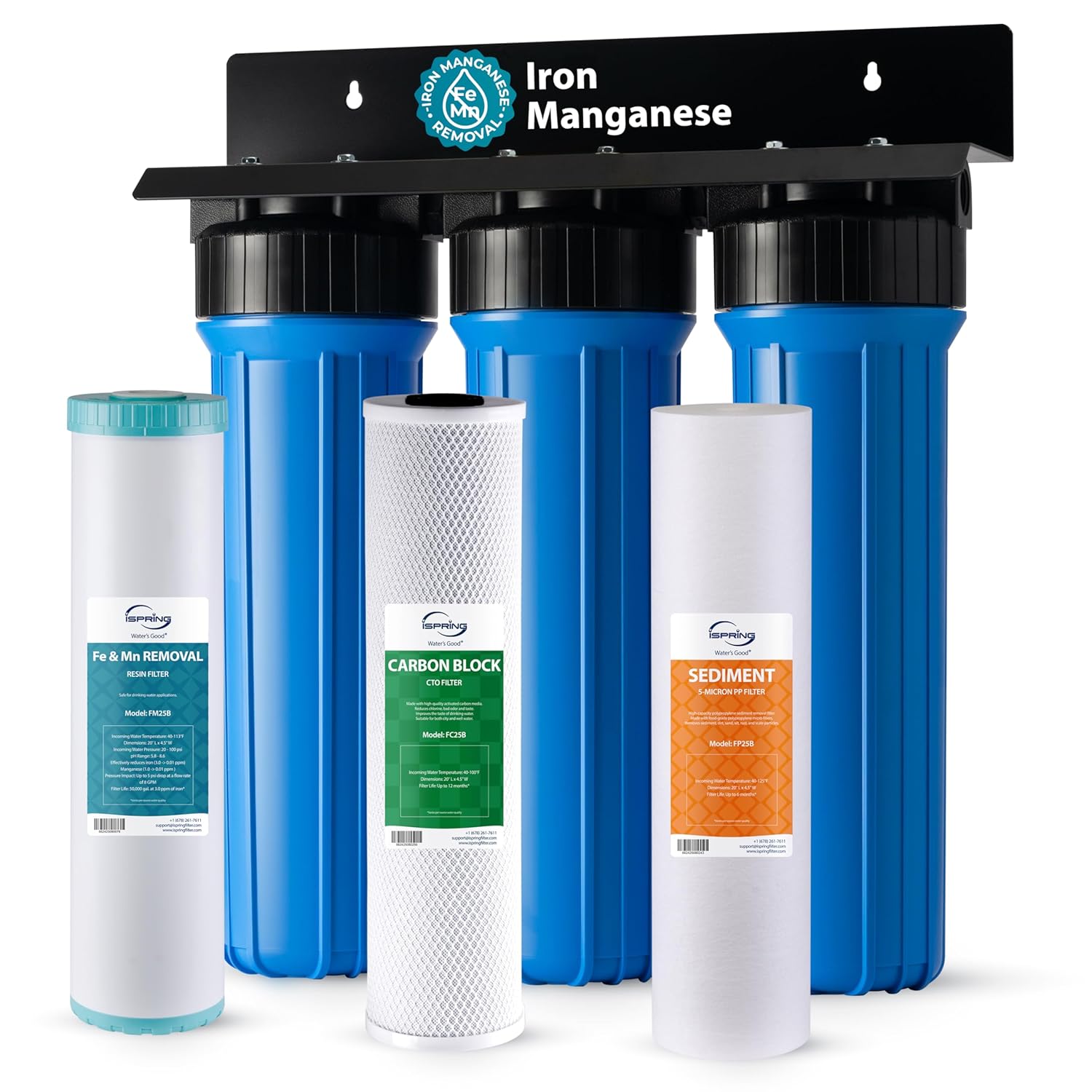
The iSpring WGB32BM is a permanent, tankless 3-stage whole-house filter intended to sit on the main supply line and treat water for drinking, bathing and household appliances. It uses a big-blue polypropylene sediment stage, a coconut-shell carbon block stage rated to 100,000 gallons, and a catalytic iron/manganese stage that reduces iron and manganese to near 0.01 ppm within its specified input limits. The system supports up to 15 gpm and 25-80 psi operating pressure, so it can handle typical well-water flow demands without noticeable pressure loss. Filters are large 20-inch cartridges and the unit is designed for DIY installation with a 1-inch NPT inlet/outlet and included wrench. Limitations include that it does not soften water or remove dissolved solids and the iron/manganese stage has maximum feed concentrations (3.0 ppm iron, 1.0 ppm manganese) beyond which you should choose a different model or pretreatment. Expect routine cartridge replacements about every 6-12 months depending on contaminant load.
Best for: Buyers who need a high-flow whole-house filter for well water that prioritizes removing sediment, chlorine, and modest iron and manganese levels while keeping household water pressure intact.
Less Ideal for: Homes with very hard water or iron/manganese concentrations above the stated limits should consider adding a softener or a higher-capacity iron removal system instead.
- Three-stage filtration targets sediment, chlorine/taste/odor, and iron/manganese
- High-capacity carbon and sediment cartridges rated up to 100,000 gallons
- Handles high flow rates up to 15 gallons per minute with minimal pressure loss
- Large 20-inch big-blue cartridges simplify maintenance and extend service intervals
- Includes necessary components for DIY installation and a wrench
- Does not reduce water hardness or remove dissolved solids
- Iron and manganese removal is limited to feed levels up to specified maxima
Verdict: Choose the WGB32BM when you want a high-capacity, high-flow whole-house filter that reliably removes sediment, chlorine, and modest iron and manganese levels while preserving water pressure.
Culligan SCWH-5 Whole House Filter

| Material Type | Carbon |
|---|---|
| Flow Rate | 4 GPM |
| Micron Rating | 5 microns |
| Service Life | 15,000 gallons |
| Compatible Models | HF-150A, HF-160, HF-360A, HF-365 |
The Culligan SCWH-5 replacement cartridges are carbon-wrapped whole-house filters sold as a two-pack for use with compatible Culligan housings. They are rated to trap particles larger than 5 microns at a 4 GPM flow rate and are meant to reduce sediment, rust, silt and chlorine taste and odor so faucets and appliances receive visibly clearer water. Installation is straightforward on compatible systems and routine replacement every three months or after roughly 15,000 gallons keeps performance consistent; homes with higher sediment will need more frequent changes. The pack is practical for kitchen and bathing water where basic taste and particulate reduction is the goal, and the filters carry WQA/ANSI testing for material safety and structural integrity. These are not specialty filters for heavy chemical removal or ultrafine filtration, so buyers seeking advanced contaminant removal should pair them with additional treatment stages.
Best for: Buyers wanting an affordable, no-frills cartridge to improve faucet water clarity and taste on a Culligan whole-house system who prioritize reliable basic filtration and easy replacement.
Less Ideal for: Homes needing removal of heavy chemical contaminants, very fine particulates, or a complete multi-stage treatment should choose more advanced filtration systems or additional filter stages.
- Reduces sediment, rust, dirt, sand and chlorine taste to improve water clarity and flavor
- Rated to remove particles larger than 5 microns at a 4 GPM flow rate for steady household flow
- Sold as a two-pack, simplifying scheduled replacements
- Compatible with multiple Culligan whole-house filter housings for easy fitment
- Does not target fine contaminants or dissolved chemicals beyond basic chlorine taste and odor
- Replacement cadence (3 months / 15,000 gallons) may be shorter in high-sediment water
Verdict: A budget-friendly carbon replacement cartridge pack that reliably clears sediment and improves faucet water taste on compatible Culligan whole-house systems.
Membrane Solutions String Wound Filter 10"

| Micron Rating | 5 Micron |
|---|---|
| Material Type | Polypropylene (PP) |
| Set Name | 6-Pack |
| Compatible Water Purifier Models | GE GNSV70R, Whirlpool WHKF-GD05 |
| External Testing Certification | NSF |
This Membrane Solutions 5-micron string-wound cartridge is a basic sediment prefilter intended to trap sand, rust, silt, and other larger particulates ahead of downstream filters and fixtures. Sold as a six-pack of standard 10"x2.5" cartridges, it installs into most 10-inch housings and is commonly used as a first-stage filter for well or whole-house systems and as a prefilter for RO setups. The polypropylene string-wound construction provides a graded density that captures larger particles on the outside and finer ones toward the core, which increases dirt-holding capacity and extends service life. The manufacturer rates the element for long life — often quoted at 15,000+ gallons depending on water quality — and the NSF material certification gives added confidence in the construction. Limitations are its single-stage sediment focus: it does not reduce chlorine, taste, or dissolved contaminants, and lifespan varies widely with heavy sediment loads so more frequent changes may be needed in very dirty well water.
Best for: Buyers who prioritize reliable, factory-quality sediment protection for whole-house or well-water prefiltration and want a long-lasting, easy-to-replace cartridge.
Less Ideal for: Homes needing chemical, taste, or dissolved-contaminant removal should pair this with a carbon or specialty filter or choose a different cartridge that targets those contaminants.
- Standard 10"x2.5" size fits most housings and many OEM replacements
- String-wound PP construction provides high dirt-holding capacity
- Sold in a six-pack for multiple changes or multi-stage systems
- NSF material certification for construction quality
- Only a sediment filter so it does not address chlorine, taste, or dissolved contaminants
- Actual filter life depends heavily on inlet water quality and may be shorter with very sandy or silty wells
Verdict: Choose this 5-micron string-wound cartridge when you need a reliable, high-capacity sediment prefilter to protect whole-house and under-sink systems.
iSpring F3WGB32BM 3-Stage Pack

| Included components | sediment filter x 1; carbon block filter x 1; iron & manganese reducing filter x 1 |
|---|---|
| Compatible models | iSpring WGB32BM |
| Material type | Sediment + Carbon + Iron & Manganese Removal |
| Capacity | 100,000 gal (stated for carbon and sediment stages) |
This three-pack from iSpring provides the standard 20" x 4.5" sediment, carbon block and iron & manganese reducing cartridges used in many whole-house housings. In normal use the polypropylene sediment stage captures visible particles down to about 5 microns, the coconut-shell carbon block reduces chlorine and organic contaminants, and the catalytic iron/manganese media targets dissolved iron and manganese at the levels specified by the manufacturer. The set is sized for typical household flow rates and is intended to fit WGB32BM-style housings, so installation is a straightforward cartridge swap for anyone with a compatible system. Benefits include long service life claims for the iron media and independent third-party testing noted for the first two stages, which should reduce maintenance frequency compared with disposable single-stage filters. Important limitations are that these cartridges do not act like an RO membrane and will not lower TDS, and very high iron or manganese well water may require a dedicated specialty system rather than simple cartridge replacement.
Best for: Homeowners who want a reliable, factory-quality cartridge set that drops into standard 20" whole-house housings and reduces common well contaminants without complex system changes.
Less Ideal for: Buyers seeking TDS reduction or those with extremely high iron/manganese levels who need a specialized treatment system should look elsewhere.
- Three-stage protection (sediment, carbon block, iron & manganese) for broad contaminant reduction
- Designed to fit standard 20" x 4.5" whole-house housings including WGB32BM
- Carbon block and sediment stages independently tested to recognized standards
- Iron and manganese media rated for extended life versus traditional greensand
- Does not reduce total dissolved solids or function as a reverse osmosis membrane
- May be insufficient for very high iron or manganese concentrations found in some wells
Verdict: Choose this cartridge pack if you need a straightforward, tested replacement that fits 20" whole-house housings and targets iron, manganese, sediment and chlorine.
Choosing the Right Well Whole-House Water Filter for Faucet: Key Factors to Consider
Filtration Performance and Contaminant Targets
Know what contaminants you need removed at the faucet before selecting a whole-house well filter. Well water commonly contains sediment, rust, iron, manganese, and organic tastes or odors. Choose systems with appropriate micron ratings or media stages for those targets because a device that cannot capture the right particle sizes will not improve faucet clarity.
Pay attention to multi-stage designs where sediment prefilters protect downstream media. Specific media types address different problems: granular or catalytic media for iron and manganese, activated carbon for taste and odor, and sediment cartridges for particulates. Matching media to your lab test or observed issues ensures the filter actually improves faucet water quality.
Flow Rate and Pressure Considerations
Whole-house filters sit in the main line and must deliver sufficient flow to all faucets simultaneously. If a system has too fine a micron rating or inadequate bypass capacity, it can cause a noticeable drop in water pressure at fixtures. Check the system's rated flow at realistic inlet pressures and compare it to your household peak demand, such as multiple taps and a shower running at once.
Also consider head loss caused by media and cartridges. Systems intended for faucet protection should balance fine filtration and flow. When in doubt, size up for higher flow or select a configuration with parallel cartridges or larger housings to avoid throttling everyday use.
Service Interval and Ease of Maintenance
Maintenance frequency affects long-term convenience and performance. Filters with long-life media or easily swapped cartridges reduce hands-on time. Consider whether the system requires special tools to change media, whether cartridges are disposable or refilled, and how straightforward drain and backwash procedures are if present.
Also think about how simple it is to diagnose when service is needed. Systems with pressure gauges or visible housings make it easier to tell when sediment has built up and a change is required. For well water, more frequent checks are common after seasonal changes or heavy sediment events.
Sizing and Installation Compatibility
Correctly sizing the filter to your well and home plumbing is vital. Confirm the inlet and outlet connections match common well plumbing sizes and that there is space for the unit near the pressure tank or inside the utility area. Consider valve placement for easy bypass during service and whether additional fittings or adapters will be required.
Some whole-house systems need a dedicated pressure relief or drain for backwashing. If your installation lacks those features, factor in the cost and complexity of adding them. Proper sizing prevents installation headaches and protects faucet flow and pressure throughout the home.
Material Durability and Corrosion Resistance
Well-water environments can be harsh on equipment. Choose housings and internal components made from corrosion-resistant materials to avoid premature failure. Metal housings should be rated for wet basements and resist rust, while plastic housings should be impact-resistant and UV-stable if exposed to light.
Also consider seals and O-rings: quality elastomers withstand repeated servicing without leaking. Durable construction translates to fewer unexpected repairs and less downtime for faucet protection.
Total Cost of Ownership and Consumables
Initial purchase price is only part of the equation. Ongoing costs include replacement cartridges, media, and any backwash water usage. Calculate the estimated annual cost based on the filter's published service interval and expected cartridge prices.
Also account for any extra plumbing materials or a professional installation charge if you do not install it yourself. A system with modest upfront cost but high consumable expenses can be more costly over its life than a more robust unit with inexpensive, long-life media.
How Whole-House Well Filters Protect Faucets
Whole-house filters act as the first line of defense for every tap in the home. By removing sediment and common well contaminants at the main line, these systems prevent scale, staining, and taste issues while reducing wear on faucet aerators and supply lines.
Installing an appropriate whole-house filter reduces the frequency of point-of-use filter changes and can make faucet water safer and more pleasant without adding separate devices at every sink.
- Reduces visible particulates and cloudiness at taps
- Improves taste and odor where carbon stages are present
- Protects fixture components from abrasive sediments
Typical Installation Locations and Space Needs
Most well whole-house filters are installed near the pressure tank or pressure switch so incoming water is treated before reaching the house. Measure the available space and allow room for cartridge removal or media access when planning placement.
Leave clearance for service actions such as cartridge swaps and for any required backwash drains. If the unit has a bypass valve, plan the plumbing so the house remains supplied during routine maintenance.
- Basement or utility room near the pressure tank is common
- Allow clearance above and around the unit for service
- Plan access to a drain if the system requires backwashing
Common Media Types and What They Treat
Different filter media target different problems: sediment cartridges trap particles, activated carbon improves taste and odor, and specialized iron-removal media oxidize and capture dissolved iron. Understanding media function helps you pick a system that directly addresses the water qualities you see at faucets.
Some systems combine stages to handle multiple issues in series. When selecting media combinations, prioritize the contaminant that most affects faucet appearance or usability.
- Sediment filters: particulate and turbidity reduction
- Activated carbon: chlorine, sulfur odors, and organic tastes
- Iron-specific media: reduces staining and metallic taste
Maintenance Best Practices for Consistent Faucet Performance
Establish a maintenance schedule based on the system's rated service life and observed water conditions. Check pressure gauges or visual indicators monthly at first; more frequent checks may be necessary if your well has seasonal turbidity spikes.
Keep a few spare cartridges or basic replacement parts on hand to minimize downtime for faucet protection. If the system uses media that requires backwashing, ensure the drain is functioning properly and that backwash intervals match the manufacturer's guidance and your water conditions.
- Inspect pressure and flow before and after service
- Follow recommended cartridge change intervals
- Store spare consumables to reduce service delays
When to Call a Professional
Professional help is wise when making plumbing modifications, working with the pressure tank, or when you are uncertain about sizing and flow calculations. A licensed technician can confirm pipe sizes, recommend bypass arrangements, and install necessary fittings safely.
If you observe ongoing pressure loss after installing a filter, a professional can diagnose whether the issue is improper sizing, a clogged prefilter, or a broader well pump concern.
- Complex installations or limited space
- Problems with water pressure after installation
- Uncertainty about matching media to lab test results
How We Chose the Best Well Whole-House Water Filter for Faucet
We prioritized filters that are appropriate for well water and that specifically address the conditions homeowners notice at faucets. Our selection process focused on measurable filtration performance, system sizing and flow deliverability, serviceability, and compatibility with common well plumbing. We favored systems using media or stages known to remove sediment, iron/manganese particulates, and chlorine or sulfur-related taste and odor where applicable. Concrete criteria included micron rating and stage count for particulate removal, published treated water flow rate at realistic pressure, ease of cartridge or media replacement, and available fittings for standard well plumbing. We also considered build quality and corrosion resistance because well-water systems often sit in basements or utility areas with variable humidity. Exclusions applied to systems intended only for point-of-use faucets or countertop filters; we only included whole-house systems sized to protect all faucets while keeping flow adequate. The result is a list that favors balanced performance: effective filtration for faucet clarity without undue pressure drop, straightforward maintenance, and straightforward installation with common well plumbing configurations.
Our full evaluation process is outlined in our review methodology.
FAQ
How do I know which micron rating I need for my faucet?
Micron needs depend on what you see at the tap. For visible sand and rust, a 5 to 20 micron sediment stage is common. If you require very fine polishing for clarity, consider sub-micron cartridges, but be aware these can reduce flow and may not be necessary for most faucet concerns.
Will a whole-house well filter reduce my water pressure?
Some systems do reduce pressure if undersized or if cartridges are clogged. Choose a filter with a rated flow that exceeds your peak household demand and maintain prefilters to minimize pressure loss.
How often should I replace cartridges or media?
Replacement frequency varies with water quality and the specific media. Sediment cartridges may need changing as often as every 3 months in high-silt wells, while carbon or specialty media often last 6 to 12 months or longer. Monitor pressure and clarity to determine the ideal interval.
Can I install a whole-house filter myself?
Homeowners with basic plumbing skills can install many systems, especially those with straightforward shutoff and bypass valves. However, if your installation involves modifications to the pressure tank, electrical controls, or complex fittings, hiring a professional is recommended.
Does a whole-house filter remove dissolved iron or sulfur completely?
Removal depends on the media used and the iron or sulfur concentration. Specialized media and multi-stage systems can substantially reduce these contaminants, but severe dissolved concentrations may require pretreatment or additional treatment steps.
Final Verdict
For well-fed homes, prioritize a whole-house water filter that matches the contaminants you observe at the faucet while preserving adequate flow. Balance filtration media that target your primary issues with a system sized for household peak demand and built from corrosion-resistant materials. Focus on serviceability and clear maintenance intervals so faucet performance remains consistent over time. When in doubt, choose a system that delivers specified flow rates above your peak use and offers straightforward servicing to keep taps clear and reliable.