
Note: This article contains affiliate links. If you click on these links and make a purchase, we may earn a small commission at no extra cost to you. This helps support our research and content. Read our full affiliate disclosure here.
If your home runs on a private well and you notice limescale, spotty fixtures, or faster wear on appliances, selecting the right well whole-house water filter matters. Hard water can cause mineral buildup throughout plumbing and on appliances, so you want a system that reduces scale while preserving household water pressure and flow. This guide covers seven shortlisted whole-house well water filtration systems suited for hard water. We evaluated systems for their ability to manage scale, maintain consistent flow rates, and fit typical well plumbing. Read on for the decision criteria we used and practical guidance to match a system to your home's water chemistry and usage patterns.
Top Picks at a Glance
| Best Overall The best all-around choice for most situations | iSpring WGB32BM 3-Stage Whole House Filter |  |
| Best Quality Built to a higher standard if you want something more solid | Aquasana Rhino Well WH-WELL-CT-UVS |  |
| Best Value The sweet spot between price and what you get | Waterdrop Whole House Filter WD-WHF21-PG |  |
| Best Budget The cheapest option that still gets the job done reliably | iFilters LWH-D Whole House Filter |  |
| Top Rated A top-rated pick with lots of positive feedback | iSpring WGB21B 2-Stage Whole House Filter |  |
| Most Popular A crowd favorite that many people choose with confidence | Culligan WH-HD200-C Whole House Filter |  |
| Best Seller A high-volume bestseller chosen again and again | SimPure DB10P Water Filter Housing |  |
iSpring WGB32BM 3-Stage Whole House Filter
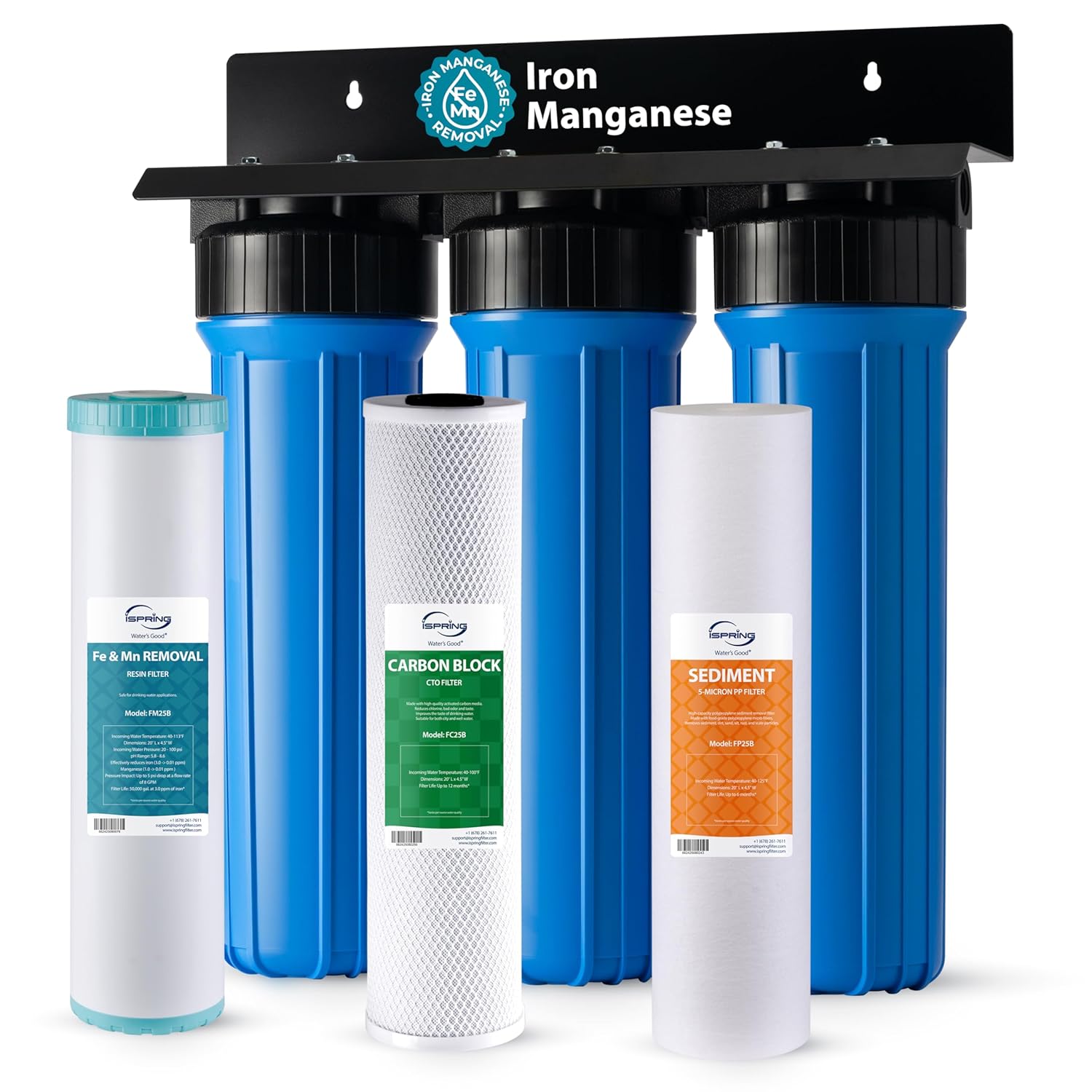
| Maximum Flow Rate | 15 gpm |
|---|---|
| Operating Pressure Range | 25 – 80 psi |
| Operating Temperature | 40 – 100 °F |
| Inlet / Outlet | 1 inch NPT |
| Filter Life Cycle | 1 years |
The iSpring WGB32BM is a three-stage whole house filter that combines a big-blue sediment cartridge, a coconut-shell carbon block, and an iron/manganese catalytic media stage to protect plumbing and supply treated water to every tap. It is installed at the main supply line and is built for DIY-friendly replacement of 20-inch cartridges; the system supports up to a 15 gpm peak flow so it can handle typical household demand with minimal pressure loss. The carbon stage removes chlorine, color, and taste while the third-stage catalytic media effectively lowers iron and manganese to trace levels within the system's rated influent limits. Filters are rated for long service life—up to 100,000 gallons or about 12 months for the carbon and sediment stages, with the iron stage rated separately for 50,000 gallons at specified iron levels. Important limitations are that it does not soften water or remove dissolved solids, and it is intended for indoor installation or properly protected outdoor installs in mild climates. Overall it is a high-capacity, maintenance-friendly option for homes dealing with moderate iron and common disinfectant contaminants.
Best for: Homeowners who want a durable, high-capacity whole-house filter that removes sediment, chlorine, and moderate iron or manganese while keeping strong household water flow and easy maintenance.
Less Ideal for: Homes with high hardness or very high iron/manganese concentrations that require a dedicated water softener or specialty iron-removal system should consider other solutions.
- Three-stage design targets sediment, chlorine/taste, and iron/manganese specifically.
- High flow capacity up to 15 gallons per minute for whole-house use with minimal pressure loss.
- Long filter life ratings (up to 100,000 gallons or ~12 months for primary stages) reduce replacement frequency.
- 20-inch big-blue cartridges and included wrench simplify DIY installation and servicing.
- Does not reduce water hardness or Total Dissolved Solids so a separate softener is required for hard water.
- Iron/manganese removal is limited to specific influent levels (max 3.0 ppm iron, 1.0 ppm manganese).
Verdict: Choose this system when you need a high-flow, low-maintenance whole-house filter that specifically cuts chlorine, sediment, and moderate iron or manganese for reliable everyday water quality.
Aquasana Rhino Well WH-WELL-CT-UVS

| Maximum Flow Rate | 14.7 gpm |
|---|---|
| Operating Pressure Range | 20-100 psi |
| Supported Water TDS Level Maximum (PPM) | 1000 |
| Filter Life Cycle | 5 years |
| Capacity | 500000 gallons |
The Aquasana Rhino Well WH-WELL-CT-UVS is a multi-stage whole-house system designed specifically for well water. It uses a 20" pre-filter, carbon and copper-zinc (KDF) media, a salt-free scale control conditioner, a 10" post-filter, and an inline UV purifier to reduce chlorine, bacteria, viruses, and scale while preserving healthy minerals. Typical use is at the main water line to deliver treated water to every tap, protecting appliances, improving taste, and reducing skin and hair drying from contaminants. Notable features include a high rated flow up to 14.7 gpm, a 500,000-gallon or five-year filter life, and included installation fittings for 3/4" or 1" lines plus an integrated drain valve for flushing. For performance-minded buyers this system offers broad contaminant reduction and UV disinfection without salt-based softening, so you get scale control without demineralized water. Limitations are that it is not a traditional water softener—very hard water or high iron conditions may require a dedicated softener or iron removal system, and installation for some homes will need space and basic plumbing work.
Best for: Buyers who prioritize high contaminant removal and whole-house protection for well water and want a long-lasting, low-maintenance system that conditions scale without using salt.
Less Ideal for: Homes with very high hardness or iron that require true ion-exchange softening or dedicated iron removal should consider a separate softener or iron treatment instead.
- Comprehensive multi-stage filtration including carbon, KDF, and UV for bacteria and virus reduction
- Salt-free scale control that conditions water without removing beneficial minerals
- Long service life rated for 500,000 gallons or five years, reducing maintenance frequency
- High maximum flow rate (14.7 gpm) suitable for larger households and simultaneous fixtures
- Includes pre/post filters and installation kit components for 3/4" or 1" mains plus an integrated drain valve
- Does not soften water chemically so it may not prevent all scale in very hard-water situations
- Not optimized for high iron levels above recommended limits without additional treatment
Verdict: Choose this system if you want a high-flow, long-life whole-house well filter with UV disinfection and salt-free scale control for performance-focused protection without chemical softening.
Waterdrop Whole House Filter WD-WHF21-PG

| Purification Method | Granular Activated Carbon, Sedimentation |
|---|---|
| Maximum Flow Rate | 15 gpm |
| Operating Pressure Range | 25 psi |
| Filter Life Cycle | 6 months |
| Upper Temperature Rating | 100 °F |
This Waterdrop WHF21-PG is a compact 2-stage whole-house filter built around a 10"x4.5" polypropylene sediment cartridge and a granular activated carbon (GAC) cartridge made from coconut shell. It is installed on the main line as a passive, no-power system and is aimed at reducing sediment, chlorine, lead and unpleasant tastes and odors for the whole home. The system supports up to 15 gallons per minute and is rated to handle typical household pressure; housings are food-grade and claim resistance to water hammer. Filter service intervals are practical for busy households: GAC is replaced about every six months and the PP sediment every 3 to 6 months depending on water quality, which balances performance and running cost. Installation is DIY-friendly and includes a wrench and mounting hardware, though customers should be comfortable with basic plumbing and using Teflon tape. It is not designed to remove dissolved hardness minerals like calcium and magnesium, so paired softening is required for hard-water scale control. The unit's strengths are steady flow and improved taste, with predictable maintenance needs for a well-kept system.
Best for: Homeowners who want a low-maintenance, no-electricity whole-house filter to improve water taste and remove sediment and common contaminants while keeping steady household flow.
Less Ideal for: Homes that need water softening or extensive removal of dissolved minerals should choose a dedicated water softener or a multi-stage treatment designed for hard water before or alongside this unit.
- Two-stage setup combining sediment and GAC for effective chlorine, taste and lead reduction
- Supports a high flow rate up to 15 gpm suitable for whole-house supply
- No electricity required so it runs continuously without power connections
- Includes mounting hardware and a wrench to simplify DIY installation
- Does not reduce dissolved hardness minerals so it will not prevent scale from hard water
- Filter replacements are periodic (3–6 months for sediment) which adds ongoing maintenance
Verdict: A practical, no-power whole-house filter that delivers steady high flow and noticeably better taste and odor control for homeowners not seeking hardness removal.
iFilters LWH-D Whole House Filter

| Purification Method | Granular Activated Carbon, Sedimentation |
|---|---|
| Maximum Flow Rate | 3 gpm |
| Supported Water TDS Level Maximum (PPM) | 500 |
| Power Source | Manual/Gravity-fed |
| Included Components | Installation Kit |
The iFilters LWH-D is a compact two-stage whole-house filter that pairs a multi-layer polypropylene sediment cartridge with a coconut-shell activated carbon stage to cut sediment, rust and chlorine taste and odor before water reaches fixtures. It installs at the point of entry with standard 3/4" NPT ports and a pressure-relief button, and the clear housings make it easy to visually inspect cartridges during maintenance. Typical use is for homeowners on a budget who want basic protection for plumbing, water heaters and appliances and a noticeable improvement in shower and tap water smell and clarity. The system is manual/gravity-fed and rated to about 3 gpm, so it is best for small to medium homes rather than high-demand whole-house systems. Filters are intended to be replaced roughly every six months depending on local water quality, and replacement cartridges are specific to the unit generation, so check gasket color when ordering. It does not reduce total dissolved solids, so hard water minerals require a separate softening solution.
Best for: Value-focused homeowners with small to medium houses who want an affordable point-of-entry system to cut sediment and chlorine smell while protecting plumbing and appliances.
Less Ideal for: Homes with high peak water demand, large multi-bath households, or users seeking mineral/TDS reduction and water softening should look at higher-capacity or specialized systems instead.
- Two-stage design combines depth-pleated sediment filtration with coconut shell activated carbon for sediment and chlorine reduction
- Clear housings allow quick visual checks of cartridge condition
- Standard 3/4" NPT ports and pressure-relief button simplify installation and filter changes
- Engineered for everyday household protection of plumbing and appliances
- Maximum flow rate (~3 gpm) limits suitability for larger homes or simultaneous high-flow use
- Does not reduce total dissolved solids or address hardness minerals
Verdict: A budget-friendly, easy-to-install two-stage point-of-entry filter that improves clarity and reduces chlorine taste and odor for small to medium homes.
iSpring WGB21B 2-Stage Whole House Filter
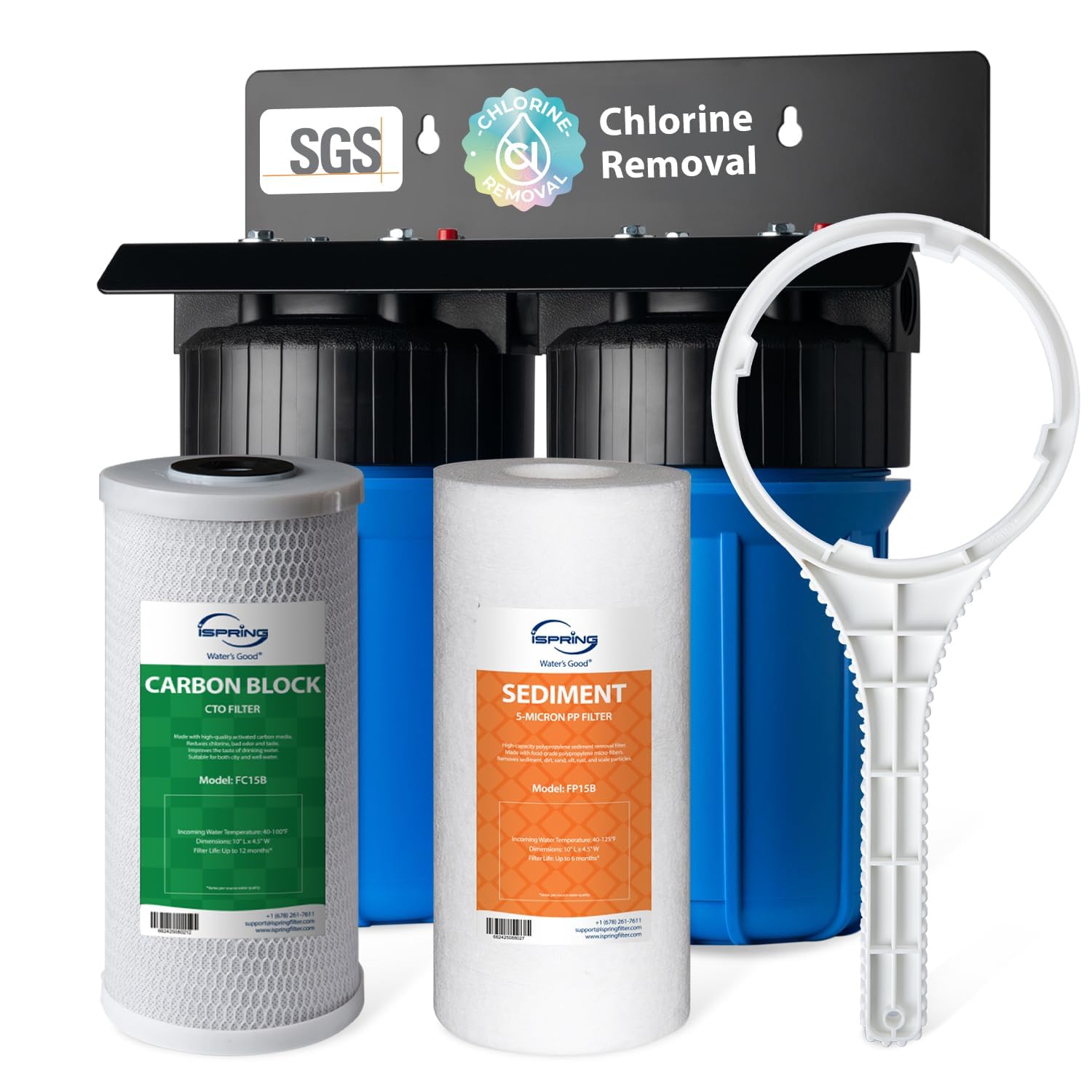
| Filter Life Cycle | 12 months |
|---|---|
| Capacity | 50,000 gallons |
| Inlet / Outlet | 1 inch Female NPT |
| Maximum Flow Rate | 15 gpm |
| Operating Temperature | 40-100 °F |
The iSpring WGB21B is a point-of-entry two-stage filtration system meant to protect plumbing and improve water taste by removing sediment and chlorine-related contaminants before water reaches fixtures. It installs at the main supply and ships with a 5-micron polypropylene sediment cartridge followed by a coconut-shell carbon CTO cartridge that reduces chlorine, VOCs, and bad tastes and odors. The unit is preassembled on a mounting bracket with 1" inlet/outlet ports for high flow and includes a filter wrench and pressure release valve to simplify filter changes. Rated to treat up to 50,000 gallons (about a year for a typical household) and operate across a wide temperature and pressure range, it is a low-maintenance, no-power solution that preserves dissolved minerals while extending appliance life. Limitations: it does not reduce TDS or soften hard water minerals, so buyers with scale or very hard well water will need an additional water softener or specialty media stage to address hardness and iron specifically.
Best for: Homeowners who prioritize a reliable, low-maintenance pre-filter and chlorine removal solution to protect plumbing and improve water taste without changing mineral content.
Less Ideal for: Homes seeking a single-device solution for hard water, high TDS, or dissolved iron should consider adding a dedicated softener or an iron-specific treatment instead.
- Two-stage design removes sediment and over 90% of chlorine to improve taste and protect plumbing
- High capacity cartridges rated up to 50,000 gallons for about yearly replacement intervals
- 1" inlet/outlet and up to 15 gpm flow support whole-house use with minimal pressure loss
- Comes preassembled with mounting bracket, filter wrench, and pressure relief for easier DIY installation and service
- Does not reduce total dissolved solids or remove hardness minerals
- Not designed to remove dissolved iron or significantly address heavy mineral scaling
Verdict: Choose the iSpring WGB21B when you want a dependable, high-capacity two-stage whole-house filter that reliably removes sediment and chlorine to protect plumbing and improve water taste.
Culligan WH-HD200-C Whole House Filter

| Maximum Flow Rate | 10 gpm |
|---|---|
| Supported Water TDS Level Maximum (PPM) | 600 |
| Capacity | 16000 gallons |
| Material Type | Stainless Steel |
The Culligan WH-HD200-C is a stainless steel-capped whole-house filter housing built to mount at the home water main and pair with heavy-duty sediment or specialty cartridges (sold separately). It is installed inline on a 1" water line and includes a built-in shutoff, bypass, pressure relief valve, mounting bracket, and housing wrench so routine cartridge changes are straightforward. The clear sump makes it easy to visually inspect filter condition without disassembly, and the unit is rated for up to 10 gpm and 16,000-gallon cartridge capacity depending on the filter used. Because the housing is not a cartridge itself, water treatment performance depends on the cartridge you choose, which gives flexibility to target sediment, chlorine taste, or other contaminants but requires buying the right replacement media. The stainless steel cap and WQA-tested durability make it a solid choice for protecting plumbing and appliances in hard-water or sediment-prone well systems, though it does add the extra step of sourcing compatible filters for your needs.
Best for: Buyers who want a durable, serviceable whole-house housing to protect plumbing and appliances and who prefer inspecting and swapping cartridges themselves using social proof and proven component brands.
Less Ideal for: Households that want an all-in-one, cartridge-included filtration solution or buyers who prefer turnkey systems with no cartridge selection or installation work.
- Clear sump allows quick visual inspection of cartridge condition
- Includes mounting bracket, bypass shutoff, pressure relief valve, and housing wrench for easier maintenance
- Stainless steel cap and WQA-tested design for durable, reliable installation
- Universal 1" inlet/outlet fits standard whole-home heavy duty filter cartridges
- Filter cartridges are sold separately so total system cost depends on cartridge choice
- Does not reduce contaminants by itself; performance varies with installed cartridge
Verdict: Choose the WH-HD200-C if you want a durable, serviceable whole-house filter housing that lets you pick the cartridge best suited to treating well water and protecting appliances.
SimPure DB10P Water Filter Housing

| Maximum Flow Rate | 20 gpm |
|---|---|
| Inlet/Outlet | 1" NPT Brass Port |
| Compatible Filter Dimensions | 10" x 4.5" |
| Working Water Pressure Range | 15-90 PSI |
| Applicable Water Temperature | 5-38 ℃ (41-100 ℉) |
The SimPure DB10P is a standalone 10" x 4.5" whole-house filter housing designed as a pre-filter for municipal or well water. It accepts standard 10" cartridges such as sediment, granular activated carbon, and CTO types to remove sand, dirt, chlorine, and other particulates ahead of downstream appliances. The housing is molded from reinforced food-grade polypropylene with brass 1" NPT inlet/outlet ports and includes a heavy-duty mounting bracket, wrench, screws, and a red pressure-relief button to simplify cartridge replacement. With a rated maximum flow of 20 gpm and a 15-90 PSI working pressure range, it can handle typical household flow and pressure needs while protecting water heaters, washers, and whole-home systems from sediment and chlorine. Practical limits are that cartridges and push fittings are sold separately and the unit requires enough installation space to swap filters; it also does not perform hardness removal or specialized scale prevention, so buyers should pair it with a water softener or scale control device for hard water applications.
Best for: Buyers who want a reliable, factory-quality pre-filter housing to protect plumbing and appliances from sediment and chlorine and prefer a straightforward, low-risk installation.
Less Ideal for: Homes seeking a single solution for hard water or scale control should avoid this as a standalone product and instead add a dedicated softener or descaler.
- Universal 10" x 4.5" cartridge compatibility lets you use sediment or carbon filters for tailored pre-filtration
- 1" NPT brass inlet/outlet provides durable, high-flow connections
- Reinforced food-grade polypropylene body resists corrosion and physical impact
- Includes mounting bracket, wrench, screws, and pressure-relief button for easier installation and cartridge changes
- Does not include filter cartridges or push fittings, so additional purchases are required
- Does not reduce water hardness or prevent limescale on its own
Verdict: A durable, easy-to-install 10" pre-filter housing that reliably protects home plumbing and appliances from sediment and chlorine when paired with the right cartridges.
Choosing the Right Well Whole-House Water Filter for Hard Water: Key Factors to Consider
Scale Reduction Effectiveness
How well a system reduces dissolved calcium and magnesium, or prevents them from depositing as scale, directly affects the longevity of plumbing and appliances.
Systems vary between true ion-exchange softening, template-assisted crystallization, and sequestration media. True hardness removal reduces mineral content, while scale control technologies convert minerals into nonadherent crystals or keep them suspended. Consider the expected hardness level in your well water and choose a technology suited to that concentration because inadequate capacity will let scale form despite having a treatment system.
Flow Rate and Pressure Retention
Whole-house filters must deliver adequate flow for simultaneous uses such as showers, washing machines, and irrigation without noticeable pressure loss.
Check the system's continuous flow rating and compare it to peak household demand. Systems with restrictive media beds or undersized pipe connections can cause pressure drop. Also evaluate whether additional bypass or parallel configurations are needed for very high-flow homes. Maintaining pressure ensures fixtures work properly and prevents increased pump cycling on well systems.
Media Longevity and Maintenance Requirements
Different media types have widely different service lives and maintenance needs, which affect ongoing ownership cost and convenience.
Some media require periodic backwashing, salt replenishment, or chemical regeneration, while others are passive and only need occasional replacement. Consider accessibility of replacement media, the frequency of service visits, and whether you can perform routine maintenance yourself. A longer-lived media can justify a higher upfront cost by reducing service interruptions and operating tasks.
Installation Compatibility With Well Systems
Proper integration with your well pump, pressure tank, and existing plumbing is essential to avoid operational issues.
Evaluate inlet and outlet sizes, recommended mounting orientation, and whether the system requires electricity or drain access. Some systems are designed for gravity-fed or municipal setups and may not suit a pressured well line without modifications. Also check whether a prefilter is recommended upstream to protect media from sediment common in well water.
Corrosion and Material Durability
Well water chemistry varies and can accelerate corrosion in certain materials, affecting longevity and safety.
Look for plumbing and vessel materials rated for potable water and resistant to the specific ions in your water, such as chlorides or sulfates. Durable housings and fittings reduce the chance of leaks and lower maintenance. Consider whether components exposed to the water are replaceable and whether seals and gaskets use standard sizes for easy servicing.
Testing Your Well Water Before Choosing
Before selecting any whole-house system, get a comprehensive well water test that includes hardness, pH, iron, manganese, TDS, and sediment levels. Hardness alone does not tell the whole story because iron and high sediment can foul media and reduce effectiveness. A baseline test lets you match treatment technologies to the actual chemistry you need to manage.
- Collect samples using a certified lab kit or local extension service for the most reliable results
- Ask the lab for hardness as grains per gallon or mg/L of calcium carbonate for accurate capacity matching
- Check for iron and manganese since they can coat media and require prefiltration
Prefiltration and Sediment Management
Well water often carries suspended solids that damage or clog whole-house media. Installing a sediment prefilter upstream protects the main media and extends service intervals. Choose a prefilter rated for the sediment size typically found in your test results and plan for regular cartridge or backwash maintenance.
- Use a sediment filter with an appropriate micron rating based on your well water turbidity
- Consider automatic backwashing sediment filters for heavy sediment loads to reduce manual maintenance
- Place the prefilter before any media that is sensitive to clogging, such as catalytic or template crystals
Salt-Based Softeners Versus Scale Control Alternatives
Salt-based ion-exchange softeners remove hardness ions but add sodium to the water and require brine regeneration, salt handling, and periodic maintenance. They provide clear, measurable hardness reduction and are effective in high-hardness situations. Scale control alternatives such as template-assisted crystallization or sequestration avoid salt use and claim to reduce scale formation without removing minerals. These systems usually require less hands-on maintenance and preserve dissolved mineral content, which can be preferable where wastewater or salt discharge is restricted.
- Salt-based systems are effective for high hardness but need brine management and periodic salt replenishment
- Template or catalytic media require less ongoing supply management but may be less effective at very high hardness levels
- Consider local regulations and septic system compatibility when evaluating salt-based options
Sizing a System for Household Demand
Match a system's flow capacity to your household's peak demand to avoid pressure loss. Calculate peak flow by adding typical simultaneous fixture flows such as two showers plus a dishwasher and lawn irrigation. Also account for future changes like a growing family or adding irrigation systems. If your peak demand exceeds standard single-unit flow ratings, consider parallel installations or systems rated for higher flow. Properly sized systems reduce pump cycling on the well and maintain user comfort across multiple fixtures.
- Estimate peak simultaneous flow and include appliances that may run concurrently
- Confirm manufacturer-specified continuous flow and peak flow values when available
- Plan plumbing layout to minimize undersized fittings that could create bottlenecks
Maintenance Access and Serviceability
Install systems where routine maintenance is easy and safe. Space for media replacement, cartridge swaps, or backwash plumbing simplifies upkeep and reduces the likelihood of deferred service. Also consider ease of sourcing replacement parts locally or from common suppliers. Accessible placement can reduce the cost and time of service calls. Document expected service intervals and keep replacement items on hand when possible to avoid downtime.
- Leave clearance for removing media tanks, cartridges, or heads during maintenance
- Position the system near existing shutoffs and a floor drain if backwash is required
- Keep a service log with dates for media changes and any observed performance shifts
How We Chose the Best Well Whole-House Water Filter for Hard Water
To assemble this list we applied selection filters focused on real-world performance and installation practicality for homes supplied by wells. First, we prioritized systems with demonstrable effectiveness at reducing hardness minerals or mitigating their effects through scale inhibition. We also looked for reliable flow capacity to avoid pressure drop issues in multi-fixture homes. Durability and maintenance burden were core filters. Systems that require frequent consumable replacements or complicated upkeep were deprioritized unless they offered significant performance advantages. We evaluated compatibility with standard well plumbing and adaptability to common pump and pressure tank setups. Safety and compliance considerations such as NSF/ANSI certifications or clear material specs were weighted when available. We excluded point-of-use gadgets and softeners that do not treat the entire house. Products were rejected if they lacked clear specification for flow rate, service life, or maintenance needs. The final picks balance scale control, sustained flow performance, ease of installation, and predictable maintenance intervals. These same dimensions map directly to the scoring criteria used in each product card.
Our full evaluation process is outlined in our review methodology.
FAQ
How do I know if my well water hardness is high enough to need a whole-house filter?
Hardness is usually measured in grains per gallon or mg/L. Levels above about 7 gpg (120 mg/L) are commonly considered hard and will cause noticeable scale. A lab test showing elevated hardness, along with visible scale on fixtures or reduced appliance efficiency, indicates a whole-house solution is worthwhile.
Can a whole-house scale control system protect my water heater and appliances?
Yes. Effective scale control or softening reduces mineral deposits in water heaters, dishwashers, and washing machines, extending their service life and maintaining efficiency. The degree of protection depends on the chosen technology and how well it matches your water chemistry and flow demands.
Do these systems require electricity or drain access?
Some whole-house systems, especially active softeners and backwashing filters, require electrical power for control valves and may need a drain for regeneration or backwash cycles. Passive scale control media generally do not need electricity or a drain, but check the installation requirements before selecting a location.
How often will I need to service or replace media?
Service intervals vary by technology and water quality. Salt-based systems need regular salt replenishment and occasional resin cleaning or replacement over many years. Passive media can last multiple years but may need replacement sooner if iron or heavy sediment is present. Your water test and the system's specified media life guide scheduling.
Will a whole-house filter affect my water pressure?
Any filtration device can introduce pressure drop if undersized or clogged. Selecting a system with adequate flow ratings and keeping prefilters clean helps preserve pressure. For very high-demand homes, consider parallel units or high-flow rated systems to avoid noticeable pressure loss.
Final Verdict
Choosing the right whole-house well water treatment for hard water comes down to matching technology to your water chemistry, household flow needs, and maintenance preferences. Prioritize systems with proven scale mitigation for your measured hardness levels, and size units to handle peak simultaneous demand to avoid pressure loss. Factor in maintenance access, media longevity, and compatibility with your well pump and plumbing. When you balance scale control capability against ongoing upkeep and installation complexity, you can pick a reliable system that reduces scale, protects appliances, and fits your household routine.