
Note: This article contains affiliate links. If you click on these links and make a purchase, we may earn a small commission at no extra cost to you. This helps support our research and content. Read our full affiliate disclosure here.
When you are planning multi-day treks or extended backcountry stays, dependable water filtration becomes one of the most important pieces of gear you carry. A whole-house water filter for backpacking narrows the field to systems designed to provide continuous, robust filtration while remaining portable enough for trail use. The right choice reduces risk from microbes and sediment without adding needless bulk to your pack. This guide shortlists the top systems built for backpacking conditions and evaluates them on practical criteria like filtration efficiency, packability, flow rate, and field maintenance. Read on to see which options match different trip styles and group sizes, and why those criteria matter for trail safety and convenience.
Top Picks at a Glance
| Best Overall The best all-around choice for most situations | iFilters XWH-1000 Whole House System |  |
| Best Quality Built to a higher standard if you want something more solid | WaterBoss WB-WH-FILTER Whole House Filter |  |
| Best Value The sweet spot between price and what you get | SimPure Whole House Filter DB10C-2 |  |
| Best Budget The cheapest option that still gets the job done reliably | A. O. Smith AO-WH-PREV Sediment Filter |  |
| Top Rated A top-rated pick with lots of positive feedback | iSpring WGB21B-PFKS Whole House Filter | 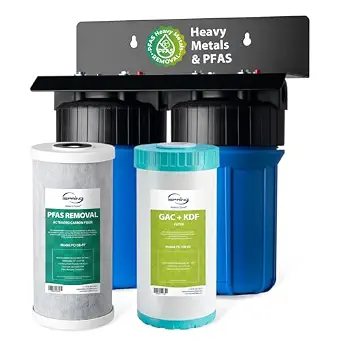 |
| Most Popular A crowd favorite that many people choose with confidence | SimPure DB10C Whole House Filter Housing |  |
| Best Seller A high-volume bestseller chosen again and again | Reverse Osmosis Revolution WHF-34F5 |  |
iFilters XWH-1000 Whole House System

| Capacity | 1000000 gallons |
|---|---|
| Purification Method | Sedimentation |
| Power Source | Gravity-fed/Water Pressure |
| Supported Water TDS Level Maximum (PPM) | 500 |
| Other Special Features | NSF certified |
The iFilters XWH-1000 is a point-of-entry two-stage whole-house filter built to handle city or well water for larger homes. It pairs a washable 30-micron pleated sediment pre-filter with a high-capacity KDF55/GAC media tank to cut sediment, rust, chlorine taste and odor, VOCs, iron, and certain heavy metals before water reaches faucets, showers, and appliances. Installation uses 1" inlet/outlet ports to maintain robust residential flow and the washable pre-filter reduces ongoing consumable costs and simplifies maintenance. The system is rated for up to 1,000,000 gallons or about six years of service depending on water quality, and NSF-certified components indicate factory-quality materials. It does not reduce total dissolved solids, so it is not a substitute for reverse osmosis where TDS or dissolved salts are a concern, and its size and plumbing connections make it unsuitable for portable or outdoor use. For a home-focused, low-maintenance whole-house solution the XWH-1000 delivers strong throughput and long service life, but it is designed for fixed residential installation rather than travel or lightweight setups.
Best for: Buyers seeking a durable, low-maintenance whole-house system to improve tap and appliance water quality across a larger home and who prioritize long service life and strong flow.
Less Ideal for: People who need a lightweight, portable, or backpacking-capable water filter or those who require removal of dissolved solids and salts should look elsewhere.
- Two-stage design with washable 30-micron sediment pre-filter plus KDF55/GAC media for broad contaminant reduction
- High-capacity media offers up to 1,000,000 gallons or roughly six years of service depending on water quality
- 1" inlet/outlet ports maintain strong flow for multiple bathrooms and appliances
- Washable pre-filter lowers replacement costs and simplifies routine maintenance
- NSF-certified components and California manufacturing indicate quality materials
- Does not reduce total dissolved solids, so it will not address high TDS or salt issues
- Bulky, permanently plumbed design makes it impractical for backpacking or portable use
Verdict: A long-lasting, high-flow whole-house filter that delivers broad contaminant reduction and low maintenance for fixed residential installations.
WaterBoss WB-WH-FILTER Whole House Filter

| Purification Method | Activated Carbon |
|---|---|
| Maximum Flow Rate | 7 gpm |
| Operating Pressure Range | 20-100 psi |
| Supported Water TDS Level Maximum (PPM) | 600 |
| Filter Life Cycle | 6 years / 600000 gallons |
The WaterBoss WB-WH-FILTER is a whole-house activated carbon tank that removes chlorine taste and odor from municipal or well water and is certified to NSF/ANSI 42. It installs inline at the house water entry and runs without electricity, using a manual system rated up to 7 gallons per minute so everyday flow and water pressure remain usable for showers, faucets, and appliances. The tank is fiberglass and supplied with a shut-off valve, nipple, and hose adapter for standard 3/4" connections, and the manufacturer rates the filter life at about 600,000 gallons or six years under typical conditions. Practical benefits include dependable chlorine reduction, low maintenance compared with cartridge systems, and no added power or moving parts. Important limitations are its focus on chlorine, taste, and odor—it does not claim broad contaminant removal like sediment, lead, or microbiological pathogens—and the fixed flow rating may be too low for very large households or heavy simultaneous demand. Installation may require basic plumbing work for proper placement and bypass setup.
Best for: Buyers who prioritize steady chlorine and taste removal across an entire home and want a low-maintenance, factory-quality carbon tank that runs without power.
Less Ideal for: If you need broad-spectrum contaminant removal (sediment, heavy metals, or microbes) or have a very large household with peak flows above 7 gpm, choose a multi-stage or higher-flow treatment system instead.
- NSF/ANSI 42 certified to reduce up to 96.9% of chlorine taste and odor
- Activated carbon media provides long service life rated to 600,000 gallons or six years
- Manual, no-power design keeps operation simple and reliable
- Rated flow up to 7 gpm aims to preserve normal household water pressure
- Includes basic installation components: shut-off valve, nipple, and hose adapter
- Targets chlorine, taste, and odor only and does not address all contaminants
- Fixed 7 gpm flow may limit performance during simultaneous high-demand use
- Fiberglass tank requires proper installation and space at the main inlet
Verdict: Choose this WaterBoss tank when you want a simple, long‑life, factory-quality whole-house carbon filter to reliably remove chlorine taste and odor without electricity.
SimPure Whole House Filter DB10C-2

| Filter Cartridges | 10" x 4.5" PP+CTO |
|---|---|
| Micron Rating | 5 microns |
| Inlet/Outlet | 1" Female NPT Brass Port |
| Maximum Flow Rate | 15 gpm |
| Feed Water Temperature | 41-100°F |
The SimPure DB10C-2 is a compact two-stage whole-house pre-filtration unit that uses a 5-micron sediment cartridge followed by a CTO carbon stage to capture sand, rust, chlorine, and odors. Its clear housings make it easy to visually monitor cartridge condition, and the upgraded brass 1" female NPT fittings reduce reliance on plastic connectors. It is designed for straightforward DIY wall- or pipe-mount installation and operates across a wide pressure range without noticeable flow loss up to the listed 15 gpm maximum. Replacement intervals depend on water quality but the carbon stage generally lasts 3 to 6 months while sediment can last longer in cleaner supplies. Important limitations are that it is a mechanical/carbon pre-filter rather than a drinking-water purifier, so it will not remove dissolved salts or pathogens; also correct sealing and careful use of thread tape are needed to avoid leaks. For routine whole-home sediment and chlorine control this unit offers visible filter monitoring and robust fittings in a compact package.
Best for: Buyers who want a reliable, low-maintenance pre-filter to reduce sediment and chlorine across a household and who value visible cartridge monitoring and easy DIY installation.
Less Ideal for: People seeking a portable or backpacking water purifier or a system that removes dissolved solids and microbes should look at purpose-built personal filters or purification systems instead.
- Clear housings allow easy visual inspection of cartridge condition
- Brass 1" NPT inlet/outlet fittings at connection points for improved durability
- Two-stage MPP sediment plus CTO carbon combination removes sediment and chlorine/odors
- Compact design supports wall mounting and straightforward DIY installation
- Rated to maintain flow with up to 15 gallons per minute and wide pressure range
- Not a pathogen or dissolved-solids purifier so it does not replace a purifier or RO system
- Some users report leaking if threads are over-tightened or not sealed properly
Verdict: Choose the SimPure DB10C-2 when you need a compact, visible two-stage whole-house pre-filter that reliably cuts sediment and chlorine and is easy to install and monitor.
A. O. Smith AO-WH-PREV Sediment Filter

| Maximum Flow Rate | 6 gpm |
|---|---|
| Operating Pressure Range | 25-100 psi |
| Upper Temperature Rating | 100 °F |
| Supported Water TDS Level Maximum (PPM) | 500 |
| Filter Life Cycle | 6 months |
The AO-WH-PREV is a simple, passive whole-house sediment filter that protects plumbing and appliances by removing dirt, rust, silt, and other particles from the main water line. It installs at the point of entry with standard 3/4" connections and includes a clear polypropylene housing, a sediment cartridge, and a wrench to ease DIY installation. A convenient valve-in-head design plus a pressure-release button and built-in bypass let you change the cartridge without shutting off the entire water supply, which is helpful during maintenance. The unit is NSF 42 certified for particulate reduction and rated for up to 6 gpm and 24,000 gallons per cartridge life cycle (about six months under typical conditions). Because it is a mechanical sediment filter, it does not reduce dissolved solids or chlorine and is best used as a pre-filter ahead of chemical or adsorption stages. The plastic housing and straightforward design make it an affordable, low-maintenance option for buyers who want basic sediment protection rather than full contaminant removal.
Best for: Buyers on a tight budget who need an inexpensive, easy-to-install pre-filter to protect pipes and appliances from sediment at a point-of-entry installation.
Less Ideal for: Anyone seeking portable filtration for backpacking or users who need chemical, microbial, or dissolved-solids reduction should look at purpose-built portable filters or multi-stage purification systems instead.
- Protects plumbing and appliances by removing visible sediment, rust, and silt.
- Clear housing allows quick visual checks of cartridge condition.
- Valve-in-head with pressure-release and bypass enables cartridge changes without shutting off house water.
- NSF 42 certification for particulate reduction provides independent verification of performance.
- Includes housing, initial sediment cartridge, and wrench for DIY installation.
- Does not reduce dissolved solids, chlorine, or chemical contaminants.
- Polypropylene housing and basic cartridge are aimed at sediment only, not comprehensive purification.
Verdict: A low-cost, NSF-certified whole-house sediment pre-filter that delivers basic protection for plumbing and appliances with easy DIY installation.
iSpring WGB21B-PFKS Whole House Filter

| Purification Method | Carbon Block, Granular Activated Carbon |
|---|---|
| Filter Life Cycle | 12 months |
| Capacity | 50000 gallons |
| Installation Type | Wall Mount |
| Supported Water TDS Level Maximum (PPM) | 300 |
This iSpring two-stage system pairs a high-efficiency KDF/GAC prefilter with an SGS-tested PFAS reduction cartridge to tackle chlorine, lead, mercury, sediment and up to 99% of PFAS compounds across the whole house. It is designed for inline, wall-mounted installation with standard 1" NPT ports and runs on household water pressure, so once plumbed in it delivers treated water to every tap without electricity. Filters are rated for about 50,000 gallons or 12 months, and the housings are made from durable materials intended for long-term service; iSpring supplies step-by-step instructions and videos to support DIY installation or a plumber-assisted setup. Practical benefits include broad contaminant coverage, compact footprint for small homes, and factory-sealed cartridges for freshness. Important limitations are that it does not reduce TDS and requires periodic cartridge replacement and proper indoor or protected outdoor installation to avoid freeze or UV exposure.
Best for: Homeowners prioritizing reliable, factory-quality contaminant removal who want a durable, low-maintenance whole-house solution that reduces PFAS and heavy metals without needing power.
Less Ideal for: People who need to lower TDS or want a portable filter for backcountry or backpacking use should look at RO or travel-specific portable purifiers instead.
- SGS-tested media that targets up to 99% of PFAS including PFOA and PFOS
- Two-stage KDF and granular activated carbon for heavy metals, chlorine, odor and 5-micron sediment
- Standard 1" NPT connections and included installation kit support straightforward DIY or pro installation
- Long service life per cartridge—about 50,000 gallons or 12 months—reducing replacement frequency
- Does not lower total dissolved solids (TDS)
- Requires indoor or well-protected outdoor installation to prevent freeze and UV damage
Verdict: Choose this iSpring system when you need a dependable, whole-house filter that specifically reduces PFAS and heavy metals with long-lasting cartridges.
SimPure DB10C Whole House Filter Housing
| Inlet / Outlet | 1" NPT Brass Port |
|---|---|
| Compatible Filter Dimensions | 10" x 4.5" |
| Maximum Flow Rate | 20 gpm |
| Working Water Pressure Range | 15-90 PSI |
| Material Type | Reinforced Polypropylene, Brass |
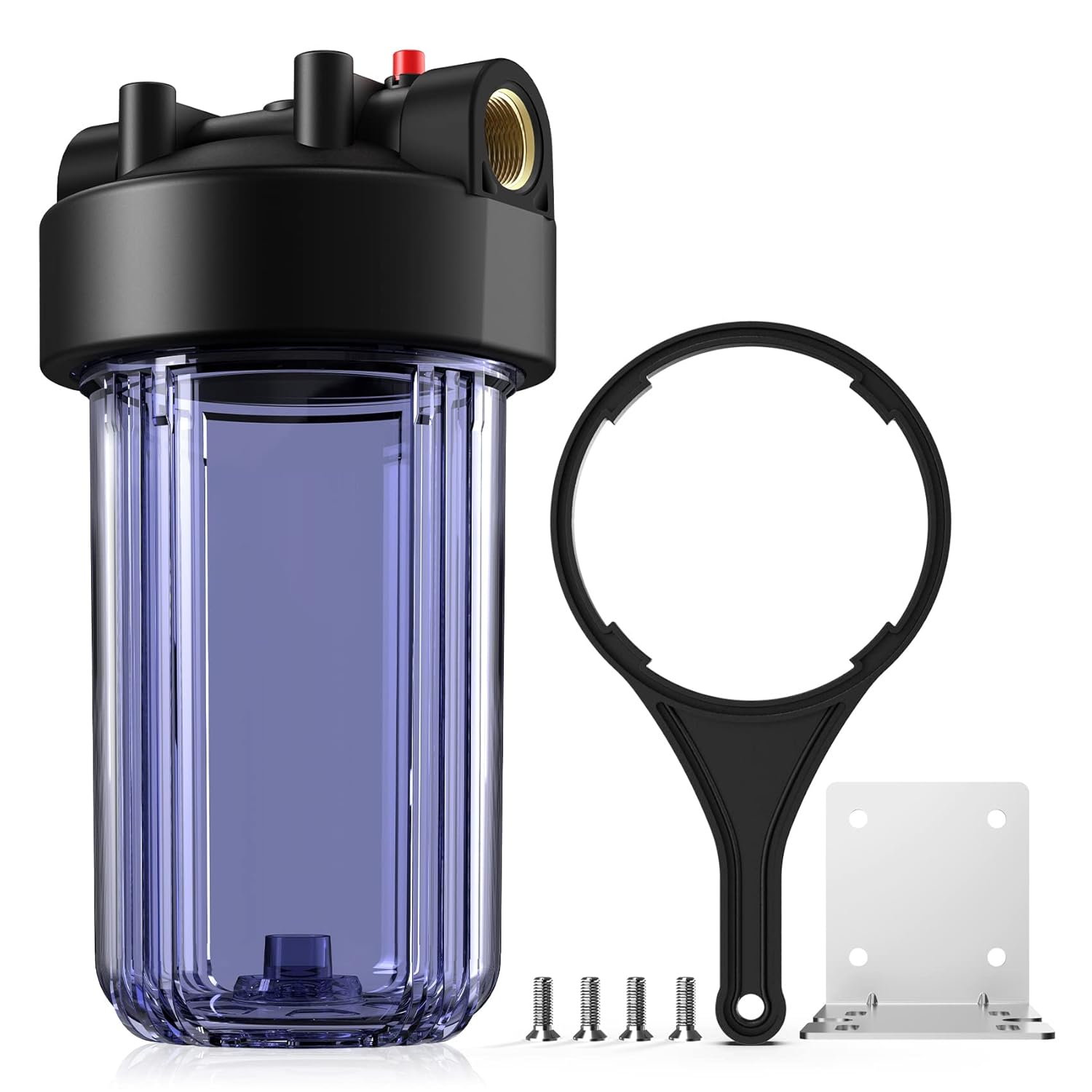
The SimPure DB10C is a heavy-duty whole-house filter housing intended as a pre-filter for municipal or well water supplies. It accepts standard 10" x 4.5" cartridges (sediment, carbon, pleated) and mounts inline using 1" NPT brass inlet and outlet ports. The clear reinforced polypropylene bowl makes it easy to see cartridge condition and the unit includes a mounting bracket, wrench, screws and a built-in red pressure-relief button that simplifies cartridge changes. The brass ports and double O-ring design aim to reduce leaks compared with cheaper plastic-thread housings, and the rated maximum flow of 20 gpm suits larger households or high-flow points. Limitations are that cartridges are sold separately and the housing is sized and intended for stationary whole-home installation, not portable or backpacking use, and it requires roughly 15 to 90 PSI to operate as specified. For buyers focused on reliable pre-filtration and visible filter monitoring, this housing is straightforward and serviceable, but it is not a complete filtration system on its own.
Best for: Buyers who want a visible, serviceable inline housing to protect home plumbing and appliances and who value leak-resistant fittings and easy cartridge changes backed by many reviews.
Less Ideal for: People seeking a lightweight, portable filtration solution for backpacking or off-grid travel should choose a dedicated portable filter instead.
- Clear reinforced polypropylene housing lets you visually check cartridge condition
- 1" NPT brass inlet/outlet and double O-ring design reduce leak risk
- Includes mounting bracket, wrench, screws, and pressure-relief button for easier maintenance
- Fits universal 10" x 4.5" cartridges so you can choose sediment or carbon media
- Rated up to 20 gallons per minute for high-flow applications
- Filter cartridges are not included so additional purchases are required
- Bulky, fixed installation not suitable for portable or backpacking use
Verdict: This clear, brass-ported 10" x 4.5" housing is a dependable visible pre-filter housing for protecting home plumbing and appliances.
Reverse Osmosis Revolution WHF-34F5

| Connection | 3/4" thread |
|---|---|
| Filtration stages | 3 (5μ sediment, GAC, CTO carbon block) |
| Capacity | 10000 gallons |
| Filter life cycle | 5 months |
This whole-house 3-stage system attaches to standard 3/4" plumbing and uses a 5-micron sediment cartridge followed by a granular activated carbon (GAC) and a carbon block CTO stage to reduce chlorine, VOCs, odors, and particulates. It is supplied as two-pack housings with six filter cartridges total, so you get two extra replacement sets on delivery. In normal use it protects downstream fixtures and improves taste and smell for the whole home rather than point-of-use taps, and the sediment stage helps keep the carbon stages from clogging prematurely. The filters are rated for roughly 4 to 6 months of life depending on water quality and a 10,000 gallon capacity is listed, so expect periodic replacement and basic maintenance. The system is manual to install to plumbing and is built in the USA, but it is not a pressurized or powered device and does not remove dissolved salts or heavy metals the way reverse osmosis does. For homes with moderate municipal chlorine and sediment concerns it offers balanced performance and spare filters for easier upkeep, but it is not designed for backpacking or remote on-the-trail use where a lightweight, portable purifier is required.
Best for: Buyers who want a conservative, whole-house filtration upgrade that reliably reduces chlorine, sediment, and common organic tastes and odors and who prefer having replacement cartridges included for predictable maintenance.
Less Ideal for: People needing a lightweight, portable purifier for hiking, backpacking, or emergency carry or anyone who needs removal of dissolved salts, metals, or microbiological pathogens.
- Three-stage filtration (sediment, GAC, carbon block) addresses chlorine, taste, odors, and particulates
- Includes two extra filter sets (six cartridges total) so replacements are on hand at purchase
- Fits standard 3/4" plumbing for whole-house installation
- Sediment prefilter extends life of carbon stages by removing sand, rust, and silt
- Listed 10,000 gallon capacity gives a rough lifetime expectation for planning replacements
- Filters require regular replacement every 4–6 months depending on water quality
- Not a treatment for dissolved solids, minerals, or heavy metals
- Designed for permanent whole-house installation, not portable or for backpacking use
Verdict: A reliable three-stage whole-house filter that improves taste and reduces chlorine and sediment while shipping with extra replacement cartridges for low-risk, maintenance-minded homeowners.
Choosing the Right Whole-House Water Filter for Backpacking: Key Factors to Consider
Filtration Efficiency and Target Contaminants
How a filter removes particles, bacteria, protozoa, and viruses directly affects safety on the trail. For backpacking, look for filtration ratings and media that explicitly list particle size capture and certified reductions for common pathogens.
Micron ratings, hollow-fiber membranes, and multi-stage media all influence what the unit will stop. Effective filtration matters because many backcountry sources contain microscopic organisms that cannot be seen. Choosing a system with proven microbe reduction reduces the need for additional chemical treatment and lowers the chance of gastrointestinal illness while traveling.
Weight, Packed Size, and Integration
Every ounce matters when you are carrying gear over long distances. Weight and packed volume determine whether a unit is practical for solo hikers or only for larger groups. Consider not just the filter body but also any housings, hoses, fittings, and replacement cartridges you will carry.
Integration with existing gear is also important. Systems that can attach to hydration reservoirs, fit into a cook pot for gravity setups, or be used with a lightweight pump provide more versatility. A compact design that stows neatly and protects fragile elements while packed reduces the risk of damage on trail.
Flow Rate and Usability in the Field
Flow rate determines how quickly you can fill bottles or hydration bladders and how long setup takes during breaks. Faster flow reduces downtime for groups but can come at the cost of heavier components or shorter cartridge life.
Usability considerations include whether the system requires manual pumping, relies on gravity, or runs by simple siphon. Controls that are intuitive and connections that do not leak under movement make real-world use less frustrating. Think about how the unit performs with cloudy or sediment-heavy sources.
Maintenance, Replacement, and Serviceability
Field maintenance affects how long a filter will provide reliable protection. Units that allow easy backflushing, quick cartridge swaps, or do not require tools for routine upkeep are better suited to remote trips.
Availability and weight of replacement cartridges matter when planning long trips. A system that uses common, widely available cartridges or that accepts multiple cartridge types will simplify resupply. Also consider whether filters can be cleaned in the field rather than fully replaced to stretch useful life.
Durability and Environmental Resistance
Trail conditions expose gear to impacts, vibration, freezing temperatures, and moisture. A backpacking-oriented filter should have robust housings, resilient seals, and components that resist cracking or clogging when dropped or exposed to cold.
Materials that withstand UV exposure and rough handling extend service life, while protective cases or sleeves can prevent damage in a pack. Weather-resistant fittings and freeze-tolerant media reduce the chance of failure during early-season or high-altitude trips.
Why 'Whole-House' Design Principles Matter on the Trail
Even though the term evokes larger installations, whole-house design principles applied to backpacking prioritize continuous, multi-source filtration rather than single-use disposable filters. Those principles—robust housings, multi-stage media, and serviceability—translate well to backcountry needs when scaled down thoughtfully.
A trail-oriented system that borrows whole-house concepts often gives you higher capacity and simpler maintenance than single-filter straws or tiny pump systems. That can be important for small groups, basecamp-style trips, or long expeditions where resupply is limited.
- Multi-stage filtration reduces clogging and preserves microbe-reducing elements
- Rugged housings protect media during transport and use
- Field-replaceable cartridges extend usable life on multi-week trips
Setting Up in the Backcountry: Quick Tips
Plan for water source variability. Fast mountain streams, slow alpine lakes, and silty river edges present different challenges. Begin by pre-filtering cloudy water through a cloth or sediment cup when available to extend cartridge life.
Position gravity setups above your camp containers and use simple tensioned lines or a tree limb to keep the filter vertical. For pumped systems, stabilize the intake to avoid drawing in bottom sediment and keep intake screens free of debris.
- Use a bandana or coffee-filter material as a pre-filter for heavy sediment
- Keep inlet hose shallow in moving water to reduce sand intake
- When possible, filter from the cleanest accessible spot rather than right at a muddy bank
Balancing Speed and Longevity
High flow rates are convenient but often shorten cartridge life and increase the chance of breakthrough when sources are very dirty. Decide whether speed or extended service life is more important for your typical trip length and group size.
For long treks, prioritize systems with easy maintenance and replaceable elements so you can clean or swap parts at camp. For short outings or emergency use, a lighter, faster system with a single durable cartridge might be preferable.
- Carry a spare cartridge only if you expect heavy use or limited resupply
- Pack a small repair kit with O-rings and tubing connectors
- Practice a quick backflush technique before you need it on the trail
Common Trail Problems and How Filters Handle Them
Sediment buildup, freezing temperatures, and accidental drops are the most common causes of filter failure in backcountry settings. Choose designs that offer sacrificial pre-filters, freeze-tolerant housings, and replaceable internal components to minimize these risks.
Also think about human factors like ease of use when tired or in bad weather. Simple color-coded fittings, tactile controls, and straightforward orientation instructions reduce the chance of user error.
- Sediment: use pre-filtration and regular backflushing
- Freezing: drain and pack filters or use freeze-resistant housings
- Impact: protective cases and internal spring mounts reduce damage
Packing and Resupply Strategies
Plan what spare parts you will realistically carry. Lightweight O-rings, hose clamps, and a small replacement cartridge can prevent major interruptions. Store spares in a sealed, crush-resistant container to keep them dry and intact.
When planning multi-week trips, map potential resupply points where you can obtain replacement cartridges or compatible media. If resupply is improbable, choose a system with longer service life per cartridge or one that accepts common filter elements.
- Distribute weight among group members for longer outings
- Keep filtration gear accessible to avoid repeated packing and unpacking
- Label spare parts to speed repairs in low light
How We Chose the Best Whole-House Water Filter for Backpacking
We focused on selecting systems that are realistic for backpacking use rather than large, home-only units. Our editorial filters prioritized compactness, verified filtration media, durable housings, and field-serviceable designs. We looked for units that either integrate with common backcountry water sources or can be adapted to lightweight gravity or pump setups. Concrete evaluation criteria included particulate and pathogen filtration performance, system weight and packed volume, achievable flow rate in field conditions, ease of filter replacement and backflushing, and long-term durability against impact and freezing. We also considered how easy it is to find replacement cartridges and whether maintenance can be completed with simple tools or by hand. We excluded residential point-of-entry installations, bulky municipal-grade assemblies, and systems that require specialized plumbing or electrical hookups. Units that only offer surface-level sediment capture without proven microbe reduction were not included. The final list is limited to designs that balance trail-worthiness with meaningful contamination control.
Our full evaluation process is outlined in our review methodology.
FAQ
Can a whole-house style filter remove viruses on the trail?
It depends on the filter media and micron rating. Many filters target protozoa and bacteria but not all reduce viruses. If viral protection is a concern, look for media rated or certified for virus reduction or plan to combine filtration with chemical disinfection.
How often will I need to replace cartridges during a long trip?
Replacement frequency depends on water quality and use. In clear sources you may get many days or weeks from a cartridge, while silty or algae-rich water can shorten life to a few days. Choose systems with easy replacement and carry spares if resupply is uncertain.
Is backflushing practical while backpacking?
Yes, when the system is designed for tool-free backflushing. Backflushing can restore flow and extend cartridge life, but it requires carrying clean water for the backflush and a place to dispose of the flush water safely away from camp water sources.
Will these systems work in freezing conditions?
Some designs tolerate freezing better than others. To avoid damage, drain water from the unit, store it in an insulated pack, or use freeze-resistant housings. Repeated freezing and thawing can degrade seals and media over time.
How much extra weight should I expect compared with a simple straw filter?
Whole-house style backpacking systems are typically heavier and bulkier than simple straw filters because they include housings and larger media. Expect a noticeable weight increase, but that tradeoff buys higher capacity, easier maintenance, and often better multi-source protection.
Final Verdict
For backpacking, prioritize meaningful filtration performance while keeping weight and packability realistic for your trip style. Filtration efficiency, ease of maintenance, and environmental durability are the primary tradeoffs: faster, lighter systems are convenient, while larger multi-stage units offer longer service life and simpler group use. Decide whether you need virus-rated protection or whether protozoa/bacteria filtration paired with chemistry is sufficient, and plan cartridge spares and maintenance tools accordingly. With those priorities clear, you can choose a system that balances safety and carry burden for your typical routes and group sizes.