
Note: This article contains affiliate links. If you click on these links and make a purchase, we may earn a small commission at no extra cost to you. This helps support our research and content. Read our full affiliate disclosure here.
If you want safer, better-tasting tap water throughout your home, a whole-house water filter for drinking is a practical upgrade. The right system removes common contaminants that affect flavor and health while maintaining water pressure for everyday use. This guide shortlists the top options and looks at the filter types, micron ratings, and maintenance needs that matter most to homeowners. Use the evaluation criteria here to match a system to your water quality goals and household plumbing so you can get consistent, drinkable water from every tap. Next, we walk through the features and tradeoffs that helped these picks stand out.
Top Picks at a Glance
| Best Overall The best all-around choice for most situations | PRO+AQUA Elite Series PRO-100-E |  |
| Best Quality Built to a higher standard if you want something more solid | Aquasana Rhino WH-1000-CS-UVS-B |  |
| Best Value The sweet spot between price and what you get | Reverse Osmosis Revolution WHF-34F5 |  |
| Best Budget The cheapest option that still gets the job done reliably | Max Water 3-Stage Whole House Filter |  |
| Top Rated A top-rated pick with lots of positive feedback | iSpring WGB21B 2-Stage Whole House Filter |  |
| Most Popular A crowd favorite that many people choose with confidence | SimPure DB10C 10" x 4.5" Housing |  |
| Best Seller A high-volume bestseller chosen again and again | A. O. Smith Whole House Filter AO-WH-Filter |  |
PRO+AQUA Elite Series PRO-100-E

| Maximum Flow Rate | 15 gpm |
|---|---|
| Operating Pressure Range | 80 psi |
| Supported Water TDS Level Maximum (PPM) | 500 |
| Filter Life Cycle | 6 months |
| Capacity | 100000 gallons |
The PRO+AQUA Elite Series PRO-100-E is a 3-stage whole-house filter designed to sit at the main water line and deliver filtered water to every outlet in small to medium homes. Stage 1 is a sediment stage in a clear housing for easy visual monitoring, stage 2 uses a proprietary media blend to reduce iron, hydrogen sulfide, and dissolved heavy metals, and stage 3 is an activated coconut shell carbon filter that removes chlorine, VOCs, pesticides, taste and odor down to about 5 microns. Stainless steel pressure gauges let you track differential pressure so you know when to replace cartridges, and the system is built with pro-grade fittings for residential or light commercial installs. It does not require chemical regeneration or backwashing and is intended for easy maintenance with filter replacements about every six months. Important limitations: it will not reduce total dissolved solids (TDS) and it is sized for homes with 1 to 3 bathrooms, so very large households or applications needing softened water or RO-level TDS reduction will need additional equipment.
Best for: Buyers who want a straightforward, professionally built whole-house filter that improves taste, odor, and removes sediment and common heavy metals across every faucet in a small to medium home.
Less Ideal for: Homes that need TDS reduction, integrated water softening, or very high flow rates for large households should consider systems with RO or dedicated softeners instead.
- Three-stage filtration sequence targeting sediment, heavy metals/hydrogen sulfide, and chlorine/VOCs
- Clear sediment housing and stainless steel pressure gauges make monitoring and maintenance straightforward
- No chemical regeneration, backwash, or electricity required for normal operation
- Constructed with commercial-grade fittings suitable for professional installation
- Does not reduce total dissolved solids (TDS)
- Rated for small to medium households and may not meet flow or capacity needs for larger homes
Verdict: Choose this PRO+AQUA 3-stage system if you want an easy-maintain, pro-grade whole-house filter that noticeably improves taste, odor, and removes sediment and common heavy metals for a small to medium household.
Aquasana Rhino WH-1000-CS-UVS-B

| Maximum Flow Rate | 14.6 gpm |
|---|---|
| Operating Pressure Range | 20-100 psi |
| Supported Water TDS Level Maximum (PPM) | 500 |
| Filter Life Cycle | 10 years |
| Purification Method | Carbon and Copper-Zinc (KDF) media; UV |
The Aquasana Rhino WH-1000-CS-UVS-B is a long-life whole-home filter designed to sit at the main water line and treat water for drinking, cooking, bathing, and appliances. It uses a sequenced setup: a 20" sediment pre-filter, activated carbon and copper-zinc KDF media for chlorine and organic reduction, a salt-free scale control stage, post-filtration, and an NSF-tested UV module for bacteria and virus sterilization. That configuration targets taste and odor improvements plus microbial protection without softening the water. Practical benefits include very high rated capacity—up to 1,000,000 gallons or 10 years under rated conditions—no backwash or drain lines to manage, and clear replacement intervals for filters and the UV bulb. The system supports household flow with a 14.6 gpm maximum and is independently tested to NSF standards for chlorine reduction and UV disinfection. Limitations to note are that it is not a water softener, so hard water minerals remain, and installation requires space and plumbing work at the main line which usually means professional install for best results.
Best for: Buyers prioritizing high-performance, long-life whole-home filtration for cleaner drinking water and microbial protection across every tap who want a low-maintenance system that reduces chlorine and biologic contaminants.
Less Ideal for: Households seeking actual water softening or those who need a compact under-sink point-of-use filter should consider other solutions.
- Multi-stage filtration including carbon and copper-zinc KDF for chlorine and organics reduction
- UV-certified module to inactivate bacteria and viruses
- Very long rated life: up to 1,000,000 gallons or 10 years under rated conditions
- Salt-free scale control that protects pipes and appliances without salt or backwashing
- Supports high household flow with up to 14.6 gpm maximum flow rate
- Does not soften water or remove dissolved hardness minerals
- Large unit requiring main-line installation and space that may need professional plumbing work
Verdict: Choose the Rhino WH-1000-CS-UVS-B when you want a proven, low-maintenance whole-home system that delivers long-lasting chlorine reduction and certified UV disinfection for drinking water at every tap.
Reverse Osmosis Revolution WHF-34F5

| Capacity | 10000 gallons |
|---|---|
| Filter Life Cycle | 5 months |
| Supported Water TDS Level Maximum (PPM) | 300 |
| Connection | 3/4" thread |
This three-stage whole-house system attaches to standard 3/4" plumbing and is built around a sediment stage followed by granular activated carbon (GAC) and a carbon block cartridge to reduce chlorine, VOCs, odors, and common particulates. It is typically installed on the main line to improve tap water taste and remove visible cloudiness before water reaches faucets and appliances. The package includes two extra filter sets (six cartridges total), and the manufacturer recommends changing filters every 4 to 6 months depending on use. Practical benefits include straightforward quick-connect sediment protection that extends carbon life and carbon media designed to target chlorine and many organic contaminants for better tasting water. Limitations to note are that this product is focused on chemical and particulate reduction rather than mineral removal or full reverse osmosis-level purification, and it requires periodic cartridge replacement and basic plumbing for installation.
Best for: Buyers who want a cost-conscious, practical upgrade to reduce chlorine, bad tastes, and visible particles across the whole house without the complexity of RO systems.
Less Ideal for: Homes needing complete demineralization, heavy metal removal, or point-of-use ultra-purification should consider different technologies.
- Three-stage filtration (5 micron sediment, GAC, carbon block) targets particulates, chlorine, odors, and many VOCs
- Includes two extra filter sets for immediate replacements
- Standard 3/4" threaded connection fits common whole-house plumbing
- Quick-connect sediment stage helps protect downstream filters and appliances
- Does not remove dissolved minerals or salts the way a reverse osmosis unit would
Verdict: A straightforward whole-house carbon-based system that improves taste and cuts chlorine for buyers prioritizing simple, affordable whole-home filtration.
Max Water 3-Stage Whole House Filter

| Flow rate | 1-10 gpm |
|---|---|
| Inlet/Outlet size | 3/4" |
| Operating pressure range | 20-90 psi |
| Supported max TDS | 500 ppm |
| Filter life cycle | 6 months |
The Max Water 3-stage whole-house system is a point-of-entry filter that delivers sediment removal followed by granular activated carbon (GAC) and carbon block (CTO) polishing so every tap in the house gets cleaner, better-tasting water. It is installed on the main line and runs on water pressure, providing flow rates up to about 1–10 gpm depending on your pressure and the 3/4" connections. The clear housings make it easy to visually check cartridges and the included filters and wrench simplify initial setup and routine changes. In use it removes visible sediment, reduces chlorine and improves taste and odor, which is useful for drinking, cooking, showering and appliance protection. Filters are expected to last roughly 6–12 months depending on water quality, so replacement costs and the need to space changes are the main ongoing considerations. The system is sized for city water conditions and supports moderate TDS and pressure ranges, making it a practical, budget-friendly upgrade over faucet or pitcher filters for whole-house drinking water improvement.
Best for: Budget-minded homeowners who want a simple, whole-house upgrade to reduce chlorine, sediment and improve tap water taste without expensive equipment or complex installation.
Less Ideal for: Homes relying on high-TDS well water, severe iron or microbial contamination, or buyers seeking certified multi-contaminant removal beyond chlorine and particulates.
- Three-stage filtration (sediment + GAC + CTO) treats sediment, chlorine, taste and odor throughout the house
- Clear housings allow quick visual inspection of filter condition
- Designed for point-of-entry installation to supply filtered water to all faucets and appliances
- Includes filters and an opening wrench for straightforward initial installation
- Filter cartridges typically need replacement every 6–12 months, adding ongoing cost
- Rated for moderate maximum TDS and pressure so it may not suit harsh well water without pre-treatment
Verdict: A cost-conscious whole-house point-of-entry filter that noticeably improves taste and removes chlorine and sediment across every tap without complex installation.
iSpring WGB21B 2-Stage Whole House Filter
| Maximum Flow Rate | 15 gpm |
|---|---|
| Operating Pressure Range | 25 – 80 psi |
| Operating Temperature | 40 – 100 °F |
| Filter Life Cycle | Up to 50,000 gallons / ~12 months |
| Inlet / Outlet | 1 inch Female NPT |
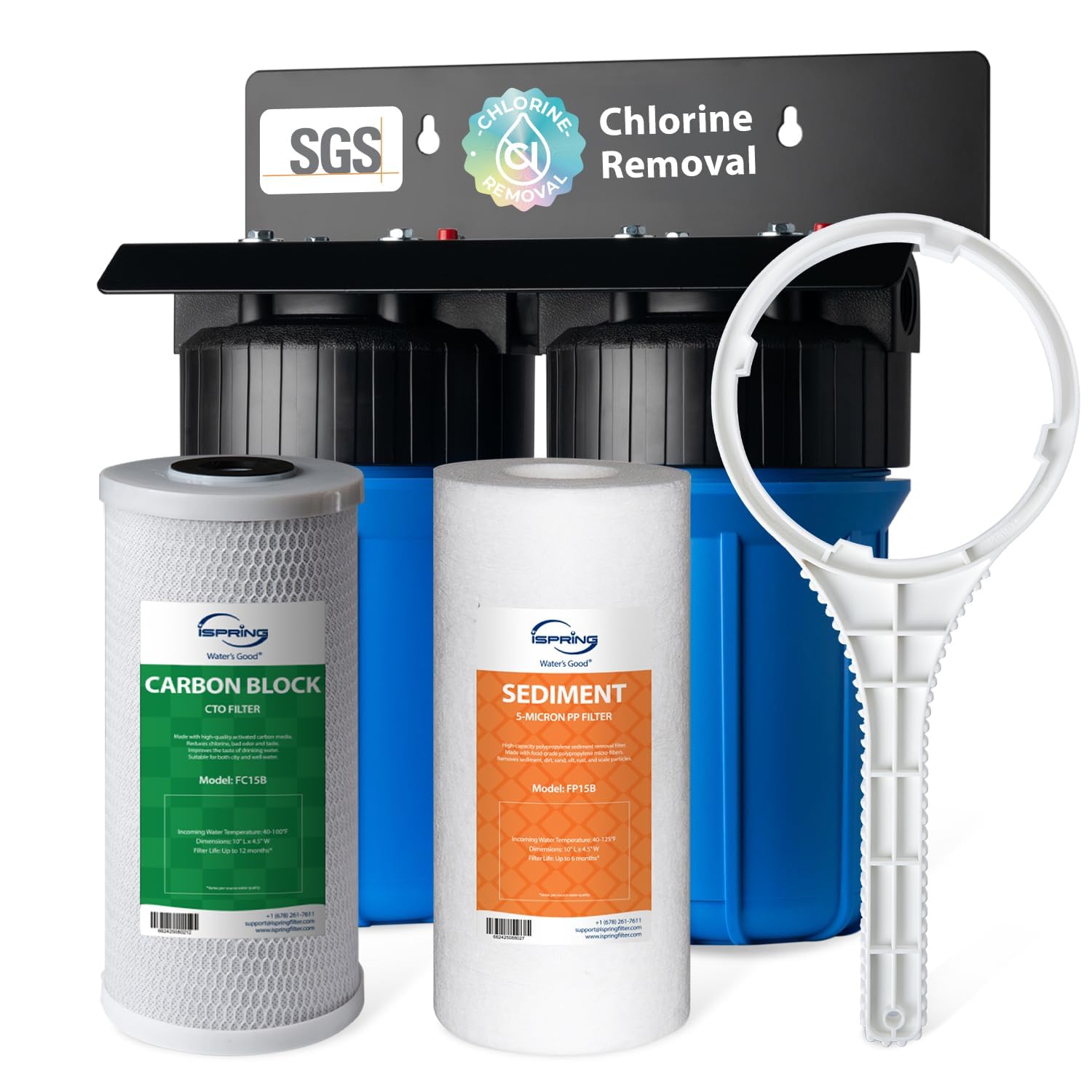
The iSpring WGB21B is a point-of-entry, two-stage whole-house filter built to reduce sediment and chlorine-related taste and odors before water reaches faucets and appliances. It uses a 5-micron polypropylene sediment cartridge as stage one to catch sand, rust, and large particles, and a coconut-shell carbon CTO block as stage two to remove chlorine, VOCs, and improve flavor. The system ships preassembled on a mounting bracket with a filter wrench and a pressure-relief valve to simplify DIY installation, and its 1-inch inlet/outlet supports high flow rates so household water pressure is largely preserved. Filters are rated up to about 50,000 gallons or roughly a year of service for an average family, which keeps routine maintenance predictable. It does not lower TDS, so it preserves minerals but will not address dissolved salts or very small contaminants. The housings are made of durable polyethylene and steel, but for long outdoor exposure or high-pressure situations adding a regulator or weatherproofing is recommended. For buyers prioritizing consistent, low-maintenance chlorine and sediment control across the whole house, this system is a solid, reliability-minded choice.
Best for: Buyers who want a dependable, low-maintenance point-of-entry filter to remove sediment and chlorine from all household taps and extend the life of plumbing and appliances.
Less Ideal for: Those seeking removal of dissolved minerals, heavy metals, or ultra-fine contaminants should consider an RO, ion-exchange softener, or specialized media system instead.
- Two-stage design targets both sediment and chlorine/taste/odor contaminants.
- Large 1-inch ports and 15 gpm maximum flow support full-house water demand with minimal pressure loss.
- Filters offer high capacity (up to ~50,000 gallons) for roughly annual replacement cycles in typical households.
- Preassembled bracket, included wrench, and video/manual support make DIY installation straightforward.
- Durable polyethylene and steel housings suitable for indoor whole-house installation.
- Does not reduce total dissolved solids so it will not soften water or remove dissolved salts.
- Housings are not intended for prolonged unprotected outdoor exposure without insulation or waterproofing.
Verdict: A reliable two-stage whole-house system for dependable removal of sediment and chlorine that keeps water tasting better across every faucet with annual, predictable maintenance.
SimPure DB10C 10" x 4.5" Housing
| Inlet/Outlet | 1" NPT Brass Port |
|---|---|
| Maximum Flow Rate | 20 gpm |
| Compatible Filter Size | 10" x 4.5" |
| Working Water Pressure Range | 15-90 PSI |
| Applicable Water Temperature | 41-104 °F |
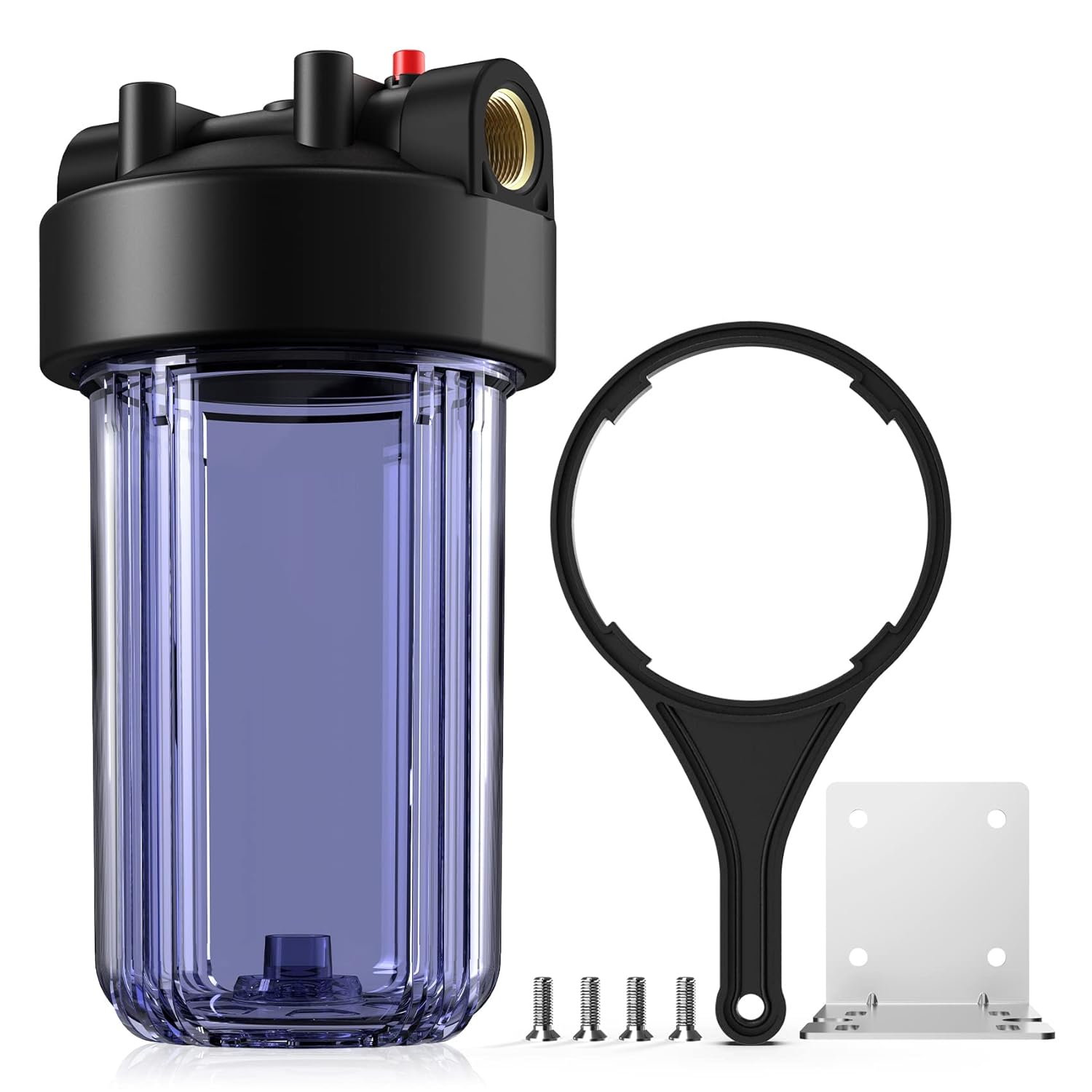
The SimPure DB10C is a stand-alone whole-house filter housing designed to hold standard 10" x 4.5" cartridges for pre-filtration of municipal or well water. It installs as a mounted inline housing with 1" NPT brass inlet and outlet to support higher flow and reduce pressure drop for downstream appliances. The clear reinforced polypropylene bowl makes visual inspection of cartridge condition easy, and the included wrench, mounting bracket, screws, and built-in red pressure-relief button simplify filter changes. Material upgrades such as brass ports and a double O-ring help reduce leakage risk compared with thinner housings. It is meant to be used with sediment, carbon, or pleated cartridges (sold separately) to remove sand, silt, chlorine taste and odor, and protect water heaters and appliances. Limitations are that the housing does not include cartridges or fittings, requires space for installation and cartridge changes, and the listed temperature and pressure ranges should be checked against your system before purchase.
Best for: Buyers who prioritize installing a durable pre-filter housing to protect plumbing and appliances and who prefer products with visible condition checks and upgraded fittings for lower leak risk.
Less Ideal for: If you need a complete filtration system with cartridges and fittings included or have very tight installation space, this standalone housing is not the best choice.
- Fits standard 10" x 4.5" cartridges so replacements are widely available
- 1" NPT brass inlet/outlet supports higher flow and more durable connections
- Clear reinforced polypropylene bowl allows quick visual checks of cartridge condition
- Includes mounting bracket, wrench, screws and pressure-relief button for easier installation and maintenance
- Filter cartridges and push fittings are not included so additional purchases are required
- Requires sufficient clearance where installed to remove and replace cartridges
Verdict: A robust, clear 10" x 4.5" housing with brass ports and easy-change features for buyers wanting a durable pre-filter to protect home plumbing and appliances.
A. O. Smith Whole House Filter AO-WH-Filter

| Purification Method | Activated Carbon |
|---|---|
| Maximum Flow Rate | 7 gpm |
| Operating Pressure Range | 20-100 psi |
| Filter Life Cycle | 6 years |
| Capacity | 600000 gallons |
The AO-WH-Filter is a whole-house activated carbon filter built to strip chlorine taste and odor from every tap without softening the water. It installs inline at the main supply and is supplied with a shut-off valve, nipple and hose adapter so a handy homeowner can complete a DIY installation; AO Smith recommends a pre-filter where sediment is present. The unit is rated for up to 7 gpm flow and an operating pressure range of 20 to 100 psi, so it will support typical household demands while leaving hardness, iron and sulfur largely unchanged. A single fiberglass tank is rated to treat about 600,000 gallons or roughly six years of use, which keeps annual maintenance infrequent and predictable. The system is NSF/ANSI 42 certified for chlorine reduction, which provides independent verification of performance for drinking and showering uses. Limitations: it does not remove dissolved minerals or kill bacteria, and homeowners with severe sulfur or iron problems will need supplemental treatment targeted to those contaminants.
Best for: Homeowners who prioritize reliable, low-maintenance chlorine removal for drinking, cooking, and bathing and who prefer a certified, long-life system they can install themselves.
Less Ideal for: Homes that need water softening or have significant iron, sulfur odor, or bacterial contamination should choose targeted or multi-stage treatment instead.
- NSF/ANSI 42 certified for chlorine taste and odor reduction
- Long service life rated at 600,000 gallons or about 6 years
- Supplies enough flow for normal household use with a 7 gpm maximum
- Includes basic installation hardware for DIY setup
- Fiberglass tank construction built for whole-house use
- Does not soften water or remove dissolved hardness minerals
- Not designed to address sulfur odor, iron, or microbiological contamination
Verdict: Buy this if you want a certified, low-maintenance whole-house carbon filter that reliably removes chlorine taste and odor for years with minimal upkeep.
Choosing the Right Whole-House Water Filter for Drinking: Key Factors to Consider
Filtration Media and Target Contaminants
Different filter media remove different contaminants, so matching media to your water issues is essential. Carbon-based media are effective against chlorine, taste, and many organic compounds, while KDF or catalytic carbon can address chloramines. Sediment prefilters protect downstream media and are rated by micron size; a lower micron rating captures finer particles but will clog faster.
If lead or heavy metals are a concern, choose systems with certified capabilities for those contaminants. Some whole-house setups combine staged media so sediment, chemical, and specific heavy-metal treatments occur in sequence. Understanding your water report or test results helps you prioritize which media matter most for drinking quality.
Flow Rate and Household Water Demand
Whole-house systems must maintain adequate flow so showers, appliances, and garden hoses operate normally. Flow rate is determined by filter diameter, media resistance, and cartridge design. Larger housings and lower-resistance media yield higher continuous flow and lower pressure drop, which is especially important for homes with multiple simultaneous water uses.
Estimate peak demand by adding flow rates of typical fixtures used at the same time. Then choose a filter system rated to handle that peak with minimal pressure loss. Consider whether the system offers parallel or modular cartridges to scale capacity for larger households.
Filter Lifespan and Replacement Frequency
Filter life affects cost of ownership and convenience. Lifespan depends on incoming water quality and the contaminant load the system must remove. Systems with larger-capacity cartridges or backwashable designs typically require less frequent intervention, while small cartridge-based systems may need changes every few months under heavy use.
Look for clear guidance on expected gallons filtered per cartridge and the indicators available for service timing, such as pressure gauges or differential-pressure ports. Ease of access to the housing and simple cartridge swaps reduce service time and the chance of installation errors during replacement.
Certification and Verified Claims
Independent certifications verify that a system reduces specific contaminants under tested conditions. Certifications from recognized laboratories provide objective evidence of performance claims, including reduction rates and flow impacts. Certification is especially valuable when the objective is drinking-water improvement rather than only odor or scale control.
Review the scope of any certification carefully because it will list which contaminants and concentrations were tested. A certified reduction for chlorine or lead is more meaningful than a vague 'improves taste' claim when you are concerned about drinking water safety.
Installation Requirements and Plumbing Compatibility
Whole-house systems connect to the main supply and must match pipe size, fitting type, and local plumbing codes. Some systems are designed for professional installation with mounting brackets and bypass valves, while other units offer homeowner-friendly connections and quick-change housings. Consider the space available near the main line and whether prefilter or softener integration is needed.
Also account for shutoff and bypass capabilities so you can service filters without interrupting the household water supply. Drain requirements and electrical needs for powered or backwashing systems are additional installation factors to plan for.
Operating Temperature and Water Chemistry Limits
Filter media and housing materials have operating temperature and pH ranges that affect durability and performance. Extremely hot water can damage some polymers or reduce the adsorption capacity of carbon media. High levels of iron, manganese, or hydrogen sulfide in source water can foul filters quickly and may require dedicated pre-treatment.
Check manufacturer specifications when your supply has extreme temperatures or unusual chemistry to avoid premature failure and to ensure the selected media remain effective for drinking-water goals.
Understanding Whole-House Systems Vs Point-of-Use Options
Whole-house systems treat all water entering a home so every faucet and fixture benefits from the same filtration. That is useful when you want consistent drinking-water taste at multiple taps and also want to protect appliances and plumbing from sediment or chlorine.
Point-of-use options focus on one outlet and can offer higher-grade filtration for drinking and cooking at that location. The tradeoff is that under-sink or countertop units protect a single tap only, while whole-house systems ensure every source of water is improved to the same standard.
- Whole-house: consistent protection for all taps and appliances
- Point-of-use: targeted, often higher-grade filtration at select outlets
- Consider a hybrid approach when main-line treatment reduces bulk contaminants and a point-of-use filter polishes drinking water
Common Installation Configurations
Whole-house filters can be installed at the main supply line before any branches. Installations commonly include a prefilter housing, the primary media vessel, and a bypass valve so water service can continue during maintenance. Some systems mount vertically and need enough clearance for cartridge removal, while others use larger horizontal tanks that require more floor space.
Backwashable systems need a drain and sometimes power for automatic cycles, whereas cartridge-change systems only require space for the housings and room to replace elements periodically.
- Prefilter upstream of the main media improves longevity
- Bypass valve allows maintenance without shutting off household water
- Plan for clearance and drainage depending on system type
Maintaining Taste and Safety Over Time
Regular maintenance keeps drinking-water quality consistent. Replace cartridges per manufacturer guidance or when pressure drop indicates fouling. For adsorptive media like carbon, saturation leads to diminished taste and odor removal, so timely replacement is important to avoid breakthrough of contaminants.
Monitor pressure changes, inspect housings for wear, and follow sanitation steps during cartridge changes to avoid introducing bacteria. For systems that handle biological risks, follow recommended sanitizing procedures during service.
- Track pressure differential to detect clogging
- Follow replacement intervals to prevent contaminant breakthrough
- Sanitize housings as recommended to limit bacterial growth
Sizing a System for Multi-Family or High-Demand Homes
Higher-occupancy homes demand larger flow capacity and greater contaminant-holding capability. Choose systems with higher gallons-per-minute ratings and larger media volumes to avoid frequent changes and pressure loss during peak use. Some manufacturers offer modular or multi-cartridge arrangements so capacity can be scaled without a complete system replacement.
If you host frequent guests or have appliances that run simultaneously, prioritize systems with proven low pressure drop at rated flow.
- Match GPM rating to calculated peak household demand
- Consider modular designs for future capacity increases
- Larger media volumes extend time between service events
When to Test Your Water Before Buying
A recent water test identifies the contaminants to target and informs media selection. Municipal reports give a baseline for common disinfectants and regulated contaminants, but private wells often need a full panel that includes bacteria, nitrates, and heavy metals. Testing first prevents over- or under-specifying a system and can save on unnecessary features.
After installation, periodic testing verifies the system functions as expected and ensures the treated water remains within safe parameters for drinking.
- Use municipal reports for baseline municipal supplies
- Order comprehensive tests for wells or unusual water characteristics
- Retest after installation to confirm performance
How We Chose the Best Whole-House Water Filter for Drinking
We focused on attributes that directly affect drinking-water safety, taste, and long-term usability. Primary evaluation criteria included filtration effectiveness against common drinking-water contaminants such as sediment, chlorine, volatile organic compounds, and lead; contaminant removal is a must for systems intended to improve tap water for drinking. We measured system flow-rate retention and pressure drop expectations to ensure the filter could support whole-house demand without causing low-pressure complaints. Service life and maintenance were scored based on typical filter lifespan, ease of cartridge changes, and availability of replacement elements. Build quality and materials were considered to reduce leaching and ensure code-compliant plumbing connections. Finally, installation versatility and compatibility with standard residential plumbing were assessed to determine how easily the system integrates into existing setups. We excluded point-of-use pitchers and under-sink filters because they do not protect all household outlets or support whole-house flow. We also set aside systems that only address odor or aesthetics without measurable contaminant reduction. The listed products met thresholds across the evaluation dimensions above and represent a range of filter media strategies and maintenance profiles suitable for drinking-water improvement.
Our full evaluation process is outlined in our review methodology.
FAQ
Will a whole-house filter make my tap water safe to drink?
It depends on the contaminants in your source water and the system chosen. Whole-house filters can significantly reduce chlorine, sediment, and many organic compounds, improving taste and odor. For specific hazards like bacteria or certain heavy metals, select a system certified for those contaminants or pair with targeted treatment.
How often do whole-house filters need cartridge changes?
Replacement intervals vary with incoming water quality and system capacity. Typical cartridge-based systems may need changes every 3 to 12 months, while larger or backwashable systems run longer between service events. Monitor pressure drop and follow manufacturer guidance for best results.
Can I install a whole-house filter myself?
Many basic cartridge systems can be installed by a competent DIYer if you are comfortable shutting off the main, making pipe connections, and following local plumbing codes. More complex systems, backwash units, or installations requiring permits are best handled by a professional to ensure compliance and reliable operation.
Will a whole-house filter affect water pressure?
All filters introduce some resistance, but properly sized systems minimize pressure loss. Choose a unit with sufficient flow rating for your household and consider larger housings or parallel cartridges if you experience pressure issues during peak use.
Do whole-house filters remove bacteria and viruses?
Most standard whole-house carbon and sediment filters do not provide reliable virus removal. To address biological hazards, select systems specifically rated or certified for microbial reduction, or add a disinfection step such as UV treatment designed for drinking-water safety.
Final Verdict
Prioritize filtration performance for the contaminants identified in your water report, and match system flow capacity to your household demand. Expect tradeoffs between higher-capacity, lower-maintenance designs and more compact systems that require frequent cartridge changes. Consider installation space, maintenance access, and certification scope when finalizing a choice. With the right media and proper sizing, a whole-house water filter for drinking can deliver consistent, better-tasting tap water across your home while protecting plumbing and appliances.