
Note: This article contains affiliate links. If you click on these links and make a purchase, we may earn a small commission at no extra cost to you. This helps support our research and content. Read our full affiliate disclosure here.
If you want safer, better-tasting drinking water from every tap, choosing the right whole-house water filter matters. A properly sized system reduces sediment, chlorine taste and odor, and common contaminants before water reaches kitchen faucets, filters, and appliances. You need a solution that matches your home water quality, household water use, and plumbing setup. This guide shortlists seven top whole-house water filter options for home drinking water and explains how we evaluated them. We focus on filtration performance, flow rate and pressure, and installation and maintenance needs so you can pick a system that fits your house and lifestyle. Read on for the criteria we used and practical buying advice before the product list.
Top Picks at a Glance
| Best Overall The best all-around choice for most situations | Aquaboon Whole House 20" Filter |  |
| Best Quality Built to a higher standard if you want something more solid | Aquasana Rhino WH-1000-CS-UVS-B |  |
| Best Value The sweet spot between price and what you get | Reverse Osmosis Revolution WHF-34F5 |  |
| Best Budget The cheapest option that still gets the job done reliably | XINSHUO 2-Stage Whole House Filter |  |
| Top Rated A top-rated pick with lots of positive feedback | iSpring WGB32B Whole House Filter |  |
| Most Popular A crowd favorite that many people choose with confidence | iSpring WGB21B 2-Stage Whole House Filter |  |
| Best Seller A high-volume bestseller chosen again and again | SimPure DB10P 10" Filter Housing |  |
Aquaboon Whole House 20" Filter

| Installation Type | Whole House |
|---|---|
| Purification Method | Activated Carbon |
| Power Source | Manual Operation |
| Supported Water TDS Level Maximum (PPM) | 500 |
| Capacity | 100 gallons |
The Aquaboon 20" x 4.5" whole house filter is a single-stage, point-of-entry canister that accepts standard 20" cartridges and uses activated carbon to reduce chlorine and improve water taste and odor for every faucet. It installs on a 1" NPT line and is built from reinforced polypropylene for chemical resistance and higher flow capacity, so it is suited to well and municipal supply lines where a simple carbon stage is needed. The housing is user-installable on a mounting bracket and includes a pressure-release feature to make cartridge changes easier. Because it is a single-stage system rated around 100 gallons per cartridge in the listed spec, plan on routine cartridge replacement if your household water has heavy sediment or higher contaminant loads. This is not a multi-stage or softening system, so it does not remove hardness or dissolved minerals beyond what an activated carbon block will adsorb. For homeowners wanting an affordable, factory-quality replacement housing that fits Pentek-style 20" Big Blue cartridges, it delivers straightforward whole-house chlorine reduction with easy maintenance.
Best for: Buyers who want an economical, easy-to-install point-of-entry carbon filter to improve chlorine taste and odor across the whole house without adding complex multi-stage equipment.
Less Ideal for: Homes seeking scale or hardness reduction, heavy sediment prefiltration, or comprehensive multi-contaminant removal should consider multi-stage or specialty systems instead.
- Fits standard 20" Big Blue cartridges and many Pentek-compatible filters for easy parts sourcing
- 1" NPT inlet/outlet and reinforced polypropylene housing support higher flow whole-house use
- Activated carbon stage effectively reduces chlorine, taste, and odor at point of entry
- Pressure-release and mounting bracket simplify cartridge changes and installation
- Single-stage design only removes chlorine and adsorbable contaminants and will not soften water or remove dissolved minerals
- Listed cartridge capacity (100 gallons) may require frequent replacements in high-use or heavily contaminated systems
Verdict: A simple, factory-quality whole-house carbon canister that delivers reliable chlorine and taste reduction for homeowners wanting an affordable, easy-to-maintain point-of-entry filter.
Aquasana Rhino WH-1000-CS-UVS-B

| Maximum Flow Rate | 14.6 gpm |
|---|---|
| Operating Pressure Range | 20-100 psi |
| Filter Life Cycle | 10 years |
| Supported Water TDS Level Maximum (PPM) | 500 |
The Aquasana Rhino WH-1000-CS-UVS-B is a point-of-entry whole-house system intended to improve water for drinking, cooking, bathing, and household use. Installed at the main line, it uses a 20" pre-filter, a large Rhino filter tank with activated carbon and copper-zinc KDF media, a salt-free conditioner to help prevent scale, a post-filter, and a UV module to address bacteria and viruses. In practice that means chlorine, sediment, organic taste and odor, and many microbial risks are reduced while minerals remain in the water and no salt-based softening is performed. The system is rated for 1,000,000 gallons or up to 10 years under rated conditions and is tested to NSF standards for chlorine reduction and UV disinfection. Benefits include long service life, high advertised flow rate to support whole-house demands, and a pro kit for installation. Important limitations are that it is not a water softener, it has operating temperature and pressure ranges to respect, and upfront size and installation complexity make professional fitting advisable for many homes.
Best for: Homeowners who prioritize high-performance, long-life whole-house filtration and want comprehensive contaminant reduction with UV protection while keeping naturally occurring minerals in their water.
Less Ideal for: Households specifically seeking a traditional salt-based water softener or chemical-free solutions for very high hardness or iron levels should consider other systems.
- Comprehensive multi-stage filtration including pre-filter, carbon, KDF, post-filter, and UV for broad contaminant reduction
- Long-rated service life of up to 1,000,000 gallons or 10 years under rated conditions
- Salt-free scale control prevents scale buildup without adding salt or requiring backwashing
- NSF-tested components for chlorine reduction and UV disinfection provide independent performance verification
- Pro kit included to simplify whole-house installation and plumbing connections
- Does not soften water or remove dissolved hardness minerals
- Large footprint and professional installation are likely needed for many homes
- Replacement filters and UV bulb will require periodic maintenance despite long overall service life
Verdict: Buy this if you want a factory-quality whole-house filtration system that delivers long-life, multi-stage contaminant reduction including UV sterilization while preserving minerals.
Reverse Osmosis Revolution WHF-34F5

| Connection size | 3/4" |
|---|---|
| Filter life cycle | 5 months |
| Capacity | 10000 gallons |
| Purification method | Carbon Block, Granular Activated Carbon |
This whole-house 3-stage system installs on 3/4" plumbing and uses a sediment prefilter, a granular activated carbon (GAC) stage, and a carbon block stage to reduce chlorine, VOCs, odors, and common particulates for improved taste and clarity. It is supplied with two extra filter sets (six cartridges total), so you get multiple change cycles out of the box. Typical use is inline on the main cold-water feed to protect downstream plumbing, fixtures, and to improve water for drinking and cooking. The sediment stage captures sand and rust to protect the carbon stages, while the GAC and CTO carbon block stages target chemicals and taste issues. Practical benefits include straightforward cartridge changes and support for up to 10,000 gallons per cartridge life guidance, though filters are recommended to be replaced every 4 to 6 months which affects ongoing costs. The system is built in the USA and fits slim 2.5" x 10" housings, but it does not include a pressure regulator or softening media and requires adequate installation space and basic plumbing connection skills.
Best for: Homeowners who want a practical, point-of-entry filtration solution to improve taste and remove chlorine and common VOCs while minimizing upfront maintenance visits.
Less Ideal for: Homes needing scale control, high-TDS treatment, or certified removal of specific contaminants like lead or nitrates should consider systems tailored to those problems.
- Three-stage filtration combining sediment, GAC, and carbon block for broad contaminant and taste reduction
- Includes two extra sets of replacement filters (six cartridges) for immediate long-term use
- Slim 2.5" x 10" housings fit into tighter installation spaces
- Designed for 3/4" plumbing connection common on whole-house installs
- Filters require replacement every 4–6 months which adds recurring cost
- Does not include scale removal or water softening media
Verdict: A straightforward, carbon-based whole-house 3-stage system that delivers noticeable taste and chlorine reduction with extra replacement cartridges to keep maintenance simple.
XINSHUO 2-Stage Whole House Filter
| Maximum Flow Rate | 15 gpm |
|---|---|
| Supported Water TDS Level Maximum (PPM) | 1000 |
| Filter Life Cycle | 24 months |
| Capacity | 8000 gallons |
| Power Source | Gravity Fed/Water Pressure |
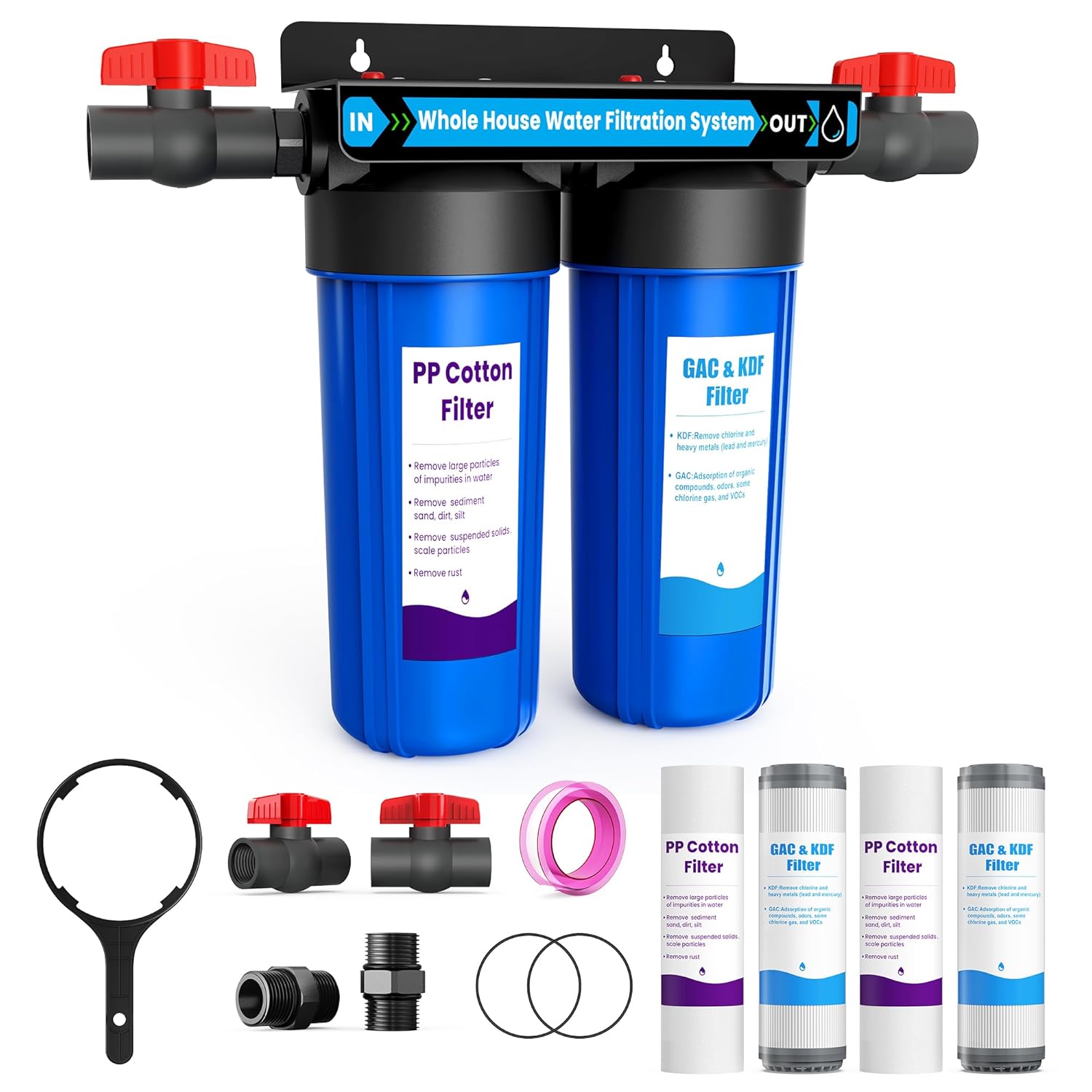
The XINSHUO 2-stage whole-house filter uses a PP prefilter plus a GAC&KDF second stage to remove chlorine, rust, heavy metals and odors across the home while maintaining high flow. It is installed on the main line with 3/4" ports and dual shutoff valves that let you replace cartridges without turning off the building supply, and the kit includes two extra replacement filter sets so you can swap cartridges for 12 to 24 months of operation. With a stated 15 GPM flow rate it can serve typical household uses like drinking, bathing, laundry and appliances without noticeable pressure loss, and the manufacturer notes the filter keeps beneficial minerals so TDS readings may not change. Practical limitations include routine cartridge changes every 4 to 6 months for optimal drinking-quality performance and the system is aimed at sediment and chlorine/heavy-metal reduction rather than fine chemical or microbiological purification.
Best for: Homeowners looking for an affordable whole-house system that improves taste and protects appliances while keeping installation and maintenance simple.
Less Ideal for: Homes that need certified removal of bacteria, viruses or very fine dissolved contaminants should consider reverse osmosis or specialist treatment instead.
- Includes two extra replacement filter sets for extended initial service life
- High 15 GPM flow rate suitable for whole-house use without reducing water pressure
- Dual shutoff valves allow cartridge changes without shutting off house water
- Targets chlorine, sediment, heavy metals and odors with PP+GAC&KDF media
- Not designed to remove all dissolved solids or provide microbial-level disinfection
- Requires cartridge replacements every few months to maintain drinking quality
Verdict: A budget-friendly whole-house two-stage filter that improves taste and protects plumbing while delivering high flow and easy cartridge swaps.
iSpring WGB32B Whole House Filter

| Maximum Flow Rate | 15 gpm |
|---|---|
| Operating Pressure Range | 25 – 80 psi |
| Operating Temperature | 40 – 100 °F |
| Supported Water TDS Level Maximum (PPM) | 300 |
| Filter Life Cycle | 1 years |
The iSpring WGB32B is a 3-stage, tankless whole-house filter designed to treat all incoming water for a household. It uses a 20×4.5-inch multi-layer PP sediment cartridge followed by two coconut-shell carbon block cartridges to remove visible particulate matter and up to 99% of chlorine, tastes, and odors while leaving beneficial minerals intact. Installation is intended for DIYers and it connects with 1-inch female NPT fittings; the system supports up to 15 gpm flow and is rated for typical residential water pressures between 25 and 80 psi. Filter cartridges are rated for up to 100,000 gallons or roughly a year of service depending on water quality, and spare cartridges and accessories are sold separately. Practical benefits include high flow for simultaneous fixtures, long filter life that limits maintenance, and lab-tested chlorine removal for noticeably fresher water and less odor. Limitations are that it does not soften water or reduce TDS, requires indoor, sheltered installation, and may need pre- or post-treatment in very hard or contaminated water conditions.
Best for: Buyers who prioritize a reliable, low-maintenance whole-house filter to remove chlorine and sediment across all fixtures while keeping steady water pressure for daily household use.
Less Ideal for: Homes seeking hardness reduction, TDS removal, or full contaminant removal (for example lead or nitrates) without additional systems should consider alternatives or add-on treatments.
- Three-stage filtration targeting sediment and chlorine for clearer, better-tasting water
- High maximum flow rate (up to 15 gpm) suitable for whole-house use without noticeable pressure loss
- Long rated capacity up to 100,000 gallons or about 12 months per set of filters
- Straightforward DIY installation with common 1-inch NPT plumbing connections and included wrench
- Does not remove hardness or lower TDS so a separate water softener or RO system is needed for those goals
- Intended for indoor, protected installation and may require insulation/protection if placed outdoors
Verdict: Choose the WGB32B if you want a dependable, high-flow three-stage whole-house filter that reliably removes chlorine and sediment with long-lasting cartridges.
iSpring WGB21B 2-Stage Whole House Filter
| Maximum Flow Rate | 15 gpm |
|---|---|
| Operating Pressure Range | 25–80 psi |
| Operating Temperature | 40–100 °F |
| Supported Water TDS Level Maximum (PPM) | 2500 |
| Filter Life Cycle | Up to 50,000 gallons / ~12 months |
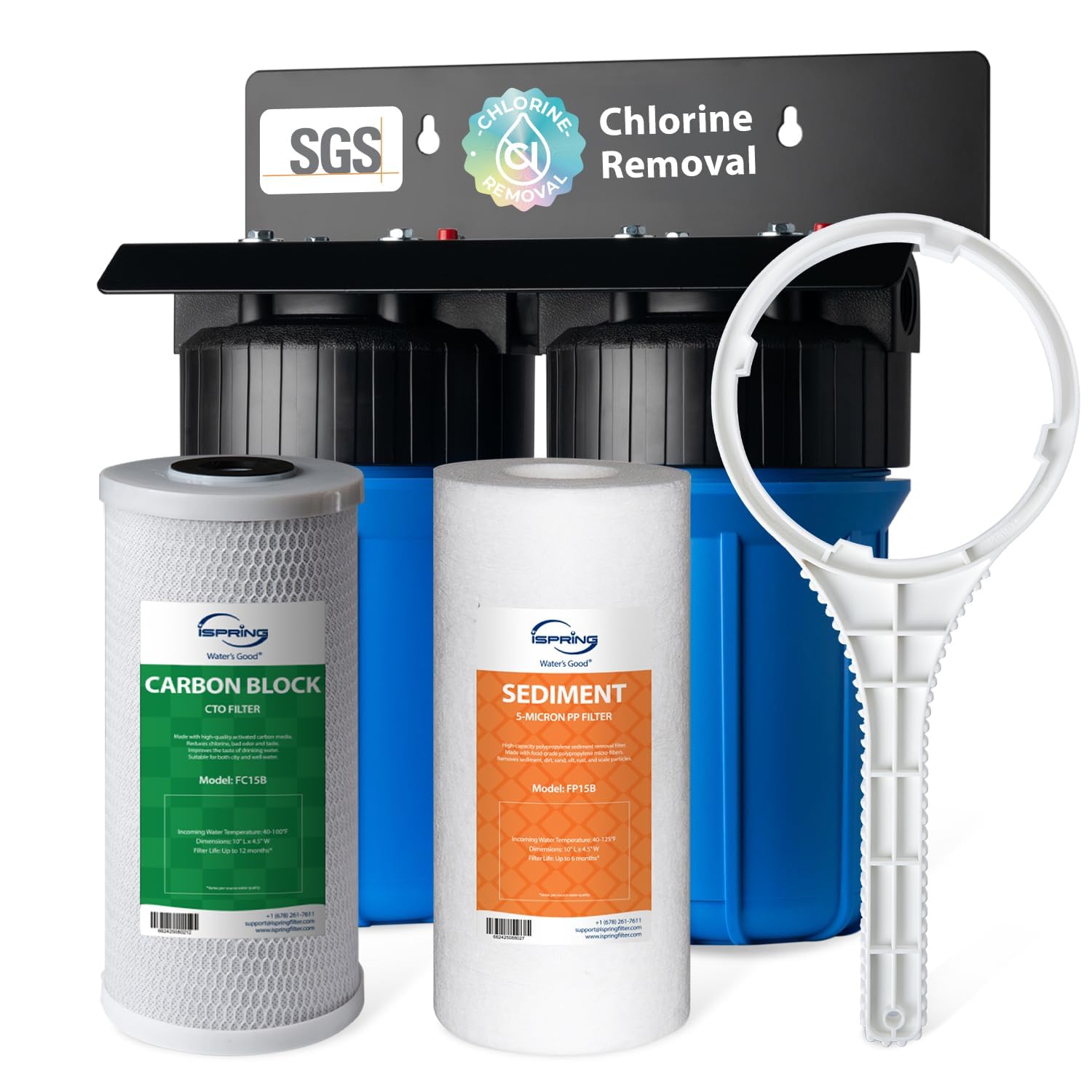
The iSpring WGB21B is a point-of-entry two-stage filter intended to clean every faucet in a home by first trapping sediment with a 5-micron polypropylene prefilter and then polishing water with a coconut-shell carbon CTO block that reduces chlorine, bad tastes, odors, and many VOCs. It is typically mounted at the main water line and comes preassembled on a bracket with a filter wrench and installation kit to support DIY installs; 1-inch inlet/outlet ports keep flow high with minimal pressure loss. The replaceable 10" x 4.5" cartridges are rated for up to 50,000 gallons or roughly a year for average household use, and housings are built from polyethylene and steel for long service life. The system does not remove dissolved solids, so it preserves beneficial minerals but will not lower TDS. Practical limits include the need to replace cartridges on schedule and a recommended indoor, sheltered install to avoid freeze or UV exposure. For buyers who value reliable chlorine and sediment removal across the whole house, this set is straightforward to install and maintain.
Best for: Buyers who want a straightforward, whole-house system that reliably removes sediment and chlorine so every tap delivers clearer, better-tasting water and who prefer a solution backed by strong user feedback and support.
Less Ideal for: Homes seeking removal of dissolved salts, heavy metals at RO-level purity, or those needing an outdoor-exposed system without additional weatherproofing should consider different solutions.
- Two-stage design targets sediment first then chlorine and VOCs for clearer, better-tasting water
- Large 10" x 4.5" filters with up to 50,000-gallon life reduce replacement frequency
- Preassembled bracket and included installation kit plus DIY videos make home installation approachable
- 1" inlet/outlet supports high flow with less pressure drop for whole-house use
- Filter wrench and pressure-relief valve simplify cartridge changes
- Does not reduce total dissolved solids or provide reverse-osmosis level purification
- Recommended for indoor or sheltered installation; outdoor use needs insulation and waterproofing
Verdict: Choose the iSpring WGB21B when you want an easy-to-install, whole-house two-stage filter that delivers long-lasting sediment and chlorine reduction for better-tasting water at every tap.
SimPure DB10P 10" Filter Housing

| Inlet / Outlet | 1" NPT Brass Port |
|---|---|
| Compatible Filter Dimensions | 10" x 4.5" |
| Maximum Flow Rate | 20 gpm |
| Working Water Pressure Range | 15-90 PSI |
| Applicable Water Temperature | 5-38 ℃ (41-100 ℉) |
The SimPure DB10P is a single-stage whole-house filter housing designed to hold standard 4.5" x 10" cartridges for sediment or carbon pre-filtration. It installs on a fixed mount using the included metal bracket and wrench and connects to plumbing via 1" NPT brass inlet and outlet ports for higher flow capacity. The reinforced food-grade polypropylene body and brass threads aim to reduce leaks and withstand household water pressure, and the built-in red pressure-relief button makes cartridge changes easier. Typical use is as a pre-filter ahead of downstream appliances or point-of-use systems to trap sand, dirt, and chlorine taste and odor when fitted with the appropriate cartridge. Limitations are that cartridges and push fittings are sold separately and you must leave space to change filters; the unit also requires some basic plumbing know-how to avoid overtightening tape on brass threads. For buyers seeking a simple, durable housing for standard 10" cartridges, the DB10P is a straightforward, no-frills option.
Best for: Homeowners who prioritize a reliable, factory-quality pre-filter housing to protect appliances and plumbing and who prefer a simple, serviceable component rather than a complete multi-stage system.
Less Ideal for: Buyers looking for a complete filtration system with cartridges included or those who need a multi-stage certified treatment device for contaminants beyond sediment and chlorine.
- Reinforced food-grade polypropylene body for strength and corrosion resistance
- 1" NPT brass inlet/outlet ports support higher flow and offer durable threading
- Built-in pressure relief button and included wrench simplify cartridge replacement
- Includes heavy-duty steel mounting bracket and screws for fixed installation
- Filter cartridges and push fittings are not included
- Requires installation space and basic plumbing skills to install correctly
Verdict: Choose the SimPure DB10P when you want a sturdy, easy-to-service housing to add standard 10" pre-filters and protect household plumbing and appliances.
Choosing the Right Whole-House Water Filter for Home Drinking Water: Key Factors to Consider
Filtration Performance and Target Contaminants
Different whole-house filters use distinct media and stages to address contaminants. Some focus on sediment removal and chlorine taste, while others add activated carbon, catalytic carbon, or specialty media to reduce volatile organic compounds, pesticides, or certain disinfection byproducts.
Understanding your incoming water profile matters because it tells you which contaminants to target. Municipal water commonly benefits from chlorine and taste removal, while well water often needs sediment, iron, and microbial or hydrogen sulfide treatment. Choosing a filter rated for the specific contaminants in your water ensures the system improves drinking water quality rather than only serving as general protection for plumbing and appliances.
Flow Rate and Household Water Demand
Whole-house filters must support simultaneous demand from showers, dishwashers, and faucets without causing pressure drops. Flow rate is typically measured in gallons per minute and should match peak household usage to avoid reduced water pressure.
When sizing a system, estimate peak flow by adding likely simultaneous fixtures. Larger families or homes with multiple bathrooms need higher-capacity units. Undersized filters can lead to reduced performance and poor user experience, while oversized systems can increase upfront complexity and cost without real benefit.
Installation Requirements and Plumbing Compatibility
Some systems are designed for straightforward do-it-yourself installation with standard fittings, while others require professional plumbing work or additional bypass valves. Consider the location where the filter will be installed, typically at the main water line entry point, and whether there is enough space for housings and filter changes.
Also check for requirements such as shutoff valves, mounting hardware, or pre-treatment needs. If your house uses unusual piping materials or has tight mechanical spaces, that can influence the choice of system and whether professional installation is advisable.
Maintenance Cycle and Cartridge Costs
Maintenance affects the real-life cost and convenience of owning a whole-house filter. Cartridge replacement frequency varies by media type, incoming water quality, and household use. Expect some filters to need changes every few months and others to last a year or more.
Factor in the availability and price of replacement cartridges, whether routine changes are tool-free, and whether the system has indicator features for filter life. Systems with frequent, inexpensive replacements may be more practical than infrequent but costly cartridges for some households.
Material Quality and Longevity
Durable housings, corrosion-resistant fittings, and high-quality media extend the lifespan of a whole-house filter. Look for pressure-rated housings, reliable seals, and materials suited to your water chemistry to avoid premature failure or leaks.
A well-built system also reduces the likelihood of emergency repairs and can provide stable performance over years. Consider warranty terms and local service availability when assessing long-term reliability.
Certifications and Performance Documentation
Independent testing or certification to recognized standards provides confidence that a system reduces specific contaminants. While not every product will have full third-party certification, documented lab results or published reduction claims help verify performance.
Review the scope of any certification carefully because it will usually cover only particular contaminants and conditions. Certification does not replace matching the system to your water profile, but it does add an extra layer of assurance when comparing options.
Assessing Your Water Before You Buy
Start with a basic water test to identify chlorine level, sediment load, hardness, and any contaminants of concern. Municipal water reports provide a useful baseline, while well owners should use a comprehensive lab test that includes iron, bacteria, and hydrogen sulfide checks.
Knowing the specific problems you want to solve makes it easier to select media types and decide whether pre-treatment or multi-stage systems are appropriate. Carry test results when consulting with a professional or comparing product specifications.
- Request the latest municipal water quality report if on a public system
- Use a certified lab test for well water to detect bacteria and metals
- Note hardness and iron levels because they affect media life
Sizing and Placement Options
Place the whole-house filter at the main water inlet before any branch lines so all taps benefit. Consider space for servicing and the ability to install a bypass valve for uninterrupted water during cartridge changes.
Select a unit whose maximum flow rating meets or exceeds your calculated peak household demand. If you plan to install additional point-of-use filters at the kitchen sink, confirm the whole-house system does not overly reduce available pressure.
- Leave clearance for removing and replacing filter cartridges
- Install a bypass to avoid water shutdowns during maintenance
- Prefer locations with floor drains or easy access in case of leaks
Common Media Types and What They Do
Sediment filters remove particulate matter and protect downstream media. Activated carbon excels at reducing chlorine taste and many organic compounds. Catalytic carbon provides enhanced performance for chloramines and some stubborn contaminants.
Specialty media exist for iron removal, sulfur control, or scale inhibition. Multi-stage systems combine these medias to address complex water profiles. Choose media based on your test results rather than general marketing claims.
- Sediment: protects other stages and plumbing
- Activated carbon: improves taste and reduces chlorine
- Catalytic carbon: better for chloramines
- Specialty media: target iron, sulfur, or scale
Maintenance Best Practices
Establish a routine maintenance schedule based on expected cartridge life and actual flow changes. Regular visual checks for pressure drops and periodic water testing can reveal when media is exhausted.
Keep a small stock of replacement cartridges and read the installation instructions for safe cartridge swaps. Use proper seals and hand-tighten housings to the recommended torque to avoid leaks and ensure reliable performance.
- Monitor household water pressure as an early warning sign
- Replace cartridges on schedule and after major contamination events
- Sanitize housings when replacing media if recommended
When to Consider Professional Help
Hire a licensed plumber when the installation requires altering main plumbing, adding pressure-regulating equipment, or installing electrical components. Professional installation ensures proper fittings, leak prevention, and correct placement of bypass valves.
A water treatment specialist can also help interpret lab results and recommend a system tailored to complex problems like high iron, manganese, or microbial contamination that may need multiple technologies.
- Choose pros for complex plumbing or uncertain water chemistry
- Ask for documentation of expected system performance
- Confirm installer experience with whole-house systems
How We Chose the Best Whole-House Water Filter for Home Drinking Water
We evaluated systems that target whole-home drinking water improvement rather than point-of-use devices. Filters were screened for documented contaminant reduction or multi-stage filtration approaches capable of addressing sediment, chlorine, common volatile organic compounds, and taste and odor issues. Flow capacity and pressure maintenance were required — systems that restrict household flow or cause large drops in pressure were excluded. We prioritized units with clear maintenance schedules and readily available replacement cartridges and note any that require specialized tools. Practical installation was another filter: we favored systems that fit standard residential plumbing and offered clear installation guidance. Materials and certifications were considered when available, with emphasis on durable housings and NSF-style testing claims or equivalent performance documentation. We also checked for compatibility with common household water usage levels so the selected systems suit small to large families. Excluded items included single-faucet pitchers and countertop units, as they do not serve whole-house needs.
Our full evaluation process is outlined in our review methodology.
FAQ
How often should I replace whole-house filter cartridges?
Replacement frequency depends on incoming water quality and media type. Sediment cartridges may need changes every few months in high-sediment homes, while carbon-based cartridges often last 6 to 12 months under typical municipal conditions. Monitor flow and taste as indicators and follow the manufacturer guidance for your chosen system.
Will a whole-house filter make my tap water safe to drink?
A whole-house system can significantly improve taste and reduce many common contaminants, but safety depends on the filter type and your water profile. For microbial contamination or specific chemical issues, targeted treatment stages or additional point-of-use filtration at the kitchen tap may be necessary.
Can I install a whole-house water filter myself?
DIY installation is possible for many systems that use standard fittings and clear instructions. However, if the job requires cutting into the main supply, adding bypass valves, or working with unfamiliar piping materials, professional installation is recommended to avoid leaks or code violations.
How does a whole-house filter affect water pressure?
A properly sized system should maintain normal household pressure. Pressure drop can occur if the flow rating is too low, if media is clogged, or if fittings restrict flow. Choose a unit rated for your peak flow and perform regular maintenance to minimize pressure loss.
Do whole-house filters remove hardness and scale?
Most standard whole-house filters are not designed to remove dissolved hardness minerals. To address hardness and scale, consider a dedicated water softening or scale-control system. Some specialty media can reduce scale tendencies, but full softening typically requires an ion-exchange or alternative softening technology.
Final Verdict
Prioritize matching filtration capabilities to your actual water issues, and size the system to meet peak household flow without causing pressure loss. Consider installation complexity and ongoing cartridge costs when weighing options, and plan for regular maintenance to preserve performance. With the right whole-house filter selected for your drinking water concerns, you can improve taste, reduce common contaminants, and protect plumbing and appliances while keeping maintenance manageable.