
Note: This article contains affiliate links. If you click on these links and make a purchase, we may earn a small commission at no extra cost to you. This helps support our research and content. Read our full affiliate disclosure here.
If your water leaves reddish stains, metallic taste, or discolored laundry, a whole-house water filter for iron can fix those problems before water reaches faucets and appliances. Choosing the right system matters because iron removal technologies, required maintenance, and flow capacity all affect household water pressure, appliance longevity, and treatment effectiveness. This guide highlights six shortlisted whole-house water filters designed to reduce iron. We evaluated systems for iron reduction effectiveness, flow-rate capacity, maintenance needs, and installation practicality. Read on to see which features match your home and water conditions before the product list.
Top Picks at a Glance
| Best Overall The best all-around choice for most situations | PRO+AQUA Elite Series PRO-100-E |  |
| Best Quality Built to a higher standard if you want something more solid | A. O. Smith Whole House Filter AO-WH-Filter |  |
| Best Value The sweet spot between price and what you get | Waterdrop WHF21-FG Whole House Filter |  |
| Top Rated A top-rated pick with lots of positive feedback | iSpring WGB21BM Whole House System | 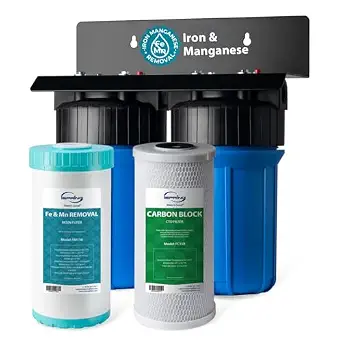 |
| Most Popular A crowd favorite that many people choose with confidence | Waterdrop WHF21-PG Whole House Filter |  |
| Best Seller A high-volume bestseller chosen again and again | iSpring WGB32BM 3-Stage Whole House Filter |  |
PRO+AQUA Elite Series PRO-100-E

| Maximum Flow Rate | 15 gpm |
|---|---|
| Operating Pressure Range | 80 psi |
| Supported Water TDS Level Maximum (PPM) | 500 |
| Filter Life Cycle | 6 months |
| Capacity | 100000 gallons |
The PRO+AQUA Elite Series PRO-100-E is a 3-stage whole-house filter meant to sit at the main water line and deliver filtered water to every outlet in small to medium homes. Stage 1 is a sediment trap in a clear housing for easy visual checks, stage 2 uses a proprietary CRK media aimed at heavy metals and hydrogen sulfide, and stage 3 is an activated coconut-shell carbon cartridge for chlorine, VOCs, taste and odor reduction down to about 5 microns. Built with industry-standard fittings and stainless-steel pressure gauges, it lets you monitor pressure drop and know when cartridges need replacement. The system is simple to operate with no regeneration, backwash, draining or electricity required, and the manufacturer recommends replacing filters every six months for best performance. Important limits to note are that it will not reduce TDS and it is sized for homes with one to three bathrooms, so households needing higher flow rates or TDS reduction will need a different solution.
Best for: Buyers who want a straightforward, professional-grade whole-house filter that reduces iron-related odors and common contaminants without complex regeneration, and who prioritize easy monitoring and low-maintenance operation.
Less Ideal for: Homes that require TDS reduction, higher flow rates than a 1-3 bathroom household, or an integrated water softening solution should consider other systems.
- Three-stage design targets sediment, heavy metals/hydrogen sulfide, and chemical/taste contaminants
- Clear sediment housing makes visual monitoring simple
- Stainless-steel pressure gauges provide easy, reliable pressure-readout to time filter changes
- No regeneration, backwash, or electricity required for operation
- Activated coconut-shell carbon and CRK media address chlorine, VOCs and common well-water odors
- Does not reduce total dissolved solids (TDS)
- Recommended service interval of about six months increases ongoing filter costs
- Specified for small to medium homes and may not meet higher whole-house flow demands
Verdict: A simple, serviceable 3-stage whole-house filter that effectively tackles iron odors and common contaminants for small to medium homes.
A. O. Smith Whole House Filter AO-WH-Filter

| Purification Method | Activated Carbon |
|---|---|
| Other Special Features | Chlorine Reduction, NSF/ANSI 42 Certified |
| Maximum Flow Rate | 7 gpm |
| Operating Pressure Range | 20-100 psi |
| Filter Life Cycle | 6 years |
The AO-WH-Filter is a tank-style whole-house activated carbon filter that connects to 3/4" plumbing and treats all water entering a home, primarily to remove chlorine taste and odor. It is intended for households that want better-smelling and tasting water at every tap and to limit chlorine exposure during showering and laundry. The unit advertises a high capacity rating—600,000 gallons or roughly six years of service—and no drain or backwash is required, so maintenance is limited to eventual replacement. Installation is intended to be DIY-friendly and the package includes a shut-off valve, nipple for flushing and a hose adapter, though basic plumbing tools are recommended. The filter is NSF/ANSI 42 certified for chlorine reduction and is sized for flows up to 7 gpm with standard residential pressure ranges. Important limitations: this is not a water softener and will not remove dissolved iron, sulfur long-term, or hardness, so it should be paired with targeted treatment if iron is the concern.
Best for: Buyers who prioritize long-lasting, low-maintenance chlorine removal across an entire home and want a durable factory-quality carbon tank they can install themselves.
Less Ideal for: Homes whose primary water problem is dissolved iron, heavy sulfur odor, or hard water should choose a product specifically designed to remove those contaminants rather than this carbon-only system.
- Reduces chlorine taste and odor and is NSF/ANSI 42 certified.
- High claimed service life of 600,000 gallons or about six years, lowering replacement frequency.
- No backwash or drain required, simplifying maintenance and installation.
- Includes basic installation hardware (shut-off valve, nipple, hose adapter) for DIY setup.
- Does not treat dissolved iron, hardness, or reliably eliminate sulfur odors.
- Requires additional treatment components for specific contaminants beyond chlorine.
- Flow rated to 7 gpm may limit peak flow on larger plumbing layouts.
Verdict: Buy this if you want a durable, low-maintenance whole-house carbon filter that reliably removes chlorine taste and odor for years.
Waterdrop WHF21-FG Whole House Filter

| Purification Method | Granular Activated Carbon |
|---|---|
| Maximum Flow Rate | 15 gpm |
| Filter Life Cycle | 6 months |
| Supported Water TDS Level Maximum (PPM) | 1000 |
| Capacity | 50000 gallons |
The Waterdrop WHF21-FG is a 2-stage whole‑house filter that pairs an iron and manganese reduction cartridge with a granular activated carbon stage to cut heavy metals, chlorine, odor and particles above 5 microns. It is installed at the main line and intended to protect appliances and plumbing while improving water taste for showers and faucets without a noticeable pressure drop thanks to a 1" inlet/outlet rated up to 15 gpm. Filters are preinstalled for an easier DIY setup and the system includes a wrench and mounting hardware; Waterdrop claims the combined cartridges treat up to 50,000 gallons or about six months under typical use. Build details such as brass threads and dual O‑rings plus water‑hammer testing suggest reasonable durability. Limits to note: the system is sized for common household flow and TDS up to 1000 ppm but does not replace a dedicated softener for severe hardness, and you will need periodic cartridge changes every six months to maintain performance.
Best for: Buyers who want a practical, serviceable whole‑house filter that focuses on reducing iron, manganese and chlorine while maintaining household water pressure and easy DIY installation.
Less Ideal for: Homes needing full water softening for very hard water or treatment for contaminants outside the listed heavy metals and chlorine should consider specialized softeners or advanced multi‑media systems.
- Targets iron and manganese reduction alongside chlorine and sediment removal
- High flow capacity up to 15 gallons per minute to preserve household water pressure
- Preinstalled filters and included wrench/hardware simplify DIY installation
- Long claimed service life of up to 50,000 gallons or approximately six months per set
- Reinforced brass threads and dual O‑rings designed to reduce leak risk
- Not a water softener so it will not remove dissolved calcium/magnesium that cause hard water
- Replacement cartridges must be changed roughly every six months which adds ongoing cost
Verdict: Choose this Waterdrop system if you want an easy‑to‑install, high‑flow whole‑house filter that specifically reduces iron and manganese while preserving water pressure.
iSpring WGB21BM Whole House System

| Maximum Flow Rate | 15 gpm |
|---|---|
| Filter Life Cycle | 1 years |
| Capacity | 50000 gallons |
| Inlet / Outlet | 1 inch Female NPT |
The iSpring WGB21BM is a two-stage point-of-entry system designed to remove chlorine, bad tastes and odors, and to significantly reduce iron and manganese before water reaches fixtures and appliances. It ships preassembled on a mounting bracket and includes a filter wrench and manual, so DIY-capable homeowners can install it at the main inlet using the standard 1" female NPT connections. The first stage is a coconut shell carbon block that targets chlorine and VOCs and the second stage uses catalytic media formulated to lower iron and manganese concentrations from ppm levels down to trace amounts. The system supports up to 15 gallons per minute flow and the cartridges are rated for up to about 50,000 gallons, which equates to roughly a year of service for a typical household. The metal housings are built for heavy duty use, but note this system does not reduce TDS and very high iron well water may require additional pretreatment or a custom solution. Routine filter changes are straightforward, though access and plumbing work are required during installation.
Best for: Homeowners who prioritize a reliable, low-maintenance whole-house solution to remove chlorine and reduce iron and manganese at the main water line and who prefer a system that can be installed with minimal professional help.
Less Ideal for: People whose primary goal is reducing TDS or those with extremely high iron concentrations without first testing water and consulting on pretreatment options.
- Two-stage design specifically targets chlorine plus iron and manganese for whole-house protection.
- High-capacity carbon and catalytic cartridges rated up to 50,000 gallons reduce replacement frequency.
- Preassembled bracket and included wrench simplify DIY installation.
- 1" NPT and 15 GPM max flow maintain household water pressure with minimal impact.
- Does not lower total dissolved solids (TDS).
- May need additional pretreatment for very high iron or unusual well water chemistry.
Verdict: Choose the iSpring WGB21BM if you want a dependable, two-stage whole-house filter that specifically reduces iron and manganese while preserving household flow.
Waterdrop WHF21-PG Whole House Filter

| Purification Method | Granular Activated Carbon, Sedimentation |
|---|---|
| Maximum Flow Rate | 15 gpm |
| Operating Pressure Range | 25 psi |
| Upper Temperature Rating | 100 °F |
| Filter Life Cycle | 6 months |
The Waterdrop WHF21-PG is a DIY-friendly two-stage whole-house filter that pairs a PP sediment cartridge with a granular activated carbon (GAC) cartridge to cut chlorine, taste and common particulates down to 5 microns. It installs inline on a 1" plumbing run and is sized for typical household flow, with a stated maximum of 15 gpm and tested resistance to water hammer and standard pressure ranges. The GAC uses coconut-shell carbon, which helps remove chlorine and improves taste and odor, while the sediment stage captures sand, rust and larger debris before it reaches appliances. Cartridges are expected to be replaced on a 3 to 6 month cadence for sediment and roughly six months for the GAC under municipal water conditions, so ongoing maintenance is straightforward but regular. The system does not claim a dedicated iron removal stage or media specialized for dissolved iron or manganese, so it will help with particulate iron and rust but is not a full solution for high dissolved-iron well water. For buyers seeking simple whole-house particulate and chlorine reduction with easy installation, this unit is practical; households needing targeted iron or manganese removal should consider a system with a dedicated iron-removal stage.
Best for: Homeowners seeking a cost-effective, easy-to-install whole-house filter to reduce chlorine, sediment and improve water taste for municipal supplies who value proven performance and social proof.
Less Ideal for: Homes with high levels of dissolved iron or manganese from well water that need specialized iron-removal media or oxidizing filtration should look at systems designed specifically for iron treatment.
- Two-stage setup (sediment + GAC) effectively reduces chlorine, odor and particulates down to 5 microns
- Rated for up to 15 gpm to support typical whole-house flow without noticeable pressure loss
- DIY installation with included wrench and mounting hardware simplifies setup
- GAC cartridge made from coconut-shell carbon improves taste and reduces organic contaminants
- No dedicated media or stage specifically for dissolved iron or manganese removal
- Filter cartridges require replacement every 3–6 months, adding regular maintenance cost
Verdict: Choose this unit if you want an affordable, easy-to-install whole-house filter to reduce chlorine, sediment and improve taste for municipal water but not for heavy dissolved-iron problems.
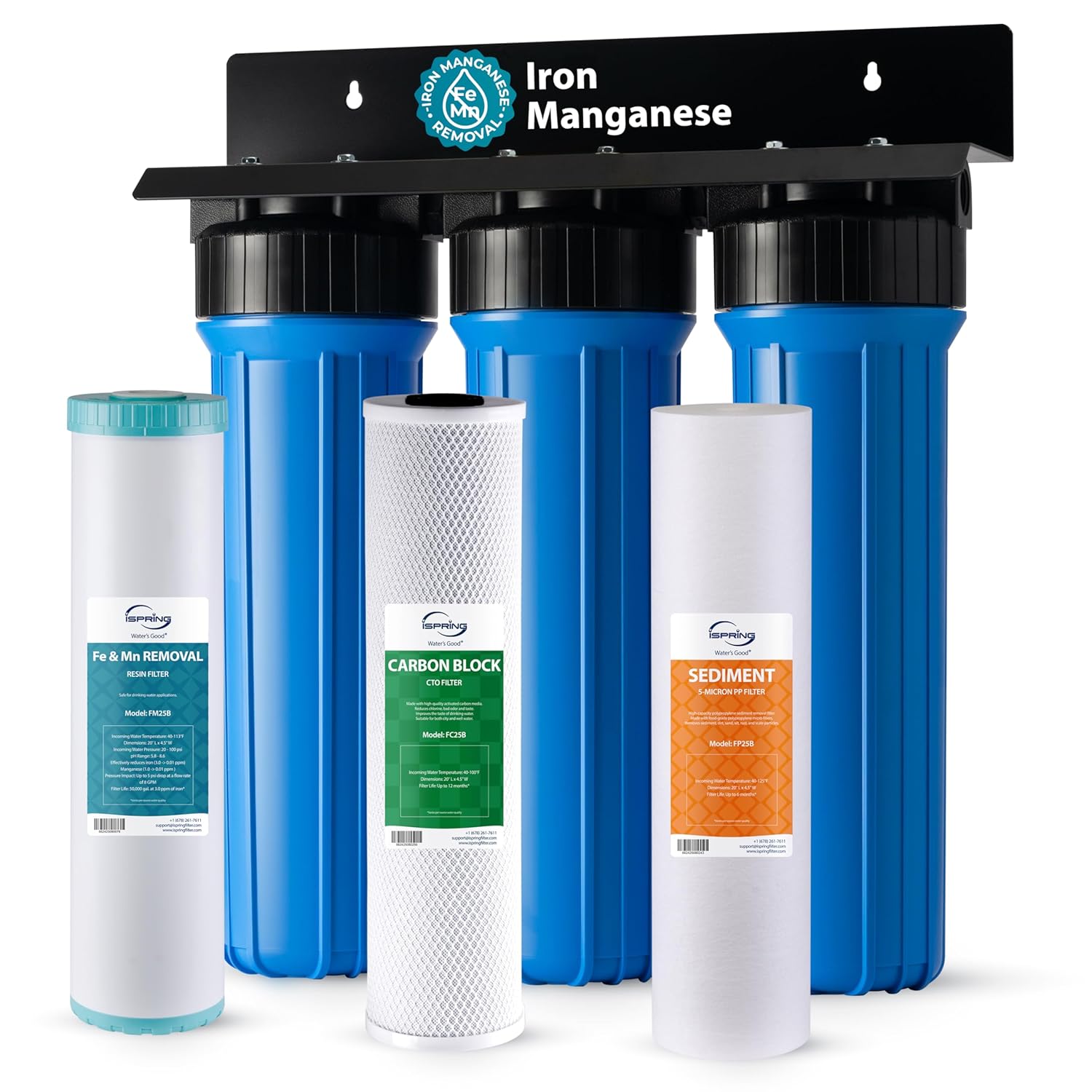
iSpring WGB32BM 3-Stage Whole House Filter
| Maximum Flow Rate | 15 gpm |
|---|---|
| Operating Pressure Range | 25 – 80 psi |
| Operating Temperature | 40 – 100 °F |
| Inlet / Outlet | 1 inch NPT |
| Capacity | 100000 gallons |
The iSpring WGB32BM is a permanent, tankless 3-stage whole-house filtration system that combines a big-blue sediment cartridge, a coconut-shell carbon block, and a catalytic iron-and-manganese media to treat incoming water at the main supply. It is installed inline with 1-inch NPT fittings and is rated for flows up to 15 gallons per minute, so it can supply a typical household without noticeable pressure loss. The first stage traps sand, rust, and large particles, the carbon block knocks down chlorine, color, and odors, and the third-stage catalytic media specifically reduces iron (up to 3.0 ppm) and manganese (up to 1.0 ppm) to near 0.01 ppm under the stated conditions. Filters are high-capacity (up to 100,000 gallons or about 12 months for some stages), which cuts replacement frequency for families. Practical limits: it does not remove hardness or high levels of iron/manganese above the stated maxima, and the unit is recommended for indoor installation with basic freeze and sun protection if placed outside. DIY-friendly instructions and U.S. tech support make service and setup easier for cautious buyers.
Best for: Homeowners who want a dependable whole-house filter that specifically reduces modest levels of iron and manganese while improving taste and protecting plumbing, and who prefer a high-capacity, lower-maintenance system backed by vendor support.
Less Ideal for: Homes with very high iron or manganese concentrations or buyers who need water softening or TDS reduction should consider alternative or additional systems.
- Targets iron and manganese down to low ppm levels with a dedicated third-stage catalytic media
- High-capacity cartridges (up to 100,000 gallons / 12 months for some stages) reduce maintenance frequency
- 15 gpm peak flow and 1-inch inlet/outlet preserve household water pressure for multi-fixture use
- Three-stage design addresses sediment, chlorine/taste/odor, and metal reduction in sequence
- Includes filters and a wrench and offers DIY installation resources and U.S. tech support
- Does not soften water or reduce total dissolved solids so hard-water issues remain
- Not rated for iron or manganese levels above the specified maxima, requiring a different system for very high concentrations
Verdict: Choose the iSpring WGB32BM if you want a high-capacity, three-stage whole-house system that reliably cuts iron and manganese at modest levels while also treating sediment and chlorine.
Choosing the Right Whole-House Water Filter for Iron: Key Factors to Consider
Type of Iron Present
Iron in well water appears in different forms, typically dissolved ferrous iron or particulate ferric iron. Dissolved iron is invisible and requires oxidation plus filtration or specialized media to convert it into removable particles. Particulate iron can often be filtered mechanically but may clog screens quickly.
Knowing which form dominates your water is essential because it determines whether you need oxidation-based media, an air-injection/oxidizer pre-treatment, or a simple sediment filter. A water test that reports iron concentration and whether the iron is dissolved or particulate will guide the correct system selection and sizing.
System Flow Capacity
Whole-house systems must maintain adequate flow for simultaneous fixtures such as showers, washing machines, and dishwashers. Flow capacity is expressed in gallons per minute and should match or exceed your household peak demand. Undersized systems will reduce water pressure, causing poor shower performance or interrupted appliance cycles.
Consider expected simultaneous use and choose a system with some headroom above calculated peak flow. Some designs maintain flow better under load due to larger tanks or parallel media beds; others include bypass valves to preserve critical flows during maintenance.
Media Type and Lifespan
Different media address iron in different ways: catalytic carbon and proprietary iron-specific resins oxidize and trap iron, manganese greensand requires regeneration, and oxidizing media convert dissolved iron to particulates for mechanical filtration. Media lifespan varies by iron concentration, water pH, and suspended solids.
Longer-lasting media reduce replacement frequency and lifetime cost but may require more complex regeneration equipment. Evaluate both expected service interval and the accessibility and cost of replacement media when planning ongoing maintenance.
Maintenance Requirements
Maintenance can include media backwashing, chemical regeneration, cartridge replacement, or periodic tank draining. Frequency depends on iron load, media type, and whether prefiltration is used to remove sediment. Systems with simple backwash cycles typically need less hands-on work, while those needing chemical regeneration require supply of reagents and careful scheduling.
Factor in the time and skills you can commit. If you prefer low-touch systems, prioritize designs with automatic backwash and long service intervals. If you are comfortable with occasional service, systems with higher capacity or lower upfront cost but more involved upkeep can be acceptable.
Water Chemistry and pH
Water pH and dissolved oxygen levels influence iron removal. Low pH can keep iron dissolved and make oxidation harder, while high pH can promote precipitation and scaling. Some media require pH adjustments or supplemental oxidants to work effectively.
A baseline water chemistry report helps determine if pretreatment such as aeration, pH correction, or a sediment prefilter is necessary. Planning treatments that address water chemistry avoids premature media fouling and ensures consistent iron reduction.
Installation Space and Plumbing Integration
Whole-house units can be tank-style or inline housings and differ in footprint. Some require a concrete pad or floor drain for backwash discharge and additional space for clearance and servicing. Others connect directly to existing plumbing with minimal footprint.
Check available installation space, required clearance for media access, and whether a drain or bypass loop is needed. Consider proximity to power if the system uses pumps or controllers and plan for safe waste-water disposal during backwash cycles.
How Iron Treatment Technologies Differ
Iron treatment relies on either converting dissolved iron into a filterable form or selectively binding metal ions with specialized media. Common approaches include oxidizing media that change soluble iron into particulates, greensand or coated sand that trap iron and require periodic regeneration, and catalytic carbon that promotes oxidation without chemical additions.
Each technology has tradeoffs in complexity, operating cost, and suitability for different iron concentrations. Oxidizing media can be simple to operate but may need a larger footprint. Regenerable media handle higher loads but add consumables and periodic regeneration steps.
- Oxidation plus filtration is effective for low to moderate dissolved iron.
- Regenerable media suits higher iron loads but requires regenerant supply.
- Mechanical filtration is helpful for particulate iron but does not address dissolved iron.
Pre-Filtration and Why It Matters
A sediment prefilter protects iron-removal media from sand, silt, and rust particles that can clog beds and shorten service life. Installing a coarse sediment filter ahead of the main system reduces maintenance frequency and preserves flow performance.
Prefilters are inexpensive relative to major media replacements and are especially important if your source water contains visible particulate or you have older plumbing that sheds rust.
- Use a multi-stage approach: sediment first, then iron-specific treatment.
- Check prefilter pressure drop periodically to avoid flow restrictions.
Sizing a System for Your Home
Calculate peak household demand by adding flows from fixtures that run simultaneously. Typical fixture flow rates are available from plumbing guides but err on the side of extra capacity for families with multiple bathrooms. Choose a system with a rated continuous flow above your calculated peak.
Also size the media capacity to handle the measured iron concentration. Systems with larger media volumes or multiple parallel tanks reduce backwash frequency and deliver steadier iron removal between services.
- Plan for future needs if household size or water use may increase.
- Confirm the rated flow in real-world conditions, not just lab numbers.
Practical Installation Tips
Locate the system near the main water shutoff to make servicing and bypass installation easier. Ensure there is a suitable drain for backwash water and enough clearance to remove and replace media or filter housings. If the system requires electricity, position it near a protected, GFCI-protected outlet.
Label bypass valves clearly and install pressure gauges upstream and downstream to monitor pressure drop over time. This helps diagnose clogging or failing components before they impact household water pressure.
- Install check valves if the system uses chemical feed pumps to prevent backflow.
- Consider a bypass loop so you can isolate the system without shutting off house water.
Long-Term Upkeep and Monitoring
Track pressure drop and iron levels before and after the system to confirm ongoing performance. Keep a maintenance log with dates for backwash cycles, media regeneration, and part replacements. Regular inspection helps catch gradual failures such as media compaction or valve wear.
Periodic water tests validate that the system still meets iron reduction targets and reveal if media needs replacement sooner than expected due to changing water chemistry.
- Retest source water annually or after significant changes like well servicing.
- Replace consumables on the recommended schedule rather than waiting for failure.
How We Chose the Best Whole-House Water Filter for Iron
We focused on systems proven for dissolved and particulate iron control and prioritized features that matter to real homes. Evaluation criteria included iron-reduction method and rated removal capacity, system flow rate and pressure retention, filter media longevity and service intervals, ease of installation and filter change, and corrosion resistance of wetted components. We also considered maintenance cost factors such as media replacement frequency and availability of standard parts. We excluded single-point countertop or point-of-use devices because they do not protect the whole plumbing system. Systems that required proprietary recurring cartridges with unclear media specifications were deprioritized. Each shortlisted option offers clear iron treatment approaches, documented flow capacities suitable for typical household demand, and practical maintenance intervals so buyers can plan long-term upkeep. Our scoring emphasized measurable performance metrics and real-world usability over marketing claims.
Our full evaluation process is outlined in our review methodology.
FAQ
How do I know whether my iron is dissolved or particulate?
A basic water test that reports iron concentration and whether it is soluble will tell you the form. Often a lab report or a field test with oxidation steps clarifies if iron is present as dissolved ferrous iron or visible particulates that settle out.
Will a whole-house iron filter remove iron stains from fixtures immediately?
Treatment prevents further staining by removing iron from incoming water, but existing stains on fixtures and laundry may require separate cleaning. Over time, stopping the source of iron will reduce new staining and make restoration easier.
Can these systems handle manganese and other metals too?
Many iron-specific media also reduce manganese and some other transition metals, but effectiveness depends on concentration and chemistry. Check media specifications and consider combined treatment methods if multiple contaminants are reported.
How often do whole-house iron systems need service?
Service intervals vary with iron load and media type. Systems with automatic backwash often need less frequent hands-on work, while regenerable media require scheduled regenerant refill and periodic deep service. Expect to inspect components at least annually.
Do I need a drain for backwash cycles?
Yes. Most whole-house systems that use backwashing require a nearby drain or waste disposal path to discharge backwash water. Plan for waste volume and local regulations regarding discharge.
Is professional installation necessary?
Many homeowners can install a system with moderate plumbing skills, but complex setups requiring electrical connections, pump integration, or chemical feed systems benefit from professional installation to ensure safe operation and warranty compliance.
Final Verdict
When choosing a whole-house water filter for iron, prioritize the treatment method that matches the iron form reported by your water test and pick a system sized for your household flow demands. Balance media lifespan and maintenance complexity against available space and your willingness to perform periodic service. Favor solutions that include sediment prefiltration and clear service intervals so you can maintain consistent iron control. Ultimately, select the configuration that fits your water chemistry and daily usage patterns. Prioritizing the right iron-reduction approach and realistic maintenance expectations will deliver stain-free water and protect plumbing and appliances over the long term.