
Note: This article contains affiliate links. If you click on these links and make a purchase, we may earn a small commission at no extra cost to you. This helps support our research and content. Read our full affiliate disclosure here.
If tiny plastic particles are showing up in your taps, a purpose-built whole-house water filter can stop them before they reach fixtures and appliances. You want a system that captures very small particles while keeping water pressure steady across showers, outdoor spigots, and irrigation lines. This guide shortlists seven top-rated whole-house water filters for microplastics and explains the technical tradeoffs that matter for everyday use. We evaluate units by their ability to remove submicron and micron-sized particles, ongoing filter maintenance, and how they affect household flow. Read on for the criteria we used and clear buying guidance to help you pick the best fit for your home.
Top Picks at a Glance
| Best Overall The best all-around choice for most situations | A. O. Smith Whole House Filter AO-WH-Filter |  |
| Best Quality Built to a higher standard if you want something more solid | Aquasana Rhino WH-1000-CS-UVS-B |  |
| Best Value The sweet spot between price and what you get | Reverse Osmosis Revolution WHF-34F5 |  |
| Best Budget The cheapest option that still gets the job done reliably | Max Water 3-Stage Whole House Filter |  |
| Top Rated A top-rated pick with lots of positive feedback | iSpring WGB21B-PFKS Whole House Filter | 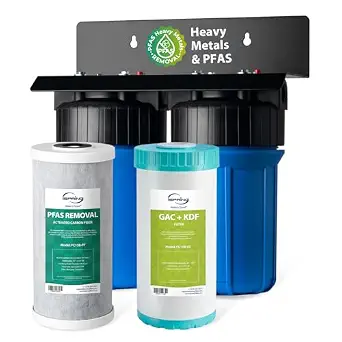 |
| Most Popular A crowd favorite that many people choose with confidence | SimPure DB10C 10" x 4.5" Housing |  |
| Best Seller A high-volume bestseller chosen again and again | iSpring WGB32BM 3-Stage Whole House Filter |  |
A. O. Smith Whole House Filter AO-WH-Filter

| Purification Method | Activated Carbon |
|---|---|
| Maximum Flow Rate | 7 gpm |
| Operating Pressure Range | 20-100 psi |
| Filter Life Cycle | 6 years |
| Capacity | 600000 gallons |
The AO-WH-Filter is a single-tank whole-house activated carbon system that installs on the main water line to reduce chlorine taste and odor and improve water for drinking, cooking, and bathing. It uses a long-life carbon media rated for about 600,000 gallons or six years, so it is aimed at buyers who want low-maintenance filtration without regular cartridge swaps. The unit ships with a shut-off valve, flushing nipple, and hose adapter to support a straightforward DIY hook-up for most installers. Because it is an activated carbon absorber certified to NSF/ANSI 42, it performs well on chlorine and associated tastes and smells and helps limit chlorine off-gassing in showers. It is not a softener and will not remove hardness, sulfur long-term, dissolved solids, iron, or reliably remove microplastics unless paired with a sediment pre-filter or a multi-stage system that includes mechanical filtration. Flow capacity and pressure range suit typical households, and the fiberglass tank and long media life make it a cost-effective central filter for balanced buyers who prioritize simplicity and lower ongoing maintenance over multi-contaminant removal.
Best for: Buyers who want a low-maintenance, single-stage whole-house solution that primarily removes chlorine taste and odor and reduces chemical exposure throughout the home.
Less Ideal for: Homes needing scale reduction, iron or sulfur treatment, or verified microplastic removal should choose a multi-stage system or add purpose-built sediment filters and softening equipment.
- Long service life rated at 600,000 gallons or six years reduces replacement frequency.
- NSF/ANSI 42 certified activated carbon media effectively reduces chlorine taste and odor.
- Includes shut-off valve and flushing nipple to support DIY installation and initial flushing.
- Compatible with city and well water and supports household flow rates up to 7 gpm.
- Does not soften water and will not remove dissolved hardness minerals.
- Not designed to capture fine sediment or microplastics without an added sediment or mechanical filter stage.
- Does not address sulfur, iron, or total dissolved solids effectively.
Verdict: Buy this if you want a durable, low-maintenance whole-house carbon filter to eliminate chlorine taste and odor across the home while minimizing yearly maintenance.
Aquasana Rhino WH-1000-CS-UVS-B

| Maximum Flow Rate | 14.6 gpm |
|---|---|
| Operating Pressure Range | 20-100 psi |
| Supported Water TDS Level Maximum (PPM) | 500 |
| Filter Life Cycle | 10 years |
| Purification Method | Carbon and Copper-Zinc (KDF) media with UV |
The Aquasana Rhino WH-1000-CS-UVS-B is a whole-home filter installed at the main water line to reduce chlorine, sediment, organics, scale, bacteria, and viruses while leaving beneficial minerals in the water. It uses a sequenced stack: a 20" sediment pre-filter, activated carbon, copper-zinc KDF media, salt-free scale control media, a post-filter, and an NSF-tested UV unit for microbial control. In daily use it supplies treated water to every tap, protecting appliances and improving taste and skin feel without requiring backwashing or drain lines. The system is sized for long-life performance—rated for 1,000,000 gallons or roughly 10 years under stated conditions—and supports high flow with a maximum flow rate of 14.6 gpm, so it can keep up with simultaneous household demands. Practical limits include recommended water hardness and iron ranges for optimal conditioning and the need to replace the specified replacement filters and UV bulb on schedule; it does not soften water in the traditional ion-exchange sense. For buyers seeking a performance-focused, low-maintenance whole-house package with UV disinfection, the Rhino is a robust option.
Best for: Buyers who prioritize long-term, high-capacity whole-home contaminant reduction and UV microbial protection and want a system that keeps up with heavy household flow demands.
Less Ideal for: Homes that need conventional water softening for high hardness levels or properties with iron or TDS above the stated limits should consider specialized softeners or pre-treatment instead.
- Comprehensive multi-stage filtration including carbon and copper-zinc KDF for broad contaminant reduction
- Includes NSF-tested UV purifier for microbial sterilization
- Long service life rated to 1,000,000 gallons or 10 years under rated conditions
- High maximum flow rate (14.6 gpm) suitable for busy households
- Salt-free scale control protects pipes and appliances without salt or backwashing
- Does not perform traditional ion-exchange softening or remove dissolved hardness salts
- Performance depends on inlet water meeting recommended hardness and iron limits
- Requires periodic replacement of filters and UV bulb to maintain rated performance
Verdict: A high-capacity, performance-focused whole-house system that pairs multi-stage carbon/KDF filtration with UV disinfection for long-lasting, low-maintenance protection across all household taps.
Reverse Osmosis Revolution WHF-34F5

| Purification Method | Carbon Block, Granular Activated Carbon |
|---|---|
| Supported Water TDS Level Maximum (PPM) | 300 |
| Filter Life Cycle | 5 months |
| Capacity | 10000 gallons |
This three-stage whole-house filtration kit mounts inline with 3/4" plumbing and is built around a sediment cartridge followed by a granular activated carbon (GAC) and a carbon block stage, with two extra filter sets included. In practice the first 5-micron sediment stage traps sand, rust and large particles to protect the carbon stages, while the GAC and CTO block stages reduce chlorine, VOCs, odors and improve taste. The package is aimed at routine household use and is sized for long runs with a stated 10,000 gallon capacity and roughly 4 to 6 month filter life per set. Benefits include straightforward plumbing-friendly 3/4" connections and extra replacement cartridges so you can swap filters without hunting parts. Limitations: the system is not described as having a dedicated microplastic-specific membrane, so its microplastic removal will depend on particle size and the sediment stage rating, and filters require regular replacement to maintain performance.
Best for: Buyers who prioritize a practical, serviceable whole-house system that reduces chlorine, odors and common contaminants while keeping replacement cartridges on hand for routine maintenance.
Less Ideal for: Homes specifically seeking certified microplastics or submicron particle removal should consider systems with microfiltration or membrane stages instead.
- Three-stage design (sediment, GAC, carbon block) targets sediment, chlorine, VOCs, tastes and odors
- Includes two extra filter sets (six cartridges) so replacements are on hand
- 3/4" threaded connections fit common household plumbing for easier installation
- Sediment prefilter extends life of downstream carbon stages by trapping larger particles
- No dedicated microfiltration or membrane stage specifically rated for microplastics removal
- Filter life listed as about 4–6 months, requiring recurring replacements
Verdict: A straightforward three-stage whole-house kit that reliably reduces chlorine, VOCs and sediment while including extra replacement cartridges for easy upkeep.
Max Water 3-Stage Whole House Filter

| Filter Life Cycle | 6 months |
|---|---|
| Maximum Flow Rate | 10 gpm |
| Operating Pressure Range | 20-90 psi |
| Supported Water TDS Level Maximum (PPM) | 500 |
The Max Water 3-stage whole-house system is a point-of-entry filter that combines a 5-micron polypropylene sediment cartridge with granular activated carbon (GAC) and a carbon block (CTO) stage to remove sediment, chlorine, tastes, and odors across the home. It installs at your main water line and supplies filtered water to every faucet without using power or producing wastewater, relying on water pressure for flow. The clear housings make visual inspection straightforward and the unit is sized for standard 10-inch replacement cartridges so servicing is simple and inexpensive; the manufacturer estimates filter life at roughly 6 to 12 months depending on water quality. Flow capability is listed up to 10 gpm for a 3/4 inch inlet but actual delivery depends on house pressure. Keep in mind this system targets particulates, chlorine and organic taste/odor compounds rather than specialized microplastic or ultrafine filtration, so very small particles below the 5-micron rating may pass through. For budget-focused buyers who want whole-home sediment and chlorine reduction with easy maintenance, this is a practical choice; buyers seeking submicron or certified microplastics removal should look to additional polishing stages or finer membrane systems.
Best for: Buyers looking for an affordable, easy-to-maintain whole-house prefilter that removes sand, rust, chlorine and improves taste across the home.
Less Ideal for: Homes needing certified submicron filtration or guaranteed microplastics removal without an added polishing stage should consider membrane or RO-based solutions instead.
- Three-stage setup (sediment + GAC + carbon block) addresses sediment, chlorine, taste, and odor
- Clear housings allow quick visual checks of cartridge condition
- Uses standard 10-inch cartridges for easy, low-cost replacement
- No electricity required and installs at point of entry to protect all fixtures
- Filter rating is 5 microns so it does not reliably remove submicron contaminants or very fine microplastics
- Flow and performance depend on household water pressure and may be lower than the maximum listed
Verdict: A cost-conscious whole-house prefilter that delivers straightforward sediment and chlorine reduction with simple, inexpensive cartridge changes.
iSpring WGB21B-PFKS Whole House Filter

| Purification Method | Carbon Block, Granular Activated Carbon |
|---|---|
| Filter Life Cycle | 12 months |
| Capacity | 50000 gallons |
| Supported Water TDS Level Maximum (PPM) | 300 |
| Upper Temperature Rating | 100 °F |
The iSpring WGB21B-PFKS is a compact two-stage whole-house filter intended to sit on the main water line and treat every tap in your home. Stage one combines KDF and granular activated carbon to strip chlorine, chloramine, sediment and a range of heavy metals while stage two uses an SGS-tested media to target PFAS such as PFOA and PFOS. It is sized for a 1” connection and installs on a wall-mounted bracket with standard plumbing fittings, and the kit includes filters and an installation manual plus video guidance for DIY setups. Each cartridge is rated for roughly 50,000 gallons or about 12 months of service, which keeps maintenance predictable. The housing is plastic but described as heavy-duty and suitable for indoor installations; outdoor placement needs extra protection. It does not reduce TDS and should be paired with additional treatment if you need mineral removal or RO-level purity. For microplastics, the 5-micron sediment removal capability helps capture many particles but very fine nanoscale plastics may bypass the system.
Best for: Buyers who prioritize dependable contaminant reduction for an entire home and want a system that targets PFAS and common heavy metals with predictable, serviceable cartridges.
Less Ideal for: Homes that need full TDS reduction, RO-quality water at every tap, or fully outdoor/unprotected installations should look at alternative systems designed for those specific needs.
- Certified PFAS-targeting media with SGS-tested removal performance
- Two-stage design that removes chlorine, sediment down to 5 microns and various heavy metals
- Standard 1" NPT connections and included installation kit support DIY or pro install
- Long cartridge service life rated to 50,000 gallons or about 12 months for predictable maintenance
- Plastic housings may be less durable than metal options in high-stress installations
- Does not lower TDS or provide reverse-osmosis level purification
Verdict: If you want a reliable whole‑home system that specifically targets PFAS and common heavy metals with long-lasting cartridges, this iSpring two-stage unit is a practical choice.
SimPure DB10C 10" x 4.5" Housing
| Inlet/Outlet | 1" NPT Brass Port |
|---|---|
| Compatible Filter Size | 10" x 4.5" |
| Maximum Flow Rate | 20 gpm |
| Working Water Temperature | 41-104 °F |
| Material Type | Reinforced Polypropylene, Brass |
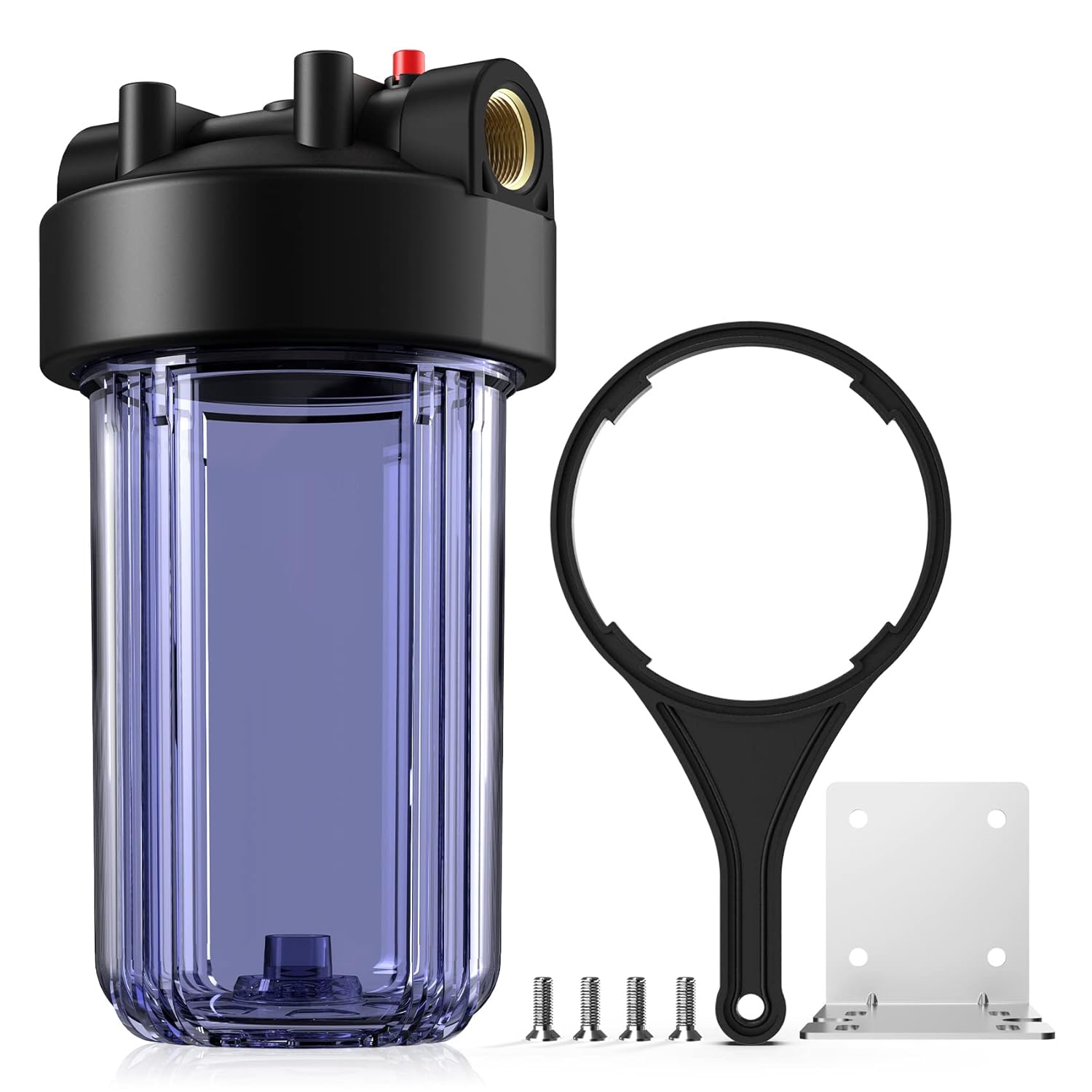
The SimPure DB10C is a durable whole-house filter housing meant to hold standard 10" x 4.5" cartridges for sediment or carbon pre-filtration. It mounts inline using 1" NPT brass inlet and outlet ports, and the clear polypropylene bowl lets you visually check cartridge condition without disassembly. The housing includes a heavy-duty steel mounting bracket, wrench, screws and a built-in red pressure-relief button to make cartridge swaps easier and safer. Rated for up to 20 gpm flow and tested against NSF standards, it is suited for municipal or well water pre-filtration to remove sand, dirt and chlorine taste and protect downstream appliances. Limitations are that cartridges are sold separately and the housing is a mechanical pre-filter only, so it will not remove dissolved contaminants or reliably capture the smallest microplastics unless paired with an appropriately fine cartridge. Also consider the physical clearance required for changing filters and avoid over-tightening Teflon tape on the brass threads.
Best for: Buyers who want a sturdy, visible whole-house housing to protect plumbing and appliances and who prefer evidence-based product choices backed by certifications and included installation hardware.
Less Ideal for: Those seeking a complete water treatment solution that removes dissolved contaminants or very fine microplastics without selecting and installing an appropriately fine cartridge should look at multi-stage or specialty systems instead.
- Clear housing for quick visual inspection of filter condition
- 1" NPT brass ports and double O-ring design for robust sealing
- Includes mounting bracket, wrench and hardware for installation
- Rated to 20 gpm to support whole-house flow demands
- Food-grade reinforced polypropylene construction tested to NSF standards
- Filter cartridges must be purchased separately
- Designed as a housings/pre-filter so it does not remove dissolved contaminants on its own
Verdict: A robust, NSF-tested 10" x 4.5" whole-house filter housing that gives visible, reliable pre-filtration and solid plumbing protection when paired with the right cartridge.
iSpring WGB32BM 3-Stage Whole House Filter
| Maximum Flow Rate | 15 gpm |
|---|---|
| Operating Pressure Range | 25 – 80 psi |
| Operating Temperature | 40 – 100 °F |
| Inlet / Outlet | 1 inch NPT |
| Filter Life Cycle | 1 years |
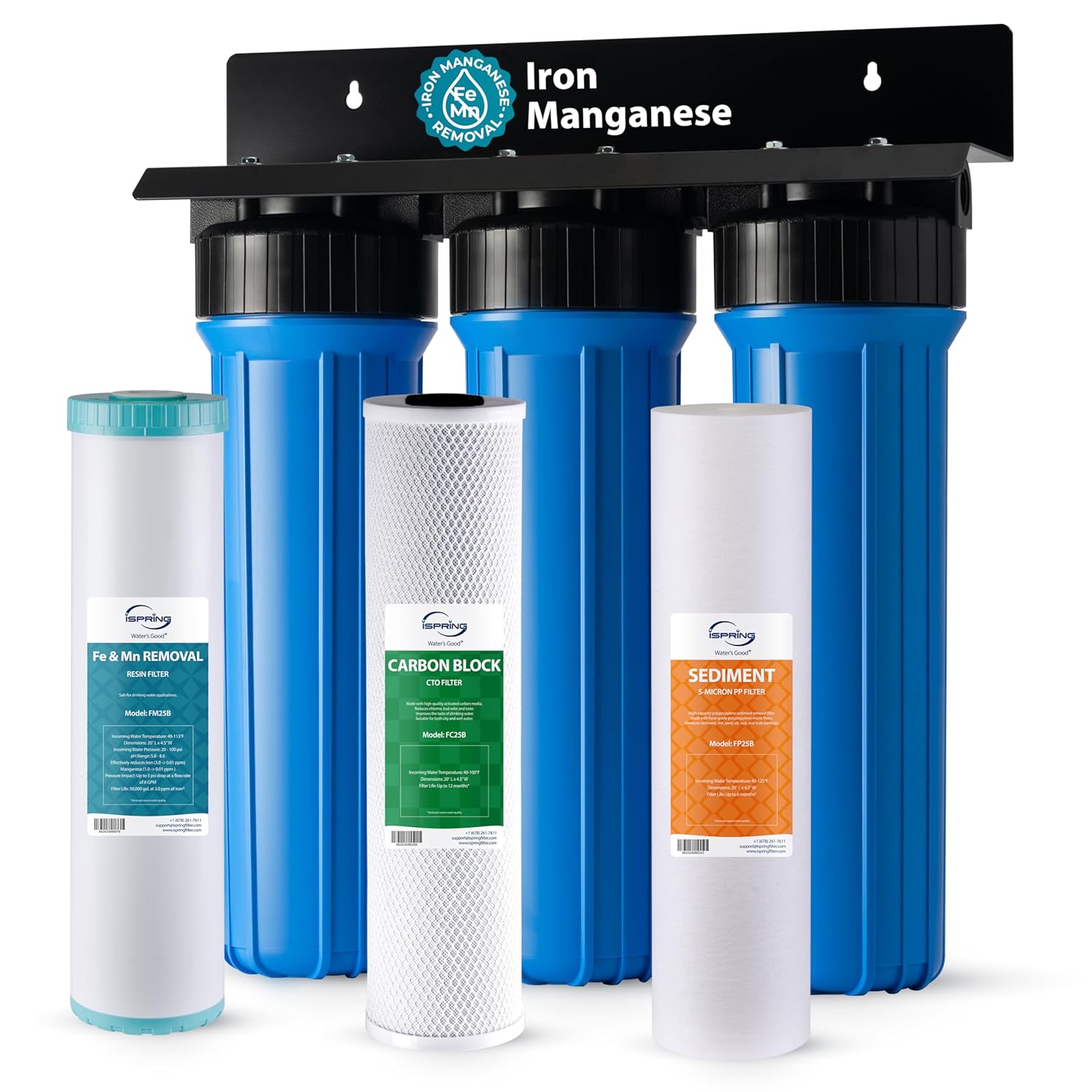
The iSpring WGB32BM is a 3-stage whole-house filter designed to sit at the main water line and treat all incoming water for a home. Water first passes through a large polypropylene sediment cartridge to capture sand, silt, rust, and other visible particulates, then a coconut-shell carbon block reduces chlorine, taste, and odor, and finally a catalytic iron and manganese stage cuts iron and manganese down to near-trace levels within its specified range. It supports up to 15 gpm peak flow and is built for permanent installation with 1-inch NPT connections, so it can supply multiple fixtures without major pressure loss. The system lasts up to about 12 months or 100,000 gallons for the carbon/sediment stages and offers DIY-friendly installation resources and replaceable cartridges. Limitations include its stated iron/manganese working ranges (not intended for iron above 3 ppm or manganese above 1 ppm) and that it does not soften water or remove dissolved solids or microplastics explicitly, so customers needing hardness reduction or certified microplastic removal should consider additional or alternative treatment stages.
Best for: Homeowners seeking a reliable, factory-quality whole-house filter that removes sediment, chlorine, and modest iron/manganese levels and prefers a high-capacity, low-maintenance system with clear installation support.
Less Ideal for: Homes with very hard water, very high iron/manganese levels, or buyers who require certified microplastic or TDS removal as a primary goal should look at systems with RO, specialty microplastic cartridges, or integrated water softening.
- Three-stage design tackles sediment, chlorine/taste/odor, and iron/manganese in sequence
- High capacity cartridges rated up to 100,000 gallons or 12 months for reduced replacement frequency
- Supports up to 15 gpm peak flow for whole-house service with minimal pressure loss
- DIY-installable with 1-inch NPT fittings and supplied wrench, plus online manuals and videos
- Not designed to reduce total dissolved solids or soften hard water
- Iron and manganese reduction is limited to specified inlet concentrations (max 3.0 ppm iron, 1.0 ppm manganese) and will not handle heavier contamination
Verdict: Buy this if you want a high-capacity, three-stage whole-house system that reliably removes sediment, chlorine, and modest iron and manganese levels with minimal impact on home water pressure.
Choosing the Right Whole-House Water Filter for Microplastics: Key Factors to Consider
Micron Rating and Particle Capture
Micron rating tells you the smallest size of particle the filter is designed to trap and is the single most important spec for microplastics. Filters with lower micron ratings capture finer particles, but the practical performance depends on the filter media and testing protocols used by the manufacturer. Look for filters that specify both nominal and absolute micron ratings or cite independent lab results.
A lower micron rating often means faster clogging when the source water carries lots of sediment, so balance the rating with expected water quality.
System Flow Rate and Household Demand
A whole-house system must deliver sufficient gallons per minute to run multiple fixtures without a drop in pressure. Check the rated flow at typical home water pressure rather than a peak or idealized number. Undersized systems can cause weak showers, slow-filling tubs, and poor performance for irrigation or fire-suppression valves.
Keep in mind that very fine filters tend to reduce flow earlier as they load with particles. Choose a system with a flow rating above your household peak demand to leave headroom for filter loading.
Filter Media Type and Longevity
Different media capture microplastics in different ways. Depth filters, pleated elements, and specialized adsorptive layers each have tradeoffs in capacity and how they clog. Longevity matters because shorter service life increases maintenance frequency and replacement-cost labor. Evaluate expected gallons-to-clog figures and whether the element can be cleaned in place or must be replaced.
Consider whether replacement cartridges are common and easy to obtain, and whether the filter design allows quick swaps without shutting off the entire house if that is a concern.
Installation and Plumbing Compatibility
Whole-house filters must integrate with existing piping and space constraints. Confirm the inlet/outlet size and orientation, mounting options, and whether a bypass or shutoff is included for service. Some systems require additional fittings, a dedicated service loop, or professional installation when working with copper, PEX, or other pipe types.
Also check clearance for filter removal and whether there is space for replacement cartridges. Ease of installation affects overall cost and how likely you are to keep the system maintained.
Pressure Drop and Household Performance
Pressure drop is the loss of water pressure across the filter and becomes more pronounced as the filter loads. A small initial drop may be acceptable, but filters that increase pressure loss quickly will degrade user experience. Look for published pressure-drop curves or data at representative flow rates.
A system with a designed bypass or multiple staged elements can reduce the rate at which pressure loss affects daily life, making maintenance windows less disruptive.
Serviceability and Replacement Part Availability
Serviceability covers how easy it is to change elements, access seals, and perform routine checks. Clear service indicators, quick-release housings, and common cartridge sizes simplify upkeep. Replacement parts should be widely available and reasonably standardized to avoid long lead times.
A design that requires specialized tools or proprietary cartridges can raise long-term costs and increase the chance of skipped maintenance, which undermines filtration effectiveness.
How Microplastics Get Into Household Water
Microplastics enter plumbing systems through multiple pathways including municipal treatment gaps, degraded plastic plumbing components, and runoff that carries fibers and fragments into source water. Even treated water can contain small plastic particles that pass conventional treatment steps if those processes are not designed for submillimeter debris.
Understanding the likely source in your water helps set expectations for what a whole-house filter can reasonably remove and where supplemental point-of-use treatments might still be useful.
- Municipal treatment can reduce but not always eliminate very fine plastics
- Aging plastic pipes and fittings may shed microscopic fragments
- Stormwater and surface water sources can carry textile fibers into supplies
Staged Filtration: Combining Screens and Fine Media
Staged systems use a coarse prefilter to catch sand and large debris, followed by finer media for microplastic capture. This approach extends the life of the fine element and preserves flow by stopping larger particles earlier in the sequence.
A prefilter also makes maintenance more predictable because the outer stage shows clogging first. For homes with visible sediment or well water, a multi-stage strategy is especially useful.
- Prefilter extends fine-media life
- Staged setups reduce frequent replacement of expensive cartridges
- Some designs offer washable prefilters to cut waste and cost
Monitoring and Service Intervals
Look for systems with pressure gauges, differential pressure indicators, or flow meters to signal when cartridges are approaching end of life. Relying on calendar-based replacement alone may either waste filter life or allow performance to decline between services.
Establish a realistic maintenance schedule based on your water quality, household consumption, and any monitoring data the system provides. That schedule determines ongoing costs and ensures continuous protection from microplastics.
- Differential pressure gauges indicate when flow resistance is increasing
- Flow-based alarms can alert you when capacity is nearing depletion
- A clear maintenance plan reduces risk of unexpected pressure loss
Point-of-Entry Vs Point-of-Use: When to Use Both
A whole-house, point-of-entry system protects plumbing and all taps from microplastics, but some homeowners still choose point-of-use filters on kitchen taps for additional polishing before drinking. Point-of-use units can use activated carbon or submicron membranes to provide extra assurance for drinking water.
Deciding whether to add a point-of-use device depends on your sensitivity to risk, testing results for drinking water specifically, and willingness to maintain two systems instead of one.
- Whole-house filters protect appliances and fixtures
- Point-of-use systems give extra polishing for drinking and cooking
- Combining both increases maintenance but can improve drinking-water confidence
Testing Your Water and Verifying Results
Before and after testing shows whether a chosen filter removes the microplastic sizes present in your water. Use certified labs or accredited testing services when possible, and request particle-size distribution data to match with a filter's micron rating.
Repeat testing after installation confirms the system is installed and performing as intended, and helps refine maintenance intervals based on how quickly particles accumulate.
- Pre-install testing identifies the particle sizes you need to target
- Post-install testing verifies real-world removal performance
- Periodic retesting catches seasonal or source-water changes
How We Chose the Best Whole-House Water Filter for Microplastics
We prioritized objective, home-relevant measures that predict long-term performance against microplastics and everyday usability. Our selection criteria focused on measurable particle-capture ratings, flow-rate capability under typical household demand, and maintenance needs tied to filter lifespan and replacement effort. We also weighed construction quality and system compatibility with standard home plumbing to ensure straightforward installation and durability. Concrete evaluation factors included published micron ratings and independent test results for particle removal, rated gallons-per-minute flow at normal household pressure, filter media longevity and replacement cadence, and the robustness of housings and seals for leak resistance. We excluded systems designed only for point-of-use treatment, undersized inline cartridges rated for very low flow, and devices without transparent specifications for particle-size removal. Finally, we favored solutions that offer clear maintenance paths and widely available replacement parts.
Our full evaluation process is outlined in our review methodology.
FAQ
Will a whole-house filter remove all microplastics from my water?
It depends on the filter's micron rating and the particle sizes present. Many whole-house systems can remove a large portion of microplastics above their rated cutoff, but very fine particles below the rating may still pass. Testing your water helps determine whether additional point-of-use polishing is needed.
How often will I need to change filter cartridges?
Replacement intervals vary with water quality and household use. Filters in cleaner municipal supplies may last months to a year, while sediment-heavy sources or well water can require more frequent changes. Monitoring pressure differential or flow patterns gives a more reliable service schedule than fixed calendars.
Can these systems reduce water pressure in my home?
All filters introduce some pressure drop, and that increases as elements load with debris. Choosing a system with a higher rated flow at normal household pressure and including prefiltration reduces the likelihood of noticeable pressure loss during typical use.
Do whole-house microplastic filters need professional installation?
Some homeowners can install whole-house units if they are comfortable with plumbing and have adequate space and tools. However, systems that require pipe reconfiguration, new shutoffs, or bypass loops often benefit from professional installation to ensure leak-free connections and correct orientation.
Are replacement parts and cartridges easy to find?
Availability depends on the filter design. Systems that use standardized cartridge sizes and common media types generally have better part availability. Before buying, confirm the supply chain for replacement elements to avoid long delays when service is required.
Final Verdict
For most homes worried about microplastics, prioritize a system with a verified low micron rating, staged filtration to protect fine media, and a rated flow above your household peak demand. Balance removal capability with realistic maintenance intervals and part availability to avoid frequent pressure problems or missed service. Decide first on the micron cutoff that matches your testing results, then select a system that supports that rating without sacrificing flow. That approach delivers reliable protection for plumbing and fixtures while keeping routine upkeep manageable.