
Note: This article contains affiliate links. If you click on these links and make a purchase, we may earn a small commission at no extra cost to you. This helps support our research and content. Read our full affiliate disclosure here.
If you are planning for long-term self-reliance or emergency preparedness, a robust whole-house water filter can be one of the most important investments you make. In a survival scenario you need filtration that delivers safe, potable water across household plumbing without frequent replacement or complex setup. This guide highlights six shortlisted whole-house water filters for survival use, chosen for their filtration capability, flow capacity, and build durability. We evaluated each option on practical performance factors that matter in emergencies: contaminant removal effectiveness, sustained flow rate for multiple outlets, ease of maintenance under austere conditions, and durable construction. Read on to compare the top contenders and understand the tradeoffs to consider when choosing a system for preparedness planning.
Top Picks at a Glance
| Best Quality Built to a higher standard if you want something more solid | iSpring WCFM500K Whole House Filter |  |
| Best Value The sweet spot between price and what you get | Waterdrop WHF21-PG Whole House Filter |  |
| Best Budget The cheapest option that still gets the job done reliably | Culligan WH-HD200-C Whole House Filter |  |
| Top Rated A top-rated pick with lots of positive feedback | Express Water Ultimate Protection WH300SCKP |  |
| Most Popular A crowd favorite that many people choose with confidence | iSpring WGB32BM 3-Stage Whole House Filter |  |
| Best Seller A high-volume bestseller chosen again and again | A. O. Smith Whole House Filter AO-WH-Filter |  |
iSpring WCFM500K Whole House Filter

| Capacity | 500000 gallons |
|---|---|
| Filter life cycle | 10 years |
| Maximum flow rate | 12 gpm |
| Purification method | Activated Carbon |
The iSpring WCFM500K is a point-of-entry whole-house filtration system built to tackle well-water style contaminants like iron, manganese and hydrogen sulfide while also trapping solids down to 3 microns. It installs at the main line and runs a programmable, LED-controlled regeneration cycle that backwashes, injects air for oxidation, then rinses the media so the system stays functional without chemical feeds or frequent cartridge swaps. The unit is aimed at high-flow homes and can support peak flows listed up to 26 GPM while offering a long media life rated up to 10 years under expected conditions. Practical benefits include reduced staining, better-tasting water at every tap, and less sediment stress on appliances and plumbing. Limits to be aware of are that it does not soften water or lower TDS, it must be installed indoors or well-protected from weather, and proper pre-treatment or disinfection is recommended for biologically unsafe sources. The programmable controls and self-cleaning make it low-maintenance once properly sized and set up.
Best for: Buyers prioritizing robust contaminant removal and continuous whole-house protection who want a low-maintenance system they can program and rely on for treating well-type water issues.
Less Ideal for: Homes that need scale control or TDS reduction as a primary goal should choose a system that includes a water softener or RO for drinking water instead.
- Targets iron, manganese and hydrogen sulfide removal and captures solids to 3 microns.
- Automatic air-assisted regeneration and backwash that requires no chemical oxidizers.
- Programmable LED control for customizable cleaning intervals and vacation mode.
- Long media life advertised up to 10 years, reducing frequent replacements.
- Does not reduce water hardness or total dissolved solids (TDS).
- Requires indoor or protected installation and proper setup to function safely.
Verdict: Choose the iSpring WCFM500K when you need a durable, low-maintenance whole-house system that reliably removes iron, manganese and hydrogen sulfide without chemical regeneration.
Waterdrop WHF21-PG Whole House Filter

| Purification Method | Granular Activated Carbon, Sedimentation |
|---|---|
| Maximum Flow Rate | 15 gpm |
| Operating Pressure Range | 25 psi |
| Filter Life Cycle | 6 months |
| Capacity | 50000 gallons |
The Waterdrop WHF21-PG is a compact two-stage whole-house filter built around a 10" x 4.5" sediment (PP) cartridge and a granular activated carbon (GAC) cartridge to remove particles down to 5 microns and reduce chlorine, lead, taste and odor. It installs on incoming municipal lines and is designed for steady household flow up to 15 gpm and typical operating pressures; the housing and components are food-grade and NSF/ANSI approved. The system is intended for routine household protection of pipes and appliances and for improving water taste rather than advanced contaminant removal such as nitrates or microbiological pathogens. Cartridge life is practical for regular maintenance—PP changes every 3 to 6 months and the GAC about every 6 months—so ongoing costs and replacement scheduling are things to plan for. Installation is user-friendly with included wrench and mounting hardware, but you should use proper pipe sealing and allow space for cartridge changes. This unit is a straightforward, low-footprint option if you want reliable sediment and chlorine reduction across a home without electrical components.
Best for: Buyers who want a practical, no-electricity whole-house prefilter that improves tap water taste, reduces chlorine and particulates, and protects plumbing and appliances with straightforward maintenance.
Less Ideal for: People needing certified removal of bacteria, viruses, or dissolved chemicals like nitrates or fluoride should choose a specialized treatment system instead.
- Reduces chlorine, lead, taste and odor using GAC and sediment stages.
- Supports up to 15 gpm to maintain typical household water flow.
- NSF/ANSI approved components and food-grade housing for safety.
- Relatively simple DIY installation with included wrench and mounting hardware.
- Compact, low-footprint design that protects pipes and water appliances.
- Does not target microbiological contaminants or dissolved inorganic contaminants beyond heavy metals and chlorine.
- Filter cartridges require regular replacement every 3–6 months, adding maintenance costs.
- Operating pressure information is limited to a single listed range so check compatibility with nonstandard plumbing conditions.
Verdict: A practical, low-maintenance whole-house prefilter that reliably reduces sediment, chlorine, and taste/odor while protecting plumbing without electrical components.
Culligan WH-HD200-C Whole House Filter

| Maximum Flow Rate | 10 gpm |
|---|---|
| Supported Water TDS Level Maximum (PPM) | 600 |
| Capacity | 16000 gallons |
| Material Type | Stainless Steel |
The Culligan WH‑HD200‑C is a stainless steel capped whole-house filter housing meant to be installed on a 1-inch main and used with a separately purchased cartridge to remove sediment, rust, sand, silt and improve taste and odor. It is a clear-sump, in-line unit with a built-in bypass, shut-off and pressure relief valve that makes cartridge changes and maintenance easier without shutting off the whole house. The housing supports up to 10 gpm flow and is rated for water up to 600 ppm TDS, so it suits typical residential supply lines and protects appliances from coarse particulates. Because the filter element is sold separately you can choose cartridge type and service life to match budget or survival-prep needs, but that also means initial cost is higher than an all-in-one kit. The housing is robust and WQA-tested for durability, but you will need plumbing know-how or a pro to install it and select the correct 1" cartridge for your specific contaminants.
Best for: Buyers wanting a durable, serviceable point-of-entry filter housing they can pair with economical sediment cartridges to protect plumbing and appliances during long-term preparedness or budget-focused builds.
Less Ideal for: People who need an all-in-one, ready-to-use filtration kit or those without access to 1" plumbing and basic installation skills should consider simpler or included-cartridge options.
- Clear sump lets you visually monitor filter condition
- Built-in shut-off, bypass and pressure relief valve simplify cartridge changes
- Stainless steel cap and heavy-duty construction for durability
- Supports up to 10 gallons per minute flow to handle typical household demand
- Filter cartridge is sold separately so ongoing cost and correct cartridge selection are required
- Requires 1" inlet plumbing and likely professional installation for many buyers
Verdict: A rugged, serviceable whole-house housing that lets budget-focused preppers choose affordable sediment cartridges to protect plumbing and supplies.
Express Water Ultimate Protection WH300SCKP

| Purification Method | Activated Carbon, KDF, Polyphosphate |
|---|---|
| Maximum Flow Rate | 17 gpm |
| Operating Pressure Range | 20-80 psi |
| Supported Water TDS Level Maximum (PPM) | 800 |
| Filter Life Cycle | 6 months |
The Express Water Ultimate Protection WH300SCKP is a three-stage whole-house filter built to treat all incoming water at the point of entry. It mounts on a stainless steel freestanding frame and uses sediment/anti-scale, KDF/activated carbon, and heavy-metal media to cut chlorine, bad tastes and odors, sediment, and a range of heavy metals while polyphosphate helps limit scale. The system is designed for high flow use and supports up to 17 gpm and a maximum TDS input of 800 ppm, so it can supply water for a typical home without noticeable pressure loss. Built-in pressure gauges and pressure-relief buttons make filter changes and monitoring straightforward, and the manual design requires no electrical hookup. Planned filter replacement is about every 6 months or up to 100,000 gallons depending on use. Limitations include no reduction in total dissolved solids, so it will not replace an RO system for salt or dissolved mineral removal, and the unit is sizable and heavier than point-of-use options which may affect siting and installation costs.
Best for: Homeowners who prioritize a robust, no-power whole-house system that reliably reduces chlorine, sediment, heavy metals, and scale across every faucet and appliance.
Less Ideal for: If you need to lower TDS, soften very hard water, or want a compact point-of-use unit, this full-house mechanical system is not the best choice.
- Three-stage filtration targets sediment, chlorine/taste/odor, and heavy metals.
- Stainless steel freestanding frame with included pressure gauges and pressure-relief buttons for easier maintenance.
- High flow capacity up to 17 gpm to serve whole-house needs without pressure loss.
- Polyphosphate stage provides anti-scale protection for pipes and appliances.
- Manual operation requires no electricity and is straightforward to monitor.
- Does not reduce total dissolved solids so it will not soften water or remove dissolved salts.
- Requires periodic cartridge replacement and has a sizable footprint that may need professional plumbing for retrofit.
Verdict: Choose this heavy-duty three-stage system when you need dependable whole-house protection against chlorine, sediment, heavy metals, and scale without relying on electricity.
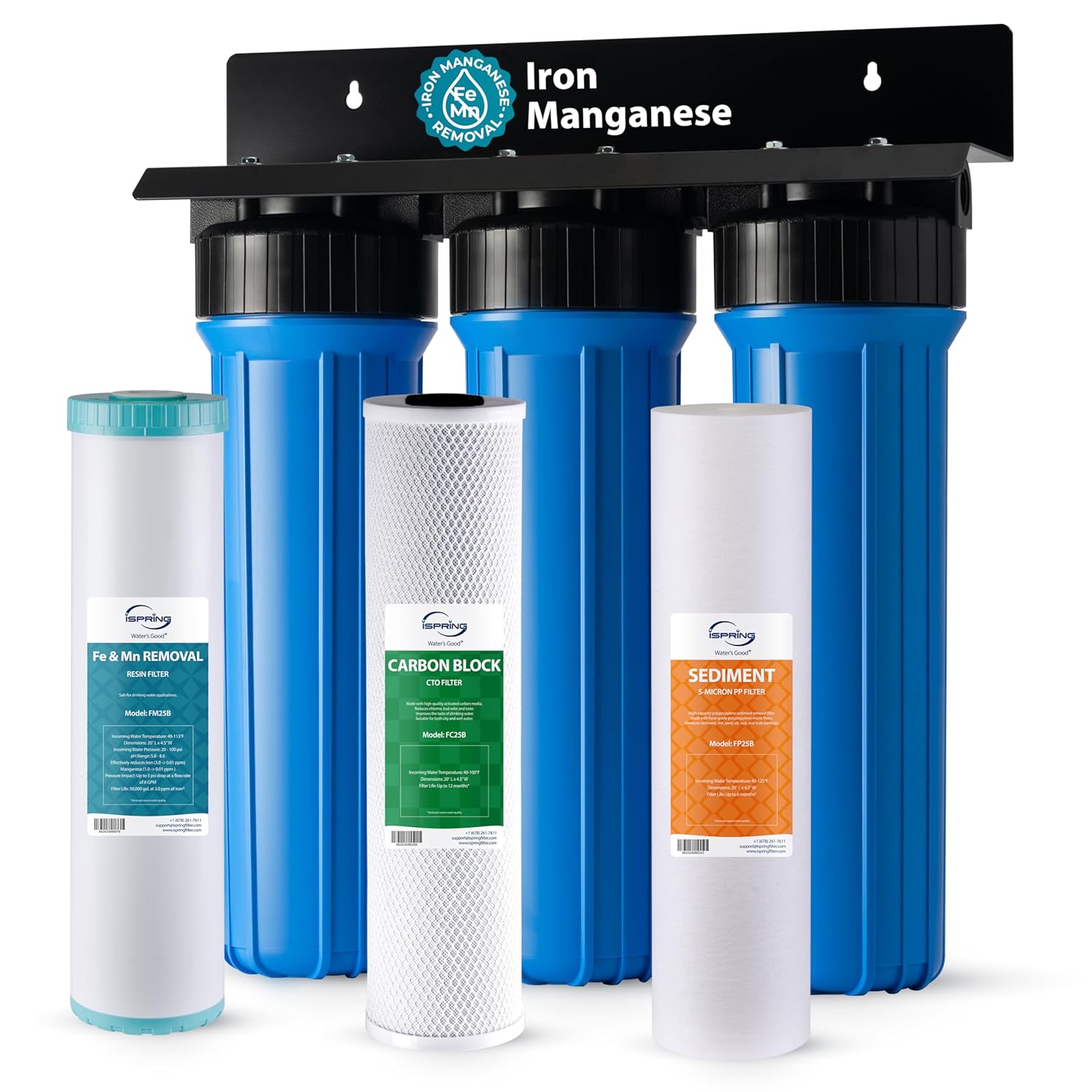
iSpring WGB32BM 3-Stage Whole House Filter
| Maximum Flow Rate | 15 gpm |
|---|---|
| Operating Pressure Range | 25 – 80 psi |
| Operating Temperature | 40 – 100 ºF |
| Inlet / Outlet | 1 inch NPT |
| Filter Life Cycle | 1 years |
The iSpring WGB32BM is a point-of-entry, tankless 3-stage system designed to treat all household water for common contaminants rather than soften it. It uses a big-blue sediment cartridge first to catch sand, rust and large particles, a coconut-shell carbon block second to remove chlorine, tastes and odors, and a catalytic iron/manganese stage that reduces iron to about 0.01 ppm (from up to 3.0 ppm) and manganese similarly. Installation is permanent at the main line with 1-inch NPT plumbing and supports flow up to 15 gpm so it will not noticeably restrict typical household supply. Filters are rated to last up to 100,000 gallons or roughly 12 months depending on use, and replacement cartridges are straightforward to swap. The system does not remove hardness or dissolved solids so homes with very hard water should add a softener ahead of the unit. It is best suited to buyers who want high-capacity, whole-home contaminant reduction with DIY-friendly installation and factory-backed support.
Best for: Buyers who want a high-capacity, whole-home filter that removes sediment, chlorine and measurable iron/manganese and who prioritize proven performance and easy DIY installation.
Less Ideal for: Homes that need water softening or removal of dissolved solids should choose a combined softener or an RO-based solution instead.
- Three-stage filtration targets sediment, chlorine/taste/odor, and iron/manganese for broad contaminant reduction
- High flow capacity up to 15 gpm keeps household water pressure steady
- Long filter life rated up to 100,000 gallons or 12 months under typical use
- Tankless, whole-house design installs at the main line to protect plumbing and appliances
- Does not reduce water hardness or total dissolved solids so a softener is required for hard water
Verdict: A durable, high-flow whole-house 3-stage filter that reliably reduces sediment, chlorine and iron/manganese for year-long service in survival-minded households.
A. O. Smith Whole House Filter AO-WH-Filter

| Purification Method | Activated Carbon |
|---|---|
| Other Special Features | Chlorine Reduction, NSF/ANSI 42 Certified |
| Maximum Flow Rate | 7 gpm |
| Operating Pressure Range | 20-100 psi |
| Filter Life Cycle | 6 years |
The AO-WH-Filter is a fiberglass tank-style whole-house activated carbon system meant to remove chlorine taste and odor from city or well water so every tap delivers improved water for drinking, cooking, showering and laundry. It installs inline at the main supply and ships with a shut-off valve, nipple and hose adapter to allow DIY installation for many homeowners; AO Smith recommends basic plumbing tools and a pre-filter in some conditions. The unit is rated for up to 7 gpm flow, operates across normal household pressures and temperatures, and is NSF/ANSI 42 certified for chlorine reduction. A major benefit is the long service life — AO Smith rates the filter for roughly 600,000 gallons or six years, which lowers maintenance frequency and replacement costs compared with cartridge systems. Limitations are that it does not soften water or remove dissolved minerals, sulfur long-term, or iron, so it is not a substitute for water softeners or treatment systems targeted at those contaminants. Sizing, plumbing compatibility and occasional need for a pre-filter are practical considerations before purchase.
Best for: Buyers who prioritize proven, low-maintenance chlorine removal for whole-home protection and want a durable factory-quality tank that minimizes replacement visits.
Less Ideal for: Homes needing hardness reduction, iron removal, or comprehensive contaminant treatment should choose a softener or multi-stage system instead.
- Reduces chlorine taste and odor with NSF/ANSI 42 certification
- Long rated life of about 600,000 gallons or six years lowers replacement frequency
- Tank design supplies filtered water to the entire house at up to 7 gpm
- Fiberglass construction and included shut-off/flush fittings support DIY inline installation
- Does not soften water or remove dissolved minerals, iron, or long-term sulfur issues
- May require a sediment pre-filter in high-sediment supplies to protect longevity
Verdict: Choose this AO Smith whole-house carbon filter when you want a low-maintenance, factory-quality solution to reliably remove chlorine taste and odor from every tap for years.
Choosing the Right Whole-House Water Filter for Survival: Key Factors to Consider
Contaminant Coverage
Know which contaminants matter most for survival scenarios and choose media that addresses those threats. Biological hazards, sediment, chemicals, and heavy metals present different challenges. Systems that combine sediment prefiltration with activated carbon or specialized media increase the chance of removing taste-and-odor compounds, organic contaminants, and some chemical pollutants.
In long-term emergencies, source water quality can change, so a system with broader coverage reduces risk. Look for documented performance against the contaminants you expect to face, and plan for supplementary disinfection if biological contamination is likely.
Flow Capacity and Household Demand
Whole-house systems must supply enough flow to run multiple fixtures simultaneously. Flow capacity is usually measured in gallons per minute. If the filter cannot sustain required flow, pressure drops will disrupt critical uses like showers, cooking, and sanitation.
Estimate peak simultaneous demand for your home or shelter, include appliances that run intermittently, and choose a system rated for that peak. Also consider that media loading and clogging will reduce flow over time, so pick a unit with headroom above your typical demand.
Service Interval and Consumables
In a survival context, long service intervals and easy-to-stock consumables are important. Filters that require frequent cartridge swaps increase logistical burden and the chance of running out of replacements. Systems using long-life media or regenerable components reduce ongoing needs.
Check how simple it is to perform maintenance without specialized tools, whether replacement cartridges are widely available, and how many spare filters you should store for extended outages.
Durability and Weather Resistance
Systems deployed for preparedness may sit unused for long periods or live in non-climate-controlled spaces. Durable housings, corrosion-resistant fittings, and components rated for typical temperature swings increase operational reliability when you need them.
Consider the filter housing materials, gasket types, and whether the system tolerates freezing or high-heat environments. Rugged mechanical design also matters if the system must be moved or installed in temporary shelters.
Installation and Integration
A system that requires minimal plumbing modifications and can be installed with basic tools is preferable for most preparedness plans. Hard-to-install systems add risk during an emergency and may need professional help when that is not available.
Evaluate whether the unit fits standard pipe sizes, if mounting hardware and clear installation instructions are included, and whether a bypass or shutoff arrangement is provided so you can maintain service while servicing the filter.
Emergency Redundancy and Fail-Safes
Think beyond a single filter. Redundancy, manual bypasses, and simple backup disinfection options increase resilience. If a primary system fails or a replacement is not on hand, you should have a clear fallback plan to maintain potable water.
Options such as parallel housings, modular cartridges you can swap quickly, and provisions for chemical disinfection or boiling are practical layers of defense in survival situations.
Sizing Your System for Survival Use
Determine how many people and fixtures the system must support during prolonged use. Calculate peak simultaneous demand by summing flow needs for showers, sinks, and essential appliances. Add a safety margin so the system is not operating at its maximum rating constantly.
Also factor in reserves for firefighting, sanitation, and any medical needs that require extra water. Choose a system with a documented maximum flow rate comfortably above your peak requirement and consider modular expansion if your needs may grow.
- Estimate peak GPM for household fixtures
- Add 20 to 30 percent headroom for safety
- Consider modular systems to increase capacity later
Prefiltration and Protecting Main Media
Sediment and particulates can quickly clog fine media. Installing a coarse prefilter or sediment trap ahead of the main treatment stage preserves flow and extends service life. In survival situations you may not be able to replace fine cartridges frequently, so a robust prefilter reduces maintenance frequency.
Prefilters are often inexpensive and simple to service. Prioritizing easy access to the prefilter housing speeds routine flushing or cartridge swaps when conditions are suboptimal.
- Use a sediment prefilter to reduce clogging
- Locate prefilter for easy access and quick changes
- Match prefilter micron rating to expected sediment load
Simple Maintenance Practices for Emergencies
Create a maintenance checklist tailored to survival conditions. Include regular visual inspections, pressure-drop monitoring, and scheduled cartridge changes based on conservative time intervals rather than waiting for failure. Conservative maintenance planning reduces the risk of unexpected downtime.
Store essential spare parts such as seals, O-rings, and at least one spare cartridge of each type you use. Label parts and provide a printed or laminated maintenance guide so anyone can perform required tasks under stress.
- Monitor inlet and outlet pressure to detect clogging
- Keep a basic plumbing tool kit and spare seals on hand
- Document step-by-step maintenance procedures
Portable Vs Permanent Installations
Permanent whole-house installations offer hands-off operation and lower long-term maintenance but require a fixed location and plumbing connections. Portable or temporary systems are useful for bug-out scenarios or shelters where plumbing is improvised. Each approach has tradeoffs in reliability and convenience.
Decide whether you need a system that travels with you or one that stays installed in a primary location. If portability is required, choose a unit designed for quick disconnects and minimal tooling.
- Permanent: best for homebase preparedness
- Portable: best for evacuation or temporary shelters
- Plan plumbing quick-disconnects for rapid deployment
Backup Disinfection Options
Mechanical filtration does not always remove or inactivate pathogens. Keep secondary disinfection options available such as household bleach dosing, portable UV devices, or boiling capability. These methods complement filtration when biological contamination is suspected.
Train household members on proper dosing and safety protocols for chemical disinfection. Maintain fuel or power supplies required for boiling or UV devices as part of your broader preparedness planning.
- Store small-volume bleach for emergency disinfection
- Consider a compact UV purifier for point disinfection
- Practice and document boiling and dosing procedures
How We Chose the Best Whole-House Water Filter for Survival
We prioritized systems that deliver credible contaminant reduction, maintain usable flow rates for whole-house distribution, and are simple to operate and maintain under emergency conditions. Key evaluation criteria included certified contaminant removal performance or documented media specifications, peak and sustained flow capacity in gallons per minute, filter service interval and ease of cartridge replacement, and mechanical robustness such as pressure-rated housings and corrosion-resistant fittings. We also considered installation simplicity and compatibility with common residential plumbing so systems can be deployed quickly in a shelter or prepped home. Units requiring specialized tools or frequent consumable swaps were deprioritized. Exclusions included small point-of-use units and systems that do not support continuous whole-house flow. Overall, we favored solutions that balance long-term reliability with realistic maintenance demands during survival situations.
Our full evaluation process is outlined in our review methodology.
FAQ
How often should I change whole-house filter cartridges in a survival stash?
Frequency depends on filter type and source water quality. For preparedness, plan conservative intervals and store extra cartridges. Monitor pressure drop across the system and replace cartridges sooner if flow declines.
Can a whole-house filter remove bacteria and viruses in contaminated water?
Many whole-house filters reduce particulates and some pathogens, but not all are certified for virus removal. For biological threats, pair filtration with disinfection methods such as chemical dosing or UV to improve safety.
What maintenance supplies should I store with a survival-focused system?
Keep spare cartridges, O-rings, housing lubricant, basic hand tools, and a pressure gauge. Also include emergency disinfection supplies and clear written instructions so maintenance can be performed under stress.
Will a whole-house filter affect my water pressure during an emergency?
A properly sized system should maintain acceptable pressure, but undersized or clogged filters will reduce flow. Allow headroom when sizing and monitor pressure to catch clogging early.
Is a bypass valve necessary for survival installations?
A bypass valve is highly recommended. It lets you maintain water service while servicing the filter or if the system needs to be isolated during an emergency.
Final Verdict
For survival-focused preparedness, prioritize systems that combine broad contaminant coverage with sustained flow capacity and low-maintenance operation. Durability and installation simplicity matter because you may need to rely on the filter under adverse conditions or without professional help. Balance contaminant removal, maintenance logistics, and sizing when choosing a system. Favor solutions with straightforward service procedures, accessible spare parts, and at least one backup disinfection method to ensure you can maintain potable water in extended emergencies.