
Note: This article contains affiliate links. If you click on these links and make a purchase, we may earn a small commission at no extra cost to you. This helps support our research and content. Read our full affiliate disclosure here.
If you plan to keep bottles for years, selecting the right wine cooler matters more than a countertop chiller. Long-term storage needs steady temperatures, controlled humidity, minimal vibration, and UV protection to preserve wine development and avoid premature aging. This guide covers seven shortlisted wine coolers chosen for storage-grade features and reliability. We focus on the controls and construction that matter most to long-term collectors and explain which specs to prioritize for cellar-like results. Read on for a practical breakdown of the criteria we used and the storage-focused features to check before you buy.
Top Picks at a Glance
| Best Overall The best all-around choice for most situations | NewAir AWR-520SB Wine Fridge |  |
| Best Quality Built to a higher standard if you want something more solid | Ca'Lefort 24" Wine Fridge CLF-WS24 |  |
| Best Value The sweet spot between price and what you get | Ivation 18-Bottle Wine Cooler |  |
| Best Budget The cheapest option that still gets the job done reliably | Electactic Wine Cooler JC-18UEL-F |  |
| Top Rated A top-rated pick with lots of positive feedback | Cuisinart 8-Bottle Wine Cellar CWC-800CEN |  |
| Most Popular A crowd favorite that many people choose with confidence | Antarctic Star 0.9 Cu. Ft. Wine Cooler |  |
| Best Seller A high-volume bestseller chosen again and again | EUHOMY Wine Cooler BR001-110 |  |
NewAir AWR-520SB Wine Fridge

| Capacity | 52 Bottle |
|---|---|
| Temperature Range | 39–64°F |
| Cooling Method | Compressor |
| Number Of Shelves | 6 |
| Installation Type | Built-In |
The NewAir AWR-520SB is a 24-inch wine refrigerator built for either under-counter installation or freestanding placement and intended for collectors who need steady, cellar-style temperatures. It uses a compressor cooling system and digital controls to hold bottles between 39 and 64°F, and the insulated glass door plus soft LED lighting help protect and display the collection without adding heat. Six slide-out shelves (wood/metal rack mix on some variants) reduce vibration and make it easy to store a mix of standard and larger bottles, while the quiet compressor supports long-term storage. Installation flexibility and the stainless steel trim give it a clean, kitchen-ready look, but the unit is fairly compact for larger collections and consumes around 260 kWh/year, so it is best where space and energy use are acceptable. Key strengths are accurate temperature range, low vibration cooling, and slide-out shelving, while buyers with very large cellars or strict low-energy priorities should consider larger or more efficient alternatives.
Best for: Buyers who want a reliable, cellar-capable cooler for a modest collection and value precise temperature control and low vibration over maximum capacity.
Less Ideal for: Those building a large wine cellar, seeking the lowest possible energy use, or needing storage for hundreds of bottles should choose a larger or more efficient model.
- Digital temperature control with a 39–64°F range suitable for whites and reds
- Compressor cooling provides consistent, low-vibration temperatures for long-term storage
- Slide-out shelves make organizing and accessing bottles easy
- Built-in or freestanding installation options with stainless steel finish for a tidy look
- Relatively compact capacity compared with larger cellar units
- Annual energy consumption is moderately high at about 260 kWh/year
Verdict: A compact, built-in-capable wine fridge that delivers cellar-style temperature control and low-vibration compressor cooling for a modest bottle collection.
Ca'Lefort 24" Wine Fridge CLF-WS24

| Capacity | 5.65 cubic feet |
|---|---|
| Bottle capacity | 61 Bottle |
| Temperature range | 40-65°F |
| Installation type | Built-in, Under Counter, Freestanding |
| Cooling method | Compressor (rotary scroll) |
The Ca'Lefort 24" Wine Fridge is a built-in undercounter cooler aimed at home collectors who want a reliable, mid-size storage unit. It uses a rotary scroll compressor with automatic defrost and front ventilation to maintain an adjustable 40 to 65°F range via a digital control panel, and the double-glazed stainless steel door with UV protection helps limit light exposure. Six removable sapele wood shelves make organizing standard 750ml bottles and a few larger-format bottles straightforward, and three-color LED lighting gives simple display options. Practical touches include power-failure memory, low-noise operation, and a front vent that allows true built-in installation. Expect solid temperature stability for everyday aging and serving, though the unit is single-zone so it is best when storing similar styles at one setpoint rather than both whites and reds at their ideal temps. The finish and door framing read as higher-end for the price range, but buyers who need dual-zone flexibility or a larger capacity should look elsewhere.
Best for: Buyers who want a reliable undercounter wine fridge that balances capacity, temperature control, and a refined look for a home bar or kitchen installation.
Less Ideal for: Collectors who need dual-zone control for storing whites and reds separately or those wanting very large long-term storage capacity.
- Holds up to 61 standard 750ml bottles, suitable for medium-sized collections
- Digital temperature control with 40–65°F range and power-failure memory
- Double-glazed stainless steel door with UV protection to reduce light exposure
- Front ventilation and built-in installation option fit undercounter spaces
- Removable wooden shelves that adjust for different bottle sizes
- Single-zone cooling limits storing whites and reds at different temperatures
- No lock included for security
Verdict: A well-rounded 24-inch undercounter wine fridge that delivers solid temperature stability and good capacity for home collectors who store one primary wine style.
Ivation 18-Bottle Wine Cooler

| Capacity | 1.8 cubic feet |
|---|---|
| Bottle Capacity | 18 Bottle |
| Temperature Range | 41°F–64°F |
| Cooling Method | Compressor |
| Defrost System Type | Automatic |
The Ivation 18-Bottle Wine Cooler is a compact freestanding unit that uses a compressor and internal fan to keep temperatures steady between 41°F and 64°F, making it suitable for storing reds, whites, and sparkling wines. It typically sits on the floor or a countertop and is configured as a single-zone cooler with six wire racks that are removable to fit different bottle sizes. Notable features include a double-paned thermopane glass door that reduces UV exposure, a digital touch display with lock, soft LED interior lighting, and automatic defrost for low-maintenance operation. The compressor design and inverter help the cooler maintain set temperatures even when ambient room temperature fluctuates, which is valuable for long-term storage and reliability-focused buyers. Trade-offs are its single-zone layout, which does not allow separate temperatures for whites and reds, and modest capacity, which limits it to small collections or secondary storage. Energy consumption is moderate and the unit is intended as a dedicated wine fridge rather than a full-size cellar.
Best for: Buyers who prioritize a reliable, temperature-stable freestanding cooler for a small collection or secondary wine storage and want a low-maintenance unit with clear digital controls.
Less Ideal for: Collectors who need a large-capacity or dual-zone cellar for storing multiple wine types at different temperatures should consider larger or dual-zone models instead.
- Compressor cooling with internal fan for stable, consistent temperatures
- Double-paned thermopane glass door that helps block UV and insulates the interior
- Digital touch controls with lock and clear LCD for easy temperature management
- Removable wire racks accommodate different bottle sizes and simplify loading
- Single-zone design cannot maintain different temperatures for whites and reds
- Limited 18-bottle capacity may be too small for larger collections
Verdict: Choose this Ivation cooler when you want a compact, compressor-driven freestanding unit that keeps a small wine collection at stable, reliable temperatures.
Electactic Wine Cooler JC-18UEL-F

| Capacity | 0.6 cubic feet |
|---|---|
| Cooling Method | Compressor |
| Defrost System Type | Frost Free |
| Voltage | 115 volts |
| Installation Type | Freestanding |
This compact Electactic wine cooler is a 0.6 cu ft freestanding unit aimed at chilling a handful of bottles or cans in small spaces. It uses a compressor with a digital LED display and a reinforced glass door to provide stable temperatures between 40 and 61F while a single metal shelf organizes bottles or cans. Blue interior LED lighting and a low-noise design make it suitable for a living room, office, or man cave, and the unit is ETL listed for safety. Because it is very small it fits where a full-size cellar cannot, but capacity limits storage to about four full-size 750 ml bottles and short-term cellaring rather than a long-term wine collection. The cooler is frost-free and rated for freestanding installation, so it is easy to place and maintain, though buyers seeking precise multi-zone temperature control, vibration reduction for delicate long-term aging, or larger bottle capacity will need a larger, more specialized cellar unit.
Best for: Buyers on a tight budget who need a simple, space-saving cooler to chill a few bottles or cans for immediate use rather than a full cellar setup.
Less Ideal for: Collectors planning long-term bottle aging or anyone needing multi-zone temperature control, large capacity, or professional cellar features should look at larger, purpose-built wine cellars.
- Very compact footprint fits tight spaces and is easy to place indoors
- Compressor cooling with digital LED control for stable temperature between 40–61F
- Reinforced glass door with interior LED lighting showcases contents
- Quiet operation suitable for living rooms or offices
- ETL listed and frost-free operation simplifies maintenance
- Very small 0.6 cu ft capacity limits storage to a few bottles, not a long-term cellar
- Single shelf and basic controls lack advanced aging features like vibration damping or multi-zone cooling
Verdict: A very affordable, space-saving compressor wine cooler for budget buyers who want a compact unit to chill a few bottles for immediate drinking.
Cuisinart 8-Bottle Wine Cellar CWC-800CEN
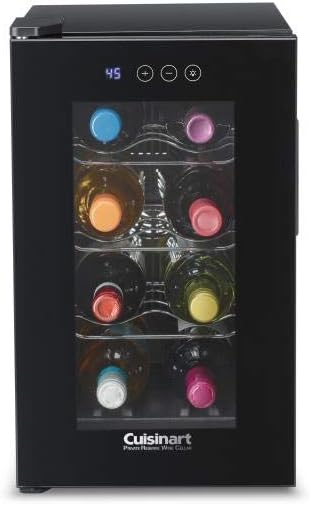
| Cooling Method | Thermoelectric |
|---|---|
| Number Of Shelves | 8 |
| Capacity | 6 liters |
| Power Source | Electric |
The Cuisinart 8-Bottle Private Reserve Wine Cellar is a small freestanding cooler designed to keep a selection of reds, whites, or sparkling wines at controlled serving temperatures. It uses a thermoelectric cooling system, which runs quietly and is more energy efficient than compressor units, and a touchscreen control with LED readout lets you set temperatures from 39°F to 68°F. Inside, contoured chrome racks and soft interior lighting make bottle access and display simple, and the unit ships with three removable racks to organize various bottle shapes. Typical use is for short- to medium-term storage and serving in an apartment, kitchen, or home bar where vibration-free, quiet operation matters. Limitations include the small 8-bottle capacity and thermoelectric cooling, which performs best in moderate ambient temperatures and is not suited for long-term cellar aging or very warm rooms. For buyers prioritizing quiet performance and a compact footprint, this is a practical countertop or freestanding option; buyers needing larger capacity or cooler performance for hot spaces should look at compressor-based models instead.
Best for: Buyers who want a quiet, energy-conscious small wine cooler to keep a few bottles at serving temperature and prefer a compact freestanding unit for a kitchen, office, or home bar.
Less Ideal for: Collectors who need long-term proper cellar conditions, those with larger collections, or people who will place the cooler in consistently hot rooms.
- Quiet thermoelectric cooling with low vibration suitable for delicate wines
- Touchscreen controls and LED display for easy temperature setting
- Soft interior lighting and contoured chrome racks for neat presentation and access
- Compact freestanding design fits small kitchens, apartments, or bars
- Only holds up to eight bottles, limiting larger collections
- Thermoelectric cooling is less effective than compressor units in very warm ambient temperatures
Verdict: Choose this Cuisinart if you want a quiet, compact 8-bottle cooler that maintains serving temperatures with energy-efficient thermoelectric performance.
Antarctic Star 0.9 Cu. Ft. Wine Cooler

| Capacity | 0.9 cubic feet |
|---|---|
| Refrigerator Net Capacity | 0.6 cubic feet |
| Temperature Range | 40-61 °F |
| Cooling Method | Compressor |
| Defrost System Type | Manual Defrost |
This Antarctic Star countertop wine cooler is a small compressor-driven fridge designed for keeping a couple of bottles or a handful of cans chilled on a counter, dorm, or office. It holds about 0.9 cu. ft. with horizontal racking that fits two standard wine bottles plus several cans, and the compressor cooling keeps temperatures steady across the advertised 40 to 61°F range. The reinforced, airtight glass door and soft blue LED interior light make it easy to see contents and help maintain humidity, while manual defrost and a compact footprint mean simple setup and placement. In real use the unit runs quietly with little vibration, so it will not disturb sediments in wine or be noisy in small rooms. Expect the limitations of very small capacity and manual defrosting, so this is best for short-term storage and display rather than larger collections or long-term aging management.
Best for: Buyers who want a compact, reliable countertop cooler to keep a few bottles or cans chilled and prefer a steady compressor-driven temperature with minimal noise.
Less Ideal for: Not a good fit for collectors needing long-term multi-bottle storage, large-capacity cooling, or fully automatic maintenance features.
- Compressor cooling keeps temperature steady across 40–61°F
- Compact countertop form fits small spaces like dorms, offices, or bars
- Quiet operation with low vibration suitable for wine storage
- Airtight glass door and LED interior light for visibility and humidity control
- Very limited capacity suitable for just a couple of bottles or a small number of cans
- Manual defrost requires occasional maintenance
Verdict: A quiet, compressor countertop cooler that reliably chills a couple of bottles or cans without taking much space.
EUHOMY Wine Cooler BR001-110

| Capacity | 3.2 cubic feet |
|---|---|
| Bottle capacity | Up to 25 standard 750ml bottles |
| Temperature range | 41°F to 64°F |
| Cooling method | Compressor |
| Door orientation | Reversible |
This EUHOMY wine cooler is a compact freestanding unit aimed at steady, long-term beverage storage. It uses a compressor cooling system with a 41 to 64°F temperature range controlled by a digital touchscreen, so you can keep reds, whites, and sparkling bottles at appropriate serving temperatures. The interior offers four chrome full-width racks, a flat shelf and a bottom compartment to fit up to 25 standard 750ml bottles and to reconfigure storage as needed. The double-layer thermopane glass door reduces temperature swings and blocks UV light, and soft LED lighting helps with visibility without harsh heat. Practical touches include adjustable leveling legs, a built-in handle and a reversible door for flexible placement under counters or freestanding in a bar or office. Expect manual defrosting and typical small-fridge energy use; for buyers prioritizing quiet, vibration-free operation the compressor is described as high-performance and low-vibration but compressor units can still be noisier than thermoelectric models. The unit is supported by a one-year warranty and arrives with a user manual for setup and operation.
Best for: Buyers who want a compact, reliable freestanding cooler for steady storage of a small to medium wine collection and value precise temperature control and flexible placement.
Less Ideal for: Those seeking a zero-maintenance built-in cellar replacement, ultra-low energy operation, or very large bottle capacity should consider larger or different-style units.
- Compressor cooling with a wide 41–64°F range for storing different wine styles
- Double-pane glass door that insulates and blocks UV to protect wine quality
- Adjustable shelves and mix of racks allow flexible storage up to 25 standard bottles
- Digital touchscreen control and internal LED lighting simplify temperature monitoring and viewing
- Reversible door and leveling legs make placement under counters or freestanding easier
- Manual defrost requires occasional user maintenance
- Annual energy consumption is relatively high compared with the smallest thermoelectric units
Verdict: A compact, compressor-cooled freestanding wine cooler that delivers precise temperature control and flexible storage for a small commercial or bar setting.
Choosing the Right Wine Cooler for Long Term Storage: Key Factors to Consider
Temperature Stability
Long-term storage demands a cooling system that holds a setpoint within a narrow band day after day. Fluctuations accelerate aging and can cause corks to expand and contract, allowing oxygen ingress. Look for clearly stated temperature tolerances and features like dual-zone zoning only if each zone maintains independent stability.
Think about the expected ambient conditions where the cabinet will sit. Units that struggle to maintain setpoint in warm rooms are poor candidates for storage. Consistent internal airflow and reliable thermostatic control are key to avoiding slow, damaging temperature swings over months or years.
Vibration Control
Vibration disturbs sediments and interferes with the subtle chemical reactions behind bottle maturation. Compressors and internal fans are the main vibration sources. For long-term storage, prioritize designs with vibration-damping mounts, low-speed compressors, or well-isolated fan assemblies.
If you plan to store older or fine wines, even small, continuous vibrations can be detrimental. Consider placement too: cabinets set on rigid, stable flooring with rubber feet minimize transmitted vibration compared with units on hollow supports.
Humidity Management
Maintaining moderate humidity helps corks stay pliable and maintain a seal, preventing oxygen from entering bottles. Ideal cellar humidity typically sits in the 50 to 80 percent range. Some coolers offer active humidity control, while many rely on passive retention through interior materials and minimized airflow.
Assess how the unit handles long idle periods; cabinets with tight seals and a design that limits excessive moisture loss are preferable. If you live in a very dry climate, plan for supplemental humidity solutions if the chosen cooler does not provide active control.
Light Protection
Ultraviolet and visible light exposure can degrade wine aromas and lead to off-flavors. Glass doors are common for display, but UV-filtering glass and recessed lighting reduce risk. For long-term storage, solid doors are the safest, though well-designed glass doors with proven UV protection are an acceptable compromise when visibility matters.
Check lamp type and placement. Interior bright LEDs or bulbs that remain off except when accessing bottles limit cumulative light exposure and are preferable for storage applications.
Interior Layout and Capacity
A usable storage layout is about more than maximum bottle count. Shelf spacing, orientation, and the ability to store a mix of bottle sizes determine how well a cooler supports a long-term cellar. Look for shelving that allows horizontal storage with minimal contact on corks and that supports stable stacking without pressure points.
Also consider future needs. A unit that fills quickly with standard bottles may lack flexibility for larger-format bottles or horizontal organization. Durable shelves and the option to reconfigure space add longevity and usefulness for a growing collection.
Build Quality and Serviceability
For long-term use, the cabinet must be constructed from materials that withstand years of operation and resist corrosion in humid interiors. Good insulation, solid door seals, and robust mechanical components reduce the likelihood of premature failure. Serviceability matters too: designs that allow access for routine maintenance or repairs extend usable life.
Consider warranty coverage and documented maintenance procedures. Even without a specific brand reference, prioritize units with straightforward user-serviceable parts and clear diagnostics to reduce downtime if issues arise during long storage periods.
Why Long-Term Storage Differs From Serving
Storage-grade conditions focus on slow, controlled evolution of the wine rather than immediate drinking temperature. That means more emphasis on stability over months and years, less on rapid cooling or presentation features.
Serving fridges often cycle frequently to maintain a ready-to-serve temperature and may use brighter interior lighting. Those behaviors are counterproductive for bottles you intend to cellar because they increase temperature swings and light exposure.
- Storage units prioritize steady-state control over quick cooldown.
- Interior lighting is usually minimal or off by default in storage-focused designs.
- Shelving is arranged for horizontal, low-disturbance storage.
Single-Zone Vs Dual-Zone for Long-Term Care
Dual-zone cabinets let you maintain two different setpoints, which can be convenient if you regularly age both reds and whites. However, complexity can introduce more points of failure and inconsistent stability between zones.
Single-zone coolers often provide better uniformity across the interior and are easier to monitor for long-term storage. If you choose dual-zone, verify that each zone has independent temperature control and stability data.
- Choose single-zone for maximum uniformity and simplicity.
- Use dual-zone only if you need genuinely different long-term setpoints in separate compartments.
Placement and Installation Tips
Position the cooler away from direct sunlight and heat sources. Ambient room temperature affects how hard the unit must work to maintain setpoint. Leave recommended clearances for ventilation and avoid cramped spots that trap heat.
Place the cooler on a stable, level floor and avoid surfaces that transmit vibration, such as hollow platforms. If possible, keep some empty space in front of the unit to allow door opening without dislodging bottles.
- Keep at least the manufacturer-recommended clearance for airflow.
- Avoid placing the unit against a wall that gets afternoon sun.
- Use rubber isolation pads if floor vibration is a concern.
Humidity Solutions for Dry Climates
If you live where indoor air is dry, corks can shrink and allow oxygen ingress. Active humidity control in a cooler is ideal but not always available. A simple remedy is a small humidity tray or a humidity pack placed inside the unit to raise local humidity without risking mold.
Monitor humidity with a compact hygrometer placed on a middle shelf. Adjust as needed and inspect corks periodically for signs of drying.
- Consider passive moisture-retention accessories if active control is absent.
- Check cork condition yearly for collections in dry environments.
Monitoring and Maintenance
Long-term storage requires periodic checks rather than constant intervention. Keep a simple log of internal temperature and humidity readings to spot trends. Address any persistent drift quickly to avoid prolonged exposure outside the desired range.
Routine maintenance like cleaning condensers, checking door seals, and ensuring shelves remain level can prevent many common failures. Replace failing fans or worn gaskets promptly to maintain the environment.
- Record temperature and humidity weekly or monthly depending on volatility.
- Inspect seals and mechanical components every six months.
How We Chose the Best Wine Cooler for Long Term Storage
We prioritized models with the features that directly affect how wine ages in storage. Key evaluation criteria included temperature stability over long periods, vibration damping to protect sediments and delicate tannin structures, humidity control or passive retention to keep corks healthy, and UV protection to prevent light-struck flavors. We also assessed interior layout and bottle capacity for realistic cellar spacing, plus construction quality that supports long-term operation and serviceability. We excluded short-term cooling units and wine fridges designed only for serving; those often emphasize speed and aesthetics over sustained environmental control. We also filtered out units without clear temperature hysteresis specifications or that lack vibration-mitigation design. The resulting list emphasizes devices built for steady operation, precise controls, and physical features that support aging rather than immediate serving.
Our full evaluation process is outlined in our review methodology.
FAQ
How cold should I set a wine cooler for long-term storage?
Aim for a steady setpoint in the cellar range, typically around 50 to 55 degrees Fahrenheit. The exact choice depends on the wines you store, but consistency is more important than the specific number.
Can I store both red and white wine in the same long-term cooler?
You can if the wines share a compatible cellar temperature. Dual-zone units allow separate setpoints, but single-zone coolers often maintain stability better. If you store both, choose a compromise temperature and monitor how wines age.
How important is UV protection for long-term bottle storage?
UV protection is important because cumulative light exposure degrades aromas and can cause off-notes. For long-term storage, aim for UV-filtering glass or minimal interior lighting, and avoid direct sunlight on the cabinet.
Do I need active humidity control inside a wine cooler?
Active humidity control helps but is not strictly necessary if the unit has tight seals and you can supplement humidity when needed. In very dry climates, plan for passive solutions or small humidifiers to keep corks from drying.
How often should I check stored bottles?
Check environmental readings monthly and inspect bottle condition, corks, and seals every six to twelve months. More frequent checks are wise when you first set up the cooler or after maintenance.
Final Verdict
For long-term bottle aging, prioritize steady temperature control, effective vibration mitigation, and a storage-friendly interior above decorative features. Humidity management and light protection are also critical to preserve corks and aromas over years. Balance capacity needs with the cabinet construction and serviceability to ensure the unit can maintain cellar-like conditions with minimal intervention. Choose the cooler that best matches your desired storage conditions and floor plan while recognizing the tradeoffs between complexity and long-term stability. A simpler, well-built unit that holds a precise setpoint will generally outperform a feature-rich model that cannot maintain consistent conditions for extended periods.