
Note: This article contains affiliate links. If you click on these links and make a purchase, we may earn a small commission at no extra cost to you. This helps support our research and content. Read our full affiliate disclosure here.
If you collect or regularly enjoy Pinot Noir, choosing the right wine cooler matters more than picking any ordinary beverage fridge. Pinot Noir is thinner-bodied and more temperature-sensitive than many other wines, so small swings in temperature or low humidity can dull aroma, hasten oxidation, and shorten cellar life. A dedicated wine cooler designed for Pinot Noir bottles helps maintain consistent cellar-like conditions that protect delicate red-fruit aromatics and elegant tannin structure. This guide covers seven carefully shortlisted wine coolers that are suited to storing Pinot Noir bottles. We focused on units that deliver precise temperature control, steady humidity, vibration reduction, and appropriate storage capacity. Read on for the evaluation criteria and practical tips to match a unit to your collection and space.
Top Picks at a Glance
| Best Overall The best all-around choice for most situations | Ivation 12-Bottle Wine Cooler |  |
| Best Quality Built to a higher standard if you want something more solid | Ca'Lefort 24" Wine Fridge CLF-WS24 |  |
| Best Value The sweet spot between price and what you get | Koolatron 6 Bottle Wine Fridge WC06 |  |
| Best Budget The cheapest option that still gets the job done reliably | RibasuBB 8-Bottle Wine Cooler |  |
| Top Rated A top-rated pick with lots of positive feedback | Cuisinart 8-Bottle Wine Cellar CWC-800CEN |  |
| Most Popular A crowd favorite that many people choose with confidence | Antarctic Star Wine Cooler 3.2cu ft |  |
| Best Seller A high-volume bestseller chosen again and again | EUHOMY 18L Wine Fridge |  |
Ivation 12-Bottle Wine Cooler
| Capacity | 1.2 cubic feet |
|---|---|
| Temperature Range | 41-64°F |
| Power | 95W / 1.2 Amps |
| Cooling Method | Compressor |
| Refrigerant | R-600A |
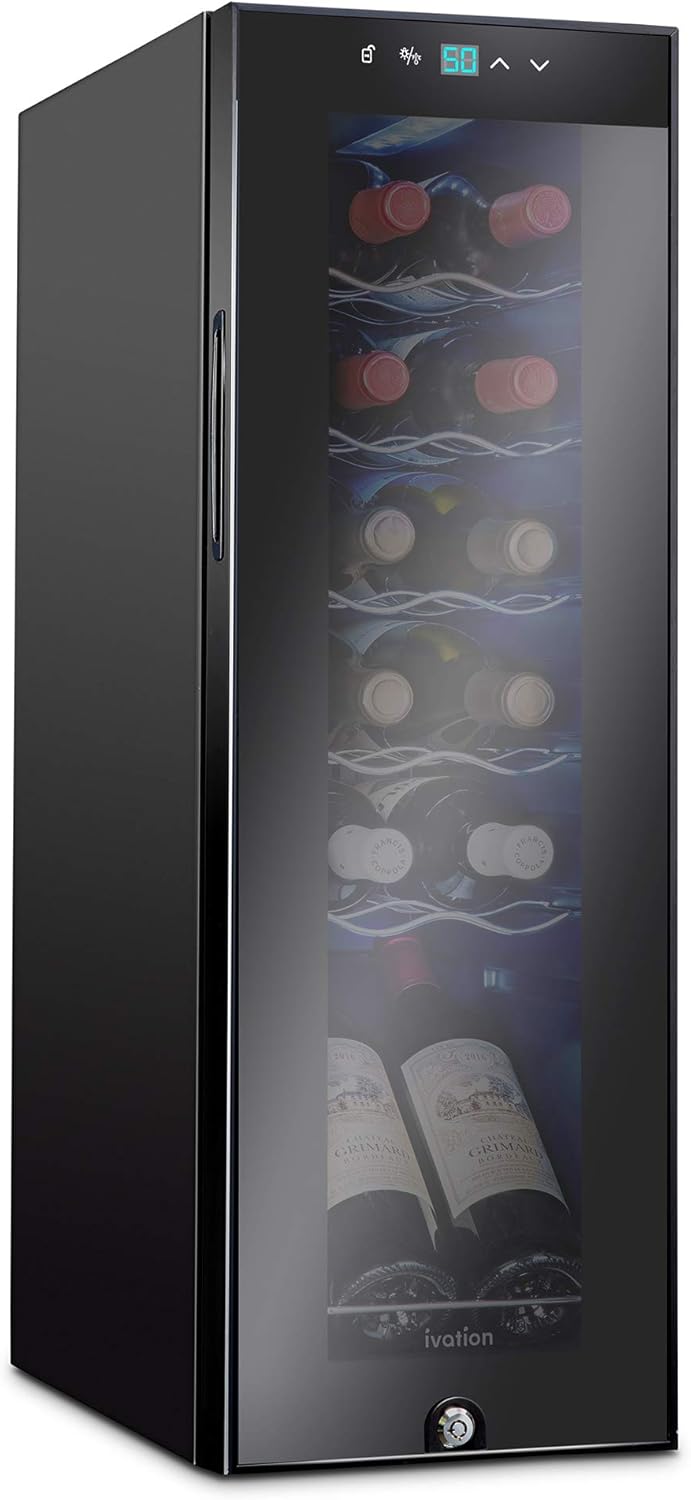
This Ivation 12-bottle cooler uses a compressor cooling system and internal fan to hold a stable 41–64°F range, making it suitable for both chilling and longer-term storage. It installs freestanding and has six removable wire racks so you can fit standard 750 ml bottles or rearrange for larger formats. The digital touch display shows temperature in Fahrenheit or Celsius and can be locked to prevent accidental changes, while the double-paned UV-resistant glass and rubber gasket help keep light and air out. Vibration-reducing compressor operation preserves sediment and the interior LED provides soft illumination for inspections without harsh heat. As a compact unit it draws modest power (rated 95W) and includes a keyed lock for security. Limitations include a small 1.2 cu ft capacity that restricts larger fermentation batches and single-zone control that prevents separate temperature settings for multiple products. The unit is best when you need a reliable, quiet compressor fridge with precise temperature stability in a compact footprint rather than a higher-capacity or dual-zone system.
Best for: Buyers seeking a compact, performance-focused compressor fridge that holds steady temperatures for precise fermentation or small-batch aging and who prioritize stability and quiet operation.
Less Ideal for: Those who need higher capacity, multiple temperature zones, or to run several fermentations at different setpoints simultaneously should look at larger or dual-zone units.
- Compressor cooling with inverter ensures stable, low temperatures suitable for fermentation control.
- Wide adjustable temperature range (41–64°F) with digital touch controls and lock for set-and-forget operation.
- Double-paned UV-resistant glass and airtight gasket protect contents from light and external air.
- Removable wire racks allow flexible bottle arrangement and easier cleaning.
- Quiet, vibration-reducing operation that minimizes disturbance to sediments or sensitive contents.
- Small 1.2 cubic foot capacity limits the number and size of fermentation vessels you can fit.
- Single temperature zone cannot maintain different temperatures for multiple simultaneous projects.
Verdict: Choose this cooler when you want a compact, compressor-driven fridge that delivers stable, low-temperature control for small-batch fermentation and precision cooling.
Ca'Lefort 24" Wine Fridge CLF-WS24

| Capacity | 5.65 cubic feet |
|---|---|
| Bottle capacity | 61 Bottle |
| Temperature range | 40-65°F |
| Installation type | Built-in, Under Counter, Freestanding |
| Cooling method | Compressor (rotary scroll) |
The Ca'Lefort 24" Wine Fridge is a built-in undercounter cooler aimed at home collectors who want a reliable, mid-size storage unit. It uses a rotary scroll compressor with automatic defrost and front ventilation to maintain an adjustable 40 to 65°F range via a digital control panel, and the double-glazed stainless steel door with UV protection helps limit light exposure. Six removable sapele wood shelves make organizing standard 750ml bottles and a few larger-format bottles straightforward, and three-color LED lighting gives simple display options. Practical touches include power-failure memory, low-noise operation, and a front vent that allows true built-in installation. Expect solid temperature stability for everyday aging and serving, though the unit is single-zone so it is best when storing similar styles at one setpoint rather than both whites and reds at their ideal temps. The finish and door framing read as higher-end for the price range, but buyers who need dual-zone flexibility or a larger capacity should look elsewhere.
Best for: Buyers who want a reliable undercounter wine fridge that balances capacity, temperature control, and a refined look for a home bar or kitchen installation.
Less Ideal for: Collectors who need dual-zone control for storing whites and reds separately or those wanting very large long-term storage capacity.
- Holds up to 61 standard 750ml bottles, suitable for medium-sized collections
- Digital temperature control with 40–65°F range and power-failure memory
- Double-glazed stainless steel door with UV protection to reduce light exposure
- Front ventilation and built-in installation option fit undercounter spaces
- Removable wooden shelves that adjust for different bottle sizes
- Single-zone cooling limits storing whites and reds at different temperatures
- No lock included for security
Verdict: A well-rounded 24-inch undercounter wine fridge that delivers solid temperature stability and good capacity for home collectors who store one primary wine style.
Koolatron 6 Bottle Wine Fridge WC06
| Cooling Method | Thermoelectric |
|---|---|
| Capacity | 0.6 cubic feet |
| Temperature Range | 46-66°F (8-18°C) |
| Included Components | 2 Removable Wire Shelves |
| Installation Type | Freestanding; Counter Top |
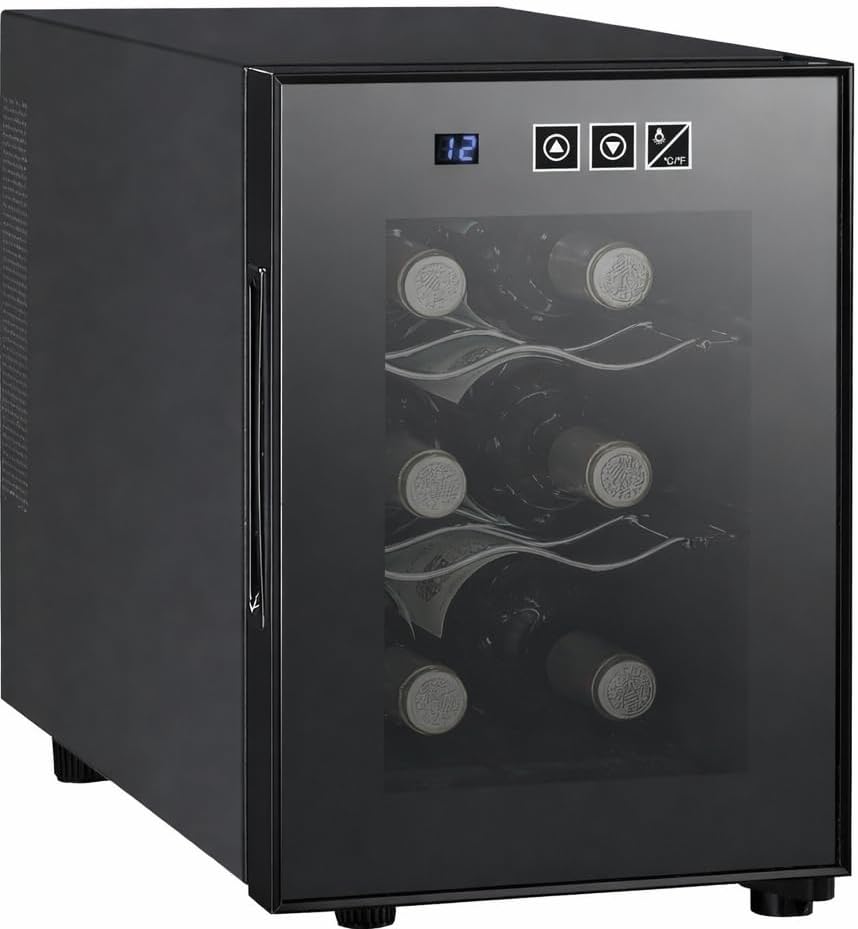
The Koolatron 6 Bottle Wine Fridge is a small countertop thermoelectric cooler that keeps up to six standard wine bottles at serving temperatures between 46 and 66°F. It is typically used on a countertop, sideboard, or in tight spaces where a full-size cellar would not fit, and it runs quietly with vibration-free cooling to avoid disturbing bottle sediment. Key features include external touch screen digital controls for setting temperature and the interior LED light, two removable wire racks for different bottle shapes, and a mirrored double-pane door that blocks UV light. Practical benefits are its compact footprint and simple controls that make it easy to store ready-to-serve bottles close at hand, plus the low-noise thermoelectric system that is suitable for living spaces. The main limitations are the small capacity and single-zone cooling, so it cannot store a larger collection or maintain different temperatures for reds and whites simultaneously, and thermoelectric cooling is less effective than compressor units in very warm rooms.
Best for: Buyers who want a space-saving, easy-to-use countertop cooler to keep a handful of bottles at serving temperature and value quiet operation and simple digital controls.
Less Ideal for: Collectors who need larger capacity, separate temperature zones, or strong cooling performance in very warm rooms should consider larger compressor-based units.
- Compact countertop design fits small kitchens, apartments, and offices
- Digital external touch controls and LED light for easy temperature management
- Mirrored double-pane glass door provides UV protection
- Quiet, vibration-free thermoelectric cooling preserves sediment and reduces noise
- Only six-bottle capacity limits storage to a few ready-to-serve bottles
- Single-zone cooling cannot hold different wines at different temperatures
Verdict: A compact, quiet countertop wine cooler that keeps a small selection of bottles at serving temperature with easy digital controls.
RibasuBB 8-Bottle Wine Cooler

| Cooling Method | Thermoelectric |
|---|---|
| Temperature Range | 46.4-64.4°F |
| Capacity | 8 Bottle |
| Power Source | Corded Electric |
| Number Of Shelves | 4 |
This compact freestanding wine cooler stores up to eight bottles on four removable shelves and uses a thermoelectric cooling system with a digital LED display and touch controls to set temperatures between about 46 and 64 degrees Fahrenheit. It is designed for countertop or floor placement and includes an interior blue LED light so you can check bottles without opening the door. The removable shelves make it easy to fit different bottle shapes, and the built-in key lock adds a basic security option. Thermoelectric cooling runs quietly and avoids compressor vibration that can disturb sediments, but it is best suited for short- to medium-term storage rather than long-term cellar aging, especially in warm rooms. Setup is simple since it is a plug-in freestanding unit and adjustable feet help level it on uneven surfaces. Expect modest power draw for a small unit and keep it out of direct sunlight to maintain stable temperatures.
Best for: Buyers who want an affordable, space-saving wine cooler for everyday chilled wine at home or in a small office and prioritize quiet operation and simple controls.
Less Ideal for: People seeking a long-term wine cellar, large-capacity storage, or precise cooling in very warm rooms should consider larger compressor-based models instead.
- Compact footprint fits on counters or small floor spaces
- Digital temperature control with readable LED display for precise set points
- Removable shelves accommodate different bottle sizes
- Thermoelectric cooling operates quietly and reduces vibration
- Interior LED light lets you view bottles without opening the door
- Thermoelectric cooling is less effective than compressor units in hot environments
- Limited capacity not suitable for larger collections
Verdict: A budget-friendly, quiet countertop wine cooler that keeps a small home collection chilled with straightforward digital controls.
Cuisinart 8-Bottle Wine Cellar CWC-800CEN
| Cooling Method | Thermoelectric |
|---|---|
| Number Of Shelves | 8 |
| Capacity | 6 liters |
| Power Source | Electric |
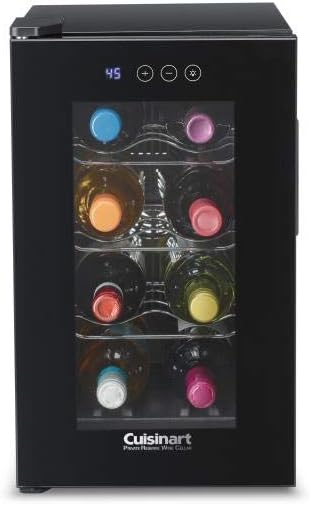
The Cuisinart 8-Bottle Private Reserve Wine Cellar is a small freestanding cooler designed to keep a selection of reds, whites, or sparkling wines at controlled serving temperatures. It uses a thermoelectric cooling system, which runs quietly and is more energy efficient than compressor units, and a touchscreen control with LED readout lets you set temperatures from 39°F to 68°F. Inside, contoured chrome racks and soft interior lighting make bottle access and display simple, and the unit ships with three removable racks to organize various bottle shapes. Typical use is for short- to medium-term storage and serving in an apartment, kitchen, or home bar where vibration-free, quiet operation matters. Limitations include the small 8-bottle capacity and thermoelectric cooling, which performs best in moderate ambient temperatures and is not suited for long-term cellar aging or very warm rooms. For buyers prioritizing quiet performance and a compact footprint, this is a practical countertop or freestanding option; buyers needing larger capacity or cooler performance for hot spaces should look at compressor-based models instead.
Best for: Buyers who want a quiet, energy-conscious small wine cooler to keep a few bottles at serving temperature and prefer a compact freestanding unit for a kitchen, office, or home bar.
Less Ideal for: Collectors who need long-term proper cellar conditions, those with larger collections, or people who will place the cooler in consistently hot rooms.
- Quiet thermoelectric cooling with low vibration suitable for delicate wines
- Touchscreen controls and LED display for easy temperature setting
- Soft interior lighting and contoured chrome racks for neat presentation and access
- Compact freestanding design fits small kitchens, apartments, or bars
- Only holds up to eight bottles, limiting larger collections
- Thermoelectric cooling is less effective than compressor units in very warm ambient temperatures
Verdict: Choose this Cuisinart if you want a quiet, compact 8-bottle cooler that maintains serving temperatures with energy-efficient thermoelectric performance.
Antarctic Star Wine Cooler 3.2cu ft

| Capacity | 3.2 cubic feet |
|---|---|
| Cooling Method | Compressor |
| Temperature Range | 32°F–61°F |
| Number Of Shelves | 4 |
| Lock Type | Key |
This Antarctic Star wine cooler is a compact single-zone unit designed for home, office, or bar use where consistent, everyday storage is the priority. It cools with a compressor system across a working range of 32°F to 61°F and offers digital temperature control so you can set and maintain a target for long-term bottle storage or beverage chilling. The clear glass door, airtight seal, and internal LED light make bottles easy to see while helping retain humidity, and four adjustable wire shelves create flexible horizontal racking for up to 26 standard bottles or stacked cans. It is built as a freestanding unit with leveling legs and a keyed lock for security, and the brand highlights low vibration and a quiet compressor, which helps protect wine sediment and keeps noise down in living spaces. Trade-offs are its manual defrost system and relatively small 3.2 cu ft capacity, so it is best where steady, reliable cooling for a moderate collection matters more than large-capacity or multi-zone precision.
Best for: Buyers who prioritize dependable, stable single-zone cooling for a modest wine or beverage collection and want a compact freestanding unit that runs quietly in living or entertaining spaces.
Less Ideal for: Collectors who need multi-zone temperature control or those who need to store a large number of bottles should look for larger or dual-zone models.
- Compressor cooling with 32°F–61°F range and digital temperature control for stable single-zone storage
- Quiet, low-vibration operation that protects bottle sediment
- Clear glass door with airtight seal and interior LED lighting for visibility and humidity retention
- Adjustable wire shelves allow flexible horizontal racking for bottles or cans
- Freestanding design with leveling legs and keyed lock for security
- Manual defrost requires occasional user maintenance
- Capacity is limited to a moderate 3.2 cu ft, not suitable for large collections
Verdict: A reliable, quiet single-zone cooler that keeps a moderate collection at stable temperatures for home use.
EUHOMY 18L Wine Fridge
| Capacity | 18 liters |
|---|---|
| Cooling Method | Compressor |
| Temperature Range | 40°F to 61°F |
| Number Of Shelves | 1 |
| Installation Type | Countertop |
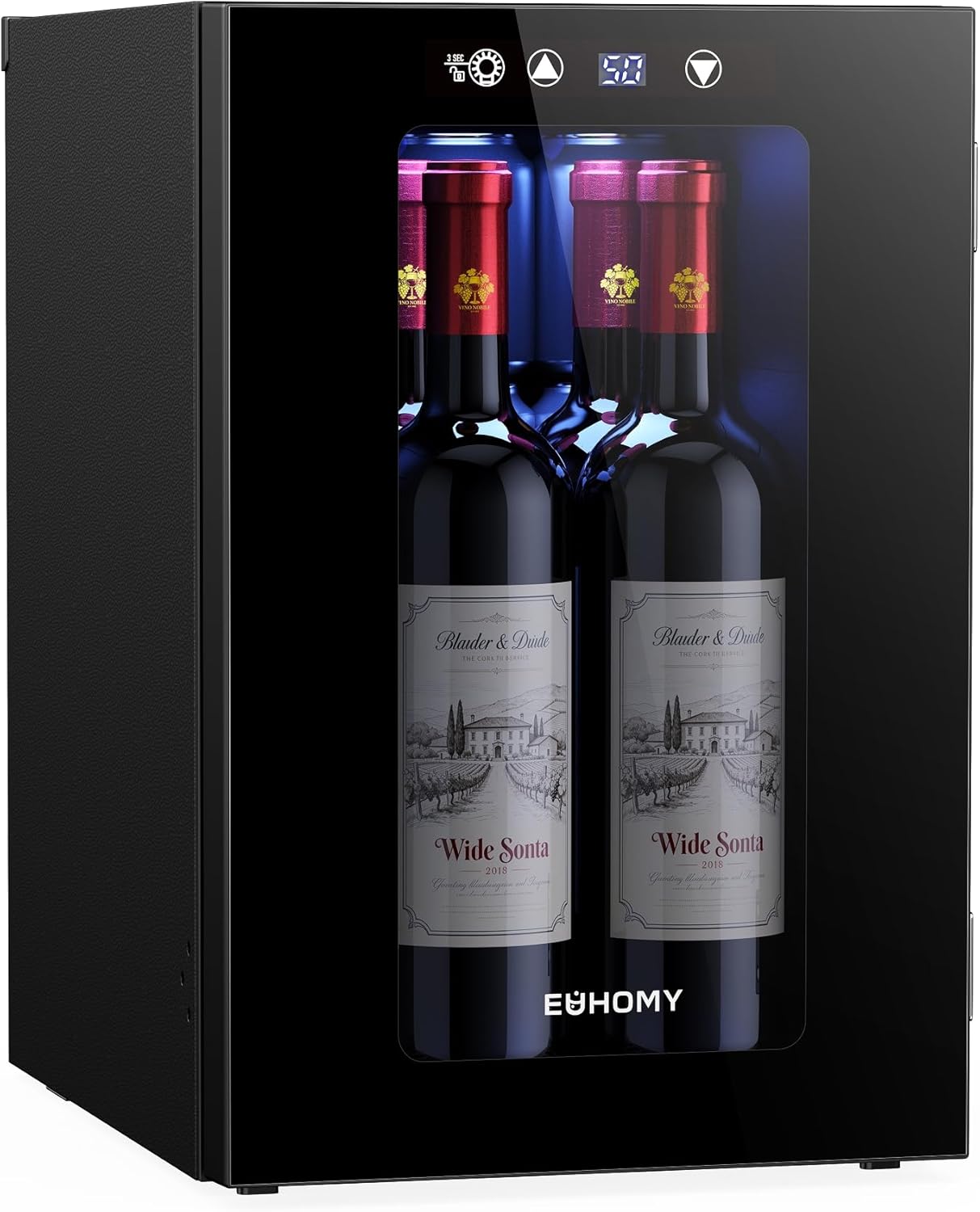
The EUHOMY 18L Wine Fridge is a small compressor-cooled cooler designed for countertop or freestanding use to store a handful of bottles and cans. It offers a digital touchscreen that sets temperatures between 40°F and 61°F, a double-pane glass door with LED interior lighting, and one removable shelf so you can fit bottles or stacks of cans. The compressor system provides steady cooling and the manufacturer states quiet operation around 38 dB, which helps the unit sit beside a bar, office, or kitchen without creating a constant noise nuisance. Practical benefits include the ability to keep red, white, sparkling wine, or beer at ready-to-serve temperatures and the compact footprint that fits tight spaces. Limitations to expect are the very small 18 L capacity that only holds about four 750 ml bottles or up to two dozen cans when arranged differently, manual defrosting, and a single door orientation without reversible mounting, so placement options are somewhat constrained.
Best for: Buyers who want a reliable, compact cooler to keep a small selection of wines or beverages at controlled serving temperatures without complicated setup or large space requirements.
Less Ideal for: Those who need to store larger collections, organize many bottle sizes, or require a built-in undercounter installation should look at larger-capacity or different-format coolers.
- Digital touchscreen with adjustable 40°F–61°F temperature range for precise control
- Compressor cooling for consistent, dependable chilling compared with thermoelectric units
- Compact countertop form that fits small kitchens, dorms, or home bars
- Double-pane glass door with LED lighting showcases contents while blocking UV rays
- Very limited 18 L capacity suitable for only a few bottles or a small can stash
- Manual defrost requires occasional maintenance and can be inconvenient
Verdict: A compact, compressor-cooled countertop wine fridge that delivers quiet, accurate temperature control for buyers who need dependable short-term storage for a few bottles.
Choosing the Right Wine Cooler for Pinot Noir Bottles: Key Factors to Consider
Temperature Range and Precision
Pinot Noir benefits from a narrow cellar range, typically a few degrees cooler than many room-temperature reds. Look for a cooler that allows precise setpoints and holds them consistently across the cabinet. Precision matters for both ready-to-drink bottles and those intended for short- to medium-term aging. Tight control reduces the risk of thermal cycling that accelerates chemical changes and dulls subtle aromatics.
Consider whether the unit uses a compressor, dual-zone compressor, or thermoelectric system, and how those technologies perform at your ambient room temperatures. If you keep your cooler in a warm room, choose a system that maintains set temperature under higher ambient load.
Humidity Control and Cork Health
Proper humidity keeps natural corks from drying out, which prevents oxygen ingress and premature oxidation. Some wine coolers include active humidity control or stable enclosed environments that preserve higher relative humidity. Even without active humidifiers, a unit with minimal air exchange and good sealing will better retain humidity.
If your ownership plan includes multi-year cellaring, prioritize models or placement strategies that maintain relative humidity between roughly 50 and 80 percent. For shorter-term storage, minimizing rapid humidity swings is still important to protect labels and foil.
Vibration Dampening and Quiet Operation
Vibration can disturb sediment and subtly accelerate molecular interactions that affect aroma and flavor, especially for delicate wines like Pinot Noir. Quiet, low-vibration compressors or thermoelectric systems are preferable. Check for rubber mounts, isolated compressors, or other design features that reduce continuous vibrations.
Noise level also affects where you can place the cooler in your home. If it will sit in a living area or open kitchen, quieter operation preserves the environment and avoids drawing attention to the unit.
Rack Design and Bottle Fit
Pinot Noir bottles are often Burgundy-style, which are slightly wider in the shoulders and sometimes have different neck proportions than Bordeaux-style bottles. Ensure rack depth and shelf spacing accommodate these shapes without forcing bottles at odd angles. Adjustable shelving or removable racks give flexibility for mixed bottle sizes and for organizing bottles by vintage or region.
Sliding shelves that allow easy access reduce the chance of accidentally knocking adjacent bottles during retrieval. Durable, non-reactive materials for racks are preferable to avoid imparting odors.
Capacity Relative to Use Case
Think realistically about how many bottles you currently own and how that collection is likely to grow. A small countertop unit may suit a casual drinker who stores open bottles and a few bottles ready to drink. Enthusiasts or collectors who cellar several vintages need larger, freestanding units with stable internal environments and room for rotation.
Also consider footprint and ventilation clearance. A larger capacity unit requires more space and often more ventilation area; freestanding coolers usually need clearance around the back and top, while built-in units require front-venting designs.
Energy Use and Long-Term Reliability
Wine coolers run continuously, so energy efficiency affects operating cost and heat output. Look for systems with efficient compressors and good insulation to reduce runtime. Reliability is also critical; a unit that fails can ruin a cellar. Prioritize proven cooling methods and simpler controls if long-term reliability and ease of repair are important.
Consider maintenance needs such as filter cleaning, defrost cycles, and gasket longevity when projecting the total cost of ownership and convenience of upkeep.
Single-Zone Vs Dual-Zone for Pinot Noir
Choose a single-zone cooler if you plan to store primarily Pinot Noir at a consistent serving or cellar temperature. Single-zone units usually offer the best temperature stability across a single compartment and are simpler to operate. They are a practical choice when the collection is focused on similar styles and aging windows.
Dual-zone coolers are useful when you regularly store different wine types at separate temperatures, for example holding Pinot Noir in one zone and white burgundies or sparkling wines in the other. If your collection often mixes red and white or you need both cellar and serving temperatures simultaneously, a dual-zone unit gives flexibility at the cost of more complex airflow management.
- Single-zone: Simpler, often more stable for a single wine style
- Dual-zone: Flexible for mixed collections but may require careful placement of bottles
Placement and Ventilation Tips
Where you put the cooler changes how well it performs. Avoid direct sunlight and locations near heat sources that force the system to work harder. Allow recommended clearance around vents and, for built-in installations, confirm the unit offers front ventilation so it can draw and exhaust air without overheating.
When positioning the cooler in a living area, consider a quieter model or look for vibration-damping features to minimize disturbance. Level the appliance carefully to prevent internal vibration and ensure proper door seal engagement.
- Keep away from ovens, radiators, and sunny windows
- Provide manufacturer-recommended clearance for airflow
- Level the unit and check gasket seals regularly
Organizing Bottles for Access and Aging
Organize bottles by vintage, producer, or drinking window to make retrieval easy and to minimize handling. Store long-term aging bottles toward the back and rotation bottles in front. Use labels or a simple inventory sheet to track what is cellared where, especially in larger units.
Rotate stock occasionally to check cork condition and to let wines settle after any movement. Keep bottles lying on their side when using natural corks to keep the cork moist and airtight.
- Group by drinking window to avoid unnecessary movement
- Keep long-term bottles toward the back
- Label rows or use a simple inventory system
Maintaining Optimal Conditions Over Time
Monitor internal temperature and humidity periodically with independent sensors if your unit does not include reliable displays. Small electronic thermometers and hygrometers are inexpensive and give peace of mind that setpoints are being met.
Clean and inspect the cooler on a seasonal basis. Check door gaskets for seal integrity, clean shelves, and ensure condensate drains or defrost systems are functioning. Regular light maintenance preserves internal conditions and prolongs the equipment life.
- Use an external thermometer/hygrometer for double-checking
- Inspect gaskets and seals periodically
- Perform seasonal cleaning and check ventilation
Storing Open Bottles and Short-Term Serving
If you frequently open bottles and want to store them short-term, some wine coolers can maintain a stable environment for open bottles for a few days. For Pinot Noir, reseal bottles with inert-preservation systems or airtight stoppers and keep them slightly cooler than serving temperature to slow oxidation.
Short-term storage strategies differ from long-term cellaring. If you will often keep partially consumed bottles, consider a unit with easy access shelving and steady temperature control rather than max capacity alone.
- Use tight stoppers or inert gas to preserve opened bottles
- Store open bottles slightly cooler than serving temperature
- Prioritize easy-access shelves for frequently used bottles
How We Chose the Best Wine Cooler for Pinot Noir Bottles
We focused on criteria that matter specifically when storing Pinot Noir, a grape variety that benefits from narrow temperature ranges and gentle handling. First, temperature stability was a primary filter; we prioritized units capable of holding setpoints with minimal fluctuation across the usable capacity. Second, humidity control and air circulation were assessed to ensure corks remain hydrated and mold risk is minimized. Third, vibration isolation and low-noise operation were considered because mechanical agitation can disturb sediment and accelerate chemical changes in delicate wines. Capacity and racking flexibility were also evaluated so bottles of varying shapes and the standard Burgundy-style Pinot Noir bottle can be accommodated without wasted space. Energy efficiency and reliable compressors or quality thermoelectric systems were weighed for long-term running costs and heat management. Finally, build quality and materials that avoid strong odors or off-gassing were required. We excluded general beverage refrigerators that lack temperature precision, units with poor documented stability, and designs that do not safely fit standard Pinot Noir bottle shoulders. The shortlist reflects products that met these performance and storage-focused filters while offering clear tradeoffs between capacity, footprint, and control precision.
Our full evaluation process is outlined in our review methodology.
FAQ
What is the ideal temperature for storing Pinot Noir in a wine cooler?
Pinot Noir typically stores well a few degrees cooler than many room-temperature reds. A target range around 50 to 55 degrees Fahrenheit is common for medium-term cellaring, while slightly warmer settings near 55 to 60 degrees work for bottles you plan to drink in the near term. Consistency is more important than the exact degree.
Do I need humidity control in a wine cooler for Pinot Noir?
Humidity control helps keep natural corks from drying and reduces oxidation risk. While many enclosed wine coolers maintain acceptable humidity passively, active humidity control or a well-sealed cabinet is beneficial if you plan to cellar bottles for several years.
Can I store different bottle shapes, like Burgundy-style Pinot bottles, in a standard wine cooler?
Many wine coolers accommodate Burgundy-style bottles, but rack spacing and shelf depth vary. Look for adjustable or removable racks and check internal dimensions to ensure shoulder width and bottle depth are compatible with Pinot Noir bottle shapes.
Is a thermoelectric cooler adequate for Pinot Noir storage?
Thermoelectric units can be quiet and vibration-free, and they work well in stable, moderate ambient temperatures. However, they may struggle to maintain set temperatures in hot rooms or at larger capacities. For strict temperature stability in variable environments, a compressor-based system often performs better.
How much capacity should I buy for a growing Pinot Noir collection?
Match capacity to your current inventory plus realistic growth for the next few years. If you plan to cellar multiple vintages, choose a larger unit with flexible racking. For casual collectors, a smaller unit that stores 12 to 24 bottles may suffice.
Will vibration from the cooler affect my Pinot Noir?
Continuous vibration can disturb sediment and may subtly impact aging. Look for designs with vibration-damping features such as rubber mounts, isolated compressors, or thermoelectric systems to minimize movement.
Final Verdict
When selecting a wine cooler for Pinot Noir bottles, prioritize steady, narrow temperature control and conditions that preserve cork health. Balance capacity and rack flexibility with the level of precision and quiet operation you need. Expect tradeoffs between footprint and control: smaller single-zone units often deliver better stability for a focused collection, while larger or dual-zone systems add flexibility for mixed wines. Decide whether your priority is long-term cellaring or short-term serving, then choose a unit that matches that use case and the bottle shapes in your collection. With the right cooler, you can protect Pinot Noir's delicate aromas and give each bottle the conditions it needs to age gracefully.