
Note: This article contains affiliate links. If you click on these links and make a purchase, we may earn a small commission at no extra cost to you. This helps support our research and content. Read our full affiliate disclosure here.
If you drink and store red wines regularly, selecting the right wine cooler makes a meaningful difference in how bottles age and how they taste when opened. A unit tuned for red wine keeps serving and cellar temperatures steady, limits vibration and UV exposure, and manages humidity so corks stay healthy. This guide narrows the field to seven carefully shortlisted wine coolers for red wine, each evaluated on storage layout, temperature control, and vibration management. Below we walk through the factors that matter when storing red wine at home, explain how we judged units, and outline practical tips for rack layout and placement. Use the quick product summaries to find the cooler that matches how many bottles you keep, where you plan to install it, and whether long-term aging or frequent serving is your priority.
Top Picks at a Glance
| Best Overall The best all-around choice for most situations | Icyglee 25-Bottle Wine Cooler |  |
| Best Quality Built to a higher standard if you want something more solid | Velivi Dual-Zone Wine Fridge |  |
| Best Value The sweet spot between price and what you get | EUHOMY Wine Cooler BR001-110 |  |
| Best Budget The cheapest option that still gets the job done reliably | EUHOMY 18L Wine Fridge |  |
| Top Rated A top-rated pick with lots of positive feedback | Ivation 18-Bottle Wine Cooler |  |
| Most Popular A crowd favorite that many people choose with confidence | NutriChef 12-Bottle Wine Fridge |  |
| Best Seller A high-volume bestseller chosen again and again | Feelfunn 12-Bottle Wine Cooler |  |
Icyglee 25-Bottle Wine Cooler

| Capacity | 3.2 cubic feet / 25 bottles |
|---|---|
| Cooling Method | Compressor (R600A) |
| Temperature Range | 41–64°F |
| Number of Shelves | 5 adjustable shelves |
| Defrost System Type | Manual |
The Icyglee 25-bottle wine cooler is a compact freestanding unit that uses a compressor to hold wine at a selectable temperature between about 41°F and 64°F, making it suitable for both red and white bottles. It has five adjustable shelves and a reversible double-layer glass door that offers UV protection while an internal LED light makes labels visible without overheating the interior. The digital temperature control and manual defrost let you dial in storage conditions, and the R600A compressor is designed for low vibration and quiet operation, which helps protect sediment and flavor. Practical benefits include a relatively high bottle capacity for a compact footprint and adjustable shelving for mixed bottle sizes, plus ETL certification and available customer support. Important limitations are its manual defrost requirement and a moderate annual energy draw, so it is best for small commercial settings or office bars where cost and space matter rather than heavy continuous-duty use.
Best for: Small businesses, office kitchens, or budget-minded bar operators who need a compact, quiet wine storage solution that balances bottle capacity and cost.
Less Ideal for: High-volume restaurants or large wine-storage operations that require larger capacity, dual-zone control, or continuous heavy-duty commercial performance.
- Compressor cooling for stable, low-vibration temperature control
- Digital temperature control across a 41–64°F range for both reds and whites
- Five adjustable shelves to accommodate mixed bottle sizes
- Double-layer glass door with UV protection and internal LED lighting
- Reversible door and compact freestanding form factor fit tight commercial spots
- Manual defrost requires occasional maintenance
- Annual energy consumption is relatively high for a compact unit
Verdict: A compact, budget-friendly compressor wine cooler that delivers quiet, stable temperature control and flexible shelving for small commercial or office use.
Velivi Dual-Zone Wine Fridge

| Capacity | 13.5 cubic feet |
|---|---|
| Temperature range upper zone | 40°F–55°F |
| Temperature range lower zone | 55°F–65°F |
| Defrost System Type | Frost Free |
| Number of Door Shelves | 12 |
This Velivi dual-zone wine fridge is built for collectors who need stable, adjustable temperatures across a large vertical cabinet. It provides separate upper and lower zones (40°F–55°F and 55°F–65°F) so you can store whites and sparkling above and reds below at their ideal serving ranges, and the compressor-based cooling promises fast, low-vibration performance that helps protect bottle sediments. The cabinet holds a very large number of bottles on 12 wood shelves including a slanted rack for easy access, and features like UV-protected glass, carbon odor filters, a safety lock, and LED lighting keep bottles visible and secure. Controls are digital with a memory function that restores settings after power loss, and the unit is rated quiet at under 40 dB. Trade-offs are its heavy, tall freestanding form factor and the space it requires, and full capacity and rapid cooling depend on proper ventilation and placement; it is not a compact countertop solution. For red wine enthusiasts who prioritize consistent cellaring temps and large capacity, this fridge delivers practical cellar-level performance.
Best for: Serious red wine collectors who need reliable, cellar-like temperature control and high capacity for long-term storage and entertaining.
Less Ideal for: People seeking a compact, portable, or countertop wine cooler for small apartments or limited spaces should consider smaller units instead.
- True dual-zone temperature range tailored for whites and reds
- Compressor cooling with low vibration for sediment-friendly storage
- Large 13.5 cu ft capacity with 12 wooden shelves and adjustable racks
- UV-protected glass and carbon filter help protect wine quality
- Digital controls with memory restore after power outages
- Large and heavy freestanding cabinet requires floor space and planning
- Not suitable for countertop or small-space installations
Verdict: If you want a high-capacity dual-zone cellar with quiet compressor cooling and precise temps for red wines, this Velivi fridge is a performance-focused choice.
EUHOMY Wine Cooler BR001-110

| Capacity | 3.2 cubic feet |
|---|---|
| Bottle capacity | Up to 25 standard 750ml bottles |
| Temperature range | 41°F to 64°F |
| Cooling method | Compressor |
| Door orientation | Reversible |
This EUHOMY wine cooler is a compact freestanding unit aimed at steady, long-term beverage storage. It uses a compressor cooling system with a 41 to 64°F temperature range controlled by a digital touchscreen, so you can keep reds, whites, and sparkling bottles at appropriate serving temperatures. The interior offers four chrome full-width racks, a flat shelf and a bottom compartment to fit up to 25 standard 750ml bottles and to reconfigure storage as needed. The double-layer thermopane glass door reduces temperature swings and blocks UV light, and soft LED lighting helps with visibility without harsh heat. Practical touches include adjustable leveling legs, a built-in handle and a reversible door for flexible placement under counters or freestanding in a bar or office. Expect manual defrosting and typical small-fridge energy use; for buyers prioritizing quiet, vibration-free operation the compressor is described as high-performance and low-vibration but compressor units can still be noisier than thermoelectric models. The unit is supported by a one-year warranty and arrives with a user manual for setup and operation.
Best for: Buyers who want a compact, reliable freestanding cooler for steady storage of a small to medium wine collection and value precise temperature control and flexible placement.
Less Ideal for: Those seeking a zero-maintenance built-in cellar replacement, ultra-low energy operation, or very large bottle capacity should consider larger or different-style units.
- Compressor cooling with a wide 41–64°F range for storing different wine styles
- Double-pane glass door that insulates and blocks UV to protect wine quality
- Adjustable shelves and mix of racks allow flexible storage up to 25 standard bottles
- Digital touchscreen control and internal LED lighting simplify temperature monitoring and viewing
- Reversible door and leveling legs make placement under counters or freestanding easier
- Manual defrost requires occasional user maintenance
- Annual energy consumption is relatively high compared with the smallest thermoelectric units
Verdict: A compact, compressor-cooled freestanding wine cooler that delivers precise temperature control and flexible storage for a small commercial or bar setting.
EUHOMY 18L Wine Fridge
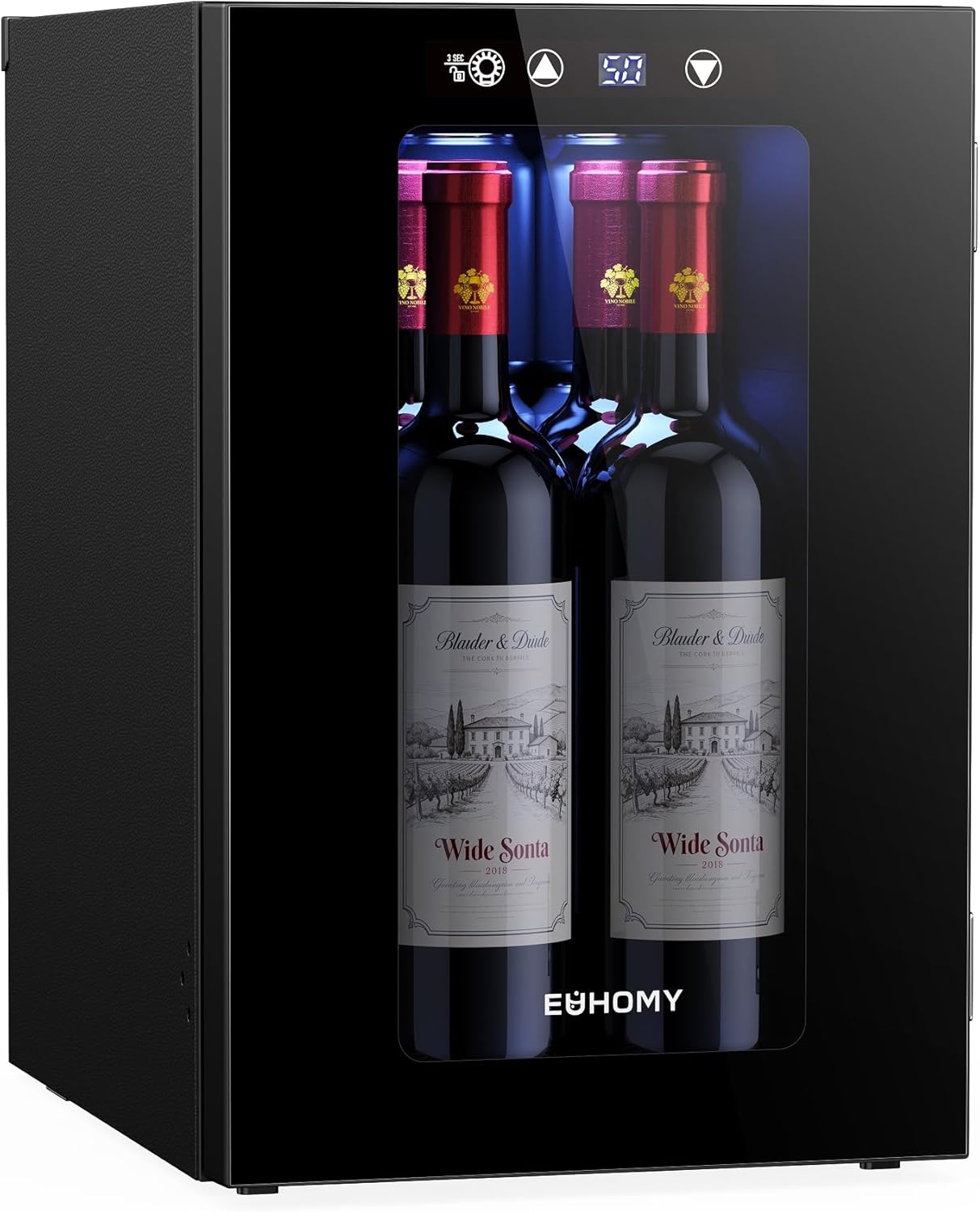
| Capacity | 18 liters |
|---|---|
| Cooling Method | Compressor |
| Temperature Range | 40°F to 61°F |
| Number Of Shelves | 1 |
| Installation Type | Countertop |
The EUHOMY 18L Wine Fridge is a small compressor-cooled cooler designed for countertop or freestanding use to store a handful of bottles and cans. It offers a digital touchscreen that sets temperatures between 40°F and 61°F, a double-pane glass door with LED interior lighting, and one removable shelf so you can fit bottles or stacks of cans. The compressor system provides steady cooling and the manufacturer states quiet operation around 38 dB, which helps the unit sit beside a bar, office, or kitchen without creating a constant noise nuisance. Practical benefits include the ability to keep red, white, sparkling wine, or beer at ready-to-serve temperatures and the compact footprint that fits tight spaces. Limitations to expect are the very small 18 L capacity that only holds about four 750 ml bottles or up to two dozen cans when arranged differently, manual defrosting, and a single door orientation without reversible mounting, so placement options are somewhat constrained.
Best for: Buyers who want a reliable, compact cooler to keep a small selection of wines or beverages at controlled serving temperatures without complicated setup or large space requirements.
Less Ideal for: Those who need to store larger collections, organize many bottle sizes, or require a built-in undercounter installation should look at larger-capacity or different-format coolers.
- Digital touchscreen with adjustable 40°F–61°F temperature range for precise control
- Compressor cooling for consistent, dependable chilling compared with thermoelectric units
- Compact countertop form that fits small kitchens, dorms, or home bars
- Double-pane glass door with LED lighting showcases contents while blocking UV rays
- Very limited 18 L capacity suitable for only a few bottles or a small can stash
- Manual defrost requires occasional maintenance and can be inconvenient
Verdict: A compact, compressor-cooled countertop wine fridge that delivers quiet, accurate temperature control for buyers who need dependable short-term storage for a few bottles.
Ivation 18-Bottle Wine Cooler

| Capacity | 1.8 cubic feet |
|---|---|
| Bottle Capacity | 18 Bottle |
| Temperature Range | 41°F–64°F |
| Cooling Method | Compressor |
| Defrost System Type | Automatic |
The Ivation 18-Bottle Wine Cooler is a compact freestanding unit that uses a compressor and internal fan to keep temperatures steady between 41°F and 64°F, making it suitable for storing reds, whites, and sparkling wines. It typically sits on the floor or a countertop and is configured as a single-zone cooler with six wire racks that are removable to fit different bottle sizes. Notable features include a double-paned thermopane glass door that reduces UV exposure, a digital touch display with lock, soft LED interior lighting, and automatic defrost for low-maintenance operation. The compressor design and inverter help the cooler maintain set temperatures even when ambient room temperature fluctuates, which is valuable for long-term storage and reliability-focused buyers. Trade-offs are its single-zone layout, which does not allow separate temperatures for whites and reds, and modest capacity, which limits it to small collections or secondary storage. Energy consumption is moderate and the unit is intended as a dedicated wine fridge rather than a full-size cellar.
Best for: Buyers who prioritize a reliable, temperature-stable freestanding cooler for a small collection or secondary wine storage and want a low-maintenance unit with clear digital controls.
Less Ideal for: Collectors who need a large-capacity or dual-zone cellar for storing multiple wine types at different temperatures should consider larger or dual-zone models instead.
- Compressor cooling with internal fan for stable, consistent temperatures
- Double-paned thermopane glass door that helps block UV and insulates the interior
- Digital touch controls with lock and clear LCD for easy temperature management
- Removable wire racks accommodate different bottle sizes and simplify loading
- Single-zone design cannot maintain different temperatures for whites and reds
- Limited 18-bottle capacity may be too small for larger collections
Verdict: Choose this Ivation cooler when you want a compact, compressor-driven freestanding unit that keeps a small wine collection at stable, reliable temperatures.
NutriChef 12-Bottle Wine Fridge
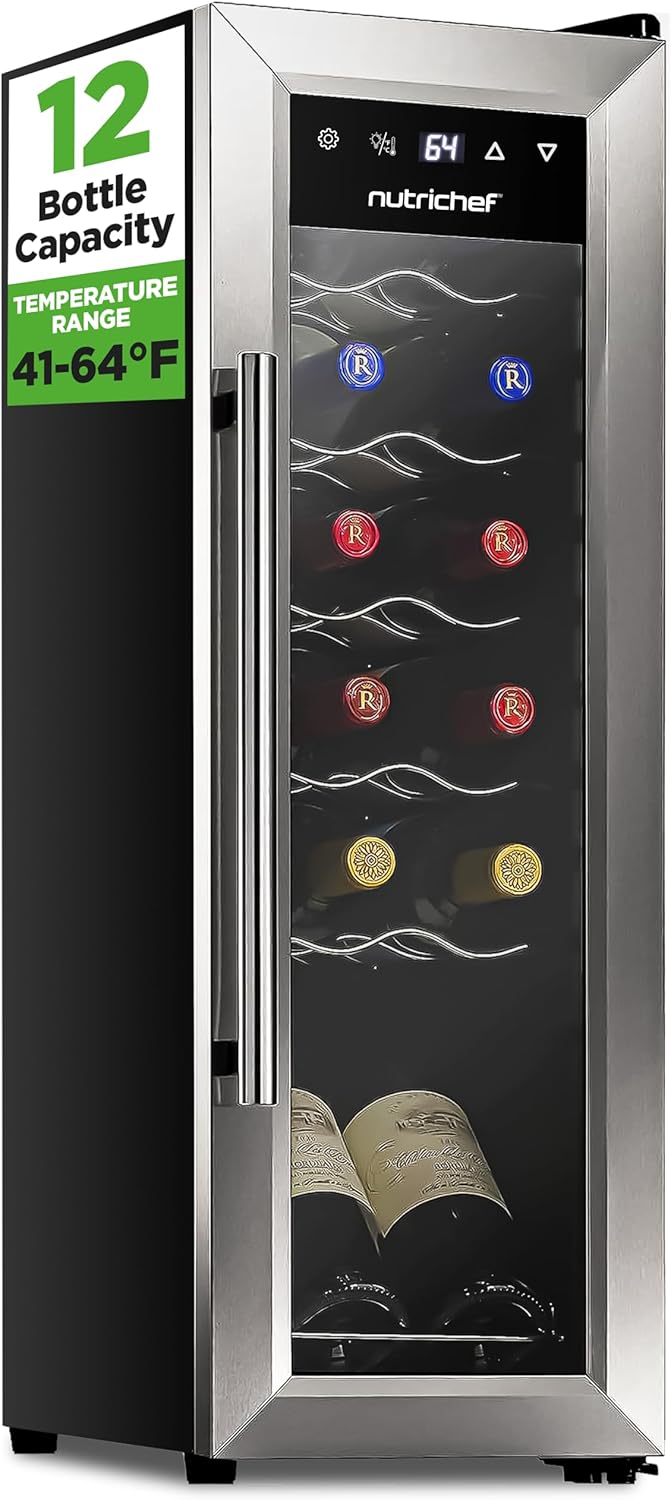
| Capacity | 12 Bottle |
|---|---|
| Refrigeration | Compressor |
| Temperature Range | 41 – 64°F |
| Power | 120 volts |
This NutriChef 12-bottle wine fridge is a slim freestanding cooler designed for buyers who want reliable bottle storage without taking up much floor space. It uses a compressor and inverter system to maintain a selectable temperature range (about 41 to 64 F) via a digital soft-touch control panel and internal LED lighting, so you can chill reds and whites to different serving temps. The unit holds a dozen standard bottles on five wire shelves and includes a bottom standing rack, a child-safety lock, and a reinforced glass door with stainless steel trim for a clean look. Practical strengths are its compact footprint for countertops or tight corners, quiet operation for living spaces, and an Energy Star referenced annual consumption figure that keeps running costs modest. Limitations include the modest internal volume that restricts larger or oddly shaped bottles and the narrow form factor that may require careful bottle arrangement to maximize capacity. Buyers should also expect standard compressor cooling behavior rather than long-term cellar-level aging performance.
Best for: Buyers who want a compact, no-nonsense wine cooler that reliably chills both red and white bottles for everyday serving and occasional entertaining.
Less Ideal for: Collectors seeking long-term cellar aging or those who need to store varied bottle shapes and larger formats should look for a larger or full-size cellar.
- Slim countertop-friendly footprint fits tight spaces
- Compressor cooling with inverter provides consistent temperature control
- Digital soft-touch controls and selectable °F/°C make adjustments simple
- Quiet operation suitable for kitchens and living areas
- Limited internal volume restricts large-format or irregular bottles
- Narrow layout means careful bottle arrangement to reach full 12-bottle capacity
Verdict: A compact, energy-conscious 12-bottle cooler that delivers reliable temperature control for everyday red and white serving in small spaces.
Feelfunn 12-Bottle Wine Cooler

| Capacity | 1.41 cubic feet / 12 Bottle |
|---|---|
| Temperature Range | 41-64°F (5-17°C) |
| Cooling Method | Compressor |
| Defrost System Type | Frost Free |
| Installation Type | Freestanding |
The Feelfunn 12-bottle wine cooler is a compact freestanding fridge designed to store and chill up to a dozen standard wine bottles. It uses a compressor cooling system with a digital touch panel to set temperatures between 41 and 64°F, and five removable wire shelves let you arrange bottles or fit a few larger formats. Double-glazed glass doors provide UV protection and a built-in soft LED light makes it easy to see contents without warming the interior. The unit is rated to run quietly (under 35 dB) so it can sit in a living room or home bar without drawing attention, and frost-free operation reduces maintenance. Practical limitations are its modest 1.41 cu ft capacity and narrow footprint, so it is best for small collections rather than long-term cellaring or large-format bottles, and the compressor-based cooler will produce some vibration compared with thermoelectric models. For someone who wants simple digital controls, adjustable shelving, and a compact, quiet fridge for everyday chilled wine, this covers the essentials well.
Best for: Buyers who want a reliable, low-maintenance cooler for everyday chilled wine in a small space and prioritize simple digital controls and quiet operation.
Less Ideal for: Collectors who need long-term aging capacity, storage for many bottles, or frequent accommodation of very large-format bottles should look at larger or dedicated cellar units.
- Digital temperature control with 41–64°F range for flexible chilling of reds, whites and sparkling
- Compact freestanding design fits kitchens, home bars or offices
- Double-glazed glass door with UV protection helps preserve wine
- Adjustable removable shelves allow flexible bottle arrangement
- Quiet compressor operation (listed under 35 dB) suitable for living spaces
- Only a 12-bottle capacity, too small for larger collections
- Compressor operation can introduce slight vibration compared with thermoelectric units
Verdict: A compact, quiet 12-bottle cooler with simple digital controls and adjustable shelving for everyday chilled wine in small spaces.
Choosing the Right Wine Cooler for Red Wine: Key Factors to Consider
Temperature Stability
Red wines are sensitive to temperature fluctuations. A cooler that holds a steady temperature within a narrow band prevents premature aging and preserves flavor structure.
Look for units with precise electronic thermostats, good insulation, and cooling systems designed to maintain set points under varying room temperatures. Temperature stability affects whether you can both store bottles for months and chill them to serving range without repeated adjustments.
Vibration and Compressor Type
Constant vibration can disturb sediment and accelerate chemical reactions in wine. Compressors tend to produce more vibration than thermoelectric systems, but not all compressors are equal.
Consider how the unit isolates vibration through internal suspension or dedicated anti-vibration mounting for racks. If quiet operation in a living area matters, check noise ratings and whether the cooling method is described as low-vibration. The right balance depends on whether you prioritize precise cooling or near-silent operation.
Storage Capacity and Rack Design
Capacity must match how many bottles you routinely keep, plus room for growth or special-format bottles. Rack type affects how bottles are stored and accessed.
Slope, spacing, and the ability to remove or reposition shelves determine whether the cooler can handle burgundy, bordeaux, or magnum bottles. Efficient rack design also eases rotation so older bottles can be consumed first, which is essential if you are aging wine over time.
Humidity Control and Light Protection
Cork dryness and UV exposure are common causes of wine spoilage. Humidity that is too low can dry corks, letting oxygen in, while direct light, especially UV, can degrade compounds in wine.
Units that include a moisture-preserving interior environment, a sealed door with UV-blocking glass, or options to add humidity packs help maintain bottle integrity. These features are especially important when storing reds for extended periods.
Installation Footprint and Venting
Where you plan to place the cooler determines acceptable dimensions and venting needs. Built-in or under-counter installations require front-venting and a precise width and depth; freestanding units are more forgiving but need clearance.
Measure intended space and consider door swing, ventilation clearance, and whether the cooler will sit on carpet or a shelf. Proper placement affects cooling performance and longevity.
Temperature Zones and Control Features
Some coolers offer single-zone control, while others provide dual or multiple zones for different serving temperatures. For red wine, a single stable zone is often sufficient, but multi-zone units help if you also store whites or sparkling wines.
Evaluate the control interface, whether digital readouts and alarms are available, and how easy it is to set and read the internal temperature. Consistent, easy-to-use controls reduce the risk of accidental temperature drift.
How to Decide Between Single-Zone and Multi-Zone
Single-zone coolers maintain one temperature throughout and are typically simpler and more energy-efficient. They are ideal when your collection focuses mainly on red wines that share a similar serving or cellar temperature.
Multi-zone coolers let you set separate temperatures for different shelves, which is useful if you keep a mix of reds with different serving ranges or store some bottles at cellar temperature while keeping others ready to serve. Consider whether your collection truly needs that flexibility before choosing a multi-zone model because they are often more expensive and take up more internal space.
- Single-zone: simpler controls, more internal storage per cubic foot
- Multi-zone: flexible serving temperatures, useful for mixed collections
- Choose based on how many wine types you store and frequency of serving
Placement and Ventilation Tips
Placement affects both performance and convenience. Avoid locations with direct sunlight, heat sources, or frequent temperature swings. If installing under a counter, confirm the unit supports front ventilation and leave recommended clearance.
Ensure the surface is level and can bear the cooler's weight when fully loaded. Poor ventilation reduces cooling efficiency and shortens compressor life, so follow the manufacturer's clearance guidance for side and rear vents.
- Avoid direct sunlight and heaters
- Confirm front-venting for built-in installations
- Keep the unit level and accessible for maintenance
Rack Layout and Organizing Your Collection
Organize bottles by vintage, region, or drink-by date to make rotation simple. Use lower shelves for longer-term cellaring and upper shelves for bottles you plan to consume sooner. Removable or sliding racks speed retrieval and reduce disturbance to other bottles.
If you collect different bottle shapes, reserve one shelf with adjustable spacing. Labelling shelves or using a simple inventory system helps track aging progress and prevents bottles from being forgotten at the back.
- Store older bottles deeper and lower when possible
- Use adjustable racks for mixed bottle formats
- Label shelves with vintage or drink-by dates for rotation
Maintaining Ideal Humidity and Light Levels
Keep humidity in a moderate range to protect corks. If the cooler does not actively manage humidity, occasional checks and use of humidity packs can help. Avoid opening the door frequently, which lets humidity fluctuate and accelerates temperature changes.
Choose a unit with UV-resistant glass or a solid door if long-term storage is the priority. Interior lights should be LED and on a timer or switch to prevent continuous exposure.
- Use humidity packs if needed
- Prefer UV-blocking doors for extended storage
- Limit interior light exposure to preserve wine compounds
Noise and Vibration Considerations for Living Areas
If the cooler will sit in a kitchen or living space, prioritize low noise and minimal vibration. Look for models with vibration-dampening racks or descriptions indicating quiet operation. Even small vibrations over time can affect sediments and the aging process for delicate reds.
Thermoelectric models are often quieter but less effective in high ambient temperatures. Consider where the unit will be placed and whether occasional louder cycles from compressors will be disruptive in your household.
- Check noise ratings if placing near living spaces
- Prefer anti-vibration rack systems for long-term aging
- Match cooling type to ambient room temperature and noise tolerance
How We Chose the Best Wine Cooler for Red Wine
Our selection focused on features that directly affect red-wine storage and serving quality. We prioritized temperature stability because red wines require a narrow range for both short-term serving and longer-term cellaring. Vibration and compressor type were next in importance since constant movement speeds oxygen transfer and can disturb sediments. Storage design and rack flexibility matter for accommodating various bottle shapes and allowing organized rotation of older bottles. Humidity control and UV protection were included because dry conditions and light exposure can damage corks and wine integrity. Finally, usable capacity and footprint were considered so a unit fits the intended space and bottle count. We excluded units lacking clear temperature control or with interiors that do not protect bottles from light and vibration. Models without adjustable shelving or with purely decorative cooling were not considered. Our picks reflect practical combinations of precise temperature regulation, low-vibration operation, adaptable storage, humidity or moisture management, and an internal layout suitable for typical red-wine bottles.
Our full evaluation process is outlined in our review methodology.
FAQ
What is the best storage temperature for most red wines?
Most red wines store well between about 55 and 65 degrees Fahrenheit. Serving temperatures for reds can be slightly higher, so consider how you plan to alternate between storage and serving when setting the cooler.
Can I store magnum and large-format bottles in a standard wine cooler?
Some coolers can accommodate magnums if they have removable or adjustable racks. Check interior height and shelf depth, because large-format bottles require more space and may reduce total bottle capacity.
How often should I open the cooler for serving?
Minimize door openings to preserve temperature and humidity. If you open the cooler frequently for serving, set a slightly lower temperature to compensate and allow time to re-stabilize after each opening.
Do I need active humidity controls for red-wine storage?
Active humidity control is helpful for long-term aging but not strictly required for short-term storage. If your environment is very dry, use humidity packs or a unit with moisture retention features to prevent cork drying.
Is a built-in unit better than a freestanding cooler for red wine?
Built-in units are designed for under-counter installation and front ventilation, which helps with aesthetics and space use. Freestanding coolers offer more placement flexibility. Choose based on where you plan to install the unit and whether front-venting is available.
Final Verdict
For red-wine storage, prioritize a cooler that delivers steady temperature control, minimizes vibration, and provides adaptable rack space for the bottle formats you own. Balance the need for humidity and light protection against the unit footprint and whether you require multi-zone flexibility. Focus on the features that align with how you store and serve bottles, and choose a unit whose capacity and venting match your intended location. Selecting a cooler with solid temperature stability and anti-vibration design will protect wine quality over time. Use the decision criteria described here to narrow options and pick a model that fits your storage goals and space constraints with confidence.