
Note: This article contains affiliate links. If you click on these links and make a purchase, we may earn a small commission at no extra cost to you. This helps support our research and content. Read our full affiliate disclosure here.
Choosing the right wine cooler matters if you want bottles stored at consistent temperatures without taking up unnecessary space. Whether you collect a few special bottles or maintain a modest cellar, the right cooler preserves flavor and aroma while fitting your home and routine. This guide shortlists seven top wine coolers under $1,000, each evaluated for temperature performance, storage flexibility, and everyday convenience. Below you will find concise guidance on features that matter and the tradeoffs to expect, plus practical tips for placement and care.
Top Picks at a Glance
| Best Overall The best all-around choice for most situations | Ivation 12-Bottle Wine Cooler |  |
| Best Quality Built to a higher standard if you want something more solid | NewAir Dual Zone Wine Fridge NWC046BS00 |  |
| Best Value The sweet spot between price and what you get | Cuisinart 8-Bottle Wine Cellar CWC-800CEN |  |
| Best Budget The cheapest option that still gets the job done reliably | Icyglee Beverage Refrigerator WC-6B |  |
| Top Rated A top-rated pick with lots of positive feedback | Vushine 12" Wine Cooler JCS-58QE |  |
| Most Popular A crowd favorite that many people choose with confidence | hOmeLabs Beverage Refrigerator HME030065N | 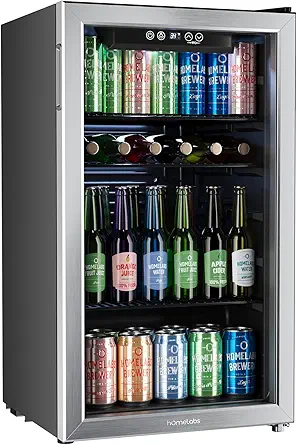 |
| Best Seller A high-volume bestseller chosen again and again | EUHOMY Wine Cooler BR001-110 |  |
Ivation 12-Bottle Wine Cooler
| Capacity | 1.2 cubic feet |
|---|---|
| Temperature Range | 41-64°F |
| Power | 95W / 1.2 Amps |
| Cooling Method | Compressor |
| Refrigerant | R-600A |
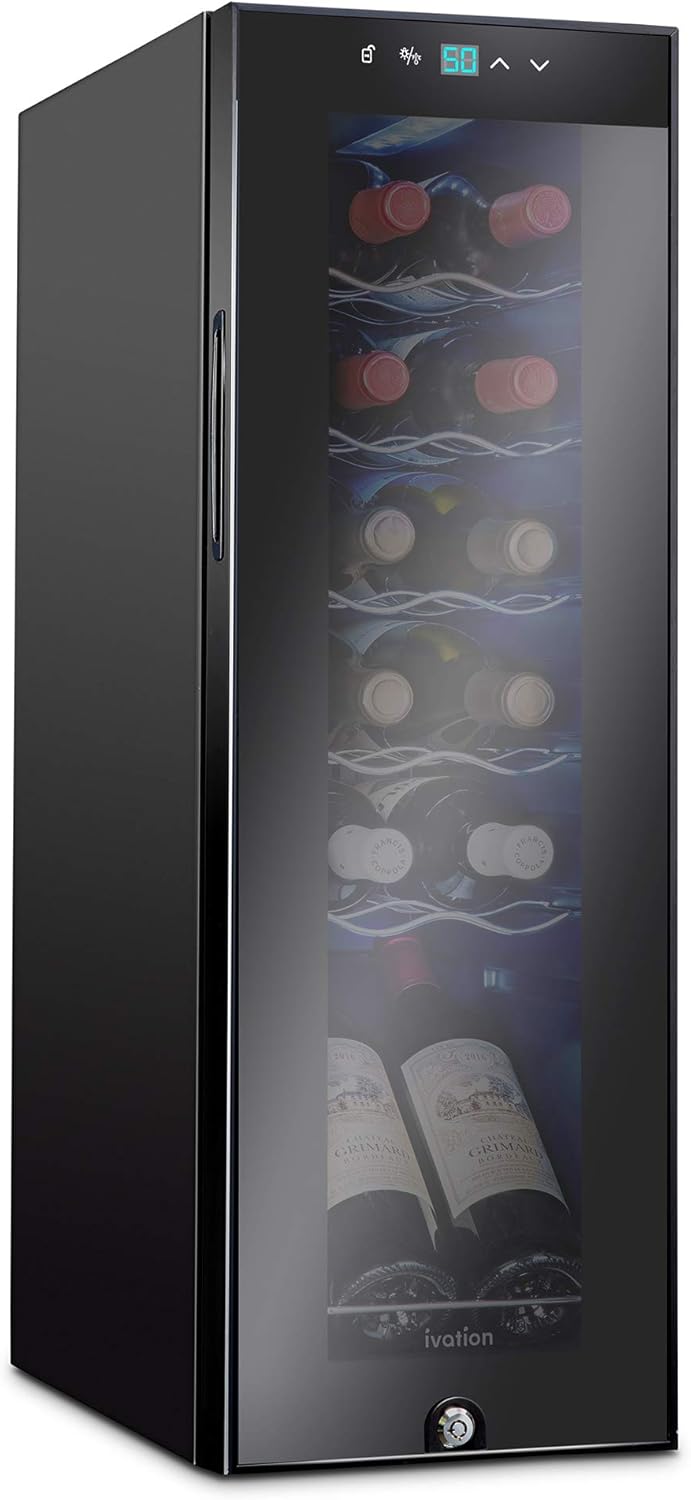
This Ivation 12-bottle cooler uses a compressor cooling system and internal fan to hold a stable 41–64°F range, making it suitable for both chilling and longer-term storage. It installs freestanding and has six removable wire racks so you can fit standard 750 ml bottles or rearrange for larger formats. The digital touch display shows temperature in Fahrenheit or Celsius and can be locked to prevent accidental changes, while the double-paned UV-resistant glass and rubber gasket help keep light and air out. Vibration-reducing compressor operation preserves sediment and the interior LED provides soft illumination for inspections without harsh heat. As a compact unit it draws modest power (rated 95W) and includes a keyed lock for security. Limitations include a small 1.2 cu ft capacity that restricts larger fermentation batches and single-zone control that prevents separate temperature settings for multiple products. The unit is best when you need a reliable, quiet compressor fridge with precise temperature stability in a compact footprint rather than a higher-capacity or dual-zone system.
Best for: Buyers seeking a compact, performance-focused compressor fridge that holds steady temperatures for precise fermentation or small-batch aging and who prioritize stability and quiet operation.
Less Ideal for: Those who need higher capacity, multiple temperature zones, or to run several fermentations at different setpoints simultaneously should look at larger or dual-zone units.
- Compressor cooling with inverter ensures stable, low temperatures suitable for fermentation control.
- Wide adjustable temperature range (41–64°F) with digital touch controls and lock for set-and-forget operation.
- Double-paned UV-resistant glass and airtight gasket protect contents from light and external air.
- Removable wire racks allow flexible bottle arrangement and easier cleaning.
- Quiet, vibration-reducing operation that minimizes disturbance to sediments or sensitive contents.
- Small 1.2 cubic foot capacity limits the number and size of fermentation vessels you can fit.
- Single temperature zone cannot maintain different temperatures for multiple simultaneous projects.
Verdict: Choose this cooler when you want a compact, compressor-driven fridge that delivers stable, low-temperature control for small-batch fermentation and precision cooling.
NewAir Dual Zone Wine Fridge NWC046BS00

| Capacity | 46 Bottle |
|---|---|
| Refrigerant | R-600A |
| Cooling Method | Compressor |
| Number of Sections | 2 |
| Installation Type | Built-In |
This NewAir 24" dual-zone wine fridge manages two independently controlled temperature zones so you can store reds and whites at optimal serving or cellaring temperatures. In daily use you set each zone with digital controls, load bottles on the adjustable beech wood shelves, and rely on the compressor cooling and inverter to hold steady temps with low vibration and quiet operation. The glass door, stainless-steel trim, and soft LED lighting make it easy to see and present a collection while the reversible door and built-in-ready cabinet fit give installation flexibility. Practical benefits include a 46-bottle capacity in a 24-inch footprint, automatic defrosting, and a keyed lock for security. Trade-offs to note are the unit weight and footprint for smaller spaces and that it consumes moderate energy compared with smaller single-zone coolers, so it is best where capacity and dual-zone control matter more than absolute energy efficiency.
Best for: Buyers who prioritize accurate, dual-zone temperature control and room for a moderate collection while keeping a quiet, presentable unit in a kitchen or home bar.
Less Ideal for: Anyone who needs an ultra-lightweight, ultra-compact cooler for tiny spaces or who prioritizes the absolute lowest energy use over capacity and temperature flexibility.
- Independent upper and lower temperature zones for storing reds and whites at different temperatures
- Adjustable beech wood shelves and smooth-glide racks that accommodate varied bottle sizes
- Built-in or freestanding installation with reversible door for flexible placement
- Quiet, low-vibration compressor operation that protects delicate wines and suits living spaces
- Larger weight and footprint may be difficult to move or fit in very small kitchens
- Higher annual energy consumption compared with smaller single-zone units
Verdict: If you want dependable dual-zone cooling and a 46-bottle capacity in a built-in-ready 24" footprint, this NewAir model delivers the performance collectors need under $1,000.
Cuisinart 8-Bottle Wine Cellar CWC-800CEN
| Cooling Method | Thermoelectric |
|---|---|
| Number Of Shelves | 8 |
| Capacity | 6 liters |
| Power Source | Electric |
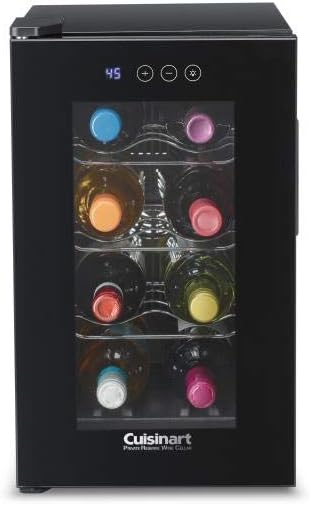
The Cuisinart 8-Bottle Private Reserve Wine Cellar is a small freestanding cooler designed to keep a selection of reds, whites, or sparkling wines at controlled serving temperatures. It uses a thermoelectric cooling system, which runs quietly and is more energy efficient than compressor units, and a touchscreen control with LED readout lets you set temperatures from 39°F to 68°F. Inside, contoured chrome racks and soft interior lighting make bottle access and display simple, and the unit ships with three removable racks to organize various bottle shapes. Typical use is for short- to medium-term storage and serving in an apartment, kitchen, or home bar where vibration-free, quiet operation matters. Limitations include the small 8-bottle capacity and thermoelectric cooling, which performs best in moderate ambient temperatures and is not suited for long-term cellar aging or very warm rooms. For buyers prioritizing quiet performance and a compact footprint, this is a practical countertop or freestanding option; buyers needing larger capacity or cooler performance for hot spaces should look at compressor-based models instead.
Best for: Buyers who want a quiet, energy-conscious small wine cooler to keep a few bottles at serving temperature and prefer a compact freestanding unit for a kitchen, office, or home bar.
Less Ideal for: Collectors who need long-term proper cellar conditions, those with larger collections, or people who will place the cooler in consistently hot rooms.
- Quiet thermoelectric cooling with low vibration suitable for delicate wines
- Touchscreen controls and LED display for easy temperature setting
- Soft interior lighting and contoured chrome racks for neat presentation and access
- Compact freestanding design fits small kitchens, apartments, or bars
- Only holds up to eight bottles, limiting larger collections
- Thermoelectric cooling is less effective than compressor units in very warm ambient temperatures
Verdict: Choose this Cuisinart if you want a quiet, compact 8-bottle cooler that maintains serving temperatures with energy-efficient thermoelectric performance.
Icyglee Beverage Refrigerator WC-6B

| Capacity | 0.6 cubic feet |
|---|---|
| Cooling Method | Compressor |
| Temperature Range | 40–61°F |
| Defrost Type | Manual Defrost |
The Icyglee WC-6B is a small compressor beverage fridge designed to chill cans and a few bottles in tight spaces. It offers one removable wire shelf so you can stack cans or lay a couple of wine bottles flat, and a temperature dial that ranges roughly from 40 to 61°F for basic beverage and wine chilling. Because it uses an R600 compressor it cools faster and more consistently than thermoelectric units, and the manual defrost and tight door seals help keep internal temps steady. The compact freestanding design and mirrored black door make it easy to tuck under a counter, in an office, or next to a home bar, and the claimed noise level under 40 dB keeps operation unobtrusive. Limitations include very small capacity — listed as 18 liters or 0.6 cu ft — so it is best for singles, couples, or very light entertaining, and there are no advanced controls like a digital thermostat or dual zones. For buyers wanting an affordable, space-saving compressor cooler for a handful of drinks, this covers the basics well.
Best for: Buyers looking for an inexpensive, space-saving beverage cooler to hold a small rotation of drinks in a dorm, office, or compact home bar.
Less Ideal for: Anyone who needs larger capacity, multi-zone temperature control, or a dedicated wine cellar solution for long-term bottle storage.
- Compressor cooling (R600) for faster, more consistent chills than thermoelectric units
- Removable shelf lets you switch between cans and a few bottles
- Very compact freestanding footprint fits tight spaces and under counters
- Quiet operation reported under 40 dB for low-noise placement
- Very small internal capacity (0.6 cu ft) limits storage to about a dozen cans or a few bottles
- No digital thermostat or dual-zone control for precise wine storage
Verdict: A budget-friendly, compressor-cooled mini beverage fridge that saves space while reliably chilling a small number of drinks.
Vushine 12" Wine Cooler JCS-58QE

| Capacity | 2.1 cubic feet |
|---|---|
| Bottle capacity | 21 bottles |
| Temperature range | 41-64°F (5-18°C) |
| Cooling method | Compressor |
| Installation type | Built-In or Freestanding |
This Vushine 12" wine cooler is a small compressor-driven cellar intended for undercounter installation or standalone use in a kitchen, bar, or office. It provides precise temperature control via a touch digital display with a 41–64°F range and a circulation fan to keep temperature uniform across its removable wooden shelves. The unit is rated for low noise and automatic defrost, and the double-pane UV-blocking glass door plus interior LED lighting help protect and present bottles. In daily use it handles chilling and short-term storage well and the compressor system cools faster and holds steady compared with thermoelectric designs. Expect straightforward setup: adjustable feet and multiple shelves let you fit different bottle sizes, but the unit is compact so capacity is limited to about 18–21 bottles. Buyers should also note the left-hinged door orientation and that it requires the usual 24-hour upright sit time before first use. For someone who wants a solid, small wine fridge that focuses on stable temperatures and build-in flexibility, this delivers sensible performance without extra bells.
Best for: Buyers who prioritize steady, reliable temperature control and a compact, installable wine fridge for everyday storage or entertaining will appreciate this unit.
Less Ideal for: Collectors who need high capacity, long-term aging storage or those who require a right-hinged door or larger footprint should consider larger models.
- Compressor cooling for faster, more stable chilling than thermoelectric units
- Digital touch temperature control with 41–64°F range for precise settings
- UV-blocking double-pane glass and interior LED protect and display bottles
- Adjustable wooden shelves and feet allow flexible storage and installation
- Automatic defrost and low-noise design suit frequent household use
- Small internal capacity limits long-term collections to roughly 18–21 bottles
- Door is left-hinged only, which may restrict placement options
Verdict: A compact, compressor-cooled wine fridge that delivers dependable, precise temperature control for everyday home use under $500.
hOmeLabs Beverage Refrigerator HME030065N

| Capacity | 3.2 cubic feet |
|---|---|
| Storage Capacity | Up to 120 cans |
| Temperature Range | 34°F-50°F |
| Cooling Method | Compressor |
| Defrost System Type | Automatic |
This hOmeLabs beverage refrigerator is a compact, performance-focused cooler for home bars, offices, or dorms. It uses a compressor-based cooling system with a whisper-quiet compressor and an adjustable digital thermostat that reaches as low as 34°F, so it reliably maintains cold, ready-to-drink beverages. The reinforced double-glazed glass door and bright internal LED let you see contents without opening the unit, and three removable chrome wire shelves give flexible storage for cans or bottles. Setup is simple: it is freestanding, has reversible door hinges, and adjustable feet to level on uneven floors. Practical benefits include steady cooling for long periods and quiet operation suitable for living spaces. Limitations are its compact 3.2 cubic foot capacity if you need larger chilled storage and moderately high annual energy consumption compared with some small fridge alternatives. If you plan to store a mixture of taller bottles and cans you will need to rearrange or remove shelves to fit larger items.
Best for: Buyers prioritizing reliable, low-noise cooling and precise temperature control who need a compact dedicated beverage fridge for a home bar, office, or dorm.
Less Ideal for: Those seeking a high-capacity refrigerator for entertaining large groups or users who need the most energy-efficient mini fridge available.
- Compressor cooling with whisper-quiet compressor for consistent, low-noise performance
- Digital touch temperature control down to 34°F for precise beverage chilling
- Reinforced glass door with bright interior LED for clear display without opening
- Three removable adjustable shelves for flexible can and bottle organization
- Reversible door and adjustable feet for flexible placement and installation
- 3.2 cubic foot capacity may be small for larger households or party use
- Annual energy consumption listed as 288 kWh per year, higher than some compact models
Verdict: Choose this unit when you want a compact, quiet beverage fridge that maintains precise, cold temperatures for ready-to-drink cans and bottles.
EUHOMY Wine Cooler BR001-110

| Capacity | 3.2 cubic feet |
|---|---|
| Bottle capacity | Up to 25 standard 750ml bottles |
| Temperature range | 41°F to 64°F |
| Cooling method | Compressor |
| Door orientation | Reversible |
This EUHOMY wine cooler is a compact freestanding unit aimed at steady, long-term beverage storage. It uses a compressor cooling system with a 41 to 64°F temperature range controlled by a digital touchscreen, so you can keep reds, whites, and sparkling bottles at appropriate serving temperatures. The interior offers four chrome full-width racks, a flat shelf and a bottom compartment to fit up to 25 standard 750ml bottles and to reconfigure storage as needed. The double-layer thermopane glass door reduces temperature swings and blocks UV light, and soft LED lighting helps with visibility without harsh heat. Practical touches include adjustable leveling legs, a built-in handle and a reversible door for flexible placement under counters or freestanding in a bar or office. Expect manual defrosting and typical small-fridge energy use; for buyers prioritizing quiet, vibration-free operation the compressor is described as high-performance and low-vibration but compressor units can still be noisier than thermoelectric models. The unit is supported by a one-year warranty and arrives with a user manual for setup and operation.
Best for: Buyers who want a compact, reliable freestanding cooler for steady storage of a small to medium wine collection and value precise temperature control and flexible placement.
Less Ideal for: Those seeking a zero-maintenance built-in cellar replacement, ultra-low energy operation, or very large bottle capacity should consider larger or different-style units.
- Compressor cooling with a wide 41–64°F range for storing different wine styles
- Double-pane glass door that insulates and blocks UV to protect wine quality
- Adjustable shelves and mix of racks allow flexible storage up to 25 standard bottles
- Digital touchscreen control and internal LED lighting simplify temperature monitoring and viewing
- Reversible door and leveling legs make placement under counters or freestanding easier
- Manual defrost requires occasional user maintenance
- Annual energy consumption is relatively high compared with the smallest thermoelectric units
Verdict: A compact, compressor-cooled freestanding wine cooler that delivers precise temperature control and flexible storage for a small commercial or bar setting.
Choosing the Right Wine Cooler: Key Factors to Consider
Temperature Range and Control
A wine cooler needs a temperature range wide enough to store both reds and whites at their ideal temperatures. Look for models that offer separate zones or a range that covers approximately 40 to 65 degrees Fahrenheit so you can chill whites and keep reds at serving temperatures. Digital thermostats and clear setpoint readouts matter because small variations over time can affect aging and flavor.
Also consider how tightly the unit holds its set temperature. A cooler that fluctuates with room conditions will force you to compensate and could shorten the useful life of stored bottles. Precise control becomes more important if you plan to age wines rather than just cool for short-term serving.
Storage Capacity and Shelf Layout
Rated bottle capacity rarely matches real-world storage because shelf design, bottle shape, and door clearance all affect how many bottles fit. Check the number of usable shelves and whether shelves slide or are removable for odd-sized bottles and larger formats like magnums.
Also consider orientation and how closely bottles are packed. Shelves that prevent label damage and allow gentle access reduce the chance of knocks and vibration when you retrieve a bottle. If you plan to rotate stock frequently, prioritize easy-access shelving over maximum rated capacity.
Cooling System Type and Vibration
Wine coolers typically use either compressor cooling or thermoelectric cooling. Compressor systems provide stronger cooling and better performance in warm rooms, while thermoelectric units are quieter and have fewer vibrations at low loads. Excessive vibration can disturb sediment in aged wines and accelerate chemical reactions that degrade flavor.
Think about where you will place the unit. If it sits near seating areas or open-plan living spaces, quieter operation and low vibration will matter more. If it will be installed in a garage or utility area, stronger compressor-based cooling may be preferable for consistent performance.
Door, Glass, and Light Protection
Ultraviolet light and frequent exposure to bright interior lights can damage wine over time. Tinted or UV-protected glass helps block harmful rays while allowing you to view labels. Also consider door seals and hinge style; a tight seal prevents warm air infiltration and reduces compressor cycling.
If you plan to display bottles, adjustable interior lighting that can be turned off is useful. For long-term storage, minimal light exposure and a solid internal environment take priority over showy illumination.
Noise, Placement, and Ventilation
Noise level affects where a wine cooler can go in your home. Units with front-venting designs allow built-in or under-counter installations without overheating, while rear-venting models need clearance at the back. Measure available space and consider whether you need a freestanding unit with top or rear ventilation.
Also verify manufacturer recommendations for clearance to maintain airflow. Poor ventilation increases compressor run time and can reduce cooling reliability, especially in warmer rooms.
Maintenance, Energy Use, and Support
Routine maintenance includes cleaning shelves, checking door seals, and occasionally defrosting depending on the model. Energy efficiency affects operating cost and the amount of heat the unit emits into the room. Look for units with straightforward filter access or minimal maintenance needs.
Warranty and accessible customer support are important because cooling components can fail over a multi-year time frame. A clear warranty that covers the compressor and sealed system provides extra assurance for a purchase under $1,000.
Single-Zone Vs Dual-Zone: Which Suits Your Collection
Single-zone coolers keep one internal temperature and are generally simpler, more efficient, and offer slightly higher capacity for the same footprint. They work well if you mostly store one type of wine or keep a consistent serving temperature across bottles.
Dual-zone units allow two independent temperature areas so you can age reds in one zone while chilling whites or rosés in the other. Dual-zone units add flexibility but can reduce usable capacity and add cost. Choose dual-zone if you regularly store different wine styles together and need separate setpoints.
- Single-zone: higher usable capacity and simpler controls
- Dual-zone: flexible storage for different wine types
- Consider how often you need separate temperatures versus extra capacity
Placement and Installation Tips
Pick a stable, level surface away from direct sunlight and heat sources. Room temperature affects how hard the cooler must work, so avoid installing near ovens, radiators, or heat-generating appliances.
Check whether the model vents from the front, top, or rear before planning built-in or under-counter installations. Front-venting designs are best for enclosed cabinets; rear-venting units need clearance and airflow behind the cooler.
- Allow recommended clearance for ventilation
- Avoid direct sunlight to minimize UV exposure
- Keep the unit level to ensure proper compressor operation
Shelf Types and Handling Special Bottles
Shelves come in wood, metal, or wire styles and may be fixed or sliding. Sliding shelves make access easier and reduce the chance of bumping bottles when you pull one out. Wood shelves reduce rattling and can be gentler on labels.
If you collect larger formats, verify that at least some shelves are removable or adjustable. Storing a mix of standard and larger bottles is a common reason to choose a model with flexible shelving.
- Sliding shelves for ease of access
- Removable shelves for larger-format bottles
- Wood shelves reduce vibration and label wear
Power, Efficiency, and Operating Costs
Energy use varies with compressor size, insulation, and how often the door opens. Models with good insulation and tight seals cycle less frequently, lowering energy use. If the unit will run continuously, prioritize insulation and efficient compressors.
Consider how the unit's efficiency influences room temperature. Poorly insulated units can dump heat into the room, making cooling systems work harder in warm climates.
- Better insulation reduces runtime
- Tight door seals prevent warm air infiltration
- Think about cumulative energy use over years of operation
Care, Cleaning, and Long-Term Storage
Regular cleaning keeps mold and odors from affecting stored bottles. Wipe shelves with a mild detergent and check door gaskets for debris that can prevent a proper seal. If the unit requires occasional manual defrosting, plan that into your maintenance routine.
For long-term storage, keep lighting off and maintain a steady temperature. Rotate inventory only when necessary to minimize vibration and handling of bottles with sediment.
- Clean shelves and gaskets regularly
- Turn off interior lights for long-term storage
- Plan for periodic defrosting if required by the model
How We Chose the Best Wine Cooler
We prioritized features that directly affect how well a wine cooler preserves and presents bottles over time. Key evaluation criteria included temperature range and accuracy, which determine whether a unit can hold both red and white wines at their ideal serving or aging temperatures. Storage capacity and shelf configuration were assessed because usable bottle count depends on shelf layout and whether shelves accommodate larger-format bottles. Vibration and light control were evaluated since mechanical vibration and UV exposure can degrade wine quality. Noise level and energy efficiency were included as daily-use considerations for home placement. Build quality and warranty coverage rounded out the assessment so buyers can weigh durability and support. We excluded units that could not maintain stable setpoints or that lacked clear temperature controls. Models that rely solely on a single narrow temperature setting were not considered for this list. The selected coolers demonstrate consistent performance across the criteria above and represent a range of sizes and installation types while staying under the $1,000 limit.
Our full evaluation process is outlined in our review methodology.
FAQ
How cold should a wine cooler be set for mixed storage?
For mixed storage, aim for a midpoint that suits both styles, often around 50 to 55 degrees Fahrenheit. This is a compromise between typical white and red serving temperatures and works for short-term mixed storage.
Can I install a wine cooler under my counter?
You can install a wine cooler under a countertop if the model supports built-in installation and venting. Front-venting units are the safest choice for enclosed spaces because they do not require rear clearance.
Is thermoelectric cooling better than compressor cooling?
Thermoelectric units are usually quieter and produce less vibration, which is good for small collections and nearby living spaces. Compressor units provide stronger cooling and better performance in warm rooms or high-load situations.
How much ventilation clearance do wine coolers need?
Ventilation needs vary by model, but most rear-venting coolers require several inches of clearance behind the unit. Check the manufacturer's installation guidance and provide the recommended space to ensure proper airflow.
Will a wine cooler age bottles like a cellar?
A wine cooler can mimic cellar conditions if it maintains a stable temperature, low vibration, and limited light exposure. Long-term aging also depends on humidity control and consistent conditions over years.
Final Verdict
Prioritize temperature stability, usable storage layout, and low vibration when choosing a wine cooler under $1,000. Decide whether flexibility from a dual-zone unit is worth reduced capacity for your collection size and typical use. Consider placement, ventilation, and maintenance needs to ensure reliable performance in your home. Focus on the tradeoffs that matter most to your routine and storage goals: choose tighter temperature control and better light protection for aging, or larger usable capacity and simpler controls for everyday serving. With those priorities in mind, you can confidently select a cooler that protects your bottles and fits your space.