
Note: This article contains affiliate links. If you click on these links and make a purchase, we may earn a small commission at no extra cost to you. This helps support our research and content. Read our full affiliate disclosure here.
Picking the right wireless printer for a home office affects daily productivity, document presentation, and ongoing operating costs. You need a device that joins your network quickly, produces readable text and acceptable image detail, and keeps running costs predictable so routine printing does not become a chore. This guide collects the top shortlisted wireless printers for home office use and explains why each type of unit made the cut. Below you will find devices suited to different home-office workflows, plus the factors we weighed during selection and practical guidance to help you match a printer to how you work.
Top Picks at a Glance
| Best Overall The best all-around choice for most situations | Epson Expression Premium XP-7100 |  |
| Best Quality Built to a higher standard if you want something more solid | Epson EcoTank ET-2800 |  |
| Best Value The sweet spot between price and what you get | Canon PIXMA TR8620a |  |
| Best Budget The cheapest option that still gets the job done reliably | HP DeskJet 2955 All-in-One |  |
| Top Rated A top-rated pick with lots of positive feedback | Brother HL-L2480DW Laser Printer |  |
| Most Popular A crowd favorite that many people choose with confidence | HP DeskJet 2855e | 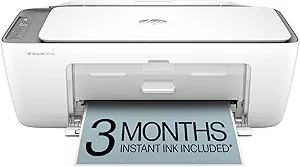 |
| Best Seller A high-volume bestseller chosen again and again | Brother DCP-L2640DW |  |
Epson Expression Premium XP-7100

| Printer Type | Inkjet |
|---|---|
| Maximum print Resolution Color | 4800 dpi |
| B&W Pages per Minute | 15.8 pages_per_minute |
| Maximum Sheet Capacity | 30 |
| Printer Connectivity Type | Wireless |
The Epson Expression Premium XP-7100 is a compact wireless all-in-one geared toward home offices that need both dependable document printing and good photo output. It uses a five-color Claria Premium ink set to produce high-resolution prints up to 4800 dpi and supports borderless photos up to 8 x 10 inches, while everyday pages print at up to about 15.8 ppm for black text. The unit includes a 30-page auto document feeder, automatic duplexing, an SD card slot and a 4.3-inch touchscreen for printing directly from memory cards or USB. Connectivity covers Wi-Fi with Wi‑Fi Direct plus an Ethernet port and USB, so you can print from computers, tablets and phones. Practical benefits include easy photo printing without a computer, automatic two-sided printing to save paper, and an intuitive touchscreen for quick tasks. Limitations to keep in mind are relatively slow color document throughput compared with mono speeds and reliance on Epson Genuine cartridges for optimal performance and warranty coverage.
Best for: Buyers who want a single compact machine that can act as a reliable home office printer while also producing high-quality photos and occasional creative projects.
Less Ideal for: Users who need very fast color document throughput or those seeking the lowest long-term ink cost for heavy color volume should consider alternative solutions.
- High photo quality with 4800 dpi maximum resolution for sharp photos and graphics
- 30-page auto document feeder and automatic duplexing for productive home office workflows
- Wi‑Fi, Wi‑Fi Direct and Ethernet plus USB and SD card slot for flexible connectivity and direct printing
- 4.3-inch touchscreen simplifies printing from cards or USB without a computer
- Color print speed for document jobs is much slower than black text speed
- Uses five individual Epson cartridges which can be costly for heavy color use
Verdict: Choose the XP-7100 if you want a compact wireless all-in-one that balances reliable home office features with impressive photo-print quality.
Epson EcoTank ET-2800
| Printer Type | Inkjet |
|---|---|
| Printer Connectivity Type | USB, Wi-Fi |
| Maximum print Resolution Color | 5760 x 1440 dpi |
| B&W Pages per Minute | 10 |
| Color Pages per Minute | 5 |
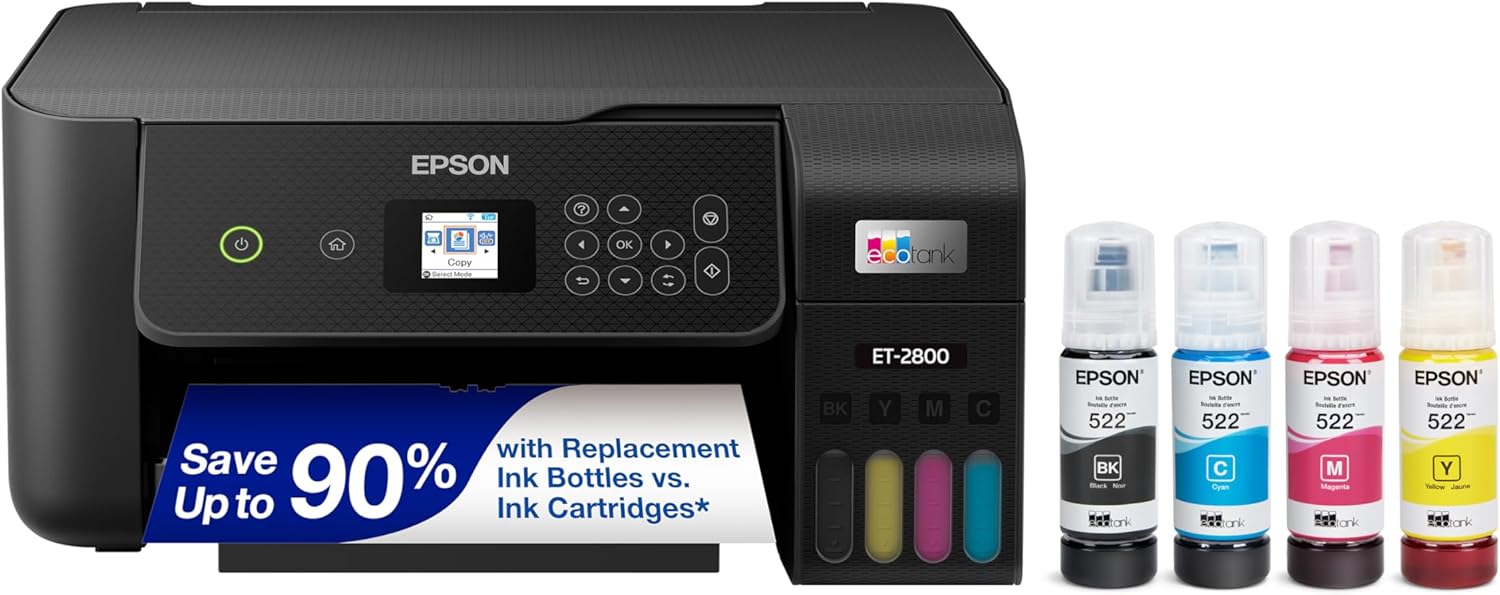
The Epson EcoTank ET-2800 is a cartridge-free all-in-one aimed at reducing ink interruptions and ongoing costs by using high-capacity refillable tanks and bundled ink bottles. It prints, copies, and scans for a home office workflow and connects via Wi-Fi or USB with app control and voice-activated printing for hands-free jobs. Print quality is high for documents and decent for photos thanks to Epson PrecisionCore and a 5760 x 1440 dpi maximum resolution, while ISO speeds reach about 10 pages per minute for black and 5 for color, good for moderate daily workloads. The integrated tanks are simple to refill with EcoFit bottles and dramatically lower the frequency of replacements compared with cartridges, which saves money over time and cuts cartridge waste. Limitations include simplex-only printing, a single USB port, and modest color photo speed that may not satisfy heavy graphics users, and the scanner is a basic flatbed without an automatic document feeder. For buyers who prioritize low running costs and dependable home-office performance, the ET-2800 delivers practical value with some compromises on advanced office features.
Best for: Buyers who need a reliable, low-running-cost home office printer that minimizes ink changes and supports wireless mobile printing for everyday documents and occasional photos.
Less Ideal for: Workplaces that require fast duplexing, heavy photo production, or frequent multi-page scanning should consider more feature-rich office models with ADFs and Ethernet connectivity.
- Cartridge-free EcoTank system with high-capacity refillable ink tanks
- Wireless and app-based printing with voice-activated support for convenient mobile workflows
- High maximum print resolution for sharp text and detailed prints
- Bundled ink bottles that supply thousands of pages before replacement, lowering operating costs
- No automatic duplex (only simplex) printing
- Single USB port and no Ethernet option limits wired connectivity for some setups
- No automatic document feeder, which slows multi-page scanning or copying
Verdict: Choose the ET-2800 if you want a wireless home-office printer that cuts ink costs and interruptions through a cartridge-free EcoTank system while delivering solid everyday print quality.
Canon PIXMA TR8620a

| Printer Type | Inkjet |
|---|---|
| Print Resolution | 4800 x 1200 dpi |
| Print Speed (B&W) | 15 pages_per_minute |
| Print Speed (Color) | 10 pages_per_minute |
| Connectivity | wireless, USB |
The Canon PIXMA TR8620a is a compact wireless all-in-one inkjet built for everyday home office tasks. It prints, copies, scans and faxes, and includes a 20-sheet automatic document feeder for multi-page scanning and copying. The five individual ink tanks and up to 4800 x 1200 dpi resolution make it capable of good-looking photos and sharp documents, while automatic duplexing and a two-tray paper path (100-sheet cassette plus rear feed) reduce manual paper handling. Setup and mobile printing are straightforward via wireless connectivity and touch display, and it supports voice integration for simple reorders and basic tasks. The printer is not a high-volume production device—print speeds are modest (15 ppm black, 10 ppm color) and long-term ink costs depend on usage—but it balances features and footprint for small offices that need scanning and duplex printing without a large multifunction laser. Expect solid image quality and convenience features at the expense of fastest throughput or the lowest per-page cost for heavy duty use.
Best for: Buyers who want a compact, feature-rich home office printer that handles scanning, two-sided printing and occasional photo printing with easy wireless and mobile setup.
Less Ideal for: Users who need the fastest throughput or the lowest long-term per-page cost for heavy daily printing should consider higher-volume laser solutions.
- All-in-one functions with a 20-sheet ADF for multi-page scanning and copying
- Five individual ink tanks and up to 4800 x 1200 dpi for good photo and document quality
- Automatic two-sided (duplex) printing to save paper
- Wireless printing with touchscreen controls and mobile device compatibility
- Moderate print speeds that are slower than typical office lasers
- Not optimized for very high monthly page volumes where toner-based printers are cheaper
Verdict: A versatile wireless all-in-one that delivers good print and scan quality with convenient features well suited to a practical home office setup.
HP DeskJet 2955 All-in-One

| Printer Type | HP Thermal Inkjet |
|---|---|
| Maximum Sheet Capacity | 60 |
| Print Speed B&W | Up to 7.5 ppm |
| Print Speed Color | Up to 5.5 ppm |
| Connectivity | Wi-Fi; USB; AirPrint; Mopria |
The HP DeskJet 2955 is a budget-friendly all-in-one aimed at basic home office needs, offering color printing, flatbed scanning, and copying in a compact footprint. It connects via dual-band Wi-Fi, AirPrint, Mopria, or USB and supports mobile printing through the HP app, which makes sending jobs from a phone straightforward. Print speeds are modest at up to 7.5 ppm black and 5.5 ppm color, and the 60-sheet tray keeps runs short but manageable for occasional use. Notable extras include a 3-month trial of HP Instant Ink for automated cartridge delivery and an icon LCD for simple local control. Image and photo quality are reasonable for documents and casual color prints given the listed dpi, but this is not designed for high-volume or photo-studio work. Duplexing is manual, so users must flip pages themselves for two-sided prints. Overall, it is practical for users who need dependable, low-cost wireless printing and occasional scanning without a lot of advanced features.
Best for: Home office users on a tight budget who need a simple wireless printer that can also scan and copy occasional documents and web pages.
Less Ideal for: People who print frequently in large volumes, need automatic two-sided printing, or require high-end photo print quality.
- Wireless connectivity with AirPrint, Mopria, and HP app support for easy mobile printing
- Compact all-in-one design with flatbed scanner and copying functions
- Includes 3-month Instant Ink trial to simplify cartridge replacement
- Made with recycled plastics and ENERGY STAR certified for lower environmental impact
- Slow print speeds and small 60-sheet tray make it unsuitable for high-volume printing
- Duplex printing is manual rather than automatic
Verdict: A cost-conscious, compact wireless all-in-one that delivers reliable basic printing, scanning, and copying for home office users who print occasionally.
Brother HL-L2480DW Laser Printer

| Printer Type | Laser |
|---|---|
| Printer Output Type | Monochrome |
| B&W Pages per Minute | 36 pages_per_minute |
| Maximum Sheet Capacity | 250 |
| Printer Connectivity Type | Ethernet, USB, Wi-Fi |
The Brother HL-L2480DW is a compact monochrome 3-in-1 laser built for home offices that need reliable black-and-white output. It prints up to 36 ppm with an 8.5 x 14 inch max media size and a 250-sheet tray, and includes automatic duplexing to cut paper use. Setup and daily use are straightforward thanks to dual-band Wi-Fi, Ethernet and USB options plus a 2.7-inch touchscreen and Brother Mobile Connect app for printing and scanning to cloud services. Scan and copy duties are handled by the flatbed scanner and basic copy features, while toner options include standard and high-yield Brother Genuine cartridges or the Refresh subscription for steady supply. Trade-offs are its monochrome-only output—no color printing—and the footprint and single-tray design mean extra paper handling for mixed workflows; also initial toner yields are modest compared with very high-volume office machines. For a small office or work-from-home setup that prioritizes reliable, fast black-and-white printing with simple connectivity, this model delivers consistent, business-quality results.
Best for: Buyers who need a dependable, fast monochrome printer for a home office or small business and value straightforward setup, solid connectivity, and consistent daily performance.
Less Ideal for: Anyone who needs color printing, advanced multi-tray paper handling, or a production-level device for very high monthly page volumes should consider other models.
- Fast monochrome printing up to 36 pages per minute for quick document turnaround
- Automatic duplex printing reduces paper use and saves time on two-sided jobs
- 250-sheet paper tray cuts refill frequency for moderate volume use
- Multiple connectivity options including dual-band Wi‑Fi, Ethernet, and USB plus a 2.7" touchscreen and mobile app for easy cloud printing
- Compatible with Brother Genuine TN830/TN830XL toner and eligible for the Refresh toner subscription for predictable supply
- Prints only in black and white so no color output is possible
- Single paper tray and compact design limit advanced paper handling and high-volume workflows
Verdict: A compact, reliable monochrome multifunction laser that delivers fast, business-quality black-and-white printing and simple connectivity for home office use.
HP DeskJet 2855e
| Printer Type | Inkjet |
|---|---|
| Print Output | Color |
| Scanner Type | Flatbed |
| Input Capacity | 60 sheets |
| Compatible Cartridge | HP 67 |
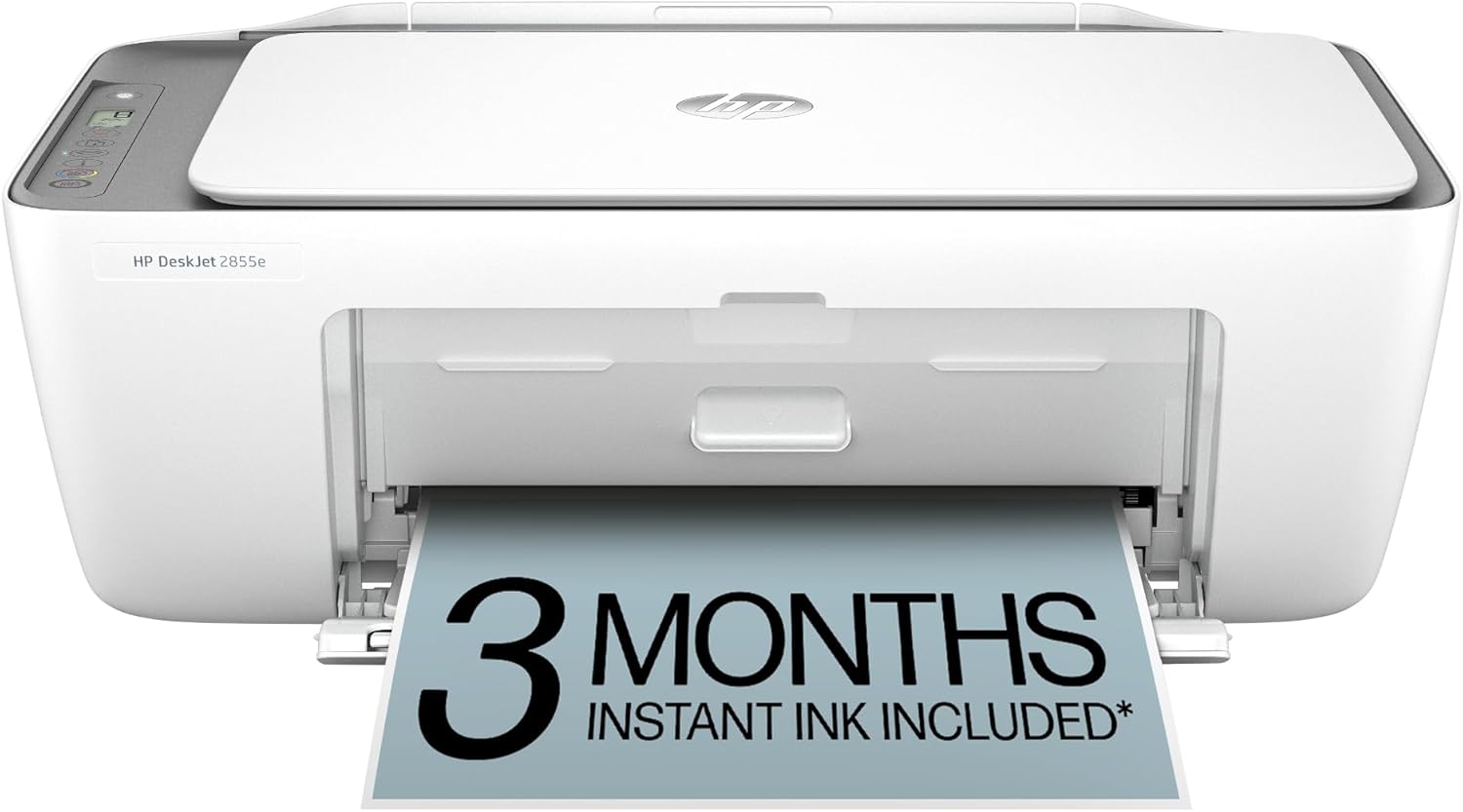
The HP DeskJet 2855e is a budget-friendly all-in-one designed for typical home office tasks like documents, web pages, and occasional photos. It connects over single-band 2.4 GHz Wi-Fi or USB 2.0 and is controlled easily from the HP app, which also enables HP+ features such as a 3-month Instant Ink trial. Print speeds are modest at about 7.5 ppm black and 5.5 ppm color, and the flatbed scanner lets you copy or digitize pages. The 60-sheet input tray and manual duplexing mean it handles light workloads but will require more hands-on feeding for longer runs or double-sided jobs. Print quality is decent for text and casual color prints, and HP AI formatting can clean up web pages before printing to avoid wasted pages. Expect typical ink costs tied to HP 67 cartridges and active Instant Ink subscription if you opt in. If you need a compact, app-driven printer for occasional home office use, the DeskJet 2855e covers the basics without extra bells.
Best for: Buyers who want an inexpensive, easy-to-use all-in-one for light home office tasks and value simple mobile printing and subscription ink options backed by many user experiences.
Less Ideal for: Those who regularly print large volumes, need fast professional photo quality, or require automatic duplexing and multi-band Wi-Fi should look at more capable models.
- Compact all-in-one design with printing, scanning, and copying in one unit
- Simple wireless setup and app control for printing from smartphones and tablets
- Includes 3-month Instant Ink trial with HP+ activation to simplify ink replacement
- 60-sheet input tray fits common home office paper needs without frequent refills
- Single-band 2.4 GHz Wi-Fi only, which may limit connectivity in some modern networks
- Manual duplexing rather than automatic two-sided printing
- Modest print speeds not ideal for high-volume use
Verdict: A compact, app-friendly all-in-one that covers everyday home office printing, scanning, and copying with easy mobile setup and an Instant Ink trial.
Brother DCP-L2640DW

| Printer Type | Laser |
|---|---|
| Print Speed | 36 pages_per_minute |
| Auto Document Feeder | 50 pages |
| Paper Tray Capacity | 250 sheets |
| Connectivity | Ethernet, USB, Wi-Fi |
The Brother DCP-L2640DW is a small-footprint monochrome laser MFP designed for home office and small business use, combining printing, scanning, and copying in one unit. It delivers fast black-and-white output up to 36 ppm and a first-page-out time under nine seconds, which keeps short jobs moving; a 250-sheet tray and 50-page auto document feeder reduce interruptions for medium-volume users. Connectivity is flexible with dual-band Wi-Fi, Ethernet, and USB plus mobile printing via Brother Mobile Connect, making it easy to print from phones or laptops. Key conveniences include automatic duplex printing to save paper, a flatbed plus sheetfed scanner for mixed originals, and support for Brother TN830/TN830XL toner cartridges with optional Refresh subscription for automatic supply delivery. Trade-offs are that it is strictly black-and-white (no color printing) and has a basic LCD rather than a large touchscreen, so advanced touchscreen workflow controls are limited. For those who prioritize reliable, fast monochrome output and straightforward networked setup, this model covers the essentials without extra complexity.
Best for: Buyers who want a dependable, no-nonsense monochrome MFP for a home office and value fast, networked printing with simple maintenance and support.
Less Ideal for: People who need color printing, photo-quality output, or advanced on-device touch controls should consider a color inkjet or higher-end MFP instead.
- Fast monochrome printing up to 36 ppm for quick document turnaround
- 50-page auto document feeder and 250-sheet tray reduce manual intervention
- Dual-band Wi-Fi, Ethernet, and USB provide flexible network and mobile printing options
- Automatic duplexing and Toner Save Mode help lower paper and toner costs
- Monochrome-only output so it cannot print color documents or photos
- Basic LCD interface limits on-device workflow control compared with touchscreen models
Verdict: A reliable, fast monochrome laser MFP that fits a home office needing steady black-and-white printing and simple networked setup.
Choosing the Right Wireless Printer for Home Office: Key Factors to Consider
Wireless Connectivity and Network Compatibility
A wireless printer must join your home network reliably and maintain a stable connection during print jobs. Look for dual-band Wi-Fi and Wi-Fi Direct if you need devices to connect without a router. Some printers also support Ethernet for a wired fallback, which can help in crowded Wi-Fi environments.
Compatibility with common network authentication methods and smooth switching between 2.4 GHz and 5 GHz bands matters when multiple devices are active. Poor connectivity leads to delayed jobs, incomplete prints, or repeated job failures, which directly impacts productivity in a home office.
Print Quality for Text and Graphics
Text sharpness and toner or ink consistency are critical for professional-looking documents. Evaluate resolution specs and sample output for crisp small-font rendering, solid blacks, and accurate color where graphics are used. For occasional photos, consider models that handle color gradients without banding.
Print quality affects readability, the impression your documents give to clients, and how often you need to reprint. If you print contracts or client-facing materials, prioritize machines that deliver consistently legible text and stable color reproductions.
Operating Costs and Consumables
Over time, toner or ink and replacement parts account for most of a printer's total cost of ownership. Compare estimated yield per cartridge or bottle and the cost of replacements. Some models offer high-yield or subscription-based consumables that lower per-page costs, while others have expensive standard cartridges that drive up running costs.
Understanding monthly print volume and cost per page helps you pick a printer that stays economical. Also consider the ease of replacing cartridges and whether consumables are easy to source locally.
Paper Handling and Media Support
Paper capacity, automatic duplexing, and the ability to handle different media types affect usability. A useful home-office printer will include a main tray with sufficient capacity for your typical week of printing and support automatic two-sided printing to save paper.
If you occasionally print envelopes, labels, or heavy-stock documents, verify that the printer specifies support for those media and has manual feed options. Poor paper handling increases jams and interrupts workflow.
Setup, Mobile Printing, and Software
Ease of setup reduces friction when integrating a printer into your home office. Look for clear setup wizards, dedicated mobile apps for printing from phones and tablets, and support for common standards like AirPrint and Mopria. Intuitive onboard menus and helpful LED or touchscreen guidance simplify routine tasks.
Software ecosystem matters for scanning, firmware updates, and accessing cloud printing features securely. Complicated or buggy apps will slow adoption and make routine tasks more frustrating.
Speed and Duty Cycle
Printing speed determines how long jobs block your workstation and how quickly you can finish batch tasks. Check pages-per-minute ratings for typical document types and whether first-page-out times are fast for short jobs. Duty cycle figures indicate the monthly volume the device is designed to handle.
Match the duty cycle to your expected monthly printing. A unit rated for low monthly volumes will wear faster under heavier use, while a higher-rated printer provides more headroom and longer service life.
Wireless Setup Tips for Stable Connections
Place the printer within a reasonable distance of your router and avoid obstructions that block the line of sight. If your home has multiple hub devices or mesh nodes, try connecting the printer to the node nearest your desk to reduce latency and packet loss.
Use the printer's setup utility or mobile app to connect to the 5 GHz band if you need higher throughput, but fall back to 2.4 GHz for wider range if the signal is weak. Enable a static IP or reserve an address in your router for the printer to prevent IP changes that can break shared printing.
- Test Wi-Fi Direct for quick mobile prints without network changes
- Reserve a router IP address for consistent network visibility
- Update printer firmware after setup to improve network stability
Choosing Between Inkjet and Laser Technologies
Inkjet printers typically excel at photo and color output and can be more affordable up front, while lasers provide crisp monochrome text and lower per-page costs for heavy document workloads. Consider your mix of color versus black-and-white printing when deciding between technologies.
For occasional color printing and photo needs, modern inkjets with pigment-based inks offer good longevity for documents. If you print primarily text and need fast, economical page throughput, a monochrome laser or color laser designed for office use may be a better fit.
- Inkjets: better color gradients and photo detail
- Lasers: faster text output and typically lower running costs for black prints
- Check pigment versus dye inks if archival quality matters
Maintaining Your Home-Office Printer
Regular maintenance extends a printer's usable life and reduces the chance of jams. Keep the paper path clean, use quality paper within the manufacturer's specified weight range, and avoid leaving spent cartridges installed long enough that nozzles or print heads dry out.
Run periodic nozzle checks and alignment procedures as recommended. For models with replaceable drums or maintenance kits, schedule replacements in line with the usage indicated in the manual to keep output consistent.
- Store spare cartridges in a cool, dry place
- Use the manufacturer-recommended paper to reduce jams
- Run occasional self-clean cycles for inkjets to prevent clogging
Optimizing Print Settings for Cost and Speed
Adjust default settings to draft or economy mode for internal documents to save ink or toner. Reserve high-quality or photo modes for client-facing materials. Enabling duplex printing by default reduces paper consumption and often speeds up multi-page handling by minimizing manual flips.
Use software features like print preview, scaling, and selective page printing to avoid unnecessary pages. If you frequently print documents from mobile apps, check app settings to control color use and resolution to balance quality and cost.
- Set default print mode to economy for internal drafts
- Enable duplex printing to save paper
- Use preview and selective printing to avoid wasted pages
Security Practices for Home-Office Printing
Protect your documents by securing the printer on the network. Disable open or guest printing, require authentication for admin functions, and enable encryption for mobile print jobs when available. Keep firmware updated to patch known vulnerabilities.
If sensitive documents are printed intermittently, consider enabling secure release features or printing via a direct connection when confidentiality is essential. Regularly audit connected devices and remove unused network shares to limit exposure.
- Require Wi-Fi password protection and WPA2/WPA3 encryption
- Keep firmware updated and change default admin passwords
- Use secure-release or direct print for confidential documents
How We Chose the Best Wireless Printer for Home Office
We focused on attributes that matter to people who regularly print from a home office. Selection prioritized reliable wireless connectivity, consistent print quality for text and occasional graphics, and reasonable ongoing costs. We inspected specification sheets and manufacturer materials to confirm features such as duplex printing support, mobile printing compatibility, and recommended paper handling. Practical usability factors included ease of initial network setup, control-panel or app clarity, and consumable replacement accessibility. We also considered duty-cycle recommendations and maintenance needs to gauge how well a printer will hold up under typical home-office workloads. Units missing basic wireless features, lacking duplex or mobile printing support, or with unusually high documented operating costs were excluded. The final list favors printers that balance low friction setup, predictable running costs, and sufficient print fidelity for letters, invoices, reports, and occasional photos.
Our full evaluation process is outlined in our review methodology.
FAQ
Can I print from both a laptop and a smartphone wirelessly?
Often yes. Most wireless printers support printing from computers and smartphones using Wi-Fi, Wi-Fi Direct, or mobile standards like AirPrint and Mopria. Confirm that your devices are on the same network or that the printer supports direct mobile printing.
How often should I replace ink or toner for a home office?
It depends on monthly print volume and the cartridge yield. For typical light-to-moderate home-office use, replacements may be needed every few months. Choosing higher-yield consumables or models designed for larger volumes reduces replacement frequency.
Is duplex printing important for a home office?
Usually yes. Automatic two-sided printing saves paper and yields more professional-looking multi-page documents. It also reduces manual handling and is especially helpful when printing booklets or long reports.
Will a wireless printer be slower than a USB-connected unit?
Not necessarily. Wireless performance depends on network quality. On a strong Wi-Fi connection, speeds are comparable for most document jobs. In congested networks, wireless may be slower or experience delays, so a wired fallback can be useful for very large batches.
What should I do if my printer keeps losing its network connection?
Try moving the printer closer to the router or connecting to a different node if you use a mesh system. Reserve a static IP for the printer, update firmware, and check for interference from other devices. If problems persist, a wired Ethernet connection can provide more stability.
Final Verdict
Focus on the features that match how much you print and what you print. Prioritize reliable wireless connectivity, the print quality you need for documents and occasional color work, and consumable economics that fit your monthly volume. Balance speed and duty-cycle expectations with maintenance requirements to avoid surprises. Choose a printer that simplifies setup and day-to-day use while keeping running costs predictable. That approach helps you maintain productivity and produce professional-looking output without unnecessary hassle.