
Note: This article contains affiliate links. If you click on these links and make a purchase, we may earn a small commission at no extra cost to you. This helps support our research and content. Read our full affiliate disclosure here.
Picking the right wireless printer on a budget matters because a poorly matched machine can cost more in time and supplies than it saves upfront. Whether you print occasional documents, schoolwork, or basic photos, you need a model that connects reliably, uses consumables efficiently, and produces acceptable quality without complicated setup. This guide shortlists seven top-rated budget wireless printers and explains the practical differences that matter. We evaluated connectivity, running costs, and everyday performance so you can pick a machine that fits typical home and small-office needs. Read on for a quick evaluation summary and the criteria we used to select these picks.
Top Picks at a Glance
| Best Overall The best all-around choice for most situations | Canon PIXMA TS6520 |  |
| Best Quality Built to a higher standard if you want something more solid | Epson EcoTank ET-2800 |  |
| Best Value The sweet spot between price and what you get | Brother Work Smart 1360 MFC-J1360DW | 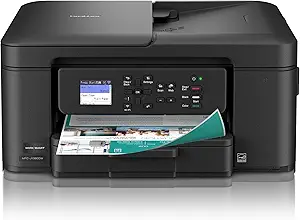 |
| Best Budget The cheapest option that still gets the job done reliably | HP DeskJet 2955 All-in-One |  |
| Top Rated A top-rated pick with lots of positive feedback | HPRT CP4100 4×6 Photo Printer |  |
| Most Popular A crowd favorite that many people choose with confidence | Canon PIXMA TR4720 |  |
| Best Seller A high-volume bestseller chosen again and again | TATTMUSE A285M Portable Thermal Printer |  |
Canon PIXMA TS6520

| Printer Type | Inkjet |
|---|---|
| Print media | Paper (plain) |
| Printer Connectivity Type | USB, Wi-Fi |
| Duplex | Automatic |
| Color Pages per Minute | 9 pages_per_minute |
The Canon PIXMA TS6520 is a home-focused all-in-one inkjet that aims for solid everyday performance without extra complexity. It prints, scans and copies with a simple 1.42-inch OLED control, and supports wireless and mobile printing via Wi‑Fi, Apple AirPrint, Mopria and the Canon app for easy setup from phones or laptops. Its two-cartridge hybrid ink system produces sharp black text and reasonably vibrant color prints and photos up to letter size, while automatic duplexing helps save paper. The flatbed scanner handles occasional document and photo scans, but there is no automatic document feeder so multi-page copying requires manual effort. Print speed is modest for home use and the single tray limits bulk jobs, but the compact footprint and voice control compatibility make it a convenient fit for small workspaces. For buyers who prioritize straightforward wireless printing, crisp everyday documents and occasional photo output without enterprise features, the TS6520 balances performance and value; power users who need fast page throughput or ADF scanning should look elsewhere.
Best for: Buyers who want a compact, easy-to-use wireless all-in-one for home, student or light hybrid-work use where good everyday print and mobile convenience matter more than high-volume throughput.
Less Ideal for: Offices or users who routinely print large volumes or need automated multi-page scanning and copying should choose a model with higher capacity and an ADF.
- Wireless and mobile printing support including dual-band Wi‑Fi and Canon PRINT, AirPrint and Mopria compatibility
- Automatic two-sided (duplex) printing to reduce paper use
- Compact all-in-one design with an intuitive 1.42-inch OLED control for easy setup and status checks
- Hybrid two-cartridge ink system that delivers sharp text and good color for documents and photos
- No automatic document feeder, so scanning or copying multi-page documents is manual
- Single paper tray and modest sheet capacity limit heavy or continuous printing jobs
Verdict: Pick the PIXMA TS6520 if you want an affordable, compact wireless all-in-one that delivers reliable everyday document and photo printing with easy mobile setup.
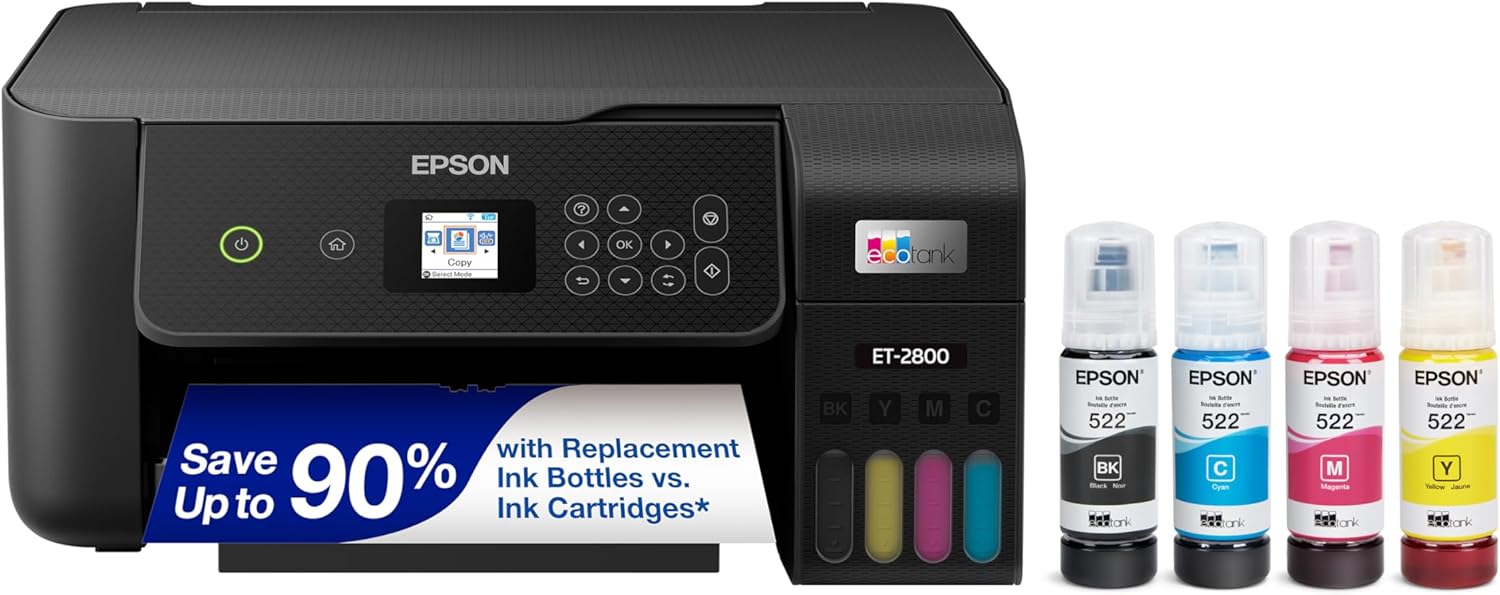
Epson EcoTank ET-2800
| Printer Type | Inkjet |
|---|---|
| Printer Connectivity Type | USB, Wi-Fi |
| Color Pages per Minute | 5 pages_per_minute |
| B&W Pages per Minute | 10 |
| Maximum print Resolution Color | 5760 x 1440 dpi |
The Epson EcoTank ET-2800 is a budget-friendly, cartridge-free all-in-one that replaces cartridges with refillable ink tanks to cut running costs and reduce interruptions for home use. It prints, scans and copies, connects via Wi-Fi and USB, and supports mobile and voice-activated printing for quick hands-free jobs. Print quality is strong for text and casual photo printing thanks to PrecisionCore and a high maximum resolution, while the included ink yields thousands of pages before needing replacement, which is its main cost-saving benefit. The ET-2800 is straightforward to set up and uses a simple LCD and app control for everyday tasks, though it lacks automatic duplexing and an automatic document feeder, so duplex and multi-page copying require manual handling. Speed is adequate for home duty at about 10 ppm mono and 5 ppm color, making it suitable for homework, documents, and occasional photos but not heavy office throughput. Expect best results with genuine Epson ink to maintain reliability and print performance.
Best for: Buyers seeking a low-cost-per-page wireless home printer that prioritizes long run ink value and reliable everyday performance for documents, schoolwork, and casual photos.
Less Ideal for: Do not choose this if you need heavy office throughput, built-in duplex automatic printing, or frequent multi-page scanning without manual intervention.
- Cartridge-free EcoTank system with high-capacity refillable ink tanks for low running costs
- Wireless and mobile printing with voice-activated support for convenient home use
- High maximum print resolution for detailed color prints and sharp text
- Includes scanning and copying in a compact all-in-one footprint
- Good ink yield (thousands of pages) from included/replacement bottle sets
- No automatic duplexing, so two-sided printing must be done manually
- Limited to a single paper tray and no automatic document feeder for multi-page scanning/copying
Verdict: Choose the ET-2800 if you want a wireless home all-in-one that dramatically lowers ink costs with refillable tanks while delivering solid everyday print quality.
Brother Work Smart 1360 MFC-J1360DW

| Printer Type | Inkjet |
|---|---|
| Duplex | Automatic |
| Maximum Sheet Capacity | 150 |
| Automatic Document Feeder | 20 sheets |
| Printer Connectivity Type | USB, Wi-Fi |
The Brother Work Smart 1360 is a compact wireless color inkjet all-in-one designed for home and small home-office use. It handles everyday print, copy, and scan tasks and includes a 20-sheet single-sided automatic document feeder and flatbed scanner for multi-page jobs. Connectivity options include Wi‑Fi and USB 2.0 with AirPrint and Mopria support, and the Brother Mobile Connect app simplifies setup and mobile printing. Productivity features that matter on a budget are present: automatic two-sided printing, a 150-sheet paper tray, and reasonably fast ISO print speeds (up to 16 ppm black, 9 ppm color). Print quality is aimed at crisp text and decent color output when paired with Brother Genuine LC501 inks, and Page Gauge helps monitor ink levels. Trade-offs for the low cost are modest: the small 1.8" display limits on-device menu control, and standard-yield starter cartridges mean you may replace inks sooner than with high-yield options. For routine documents, occasional color prints, and straightforward mobile workflows, this printer covers the essentials without extra complexity.
Best for: Buyers who want a straightforward, budget-friendly all-in-one that handles daily documents and occasional color prints with easy mobile printing and basic productivity features.
Less Ideal for: Users who need heavy-duty photo printing, large monthly page volumes, or advanced on-device controls should look at higher-end or business-focused models.
- Automatic duplex (two-sided) printing saves paper and manual flipping
- 20-sheet automatic document feeder and flatbed scanner handle multi-page scanning and copying
- Wireless printing with AirPrint, Mopria, Wi‑Fi Direct and Brother Mobile Connect app for easy mobile workflows
- 150-sheet paper tray supports longer print runs between refills
- Reasonable ISO print speeds up to 16 ppm black and 9 ppm color for typical home office tasks
- Starter ink cartridges are standard yield so replacement may be frequent for heavier users
- Small 1.8" color display limits on-device navigation and setup options
Verdict: A compact, budget-friendly wireless all-in-one that delivers reliable everyday printing, duplexing, and simple mobile workflows for home and small home-office needs.
HP DeskJet 2955 All-in-One

| Printer Type | HP Thermal Inkjet |
|---|---|
| Maximum media size | 8.5 x 11.69 in |
| Maximum print resolution (color) | Up to 4800 x 1200 optimized dpi |
| Connectivity | Apple AirPrint; USB; Wireless (Wi-Fi); Wireless direct printing; Mopria |
| Maximum sheet capacity | 60 |
The HP DeskJet 2955 is an entry-level all-in-one designed for simple home printing tasks. It prints color and black-and-white documents, copies and scans on a flatbed, and connects via Wi-Fi, AirPrint, Mopria or USB for mobile and computer printing. The 60-sheet input tray and up-to-7.5 ppm black print speed keep everyday jobs moving without taking up much space, and the built-in control panel and HP app simplify basic workflows. Notable extras include a 3-month trial of Instant Ink and AI formatting tools that trim unwanted web content before printing, which helps reduce wasted pages. Expect modest photo quality and modest page yields from the compatible HP 68 cartridges, and duplex printing is manual rather than automatic, so two-sided jobs require flipping pages yourself. The DeskJet 2955 is best when used for occasional documents, schoolwork and simple home-office needs rather than heavy-volume or high-quality photo printing.
Best for: Buyers looking for an inexpensive, space-saving all-in-one for occasional home printing, school projects and basic scans who prioritize low upfront cost and simple wireless setup.
Less Ideal for: Users who need high-volume printing, fast two-sided output, or professional photo-quality prints should consider more capable models.
- Compact footprint suitable for small desks or home use
- Wireless and mobile printing options including AirPrint and HP App
- Includes 3-month Instant Ink trial to simplify ink replacement
- Flatbed scanner and copying functions for basic multipurpose use
- Manual duplex only, so two-sided printing requires user intervention
- Modest print speeds and likely modest cartridge yields for frequent users
Verdict: A compact, budget-friendly wireless all-in-one that covers basic home printing, scanning, and copying needs with easy mobile setup.
HPRT CP4100 4×6 Photo Printer

| Printer Type | Dye Sublimation |
|---|---|
| Print Resolution | 300×300 |
| Maximum Media Size | 4 x 6 inch |
| Maximum Sheet Capacity | 108 |
| Printer Connectivity Type | Wi-Fi |
The HPRT CP4100 is a portable dye sublimation 4×6 photo printer built for quick smartphone-to-print workflows. It connects over 2.4 GHz Wi‑Fi or its own hotspot and uses the HeyPhoto app to crop, apply filters, and send images to the printer in a few taps. Prints come at about 300 dpi with a laminated finish that resists water, fingerprints, and scratches, and the bundled kit includes 108 sheets and two ribbons so you can start printing right away. Output speed is modest at roughly one 4×6 per minute, which is fine for parties, travel photos, and casual home use but too slow for high-volume production. The CP4100 is optimized for HPRT paper and ribbons, so ongoing consumable choice is limited to the maker's supplies. Setup and portability are strengths, and the built-in hotspot makes printing reliable when a router is not available, but users should plan for proprietary consumables and moderate print throughput.
Best for: Buyers who want an affordable, easy-to-use wireless photo printer for occasional 4×6 prints at home or events and who prioritize consistent, durable prints over fast throughput.
Less Ideal for: People who need fast, high-volume printing or who prefer using a wide variety of third-party paper and ribbon supplies.
- Dye sublimation printing with 300 dpi produces durable, laminated 4×6 photos resistant to water and fingerprints
- Built-in Wi‑Fi hotspot and 2.4 GHz network support enable easy wireless printing from smartphones
- Comes with 108 sheets and 2 ribbons so you can print immediately out of the box
- Compact and portable design suitable for home, events, and casual on-location printing
- Print speed is about one 4×6 per minute, which is slow for high-volume needs
- Uses proprietary HPRT paper and ribbons only, limiting third-party consumable options
Verdict: A budget-friendly wireless 4×6 photo printer that delivers durable, lab-style prints and works reliably from smartphones when you want consistent quality over speed.
Canon PIXMA TR4720

| Printer Type | Inkjet |
|---|---|
| Print Resolution | 4800 x 1200 |
| B&W Pages per Minute | 8.8 |
| Color Pages per Minute | 4.4 |
| Connectivity | USB, Wi-Fi |
The PIXMA TR4720 is a budget-friendly 4-in-1 inkjet aimed at home and small-office use. It handles everyday printing, scanning and copying, plus faxing, and includes a 100-sheet front paper tray and an auto document feeder for multi-page jobs. Wireless and USB connectivity plus Canon's Print app let you print from phones or cloud services without installing drivers, and automatic two-sided printing helps save paper. Print quality is solid for documents and decent for borderless photos up to letter size thanks to Canon's hybrid ink system, while copy and scan resolution top out at 4800 x 1200. Keep in mind the TR4720 is not fast for color jobs (about 4.4 ppm) and ink costs can add up with regular photo or heavy color printing. The unit is compact and energy efficient, but users who need high-volume, high-speed or professional photo output may find its performance limiting. For everyday documents, occasional photos and small batches the PIXMA TR4720 offers a straightforward, app-driven solution at a low price point.
Best for: Buyers who want a low-cost, space-saving all-in-one for home or small office tasks and who prioritize easy mobile printing and simple setup over speed or heavy-duty volume.
Less Ideal for: Users who print large volumes, need fast color throughput, or require professional-grade photo output should consider a faster or higher-end model instead.
- Wireless printing and mobile app support for easy phone or cloud printing
- Auto document feeder and automatic duplexing for multi-page tasks and two-sided printing
- Compact footprint with a 100-sheet front tray fits small home offices
- Hybrid ink system that produces sharp black text and acceptable color and borderless photo prints
- Slower color print speed compared with higher-end models
- Ink consumption and running costs can be high with frequent color or photo printing
Verdict: A compact, app-friendly all-in-one that delivers reliable everyday document printing and basic photo capability at a budget price.
TATTMUSE A285M Portable Thermal Printer

| Printer Type | Thermal |
|---|---|
| Maximum Media Size | 8.5 x 11 inch |
| Print Resolution | 203 dots_per_inch |
| Connectivity | Bluetooth, USB |
| B&W Pages per Minute | 7 |
The TATTMUSE A285M is a small rechargeable thermal printer designed for on-the-go black-and-white printing without ink or toner. It pairs over Bluetooth with phones and tablets using a companion app and connects to laptops and PCs over USB-C with a driver, making it useful for printing receipts, invoices, boarding passes, simple documents, and single-sheet or roll thermal media. Notable features include support for multiple thermal paper widths up to 8.5 x 11 inches, a built-in paper bin, 203 dpi monochrome output, and a modest battery capacity for mobile use. The device is lightweight and pocketable for travel or fieldwork, and the lack of consumable ink keeps running costs low, but it only prints in monochrome on thermal paper and cannot use regular copy paper. Setup on phones is straightforward via Bluetooth and the app, while computer use requires downloading a driver. Print speed is modest at about 7 ppm, so it suits occasional or mobile printing rather than high-volume office work.
Best for: Buyers who want a low-maintenance, portable printer for occasional receipts, invoices, or travel documents and prefer a simple Bluetooth phone workflow with minimal ongoing costs.
Less Ideal for: Users who need color printing, high-volume throughput, or frequent full-size office print jobs should choose a conventional inkjet or laser desktop printer instead.
- Inkless thermal printing eliminates ink and toner costs and maintenance
- Bluetooth 5.0 support for direct mobile printing from phones and tablets
- Supports multiple paper widths including US Letter and A4 for flexible document sizes
- Compact, lightweight, and rechargeable for travel and field use
- Only prints black-and-white on thermal paper and cannot use standard copy paper
- Computer printing requires downloading and installing a driver via USB connection
Verdict: A285M is a budget-friendly portable thermal printer that keeps running costs low and works well for mobile black-and-white documents when you need simple, ink-free printing.
Choosing the Right Wireless Printer on a Budget: Key Factors to Consider
Wireless Connectivity Reliability
A budget wireless printer is only useful if it stays connected. Look for models with solid 2.4 GHz Wi-Fi performance and good signal handling in homes with common interference sources. Reliable wireless connectivity reduces failed jobs, repeat prints, and time spent troubleshooting.
Also consider whether a printer supports direct mobile printing protocols like AirPrint or Mopria, and whether it offers a stable web or app interface for job management. Printers that drop off the network or require frequent reconnection can negate the savings of a low purchase price.
Consumable Cost And Ink/Toner Options
Upfront price is only part of the expense equation. Consumable cost per page often dominates lifetime cost, so prioritize models with high-yield cartridges or reasonably priced compatible options. For many buyers, black-and-white document cost is the critical figure; for occasional color printing, estimated color page costs matter too.
Check whether the manufacturer permits third-party cartridges or refillable tanks, and whether high-capacity cartridges are available. A slightly higher initial cost can be worthwhile if it drops the long-term per-page expense significantly.
Print Speed And Duty Cycle
Print speed, usually expressed in pages per minute, affects productivity for routine home-office tasks. On a budget, you may not need top-tier PPM, but excessively slow printers create frustration when printing multi-page documents or school assignments.
Also consider the rated monthly duty cycle. Budget models are designed for light to moderate use; choose a printer whose expected workload matches your typical monthly page count to avoid premature wear or frequent maintenance.
Print Quality For Intended Uses
Quality expectations vary. For text documents and forms, crisp, legible black text is most important. If you occasionally print photos or graphics, look for a model with better color handling and higher DPI. Budget printers will not match photo-lab output, but some produce acceptable snapshots for casual use.
Assess sample output when possible and prioritize clarity and tone for black text, smooth gradients for simple images, and minimal banding in color prints.
Size, Noise, And Physical Fit
Budget wireless printers are often compact, but size still matters when desk or shelf space is limited. Check the printer's footprint and paper tray arrangement to ensure it fits your workspace. Noise levels during printing and warm-up can be disruptive in shared living spaces, so quieter models are preferable for home use.
Also think about paper handling: front-loading trays and easy-access jamming points reduce aggravation when clearing misfeeds.
Software, Mobile Printing, And User Interface
An intuitive setup process and clear control panel or app make day-to-day use easier, especially for households with multiple users. Mobile printing support, cloud printing, and a responsive companion app reduce friction for wireless workflows.
Consider how the printer alerts you to low ink, how easy it is to reorder supplies, and whether firmware updates are straightforward. Simpler interfaces reduce the learning curve for less technical users.
Setting Up A Budget Wireless Printer
Most budget wireless printers offer a guided setup using an onboard display or a mobile app. Start by positioning the printer within good Wi-Fi range and connecting to your home network during the initial setup flow. Avoid relying on direct USB setup unless you plan to keep the printer physically tethered.
- Place the printer on a stable, level surface within strong Wi-Fi coverage.
- Use the printer app or onboard menu to connect to your router; enter credentials carefully to avoid network drops.
- If available, enable automatic firmware updates after initial setup to keep wireless features stable.
Lowering Ongoing Running Costs
To reduce per-page expenses, favor higher-yield cartridges, consider refillable-tank designs, and use draft or economy print modes for noncritical documents. Regularly print a small test page to keep ink lines clear and prevent wasted pages from clogged nozzles.
- Choose black-and-white mode for text-heavy jobs to save color ink.
- Buy higher-capacity cartridges or bulk ink where supported.
- Avoid long idle periods that can dry out ink; occasional test prints help maintain nozzle health.
Troubleshooting Common Wireless Issues
Typical connectivity problems include intermittent drops, slow transfer speed, or the printer not appearing on mobile devices. Begin troubleshooting by rebooting the router and printer, verifying Wi-Fi credentials, and checking for nearby interference from other electronics. If the printer supports both 2.4 GHz and 5 GHz bands, use 2.4 GHz for better range on inexpensive models.
- Power-cycle the router and printer when the device disappears from the network.
- Move the printer closer to the router for setup; once stable, test at the intended location.
- Disable temporary guest networks or VPNs that can block device discovery.
Choosing Between Inkjet And Laser In The Budget Segment
Budget inkjet printers often win on initial price and photo-capability, while budget laser printers typically offer lower black-and-white running costs and faster text output. For mostly text printing, a monochrome laser or hybrid laser-mono design can be more economical over time. For mixed use with occasional color images, an inkjet with refillable tanks may be a better fit. Think about the balance between upfront cost, monthly page volume, and the typical job mix when deciding which technology is right for you.
- Inkjet: better for color photos and initial affordability.
- Laser: better for fast, cheap black-and-white pages.
Paper Handling And Media Support
Standard budget printers handle plain paper and basic photo paper. If you need envelopes, labels, or heavier stock, confirm the model supports those media types and check the manual for maximum paper weight. Single-sheet rear feeds can simplify printing on specialty stock, while multi-sheet trays reduce the need to reload for routine jobs.
- Verify tray capacity to match your usage patterns.
- Use manufacturer guidelines for specialty media weights to avoid jams.
- Consider a printer with a separate rear feed for occasional cardstock or envelopes.
How We Chose the Best Wireless Printer on a Budget
Our selection focused on real-world usability and operating economics for buyers looking specifically for a wireless printer on a budget. We prioritized models that deliver consistent wireless connectivity, straightforward setup, and low per-page running costs. Print quality was judged relative to typical home and homework tasks rather than professional photo or press standards. We also examined print speed under common office loads and how well devices handle mixed jobs without frequent jams or errors. Concretely, we filtered for printers with reliable Wi-Fi or mobile printing support, demonstrable low-cost ink or toner options, and compact designs suited to limited desk space. We excluded specialty large-format, heavy-duty office machines, and printers that require proprietary subscription services to function. Key dimensions that determined inclusion were wireless stability, consumable cost per page, acceptable text and basic photo quality, ease of setup and daily use, and physical footprint and noise levels.
Our full evaluation process is outlined in our review methodology.
FAQ
How much should I expect to pay monthly for ink or toner?
It depends on your volume and the printer's cartridge yields. Low-volume home users often spend only a few dollars a month, while heavier users with frequent color printing can see higher costs. Comparing cost per page figures for black and color will give a realistic estimate.
Can I print from my phone without a router?
Many printers support direct mobile printing or Wi-Fi Direct, which lets a phone connect to the printer without a router. This is useful for occasional prints but can be less convenient for households that want shared, always-on access.
Are refillable ink tanks worth it on a budget printer?
Refillable tanks usually reduce long-term ink expenses significantly, especially if you print moderately often. They require slightly more careful handling during refills but can be the most economical choice for color-capable budget models.
Will a budget wireless printer handle occasional photo printing?
Yes, some budget inkjets produce acceptable casual photos, though they will not match dedicated photo labs. Use higher-quality photo paper and the printer's photo mode for the best results.
How often should I run maintenance prints to avoid clogs?
Running a small test page or nozzle check once every 1 to 2 weeks can keep ink flowing and reduce clogged nozzles. Frequency depends on humidity, ink type, and how often the printer is used.
Final Verdict
Deciding on a wireless printer on a budget means balancing upfront cost against ongoing consumable expenses and expected workload. Prioritize reliable wireless connectivity and low cost per page for text-heavy households, and favor refillable-tank inkjets if you need economical color prints. Consider print speed, paper handling, and footprint to ensure the printer fits your daily routines. Focus on the factors that will affect your monthly experience rather than the lowest purchase price alone. That approach will help you choose a dependable, affordable wireless printer that meets your home or small-office printing needs.