
Note: This article contains affiliate links. If you click on these links and make a purchase, we may earn a small commission at no extra cost to you. This helps support our research and content. Read our full affiliate disclosure here.
If you work from home or need a dedicated machine for household paperwork, a small printer for home office can save space while keeping document tasks efficient. You want a device that fits a tight desk, connects reliably to multiple devices, and produces crisp text without frequent maintenance. This guide covers seven shortlisted compact printers that suit varied home-office workloads and explains the practical tradeoffs buyers should expect. Below you will find the top compact picks along with the evaluation criteria we used to choose them and clear buying factors to help you pick the best fit for your setup.
Top Picks at a Glance
| Best Overall The best all-around choice for most situations | Epson WorkForce Pro WF-3820 |  |
| Best Quality Built to a higher standard if you want something more solid | Brother Work Smart 1360 MFC-J1360DW | 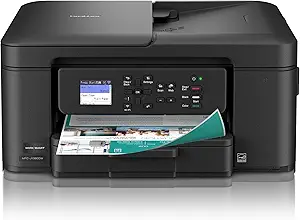 |
| Best Value The sweet spot between price and what you get | Canon PIXMA TS6520 |  |
| Best Budget The cheapest option that still gets the job done reliably | HP DeskJet 2955 All-in-One |  |
| Top Rated A top-rated pick with lots of positive feedback | Epson EcoTank ET-2800 |  |
| Most Popular A crowd favorite that many people choose with confidence | Canon PIXMA TR4720 |  |
| Best Seller A high-volume bestseller chosen again and again | TATTMUSE A285M Portable Thermal Printer |  |
Epson WorkForce Pro WF-3820

| Printer Type | Inkjet |
|---|---|
| B&W Pages per Minute | 21 pages_per_minute |
| Color Pages per Minute | 11 pages_per_minute |
| Maximum print Resolution Color | 4800 dots_per_inch |
| Printer Connectivity Type | Wi-Fi |
The WorkForce Pro WF-3820 is a compact all-in-one inkjet built for everyday home office tasks and light small-office workloads. It prints up to 21 ppm in black and 11 ppm in color using PrecisionCore Heat-Free Technology and DURABrite Ultra pigment inks, so text jobs come out quickly and photos or color documents look crisp and smudge-resistant. The 250-sheet tray and 35-sheet ADF make batch scanning and multi-page copying practical, and automatic duplexing saves paper on two-sided prints. Connectivity includes Wi-Fi plus Bluetooth and Ethernet for flexible placement, and the 2.7" color touchscreen with Epson Smart Panel app support simplifies setup and remote operation. Expect reliable output for invoices, reports, and occasional color collateral, but note it uses Epson genuine cartridges only and is optimized for standard paper sizes rather than very large-format photo work. For users who value speed, a modest paper capacity, and integrated scanning/faxing in a single footprint, the WF-3820 covers the core needs without taking up much desk space.
Best for: Buyers who need a reliable, compact all-in-one for a home office or small workgroup and prioritize fast black text printing, built-in scanning, and easy wireless setup.
Less Ideal for: Users who print large volumes of high-resolution photos, need the lowest possible ink cost per page, or require an industrial-scale paper capacity should look elsewhere.
- Fast black print speed up to 21 ISO ppm for quick document output
- 250-sheet tray plus 35-sheet ADF and automatic duplexing for efficient multi-page jobs
- PrecisionCore and DURABrite Ultra inks deliver sharp text and durable color prints
- Multiple connectivity options including Wi-Fi, Bluetooth, and Ethernet and smartphone app control
- Requires genuine Epson cartridges which can raise ongoing ink costs
- Color print speed is slower than black, so large color jobs take longer
Verdict: A space-efficient all-in-one that delivers fast, reliable black printing and useful scanning features for home office users who want solid everyday performance.
Brother Work Smart 1360 MFC-J1360DW

| Printer Type | Inkjet |
|---|---|
| Functions | Print, Copy, Scan |
| Duplex | Automatic |
| Max Sheet Capacity | 150 |
| Connectivity | USB, Wi-Fi |
The Brother Work Smart 1360 is a compact all-in-one inkjet designed for home and home-office use, handling printing, copying, and scanning from one small footprint. It prints up to 16 ppm black and 9 ppm color, supports automatic duplex (two-sided) printing and a 20-sheet single-sided automatic document feeder for short batch jobs, and offers wireless, Wi‑Fi Direct and USB connections plus mobile/cloud printing through the Brother Mobile Connect app. A 150-sheet tray and Page Gauge ink monitoring make it practical for regular home-office workloads, and the 1.8 inch color display provides basic on-device controls. Print quality aims high with up to 1,200 x 6,000 dpi on Windows, so text and color graphics look sharp for reports and flyers. Expect typical inkjet considerations: color photo printing and heavy photo production are not its focus, and standard-yield starter cartridges mean you'll want to plan for replacement or opt for higher-yield Brother cartridges for frequent printing. For buyers prioritizing fast, reliable everyday output in a space-saving machine, the Work Smart 1360 delivers a balanced mix of speed, connectivity, and duplex convenience.
Best for: Buyers who need a fast, space-efficient multifunction printer for routine home-office tasks and value wireless/mobile printing and two-sided capability.
Less Ideal for: Users who require high-volume photo production or a heavy-duty office workhorse should consider larger laser or photo-focused printers.
- Automatic duplex (two-sided) printing saves paper and reduces manual handling
- 20-sheet automatic document feeder speeds through multi-page scans and copies
- Wireless, Wi‑Fi Direct and USB connectivity plus mobile/cloud printing via Brother Mobile Connect
- Compact footprint with a 150-sheet tray suitable for home-office workflows
- High maximum print resolution for crisp text and detailed color graphics on Windows
- Starter standard-yield inks are limited so frequent users should plan for replacements
- Not optimized for high-volume photo printing or professional photo quality
Verdict: A compact, performance-focused all-in-one that delivers fast everyday black and color printing with automatic duplexing and solid mobile/cloud connectivity for home-office use.
Canon PIXMA TS6520

| Printer Type | Inkjet |
|---|---|
| Duplex | Automatic |
| Printer Connectivity Type | USB, Wi-Fi |
| Display Type | OLED |
| Color Pages per Minute | 9 pages_per_minute |
The Canon PIXMA TS6520 is a small all-in-one inkjet designed for home office and family use, combining printing, flatbed scanning, and copying in a compact chassis. It uses a two-cartridge hybrid ink system to deliver sharp text and vivid color photos, supports borderless prints up to letter size, and can print on plain paper via USB or dual-band Wi-Fi for reliable mobile and desktop workflows. A 1.42" OLED display and simple control panel make setup and status checks easy, while automatic two-sided printing cuts paper use for routine documents. Expect reasonable speed for casual work: about 14 ppm black and 9 ppm color with quick first-page times. The TS6520 omits advanced business features like an automatic document feeder and a large paper tray, so it is best suited to light to moderate print volumes rather than heavy daily office loads. Power consumption is modest and the unit includes starter ink tanks, but long-term ink costs depend on replacement cartridge pricing.
Best for: Buyers who want a space-saving, easy-to-use home office printer that handles everyday documents and occasional photos with straightforward wireless setup and low daily fuss.
Less Ideal for: People who need high monthly volumes, heavy multi-page scanning, or larger paper capacity should consider desktop models with an ADF and bigger trays.
- Compact all-in-one design saves desk space while providing print, scan, and copy functions.
- Automatic duplex printing reduces paper use and speeds common workflows.
- Dual-band Wi-Fi plus USB and mobile printing support for flexible connectivity.
- Hybrid two-cartridge ink system produces sharp text and vibrant color photos.
- Simple OLED display and intuitive controls simplify setup and status checks.
- No automatic document feeder, which slows multi-page scanning or copying.
- Paper handling is basic with a single tray and small sheet capacity.
Verdict: A compact, user-friendly all-in-one that delivers reliable wireless printing and duplexing for light home office use.
HP DeskJet 2955 All-in-One

| Printer Type | HP Thermal Inkjet |
|---|---|
| Maximum Sheet Capacity | 60 |
| Print Speed (B&W) | 7.5 pages_per_minute |
| Connectivity | AirPrint; USB; Wi‑Fi; Wireless direct; Mopria |
| Compatible Cartridge | HP 68 / HP 68e |
The HP DeskJet 2955 is an entry-level all‑in‑one that handles everyday home office tasks like printing documents, scanning pages on its flatbed, and making quick copies. It prints color and black documents at modest speeds (around 7.5 ppm black, 5.5 ppm color) and accepts standard HP 68 cartridges, while a 60‑sheet input tray keeps it compact on a desk. Wireless features include dual‑band Wi‑Fi, AirPrint, Mopria, and USB for direct connections, and the HP app simplifies mobile printing and scanning. The printer includes a three‑month trial of HP Instant Ink for automated cartridge delivery, and HP AI formatting helps trim unwanted web content before printing. Expect basic print quality suitable for text and occasional photos but not photo‑lab output, and manual duplexing if you need two‑sided pages. Its low power draw and recycled‑plastic components make it a practical, space‑saving pick for tight budgets and small workspaces.
Best for: Buyers who need an affordable, space‑saving multifunction printer for occasional to moderate home office tasks and value simple mobile printing and low upfront cost.
Less Ideal for: Do not choose this if you need fast high‑volume printing, professional photo quality, or automatic two‑sided printing for heavy duplex workloads.
- Compact footprint fits small home offices
- Wireless printing with AirPrint, Mopria, and HP app for mobile workflows
- Includes 3‑month Instant Ink trial for simpler ink replacement
- Flatbed scanner and copy functions add basic multifunction capability
- Made with recycled plastics and ENERGY STAR certified
- Print speeds and quality are modest compared with higher‑end models
- No automatic duplexing; two‑sided printing requires manual flipping
Verdict: A budget‑friendly, compact all‑in‑one that delivers straightforward home office printing, scanning, and copying with easy mobile connectivity.
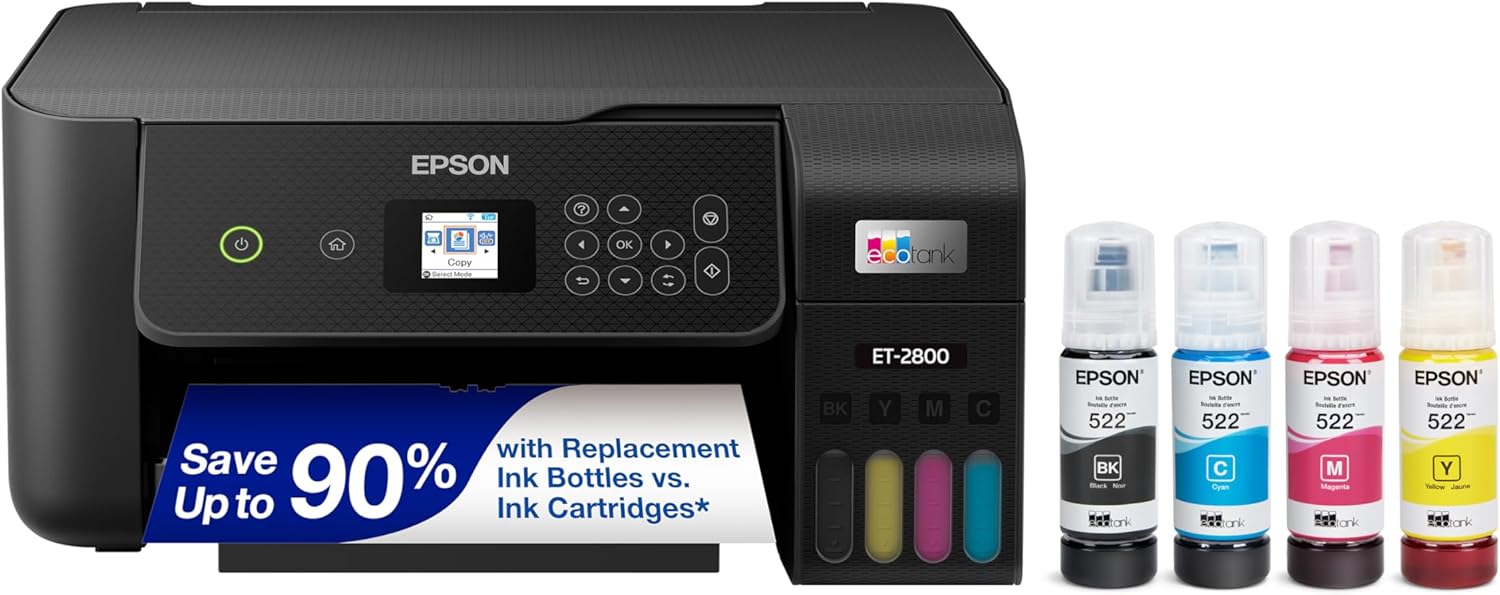
Epson EcoTank ET-2800
| Printer Type | Inkjet |
|---|---|
| Printer Connectivity Type | USB, Wi-Fi |
| Maximum print Resolution Color | 5760 x 1440 dpi |
| B&W Pages per Minute | 10 |
| Duplex | Simplex |
The Epson EcoTank ET-2800 is a compact all-in-one inkjet that replaces cartridges with high-capacity refillable tanks to reduce how often you need to change ink. It prints, copies, and scans for everyday home office tasks and offers wireless and voice-activated printing plus a small color LCD for basic control. Print quality is strong for documents and casual photos thanks to Epson's PrecisionCore/Micro Piezo technology and high resolution, and the included ink set is sized to last for many prints before a refill is needed. Practical benefits include low running costs compared with cartridge-based printers and straightforward tank refills using keyed EcoFit bottles. Limitations to expect are modest color print speed (about 5 ppm) and simplex-only printing, so duplex jobs require manual page flipping, and the single USB port and limited paper capacity mean it is best for light to moderate home office workloads rather than heavy daily production.
Best for: Buyers who prioritize a dependable, low-maintenance home printer that minimizes ink replacements and running costs for everyday documents and occasional photos.
Less Ideal for: Users who need fast, high-volume two-sided printing or multi-port connectivity for heavy small-business workloads should consider a more production-oriented office model.
- Cartridge-free EcoTank system includes high-capacity refillable ink tanks for far fewer replacements
- Low running costs with each ink bottle set equivalent to many individual cartridges
- Wireless and voice-activated printing for easy mobile and hands-free use
- High maximum print resolution for detailed text and decent photo output
- No automatic duplex printing, requiring manual flipping for two-sided jobs
- Relatively slow color print speed compared with faster office models
Verdict: Choose the ET-2800 if you want a reliable, low-running-cost home all-in-one that cuts out cartridge swaps and handles everyday printing with minimal fuss.
Canon PIXMA TR4720

| Printer Type | Inkjet |
|---|---|
| Functions | Print, copy, scan, fax |
| Maximum print Resolution Color | 4800 x 1200 dpi |
| B&W Pages per Minute | 8.8 |
| Printer Connectivity Type | USB, Wi-Fi |
The Canon PIXMA TR4720 is a small all-in-one inkjet built for light home office use where space is limited. It handles everyday tasks — printing documents, borderless photos up to letter size, scanning and faxing — and adds convenience features like a 100-sheet front tray, automatic two-sided printing and a basic auto document feeder for multipage scans or copies. Wireless and USB connectivity plus Canon Print app support make mobile printing straightforward, and the hybrid ink system delivers sharp black text and usable color photos for occasional photo projects. On the downside it is not a speed demon, with modest ISO speeds (about 8.8 ipm black, 4.4 ipm color) and a simple 2-line LCD interface that limits advanced control on the device itself. Expect typical consumer ink costs and replaceable PG-275/CL-276 cartridges, so heavy-volume users will find running costs higher than laser alternatives. For small offices or work-from-home setups that need a compact multi-function printer and easy mobile workflows, the TR4720 covers the basics reliably.
Best for: Buyers who want a compact, straightforward all-in-one for occasional to moderate home office printing, scanning and faxing with easy mobile connectivity and reliable basic output.
Less Ideal for: People who need high-volume, high-speed printing or the lowest long-term cost per page should consider more robust laser or business-class printers instead.
- Compact 4-in-1 design fits small home office spaces
- Automatic duplex printing and 100-sheet front tray reduce paper handling
- Wireless printing and Canon Print app enable easy mobile and cloud printing
- Auto document feeder simplifies multi-page scanning and copying
- Modest print speeds for color and black compared with higher-end models
- Basic on-device controls and small LCD limit advanced workflows
Verdict: A compact, easy-to-use all‑in‑one that delivers reliable home office printing, scanning and faxing with straightforward mobile connectivity.
TATTMUSE A285M Portable Thermal Printer

| Printer Type | Thermal |
|---|---|
| Printer Connectivity Type | Bluetooth, USB |
| Maximum Media Size | 8.5 x 11 inch |
| B&W Pages per Minute | 7 |
| Wattage | 11.1 watt-hours |
The TATTMUSE A285M is a lightweight, travel-friendly thermal printer designed for quick black-and-white printing without ink. It pairs over Bluetooth with phones and tablets through a companion app and uses a USB-C connection plus a driver for laptop or PC printing, making it suitable for on‑the‑go receipts, invoices, boarding passes, and single-sheet US Letter or A4 thermal output. Notable features include support for five thermal paper widths (including 8.5 x 11"), a built-in paper bin, rechargeable battery, and a claimed 7 ppm print speed with up to 203 dpi effective resolution for text and simple graphics. The inkless thermal design eliminates ink and toner costs, but it only prints on thermal paper and only in monochrome, so it is not a substitute for full-feature office printers that need color or standard copy paper. Setup requires installing the mobile app for phone printing and a driver for PC use, and Bluetooth is limited to phones and tablets while computers need USB. For a small home office that values portability and low running cost for receipts and short documents, this model delivers practical convenience with predictable limitations.
Best for: Buyers who want a portable, low-maintenance printer for printing receipts, invoices, boarding passes, and short documents from phones or a laptop while traveling or working from a small home office.
Less Ideal for: Users who need color printing, high-resolution photo output, or routine printing on standard copy paper should choose a conventional inkjet or laser office printer instead.
- Inkless thermal printing eliminates ink or toner costs and maintenance
- Bluetooth pairing for phones and tablets plus USB-C for computers
- Supports multiple thermal paper widths including US Letter and A4
- Compact and lightweight for travel or mobile work with built-in paper bin
- Prints only in black-and-white on thermal paper, not regular copy paper
Verdict: If you need a compact, inkless printer for mobile-friendly black-and-white documents and receipts in a home office, the A285M is a practical, low-maintenance choice.
Choosing the Right Small Printer for Home Office: Key Factors to Consider
Physical Footprint and Placement
A compact footprint matters because home offices often share space with other activities. Measure width, depth, and height against your available desk or shelf space before deciding. Consider whether you need a flat-top scanner lid that increases overall height when opened and whether the printer can sit under a low shelf.
Placement also affects ventilation and access for paper jams or cartridge changes. A printer placed inside a cabinet or tight alcove can trap heat and make routine maintenance harder, so leave enough clearance to open trays and access the consumables easily.
Print Output Needs and Quality
Decide what you print most often. If your workload is mostly text documents, prioritize sharp black-and-white output and toner-based options that render small fonts cleanly. If you print photos or marketing materials occasionally, check color gamut and photo mode settings; small printers vary widely in color accuracy and saturation.
Also consider whether you require duplex printing for two-sided documents, which saves paper and looks more professional for reports and handouts. Print resolution and the device's handling of fine lines will determine how suitable a compact printer is for detailed charts or graphics.
Operating Costs and Consumables
A low initial price can be offset by high ongoing costs. Look at the advertised page yield for cartridges or toner and calculate an estimated cost per page using the manufacturer yield figures. High-yield or XL cartridges usually lower the per-page cost, but verify that these options are available for the model you choose.
Factor in the frequency of replacements based on your monthly page volume. Some compact models use multiple color cartridges, which can drive up cost if one color runs out early. Also check if the printer supports third-party or remanufactured consumables if that is part of your cost strategy.
Connectivity and Workflow Integration
Small printers for home office should offer flexible connectivity. Wi-Fi and Ethernet allow shared access across devices, while Bluetooth or USB may be adequate for single-user setups. Mobile printing protocols and cloud print options simplify printing from smartphones and tablets, which is handy for multitasking home workers.
Consider if the printer provides an easy setup process and clear status notifications. Integration with common scanning workflows, scan-to-email, and basic on-device editing features can save time when you need quick digital copies of receipts or signed documents.
Speed and Duty Cycle
Print speed influences productivity. Compact printers often trade speed for size, so check pages-per-minute ratings under realistic conditions. Consider whether the device can handle your typical daily or monthly page volume; the rated monthly duty cycle indicates the maximum recommended workload and helps avoid premature wear.
If you occasionally print larger batches, a slower but reliable compact printer may still work, but frequent heavy use suggests looking for higher-duty-cycle models to reduce maintenance and downtime.
Maintenance and Reliability
Small printers can be convenient but may require more frequent attention than larger office models. Look for devices with accessible paper paths, clear error messages, and user-replaceable components. Features like automatic alignment, dust covers for cartridges, and straightforward firmware updates reduce hassle.
Also consider warranty options and the availability of customer support. A model with a solid support pathway and easy-to-follow online resources will shorten the time spent troubleshooting issues, which matters when a single compact printer supports an entire home office.
When to Choose an Inkjet Vs Laser for a Home Office
Inkjet and laser technologies each have strengths for home-office use. Inkjet printers are typically better for occasional photo printing and produce richer colors on coated papers. They also tend to have a smaller initial footprint for similar feature sets. Laser printers, especially monochrome lasers, offer crisp text, faster first-page-out times, and lower cost per page for black-and-white documents.
- Choose inkjet if you print photos or color marketing materials occasionally.
- Choose monochrome laser if your workload is mostly text and you prioritize low running costs and speed.
- Consider color laser if you need vibrant color output but expect higher consumable costs.
Setting Up a Compact Printer on a Home Network
Place the printer within good Wi-Fi coverage to avoid intermittent connectivity. During setup, use the manufacturer's Wi-Fi setup tool or WPS if available for a quick connection. For the most reliable performance with multiple users, connect via Ethernet if your home office has a wired network point available.
Modern printers usually install device drivers automatically on common operating systems. If driver installation fails, download the latest driver package from the manufacturer's support site and follow the documented steps for your operating system. Enable automatic firmware updates if you want security and bug fixes applied without manual intervention.
- Check signal strength at the printer location before final placement.
- Assign a static IP address on your router for networked printers to reduce connection hiccups.
- Secure the printer with a strong network password and, if available, enable access controls to prevent unauthorized use.
Tips to Reduce Running Costs
Use duplex printing for drafts and internal documents to halve paper use. Select draft or economy print modes for noncritical documents to extend cartridge life. When using color, consider converting documents to grayscale if color is not necessary.
Buy high-yield cartridges when available and compare estimated cost per page across replacement options. If you print infrequently, run a nozzle check and occasional color maintenance routines to avoid clogging. Store spare cartridges in a cool, dry place and avoid third-party consumables only if you require manufacturer-backed support.
- Enable draft mode for internal documents.
- Schedule weekly or biweekly test pages if printing is infrequent to keep ink flowing.
- Consolidate print jobs to reduce warm-up cycles on laser models.
Managing Scans and Documents From a Small Printer
Many compact printers include a scanner that supports single-pass or flatbed scanning. For multi-page documents, look for an automatic document feeder to save time. Pay attention to scan resolution and file format options; PDF with text recognition is useful for searchable documents.
Organize scanned files with consistent naming and automatic destinations where possible. Use the device's scan-to-email or cloud features for quick sharing, but confirm privacy settings and account connections for cloud services before storing sensitive documents.
- Use OCR when you need editable text from scans.
- Choose PDF/A if you need archival-quality scanned documents.
- Check that the scanner glass is easy to clean to avoid streaks on scans.
How We Chose the Best Small Printer for Home Office
We prioritized compact printers that deliver the core capabilities home-office users need. Our selection filters favored devices with a small physical footprint and simple network connectivity options suitable for shared Wi-Fi environments. We evaluated print output for text legibility and acceptable photo reproduction, and we checked input/output capacity for typical home-office batch jobs. We examined operating cost estimates based on per-page ink or toner yields, the availability of high-yield consumables, and whether the devices offer duplex printing to reduce paper use. Ease of setup and ongoing maintenance were weighed, including driver support and common troubleshooting needs. We also considered scan and copy capability when present, and whether mobile printing and basic security features are included. Products were excluded if their size, connectivity, or consumable costs made them impractical for a small desk home-office use case, or if they lacked basic network or mobile printing support. The four to six evaluation dimensions below drove our scoring and recommendations.
Our full evaluation process is outlined in our review methodology.
FAQ
How much desk space does a small home-office printer typically need?
Compact printers vary, but most require roughly the footprint of a large textbook plus room to open trays. Measure width and depth and allow extra clearance to access paper trays and the scanner lid. Manufacturers list dimensions for planning a placement.
Are all small printers compatible with Mac and Windows?
Most modern compact printers support both Mac and Windows, often with automatic driver installation. Always check system requirements and download the latest drivers from the support site if the operating system is new or uncommon.
Can I print from my phone or tablet to a small printer?
Many small printers support mobile printing via Wi-Fi, Bluetooth, or app-based cloud services. Features differ by model, so confirm that the printer supports your preferred mobile protocol and that the companion app works with your device.
Is a color printer necessary for a home office?
It depends on your workflow. If your output is mostly text documents and invoices, a monochrome laser often saves money and prints faster. If you need occasional photos, color diagrams, or client-facing materials, a color inkjet or color laser may be appropriate.
How can I keep ink from drying if I use the printer infrequently?
Run a short test print or nozzle check weekly or biweekly to keep ink flowing. Store cartridges sealed until use and keep the printer in a moderate temperature environment. Some users print a small color page before important jobs to ensure output quality.
Final Verdict
Small printers for home-office use are a balance between size, output quality, and ongoing cost. Prioritize the features that match your daily workload: choose a compact monochrome laser for heavy text printing and low per-page cost, or a small inkjet if color and photo capability matter more. Pay attention to connectivity, footprint, and consumable options to avoid surprises over time. With a clear sense of monthly page volume and the types of documents you produce, you can select a compact printer that minimizes interruptions and running costs while fitting your workspace.