
Note: This article contains affiliate links. If you click on these links and make a purchase, we may earn a small commission at no extra cost to you. This helps support our research and content. Read our full affiliate disclosure here.
If you plan to store a mix of reds and whites in a tight kitchen, a 24-inch undercounter wine cooler can make a big difference. You want reliable temperature control, minimal vibration, and an interior layout that fits your bottle mix without wasting space. This guide shortlists the top 24-inch undercounter wine coolers that excel at those priorities. Each pick was chosen for consistent cooling, usable capacity, and quiet operation. Below you will find the key evaluation points we used to compare options and clear buying guidance to help you pick a unit that fits your installation and wine-storage goals.
Top Picks at a Glance
| Best Overall The best all-around choice for most situations | Ca'Lefort 24" Wine Fridge CLF-WS24 |  |
| Best Quality Built to a higher standard if you want something more solid | KoolMore Reserve Dual Zone Wine Cooler |  |
| Top Rated A top-rated pick with lots of positive feedback | Yeego 24 Inch Wine Fridge |  |
| Most Popular A crowd favorite that many people choose with confidence | Velieta 24 Inch Dual Zone Wine Cooler |  |
| Best Seller A high-volume bestseller chosen again and again | Feelfunn 24" Beverage Refrigerator | 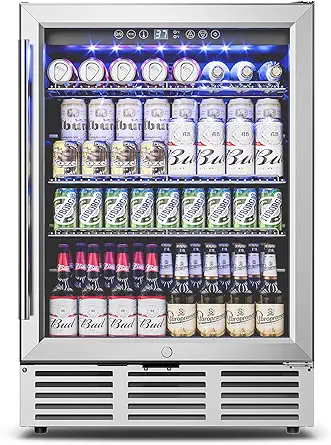 |
Ca'Lefort 24" Wine Fridge CLF-WS24

| Capacity | 5.65 cubic feet |
|---|---|
| Bottle capacity | 61 Bottle |
| Temperature range | 40-65°F |
| Installation type | Built-in, Under Counter, Freestanding |
| Cooling method | Compressor (rotary scroll) |
The Ca'Lefort 24" Wine Fridge is a built-in undercounter cooler aimed at home collectors who want a reliable, mid-size storage unit. It uses a rotary scroll compressor with automatic defrost and front ventilation to maintain an adjustable 40 to 65°F range via a digital control panel, and the double-glazed stainless steel door with UV protection helps limit light exposure. Six removable sapele wood shelves make organizing standard 750ml bottles and a few larger-format bottles straightforward, and three-color LED lighting gives simple display options. Practical touches include power-failure memory, low-noise operation, and a front vent that allows true built-in installation. Expect solid temperature stability for everyday aging and serving, though the unit is single-zone so it is best when storing similar styles at one setpoint rather than both whites and reds at their ideal temps. The finish and door framing read as higher-end for the price range, but buyers who need dual-zone flexibility or a larger capacity should look elsewhere.
Best for: Buyers who want a reliable undercounter wine fridge that balances capacity, temperature control, and a refined look for a home bar or kitchen installation.
Less Ideal for: Collectors who need dual-zone control for storing whites and reds separately or those wanting very large long-term storage capacity.
- Holds up to 61 standard 750ml bottles, suitable for medium-sized collections
- Digital temperature control with 40–65°F range and power-failure memory
- Double-glazed stainless steel door with UV protection to reduce light exposure
- Front ventilation and built-in installation option fit undercounter spaces
- Removable wooden shelves that adjust for different bottle sizes
- Single-zone cooling limits storing whites and reds at different temperatures
- No lock included for security
Verdict: A well-rounded 24-inch undercounter wine fridge that delivers solid temperature stability and good capacity for home collectors who store one primary wine style.
KoolMore Reserve Dual Zone Wine Cooler

| Capacity | 45 Bottles |
|---|---|
| Cooling Method | Compressor |
| Configuration | Panel Ready |
| Annual Energy Consumption | 120 kilowatt hours per year |
| Installation Type | Built-In |
This KoolMore Reserve dual-zone wine cooler is a built-in, panel-ready unit designed to store a mixed collection of wines at two independently controlled temperatures. It uses a compressor cooling system and five wood shelves to hold up to 45 standard bottles across two zones, while a digital touchpad lets you set temperatures precisely and choose amber, blue, or white LED lighting. Automatic defrost simplifies maintenance and a reversible glass door with key lock improves security and installation flexibility. Silent Mode reduces noise for quieter spaces, and the unit meets ETL certification. The cooler is energy rated at about 120 kWh/year, so running costs are reasonable for a compressor model. Limitations include the need for proper built-in ventilation and a heavier cabinet that requires professional fitting, and the panel-ready design means you must supply and attach a custom cabinet panel for a fully integrated look.
Best for: Buyers who prioritize cellar-grade temperature control and a built-in, custom look for a mixed wine collection and who plan to install the unit into cabinetry.
Less Ideal for: People looking for a freestanding plug-and-play cooler or a lightweight portable option that needs no cabinet work should consider alternatives.
- Dual-zone compressor cooling for separate red and white storage
- Panel-ready design for seamless built-in integration
- Digital touchpad with selectable LED lighting for easy temperature and display control
- Silent Mode for reduced operational noise
- Automatic defrost reduces maintenance needs
- Requires built-in installation and a custom panel for true integrated appearance
- Heavier unit that may need professional installation and proper ventilation planning
Verdict: Choose this unit if you want a 24-inch built-in, dual-zone compressor cooler that delivers precise temperature control and a panel-ready, professional look.
Yeego 24 Inch Wine Fridge

| Temperature range | 40-65°F |
|---|---|
| Capacity | 5.12 cubic feet |
| Bottle capacity | 47 Bottles |
| Cooling method | Compressor |
| Installation type | Freestanding/Built In/Under-Counter |
The Yeego 24 Inch Wine Fridge is a compact compressor-cooled wine refrigerator intended for undercounter or freestanding installation. It uses a reciprocating compressor and 360° air circulation to deliver relatively fast, even cooling and claims low vibration operation around 41–43 dB, which helps protect bottle sediment and aging. The unit includes five wooden shelves that are adjustable and removable so you can rearrange storage for different bottle sizes and a digital LED control with 1°F temperature steps plus power-failure memory. The cabinet is built with dual-pane tempered glass and a stainless steel frame to reduce UV exposure, and automatic defrost and a carbon purification/fan circulation system help keep odors out. Practical trade-offs are size and capacity: it is designed for a single-zone 40–65°F range rather than multi-zone cellar storage, and the compressor-style design is heavier and uses more energy than thermoelectric alternatives. Installation flexibility for built-in or freestanding use and ETL certification make it a sensible option if you want a reliable, conventional cooler for everyday wine storage rather than a multi-temperature display cellar.
Best for: Buyers who prioritize consistent, factory-quality cooling and want a durable undercounter wine fridge that protects bottles and runs with low vibration for everyday storage.
Less Ideal for: Those who need dual-zone temperature control for storing different wine types at once or who want the lowest possible energy draw for occasional use.
- Compressor cooling with 360° air circulation for steady, even temperatures
- Adjustable wooden shelves to fit different bottle sizes and reduce vibration
- Digital temperature control with 1°F increments and power-failure memory
- Dual-pane tempered glass and stainless steel frame to block UV and resist fingerprints
- Built for built-in or freestanding installation with ETL safety certification
- Single temperature zone only, so you cannot store whites and reds at different setpoints simultaneously
- Annual energy consumption is relatively high compared with thermoelectric or smaller units
Verdict: A dependable compressor undercounter wine fridge that delivers steady, low-vibration cooling and flexible shelf storage for long-term everyday wine preservation.
Velieta 24 Inch Dual Zone Wine Cooler

| Capacity | 4.24 cubic feet |
|---|---|
| Cooling Method | Compressor |
| Temperature Range (Left) | 35°F–50°F |
| Temperature Range (Right) | 41°F–64°F |
| Installation Type | Built-in/under counter/Freestanding |
This Velieta 24-inch dual-zone wine and beverage refrigerator separates bottles and cans into two independently controlled compartments so you can store wine and chilled drinks at different temperatures. The left side uses wire racks for cans and bottles with a 35°F–50°F range while the right side uses wooden shelves for wine at 41°F–64°F, and the touch LCD makes setting each zone straightforward. A compressor with fan circulation promises relatively fast cooling and low noise, and front ventilation lets you install it under a counter without overheating. Practical extras include removable shelves for flexible storage, a charcoal filter to reduce odors, a door lock, and blue LED ambient lighting that helps when accessing drinks in low light. Trade-offs to consider are that the listed capacity (about 4.24 cu ft) limits large collections and the stainless steel door may show fingerprints; buyers should also confirm the exact built-in clearances for flush installation. For a buyer prioritizing separate wine and beverage temperatures in a compact undercounter package, this model covers the essentials with useful convenience features.
Best for: Buyers who want a compact undercounter cooler that keeps wine and canned beverages at separate, user-controlled temperatures and value a quiet compressor and simple controls.
Less Ideal for: Those seeking high-capacity wine cellars or storage for large-format bottles should look at larger, dedicated wine refrigerators instead.
- True dual-zone cooling with independent temperature ranges for wine and beverages.
- Front ventilation design supports undercounter built-in installation.
- Touch LCD controls and LED ambient lighting make temperature and access simple.
- Removable shelves and mixed shelf types (wood for wine, wire for drinks) increase storage flexibility.
- Capacity is modest for serious collectors, suitable for smaller collections and beverage storage.
- Stainless steel finish can show fingerprints and may need regular cleaning.
Verdict: If you need a compact undercounter unit that reliably stores wine and beverages at separate temperatures, this Velieta dual-zone cooler is a practical, install-friendly choice.
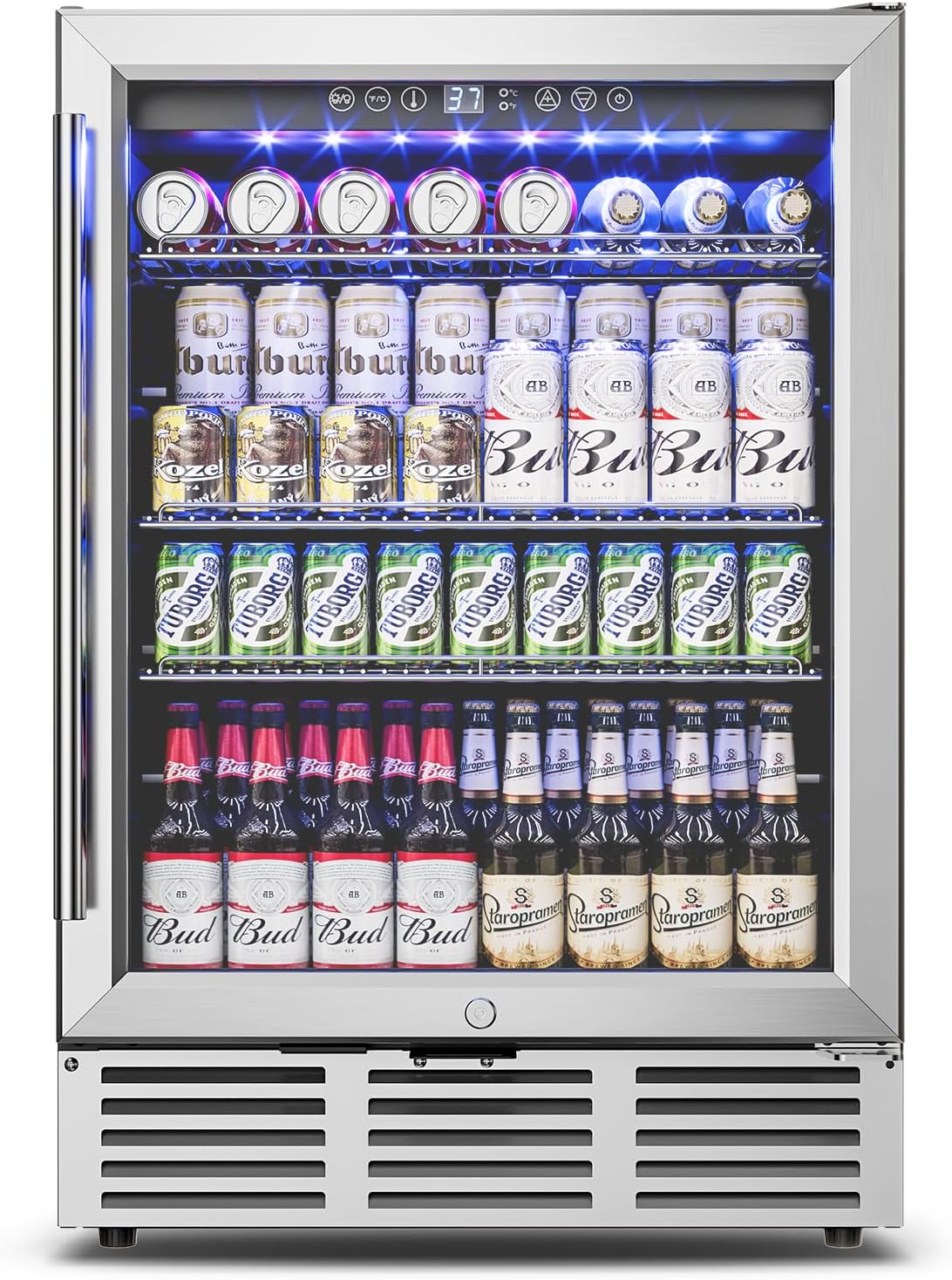
Feelfunn 24" Beverage Refrigerator
| Capacity | 5.3 cubic feet |
|---|---|
| Temperature range | 37-65°F |
| Cooling method | Compressor |
| Defrost system type | Frost Free |
| Installation type | Undercounter |
The Feelfunn 24-inch beverage refrigerator is an undercounter-capable cooler designed to hold a large assortment of drinks while offering visible storage through a double-glazed glass door. It uses a compressor and an internal air circulation system to keep temperatures between 37 and 65°F, with a digital touch panel for setting and monitoring the interior. Three removable adjustable shelves make it easy to organize cans, bottles and mixed sizes, and interior LED lighting helps you see contents without raising the door. The unit is built for flexible installation with a front vent and reversible door, and adjustable feet simplify leveling under counters. Notable practical benefits include a reported low operating noise near 40 dB and frost-free operation that reduces maintenance. Important limitations are that it is a full-sized freezerless fridge so it cannot freeze or rapidly chill large warm loads, and its sizeable cabinet means proper undercounter clearance and ventilation planning are required for reliable cooling. For buyers who prioritize stable, visible beverage storage in a kitchen or bar, this model covers the essentials well.
Best for: Buyers seeking a reliable, no-frills undercounter beverage cooler that keeps a large selection of drinks at consistent temperatures and emphasizes quiet, maintenance-light operation.
Less Ideal for: People who need a compact mini-fridge for small spaces or require freezing capability or rapid chill features for large warm loads.
- Large 5.3 cu ft capacity suitable for extensive beverage storage
- Compressor cooling with air circulation for even temperature control
- Digital touch panel and LED display for easy temperature management
- Double-glazed glass door and interior LED lighting for clear product visibility
- Front vent and reversible door allow built-in undercounter or freestanding installation
- Does not include a freezer compartment so it cannot make ice or freeze items
- Relatively heavy unit that requires planning for installation and ventilation
Verdict: A spacious, quiet undercounter beverage refrigerator that provides stable compressor cooling and clear display for buyers who want reliable, low-maintenance drink storage.
Choosing the Right 24-Inch Undercounter Wine Cooler: Key Factors to Consider
Temperature Range and Accuracy
A wine cooler must maintain stable setpoints across its advertised range because wine is sensitive to temperature swings. Accuracy matters more than a wide range for most home collectors; being able to hold a steady 55 to 57 degrees Fahrenheit for aging or distinct zones for reds and whites will preserve flavor and structure. Check whether the unit offers digital thermostats and whether the controls allow small adjustments rather than only broad presets.
Also consider how long the unit takes to recover temperature after the door opens. Faster recovery is important if you access the cooler frequently. Units that overshoot or cycle wildly tend to stress corks and accelerate aging in unpredictable ways.
Shelving and Capacity
A 24-inch undercounter cabinet limits width, so efficient shelf design is crucial to maximizing bottle count. Look for adjustable or removable shelves, half-depth racks, and provisions for large-format bottles if you collect magnums. Shelves that glide or pull out make retrieval easier and reduce door-open time, helping temperature stability.
Consider not just nominal bottle count but the practical layout. Manufacturers often quote counts based on Bordeaux bottles packed tightly; your typical bottle mix may include wider or taller bottles that reduce effective capacity.
Noise, Vibration, and Compressor Type
Wine is affected by vibration, which can disturb sediments and accelerate chemical reactions. Lower vibration levels are especially important for long-term storage. Compressors, thermoelectric systems, and inverter-driven compressors differ in noise and vibration output. Compressors typically cool faster and handle variable loads better, while thermoelectric units are quieter but less effective in warm spaces.
Pay attention to stated dB levels and user experience reports about hums or rattles. Also evaluate whether racks and interior panels damp vibration; loose components can amplify even modest compressor movement.
Undercounter Installation and Ventilation
A true undercounter wine cooler must fit the cabinet width and depth and offer compatible ventilation options. Some units require front-venting to operate safely in a built-in space, while others need rear or top clearance. Measure your cabinet opening and note whether toe-kick ventilation is supported. Ventilation choice affects heat rejection and long-term compressor life.
Also check door hinge type and whether the unit supports reversible doors, integrated panels, or a stainless trim kit for a flush look. Units that cannot be properly vented or secured risk overheating and reduced reliability.
Door Construction and UV Protection
Light, especially UV, degrades wine over time. A door with double-pane glass and a UV-resistant coating helps protect the interior while letting you preview bottles. Solid doors offer the best light protection but sacrifice visibility and may not suit display needs. Evaluate the balance between UV protection and the desire to showcase your collection.
Also consider door seals and locking options. A tight magnetic seal prevents warm air infiltration and reduces cycling, while a lock can be useful if the unit sits in a family area or a shared household.
Controls, Sensors, and Energy Use
Intuitive controls and reliable sensors reduce the chance of mis-set temperatures that could harm wine. Digital displays with clear setpoint readouts and alarms for high temperature events are valuable features. Some units include dual-zone controls with independent sensors for each compartment; this is useful if you store both reds and whites.
Energy efficiency matters for long-term operation. Higher-efficiency compressors and better insulation reduce runtime and electricity draw. Look for units with consistent thermostat behavior and documented energy consumption if this is a priority for ongoing cost and environmental impact.
Built-In Vs. Freestanding Installation
Although the guide focuses on 24-inch undercounter wine coolers, not every model installs the same way. Built-in units are designed for front ventilation and flush mounting, while some compact coolers are technically freestanding but can be used undercounter if sufficient airflow is available. Confirm the ventilation path required by the model you choose to avoid overheating.
Front-vented units are ideal for cabinetry because they expel heat through the grille at the toe kick. If your cabinet lacks a dedicated vent, select a model specified for freestanding use and plan for additional clearance or an aftermarket vent grill.
- Verify whether the unit requires front, top, or rear ventilation.
- Measure cabinet depth and door swing to ensure full function.
- Plan for a small gap above or beside the unit if rear/top ventilation is required.
Managing Dual Zones and Single-Zone Options
Dual-zone 24-inch undercounter coolers let you maintain separate temperatures for two shelves or compartments, which is helpful if you store both serving-ready reds and chilled whites. Decide whether you need independent zones or prefer a single, steady environment for most bottles. Dual zones add complexity and sometimes reduce total usable space.
If you rarely serve both types at once, a single-zone unit set to a middle-range temperature and supplemented with a short chill before serving may be simpler and more reliable.
- Dual zone: better for mixed collections, more controls to monitor.
- Single zone: typically more stable and slightly more capacity for a given footprint.
Shelf Types and Bottle Orientation
Shelving styles include wooden slatted racks, wire shelves, and chrome or stainless trays. Wooden racks provide a traditional look and reduce vibration transfer. Wire or metal shelves often allow more flexible spacing and are easier to clean. Look for shelves that securely cradle bottles to prevent rolling and limit vibration transmission.
Consider whether you need adjustable shelf spacing to accommodate taller bottles or if you prefer pull-out trays for quick access. Flexible shelf layouts increase the long-term usefulness of a 24-inch undercounter cooler.
- Wood racks absorb slight vibration and look upscale.
- Metal shelves offer durability and simpler cleaning.
- Pull-out shelves reduce door-open time and make retrieval easier.
Maintaining Stability and Reducing Vibration
Placement and leveling matter. Even a well-built unit will transmit vibration if it sits on an uneven surface or if internal components are loosely mounted. Use the adjustable feet to level the cooler and consider a thin anti-vibration pad between the unit and cabinetry if the floor is particularly resonant.
Inspect for solid shelf mounts and check that bottles do not rattle when the compressor cycles. If you plan long-term cellaring, prioritize units with documented low vibration and compressor isolation features.
- Level the unit using the adjustable feet before final installation.
- Tighten loose interior parts to reduce rattles.
- Store long-term bottles away from the door zone to minimize temperature fluctuations.
Cleaning, Maintenance, and Long-Term Care
Regular cleaning prevents mold and stale odors. Empty the unit periodically and wipe down interior surfaces with a mild detergent. Remove racks where possible to clean recesses and drain lines. Check door seals for debris that could compromise the airtight closure.
For long-term reliability, monitor door seals and ventilation openings. Replace worn gaskets and ensure vents are free of dust. If your unit has a drain pan or condensate line, inspect it seasonally to prevent overflow or microbial growth.
- Clean interior surfaces every few months and remove spilled sugar or cork fragments promptly.
- Inspect door gaskets and hinges annually.
- Keep ventilation grilles dust-free to maintain cooling efficiency.
How We Chose the Best 24-Inch Undercounter Wine Cooler
We focused on attributes that matter for storing wine in a 24-inch undercounter cabinet footprint. Core evaluation criteria included temperature accuracy because even small fluctuations compromise wine aging; cooling method and noise level since these units sit near living spaces; interior capacity and shelf layout for practical bottle organization; and installation fit such as ventilation options and trim for true undercounter mounting. We also considered build quality and door glazing because insulation and glass type affect thermal stability and light exposure. Energy efficiency and control interfaces were reviewed to reflect typical daily use and long-term operating costs. Units with inconsistent thermostat behavior, excessive vibration, or ventilation incompatible with undercounter installation were excluded. The result is a short list of refrigerators that meet real-world installation constraints and storage needs for 24-inch undercounter wine storage.
Our full evaluation process is outlined in our review methodology.
FAQ
Can a 24-inch undercounter wine cooler hold both red and white wines?
Yes. Many 24-inch undercounter coolers offer sufficient capacity to store both reds and whites. If you want different serving temperatures simultaneously, choose a dual-zone model; otherwise, set a single zone to a middle temperature and chill or warm bottles briefly before serving.
Do undercounter wine coolers need special ventilation?
Many do. Built-in models often require front ventilation to expel heat through the toe kick. Others need rear or top clearance. Always check the installation requirements to avoid restricting airflow, which can shorten compressor life.
How much vibration is acceptable for wine storage?
Some low-level vibration is normal, but sustained or noticeable shaking can disturb sediments and affect wine aging. Look for units advertised with low vibration or compressor isolation, and check real-world reports about rattling or hums before buying.
Are glass-front doors safe for long-term storage?
Glass doors can be safe if they are double-pane with UV-resistant coating. They allow display while reducing light exposure. For long-term cellaring in bright rooms, a solid door offers better protection from light, but many glass doors are adequate when UV protection is specified.
What maintenance does a wine cooler require?
Basic maintenance includes cleaning the interior and shelves periodically, keeping ventilation grilles clear, and checking door seals. For units with condensate drains or pans, inspect and clean those parts to prevent blockages or microbial growth.
Final Verdict
Prioritize temperature stability, vibration control, and installation fit when choosing a 24-inch undercounter wine cooler. Decide whether dual-zone capability is worth the tradeoff in usable space, and favor units with secure shelving and front ventilation if you plan built-in installation. Regular maintenance and proper leveling will extend service life. Focus your decision on the dimensions and ventilation configuration that match your cabinetry, then weigh the tradeoffs between display-friendly glass doors and maximum light protection. Those priorities will lead you to a unit that protects bottles and fits seamlessly into your space.