
Note: This article contains affiliate links. If you click on these links and make a purchase, we may earn a small commission at no extra cost to you. This helps support our research and content. Read our full affiliate disclosure here.
When you manage a busy hospitality operation, the right Commercial Wine Cooler matters for drink quality, inventory management, and service speed. A cooler that keeps steady cellar temperatures and handles frequent door openings protects bottle integrity and preserves flavor. This guide presents the top shortlisted commercial wine coolers chosen for busy bars, restaurants, and tasting rooms. We evaluate options based on capacity, temperature stability, durability, and serviceability so you can pick a unit that fits your workflow and storage needs. Read on for an overview of the evaluation approach and practical buying guidance before the product list.
Top Picks at a Glance
| Best Overall The best all-around choice for most situations | Elite Kitchen Supply EKS-WI321DD Wine Cooler |  |
| Best Quality Built to a higher standard if you want something more solid | BODEGA 30" Wine & Beverage Cooler |  |
| Best Value The sweet spot between price and what you get | FoMup FM24WS Wine Cooler |  |
| Best Budget The cheapest option that still gets the job done reliably | Icyglee 25-Bottle Wine Cooler |  |
| Best Seller A high-volume bestseller chosen again and again | EUHOMY Wine Cooler BR001-110 |  |
Elite Kitchen Supply EKS-WI321DD Wine Cooler

| Configuration | Freezerless |
|---|---|
| Cooling Method | Compressor |
| Number Of Shelves | 15 |
| Defrost System Type | Automatic |
| Specification Met | ETL |
This Elite Kitchen Supply EKS-WI321DD is a freestanding dual-zone commercial wine cooler designed for restaurant or bar use. It uses a compressor cooling system with separate upper and lower temperature ranges and an electronic control panel, so you can store different wine types at their ideal temperatures. The cabinet is stainless steel with LED interior lighting and sliding removable shelves for organizing bottles, and a keyed lock adds basic security for a public setting. Practical strengths include large capacity and a commercial-grade compressor that is quiet and energy efficient for continuous use. Installation requires planning for ventilation and freight delivery because the unit is heavy and sized for commercial spaces. Important limitations are that the unit is built for freestanding installation only and the warranty excludes certain nonstandard installations like food trucks or boats; buyers should also confirm doorway clearances and delivery logistics before purchase. For a commercial kitchen or bar needing large, two-zone storage, this model delivers the core features you would expect from a merchandiser.
Best for: Buyers who need a high-capacity, commercial-grade dual-zone cooler for a bar, restaurant, or busy retail setting and prioritize reliable compressor cooling and durable construction.
Less Ideal for: Home users with limited space, people needing a built-in unit, or customers who cannot accommodate freight delivery and professional placement.
- Dual temperature zones for storing different wine types simultaneously
- Commercial compressor cooling that is designed for energy efficiency and low noise
- Stainless steel construction and sliding removable shelves for durable, easy cleaning and flexible storage
- LED interior lighting and keyed lock for visibility and basic security in public settings
- Very large and heavy, requiring freight delivery and space planning
- Not intended for built-in installations or some specialty locations per warranty exclusions
Verdict: Choose this unit when you need a durable, high-capacity commercial dual-zone wine cooler with reliable compressor cooling for a busy bar or restaurant.
BODEGA 30" Wine & Beverage Cooler
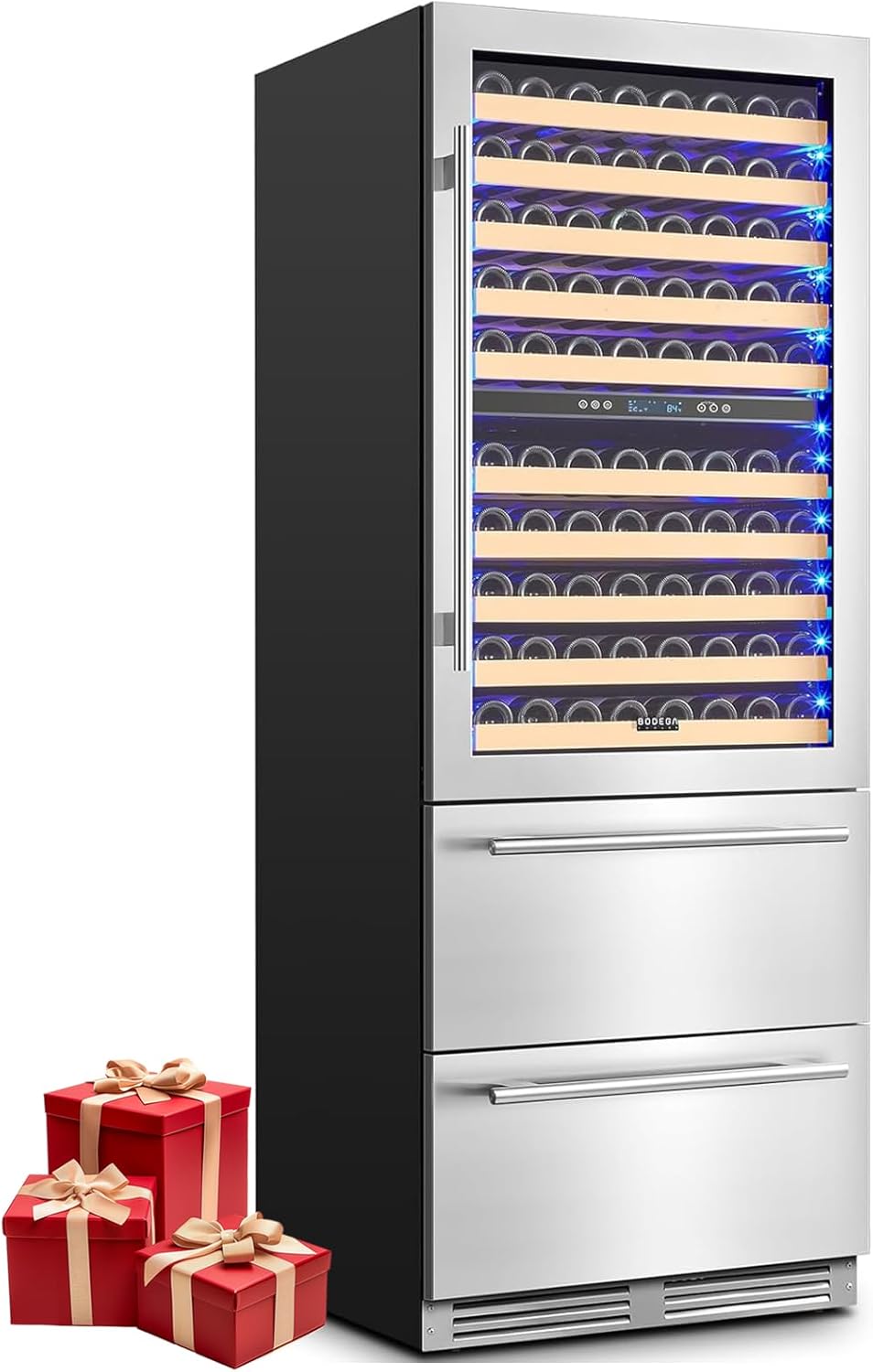
| Configuration | Dual zone wine cooler & two beverage drawers |
|---|---|
| Capacity | 150 Bottles and 234 Cans |
| Temperature range | Upper 41℉-54℉, lower 54℉-68℉ |
| Cooling Method | Compressor |
| Refrigerant | R-600A |
This BODEGA 30" wine and beverage cooler pairs a compressor-driven dual-zone cabinet with two pull-out beverage drawers to store both bottles and cans in one unit. It is typically installed under counter or used freestanding in a back bar, restaurant, or dedicated storage room where high capacity matters. The unit offers digital touch controls and an LED display for setting independent temperature ranges, tempered double-glazed glass for light protection, and 10 wooden and wire shelves plus two large stainless steel drawers for flexible organization. A reciprocating compressor and internal fan promise rapid, even cooling while the manufacturer emphasizes low noise and energy efficiency, which is useful in commercial service areas. Important limitations are its large physical footprint and installation needs for front-vented built-in placement, and the product documentation notes a one-year warranty rather than extended commercial coverage. Expect solid cooling performance and generous storage but plan cabinet space and service expectations accordingly.
Best for: Buyers who prioritize high-capacity, performance-focused refrigeration for commercial or heavy-duty home use and need separate temperature zones for wine and beverages.
Less Ideal for: Small-footprint bars, mobile service operators, or buyers seeking long commercial warranties and minimal installation planning should consider alternatives.
- Very large combined capacity supporting both wine bottles and cans
- Dual temperature zones with digital touch controls for storing different beverages
- Compressor cooling with internal fan for even, reliable temperature control
- Front-vented design allows built-in or freestanding installation
- Tempered double-layer glass and wooden shelves for wine-friendly storage
- Large footprint requires planning for installation and placement
- One-year warranty may be short for heavy commercial use
Verdict: Choose this cooler when you need a high-capacity, dual-zone, built-in-capable unit that delivers reliable compressor cooling for mixed wine and beverage storage.
FoMup FM24WS Wine Cooler

| Configuration | Full-Sized Freezerless |
|---|---|
| Cooling Method | Compressor |
| Number Of Shelves | 14 |
| Voltage | 115 volts_of_alternating_current |
| Annual Energy Consumption | 236 kilowatt hours per year |
The FoMup FM24WS is a tall, freestanding wine cooler designed to store a large collection while running quietly in commercial or home settings. It uses a compressor-based cooling system with two fans to circulate air and a digital touch panel to set temperatures between 40 and 65°F, plus a memory function that restores the set temperature after a power loss. The unit offers 14 sliding shelves and reversible door orientation for flexible placement, a keyed lock for security, soft blue LED lighting for display, and an activated carbon filter to limit odors. Practical benefits include fast, even cooling from the compressor and easy access to bottles thanks to sliding rails, while the matte stainless steel door and larger capacity tiers accept bigger bottles and help protect labels. Trade-offs are its large footprint and weight for installation and that annual energy consumption is notable at 236 kWh, so it is best where capacity and presentation matter more than ultra-low operating cost.
Best for: Buyers who prioritize storing and displaying a sizable wine collection in a quiet, commercial-capable unit and want straightforward temperature control and secure shelving.
Less Ideal for: Those needing a compact, lightweight cooler for limited floor space or buyers focused primarily on the lowest possible energy use should consider smaller or more efficient models.
- High capacity shelving with 14 sliding rails for easy access to many bottles
- Compressor cooling with dual fans for fast, even temperature distribution
- Digital touch control with memory function to restore settings after power loss
- Reversible door and keyed lock add installation flexibility and security
- Soft blue LED lighting and activated carbon filter for attractive, low-odor display
- Large weight and tall footprint make placement and installation more demanding
- Relatively high annual energy consumption compared with small coolers
Verdict: A high-capacity, compressor-cooled upright wine cooler built for quiet, secure storage and easy bottle access in commercial or serious home collections.
Icyglee 25-Bottle Wine Cooler

| Capacity | 3.2 cubic feet / 25 bottles |
|---|---|
| Cooling Method | Compressor (R600A) |
| Temperature Range | 41–64°F |
| Number of Shelves | 5 adjustable shelves |
| Defrost System Type | Manual |
The Icyglee 25-bottle wine cooler is a compact freestanding unit that uses a compressor to hold wine at a selectable temperature between about 41°F and 64°F, making it suitable for both red and white bottles. It has five adjustable shelves and a reversible double-layer glass door that offers UV protection while an internal LED light makes labels visible without overheating the interior. The digital temperature control and manual defrost let you dial in storage conditions, and the R600A compressor is designed for low vibration and quiet operation, which helps protect sediment and flavor. Practical benefits include a relatively high bottle capacity for a compact footprint and adjustable shelving for mixed bottle sizes, plus ETL certification and available customer support. Important limitations are its manual defrost requirement and a moderate annual energy draw, so it is best for small commercial settings or office bars where cost and space matter rather than heavy continuous-duty use.
Best for: Small businesses, office kitchens, or budget-minded bar operators who need a compact, quiet wine storage solution that balances bottle capacity and cost.
Less Ideal for: High-volume restaurants or large wine-storage operations that require larger capacity, dual-zone control, or continuous heavy-duty commercial performance.
- Compressor cooling for stable, low-vibration temperature control
- Digital temperature control across a 41–64°F range for both reds and whites
- Five adjustable shelves to accommodate mixed bottle sizes
- Double-layer glass door with UV protection and internal LED lighting
- Reversible door and compact freestanding form factor fit tight commercial spots
- Manual defrost requires occasional maintenance
- Annual energy consumption is relatively high for a compact unit
Verdict: A compact, budget-friendly compressor wine cooler that delivers quiet, stable temperature control and flexible shelving for small commercial or office use.
EUHOMY Wine Cooler BR001-110

| Capacity | 3.2 cubic feet |
|---|---|
| Bottle capacity | Up to 25 standard 750ml bottles |
| Temperature range | 41°F to 64°F |
| Cooling method | Compressor |
| Door orientation | Reversible |
This EUHOMY wine cooler is a compact freestanding unit aimed at steady, long-term beverage storage. It uses a compressor cooling system with a 41 to 64°F temperature range controlled by a digital touchscreen, so you can keep reds, whites, and sparkling bottles at appropriate serving temperatures. The interior offers four chrome full-width racks, a flat shelf and a bottom compartment to fit up to 25 standard 750ml bottles and to reconfigure storage as needed. The double-layer thermopane glass door reduces temperature swings and blocks UV light, and soft LED lighting helps with visibility without harsh heat. Practical touches include adjustable leveling legs, a built-in handle and a reversible door for flexible placement under counters or freestanding in a bar or office. Expect manual defrosting and typical small-fridge energy use; for buyers prioritizing quiet, vibration-free operation the compressor is described as high-performance and low-vibration but compressor units can still be noisier than thermoelectric models. The unit is supported by a one-year warranty and arrives with a user manual for setup and operation.
Best for: Buyers who want a compact, reliable freestanding cooler for steady storage of a small to medium wine collection and value precise temperature control and flexible placement.
Less Ideal for: Those seeking a zero-maintenance built-in cellar replacement, ultra-low energy operation, or very large bottle capacity should consider larger or different-style units.
- Compressor cooling with a wide 41–64°F range for storing different wine styles
- Double-pane glass door that insulates and blocks UV to protect wine quality
- Adjustable shelves and mix of racks allow flexible storage up to 25 standard bottles
- Digital touchscreen control and internal LED lighting simplify temperature monitoring and viewing
- Reversible door and leveling legs make placement under counters or freestanding easier
- Manual defrost requires occasional user maintenance
- Annual energy consumption is relatively high compared with the smallest thermoelectric units
Verdict: A compact, compressor-cooled freestanding wine cooler that delivers precise temperature control and flexible storage for a small commercial or bar setting.
Choosing the Right Commercial Wine Cooler: Key Factors to Consider
Temperature Stability
Stable temperatures are essential because wine chemical balance and aging depend on steady conditions. In a commercial environment frequent door openings and warm ambient kitchens create thermal stress, so a cooler must recover quickly and maintain narrow variance across the cabinet. Look for units with precise thermostatic control, separate cooling zones if you store varied styles, and documented delta figures for how much the internal temperature rises after door cycles.
Poor stability forces faster turnover of inventory or degrades bottles over time, which affects taste and costs. Temperature control also impacts staff confidence during service; consistent readouts reduce guesswork and help maintain predictable pours.
Usable Capacity
Capacity matters in two ways: bottle count and how that space is organized for real-world bottles. Manufacturers often quote maximum counts, but usable capacity depends on shelf layout, whether shelves are adjustable, and whether your most common bottle shapes fit without wasted space. Consider realistic loading scenarios like mixed bottle sizes, display rows for featured wines, and room for incoming inventory.
For service settings, think about access patterns too. A very high nominal capacity is less useful if retrieving bottles interrupts workflow. Choose a unit with shelving and door orientation that match how staff reach and rotate stock.
Build Durability
Commercial environments demand sturdy construction. Look for reinforced shelving, heavy-duty door hinges, durable gaskets, and corrosion-resistant finishes that hold up to cleaning and high humidity. Compressor quality and ventilation design also factor into long-term reliability because poor airflow or underspecified compressors fail sooner in constant-use scenarios.
Durable units reduce downtime and maintenance costs. They also maintain thermal performance longer, which is especially important when the cooler is placed near kitchen heat sources or in high-traffic service areas.
Energy Efficiency
Operating cost is a major concern for businesses. Energy-efficient coolers use better compressors, improved insulation, and intelligent fans to lower power draw while maintaining set temperatures. Look at documented energy consumption or efficiency ratings and consider how runtime will add up across a year of continuous operation.
Lower energy use directly reduces overhead and can justify a higher initial investment. Efficiency also tends to correlate with better temperature control because improved insulation and cooling components reduce workload spikes during door openings.
Serviceability & Access
Minimizing downtime is critical for commercial operators. Serviceability covers how easy it is to access mechanical components, replace parts, and perform routine cleaning. Features that help include front-serviceable compressors, removable shelves, and clear diagnostic displays or alert systems.
Good access reduces labor and repair time for routine maintenance. It also enables faster recovery from failures so inventory disruption is minimized. Confirm availability of replacement parts and local service options when evaluating units for operational resilience.
Sizing the Cooler for Your Operation
Estimate peak simultaneous storage needs rather than average stock. Consider the busiest service periods, upcoming events, and how often deliveries arrive. Plan for a buffer so you do not run out of service-ready bottles during spikes.
Also map physical space and ventilation. Commercial coolers need adequate airflow at the front or rear depending on model. Ensure the chosen unit fits clearance requirements to avoid performance loss.
- Measure installation footprint including door swing and service clearance
- Account for planned inventory rotation and promotional displays
- Allow 10 to 20 percent capacity buffer for unexpected demand
Cooling Systems and Zone Options
Commercial wine coolers use different cooling architectures such as direct compressor cooling and remote or split systems. Some offer multiple temperature zones to store sparkling, white, and red wines at their ideal ranges within one cabinet.
Multiple zones are useful when you need to hold varied styles ready for service without separate units. However, zoned systems can add complexity to maintenance, so weigh that against operational convenience.
- Single-zone units simplify maintenance and often have greater usable capacity
- Multi-zone units increase flexibility for mixed-stock service
Door Types and Service Workflow
Door design affects both thermal performance and speed of service. Solid doors usually insulate better while glass doors help staff and guests see stock without opening the cabinet. Choose the door type that suits your service model and staff habits.
Also evaluate hinge construction and gasket quality since these components see the most wear. Reversible doors or options for field-swapping the hinge can make installation easier in constrained spaces.
- Glass doors reduce unnecessary openings but may need anti-UV glazing
- Solid doors improve energy efficiency in back-of-house locations
Placement, Ventilation, and Installation
Proper placement ensures reliable operation. Install coolers away from direct heat sources and provide the ventilation clearance recommended by the manufacturer. Inadequate airflow is a common cause of premature compressor cycling and reduced cooling capacity.
Plan electrical supply and service access before installation. Some commercial units require dedicated circuits or specific ventilation grills to maintain warranty coverage and performance.
- Verify electrical and ventilation requirements during planning
- Avoid installing directly next to ovens, dishwashers, or heat-producing equipment
Maintenance and Routine Care
Regular cleaning of coils, door gaskets, and interior surfaces extends service life and keeps temperature performance consistent. Establish a maintenance schedule that includes coil inspection, gasket replacement as needed, and calibration checks for thermostats.
Train staff on gentle door handling and proper stocking techniques to reduce cold-air loss and mechanical wear. Small operational changes often yield big gains in longevity and energy use.
- Create a maintenance checklist for daily, monthly, and annual tasks
- Keep replacement gaskets and common filters on hand for quick fixes
How We Chose the Best Commercial Wine Cooler
We focused on factors that matter most in commercial settings: consistent temperature control under heavy use, usable storage capacity in standard bottle counts, robust construction for daily traffic, energy efficiency for long-term operating cost, and serviceability for simple maintenance and repairs. Units were screened for built-for-purpose features such as commercial-grade compressors or cooling systems designed to recover quickly after frequent door openings, adjustable shelving to fit common bottle shapes, and durable door and gasket designs suited to high-traffic environments. We excluded residential-only models and units with ambiguous commercial ratings or lacking documented temperature performance. Our process prioritized measurable specifications and design features buyers can verify, including temperature range and stability data, rated capacity, service access, and ventilation requirements. The resulting shortlist emphasizes real-world reliability and operational efficiency rather than consumer-focused extras that do not scale to commercial use.
Our full evaluation process is outlined in our review methodology.
FAQ
What temperature range should a commercial wine cooler maintain?
Commercial coolers should typically offer a range that covers about 45 to 65 degrees Fahrenheit to accommodate most table wines. Exact setpoints depend on whether you store sparkling, white, or red wines, and a unit with tight control within that range is preferable.
How often should a commercial unit be serviced?
Routine checks every three to six months are common for coils, fans, and gaskets, with a more thorough annual inspection for compressors and refrigerant. Service frequency depends on usage intensity and ambient conditions.
Can glass-door commercial coolers be used for long-term storage?
Glass doors can be fine for short- to medium-term storage, especially with UV-treated glazing and low-light placement. For long-term aging, a solid, well-insulated cabinet in a stable environment is usually better.
Do commercial wine coolers need special electrical installations?
Some commercial models require dedicated circuits or specific amperage to run reliably under load. Check the electrical requirements before purchase and plan for service access to avoid tripping breakers during busy periods.
How should bottles be organized for best airflow and access?
Organize bottles by turnover rate and style, placing frequently used stock at easy-reach levels. Avoid blocking ventilation passages and leave small gaps for air circulation to help maintain uniform temperatures.
Final Verdict
Choose a commercial wine cooler by prioritizing temperature stability, usable capacity, and durable construction to match your service rhythm. Expect tradeoffs between capacity and zone flexibility, and factor in energy use and service access when planning installation. With those priorities in mind, select a unit that fits your busiest operating scenarios and maintenance capabilities so you maintain wine quality while minimizing downtime.