
Note: This article contains affiliate links. If you click on these links and make a purchase, we may earn a small commission at no extra cost to you. This helps support our research and content. Read our full affiliate disclosure here.
Working with carbon-fiber-filled filaments changes the game for functional prototyping and durable end-use parts, but it also raises specific demands for hardware. If you need stiff, lightweight components without a large equipment outlay, choosing an inexpensive 3D printer tuned for abrasive, high-temp filaments matters more than raw speed or flashy features. This guide highlights seven shortlisted printers that balance affordability with the hardware features required for carbon-fiber blends. We evaluated thermal stability, abrasive filament handling, and dimensional consistency to assemble the list. Read on to find options that fit small workshops and hobbyist budgets while supporting strong carbon-fiber prints.
Top Picks at a Glance
| Best Overall The best all-around choice for most situations | Anycubic Kobra X |  |
| Best Quality Built to a higher standard if you want something more solid | ELEGOO Centauri Carbon |  |
| Best Value The sweet spot between price and what you get | FLASHFORGE Adventurer 5M |  |
| Best Budget The cheapest option that still gets the job done reliably | ELEGOO Neptune 3 Pro |  |
| Top Rated A top-rated pick with lots of positive feedback | Bambu Lab P1S 3D Printer |  |
| Most Popular A crowd favorite that many people choose with confidence | Creality K1C 3D Printer |  |
| Best Seller A high-volume bestseller chosen again and again | FLASHFORGE Adventurer 5M |  |
Anycubic Kobra X

| Build volume | 260×260×260 mm |
|---|---|
| Max nozzle temperature | 300°C |
| Materials supported | PLA, PETG, TPU, PVA, ASA |
| Connectivity | Dual-band Wi‑Fi (2.4G/5G) and LAN |
The Anycubic Kobra X is a user-friendly FDM printer aimed at fast, multicolor prints using up to four built-in extruders and an expandable palette. It pairs a hardened steel nozzle and vibration compensation with a high top speed (advertised up to 600 mm/s) so short prints finish quickly, and LeviQ 3.0 auto bed leveling with 49-point calibration makes first-layer adhesion more reliable. Practical features include AI camera monitoring, spaghetti and foreign-object detection, power and filament recovery, and dual-band Wi‑Fi and LAN for remote control. The ACE GEN 2 extruder is described as adaptive for soft and hard filaments, and the machine supports common materials including PLA, PETG, TPU, PVA, and ASA at nozzle temps to 300°C. For buyers interested in carbon-fiber filaments, the hardened nozzle and compatibility with higher temperatures are useful, but carbon-filled filaments are abrasive and will shorten a standard nozzle faster than a true hardened or specialty nozzle designed for abrasive materials. Assembly and setup are aimed at beginners and makerspaces, so you get a lot of convenience features without needing deep tuning, though serious composite printing will still benefit from hardened abrasion‑resistant nozzles and tuned slicer profiles.
Best for: A balanced buyer who wants a versatile, beginner-friendly machine that prints multicolor parts quickly and supports a wide range of filaments while offering smart monitoring and easy setup.
Less Ideal for: Users needing a dedicated, production-grade carbon fiber printer for heavy use should choose a printer with factory‑specified abrasive-resistant hotend components and hardened toolpaths for composites.
- Native multicolor capability with four built-in extruders and expandability to more colors
- LeviQ 3.0 49-point auto bed leveling for consistent first layers
- Hardened steel nozzle and 300°C max nozzle temperature support a wide range of filaments
- AI camera monitoring, filament/spaghetti detection, and recovery features for reliable unattended prints
- Dual-band Wi‑Fi and LAN enable remote control and live monitoring
- Standard hardened nozzle still wears faster with abrasive carbon-fiber filaments compared with specialty abrasive-resistant nozzles
- High advertised speeds require careful tuning to maintain part quality on complex or composite prints
Verdict: The Kobra X delivers fast, multicolor printing with beginner-friendly leveling and smart monitoring, making it a strong balanced choice for hobbyists who want to experiment with carbon‑filled filaments after upgrading to more wear‑resistant nozzles.
ELEGOO Centauri Carbon

| Build Volume | 256 × 256 × 256 mm |
|---|---|
| Max Printing Speed | 500 mm/s |
| Max Hot End Temp. | 320 °C |
| Max Heated Bed Temp. | 110 °C |
| Supported Filament | Carbon/Glass fiber, PLA, PETG, ABS, ASA, TPU, PC, PA |
The ELEGOO Centauri Carbon is a ready-to-print CoreXY FDM machine aimed at fast, engineering-material workflows. It ships assembled and auto-calibrated with an auto-leveling system, touchscreen controls, and a dual-sided textured PEI plate to simplify first-layer adhesion. The rigid die-cast frame, automatic vibration compensation and pressure-advance tuning help keep prints smooth even at the model's claimed high speeds, while a 320°C all-metal hotend and brass-hardened steel nozzle let you run carbon and glass fiber reinforced filaments, ABS, PETG and other high-temp materials. A heated bed up to 110°C plus an enclosed metal and glass chamber reduce warping for engineering plastics, and the chamber camera with dual lighting makes monitoring and time-lapse capture practical for long jobs. Practical limits include the moderate 256 mm cube build volume and reliance on optional nozzle sizes for very fine or very coarse extrusion; achieving the top speeds also requires careful tuning and robust filament. For buyers focused on fast, strong-material parts, this balances performance-ready hardware with sensible usability features.
Best for: Buyers who prioritize speed and the ability to print carbon or other engineering filaments on a budget and want a mostly turnkey machine that minimizes setup time.
Less Ideal for: Users needing very large build volumes, hobbyists who want an ultra-simple slow printer without tuning, or those who must print only at the finest micro-detail without nozzle upgrades.
- CoreXY motion system and die-cast frame for higher-speed, stable printing
- 320°C all-metal hotend and hardened-steel nozzle support carbon/glass fiber and other high-temp filaments
- Enclosed metal and glass chamber plus 110°C heated bed reduce warping on engineering plastics
- Auto-leveling, preassembled setup and dual-sided PEI plate simplify first-layer adhesion and startup
- Built-in chamber camera and lighting for real-time monitoring and time-lapse capture
- 256×256×256 mm build volume may be small for very large parts
- Top speed and acceleration require careful tuning and high-quality filament to reliably achieve
Verdict: If you want a budget-friendly, high-speed CoreXY printer that is ready for carbon-fiber and other high-temp filaments, the Centauri Carbon delivers the core hardware to get those parts reliably.
FLASHFORGE Adventurer 5M

| Build Size | 220 x 220 x 220 mm |
|---|---|
| Nozzle Dimension | 0.4mm (0.25/0.6/0.8 optional) |
| Leveling Method | Full-Auto One-Click Leveling |
| Travel Speed and Acceleration | 600mm/s and 20,000mm/s² |
| Compatible Filaments | PLA/ABS/PETG/ASA/TPU/CF/etc. |
The Adventurer 5M is a CoreXY desktop 3D printer designed to speed up everyday printing while keeping setup simple. It uses a fully automatic one-click leveling system and a flexible dual-texture PEI plate so first-layer adhesion and part removal are straightforward, and the patent quick-release nozzle system lets you swap 0.25/0.4/0.6/0.8 mm tips quickly for precision or high-flow prints. Flashforge rates travel speed and acceleration up to 600 mm/s and 20,000 mm/s², which helps reduce print time on larger parts, and the machine accepts common filaments including PLA, PETG, ABS, TPU, ASA and carbon-fiber blends. Connectivity options include Wi-Fi, Ethernet, USB and cloud control plus an app and slicer for remote monitoring and batch sending. Practical conveniences like print-resume after power loss and a removable PEI plate make day-to-day use less fussy. Limitations for carbon-fiber work: the stock nozzle sizes and unspecified hardened nozzle material mean you should fit a hardened steel or ruby nozzle for abrasive CF filaments, and heavier continuous use at high speeds needs upgraded wear-resistant hardware for long-term durability.
Best for: Buyers who want a fast, easy-to-use desktop printer that can handle reinforced filaments with minor upgrades and who prioritize reliable first-layer setup and networked workflow.
Less Ideal for: Those who need out-of-the-box heavy-duty abrasive printing without installing hardened nozzles and wear-resistant extruder parts should look at industrial or explicitly fiber-ready machines instead.
- CoreXY all-metal motion for better stability at higher speeds
- One-click full-auto leveling and flexible dual-texture PEI plate for easier first layers and part removal
- Quick-release interchangeable nozzles across multiple diameters for precision or fast prints
- Wide filament compatibility including PLA, ABS, PETG, TPU and carbon-fiber blends
- Networked connectivity and app/slicer support for remote monitoring and batch printing
- No indication the stock nozzle is hardened for abrasive carbon-fiber filaments
- High advertised speeds may require nozzle and drive upgrades for reliable long-term abrasion resistance
Verdict: A practical, fast CoreXY desktop printer that handles carbon-fiber blends well for budget-conscious makers if you add a hardened nozzle for abrasive filament use.
ELEGOO Neptune 3 Pro

| Build volume | 225×225×280 mm |
|---|---|
| Noise level | ~47 dB |
| Extruder type | Dual-gear direct drive |
| Filament diameter | 1.75 mm |
| Auto leveling | 36-point one-click |
The ELEGOO Neptune 3 Pro is a ready-to-assemble FDM desktop printer targeted at everyday makers who want reliable prints without a lot of setup fuss. It ships with most main parts pre-assembled, a PEI magnetic platform for easier part removal, and one-click 36-point auto bed leveling so you can get consistent first layers quickly. The dual-gear direct-drive extruder and titanium throat/brass nozzle combination help feed flexible and abrasive filaments more reliably than a basic Bowden setup, and the widened heat sink plus front cooling fan reduce clogs on longer prints. Dual Z lead screws and silent stepper motors improve vertical accuracy while keeping noise to about 47 dB, and filament runout detection plus power-loss resume reduce failed prints on longer jobs. For buyers focused on carbon-fiber filaments, the Neptune 3 Pro can handle tougher materials better than many entry-level machines, but it lacks a hardened nozzle as standard and the build volume is moderate, so heavy use with abrasive CF blends will need a hardened or steel nozzle upgrade over time.
Best for: Buyers on a tight budget who want a near-turnkey FDM printer that can handle occasional abrasive or flexible filaments with minor upgrades and reliable everyday performance.
Less Ideal for: Users who need a factory-ready hardened-nozzle setup for frequent heavy-duty printing of abrasive carbon-fiber composites or who require a much larger build volume for big parts.
- Direct-drive dual-gear extruder improves filament feeding for TPU and filled filaments
- 36-point one-click auto bed leveling simplifies first-layer setup
- PEI magnetic build plate for easy part removal and adhesion
- Filament runout sensor and power-loss resume protect long prints
- Dual lead screws and quiet stepper motors give stable, low-noise Z-axis movement
- No hardened nozzle included for abrasive carbon-fiber filaments
- Build volume is modest for larger carbon-fiber parts
Verdict: A budget-friendly, ready-to-print FDM machine that handles tougher filaments better than basic entry models when paired with a hardened nozzle upgrade.
Bambu Lab P1S 3D Printer
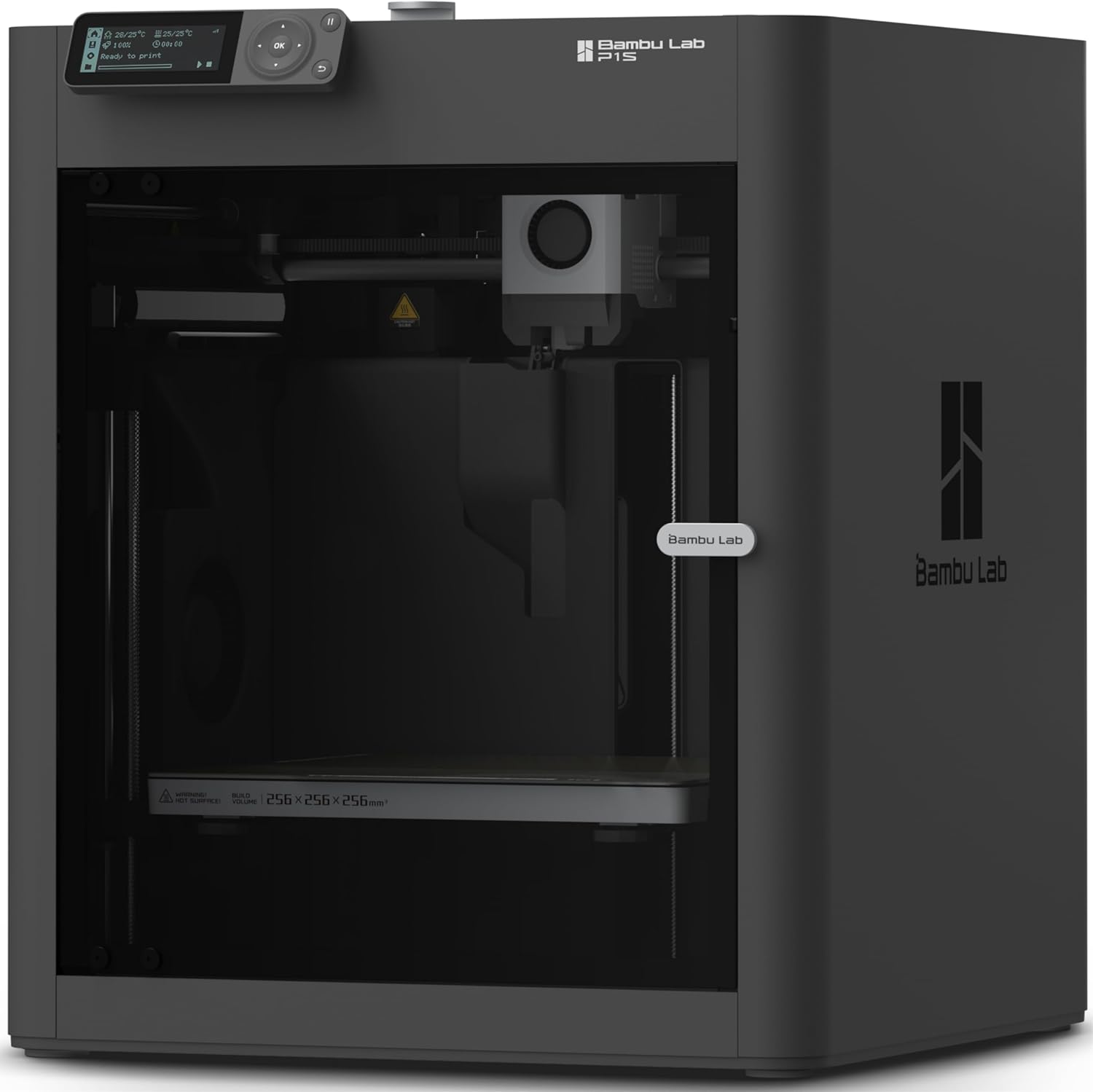
| Build Volume | 256×256×256 mm³ |
|---|---|
| Max Speed | 500 mm/s |
| Max Acceleration | 20 m/s² |
| Supported Filaments | PLA, PETG, TPU, PVA, PET, ABS, ASA; capable: PA, PC |
The Bambu Lab P1S is a ready-to-use, enclosed CoreXY FDM printer that emphasizes speed and ease of use. It ships with automatic bed leveling, a direct-drive extruder that broadens material support, and an onboard camera for timelapses, and it integrates with Bambu's MakerWorld model library for quick starts. The P1S targets high throughput printing with advertised top speeds of 500 mm/s and very high acceleration, which shortens job times for many parts. The enclosed frame helps stabilize temperatures for materials like ABS and ASA and reduces draft-related failures, while the direct-drive setup makes printing flexible filaments such as TPU more reliable. Limitations for this article's focus: the manufacturer does not recommend carbon or glass fiber reinforced filaments, and the printer lacks the hardened extrusion path or wear-resistant components that longer-term carbon-fiber printing usually requires. For buyers prioritizing dependable, fast prints from standard engineering filaments, the P1S is a compelling, easy-to-use option, but it is not the best choice if you plan regular printing with abrasive, fiber-filled materials without additional hardened hardware.
Best for: Engineers or hobbyists who value a reliable, fast, easy-to-use enclosed printer for standard engineering filaments and frequent daily printing.
Less Ideal for: Users planning routine printing of abrasive carbon-fiber or glass-filled filaments who need a factory-quality hardened extrusion path and abrasion-resistant hotend components.
- Enclosed CoreXY design improves temperature stability and reduces print failures from drafts
- Automatic bed leveling and user-focused setup make first prints straightforward
- Direct-drive extruder increases compatibility with flexible and common engineering filaments
- Very high top speed and acceleration reduce print times for many parts
- Manufacturer does not recommend carbon or glass fiber reinforced filaments
- Not fitted with factory wear-resistant/hardened extrusion path for abrasive materials
Verdict: Choose the P1S when you want a fast, reliable, enclosed printer for consistent daily printing with common engineering filaments but not for regular abrasive carbon-fiber jobs.
Creality K1C 3D Printer

| Max printing temperature | 300 ℃ |
|---|---|
| Supported filaments | PLA-CF, PET-CF, PLA, ASA, ABS, TPU |
| Printing speed | 600 mm/s |
| Build volume | 8.66 x 8.66 x 9.84 inch |
The Creality K1C is a plug-and-play desktop FDM printer aimed at quick setup and fast prototyping. It ships largely assembled so you can power up and start printing within minutes, and the machine uses auto Z offset, auto leveling and auto input shaping to reduce manual tuning. The printer supports PLA-CF and PET-CF along with PLA, ASA, ABS and TPU, and its clog-free direct extruder with steel-tipped copper nozzle and titanium-alloy heat break is built for higher-temperature filaments up to about 300°C. Creality highlights a high top speed (600 mm/s) and strong acceleration for faster prints, and an upgraded multi-fan cooling arrangement plus an onboard AI camera for spool failure detection and time-lapse monitoring. Practical benefits include less fiddling with leveling, better reliability on filled filaments thanks to the direct extruder, and quicker turnaround on small functional parts. Limitations to expect are the compact build volume (about 8.66 x 8.66 x 9.84 inches) and that ultra-high advertised speeds will require tuned slicer settings and quality filament to avoid surface artifacts.
Best for: A buyer who values fast setup and reliable printing of carbon-fiber and engineering filaments on a modest budget and wants built-in monitoring to reduce failed prints.
Less Ideal for: Users who need to print large parts or who expect flawless high-speed surface finish without spending time tuning slicer and print settings.
- Ready-to-print out of the box with auto-calibration to cut setup time
- Supports carbon-fiber filled filaments (PLA-CF, PET-CF) and common engineering materials
- Clog-free direct extruder with steel-tipped nozzle and titanium heat break for higher-temperature filaments
- AI camera for print monitoring and failure detection
- Upgraded multi-fan cooling improves layer cooling and reduces stringing and warping
- Relatively small build volume limits large parts or assemblies
- Top theoretical speeds require careful tuning and may reduce surface quality if pushed aggressively
Verdict: If you want an affordable, mostly ready-to-run printer that can handle carbon-fiber filled filaments and cuts setup time with auto-calibration and onboard monitoring, the Creality K1C is a strong budget choice.
FLASHFORGE Adventurer 5M
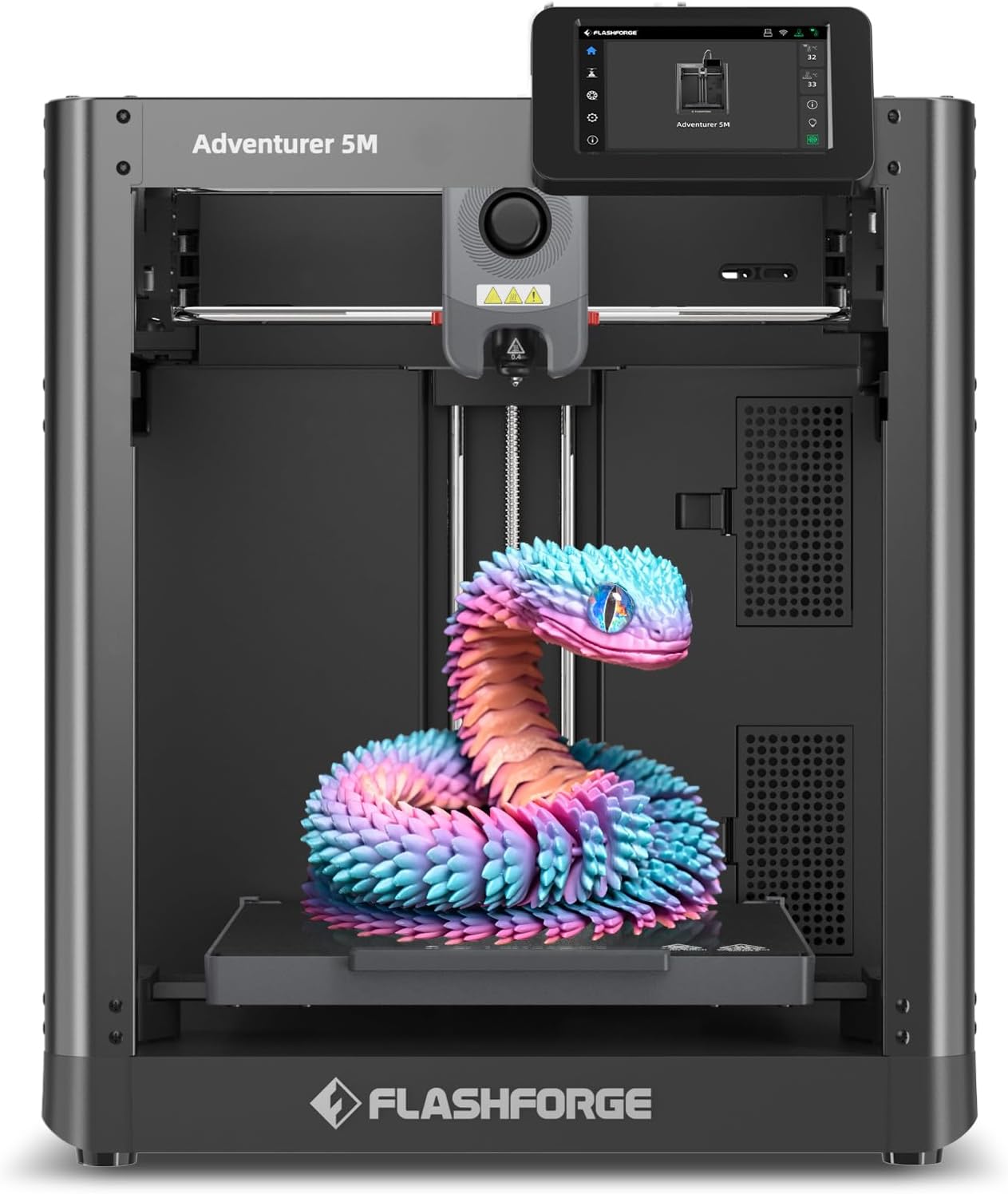
| Build Volume | 220 x 220 x 220 mm |
|---|---|
| Extruder Max Temp | 280°C Direct Drive |
| Travel Speed | 600mm/s |
| Acceleration | 20,000mm/s² |
| Platform Type | Double-Sided PEI Platform |
The FLASHFORGE Adventurer 5M is a CoreXY desktop printer aimed at faster prototyping while keeping setup simple. It uses a 280°C direct-drive extruder with quick 3-second nozzle changes and a dual-sided PEI platform, which helps with adhesion and tool-free part removal. One-button automatic bed leveling and a 35-second warm-up to 200°C make first prints and daily use less fiddly, and the mobile Flash Maker app offers remote monitoring. The AD5M emphasizes speed with a 600mm/s travel rate and high acceleration, so it cuts print time for iterative parts, and the all-metal structure improves motion stability during fast moves. Limitations to note: the advertised high speeds require tuned slicer settings and suitable filament to avoid ringing and loss of fine detail, and true carbon-fiber filaments can be abrasive so hardened nozzles or compatible nozzle options are recommended. For routine prints and quick prototyping the machine balances usability and pace, but material-specific precautions are needed for long-term use with abrasive composites.
Best for: Buyers who want a straightforward, faster desktop printer for rapid prototyping and hobby projects and who value easy setup and remote monitoring.
Less Ideal for: Users who need out-of-the-box, production-grade carbon-fiber printing without upgrading the nozzle or taking extra filament handling precautions should look at more specialized industrial machines.
- Fast CoreXY motion system for shorter print cycles
- One-button automatic bed leveling simplifies first-layer setup
- 280°C direct-drive extruder with quick-change nozzle for varied materials
- Dual-sided PEI platform for reliable adhesion and easy part removal
- Mobile app and camera options enable remote monitoring
- High advertised speeds need careful tuning to maintain detail
- Carbon-fiber and other abrasive filaments require hardened nozzles or upgrades
Verdict: A fast, user-friendly CoreXY desktop printer that makes rapid prototyping easy, provided you upgrade the nozzle and tune settings for abrasive carbon-fiber filaments.
Choosing the Right 3D Printer for Carbon Fiber on a Budget: Key Factors to Consider
Hotend and Nozzle Materials
Carbon-fiber-filled filaments are abrasive and can quickly wear standard brass nozzles. Choosing a printer that supports hardened steel, ruby, or other wear-resistant nozzles matters because nozzle wear changes extrusion diameter and degrades print accuracy over time.
Also consider the hotend material and thermal design. A full-metal hotend with a reliable heat break and consistent temperature control reduces the risk of softening or clogging when printing at the higher temperatures these blends sometimes require.
Extruder and Filament Path
A direct-drive or well-tuned geared extruder helps push abrasive, often stiffer filaments through without grinding. The filament path should minimize sharp bends and use hardened drive gears or idlers where possible to resist wear.
If a printer has a Bowden setup, check whether the kit supports high-temperature PTFE liners or upgrade paths to an all-metal feed path. Smooth filament feeding reduces under-extrusion and inconsistent layer lines on functional parts.
Bed Adhesion and Heated Bed Performance
Carbon-fiber blends can have different thermal contraction and bed-adhesion characteristics than standard PLA. A bed that heats quickly and holds stable temperature helps avoid warping on larger parts and improves first-layer bonding.
Surface options matter too. Consider whether the printer supports common build surfaces or textured plates that work with abrasive filaments and whether the platform allows for easy leveling and repeatable first-layer calibration.
Structural Rigidity and Motion Components
Prints with carbon-fiber fillers benefit from machines with stiff frames and precise motion components because the material accentuates layer lines and dimensional deviation. A rigid gantry and quality linear rails or rods reduce vibration and ringing, giving cleaner edges and better mechanical properties in printed parts.
Look at lead screw or belt quality, frame material, and how axes are supported. Less frame flex means more repeatable dimensions and stronger printed parts in real-world loads.
Cooling and Part Warpage Management
Cooling strategy affects surface finish and interlayer bonding. Too much part cooling can reduce interlayer adhesion on functional parts, while too little can cause visible defects. A printer that offers adjustable part-cooling and the ability to tune fan placement will let you balance surface quality and layer bonding for carbon-fiber prints.
Also consider how the printer handles part warpage through enclosure compatibility or the ability to add an inexpensive enclosure. Controlled ambient temperature reduces layer separation and improves mechanical strength.
Maintenance and Replacement Parts
Because abrasive filaments are harder on hardware, maintenance frequency and the availability of replacement parts are important. Choose printers with easy-to-replace nozzles, accessible extruder components, and a straightforward disassembly process to swap worn parts quickly.
Check whether common upgrades such as hardened nozzles, all-metal hotends, or improved feed components are straightforward to install. Lower maintenance complexity reduces downtime and long-term ownership cost.
Preparing Your Workshop for Abrasive Filaments
Set up a clean, well-ventilated workspace and plan for regular maintenance when printing carbon-fiber blends. Keep spare hardened nozzles and basic tools on hand to swap worn components quickly.
Consider an enclosure to stabilize ambient temperature. Enclosures reduce warping and improve layer bonding for high-strength parts, and they also keep dust and debris away from moving components.
- Stock a hardened nozzle or nozzle kit before your first carbon-fiber print
- Inspect drive gears and filament path weekly during heavy use
- Use a removable build surface for easier part removal and cleaning
Upgrades That Extend Printer Life for Carbon-Fiber Printing
Small upgrades can make budget printers much more suitable for abrasive filaments. The most impactful changes are hardened nozzles and an all-metal hotend. These reduce the need for frequent nozzle swaps and improve reliability at higher temperatures.
Other useful upgrades include reinforced filament drive gears, a better extruder tensioner, and improved bed leveling hardware. Upgrading to a glass or textured PEI plate can also improve first-layer adhesion and part finish.
- Hardened steel or coated nozzles for abrasion resistance
- All-metal hotend or PTFE liner rated for higher temperatures
- Improved extruder gear sets and tensioners
Tuning Print Settings for Carbon-Fiber Blends
Start with lower print speeds and slightly higher extrusion temperatures than you use for standard filaments. Slower printing reduces mechanical stress on the filament and helps maintain consistent extrusion when particulates are present.
Adjust retraction and coasting settings to prevent stringing without causing under-extrusion. Increase extrusion multiplier carefully if you see gaps, and use temperature towers or calibration prints to dial in the best settings for your specific filament batch.
- Reduce print speed by 20 to 50 percent compared to standard PLA settings
- Run a temperature tower to find the best balance of layer adhesion and surface finish
- Tune retraction to avoid grinding while preventing blobs
Safety and Filtration Considerations
Carbon-fiber-filled filaments can produce fine particulate and volatile byproducts when heated. Use ventilation or a dedicated filtered extraction solution to reduce exposure in enclosed spaces. If you work indoors, a small HEPA/charcoal filtration unit helps capture ultrafine particles and odors.
Wear gloves when handling freshly printed parts, as edges can be sharp and particulate residue may be present. Clean work surfaces after sanding or machining printed parts to avoid spreading abrasive dust onto moving components.
- Use local exhaust ventilation or a filtration box with HEPA and activated carbon
- Avoid sanding near electronics; clean with a vacuum rated for fine dust
- Store filaments in dry, sealed containers to preserve printability
Common Failure Modes and How to Troubleshoot Them
Clogging is a frequent issue with abrasive or particulate-filled filaments. If you experience intermittent extrusion, check for nozzle wear and debris, and perform a cold-pull or nozzle swap. Regularly inspect the filament for inconsistent diameter and brittle spots that can cause jams.
Dimensional inaccuracy or delamination often stems from inadequate thermal control or frame flex. Tighten mounts, check belt tension, and verify that the bed temperature is stable. If layer adhesion is poor, try increasing print temperature slightly or reducing cooling during the first several layers.
- Use cold-pulls and a backup nozzle to diagnose partial clogs
- Verify belt tension and stepper motor current if layers shift
- Check filament spool tension to avoid sudden feed resistance
How We Chose the Best 3D Printer for Carbon Fiber on a Budget
We focused on machines that make carbon-fiber-filled filaments practical on a budget. Key filters included a hotend and extruder path compatible with abrasive or particulate-filled filaments, stable heated-bed performance for consistent layer adhesion, and a rigid motion system to preserve dimensional accuracy under the higher extrusion forces and temperatures carbon-fiber blends demand. We also considered build volume practicality for functional parts, ease of maintenance when working with abrasive materials, and available community support or firmware maturity that reduces tuning time. Excluded from consideration were printers that require expensive, proprietary consumables or that lack a metal hotend option because those raise long-term costs or make abrasive filaments unsafe to use. We prioritized models with metal hotends or easy upgrade paths, hardened or replaceable nozzles, and reliable thermal control. Durability for abrasive filaments, stable motion components, and user-accessible maintenance were the primary selection dimensions.
Our full evaluation process is outlined in our review methodology.
FAQ
Can I print carbon-fiber-filled filaments on a budget 3D printer?
Often you can, provided the printer has or can be upgraded with a hardened nozzle and a stable hotend. Many budget machines accept simple upgrades that make abrasive filaments practical without replacing the entire printer.
What nozzle material should I use for carbon-fiber blends?
Hardened steel, stainless steel with wear coatings, or other abrasion-resistant nozzle materials are recommended. Brass nozzles wear quickly with particulate-filled filaments and will affect extrusion consistency.
Do carbon-fiber filaments need different print temperatures?
They often print at similar or slightly higher temperatures than their base polymer matrix. Running a temperature calibration helps you find the best balance between interlayer adhesion and surface finish for the specific filament and printer.
How often should I replace nozzles when printing carbon-fiber blends?
Replacement frequency depends on print volume and filament abrasiveness. With heavy use you may need to replace nozzles much more often than with standard filaments. Keeping spare hardened nozzles on hand reduces downtime.
Is an enclosure necessary for printing carbon-fiber filaments?
An enclosure is not always mandatory, but it helps control ambient temperature, reduce warping, and improve layer bonding for larger or high-temperature prints. Small enclosures are an inexpensive way to improve reliability.
Final Verdict
Choosing an affordable 3D printer that will reliably handle carbon-fiber blends means prioritizing durability and thermal control over raw speed or a large feature list. Focus on machines that either include or can accept hardened nozzles, stable heated beds, and a rigid motion system. Expect to perform more frequent maintenance and consider a few targeted upgrades to extend hardware life. Prioritize the tradeoffs that matter for your parts: if dimensional accuracy and mechanical strength are critical, favor rigidity and thermal stability. If occasional prototyping is your main goal, a budget machine with accessible upgrades and spare parts will give you the best balance of cost and capability.