
Note: This article contains affiliate links. If you click on these links and make a purchase, we may earn a small commission at no extra cost to you. This helps support our research and content. Read our full affiliate disclosure here.
Printing flexible TPU successfully depends on more than just slicing profiles. You need a machine with the right feed path, extrusion control, and bed characteristics so flexible parts come out dimensionally accurate and free of excessive stringing. This guide shortlists top 3D printers for TPU that are suited to hobbyists and makers who want consistent, usable flexible parts. We evaluated models based on extrusion reliability, filament path design, temperature stability, and build-surface adhesion. Read on for the factors that matter and a clear set of practical considerations to help you pick the right printer for TPU projects.
Top Picks at a Glance
| Best Overall The best all-around choice for most situations | QIDI PLUS4 3D Printer |  |
| Best Quality Built to a higher standard if you want something more solid | Original Prusa MK4S Kit |  |
| Best Value The sweet spot between price and what you get | FLASHFORGE AD5M 3D Printer |  |
| Best Budget The cheapest option that still gets the job done reliably | Creality SPARKX i7 3D Printer |  |
| Top Rated A top-rated pick with lots of positive feedback | ELEGOO Centauri Carbon |  |
| Most Popular A crowd favorite that many people choose with confidence | Bambu Lab P1S Combo |  |
| Best Seller A high-volume bestseller chosen again and again | FLASHFORGE Adventurer 5M |  |
QIDI PLUS4 3D Printer

| Build volume | 305×305×280 mm |
|---|---|
| Max nozzle temp | ≤370°C (80W) |
| Active chamber temp | ≤65℃ |
| Hot bed temp | ≤120℃ (6mm Aluminum Bed |
| Toolhead speed | ≤600mm/s |
The QIDI PLUS4 is a Core XY 3D printer built for large, higher-temperature prints and extended material compatibility. It offers a 305 × 305 × 280 mm build area and a high-temperature 80W hotend with a multi-metal integrated nozzle that reaches up to 370°C, so it can handle engineering filaments as well as flexible materials with the right settings. A second-generation active chamber heater with dual-layer insulation and air circulation helps hold temperature and reduce warping on ABS-like and high-temp filaments, while a 6 mm aluminum bed and dual Z motors improve bed flatness and stability for taller parts. The printer includes features that make day-to-day use easier: fully automatic bed leveling, filament runout/break detection, power-loss recovery, a 5-inch HD touchscreen, remote printing and live camera monitoring via the brand app, and an included slicer. That said, the machine is sizeable and aimed at experienced or committed hobbyists; dialing in flexible filaments like TPU still requires slower speeds, tuned retraction and part fixturing despite the hardware support. The PLUS4 is strongest when you need a roomy, robust platform for a wide range of filaments and higher-temperature printing workflows.
Best for: Buyers who want a spacious, capable printer that can handle engineering and flexible filaments and who value hardware features that reduce warping and improve uptime.
Less Ideal for: Those looking for a compact, turn-key printer for occasional hobby prints or users unwilling to spend time tuning profiles for challenging materials should consider simpler, smaller models instead.
- Large 305×305×280 mm build volume for printing bigger or multiple parts
- 80W high-temperature hotend and 370°C nozzle for engineering filaments
- Active heated chamber with circulation and insulation to reduce warping
- Automatic bed leveling, filament detection and power-loss recovery for convenience
- Remote printing and live camera monitoring via app for easy workflow control
- Large footprint and weight make it less suitable for casual desktop use
- High-temperature capability and advanced features require tuning and experience to exploit fully
Verdict: If you need a large, robust printer that can run high-temperature and flexible filaments with active chamber control, the QIDI PLUS4 delivers the hardware to make those prints feasible.
Original Prusa MK4S Kit

| Print size | 9.84 x 8.3 x 8.6 in |
|---|---|
| Item model number | MK4S-KIT-PEI |
| Manufacturer | Original PRUSA |
The Prusa MK4S Kit is a DIY high-performance FDM printer intended for users who want a hands-on build plus professional-quality results. You assemble the machine from a guided kit, which teaches the mechanics and electronics while delivering a 9.84 x 8.3 x 8.6 inch build volume when complete. It uses input shaping and refined motion control to reduce ringing and vibration, allowing cleaner edges and faster print speeds than typical hobby printers. The platform is engineered for repeatable output and long-term use, with Prusa's active firmware development, modular hardware, and included sample Prusament PLA for initial tests. As a kit, it rewards builders with deeper system knowledge but requires time and some comfort with tools and calibration. For flexible filaments like TPU, the MK4S's mature motion control and material support should help with stringing and surface finish, though successful TPU printing still depends on tuned extruder settings and slow, consistent filament feed. The printer is best suited to experienced hobbyists and small production users who value stability, serviceability, and upgrade paths over plug-and-play simplicity.
Best for: Buyers who prioritize high-speed, repeatable print quality and want a hands-on kit that is serviceable and upgradeable for demanding projects.
Less Ideal for: If you need a ready-to-run, out-of-the-box printer with minimal setup or you prefer to avoid hands-on assembly and tuning, this kit is not a good fit.
- Input shaping and refined motion control reduce ringing and allow higher quality edges at increased speeds
- Proven, professional-grade design with ongoing firmware support and modular upgradeability
- Kit format teaches mechanics and electronics and includes sample Prusament PLA for testing
- Requires assembly and time to build and calibrate compared with turnkey printers
- Successful TPU printing still needs careful tuning of extrusion and feed settings
Verdict: Choose the MK4S Kit if you want a high-speed, upgradeable Prusa platform that rewards hands-on builders with reliable, production-quality FDM prints.
FLASHFORGE AD5M 3D Printer

| Build Volume | 220 x 220 x 220 mm |
|---|---|
| Nozzle Options | 0.25/0.4/0.6/0.8 mm |
| Leveling Method | Full-Auto One-Click Leveling |
| Travel Speed | 600 mm/s and 20,000 mm/s² |
| Connectivity | Wi-Fi; Ethernet; USB; Cloud |
The FLASHFORGE AD5M is a CoreXY desktop printer designed to speed up production without demanding constant tinkering. It uses a fully automatic one-click leveling system to set nozzle-to-bed offsets, a dual-texture PEI plate for easier part removal, and quick-release nozzles available in 0.25, 0.4, 0.6 and 0.8 mm for switching between fine detail and fast extrusion. Connectivity options include Wi‑Fi, Ethernet, USB and cloud control plus an app and slicer that support batch file transmission and remote monitoring. High travel speed and acceleration (600 mm/s and 20,000 mm/s²) promise shorter print times, and resume-after-power-loss protects long TPU prints from interruptions. It lists TPU among compatible filaments, and the one-click leveling and flexible PEI plate make flexible filament feeds and part removal easier for practical users. Limitations to note are that advanced TPU printing still benefits from tuned retraction, a suitable extruder and slower print speeds for best surface finish, and some higher-end enclosure or active filtration features are only present on Pro variants rather than this base model.
Best for: Buyers who prioritize practical, time-saving features and want a fast CoreXY desktop printer that handles everyday flexible filaments with minimal manual leveling and straightforward maintenance.
Less Ideal for: Users who need a fully enclosed, industrial-grade system with built-in air filtration or who expect out-of-the-box perfect TPU prints without fine-tuning extrusion and retraction settings.
- Fully automatic one-click leveling reduces setup time and improves first-layer reliability.
- Quick-release nozzles in multiple diameters let you swap for fine detail or high-flow TPU prints.
- Flexible dual-texture PEI plate simplifies part removal, including flexible TPU prints.
- Fast travel speed and high acceleration cut print times for large or batch jobs.
- Multiple connectivity options and app/slicer support make remote monitoring and batch uploads convenient.
- Base model lacks some Pro features like enclosure, active filtration, and certain silent/monitoring options.
- High advertised speeds still require tuning; TPU often prints best at slower speeds to avoid stringing.
Verdict: A fast, practical CoreXY printer with auto-leveling and quick-change nozzles that makes reliable TPU printing easier for users focused on throughput and low-maintenance workflows.
Creality SPARKX i7 3D Printer

| Build volume | 260×260×255mm |
|---|---|
| Preassembly | 95% preassembled |
| Monitoring | Built-in AI camera with real-time alerts |
| Auto calibration | One-touch automatic bed leveling and Z-offset |
The Creality SPARKX i7 is a mostly preassembled desktop 3D printer designed for multicolor and single-color prints with features that simplify setup and monitoring. It uses Creality CubeMe AI to convert portraits to 3D models and offers a built-in AI camera that watches prints in real time to detect issues like filament entanglement and spaghetti prints, sending alerts to help salvage jobs. The printer promises one-touch automatic calibration for bed leveling and nozzle Z-offset plus input shaping and pressure advance to reduce ringing and oozing, which helps produce smoother surfaces and sharper corners. A 260×260×255mm build volume gives room for medium-size parts, and claimed reductions in purging waste and modest speed gains target filament savings. Custom RGB lighting and a near-silent night mode are handy extras for desktop use. Important limitations to consider are mixed user feedback and the fact multicolor capability relies on Creality's CFS system, which may add cost and complexity compared with single-extruder setups; TPU printing success will depend on filament path and feeder compatibility rather than these headline features alone.
Best for: Buyers who want an easy-to-start multicolor-capable printer with automated calibration and active print monitoring to reduce setup time and filament waste.
Less Ideal for: People who need a dedicated, proven TPU workstation or want the simplest single-extruder setup without vendor-specific consumables should consider more TPU-focused machines or direct-drive feeders.
- 95% preassembled for quick setup and one-touch automatic calibration to get printing fast
- Built-in AI camera with real-time monitoring and alerts to catch common print failures
- Input shaping and pressure advance for improved surface finish and reduced ringing
- Large 260×260×255mm build volume suitable for medium-sized parts
- Night mode and programmable RGB lighting for quieter, user-friendly desktop operation
- Multicolor printing depends on Creality CFS consumables and workflow, adding cost and complexity
- TPU-specific handling not guaranteed—flexible filament performance will depend on feeder and filament path rather than advertised AI features
Verdict: Choose the SPARKX i7 if you want a plug-and-play multicolor desktop printer with AI monitoring and automated calibration to speed up setup and reduce wasted filament.
ELEGOO Centauri Carbon

| Build Volume | 256 × 256 × 256 mm |
|---|---|
| Max Hot End Temp. | 320 °C |
| Max Printing Speed | 500 mm/s |
| Extruder | Hardened Steel Dual-Gear Direct Extruder |
| Connectivity | USB & Wi‑Fi |
The ELEGOO Centauri Carbon is an out-of-the-box CoreXY FDM printer designed for fast, reliable production and a wide range of filaments. It ships preassembled with auto bed leveling, a dual-sided textured PEI plate, and a rigid die-cast aluminum frame to reduce vibration when printing at up to 500 mm/s and high accelerations. The all-metal hotend reaches 320°C and the enclosed metal and glass chamber plus a hardened-steel dual-gear direct extruder make it capable of running TPU, PETG, ABS and abrasive carbon/glass-filled filaments with less wear and better dimensional stability. Built-in features like automatic vibration compensation, pressure advance, and a chamber camera with dual LED lighting help maintain print quality and let you monitor or capture timelapses remotely. Practical limits include its relatively large footprint and weight compared with hobbyist carts, and while rapid speeds are possible, dialing in settings for flexible TPU at high speed can still require careful tuning. For users prioritizing dependable, high-temperature material capability and consistent results, the Centauri Carbon is engineered to deliver.
Best for: Buyers who need a dependable, factory-ready printer that handles high-temperature and abrasive filaments reliably and minimizes time spent on mechanical setup and calibration.
Less Ideal for: If you need a very compact, lightweight desktop printer for casual hobby prints or plan to move the machine frequently, a smaller benchtop model would be a better fit.
- High max hotend temperature (320°C) supports high-performance and abrasive filaments.
- Sturdy die-cast frame and vibration compensation improve dimensional accuracy at high speeds.
- Enclosed metal and glass chamber expands material compatibility and reduces warping.
- Auto-leveling, dual-sided PEI plate, and preassembled setup minimize initial calibration time.
- Built-in chamber camera and Wi-Fi/USB connectivity enable remote monitoring and easy workflow integration.
- Large and heavy unit may be less convenient for small workspaces or frequent repositioning.
- Achieving reliable high-speed TPU prints still requires careful tuning of speed, retraction, and cooling settings.
Verdict: Choose the Centauri Carbon when you want a robust, preassembled CoreXY printer that reliably handles TPU and other high-performance filaments with minimal mechanical tinkering.
Bambu Lab P1S Combo

| Build Volume | 256*256*256 mm³ |
|---|---|
| Max Speed | 500 mm/s |
| Max Acceleration | 20 m/s² |
| Supported Filaments | PLA, PETG, TPU, PVA, PET, ABS, ASA |
The P1S Combo is a racing‑focused desktop 3D printer that pairs a CoreXY motion system with a direct‑drive extruder and Bambu Lab's AMS multi‑spool accessory to enable multi‑color and multi‑material prints. It is designed for fast prints with top speeds up to 500 mm/s and very high acceleration, and the enclosed chassis plus auto bed leveling help when running flexible filaments like TPU. Setup is straightforward and the printer includes a camera for time‑lapses, making it easy to monitor jobs. The direct‑drive extruder and enclosed build volume make TPU and other flexible materials more usable than many bowden machines, though strongly reinforced or abrasive filaments are not recommended. The Combo shines when you need speed plus the ability to switch colors or materials automatically, but users should expect to follow filament handling best practices for TPU and verify AMS connection during setup because the AMS is required for multi‑color operation.
Best for: Buyers who prioritize fast, reliable prints and want to print flexible filaments or multi‑color parts with minimal manual filament swaps, and who value devices with strong community feedback and proven real‑world results.
Less Ideal for: People who need a simple, budget single‑color hobby printer or who plan to print highly abrasive reinforced filaments frequently should look elsewhere.
- High top speeds (up to 500 mm/s) and very high acceleration for fast prints
- Direct‑drive extruder improves reliability with flexible filaments like TPU
- Enclosed design stabilizes temperature for advanced materials
- Includes AMS for automated multi‑color or multi‑material printing
- Auto bed leveling simplifies first‑layer calibration and increases print success
- AMS is required for multi‑color features so additional setup and compatibility checks are necessary
- Not recommended for carbon or glass fiber reinforced filaments
Verdict: Choose the P1S Combo if you want a fast CoreXY printer with a direct‑drive setup and an AMS that together make printing TPU and multi‑color parts practical and efficient.
FLASHFORGE Adventurer 5M
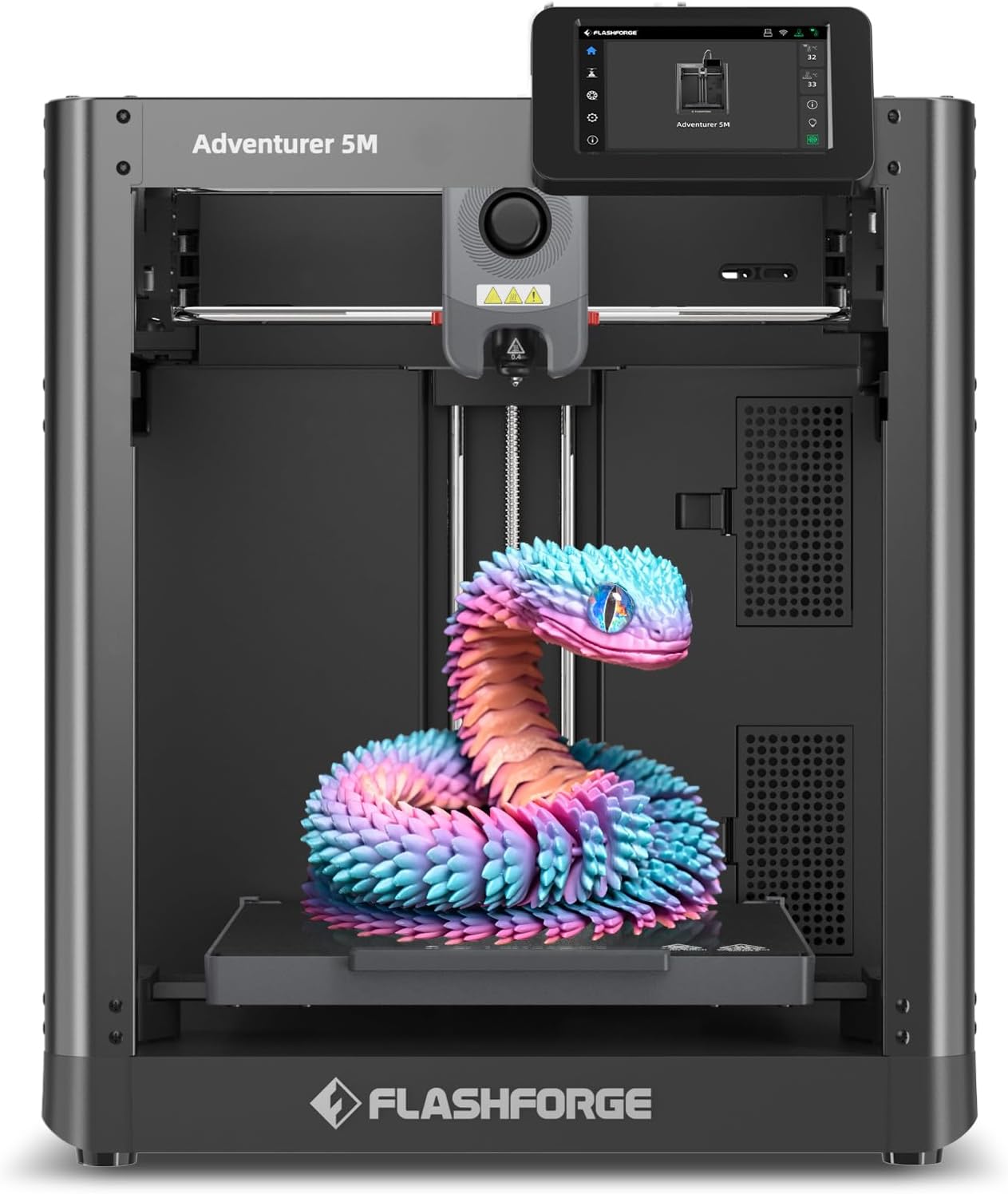
| Build Volume | 220 x 220 x 220 mm |
|---|---|
| Extruder Max Temp | 280°C |
| Travel Speed | 600mm/s |
| Platform Type | Double-Sided PEI Platform |
| Structure | All-metal Core XY Structure |
The FlashForge Adventurer 5M is a CoreXY desktop printer aimed at faster, reliable part production. It uses one-click automatic bed leveling and a double-sided PEI platform to simplify first-layer adhesion and part removal, and a 280°C direct-extruder with interchangeable nozzles for a range of filament types. The all-metal CoreXY structure plus high travel speed (600mm/s) and strong acceleration reduce print times, which suits rapid prototyping and small-batch runs. Practical touches include a quick-change nozzle system, dual-fan nozzle cooling, and a mobile app for remote monitoring. For flexible filaments like TPU, the direct drive and supported materials list indicate compatibility, though successful TPU printing will still depend on tuned slicer settings and slower print speeds than rigid filaments. The unit favors users who want a more plug-and-play experience and speed without deep manual leveling, but expect the usual limitations of compact build volume and the need for routine nozzle and platform maintenance to keep consistent results.
Best for: Buyers who prioritize a turnkey, lower-fuss 3D printer for rapid prototyping and want a machine that handles a variety of filaments with minimal manual leveling effort.
Less Ideal for: Those who need a very large build volume or users wanting an ultra-simple beginner machine with no tuning at all should consider other options.
- One-button automatic bed leveling for easier first layers and less setup time
- CoreXY all-metal frame with high travel speed and acceleration speeds up prints
- 280°C direct extruder and multiple nozzle sizes support a wide range of filaments
- Double-sided PEI platform allows easier part removal and good adhesion
- Quick 3-second nozzle change and mobile app for remote monitoring and control
- 220×220×220mm build volume is modest for larger parts
- High-speed capability may require tuning to achieve best print quality at top speeds
Verdict: Choose the Adventurer 5M if you want a faster CoreXY desktop printer that reduces setup fuss and handles flexible filaments when tuned properly.
Choosing the Right 3D Printer for TPU: Key Factors to Consider
Filament Path and Drive Type
A short, constrained filament path from the drive gear to the hotend reduces the chance of TPU buckling and jammed prints. Direct-drive or geared-extruder systems typically handle flexible filament better because they apply force close to the melt zone, enabling lower retraction settings and finer extrusion control.
If a machine uses a Bowden-style long tube, look for printers that allow a guided PTFE liner or that use very low retraction values. The easier the filament routing is to inspect and maintain, the faster you can diagnose feed issues without lengthy teardown.
Hotend and Temperature Control
TPU prints best with consistent, stable hotend temperatures in the typical TPU range. An all-metal hotend can work for some flexible blends, but a PTFE-lined hotend can reduce friction for softer filaments at lower temperatures. Accurate thermistor readings and a firmware that prevents temperature overshoot help maintain layer consistency.
Consider printers with a reliable heater cartridge and well-calibrated thermal controls to avoid sudden cold spots that can cause under-extrusion or inconsistent layer bonding. Rapid temperature recovery after retractions also reduces blobs and stringing.
Bed Adhesion and Surface Options
Flexible parts are often thin and rely on surface grip to avoid warping or lifting. A build surface that offers good mechanical grip—such as textured PEI, TPU-compatible tape, or a flexible removable sheet—improves first-layer bonding and part removal.
Look for printers that support a range of adhesion techniques and that allow for easy bed adjustments. A heated bed with stable temperature control reduces the risk of parts detaching during longer prints.
Retraction and Extrusion Tuning
TPU requires lower retraction distances and slower retraction speeds than rigid filaments to prevent filament deformation in the feed path. Printers that allow fine-grained retraction tuning in firmware or slicer profiles will let you dial in settings that reduce stringing without causing under-extrusion.
Check that the printer's firmware supports small retraction increments and that the workflow for testing and saving profiles is straightforward. Smooth, predictable extrusion at low speeds aids reliable layer transitions.
Mechanical Stability and Motion Control
Mechanical rigidity reduces vibrations and sudden jerks that can exacerbate ooze and stringing when printing flexible filaments. A stable gantry and precise belt tension maintain consistent layer alignment, which is particularly important for thin TPU features.
Drive backlash, loose bearings, or inconsistent stepper microstepping can all affect print quality. Choose machines with solid framing and accessible maintenance points so you can keep motion components properly tensioned.
Preparing TPU Filament Before Printing
TPU is hygroscopic and absorbs moisture that leads to bubbling, poor layer adhesion, and noisy extrusion. Drying filament before printing and storing it in sealed containers with desiccant significantly improves print quality. Typical drying methods include low-temperature oven cycles or dedicated filament dryers set according to the filament manufacturer's guidance.
Also ensure your filament path is clean and free of dust or brittle particles that can increase friction. Feeding a small test length through the extruder by hand helps confirm smooth movement and reveals any problematic snags before you start a print.
- Dry filament for several hours at recommended temperature ranges.
- Store unused filament in airtight containers with desiccant.
- Manually feed a short length to check for smooth motion.
Slicer Settings That Help With TPU
Start with lower print speeds than you would for PLA or PETG. Slower printing reduces filament whipping and helps the extruder maintain a consistent flow. Typical TPU print speeds are often in the 20 to 30 mm/s range but adjust based on how the machine handles the filament.
Tune retraction to be minimal and slower; many users disable retraction on travel moves and rely on coasting or combing settings to reduce stringing. Increase extrusion multiplier slightly if you notice under-extrusion, and enable features like linear advance or pressure control where available to smooth flow during speed changes.
- Reduce print speed compared to rigid filaments.
- Minimize retraction distance and speed.
- Enable pressure compensation features if supported.
Bed Preparation and First-Layer Techniques
A clean, level first layer is critical for flexible parts. Use a moderate first-layer height and slightly slower first-layer speed to ensure solid adhesion. If your printer supports a textured PEI sheet or flexible build plate, those surfaces often provide reliable grip for TPU without additional adhesives.
Consider adding a brim to very small or delicate parts to increase contact area and reduce the risk of lifting. Avoid excessive bed temperatures that can make the part too soft and difficult to remove without deformation.
- Use moderate first-layer height and slower speeds.
- Add a brim for small contact-area parts.
- Avoid overly high bed temps that hinder removal.
Maintenance Tips to Keep TPU Printing Reliable
Regular maintenance of the extruder drive gear and filament path prevents slipping and inconsistent feeds. Clean or replace worn hobbed gears and inspect PTFE liners for wear. Lubricate linear rails or lead screws per the machine's maintenance guide to preserve smooth motion.
Keep spare PTFE tubing and nozzle options on hand so you can swap to a more favorable hotend geometry if you encounter persistent jamming. Routine checks on belt tension and stepper motor behavior also prevent print artifacts that are amplified with flexible materials.
- Clean hobbed gears and inspect PTFE tubing regularly.
- Keep spare nozzles and liners available for quick swaps.
- Check belt tension and motion components monthly.
Use Cases That Benefit Most From TPU
TPU excels at functional parts that need elasticity and impact resistance, such as gaskets, cable management hooks, wearable prototypes, and vibration-damping mounts. Its flexibility makes it well suited to applications that require repeated bending or compression while maintaining shape.
When designing for TPU, favor slightly thicker walls and larger radii over thin, sharp features, which can tear under stress. Orientation and infill choices also affect part flexibility and durability, so plan geometry with the filament's mechanical properties in mind.
- Good for gaskets, seals, and wearable prototypes.
- Design with thicker walls and rounded features.
- Choose infill patterns that balance flexibility and strength.
How We Chose the Best 3D Printer for TPU
We focused on properties that directly affect printing flexible TPU filament rather than general-purpose hotend or speed specs. Primary evaluation criteria included extrusion feed geometry and drive type, hotend and temperature control stability, print surface adhesion options and bed leveling, firmware and retraction control, and overall mechanical rigidity to reduce oozing and stringing during long moves. We favored printers that provide limited filament path distance between the drive gear and the hotend or that use a guided/direct drive system to minimize filament buckling. We also prioritized machines with reliable bed adhesion solutions and consistent temperature control across common TPU printing ranges. Ease of access to firmware or slicer tuning that supports low retraction speeds and pressure advance-style compensation was counted positively. Excluded were machines that require extensive hardware modification to handle TPU or that lack basic features like adjustable retraction and bed adhesion options. We did not consider aftermarket extruders or third-party modifications in the primary selection, instead focusing on the out-of-box capabilities and documented setup routes that matter to most buyers.
Our full evaluation process is outlined in our review methodology.
FAQ
Do I need a direct drive extruder to print TPU well?
Direct drive systems generally make TPU easier to print because the drive gear is closer to the hotend, reducing filament buckling. However, Bowden setups can work if the filament path is short, well-guided, and you use conservative retraction settings.
What print speed should I use for TPU?
TPU typically prints much slower than rigid filaments. Many users find reliable results in the 20 to 30 mm/s range, but the optimal speed depends on your printer's extrusion control and the specific TPU formulation.
How do I reduce stringing when printing with TPU?
Lower retraction distances and speeds, slower travel moves, and enabling pressure compensation features all help reduce stringing. Proper filament drying and a clean extrusion path also significantly lower the tendency to string.
Is a heated bed necessary for TPU?
A heated bed is helpful but not always essential. Moderate bed temperatures improve first-layer adhesion for many TPU blends, but the exact temperature depends on the material. Using a suitable build surface can sometimes replace the need for high bed temps.
How should I store TPU filament when not in use?
Store TPU in airtight containers or resealable bags with desiccant to prevent moisture uptake. Keeping filament dry preserves printability and reduces issues like bubbling and inconsistent extrusion.
Final Verdict
When choosing a 3D printer for TPU, prioritize a short, well-constrained filament path, reliable extrusion control, and build-surface options that promote adhesion without damaging flexible parts. Tradeoffs include print speed and tuning time versus out-of-box reliability; more robust drive systems and stable temperature control reduce the need for constant tweaks. Focus on machines that make it easy to tune retraction and extrusion settings and that offer straightforward bed preparation. With those priorities, you can confidently select a printer that handles TPU consistently for functional, flexible parts.