
Note: This article contains affiliate links. If you click on these links and make a purchase, we may earn a small commission at no extra cost to you. This helps support our research and content. Read our full affiliate disclosure here.
Picking the right All-in-One Printer under $200 matters because a single machine must handle printing, copying, and scanning without wasting time or money. You want fast setup, sharp text and images, and affordable consumables so the printer actually saves you effort in everyday tasks. This guide highlights seven shortlisted All-in-One Printers that balance those priorities for home and small-office users. We evaluated fundamentals like print quality, ink or toner cost, connectivity options, and ease of use to surface practical choices. Read on to see which features we prioritized and which models fit different usage patterns before you decide.
Top Picks at a Glance
| Best Overall The best all-around choice for most situations | Epson WorkForce Pro WF-4820 |  |
| Best Quality Built to a higher standard if you want something more solid | Epson EcoTank ET-2800 |  |
| Best Value The sweet spot between price and what you get | Brother Work Smart 1360 MFC-J1360DW | 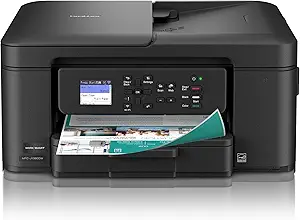 |
| Best Budget The cheapest option that still gets the job done reliably | HP DeskJet 2955 All-in-One Printer |  |
| Top Rated A top-rated pick with lots of positive feedback | Canon PIXMA TR8620a |  |
| Most Popular A crowd favorite that many people choose with confidence | Canon PIXMA TR4720 |  |
| Best Seller A high-volume bestseller chosen again and again | HP Envy 6155 All-in-One Printer |  |
Epson WorkForce Pro WF-4820

| Printer Type | Inkjet |
|---|---|
| Print Speed (B&W) | 25 pages_per_minute |
| Print Speed (Color) | 12 pages_per_minute |
| Maximum Print Resolution | 4800 x 2400 dpi |
| Connectivity | Bluetooth, Ethernet, USB, Wi-Fi |
The WF-4820 is a versatile all-in-one built for small offices or home users who need steady daily output. It prints up to 25 ppm black and 12 ppm color, handles duplex printing automatically, and includes a 35-page ADF for multi-page scanning and copying. PrecisionCore heat-free printheads and DURABrite Ultra pigment inks deliver sharp text and respectable color for documents and occasional photos, while a 4.3" color touchscreen and the Epson Smart Panel app make setup and mobile printing straightforward. Connectivity options are broad: Wi-Fi, Wi-Fi Direct, Bluetooth Low Energy, Ethernet, and USB give flexible placement and device pairing. The 250-sheet capacity reduces paper refills for higher-volume jobs, but buyers should note this is an inkjet not a laser, so long-run cost depends on cartridge use and genuine Epson cartridges are required for full compatibility. For buyers focused on balanced speed, features, and network options under $200, the WF-4820 is a practical choice that favors productivity over ultra-low running costs.
Best for: Buyers who want a balanced, feature-rich all-in-one for home office or small-business use that prioritizes speed, network flexibility, and everyday productivity.
Less Ideal for: Those who need the absolute lowest cost per page for very high monthly volumes or who prefer a monochrome laser workflow should consider alternatives.
- Fast black text printing up to 25 pages per minute for quick document jobs
- Automatic duplex printing and 35-page ADF streamline two-sided copying and scanning
- Wide connectivity including Wi-Fi, Wi-Fi Direct, Bluetooth LE, Ethernet, and USB
- Large 250-sheet paper capacity reduces frequent refills for moderate workloads
- 4.3" color touchscreen and mobile app simplify setup and daily operation
- Inkjet running costs can be higher than comparable laser printers depending on usage
- Requires genuine Epson cartridges for full compatibility which may limit third-party savings
Verdict: A well-rounded all-in-one that delivers fast black printing, duplex and ADF convenience, and broad connectivity for balanced home office productivity under $200.
Epson EcoTank ET-2800
| Printer Type | Inkjet |
|---|---|
| Printer Connectivity Type | USB, Wi-Fi |
| Maximum print Resolution Color | 5760 x 1440 dpi |
| B&W Pages per Minute | 10 |
| Maximum Sheet Capacity | 100 |
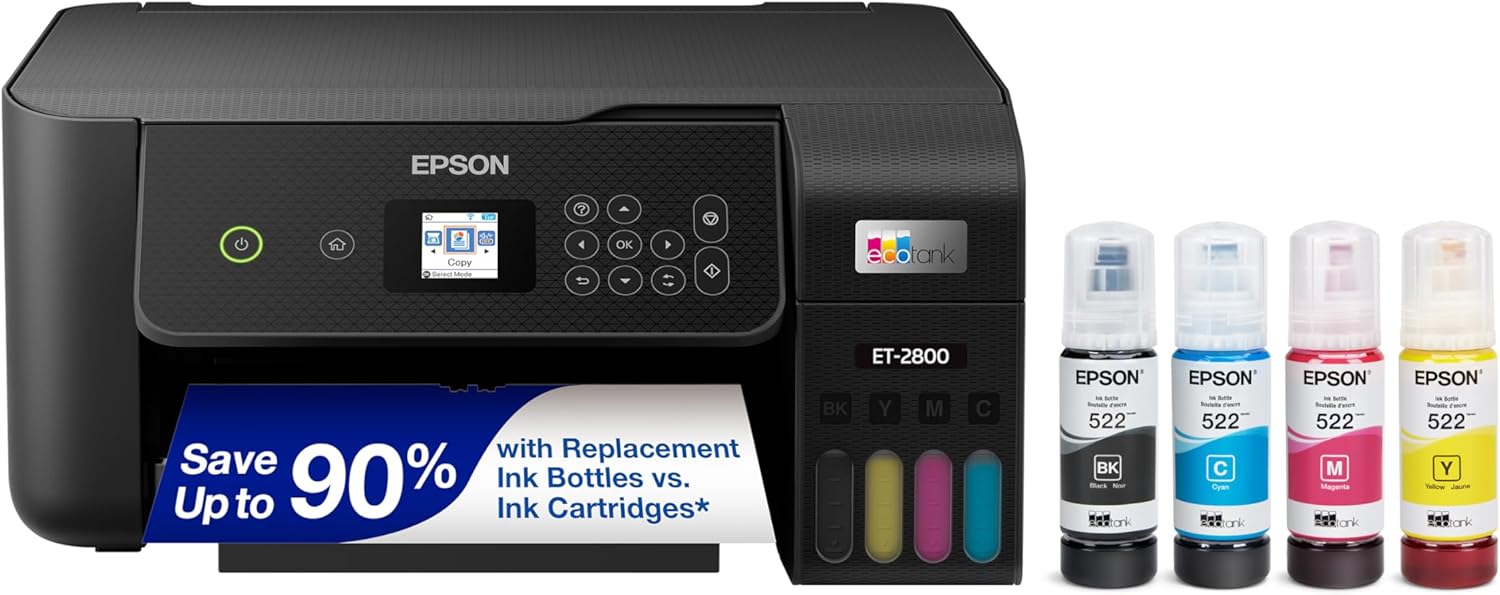
The Epson EcoTank ET-2800 replaces cartridges with high-capacity refillable ink tanks so you can print long runs without frequent replacements; a set of bottles is equivalent to roughly 90 cartridges. It prints up to 10 ISO pages per minute for black and 5 ppm for color, and uses PrecisionCore/Micro Piezo heat-free technology to deliver sharp text and detailed color photos on common paper types. Setup and daily use are simplified by wireless printing, app control and a small color LCD, and the flatbed scanner handles basic copying and scanning tasks. Practical benefits include much lower ongoing ink costs, reduced cartridge waste, and a 100-sheet input capacity for modest home workloads. Limits for buyers: duplexing is manual only, photo speed and photo-specific features are basic, and Epson recommends genuine ink to maintain performance and warranty coverage. For buyers focused on reliable everyday printing and low ink costs, the ET-2800 is a compact, no-frills choice that emphasizes long-term value over advanced office features.
Best for: Buyers who prioritize low ongoing ink costs and dependable everyday performance for home or small-family use and want a simple wireless all-in-one without enterprise features.
Less Ideal for: Workgroups that need fast two-sided printing, heavy monthly volumes, or advanced photo printing controls should consider higher-end models instead.
- Cartridge-free EcoTank system greatly reduces frequency of ink replacement
- Low running costs with high-capacity ink bottles (approx. one set equals ~90 cartridges)
- Wireless printing and app control for mobile and voice-activated workflows
- High optical print resolution for detailed documents and photos
- Compact all-in-one with built-in flatbed scanner and 100-sheet input capacity
- No automatic duplex unit; two-sided printing requires manual page flipping
- Color print speed is modest compared with some rival models
- Printer performance depends on using genuine Epson ink to avoid issues
Verdict: If you want an inexpensive all-in-one that slashes ink costs and reliably handles everyday home printing, the EcoTank ET-2800 is a top value under $200.
Brother Work Smart 1360 MFC-J1360DW

| Printer Type | Inkjet |
|---|---|
| Duplex | Automatic |
| Maximum Sheet Capacity | 150 |
| ADF Capacity | 20 sheets |
| Connectivity | USB, Wi-Fi |
The Brother Work Smart 1360 is a small all-in-one inkjet built for basic home and home-office tasks. It supports wireless and USB connections, prints in color, and uses a 20-sheet single-sided automatic document feeder plus a flatbed scanner for copying and scanning jobs. Notable practical features include automatic duplex (two-sided) printing, a 150-sheet input capacity, and the Brother Mobile Connect app for mobile printing, cloud uploads, and ink monitoring via Page Gauge. Print speeds are reasonable for the class at up to 16 ppm black and 9 ppm color, and initial-page times are quick for short jobs. The printer uses Brother LC501 ink with standard and high-yield options and offers a Refresh subscription trial for auto-reordering. Trade-offs are typical for budget inkjets: color photo quality is adequate but not professional, ongoing ink costs depend on cartridge choices, and the small 1.8" display limits on-device navigation compared with larger touchscreens. For buyers wanting straightforward, space-saving multifunction performance under $200, this model covers core needs efficiently.
Best for: Buyers who want a compact, no-frills all-in-one for everyday home or small office printing and who prioritize space efficiency and easy mobile/cloud printing.
Less Ideal for: Users who need professional photo-quality output, large-volume production printing, or an advanced touchscreen interface should look at higher-tier models.
- Automatic duplex (two-sided) printing for reduced paper use
- 20-sheet ADF plus flatbed scanner for quick multi-page scanning and copying
- Wireless printing with Wi‑Fi, Wi‑Fi Direct, AirPrint, and Mopria support
- 150-sheet paper tray reduces how often you refill paper
- Brother Mobile Connect app and Page Gauge let you print from mobile and monitor ink levels
- Small 1.8" color display limits on-device menu navigation
- Ink costs can add up if you print frequently and choose standard-yield cartridges
Verdict: A compact, practical all-in-one that delivers reliable two-sided printing, mobile/cloud convenience, and basic scan/copy features for budget-conscious home and small-office users.
HP DeskJet 2955 All-in-One Printer

| Printer Type | HP Thermal Inkjet |
|---|---|
| Maximum Sheet Capacity | 60 |
| Scanner Type | Flatbed |
| Color Pages per Minute | 5.5 pages_per_minute |
| Printer Connectivity Type | Apple AirPrint; USB; Wireless (Wi-Fi); Wireless direct printing; Mopria |
The HP DeskJet 2955 is a budget-focused all-in-one designed for everyday home use. It prints color and black-and-white documents, scans on a flatbed, and makes basic copies, all from a compact footprint that fits small desks. Setup and mobile printing are straightforward thanks to dual-band Wi‑Fi, wireless direct, AirPrint and the HP app, and the 60-sheet input tray keeps light workloads moving. Print quality is adequate for text, forms, and casual color documents, and HP AI formatting tools aim to reduce wasted pages when printing web content. Important limitations are modest print speeds (around 7.5 ppm B&W, 5.5 ppm color), manual duplexing only, and modest copy/scan resolution compared with midrange machines. The printer uses HP 68-series cartridges and includes a three-month Instant Ink trial which can lower running costs initially but becomes a subscription afterward. For buyers who need occasional home prints, scans, and copies without advanced features, this is a practical, compact choice.
Best for: Buyers seeking an inexpensive, space-saving all-in-one for light home tasks who prioritize easy mobile printing and low upfront cost.
Less Ideal for: Users who print large volumes, need fast duplexing, or require high-resolution photo and professional-quality color output should consider a more capable model.
- Compact all-in-one that fits small home workspaces
- Multiple wireless options including dual-band Wi‑Fi, AirPrint, and mobile app printing
- Includes 3-month Instant Ink trial to reduce initial ink costs
- 60-sheet input tray suitable for light home print jobs
- HP AI print formatting reduces wasted pages when printing web content
- Manual duplexing only, no automatic double-sided printing
- Modest print speeds and copy/scan resolutions compared with higher-end models
Verdict: A compact, budget-friendly all-in-one that covers basic home printing, scanning, and copying with convenient mobile connectivity and an Instant Ink trial.
Canon PIXMA TR8620a

| Printer Type | Inkjet |
|---|---|
| Print Speed (B&W) | 15 pages_per_minute |
| Print Speed (Color) | 10 pages_per_minute |
| Maximum Print Resolution | 4800 x 1200 dpi |
| Duplex | Automatic |
The Canon PIXMA TR8620a is a compact wireless all-in-one inkjet aimed at home offices that need basic multifunction capability and reliable day-to-day output. It prints, copies, scans and faxes, and includes a 20-sheet automatic document feeder for multi-page scans and copies, plus automatic two-sided printing to save paper. The five individual ink tanks and high 4800 x 1200 dpi resolution make it competent for documents and occasional photo prints, while wireless and USB connectivity plus mobile printing support simplify workflows from phones and PCs. Paper handling is flexible with two trays and support for up to 8.5 x 14 inch media, and the touchscreen control is straightforward for common tasks. Expect modest print speeds (about 15 ppm black, 10 ppm color) so it is best for moderate volumes rather than heavy daily production, and like most consumer inkjets ongoing ink costs can add up if you print a lot. For buyers who prioritize dependable multifunctions and easy setup, it delivers a practical mix of features in a small footprint.
Best for: Buyers who want a compact, reliable multifunction printer for home or small office tasks and value straightforward wireless setup and consistent everyday performance.
Less Ideal for: Workplaces that require high monthly page volumes, commercial photo studios, or users seeking the lowest long-term cost per page should consider higher-capacity laser or dedicated photo solutions instead.
- All-in-one functions with a 20-sheet ADF for multi-page scanning and copying
- Automatic two-sided printing to reduce paper use
- Five individual ink tanks for easier individual cartridge replacement
- High maximum print resolution suitable for sharp text and decent photo prints
- Wireless and USB connectivity with mobile printing support
- Print speeds are moderate, not optimized for high-volume office throughput
- Ongoing ink costs can be significant for heavy color printing
Verdict: A dependable compact all-in-one that balances multifunction convenience and good print quality for home office users on a budget.
Canon PIXMA TR4720

| Printer Type | Inkjet |
|---|---|
| Maximum print Resolution Color | 4800 x 1200 dots_per_inch |
| B&W Pages per Minute | 8.8 |
| Color Pages per Minute | 4.4 |
| Printer Connectivity Type | USB, Wi-Fi |
The Canon PIXMA TR4720 is a compact 4-in-1 inkjet aimed at home and small-office use. It supports wireless and USB connections, mobile printing via the Canon Print app, and comes with a front-loading 100-sheet tray and a built-in auto document feeder for multi-page scanning and copying. Notable features include automatic two-sided printing to save paper, borderless photo printing up to letter size, and a hybrid ink system meant to deliver sharp black text and decent color photos. Print speeds are modest — roughly 8.8 ipm mono and 4.4 ipm color — so it is best for occasional to moderate daily jobs rather than heavy production. Setup is straightforward and the two-line LCD with simple buttons makes basic tasks and faxing easy without deep menu diving. Limitations include relatively slow photo and color output and reliance on Canon CL-276/PG-275 cartridges, which can raise running costs if you print frequently. For buyers seeking a space-saving, feature-rich home AIO under $200, the TR4720 balances capability and simplicity.
Best for: Buyers who want a compact, easy-to-set-up all-in-one for home or small-office tasks and value built-in ADF, duplexing, and mobile printing over high-speed or high-volume performance.
Less Ideal for: Users who need fast, high-volume color or photo printing or who prioritize the lowest ongoing ink costs should consider more robust or business-class models.
- 4-in-1 functionality with print, copy, scan and fax in a compact footprint
- Automatic duplex printing and 100-sheet front paper tray for everyday document tasks
- Auto document feeder simplifies multi-page scanning and copying
- Mobile printing support via Canon Print app and Wi‑Fi connectivity
- Borderless photo printing up to 8.5 x 11 inches
- Modest color print speed and photo output compared with higher-end models
- Uses Canon CL-276/PG-275 cartridges which may increase cost per page with heavy use
Verdict: A compact, feature-packed home all-in-one that delivers duplexing, an ADF and easy mobile printing—an excellent choice under $200 for light to moderate daily use.
HP Envy 6155 All-in-One Printer

| Printer Type | Inkjet |
|---|---|
| Print Speed B&W | 10 pages_per_minute |
| Print Speed Color | 7 pages_per_minute |
| Maximum print Resolution Color | 4800 x 1200 dots_per_inch |
| Duplex | Automatic |
The HP Envy 6155 is a home-focused all-in-one inkjet that handles everyday documents and borderless photos. It connects via dual-band Wi-Fi and USB and offers an intuitive 2.4-inch color touchscreen and mobile printing through the HP app, so basic tasks like printing homework, invoices, and occasional photos are straightforward. Print speeds are modest at about 10 ppm for black and 7 ppm for color, while automatic two-sided printing and a 100-sheet input tray reduce manual handling for multi-page jobs. Photo quality benefits from a high maximum color resolution and HPs true-to-screen color processing, but running costs depend on HP cartridges and the Instant Ink subscription for convenience. Setup and routine use are eased by the touchscreen and app, and the printer includes basic flatbed scanning. The main limitations are average speed and reliance on original HP cartridges and firmware-enforced cartridge compatibility, which matters for buyers prioritizing low ink costs or third-party supplies.
Best for: Buyers who want a reliable, easy-to-use home all-in-one for everyday documents, schoolwork, and occasional photos and who prefer straightforward setup and manufacturer-backed features.
Less Ideal for: Users who need high-volume, high-speed printing or who want to rely on third-party or refillable cartridges to minimize ink costs.
- All-in-one functionality: print, scan, copy with automatic duplexing
- Easy wireless and mobile printing via dual-band Wi-Fi and HP app
- Intuitive 2.4-inch color touchscreen for quick control
- 100-sheet input tray reduces frequent refilling
- High maximum color resolution for vibrant photos and documents
- Uses original HP cartridges only and enforces compatibility through firmware
- Print speeds are moderate compared with faster home office models
Verdict: A dependable, user-friendly home all-in-one that delivers good photo-quality prints and simple wireless operation, making it a sensible low-risk choice under $200.
Choosing the Right All-in-One Printer: Key Factors to Consider
Print Quality and Resolution
Print quality determines how professional your documents and images look. For most home and small-office uses, readable, crisp black text is essential for letters and reports, while moderate color resolution is desirable for occasional flyers or photos.
Higher optical resolution and more accurate color reproduction matter if you occasionally print graphics or family photos. When evaluating budget All-in-One Printers, inspect test pages for text sharpness, color banding, and how well small fonts render. A printer with decent default print quality will save time and reprints.
Running Costs and Ink Or Toner Yield
The upfront price is only part of the cost of ownership. Ink and toner consumption, cartridge capacity, and availability of high-yield replacements directly affect long-term expense. Some budget All-in-One Printers have low initial prices but require frequent cartridge changes that drive up per-page cost.
Look at manufacturer page-yield estimates and calculate estimated cost per page for black and color printing. Consider whether third-party or high-yield cartridges are supported and how easy they are to install. For mixed black-and-white and occasional color use, a printer with efficient black printing and optional high-yield color cartridges often makes the most sense.
Connectivity Options and Mobile Printing
Connectivity shapes how you use the printer in daily workflows. Wi-Fi and mobile printing enable easy printing from laptops, tablets, and phones without running cables. For shared home or small-office environments, reliable wireless setup and stable network performance are critical to avoid repeated troubleshooting.
Also consider wired USB for a dedicated workstation, Ethernet for a small office network, and support for common mobile standards such as AirPrint or Mopria. A clear, user-friendly setup process and a well-designed companion app reduce friction for less technical users.
Scan Quality and Software Features
The scanner is as important as the printer on an All-in-One device. Scan resolution, color accuracy, and the included software determine how usable scans are for archiving receipts, digitizing documents, or sharing photos. Optical resolution and color depth affect the fidelity of scanned images.
Pay attention to whether the scanner supports automatic document feeding for multi-page jobs, OCR text recognition for searchable PDFs, and easy export to email or cloud services. Good bundled software and simple workflows save time and make the scanner genuinely useful.
Paper Handling and Physical Design
Paper handling includes input capacity, output tray reliability, and support for different media sizes. A small tray may be fine for light home use, but frequent printing favors a larger cassette or a printer that accepts common paper sizes without frequent refilling. Feed reliability prevents jams and misfeeds that interrupt tasks.
Also consider physical footprint, access for swapping cartridges and clearing jams, and whether the printer supports duplex printing for automatic double-sided output. Compact, well-built machines fit tighter workspaces and typically offer a better everyday experience.
Reliability and Maintenance
A budget All-in-One should still be dependable for routine tasks. Reliability covers consistent print output, minimal paper jams, and solid performance over months of typical use. Maintenance needs, such as required cleaning cycles or printhead replacements, increase ownership friction and cost.
Assess user-reported longevity for similar models, the ease of replacing consumables, and whether routine maintenance steps are straightforward. A slightly more robust mechanism or simpler maintenance can be worth choosing in the long run.
Who Benefits Most From Under-$200 All-in-One Printers
Budget All-in-One Printers are best for students, remote workers, and small households that need occasional color prints and dependable document scans without a large upfront investment. These users typically print modest volumes and value low complexity and compact size.
If you rarely print photos professionally or run high monthly page counts, an under-$200 model often covers your needs while keeping running costs manageable. For light to moderate home office workflows, the convenience of integrated scanning and mobile printing outweighs the lower absolute print speed of budget machines.
- Ideal for workloads of a few dozen to a few hundred pages per month
- Most models provide acceptable photo printing for casual use
- Compact footprint fits desks and small workspaces
How to Evaluate Print Speed Claims
Manufacturers publish pages-per-minute figures, but real-world speed depends on print mode and document complexity. Draft mode and plain text will be faster than color graphics or high-resolution photos. When comparing models, focus on advertised black text speed and typical color document throughput for mixed jobs.
Also consider first-page-out time, which affects responsiveness for sporadic printing. A low first-page-out time makes short print jobs feel quicker even if sustained throughput is average.
- Check black text PPM for everyday documents
- Look at first-page-out time for on-demand prints
- Expect slower speeds for color and high-resolution images
Tips for Lowering Ongoing Printing Costs
Simple habits and settings can significantly reduce how often you replace ink or toner. Use draft mode for internal documents, print in black-only when color is unnecessary, and enable duplex printing to halve paper usage for two-sided documents. Regularly check estimated cartridge levels to avoid emergency replacements that disrupt workflows.
For frequent printing, investigate high-yield cartridge options and consider third-party supplies carefully, weighing warranty and reliability tradeoffs. Proper storage of spare cartridges and avoiding unnecessary frequent test prints help stretch supplies further.
- Use draft or economy modes for noncritical prints
- Choose high-yield cartridges when available
- Enable duplex printing and print previews to avoid waste
Scanner Workflows That Save Time
The most useful scanners are those that fit your everyday workflows. If you scan multi-page documents regularly, an automatic document feeder is a big time-saver. For occasional single-page scans, a flatbed scanner is usually sufficient and better for books or photos.
OCR capability is a practical addition for turning paper into editable text. Also check how easily scans can be routed to email, cloud storage, or directly to a connected device using bundled software or mobile apps.
- Prefer ADF for multi-page scanning tasks
- Look for built-in OCR if you need searchable documents
- Confirm software supports direct export to common services
Space, Setup, and Ergonomics
Measure the footprint and allow clearance for opening trays and the scanner lid when choosing a printer for a small desk. Some models require extra space behind for paper output or cable management. A compact design that keeps controls and paper paths accessible reduces frustration.
Easy-to-read controls, a responsive app, and clear error messages make everyday use smoother for nontechnical users. Consider whether you prefer a physical control panel or rely mostly on mobile app control.
- Allow space for scanner lid and paper output
- Check whether controls are intuitive and easy to access
- Wireless-first setups reduce cable clutter but require reliable Wi-Fi
How We Chose the Best All-in-One Printer
We focused on practical performance and ongoing ownership costs for All-in-One Printers under $200. Selection began with units that explicitly include printing, scanning, and copying in one compact chassis and offer commonly used connectivity options such as USB, Wi-Fi, and mobile printing support. We prioritized models with consistently solid text output and acceptable photo or graphics detail for their price class. Editorial filters included measured print speed for black and color documents, the effective cost per page using standard cartridges or toner, and the ease of installing and using the device for nontechnical users. We also assessed duplexing capability, paper handling flexibility, and the quality of the scanner glass and software for simple document workflows. Products with persistently unreliable wireless connections, very high running costs, or missing basic scanning features were excluded. In short, choices were driven by print and scan quality, operating cost, connectivity and setup, physical reliability, and convenience features that matter day to day. These are the dimensions that most affect whether a budget All-in-One will be a useful tool or a frustrating expense.
Our full evaluation process is outlined in our review methodology.
FAQ
How many pages per month can an under-$200 All-in-One handle?
Most budget All-in-One Printers are rated for light to moderate monthly usage, typically a few hundred pages per month. If you regularly exceed that volume, expect higher maintenance and faster cartridge depletion.
Are refilled or third-party cartridges a good way to save money?
Third-party or refilled cartridges can lower per-page costs but quality and reliability vary. They often work fine for everyday documents, though you should consider potential tradeoffs in print consistency and the printer warranty.
Do cheaper All-in-One Printers support duplex scanning and printing?
Some models in this price range offer automatic duplex printing, but automatic duplex scanning is less common. If two-sided scanning is important, look specifically for ADF units with duplex scan capability.
Is wireless printing reliable on budget models?
Wireless reliability varies by model and home network. Many budget printers provide stable Wi-Fi and mobile printing, but expect occasional setup hiccups. Choosing models with straightforward setup guides and strong user feedback on connectivity reduces risk.
What should I do to keep the scanner glass clean and accurate?
Turn off the printer before cleaning and use a soft, lint-free cloth with a small amount of glass cleaner applied to the cloth, not the glass. Avoid abrasive materials and clean regularly to prevent streaks and dust from degrading scan quality.
Final Verdict
When choosing an All-in-One Printer under $200, prioritize what you use most: crisp black text and low per-page cost for heavy document users, or better color reproduction and scanner features for mixed media tasks. Balance the upfront price against cartridge yield and connectivity options to avoid surprises after purchase. Focus on print and scan quality, reliable wireless setup, and reasonable running costs. That approach helps you pick a machine that handles daily tasks with minimal fuss and keeps ongoing expenses predictable.