
Note: This article contains affiliate links. If you click on these links and make a purchase, we may earn a small commission at no extra cost to you. This helps support our research and content. Read our full affiliate disclosure here.
Choosing the right all-in-one printer matters because this device often handles everything from homework and contracts to occasional photo prints and scanning. You want a model that produces crisp text, acceptable color output, easy scanning, and predictable running costs without wasting time on frequent paper jams or setup headaches. This guide covers seven shortlisted all-in-one printers that excel in the most common home and small-office tasks. We evaluated each option on practical criteria like print quality, cost to operate, connectivity, and ease of use. Read on to see which features matter most and find the best fit for your workflow.
Top Picks at a Glance
| Best Overall The best all-around choice for most situations | HP OfficeJet Pro 8135 |  |
| Best Quality Built to a higher standard if you want something more solid | Epson EcoTank ET-5800 |  |
| Best Value The sweet spot between price and what you get | HP OfficeJet Pro 8125e | 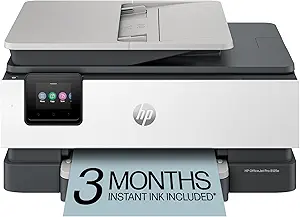 |
| Best Budget The cheapest option that still gets the job done reliably | Canon PIXMA TS3720 | 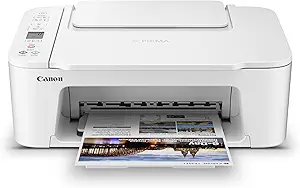 |
| Top Rated A top-rated pick with lots of positive feedback | Brother HL-L2480DW Laser MFP |  |
| Most Popular A crowd favorite that many people choose with confidence | Canon PIXMA TR4720 |  |
| Best Seller A high-volume bestseller chosen again and again | Epson EcoTank ET-2800 |  |
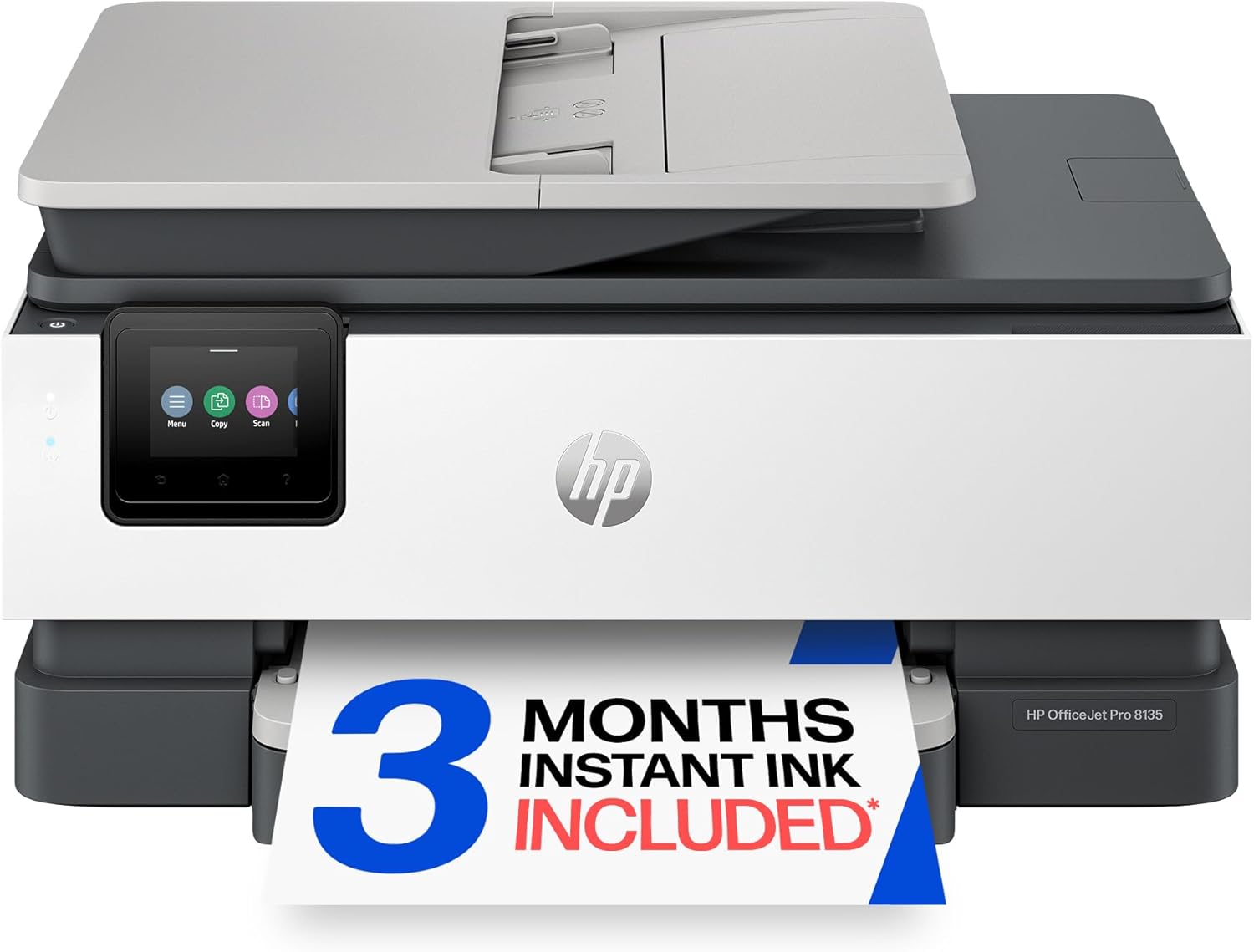
HP OfficeJet Pro 8135
| Printer Type | HP Thermal Inkjet |
|---|---|
| Print Speed (B&W) | 20 pages_per_minute |
| Print Speed (Color) | 10 pages_per_minute |
| Maximum Sheet Capacity | 225 |
| Duplex | Automatic (standard) |
The OfficeJet Pro 8135 is an all-in-one inkjet aimed at home offices that need a mix of speed, color quality, and convenience. It prints up to 20 ppm black and 10 ppm color, supports automatic two-sided printing, and includes a 2.7-inch color touchscreen and a one-sided ADF for multi-page scanning and copying. Connectivity covers Wi‑Fi (including wireless direct), Ethernet, USB and AirPrint, and the HP app lets you print and scan from a phone. Photo-optimized output claims up to 4800 x 1200 dpi for detailed color pages while routine documents print quickly. A 225-sheet input capacity and 60-sheet output make it practical for moderate workloads, and built-in security and AI-driven print formatting help avoid wasted pages. It uses HP 923-series cartridges and is designed to work with original HP chips, which simplifies ink management but limits third-party cartridge options. The printer is solid for mixed document and occasional photo tasks, though users who need heavy duty, very high-volume color production or third-party ink flexibility should consider alternatives.
Best for: Buyers who want a balanced all-in-one for a home or small office that reliably handles mixed document tasks, occasional photos, and mobile printing with simple management.
Less Ideal for: Large offices or users who print very high monthly volumes or require unrestricted use of third-party ink and refill supplies should look at higher-volume or serviceable commercial models.
- Fast black document speeds for a small office environment
- Automatic duplex printing and a one-sided ADF streamline multi-page jobs
- 225-sheet input capacity reduces refill frequency for moderate workloads
- Multiple connectivity options including Wi‑Fi, Ethernet, USB and AirPrint
- 2.7-inch color touchscreen and HP app make setup and mobile printing straightforward
- Requires original HP 923 or 923e cartridges with HP chips, blocking some third-party refill options
- Not intended for very high-volume commercial printing
Verdict: A well-rounded all-in-one that balances speed, convenient mobile connectivity, and automatic duplexing for home and small office users.
Epson EcoTank ET-5800

| Printer Type | Inkjet |
|---|---|
| Other Special Features of the Product | Refillable Ink Tank |
| Color Pages per Minute | 12 pages_per_minute |
| B&W Pages per Minute | 23 pages_per_minute |
| Printer Connectivity Type | Wi-Fi |
The ET-5800 is built for high-volume office work that needs low running costs and solid print quality. It replaces cartridges with supersized refillable ink bottles and includes starter bottles, which greatly reduces cost per page for black and color printing. You get two 250-sheet front trays plus a rear specialty feed, a 4.3" color touchscreen, auto duplexing and an ADF for hands-free scanning and copying, and both Wi-Fi and Ethernet for flexible network placement. Print quality is driven by PrecisionCore and DURABrite pigment inks, producing sharp text and vibrant color up to 8.5" x 14". Power consumption is low for the class and voice-activated printing is supported for quick mobile workflows. Downsides are the unit's large footprint and heavier weight compared with desktop models, and initial setup uses some ink from the included bottles so first-yield numbers are lower than replacement-bottle yields. This is a practical choice when fast mono output, low long-term ink cost, and reliable ADF/duplex workflows matter most.
Best for: Buyers who prioritize fast, reliable document printing and low long-term ink costs for busy home offices or small workgroups and value touchscreen and networked workflows.
Less Ideal for: Users with very tight desk space or who need a compact portable printer should consider smaller models instead.
- Very low running cost thanks to high-capacity refillable ink bottles
- Fast black print speeds and automatic duplex for efficient document workflows
- Large paper capacity with two 250-sheet trays plus rear specialty feed
- Pigment-based DURABrite ink and PrecisionCore deliver crisp text and strong color output
- Multiple connectivity options including Wi-Fi and Ethernet and a 4.3" color touchscreen
- Physically large and heavy compared with typical home printers
- Initial setup consumes some of the included ink so first replacement yields are lower than listed
Verdict: Choose the ET-5800 when you need fast, networked all-in-one performance with very low running costs for heavy document and mixed color printing.
HP OfficeJet Pro 8125e

| Printer Type | HP Thermal Inkjet |
|---|---|
| Print speed (Color) | 10 pages_per_minute |
| Print speed (B&W) | 20 pages_per_minute |
| Maximum sheet capacity | 225 |
| Connectivity | Apple AirPrint; Ethernet; USB; Wi‑Fi; Wireless direct printing |
The HP OfficeJet Pro 8125e is a compact all-in-one inkjet aimed at home offices that need reliable color document printing plus scanning and copying. It prints up to 10 color or 20 black pages per minute, offers automatic two-sided printing and a 1-sided ADF for multi-page scans, and supports Ethernet, USB, AirPrint and dual-band Wi-Fi for easy mobile and networked workflows. AI-enabled formatting helps trim unwanted web content before printing and the HP app provides straightforward print/scan controls from phones. The 225-sheet input and 60-sheet output capacities reduce trips to the tray for medium-volume jobs, while ENERGY STAR and recycled-plastic design help on efficiency and sustainability. Limitations include dependence on HP 923 cartridges and the Instant Ink enrollment nudges that may lead to subscription costs for frequent color printing, and photo-quality output requires specific photo papers for best results. For buyers focused on steady home-office productivity, the 8125e balances speed, connectivity, and practical scan features in a compact footprint.
Best for: Buyers who want a practical, networked all-in-one for a home office that prioritizes dependable everyday printing, scanning, and hands-off duplex workflows.
Less Ideal for: Users who need studio-grade photo printing or who want to avoid branded cartridge ecosystems and subscription ink services entirely.
- Fast everyday speeds: up to 20 ppm black and 10 ppm color for typical office documents
- Automatic duplex printing and 1-sided ADF simplify double-sided jobs and multi-page scanning
- Wide connectivity: Ethernet, USB, AirPrint, wireless direct and dual-band Wi-Fi for reliable network and mobile printing
- 225-sheet input capacity reduces refills for moderate printing volumes
- AI formatting and HP app streamline mobile printing and remove unwanted web content before printing
- Relies on HP 923 cartridge ecosystem which can be costly without Instant Ink subscription
- Photo or high-resolution print quality needs specialty papers to reach maximum advertised dpi
Verdict: A pragmatic all-in-one that delivers dependable speed, duplexing, and strong connectivity for steady home-office document workflows.
Canon PIXMA TS3720

| Printer Type | Inkjet |
|---|---|
| Maximum print Resolution Color | 4800 x 1200 dpi |
| Color Pages per Minute | 4 pages_per_minute |
| B&W Pages per Minute | 7.7 pages_per_minute |
| Printer Connectivity Type | USB, Wi-Fi |
The Canon PIXMA TS3720 is a small all-in-one inkjet that handles printing, copying and flatbed scanning for everyday home use. It uses a two-cartridge hybrid ink system with pigment black for sharper text and dye-based color for photos, and it can print borderless photos up to 5 x 7 inches and documents up to 8.5 x 14 inches. Setup and mobile printing are straightforward via the Canon PRINT app, AirPrint or Mopria, and the rear paper tray holds up to 60 sheets for light household workloads. Print speeds are modest at about 7.7 ppm black and 4 ppm color, so it is best for occasional documents, schoolwork and photo prints rather than heavy office jobs. The printer is single-sided only and lacks automatic duplexing, so users who need two-sided printing will have to flip pages manually. Overall, the TS3720 delivers simple, reliable home printing and easy mobile connectivity at a compact footprint and with minimal ink complexity.
Best for: Buyers who want an affordable, no-frills home all-in-one for occasional document and photo printing with easy mobile connectivity.
Less Ideal for: Users who need heavy monthly page volumes, fast color output, or built-in automatic two-sided printing should consider a different model.
- Compact footprint and simple setup suitable for small spaces
- Two-cartridge hybrid ink offers sharp black text and vivid color photos
- Wireless and mobile printing via Canon PRINT, AirPrint and Mopria
- Supports borderless photo printing and multiple media types
- Single-sided printing only with no automatic duplexing
- Relatively slow color print speed compared with higher-end models
Verdict: A budget-friendly, compact all-in-one that simplifies home printing and mobile workflows for light use.
Brother HL-L2480DW Laser MFP

| Printer Type | Laser |
|---|---|
| Printer Output Type | Monochrome |
| B&W Pages per Minute | 36 pages_per_minute |
| Maximum Sheet Capacity | 250 |
| Printer Connectivity Type | Ethernet, USB, Wi-Fi |
The Brother HL-L2480DW is a compact monochrome laser multifunction printer built for steady everyday use in small offices and home workspaces. It prints up to 36 ppm with a 250-sheet tray, offers automatic duplex printing, and includes flatbed scanning and copying in a small footprint. Connectivity is flexible: dual-band Wi‑Fi, Ethernet, and USB let you print from computers and mobile devices, and the 2.7" touchscreen plus Brother Mobile Connect app simplify common tasks like cloud scans and remote printing. It accepts Brother TN830 series cartridges and supports an optional Refresh subscription for automated toner delivery. Practical benefits include fast black‑and‑white output, reliable networked operation, and low user interaction thanks to the larger paper tray and duplexing. Limitations are that it is monochrome only, so color jobs require a separate device, and advanced scanning features like an automatic document feeder are not included on this model, which can slow batch scanning. The unit is a sensible, no-nonsense choice when dependable text printing and straightforward network management matter more than color or fax capabilities.
Best for: Buyers who prioritize dependable black‑and‑white throughput and simple, networked operation for a small office or home workspace will appreciate this machine.
Less Ideal for: Those who need color printing, high-volume automated scanning, or advanced multifunction features should consider a different model.
- Fast monochrome printing up to 36 pages per minute.
- Automatic duplex printing reduces paper use and handling.
- Multiple connectivity options: dual-band Wi‑Fi, Ethernet, and USB.
- 250-sheet tray lowers frequency of paper refills.
- 2.7" touchscreen and mobile app simplify printing and scanning tasks.
- No color printing capability.
- No automatic document feeder for multi-page scanning.
Verdict: A dependable, compact monochrome all‑in‑one that delivers fast, networked black‑and‑white printing for users who value reliability and straightforward operation.
Canon PIXMA TR4720

| Printer Type | Inkjet |
|---|---|
| Maximum print Resolution Color | 4800 x 1200 dpi |
| B&W Pages per Minute | 8.8 |
| Color Pages per Minute | 4.4 |
| Printer Connectivity Type | USB, Wi-Fi |
The Canon PIXMA TR4720 is a space-conscious all-in-one inkjet meant for light home or small office use. It handles printing, copying, scanning and faxing, with a 100-sheet front tray and an automatic document feeder for multi-page jobs. Print quality is solid for documents and borderless photos up to letter size thanks to Canon's hybrid ink system and up to 4800 x 1200 dpi resolution, while automatic two-sided printing helps reduce paper use. Connectivity is straightforward with Wi‑Fi and USB and mobile printing through the Canon Print app, and the small 2-line LCD keeps basic controls simple. Expect modest speeds — about 8.8 ipm for black and 4.4 ipm for color — so it is not built for heavy daily print volumes. Cartridge compatibility with Canon PG-275 and CL-276 is convenient but ink costs will add up if you print frequently. Setup and cartridge replacement are designed to be user-friendly, though advanced workflow features are limited compared with higher-end office models.
Best for: Buyers who want a simple, space-saving all-in-one for occasional home or small-office printing and value easy mobile setup and basic multifunction capability with predictable performance supported by many user reviews.
Less Ideal for: Users who need high monthly page volumes, fast color throughput, or advanced office features like large paper handling and enterprise-level connectivity should consider more robust models.
- Compact 4-in-1 design fits small desks or home offices
- Automatic duplex printing cuts paper use
- 100-sheet front paper tray plus auto document feeder for small multi-page jobs
- Wireless and USB connectivity with mobile printing via Canon Print app
- High maximum resolution for sharp text and borderless photos
- Relatively slow color print speed compared with higher-end models
- Not intended for high-volume or business-grade printing due to modest sheet capacity and speed
Verdict: A compact, easy-to-use 4-in-1 that’s a safe, low-risk choice for home or small-office users who prioritize space, simple mobile printing, and reliable basic performance.
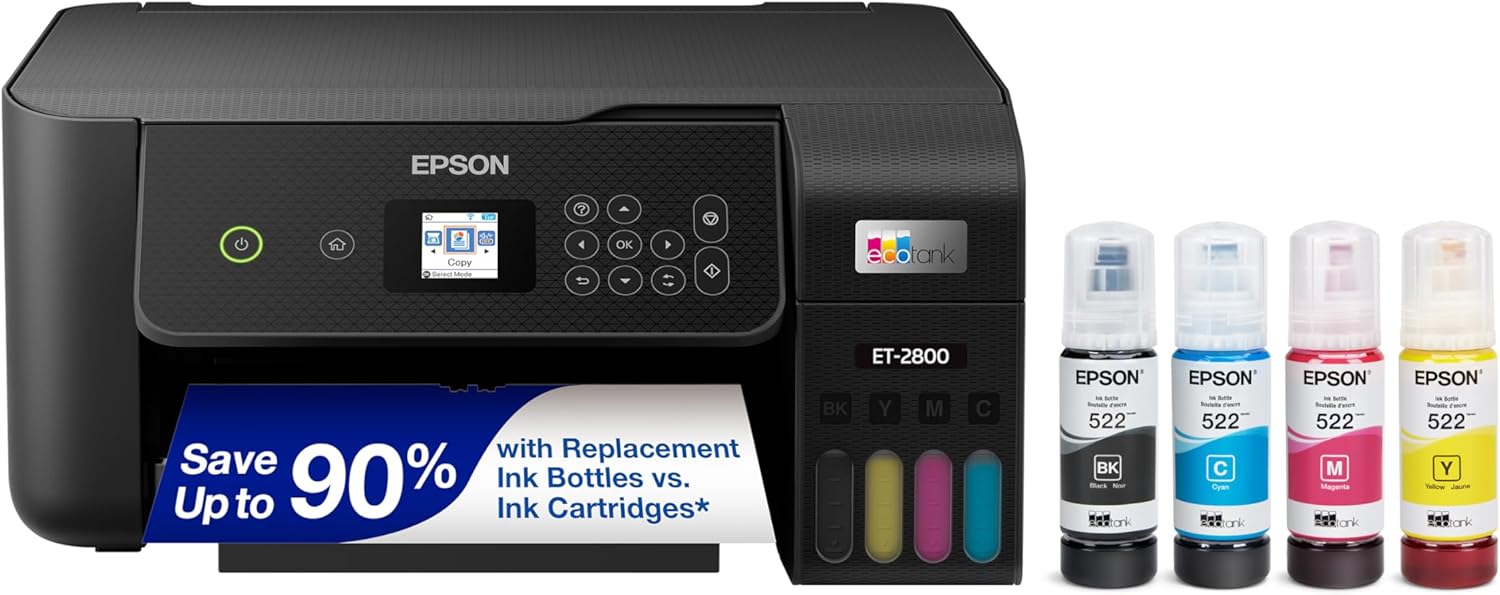
Epson EcoTank ET-2800
| Printer Type | Inkjet |
|---|---|
| Printer Connectivity Type | USB, Wi-Fi |
| Maximum print Resolution Color | 5760 x 1440 dpi |
| B&W Pages per Minute | 10 |
| Duplex | Simplex |
The Epson EcoTank ET-2800 is a home-focused all-in-one inkjet that replaces cartridges with large refillable ink tanks to cut running costs and reduce waste. It prints, copies, and scans, and connects over Wi-Fi or USB with support for mobile and voice-activated printing, making everyday document and photo tasks simple from a phone or computer. The included ink bottles yield thousands of pages so you change ink far less often than with cartridge printers, and PrecisionCore Micro Piezo print technology delivers sharp text and decent color photos at up to 10 ISO pages per minute for black-and-white jobs. The flatbed scanner and color LCD make copying and simple scanning straightforward, though the printer lacks automatic duplexing. For cautious buyers this model offers reliable factory-quality printing and low ongoing ink costs, but buyers who need two-sided automatic printing or faster color throughput should consider other models.
Best for: Home users who want a low-maintenance, cost-conscious all-in-one that prioritizes reliability and long intervals between ink replacements.
Less Ideal for: People who need built-in automatic two-sided printing or very fast color/photo throughput for frequent high-volume jobs.
- Cartridge-free EcoTank system with high-capacity refillable ink tanks for far fewer replacements
- Wireless and mobile printing with voice-activated support for easy home use
- High print resolution (up to 5760 x 1440 dpi) for detailed documents and photos
- Included ink yields thousands of pages, lowering long-term running costs
- No automatic duplex (two-sided) printing
- Color printing speed is modest compared with higher-end all-in-ones
Verdict: Choose the ET-2800 if you want a dependable cartridge-free home all-in-one that slashes ink replacements and ongoing costs.
Choosing the Right All-in-One Printer: Key Factors to Consider
Print Quality (Text and Color)
Print quality determines whether documents and occasional photos look professional. For most home and small-office needs, sharp black text for contracts and clear color for basic marketing materials or photos are essential. Evaluate resolution specs and sample output if possible, but also consider how well a model handles gradients, color consistency, and small-font legibility.
Different printing technologies emphasize different strengths. Laser-based all-in-one printers usually produce crisper black text and tolerate heavy text workloads, while inkjets can offer better color blending and photo detail. Consider what you print most and prioritize models tuned to that workload.
Running Cost and Consumables
Long-term ownership cost is driven by replacement ink or toner and how many pages those consumables yield. A low upfront purchase price can be offset quickly by expensive cartridges, so look at estimated cost per page or cartridge page yields. Also check whether high-capacity cartridges or refillable systems are available, which can lower cost per page.
Consumable availability matters too. If replacement cartridges are hard to find or only sold in small packs, you may face frequent replacements or long delays. Consider total cost including occasional color printing and whether third-party consumables are compatible without voiding basic support.
Connectivity and Mobile Printing
Modern all-in-one printers should offer flexible connectivity for how you work. Look for Wi-Fi with robust setup options, wired Ethernet if you need a stable shared connection, and USB for direct prints. Mobile printing support from phones and tablets is increasingly important; check for standard protocols like AirPrint or Mopria and the availability of a reliable app for scanning and remote management.
Good connectivity reduces friction when sharing a device among several users and makes scanning to cloud services or email straightforward. Also consider how easy firmware updates and driver installation are for your operating systems.
Speed and Duty Cycle
Speed matters when you regularly print multi-page documents. Look at pages-per-minute figures for black and color, but treat them as comparative rather than absolute guarantees. Duty cycle indicates the maximum monthly page volume a machine can handle; choose a model with a comfortably higher duty cycle than your expected monthly use to avoid premature wear.
For most home offices, moderate speeds and a modest duty cycle are fine. If your work involves frequent bulk printing, prioritize a model with higher rated monthly capacity and faster sustained output.
Ease of Setup and Ongoing Maintenance
A printer that is straightforward to install, connect, and maintain reduces frustration and downtime. Check for guided setup processes, clear control panels, and intuitive mobile or desktop apps for scanning and status monitoring. Paper path design and front-loading trays simplify routine tasks like refilling paper and clearing jams.
Maintenance also includes how easy it is to replace cartridges, align printheads, or run cleaning cycles. Consider whether the device provides helpful status alerts for low supplies or maintenance needs.
Scanner and Copy Functionality
Since these devices are all-in-one, scanning and copying performance is integral to value. Important aspects include scan resolution, automatic document feeder capacity, duplex scanning ability, and software features for OCR and save-to-cloud workflows. A good scanner should handle occasional multi-page document scanning smoothly and produce accurate, usable digital files.
If you frequently archive receipts, contracts, or multi-page forms, prioritize models with higher ADF capacity and reliable duplex scanning to cut down on manual page handling.
Home Office Vs Occasional Photo Printing
Decide whether your primary need is crisp document output or higher-quality photo printing. Many all-in-one printers are optimized for one or the other. Models tuned for office work deliver better black text and faster multi-page prints, while photo-oriented units use different ink formulations and printheads to reproduce color and tonal detail.
If you print photos rarely, choose a device that excels at document tasks and offers acceptable color. For regular photo work, look for features like wider color gamuts, dedicated photo papers, and better color management options.
- Office-focused: prioritize text clarity and speed
- Photo-focused: prioritize color depth and photo media handling
- Mixed use: balance running cost with occasional photo quality
Paper Handling and Media Flexibility
Paper capacity and tray design affect convenience. A larger input tray reduces refill frequency; a dedicated photo tray or rear feed helps with thick or specialty papers. Also check whether the unit supports multiple paper sizes and weights without constant reconfiguration.
If you use labels, envelopes, or thicker photo stocks, confirm the printer supports those media and offers a reliable manual feed path to prevent jams and misfeeds.
- Look for adjustable trays and manual feed options
- Check maximum paper weight and supported sizes
- Consider a unit with a separate tray for specialty media
Software Features That Save Time
A capable mobile and desktop app makes scanning, copying, and monitoring supplies much faster. Useful features include automatic file naming, OCR for editable text, scheduled scans, and direct save to common cloud platforms. Good software reduces the time spent transferring scanned documents and organizing files.
Also consider firmware update workflows and whether the app provides clear troubleshooting tips. Smooth software integration is particularly helpful when multiple devices or users access the same printer.
- OCR and scan-to-PDF features for document workflows
- Cloud integration for easy backup and sharing
- Responsive app for status alerts and firmware updates
Space and Placement Considerations
All-in-one printers vary widely in footprint. Measure the intended location and account for opened trays and ADF height when the lid is raised. Compact models are convenient for tight desks but may sacrifice input capacity or ADF features.
Also think about ventilation and cable routing. If you plan to keep the unit under a shelf or in a cabinet, confirm that recommended clearance and airflow needs are met to avoid overheating or restricted access.
- Measure footprint including open trays and ADF
- Account for power and data cable access
- Check manufacturer clearance recommendations for enclosed spaces
Security and Network Settings
If your printer will be on a home or small-business network, consider built-in security features. Look for support for secure wireless protocols, guest network printing, and the ability to require authentication for sensitive scanning or printing tasks. Some devices include encryption for network transfers and options to restrict access to certain functions.
Regular firmware updates help address vulnerabilities, so factor in how frequently the manufacturer releases updates and how straightforward they are to apply.
- Use WPA2 or WPA3 Wi-Fi and secure printer admin interfaces
- Enable access controls if multiple users share the device
- Check update mechanism for ease and frequency
How We Chose the Best All-in-One Printer
We focused on real-world usability and measurable specifications that affect daily ownership. Primary evaluation criteria included print quality for both text and color, cost to operate over time, connectivity and driver support, speed and duty cycle relative to home-office needs, and ease of setup and maintenance. We prioritized devices that deliver consistent output with minimal maintenance and clear supply options. Models with unclear consumable availability, poor connectivity options, or no straightforward firmware or driver support were excluded. We also filtered out devices intended solely for heavy commercial use since their design and cost profiles do not match typical home or small-office buyers. The resulting shortlist reflects devices that balance long-term operating cost, dependable performance, and user-friendly features most relevant to everyday printing, scanning, copying, and occasional photo tasks.
Our full evaluation process is outlined in our review methodology.
FAQ
How often should I replace ink or toner cartridges?
Replacement frequency depends on print volume and the cartridge yield. Typical home users may replace cartridges every few months, while heavy users replace them more often. Look at the pages-per-cartridge rating to estimate your schedule and plan for spare cartridges if you rely on consistent printing.
Can I scan double-sided documents automatically?
Many all-in-one printers include an automatic document feeder with duplex scanning. Whether yours does depends on the model. Duplex ADFs save time on multi-page documents, so prioritize that feature if you frequently scan two-sided materials.
Is wireless printing reliable for a shared home-office?
Wireless printing can be reliable if your Wi-Fi signal is strong and the printer supports robust protocols and stable drivers. For critical shared environments, a wired Ethernet connection often provides more consistent performance, but a well-configured Wi-Fi printer is sufficient for most household and small-office use.
How do I improve photo print quality from an all-in-one printer?
Use high-quality photo paper, select the appropriate media and print settings, and ensure the printer has sufficient color cartridges or a wider color gamut. Regular printhead maintenance and using manufacturer-recommended profiles or ICC color settings also help achieve better photo results.
What should I do if my printer frequently jams?
First, confirm you are using compatible paper sizes and weights and that trays are loaded correctly. Check for small debris or misaligned rollers and follow the manufacturer's guidance for clearing jams. Regularly cleaning the paper path and using the recommended paper type reduces jam frequency.
Final Verdict
Prioritize the features that match how you work: choose a model optimized for text and speed if you print many documents, or favor color handling and media flexibility if you print photos. Balance upfront features with expected running cost and consumable availability. Consider connectivity, scanner capabilities, and ease of maintenance when finalizing your choice. With those tradeoffs in mind, you can select an all-in-one printer that reliably meets your home or small-office needs.