
Note: This article contains affiliate links. If you click on these links and make a purchase, we may earn a small commission at no extra cost to you. This helps support our research and content. Read our full affiliate disclosure here.
Finding an easy-to-use thermostat that still helps you control energy costs matters for everyday comfort and monthly bills. A budget programmable thermostat gives you scheduled temperature control without the complexity or expense of advanced smart systems. In this guide we shortlisted the top-performing affordable programmable thermostats that deliver reliable scheduling, clear displays, and basic energy-saving features. You will see options chosen for simple setup, straightforward programming, and dependable performance across typical home heating and cooling systems. Read on to find a model that fits your installation and control preferences, plus the evaluation criteria we used to pick the best budget choices.
Top Picks at a Glance
| Best Overall The best all-around choice for most situations | White-Rodgers 70 Series 1F78-151 |  |
| Best Quality Built to a higher standard if you want something more solid | Honeywell Home T5 Touchscreen |  |
| Best Value The sweet spot between price and what you get | Suuwer S705 Programmable Thermostat |  |
| Best Budget The cheapest option that still gets the job done reliably | Riseem STN605 Programmable Thermostat |  |
| Top Rated A top-rated pick with lots of positive feedback | Honeywell Home X2P Programmable Thermostat |  |
| Most Popular A crowd favorite that many people choose with confidence | Amazon Smart Thermostat |  |
White-Rodgers 70 Series 1F78-151

| Controller Type | Push Button |
|---|---|
| Temperature Control Type | Cooling/Heating |
| Display Type | LCD |
| Power Source | Battery Powered |
| Number of Batteries | 3 AA batteries required. (included) |
The White-Rodgers 70 Series 1F78-151 is a straightforward 5-2 day programmable thermostat designed for single-stage heating and cooling systems and heat pumps. It provides a clear backlit LCD, simple button controls, and a clock display that make daily scheduling easy for homeowners who want basic automation without smart features. Battery power (two or three AA/AAA notes differ across listings) lets you install it without a C-wire, and the unit advertises temperature control to within about one degree F for steady comfort. Notable limits are its lack of Wi-Fi app control and no support for electric baseboard heat or some nonstandard systems, so it is not suitable where remote access or multi-stage HVAC control is needed. In practice it is useful for renters or budget-conscious buyers who want reliable programmable setback capability and an uncomplicated interface; installation is typical for a wall-mounted thermostat and the included manual and batteries simplify first-time setup.
Best for: Buyers who want a low-cost, no-frills programmable thermostat that delivers dependable schedule-based temperature control without smart features or complex setup.
Less Ideal for: Users who need remote app control, multi-stage HVAC support, or compatibility with electric baseboard heating should look at more advanced or specialized models.
- Simple 5-2 day programming for separate weekday and weekend schedules
- Backlit LCD and easy button controls make setup and daily use straightforward
- Battery-powered installation avoids the need for a common wire on most systems
- Compatible with single-stage heating, cooling, and many heat pump systems
- No Wi-Fi or smartphone control for remote adjustments
- Not compatible with electric baseboard heat and some specialized systems
Verdict: A budget-friendly programmable thermostat that delivers reliable, easy-to-use schedule control for standard single-stage HVAC systems.
Honeywell Home T5 Touchscreen

| Controller Type | Touch Screen |
|---|---|
| Additional Features | Smart Response Technology |
| Temperature Control Type | Heating and Cooling |
| Power Source | Battery Powered |
| Number of Batteries | 2 AA batteries required. |
The Honeywell Home T5 Touchscreen is a straightforward programmable thermostat aimed at keeping indoor temperatures on schedule without smart-home complexity. It uses a large backlit touchscreen for setup and daily operation and supports 7-day customizable schedules so you can program weekdays and weekends independently or set a single weekly program. Smart Response Technology learns heating and cooling cycle times to reach target temperatures when you want them, and the unit can run on two AA batteries or be hard-wired to 24V systems so installation fits most setups. The display also shows indoor humidity and provides reminders for filter changes and low batteries, which helps with routine maintenance. It does not include Wi-Fi or remote app control, so adjustments must be made at the unit, and advanced remote scheduling or voice integration are not available. For buyers focused on reliable temperature control and simple programming at a budget-friendly level, the T5 delivers core performance without unnecessary extras.
Best for: Buyers who prioritize dependable temperature control and easy on-device programming over connected features and want a budget-friendly, performance-focused programmable thermostat.
Less Ideal for: Users who want remote access, smartphone scheduling, or integration with smart home ecosystems should consider a Wi-Fi enabled thermostat instead.
- Large backlit touchscreen makes programming and daily adjustments easy to read and use.
- Smart Response Technology learns cycle times to help reach set temperatures reliably.
- Supports both battery and 24V hard-wired power for flexible installation options.
- Shows indoor humidity and gives filter change and low battery reminders.
- No Wi-Fi or remote/app control for adjusting settings away from the thermostat.
- Limited advanced features compared with connected smart thermostats.
Verdict: A no-frills, performance-focused programmable thermostat that delivers reliable scheduling and temperature control without smart-home bells and whistles.
Suuwer S705 Programmable Thermostat

| Power Source | 24VAC or 2 AAA batteries |
|---|---|
| Display Size | 4.5 inches |
| Program Type | 5-1-1 day programmable, 4 periods/day |
| Temperature Range | 44°F to 90°F control range |
The Suuwer S705 is a budget-friendly 5-1-1 day programmable thermostat built for conventional single-stage heating and cooling systems. It provides four periods per day for separate weekday and weekend schedules, a large blue backlit LCD for easy reading, and simple push-button controls that make programming straightforward. The unit runs on 24VAC or two AAA batteries so it can often be installed without a common wire, and it includes selectable features such as a 5-minute compressor delay, separate heat/cool swing adjustment, ambient temperature correction, and reminders for low battery and air filter changes. Practical benefits include clearer display visibility for older users and the ability to fine-tune cycle rates to avoid short-cycling. Limitations are compatibility—this model only supports single-stage systems and will not work with multistage, most heat pump, line-voltage, mini-split, or PTAC setups—so buyers need to confirm their system before purchase. The controls and feature set are utilitarian rather than high-end, but sufficient for straightforward, energy-aware scheduling on compatible systems.
Best for: Buyers who want a straightforward, low-cost programmable thermostat to set weekday/weekend schedules and improve daily comfort and efficiency on a conventional single-stage HVAC system.
Less Ideal for: People with multistage HVAC systems, mini-split heat pumps, line-voltage baseboard heat, PTACs, or other advanced system types should look for a model designed for those systems.
- 5-1-1 day programming with four periods per day for weekday/weekend scheduling
- Large backlit 4.5 sq inch LCD that is easy to read
- Dual power options (24VAC or 2 AAA batteries) so no c-wire is required in many installs
- Selectable 5-minute compressor delay and adjustable heat/cool swing to protect equipment and reduce short-cycling
- Only compatible with single-stage conventional systems and incompatible with multistage, many heat pump, line-voltage, mini-split, and PTAC systems
Verdict: A no-frills, budget programmable thermostat that gives clear display and reliable weekday/weekend scheduling for single-stage systems.
Riseem STN605 Programmable Thermostat

| Controller Type | Push Button |
|---|---|
| Temperature Control Type | Conventional Single Stage Systems |
| Display Type | LCD |
| Power Source | 24 volts_of_alternating_current or 2 AAA batteries required. |
The Riseem STN605 is a no-frills programmable thermostat aimed at basic home heating and cooling control. It provides 5-1-1 day programming, a backlit LCD, and push-button controls that make setting weekday/weekend schedules straightforward for energy savings. The unit supports common forced-air systems and many heat-only or cool-only configurations and can run on 24VAC or two AAA batteries, which simplifies installation where a C-wire is not present. Practical touches include compressor delay protection, adjustable temperature swing for stability, and an easy front-load battery compartment. Installation is designed to be quick using the universal sub-base and large terminal blocks, and the package includes screws, anchors, and a cable label. Limitations include its focus on single-stage systems only, no Wi-Fi or smart-home integrations, and a basic interface that lacks touchscreen or advanced scheduling features found on higher-end models. For buyers who want a straightforward programmable thermostat on a budget, the STN605 covers the essentials without extras.
Best for: Shoppers looking for an affordable, programmable replacement thermostat that saves energy without smart features or complicated installation.
Less Ideal for: Users who want Wi-Fi control, voice assistant integration, multi-stage or heat-pump support, or advanced learning schedules should look at higher-end smart thermostats.
- 5-1-1 day programmable schedule for weekday/weekend flexibility
- Works on 24VAC or with 2 AAA batteries so most installs do not need a common wire
- Large terminal blocks and universal sub-base make installation straightforward
- Backlit LCD and front-load battery compartment improve everyday usability
- No Wi-Fi or smart-home connectivity for remote control or scheduling
- Limited to conventional single-stage and select system types, not compatible with many heat pump or line-voltage systems
Verdict: A straightforward, wallet-friendly programmable thermostat that provides reliable basic scheduling and easy installation for conventional single-stage systems.
Honeywell Home X2P Programmable Thermostat

| Temperature Control Type | Programmable |
|---|---|
| Specific Uses For Product | automate and manage temperature |
| Display Type | LCD |
| Power Source | Battery Powered |
| Number of Batteries | 2 AA batteries required. |
The Honeywell Home X2P is a straightforward programmable thermostat built for single-stage heating and cooling systems. It offers 5-2 day scheduling or a non-programmable mode, a large backlit LCD for easy reading, and simple touchpad controls that make daily adjustments quick. Installation is typical for a battery-powered wall thermostat and uses 2 AA batteries, with the Honeywell UWP wall plate available to simplify mounting and future upgrades. Useful features include change-filter reminders, selectable display settings, and an extended low-heat setpoint, which help with routine maintenance and comfort control. Limitations worth noting are its single-stage focus and lack of electric baseboard compatibility, so it will not work on all heating systems, and it lacks the connectivity and remote controls found in smart thermostats. For buyers who prioritize a reliable, no-frills programmable control and clear local operation, the X2P covers the basics well without extra complexity.
Best for: Buyers who want a dependable, low-cost programmable thermostat that provides clear local controls and simple scheduling without smart features.
Less Ideal for: People who need Wi‑Fi remote control, smart-home integration, multi-stage HVAC support, or compatibility with electric baseboard heating should look elsewhere.
- 5-2 day scheduling with an option for non-programmable operation for flexible programming.
- Large backlit LCD and clear font for easy daily use and adjustments.
- Change filter reminder and selectable display settings to help with routine maintenance.
- Battery-powered design that installs without requiring a C-wire and works with common single-stage systems.
- Not compatible with electric baseboard heat (120-240V) so system compatibility is limited.
- No Wi-Fi or app control, so remote scheduling and smart-home integration are not available.
Verdict: A reliable, budget-focused programmable thermostat that gives straightforward local scheduling and easy daily use for single-stage HVAC systems.
Amazon Smart Thermostat
| Manufacturer | Amazon |
|---|---|
| Works with | Alexa and Ring |
| C‑wire requirement | Required |
| Made with | Honeywell Home Thermostat Technology |
| Remote control | Alexa app |
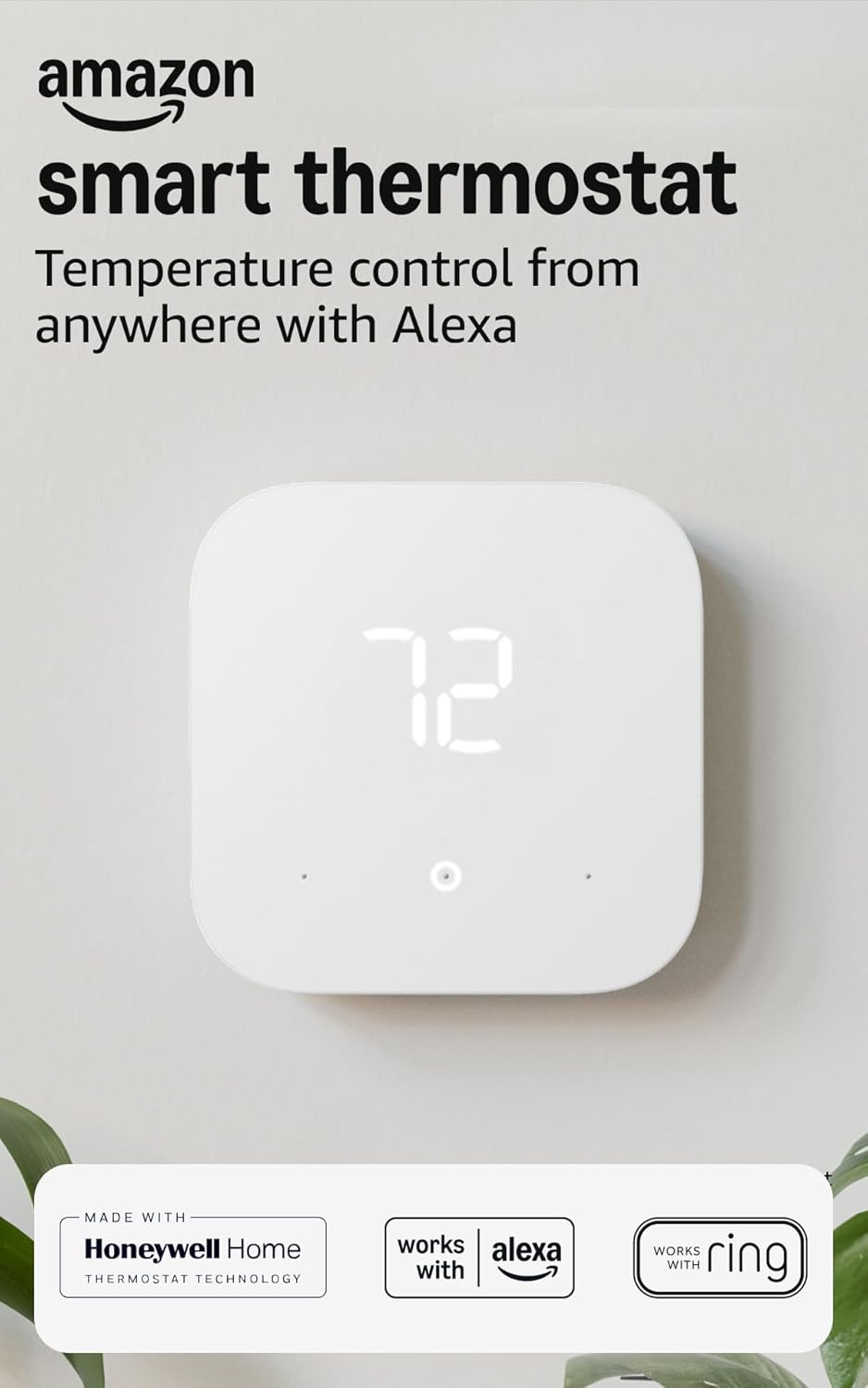
The Amazon Smart Thermostat is a straightforward Wi‑Fi thermostat built for homeowners who want Alexa integration and simple scheduling without extra frills. It connects to the Alexa app for remote temperature control, lets you create home, away and sleep schedules, and can adjust settings automatically when paired with compatible Alexa devices for presence-based changes. The unit uses Honeywell Home thermostat technology under the hood and supports DIY installation guided by the app; it requires a C‑wire. Practical benefits include energy-saving schedules and access to Alexa+ features for routines and multi-device control, plus eligibility details for local utility rebates provided after purchase. Limitations are minimal but important: this is a budget-focused, no‑screen design with basic controls and no advanced HVAC diagnostics, so it will not replace a full-featured smart thermostat for complex systems. For buyers prioritizing simple Alexa-first control and lower cost, it covers the essentials effectively.
Best for: Buyers who want an inexpensive, Alexa‑centric programmable thermostat that makes scheduling and remote control easy and who value straightforward setup and proven temperature control.
Less Ideal for: Users who need advanced HVAC features, extensive diagnostic information, or a touchscreen interface for in-depth system management should consider higher-end models.
- Alexa app and voice control for remote adjustments and routines
- Programmable schedules for home, away and sleep modes to reduce energy use
- Simple DIY installation with step-by-step app guidance
- Built with Honeywell Home thermostat technology for reliable temperature control
- Requires a C‑wire, so older homes may need a common wire or adapter
- Basic feature set with no advanced HVAC diagnostics or large touchscreen
Verdict: A budget-friendly, Alexa-first programmable thermostat that delivers simple scheduling and remote control to cut energy use.
Choosing the Right Budget Programmable Thermostat: Key Factors to Consider
Compatibility and Wiring
Confirming system compatibility matters because not all programmable thermostats support every HVAC configuration. Check whether the thermostat requires a common wire, what terminals are present for heat, cool, fan, and whether it supports single-stage or multi-stage systems. Wrong expectations about wiring can lead to installation headaches or a nonfunctional thermostat.
If you are replacing an existing thermostat, compare terminal labels and wiring diagrams before you buy. Some budget programmable thermostats are designed for straightforward single-stage heat/cool systems and may not support heat pump or multi-stage setups. Knowing your system reduces the risk of returns and ensures the unit will provide reliable control once installed.
Ease of Programming
Programming simplicity is a primary reason to choose a budget programmable thermostat. Look for models with intuitive menu flow, clearly labeled buttons, and timed program slots that match your daily routine. Complex nested menus or cryptic symbols can make adjustments frustrating, undermining the expected energy savings.
Consider how many periods per day the thermostat allows and whether weekday/weekend scheduling is supported. Features like temporary overrides, an easy hold function, and clear confirmation of setpoints make day-to-day use simple and reduce accidental schedule disruptions.
Temperature Accuracy and Sensor Quality
Accurate temperature measurement affects both comfort and efficiency. A thermostat with a poorly calibrated sensor or inconsistent readings can cause frequent cycling, temperature swings, or incorrect setbacks that waste energy. Look for units that report consistent setpoint hold and have minimal variance from room temperature.
Consider the sensor placement as well; budget thermostats often use a single internal sensor, so installation location matters. Avoid installing a thermostat in direct sunlight, near drafts, or above heat sources to preserve accuracy regardless of the model chosen.
User Interface and Display Readability
A clear, readable display and straightforward controls make daily adjustments and schedule checks faster. Many buyers prefer larger digits, backlighting for low-light visibility, and physical buttons over capacitive or tiny controls. Budget models vary widely in screen contrast and layout, which affects how easily you can confirm the current mode and setpoint at a glance.
Menus should show current time, active program period, and whether the system is calling for heat or cool. If you or other household members will interact with the thermostat frequently, prioritize a model with simple toggles or labeled buttons so accidental misconfiguration is less likely.
Energy-Saving Features and Scheduling Flexibility
The primary financial benefit of a programmable thermostat is reduced energy use from scheduled setbacks. Evaluate how many daily program periods are supported, whether there are separate weekday and weekend schedules, and if there are built-in vacation or temporary hold modes. These capabilities directly influence how effectively you can reduce runtime during unoccupied hours.
Some budget thermostats include adaptive features like automatic changeover or a minimum off time to protect equipment. Even without learning algorithms, clear setback options and straightforward programming will deliver measurable savings when used correctly.
Durability and Long-Term Reliability
Durability matters because a thermostat is a long-term household control point. Look for units with robust physical buttons, secure terminal screws, and a stable mounting plate. Budget models that skimp on build quality may suffer from loose wiring connections or button failure over time.
Consider warranty terms and the availability of straightforward user documentation. Well-documented units are easier to troubleshoot, which reduces the chance of unnecessary replacements and improves the overall ownership experience.
Wiring Checklist Before You Buy
Before selecting a budget programmable thermostat, visually inspect the wiring at your existing control. Note the terminals in use and take a photo if possible. Common labels include R, Rc, Rh, W, Y, G, and C. If a common wire is present, confirm whether your target thermostat requires it for power.
If you find fewer wires than your chosen thermostat expects, look for models designed for minimal wiring or those that offer battery operation. When in doubt, consult a technician for confirmation, but most single-stage heat/cool systems can be matched to an affordable programmable thermostat with basic terminal compatibility.
- Take a clear photo of your current thermostat wiring and terminal labels
- Count wires and note whether a common wire (C) is present
- Match terminal names on the new thermostat to your existing labels
Programming Tips for Maximum Savings
To get the most from a programmable thermostat, set realistic setback periods that fit your household schedule. Aim for lower heat or higher cooling temperatures during long absences and return-to-comfort periods shortly before occupancy.
Avoid tiny setbacks that do not allow the HVAC system to run more efficiently. Larger, consistent setbacks for predictable periods usually produce clearer energy savings. Use temporary holds only when needed to preserve the main schedule.
- Set distinct wake, leave, return, and sleep periods for weekdays
- Use a separate weekend schedule if your routine differs
- Prefer longer setback durations over frequent small changes
Installation Best Practices
Mount the thermostat on an interior wall at eye level away from direct sunlight, drafts, or heat sources. A stable ambient reading requires placement on a wall that reflects the room's average temperature.
When connecting wires, shut off power at the breaker for safety and ensure terminal screws are snug but not over-torqued. Label wires during removal and consult the wiring diagram provided with the thermostat. After power is restored, verify the system responds correctly to heat and cool calls and that the display shows active mode.
- Turn off HVAC power before touching wiring
- Verify each wire is inserted fully and secured
- Test all modes after installation to confirm correct operation
When to Choose Simple Over Smart
A budget programmable thermostat is the right choice when you want straightforward scheduling without relying on Wi-Fi, smartphones, or cloud services. Simple units avoid account setup, app updates, and potential connectivity issues while still delivering scheduled temperature control.
Choose a simple programmable model if you prefer physical controls, predictable schedules, and minimal maintenance. For households that do not need remote access or advanced learning features, a basic programmable thermostat often provides better reliability and lower ongoing fuss.
- Prefer simple models for stable, offline scheduling
- Avoid smart features if you want to minimize account management
- Select physical buttons and clear displays for ease of daily use
Troubleshooting Common Issues
If the thermostat shows the wrong temperature after installation, check the mounting location first. A thermostat mounted near a heat source or draft will report incorrect room temperature regardless of sensor quality.
If the HVAC system does not respond to calls, verify wiring connections and that the power was restored. Also confirm the selected mode matches your system type. For intermittent issues, inspect terminal screws and battery health if the unit uses batteries.
- Recheck wiring and terminal seating for loose connections
- Move the thermostat location if readings consistently differ from actual room temperature
- Replace batteries and reinitialize if the unit behaves erratically
How We Chose the Best Budget Programmable Thermostat
We focused on thermostats that deliver dependable scheduled temperature control at an affordable price point. Important evaluation criteria included accuracy and temperature control stability, because precise setback schedules directly affect comfort and energy savings. Ease of programming and user interface were weighed heavily since many buyers choose a budget unit to avoid complex apps and frequent adjustments. Compatibility and wiring requirements were examined to ensure each thermostat works with the common home HVAC setups it is intended for. Build quality and display readability were considered for long-term daily use and visibility. We also evaluated basic energy features such as hold and setback modes and whether the unit supports multiple programmable periods per day. We excluded units that require complex smart-home ecosystems or ongoing subscription services, as well as models focused primarily on touchscreen or app-only control. Products that lacked clear wiring instructions or had poor display contrast were removed. The shortlist highlights thermostats that balance straightforward programming, accurate control, and installation clarity for typical residential systems.
Our full evaluation process is outlined in our review methodology.
FAQ
Do budget programmable thermostats save energy compared with manual thermostats?
Often they do because scheduled setbacks reduce runtime during unoccupied hours. Savings depend on how consistently you use the programmed schedule and the size of the setbacks.
Will a budget programmable thermostat work with my existing heating and cooling system?
It depends on your system type and wiring. Most budget units support single-stage heat and cool systems, but you should verify terminal compatibility and whether a common wire is required.
Can I install a programmable thermostat myself?
Usually yes for homeowners comfortable with basic electrical safety. Turn off power before wiring, document existing connections, and follow the included wiring diagram. Call a technician if your system is multi-stage or uses uncommon terminals.
How often do I need to reprogram a programmable thermostat?
Not often if your schedule is stable. You may adjust seasonal setpoints or temporary holds as needed. Many users program once and only make occasional tweaks for holidays or schedule changes.
Are batteries required for budget programmable thermostats?
Some models use batteries while others use power from a common wire. Battery-powered units need occasional replacement, which can affect reliability if neglected.
Final Verdict
For buyers focused on straightforward scheduling and reliable temperature control without the complexity of smart systems, prioritize compatibility, programming simplicity, and sensor accuracy. Expect tradeoffs between features and price: the most affordable units will have limited scheduling flexibility and basic displays, while slightly higher-budget models improve programming and readability. Choose a thermostat that matches your HVAC wiring and offers the programming options you will actually use. When installation and daily operation are easy, a budget programmable thermostat can deliver consistent comfort and meaningful energy savings over time.