
Note: This article contains affiliate links. If you click on these links and make a purchase, we may earn a small commission at no extra cost to you. This helps support our research and content. Read our full affiliate disclosure here.
If you need dependable filtration for your entire plumbing system without a major upfront cost, a budget whole-house water filter can be the practical solution. These systems protect faucets, showers, and appliances from sediment, chlorine, and common taste-and-odor issues while preserving household water pressure. Choosing the right model matters because undersized or poorly filtered systems can reduce flow, require frequent cartridge swaps, or fail to remove key contaminants. This guide highlights six shortlisted, budget-oriented whole-house water filters. We focus on real-world decision factors like flow rate capacity, contaminant reduction capability, ease of maintenance, and long-term operating cost. Read on to find a model that balances performance and affordability for your home, plus practical buying considerations and maintenance tips.
Top Picks at a Glance
| Best Overall The best all-around choice for most situations | Culligan WH-HD200-C Whole House Filter |  |
| Best Quality Built to a higher standard if you want something more solid | iSpring WGB32BM 3-Stage Whole House Filter |  |
| Best Value The sweet spot between price and what you get | ICEPURE CTO10 10" x 2.5" Carbon |  |
| Best Budget The cheapest option that still gets the job done reliably | Culligan P5 Whole House Filter |  |
| Top Rated A top-rated pick with lots of positive feedback | Membrane Solutions String Wound Filter 10" |  |
| Most Popular A crowd favorite that many people choose with confidence | PUREPLUS CTO10 Carbon Filter |  |
Culligan WH-HD200-C Whole House Filter

| Maximum Flow Rate | 10 gpm |
|---|---|
| Supported Water TDS Level Maximum (PPM) | 600 |
| Capacity | 16000 gallons |
| Material Type | Stainless Steel |
The Culligan WH-HD200-C is a durable whole-house filter housing intended to pair with a compatible cartridge (sold separately) to provide point-of-entry sediment and particulate reduction for a residence. Install it inline on a 1-inch water main and use the appropriate cartridge to cut down on rust, sand, silt, scale and chlorine-related taste and odor before water reaches fixtures and appliances. The unit includes a stainless steel cap, built-in shut-off and bypass valves, pressure relief and a mounting bracket, which makes installation and routine cartridge changes easier and neater. The clear sump lets you visually monitor filter loading, and the housing is WQA-tested for durability. Because the filter element is not included and performance depends on the cartridge chosen, buyers should plan for ongoing cartridge purchases and match cartridge type to their specific contaminants. Flow capacity is suitable for typical household demand but check compatibility with your plumbing size and water conditions before buying.
Best for: Buyers seeking an affordable, durable point-of-entry filter housing who want an easy-to-install solution to protect plumbing and appliances while choosing cartridges that match local water issues.
Less Ideal for: Homes that need a turnkey, multi-stage purification system or specific contaminant reduction (for example, lead or microbes) without selecting and installing specialized cartridges.
- Universal 1-inch inline housing fits standard whole-home setups
- Stainless steel cap and WQA-tested design for durability
- Built-in shut-off, bypass and pressure relief simplify maintenance
- Clear sump allows visual inspection of cartridge condition
- Mounting bracket and wrench included for easier installation
- Filter cartridge is sold separately so initial purchase is incomplete
- Performance varies with cartridge choice; not a complete filtration solution by itself
Verdict: A robust, budget-friendly whole-house filter housing that provides visible, easy-to-service sediment protection when paired with the right replaceable cartridge.
iSpring WGB32BM 3-Stage Whole House Filter
| Maximum Flow Rate | 15 gpm |
|---|---|
| Operating Pressure Range | 25 – 80 psi |
| Operating Temperature | 40 – 100 °F |
| Inlet / Outlet | 1 inch NPT |
| Capacity | 100000 gallons |
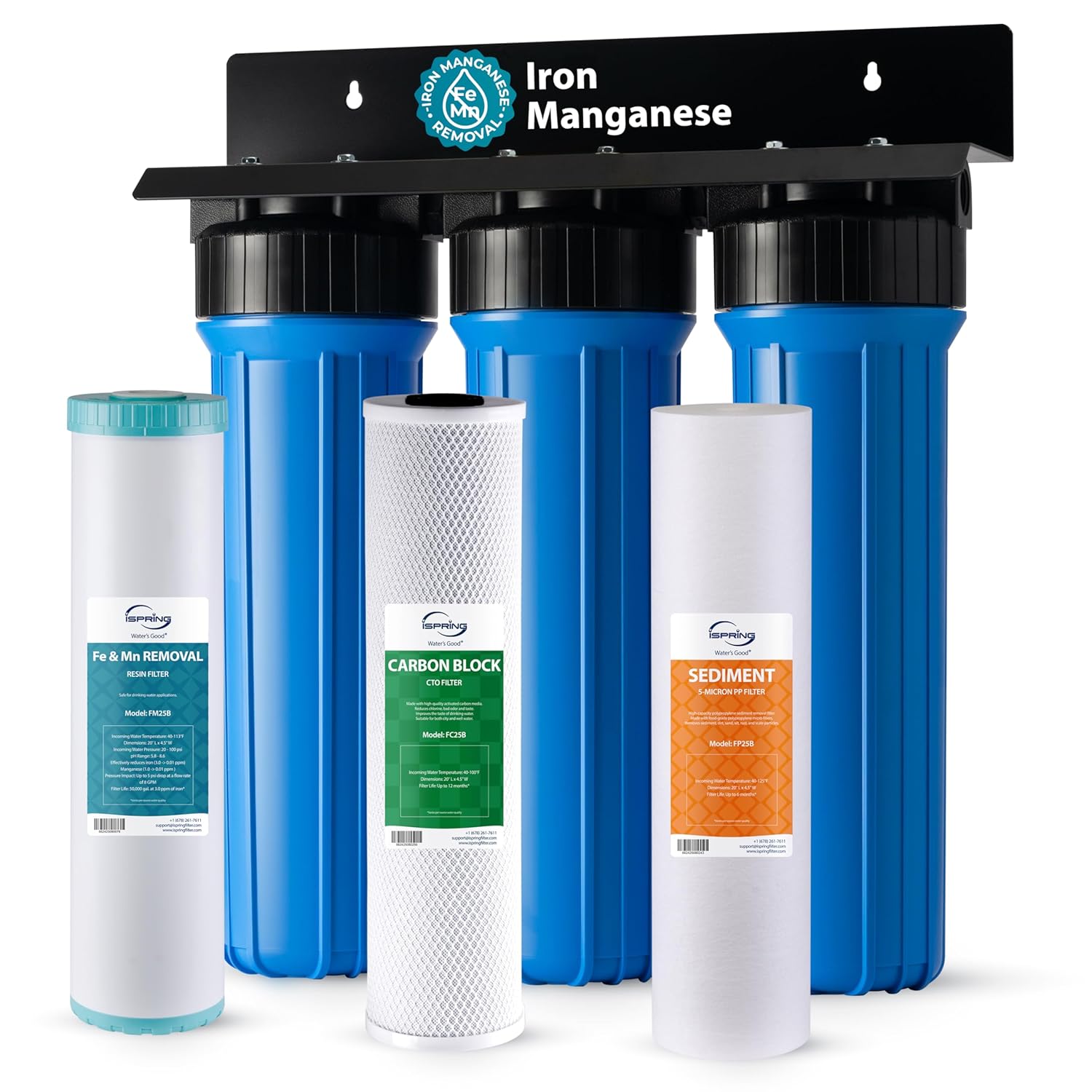
The iSpring WGB32BM is a tankless, 3-stage whole-house filter built for high-capacity, performance-focused homeowners. It uses a 20-inch big blue sediment cartridge for coarse particulate removal, a coconut-shell carbon block to cut chlorine, taste and odor, and a catalytic iron/manganese stage that reduces iron from up to 3.0 ppm and manganese up to 1.0 ppm. The system handles up to 15 gpm with a recommended replacement cycle around 12 months or 100,000 gallons on the main carbon/sediment stages, so it can supply a typical family without noticeable pressure loss. Installation is permanent at the main supply line with 1-inch NPT plumbing and DIY-friendly documentation and videos, though indoor sheltered mounting is recommended. Practical strengths are high flow capacity, long-lived cartridges, and targeted iron removal; limitations are that it does not soften water or remove dissolved solids, and it is not rated for iron or manganese above the stated maximums.
Best for: Homeowners who prioritize high flow performance and targeted contaminant removal for whole-house protection and want long-lived cartridges with DIY installation support.
Less Ideal for: People seeking a water softening solution or systems that remove dissolved solids should choose a combined softener or reverse osmosis option instead.
- High peak flow up to 15 gallons per minute supports whole-house use without major pressure drop
- Three-stage setup targets sediment, chlorine/taste/odor, and iron/manganese specifically
- Long filter life on primary stages — up to 100,000 gallons or about 12 months
- Includes necessary components for installation: three filters and a wrench
- Does not reduce water hardness or total dissolved solids
- Not suitable for iron levels above 3.0 ppm or manganese above 1.0 ppm
Verdict: Choose this system if you need a high-flow, long-life whole-house filter that specifically reduces sediment, chlorine, and modest levels of iron and manganese.
ICEPURE CTO10 10" x 2.5" Carbon

| Material Type | Activated Carbon |
|---|---|
| Unit Count | 4 Count |
| Compatible Water Purifier Models | Bepure Ace, GE GXWH20F |
| External Testing Certification | NSF/ANSI42 Certified by IAPMO |
These ICEPURE CTO10 cartridges are straightforward coconut-shell activated carbon replacements sold as a four-pack for any standard 10" x 2.5" filter housing. They are NSF/ANSI 42 certified for chlorine, taste, and odor reduction and are built with a BPA-free housing and multi-stage quality checks that the brand highlights. In typical use you install one in an under-sink or point-of-entry cartridge housing to improve drinking-water taste and cut chlorine smell; ICEPURE claims up to 13,000 gallons life per cartridge depending on water quality and suggests changing every six months. The filters are compatible with many common RO and whole-house models, and the leak-resistant sealing design and pressure testing specs reduce fuss during replacements. Limitations to note are the intended use for municipal tap water rather than very dirty well water, where larger sediments can clog the cartridge faster, and these are carbon CTO filters so they do not target microbiological contaminants or heavy particulate loads on their own.
Best for: Buyers who want an affordable, certified carbon cartridge to improve chlorine taste and odor in municipal tap water and prefer predictable, easy-to-replace four-pack maintenance.
Less Ideal for: Homes relying on untreated well water with high sediment or users seeking a single cartridge to address microbiological contamination should look at sediment prefilters or more advanced multi-stage systems instead.
- NSF/ANSI 42 certification for chlorine, taste, and odor reduction
- Made with coconut shell activated carbon and BPA-free housing
- Compatible with standard 10" x 2.5" housings and many named models
- Sold as a four-pack for multiple replacements or multi-stage systems
- Not optimized for well water with heavy sediment which can clog the cartridge
- Does not filter microbes or very fine heavy metals as a standalone solution
Verdict: A cost-conscious, NSF-certified carbon replacement pack that reliably reduces chlorine taste and odor for standard 10" x 2.5" municipal water filter housings.
Culligan P5 Whole House Filter

| Micron rating | 5 micron |
|---|---|
| Flow rate | 4 GPM |
| Filter life | 2 months / 8,000 gallons |
| Compatible models | HF-150A, HF-160, HF-360A, HF-365 |
The Culligan P5 whole-house replacement cartridge is a straightforward spun-bonded polypropylene sediment filter designed to trap particles down to about 5 microns and reduce visible sediment, rust, scale, dirt and fine sand. Intended for use in compatible Culligan housings, it installs like a standard cartridge and delivers a rated flow of up to 4 GPM with a suggested life of roughly 2 months or 8,000 gallons under typical conditions. The cartridge is NSF/IAPMO tested for several aesthetic and contaminant reductions and uses food-grade plastic construction. Practical benefits include clearer water at fixtures, less wear on appliances and simpler maintenance because the filter is inexpensive and available in a two-pack. Limitations are that it focuses on particulate and aesthetic contaminants rather than chemical removal or advanced contaminant reduction, so homes needing chlorine, heavy metals or microbiological treatment will need additional stages or different filters.
Best for: Buyers wanting a low-cost, no-frills replacement sediment cartridge to keep whole-house systems and appliances protected and water visibly clearer on a tight budget.
Less Ideal for: Homes that need chemical, microbial, or heavy-metal removal as their primary concern should choose multi-stage or specialty filters instead.
- 5-micron rating captures sediment, rust, sand and silt for visibly clearer water
- Rated flow up to 4 gallons per minute suitable for typical residential use
- Sold as a two-pack which lowers per-filter cost for frequent replacement
- Compatible with several common Culligan filter housings for easy swap-in
- Only a sediment/aesthetic filter so it does not remove many chemical contaminants or pathogens
Verdict: If you need an affordable, effective sediment cartridge to protect plumbing and improve water clarity, the Culligan P5 two-pack is a practical budget choice.
Membrane Solutions String Wound Filter 10"

| Micron Rating | 5 Micron |
|---|---|
| Material Type | Polypropylene (PP) |
| Set Name | 6-Pack |
| Compatible Water Purifier Models | GE GNSV70R, Whirlpool WHKF-GD05 |
This six-pack of 5-micron string-wound polypropylene cartridges is a straightforward sediment prefilter for whole-house and under-sink systems. Install them in standard 10"x2.5" housings ahead of finer cartridges or RO units to capture rust, sand, silt and other larger particulates and help prevent downstream clogging. The deep graded winding traps large particles at the outside and finer particles toward the core, which raises dirt-holding capacity and extends service life compared with simple melt-blown cartridges. The filters are NSF-tested for material safety and are made from food-grade polypropylene, so they are stable and chemically inert. Expect long life when feed water is relatively clean, with the manufacturer estimating up to 15,000 gallons before replacement depending on sediment load. These are purely sediment filters so they do not reduce chlorine, taste, or dissolved contaminants and they require correct sizing and periodic replacement based on local water quality.
Best for: Buyers who prioritize dependable, no-frills sediment protection for whole-house or under-sink systems and want cartridges that hold more dirt and last longer between changes.
Less Ideal for: Anyone looking for chemical, taste, or dissolved-solids reduction or a single-filter solution for heavily contaminated water should choose a carbon or specialized filter instead.
- Fits standard 10"x2.5" filter housings for easy swap-in replacement
- High dirt-holding capacity from graded string-wound construction
- NSF-tested material and food-grade polypropylene for chemical stability
- Sold as a 6-pack so you can stock multiple change-outs or service several housings
- Only removes sediment and particulates, not chlorine, taste, or dissolved contaminants
- Lifespan depends strongly on inlet water quality so heavy sediment may require frequent changes
Verdict: If you need reliable, high-capacity sediment prefiltration for standard 10" housings on a budget, this 6-pack delivers durable, NSF-tested polypropylene cartridges that extend downstream filter life.
PUREPLUS CTO10 Carbon Filter

| Material Type | Carbon |
|---|---|
| Unit Count | 4 Count |
| Model Number | CTO10 |
| External Testing Certification | IAPMO |
| Compatible Water Purifier Models | GE GNQH38S, GE GNWH38S, GE GXWH30C, GE GXWH35F, GE GXWH40L |
This PUREPLUS CTO10 is a 10" x 2.5" activated carbon block cartridge sold as a 4-pack for whole-house or under-sink housings that accept standard 10" filters. It uses coconut shell activated carbon and a fine 1-micron structure to reduce chlorine, odor, color and particulates while improving water taste, and the listing cites IAPMO certification. Installation is straightforward: shut off the water, press the soft end caps into the housing and flush the cartridge for a few minutes before use. The brand rates the capacity up to about 13,000 gallons depending on water quality and recommends replacing cartridges every 3 to 6 months in typical households. Practical benefits include better-tasting tap water and broad compatibility with many standard 10" x 2.5" housings and marketplace model numbers. Limitations are typical for carbon blocks: they do not target dissolved salts or all heavy metals and lifespan depends heavily on local water conditions, so you may need to swap sooner if flow slows or taste returns.
Best for: Buyers who want an inexpensive, certified carbon replacement to improve tap water taste and remove chlorine and sediment across standard 10" housings while preferring options with solid user feedback.
Less Ideal for: People seeking targeted removal of dissolved minerals, salts, or broad-spectrum contaminant removal should choose specialty or multi-stage filtration systems instead.
- Coconut shell activated carbon block for fine 1-micron filtration of chlorine, odor and particulates
- Sold in a 4-pack that covers multiple changes for a household
- Compatible with many standard 10" x 2.5" housings and common model cross-references
- IAPMO certification listed which supports third-party testing claims
- Does not remove dissolved salts or all heavy metals since it is a carbon block design
- Actual service life varies with water quality and may be shorter than the listed capacity
Verdict: A budget-friendly, certified coconut-shell carbon block replacement that reliably improves chlorine taste and sediment control in standard 10" filter housings.
Choosing the Right Budget Whole-House Water Filter: Key Factors to Consider
Flow Capacity and Household Demand
Flow capacity determines how many fixtures can run simultaneously without noticeable pressure loss. For whole-house systems, this is usually specified in gallons per minute. Match the rated flow to your peak household demand, accounting for simultaneous showers, laundry, and dishwasher use.
Undersized systems lead to poor water pressure at multiple points, which creates the impression the filtration is the problem even when the filter is otherwise effective. Consider future changes to household size or water use habits when estimating necessary flow capacity.
Contaminant Reduction Targets
Budget whole-house filters vary in what they remove. Many standard units focus on sediment, rust, and chlorine/taste-and-odor removal through mechanical and activated-carbon stages. If your water test shows specific contaminants such as heavy metals, nitrates, or microbiological concerns, a basic budget system may not be sufficient.
Identify the most relevant contaminants for your supply—municipal or well—and choose a filtration approach that addresses those issues. For common municipal chlorine and sediment, carbon-plus-sediment setups are cost-effective and broadly useful.
Filter Life and Ongoing Costs
Initial purchase price is only part of the cost picture. Cartridge lifespan and replacement price determine the long-term operating expense. Budget units often use shorter-life cartridges to keep upfront cost low, which can raise yearly maintenance costs.
Estimate annual replacement frequency under your household's water quality and usage. Look for clear manufacturer guidance on expected cartridge life in gallons or months, and factor shipping and waste disposal if applicable.
Installation Requirements
Some whole-house filters are designed for DIY installation while others require professional plumbing. Consider the space available near the main water inlet, pipe diameter, and whether pipe modification or mounting hardware is needed.
Simpler installations use standard fittings and inline housings that attach to existing shutoffs. If you lack basic plumbing skills or the installation requires cutting and soldering copper, budget accordingly for professional help.
Pressure Drop and System Efficiency
All filtration creates some pressure loss. Efficient media and properly sized housings minimize that drop. Excessive pressure loss reduces appliance performance and can shorten pump life where present.
Review the manufacturer's pressure-drop specs at different flow rates and ensure they align with your household fixtures. Systems with low initial resistance tend to maintain better performance as filters load with sediment.
Materials, Certifications, and Build Quality
Materials affect longevity and safety. Look for corrosion-resistant housings, reliable sealing methods, and media that do not leach contaminants. Certifications from recognized testing organizations provide independent assurance about contaminant reduction claims when available.
Even on a budget, prioritize housings and fittings that match your plumbing material and are built to last, since failures on the main line can be disruptive and costly to repair.
When a Budget Whole-House Filter Is the Right Choice
A budget whole-house water filter is a sensible option when your primary concerns are sediment, rust, chlorine taste, or basic particulate removal across all home fixtures. These systems offer broad protection for plumbing and appliances while keeping initial costs modest.
They are not intended to address complex contamination like persistent heavy metals, high iron concentrations, or microbiological contamination. If your water test shows specific hazardous contaminants, a targeted treatment strategy is usually required rather than a generic budget system.
- Best for sediment, rust, and chlorine/taste-and-odor control
- Protects fixtures and extends appliance life
- Lower upfront cost but possible higher recurring cartridge cost
Preparing for Installation
Measure your main water line diameter and clear the area around the inlet to provide room for the filter and cartridge changes. Confirm shutoff valves are accessible so you can isolate the system during service.
Consider adding a bypass loop if you want to maintain water while swapping cartridges. Check whether the unit requires vertical clearance for long sediment or carbon cartridges and allow extra room for wrench access when changing filters.
- Verify pipe size and shutoff access
- Allow clearance for cartridge changes
- Plan for a bypass valve to reduce downtime during maintenance
Maintenance Tips to Keep Costs Low
Follow the recommended cartridge-change intervals but also inspect pressure and flow regularly. A sudden pressure drop or change in taste often signals a saturated cartridge. Replacing filters on schedule prevents strain on plumbing and preserves flow.
Buy replacement cartridges in multi-packs when possible to lower per-change cost, and store spares in a cool, dry place. Keep a record of change dates and inlet/outlet pressure readings to anticipate future maintenance needs.
- Inspect pressure regularly to detect clogging early
- Stock replacement cartridges to avoid last-minute purchases
- Record maintenance dates to track real operating life
Testing Your Water Before and After
A baseline water test helps you select the right filtration approach and verify performance after installation. For basic budgets, test for turbidity, chlorine, and common minerals. If a test reveals contaminants outside the system's capability, consider targeted treatment.
After installation, repeat targeted tests to confirm reduction of the prioritized contaminants. Keep in mind that some improvements like taste and odor are immediately noticeable, while particulate reduction is validated best through lab or test-kit results.
- Test for chlorine, turbidity, and common minerals
- Use baseline and follow-up testing to verify performance
- Adjust cartridge types if test results indicate different priorities
Common Pitfalls to Avoid
Avoid picking a unit based solely on sticker price without checking flow ratings and cartridge life. Underpowered systems that clog quickly become more expensive over time. Also avoid assuming every carbon filter removes all chemical contaminants; media type and contact time matter.
Neglecting installation constraints such as space and pipe compatibility leads to longer service times and possible returns. Finally, do not skip seals and O-ring inspections during maintenance, since leaks on the main line can cause significant damage.
- Do not ignore flow rating relative to household needs
- Confirm media suitability for the contaminants you need removed
- Inspect seals and fittings during every service to prevent leaks
How We Chose the Best Budget Whole-House Water Filter
We prioritized systems that deliver proven, practical performance for homeowners seeking whole-house filtration on a limited budget. Our selection filters favored units with documented contaminant reduction methods suitable for common municipal and well-water concerns, such as sediment, chlorine, and volatile organic compounds when applicable. Flow capacity was a key criterion because inadequate gallons-per-minute ratings lead to pressure loss across multiple fixtures. We also assessed maintenance demands, including cartridge lifespan and replacement complexity, since ongoing costs quickly affect affordability. Durability and materials were evaluated to avoid systems prone to corrosion or premature failure. We considered installation compatibility with standard residential plumbing and whether the design supports straightforward DIY installation or requires simple plumbing work. Systems lacking clear flow specs, reliable filter chemistry, or with excessively frequent replacement intervals were excluded. Overall, we selected models that balance upfront cost, operating expense, and measurable filtration performance for everyday household use.
Our full evaluation process is outlined in our review methodology.
FAQ
How do I know what contaminants my house water has?
A basic laboratory water test or a reputable home test kit will identify common contaminants like chlorine, turbidity, and some metals. Local water authorities also publish annual quality reports that indicate typical municipal supply characteristics.
Will a budget whole-house filter lower my water pressure?
Some pressure drop is normal, especially if the filter is undersized or the cartridge is clogged. Choose a system with a flow rating that matches your household demand and maintain cartridges on schedule to minimize pressure loss.
How often should I replace whole-house filter cartridges?
Replacement frequency depends on water quality and usage. Typical budget cartridges may need changing every 3 to 12 months. Monitor pressure and taste, and follow manufacturer guidance expressed in gallons or months for best results.
Can I install a whole-house filter myself?
Many budget systems are designed for DIY installation using standard fittings, but installation complexity varies. If the job requires cutting pipes, soldering, or handling unfamiliar plumbing materials, professional installation is advisable.
Are there certifications I should look for?
Independent test certifications that confirm specific contaminant reduction claims are useful verification. Look for clear documentation about what the system is certified to remove, rather than relying on general marketing language.
Final Verdict
A budget whole-house water filter can be an effective, affordable way to protect plumbing, fixtures, and appliances from sediment and common taste-and-odor issues. Focus on matching flow capacity to your household demand, choosing media that targets your most relevant contaminants, and factoring in cartridge lifespan and replacement cost. Prioritize systems with durable housings and clear maintenance guidance to avoid hidden costs. With accurate water testing and a plan for routine upkeep, you can select a budget-friendly system that provides reliable whole-home filtration without unnecessary compromises.