
Note: This article contains affiliate links. If you click on these links and make a purchase, we may earn a small commission at no extra cost to you. This helps support our research and content. Read our full affiliate disclosure here.
If you want to roast better coffee at home or for a small micro-roastery, choosing the right Coffee Roaster matters more than you might expect. Roast consistency, temperature control, and drum or heating design all affect flavor development, roast uniformity, and yield. This guide presents seven shortlisted Coffee Roasters under $1000 that balance control, build quality, and capacity for small-batch roasting. We evaluate models on measurable factors like temperature accuracy, airflow and drum design, and ease of cleaning so you can pick a machine that fits your workflow and batch goals. Read on for a practical breakdown of what to expect and how to decide which roaster suits your needs.
Top Picks at a Glance
| Best Overall The best all-around choice for most situations | SANDBOX SMART R1 Coffee Roaster |  |
| Best Quality Built to a higher standard if you want something more solid | OENKKC FR-RE-1 Coffee Roaster |  |
| Best Value The sweet spot between price and what you get | JIAWANSHUN Home Coffee Roaster |  |
| Best Budget The cheapest option that still gets the job done reliably | LUOSHALIYA Electric Coffee Roaster |  |
| Top Rated A top-rated pick with lots of positive feedback | Fresh Roast SR800 Coffee Roaster |  |
| Most Popular A crowd favorite that many people choose with confidence | Nuvo Eco Ceramic Handy Roaster |  |
| Best Seller A high-volume bestseller chosen again and again | Fresh Roast SR540 | 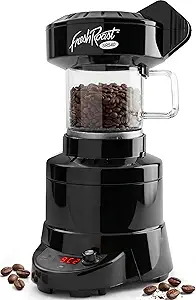 |
SANDBOX SMART R1 Coffee Roaster

| Wattage | 600 watts |
|---|---|
| Capacity | 150 g |
| Coffee Input Type | whole bean |
| Power Source | Electric |
The Sandbox Smart R1 is a countertop electric roaster made for home users who want fresh-roasted coffee without a steep learning curve. It roasts 100–150 g of green beans in roughly 10–20 minutes and connects to the Sandbox Smart app via Bluetooth to run 16 built-in roast curves, save profiles, and share or import community recipes. Manual Mode lets you tweak power and fan speed in real time, which helps dial in espresso or specialty roast targets, and the removable chaff drawer plus built-in cooling tray keep cleanup simple. The compact metal housing fits on a kitchen counter and includes a glove and brush for handling and maintenance. Expect small-batch convenience and strong profile control, though batch size limits how much coffee you can roast in one go and the unit is best for users who will use the app or spend time learning roast curves to get consistent results.
Best for: Home coffee enthusiasts who want precise, repeatable small-batch roasts and are willing to use an app to build and save roast profiles.
Less Ideal for: People who need larger batch volumes, want a purely standalone mechanical roaster, or prefer countertop appliances with minimal setup and learning.
- App control with 16 built-in roast curves and profile saving for repeatable results
- Manual Mode offers real-time power and fan adjustments for fine tuning
- Small 100–150 g batches roast quickly in 10–20 minutes
- Removable chaff drawer and built-in cooling tray for easier cleanup
- Limited batch capacity restricts output for larger households or frequent roasting
- Bluetooth app dependence may be inconvenient if you prefer fully manual standalone operation
Verdict: Choose the R1 if you want fast, small-batch home roasts with app-driven profiles and hands-on manual control for consistent flavor exploration.
OENKKC FR-RE-1 Coffee Roaster

| Power | 1000W |
|---|---|
| Voltage | 220-240V/50-60Hz, 110V/60Hz |
| Roasting Capacity | 350-400g |
| Materials | Stainless Steel and Aluminum |
| Smoke Exhaust Pipe | 1m length, 7.1cm diameter |
The OENKKC FR-RE-1 is a compact electric drum roaster aimed at home roast enthusiasts who want control without a commercial footprint. It handles 350 to 400 g batches and offers three modes — automatic, assistant, and manual — accessed through a digital controller that adjusts temperature, power, and fan speed so you can dial in roast curves. Practical touches include a visible observation window, a chaff collector, a smoke filter with an exhaust pipe to reduce odor, and an automatic cooling cycle that stops development by cooling beans in about 3 to 5 minutes. The machine preheats and holds drum temperature for short runs, and its stainless steel/aluminum construction looks durable and cleans up reasonably. Because it is a 1000 W, small-batch unit, it is best for experimenting and sharpening technique rather than high-volume roasting, and it requires a 110–240 V supply depending on region. Expect some learning to get consistent profiles, but the FR-RE-1 gives the control and features a performance-focused home roaster buyer will appreciate.
Best for: Home roast enthusiasts focused on flavor and control who want a performance-oriented small-batch roaster for experimenting and refining roast profiles.
Less Ideal for: People who need high-volume or commercial roasting capacity or expect plug-and-play consistency without practice should consider larger or purpose-built commercial machines.
- Three roasting modes (Auto, Assistant, Manual) for flexible control over profiles
- Digital controller lets you adjust temperature, power, and fan speed precisely
- Built-in smoke filter, exhaust pipe, and chaff collector reduce mess and odors
- Automatic cooling system cools beans quickly to preserve roast development
- Small 350–400 g capacity limits throughput for users needing larger batches
- Requires learning to produce consistent roast profiles despite digital controls
Verdict: If you want a feature-rich, small-batch electric drum roaster that gives precise control for refining home roast profiles, the FR-RE-1 delivers performance-oriented capability under $1000.
JIAWANSHUN Home Coffee Roaster
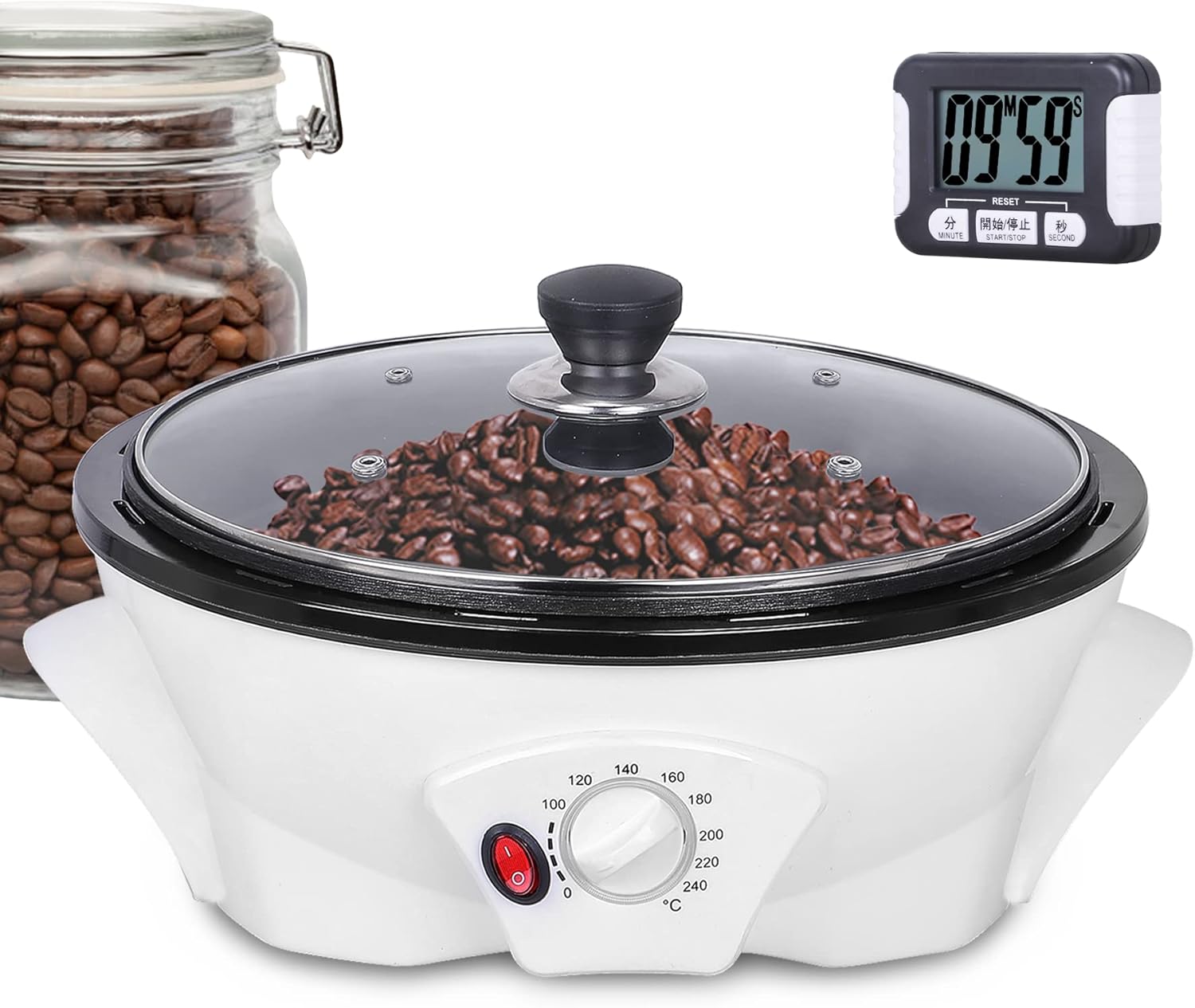
| Wattage | 1200 |
|---|---|
| Voltage | 120 volts |
| Capacity | 800g (recommended 300–500g) |
| Temperature range | 100–240℃ |
This JIAWANSHUN roaster is a compact, user-friendly machine aimed at home coffee enthusiasts who want to roast small batches. It heats with 1200W power and offers 100 to 240℃ temperature control plus a timer so you can target light, medium, or dark roasts; an automatic stirring rod helps keep beans turning for more even results. The clear glass lid with ventilation holes lets you watch color development and the honeycomb nonstick interior wipes clean easily. The manufacturer recommends 300 to 500g batches for best evenness though the unit is marketed with an 800g capacity, so you should avoid overfilling to prevent the stirrer from jamming. Setup and operation are straightforward, making it suitable for beginners, and the included cooler/separation accessories described by the brand help remove chaff. Expect some learning curve dialing roast profiles and occasional cleanup of chaff, but for the price this unit delivers practical home roasting controls and visible feedback during the roast.
Best for: Buyers who want an affordable, hands-on home roaster that gives visible control over roast degree and is easy to operate for regular small-batch roasting.
Less Ideal for: People seeking fully automatic, large-capacity commercial roasting or plug-and-play profiles with no manual learning will want a higher-end or prosumer machine instead.
- Adjustable 100–240℃ temperature range with timer for repeatable roast control
- 1200W heating and automatic stirring rod promote even roasting across a batch
- Transparent glass lid lets you monitor roast color and progress in real time
- Honeycomb nonstick interior simplifies cleaning after use
- Recommended roast size (300–500g) is smaller than the listed 800g capacity to achieve even results
- Stirring rod can jam if defective or smaller beans are not removed beforehand
Verdict: A budget-friendly, easy-to-use home roaster that gives visible temperature control and stirring for consistent small-batch roasting.
LUOSHALIYA Electric Coffee Roaster

| Rated power | 800w |
|---|---|
| Voltage | 110V,60HZ |
| Max capacity | 1500g |
| Best capacity | 300-500g |
| Operating time | 35 min max |
This LUOSHALIYA electric coffee roaster is a countertop machine aimed at small-batch home roasting and light cafe use. It uses an 800W heater and a nonstick pan with internal rotating rods to stir beans for more even roasting, and the transparent lid with vents lets you watch color development and aroma. Temperature is adjustable and a 0–35 minute timer helps reproduce roast profiles; a lights-out safety device and a simple on/off switch keep operation straightforward. The manufacturer states a maximum capacity of 1500 g but recommends best results at 300–500 g per batch, which makes it useful for hobbyists roasting weekly batches. Practical limitations include a basic control set without digital profiles or airflow control, and a plastic shell that suggests modest durability compared with heavier-duty metal roasters. Cleanup is eased by the nonstick pan, but the unit is best for experimenters or small-scale roasting rather than continuous commercial use.
Best for: Buyers seeking an inexpensive, small-batch roaster to experiment with home roasting and produce weekly batches for personal or light cafe use.
Less Ideal for: Users who need commercial-duty throughput, precise digital roast profiling, or heavy continuous operation should look at more robust, higher-end roasters.
- Adjustable temperature and a 0–35 minute timer let you control roast level
- Nonstick heated pan and rotating rods promote uniform roasting and easier cleanup
- Transparent vented lid for monitoring color and aroma during roasting
- Compact, tabletop design suitable for home kitchens or small cafes
- Controls are basic with no digital profiles or precise temperature readout
- Plastic shell and consumer-grade construction limit heavy commercial use
Verdict: A budget-friendly compact roaster that gives hobbyists adjustable temperature control and visible roasting for reliable small-batch results.
Fresh Roast SR800 Coffee Roaster

| Item Form | Whole Bean |
|---|---|
| Flavor | Green Coffee |
| Coffee Roast Level | Unroasted |
| Included Components | 2 lbs Green Coffee, Digital Scale, SR800, Extension Tube, Sample Trays, Chaff Brush |
The Fresh Roast SR800 bundle is a compact home coffee roasting system aimed at hobbyists who want hands-on control over small batches. It roasts 6–8 ounces per batch using adjustable heat and fan controls via a push-turn knob, and the included glass extension tube improves bean circulation for more even roasts. The kit adds a 0.1 g digital scale for precise dosing and a three-stage auto cooling sequence that helps lock in flavor without manual intervention. Practical extras like sample trays, a chaff brush, and two pounds of green beans make it ready to use out of the box. Expect quick roast cycles under ten minutes, which is convenient for repeated experimentation, but the small batch size means you will need multiple runs for larger households. The roaster requires attention to chaff cleanup and safe handling of hot parts, and it does not replace larger, higher-capacity machines for heavy use. For a reliability-focused home setup, the SR800 bundle gives predictable, repeatable results and the accessories to learn and refine your roast profiles.
Best for: Buyers who want a reliable, compact home roaster to learn roasting and produce consistent small batches with accessories included for a complete workflow.
Less Ideal for: Not a good fit for users who need high-volume roasting or a fully automated commercial setup.
- Complete starter kit with roaster, scale, green beans, extension tube, and cleaning tools
- Precise dosing with 0.1 g digital scale for repeatable batch weights
- Adjustable heat and fan controls let you fine-tune roast profiles
- Auto three-stage cooling simplifies cooling and preserves flavor
- Glass extension tube improves bean movement for more even roasts
- Small 6–8 oz batch capacity requires multiple runs for larger quantities
- Involves hot surfaces and chaff that need regular cleaning and safe handling
Verdict: For reliable, small-batch home roasting with everything needed to start learning and dialing in consistent roasts, the SR800 bundle is a ready-to-use choice.
Nuvo Eco Ceramic Handy Roaster

| Material Type | Ceramic, Cowhide |
|---|---|
| Capacity | 70 g |
| Model Number | NV-1CHR |
The Nuvo Eco Ceramic Handy Roaster is a compact, 100% ceramic device for small-batch home roasting of green coffee beans. You load roughly 30 to 70 g of beans into the waffle-shaped ceramic chamber and heat it over a stovetop or other heat source; the textured interior aims to promote even roasting and a rear vent lets you hear bean "popping" as a roasting cue. Its ceramic construction offers good heat retention and a neutral surface that will not impart flavors, and the cowhide grip provides a safer hold when handling hot pottery. Because it is manual and small capacity, you can experiment with roast profiles by controlling heat and agitation but you will need separate equipment to measure temperature or perform larger batches. The unit is simple, durable, and easy to clean compared with metal drum-style roasters, but it requires more hands-on attention and produces only one small batch at a time, so it is best for hobbyists rather than high-volume needs.
Best for: Someone who wants to experiment with home roasting on a small scale and values a simple, hands-on ceramic roaster backed by positive user feedback.
Less Ideal for: Those needing larger batches, hands-off automated roasting, or precise temperature control for repeatable commercial-style profiles.
- All-ceramic construction resists flavor carryover and retains heat for steady roasting
- Waffle-shaped interior promotes more even bean agitation and contact during roast
- Small footprint and simple design make it easy to use and clean for trial batches
- Rear vent provides audible feedback via bean popping to help judge roast progress
- Very small capacity limits output to about 30–70 g per batch
- Manual operation requires close attention to heat and frequent agitation
Verdict: Choose this if you want an affordable, all-ceramic handheld roaster for small, experimental home batches and hands-on control.
Fresh Roast SR540
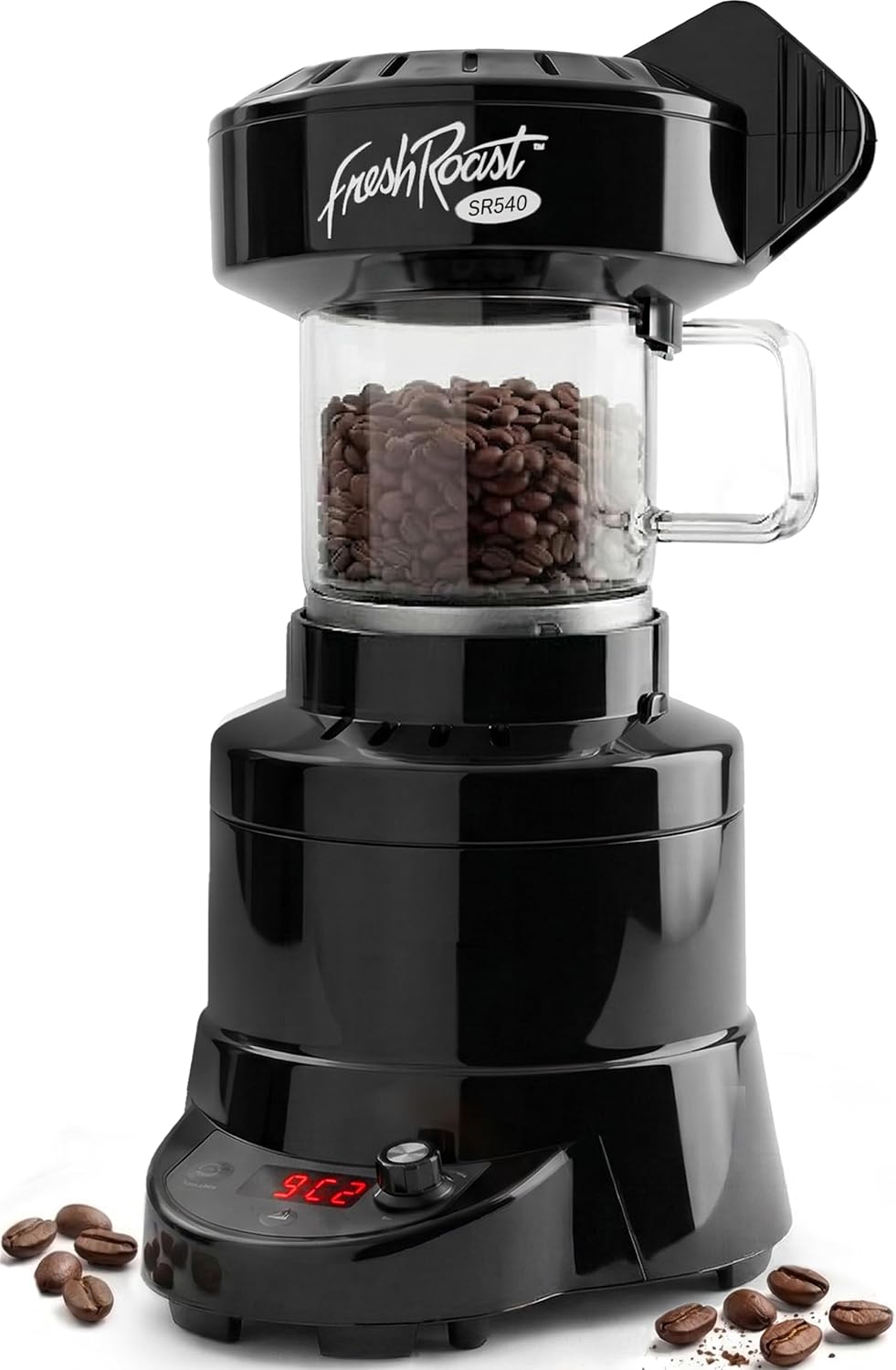
| Model Number | SR540 |
|---|---|
| Included Components | Chaff Basket, Glass Roasting Chamber |
| Roast Capacity | 3-4 oz (approx 120 g wet) |
The Fresh Roast SR540 is a small-batch convection coffee roaster designed for home use that roasts 3 to 4 ounces of green beans in under 10 minutes. It uses a clear glass roasting chamber so you can watch color development, and a single push-turn knob gives access to nine heat levels, nine fan speeds, a timer, and a real-time temperature display for repeatable results. The unit includes a chaff basket and a glass chamber and follows a roast-and-cool workflow so you can roast and then cool in the same system. For everyday use it is quick to set up and intuitive enough for beginners while still offering enough control for someone learning how different heat and airflow affect flavor. The compact footprint fits on a kitchen counter, but capacity is intentionally small, so you will roast frequently for freshest coffee. Noise and chaff collection are practical considerations when used indoors, and it lacks the larger capacity and automation of pricier flagship models, but it delivers consistent, hands-on roasting for home enthusiasts.
Best for: Buyers who want hands-on control over small, daily home roasts and prefer a straightforward, visual machine that is approachable for beginners but tunable by more careful roasters.
Less Ideal for: People who need large batch capacity, fully automated profiles, or a near-silent appliance for shared living spaces should consider other options.
- Clear glass chamber allows visual monitoring of bean color during roast
- Nine heat levels and nine fan speeds with real-time temperature display for precise control
- Fast small-batch roasting — 3–4 oz in under 10 minutes
- Includes chaff basket and integrated roast-to-cool workflow for a single-session process
- Small roast capacity requires frequent batches for larger households
- Produces chaff and noise typical of convection roasters when run indoors
Verdict: A compact, hands-on roaster that gives precise heat and airflow control for fast, fresh small-batch home roasting.
Choosing the Right Coffee Roaster: Key Factors to Consider
Temperature Control and Responsiveness
Precise temperature control matters because roast development happens across specific temperature zones. A roaster that holds setpoints accurately and responds quickly to adjustments helps you reproduce profiles and avoid sudden scorching or stalled development. Look for systems with reliable sensors and clear feedback so you can monitor rate of rise and target end temperatures.
Responsiveness also affects how well you can execute roast curve adjustments on the fly. Fast-acting heating elements or burner controls make it easier to shape the roast, while slow or lagging controls force you to anticipate changes instead of reacting to real-time bean behavior.
Drum Design and Airflow
Drum geometry, material, and the machine's airflow pattern determine how evenly beans tumble and how heat and volatile compounds are evacuated. Even agitation prevents scorching and ensures uniform color and flavor across a batch. Consider drum perforation, baffle design, and whether the roaster uses forced air, convection, or hybrid heating.
Airflow also impacts roast clarity and smoke management. Better airflow control lets you manage development and acidity retention versus body and sweetness. A well-designed drum and airflow system reduces the need for repeated profiling to correct uneven roasts.
Batch Capacity and Practical Throughput
Capacity drives how many batches you can roast in a session and whether the machine supports growing demand. For home and small-batch roasters, look for machines whose green-bean capacity matches your typical batch size without being wasteful. Underpowered or oversized units create inefficiencies: too small means more cycles, too large means inconsistent heat mass and longer recovery times.
Consider roast cycle length and cooldown time as part of throughput. Faster recovery between batches increases daily output and can be important if you plan to offer freshly roasted beans regularly.
Ease of Cleaning and Maintenance
Roasting generates chaff, oils, and carbon build-up that affect flavor and machine safety if not managed. Machines that allow easy access to the drum, chaff collection, and burners reduce maintenance time and help keep roast quality consistent. Check how simple routine tasks are, like emptying chaff trays, cleaning cooling trays, and accessing sensors for calibration.
Long-term serviceability matters too. Units with modular components and straightforward replacement parts will cost less in downtime and avoid complex repairs that require specialist service.
Control Interface and Data Output
A clear control interface helps you run repeatable profiles. Digital displays, programmable curves, or manual knobs each have trade-offs. Programmable interfaces and data logging let you capture roast curves, compare batches, and refine profiles over time. Manual controls can be fast and intuitive for experienced roasters but make documentation harder.
Consider whether you need software integration or simple readouts. If you plan to scale your roasting or do rigorous cupping, data output and the ability to save profiles are valuable for consistency.
Construction Quality and Safety Features
Durable materials and solid construction affect how long the roaster performs reliably. Look at the chassis, drum bearings, and access points for signs of robust design. Safety features matter because roasting involves high temperatures and combustion. Automatic shutoffs, over-temperature protection, and secure ventilation paths reduce risk.
Sturdy construction also helps maintain stable thermal mass and reduces vibration, which contributes to uniform roasting and less wear on moving parts over time.
Choosing the Right Roast Capacity
Match roaster capacity to your typical batch size rather than maximum possible volume. For hobbyists, small 100 to 300 gram batches may be ideal for practice and experimentation. For retail or micro-roastery needs, look for machines that handle 500 grams to 1 kilogram green-bean loads with stable heat application.
Also factor in how many batches you want to run per day. If you expect multiple cycles, prioritize a roaster with fast thermal recovery and manageable cooldown to keep throughput reasonable without sacrificing quality.
- Estimate daily volume to choose a capacity that minimizes wasted cycles.
- Check recovery time between batches to gauge throughput.
- Consider whether you will scale, and select a machine that can meet modest growth.
Roasting Profiles and Repeatability
Reproducible roast curves are essential if you want to dial in a specific flavor profile. Machines that offer programmable profiles or clear, consistent manual controls make it easier to repeat successful roasts. Pay attention to how the roaster reports temperatures and whether those sensors are bean-probe or ambient readings.
If you are learning, pick a roaster that displays rate-of-rise and cumulative time so you can learn how changes affect the cup. For experienced roasters, fine control over heat and airflow will let you experiment with acceleration and development times.
- Prefer machines with clear, stable temperature readouts.
- Look for rate-of-rise feedback to control development.
- Consider the availability of profile storage if you plan repeat batches.
Ventilation, Smoke Management, and Indoor Use
Roasting produces smoke and odor that can be significant indoors. Evaluate ventilation requirements and whether the roaster needs a dedicated exhaust or works with simple kitchen ventilation. Good smoke management keeps your roasting area safe and preserves a pleasant working environment.
Some roasters have integrated chaff collection and filters that reduce smoke and particulate escape. If you are in an apartment or small space, prioritize machines with compact, sealed airflow paths or plan for external ventilation.
- Check whether the unit requires direct venting.
- Look for effective chaff collection to minimize airborne particles.
- Plan smoke mitigation if operating indoors frequently.
Power and Installation Needs
Confirm electrical requirements and whether the roaster runs on standard outlets or needs a dedicated circuit. Undersized wiring or frequent trips can create safety hazards and poor performance. Consider the physical footprint and clearance for ventilation and maintenance access.
Portable machines are convenient but may trade off capacity or control. Factor in where you will place the roaster, how you will manage cooling and chaff, and whether the location allows safe operation.
- Verify voltage and amperage needs before purchase.
- Allow clearance for airflow and maintenance access.
- Assess portability versus permanent installation trade-offs.
Learning Curve and Workflow Integration
Your comfort level with manual adjustments and your preferred workflow should influence the choice. Some roasters reward hands-on control and sensory adjustments, while others streamline the process with presets and automation. Consider how much time you want to spend monitoring roasts versus running other tasks.
Also think about how the roaster fits into your overall workflow, from green-bean storage and quality control to cooling, packaging, and cupping. Integrating a roaster that matches your routine will reduce friction and improve consistency.
- Decide how involved you want to be during each roast.
- Choose controls that match your skill level and objectives.
- Plan the full roasting workflow to avoid bottlenecks.
How We Chose the Best Coffee Roaster
Our selection focused on machines that deliver repeatable results for home roasters and micro-roasteries while staying under the specified budget. We prioritized temperature control fidelity and responsiveness because accurate heat application is essential to consistent roast development. Drum and airflow design was the next major filter since it determines bean agitation and uniformity across batches. We also weighed capacity and throughput to ensure each roaster supports small-batch workflows without excessive cycle times. Build quality and serviceability were considered to assess long-term reliability and ease of routine maintenance. Finally, we looked at user controls and data output, favoring machines that offer clear, adjustable controls or reliable profiles for repeatable results. We excluded industrial or commercial machines with capacities well above typical small-batch needs and units requiring significant custom installation. The final picks reflect a balance of controllability, roast consistency, reasonable capacity, and maintainability suitable for hobbyists and small-scale roasters.
Our full evaluation process is outlined in our review methodology.
FAQ
How much green coffee can I roast per batch with typical under-$1000 roasters?
Most consumer and small-batch roasters under $1000 handle anywhere from about 100 grams up to around 1 kilogram per batch. Exact capacity depends on the model's design, and effective capacity is often lower than maximum advertised weight to preserve roast quality.
Do I need special ventilation to roast indoors?
It depends on the roaster and your space. Many small roasters produce noticeable smoke and odor and perform best with good ventilation. Some units have better smoke management and chaff collection, but planning for an exhaust path or using a well-ventilated area is usually advisable.
Can I reproduce the same roast profile every time?
You can achieve repeatability with the right controls and consistent technique. Machines that report temperature and rate-of-rise, and that let you store or replicate settings, make it much easier to reproduce profiles. Sensor placement and maintenance also affect repeatability.
How often should I clean and maintain a small coffee roaster?
Routine cleaning should happen after each roasting session to remove chaff and prevent oil build-up. Deeper maintenance, like checking bearings, vents, and sensors, is typically required on a monthly or quarterly basis depending on usage intensity.
What is the typical learning curve for home roasting?
Learning to roast reliably can take a few dozen batches to internalize how temperature, airflow, and time affect flavor. Using consistent measurement and keeping notes on each roast accelerates progress and helps you refine repeatable profiles.
Final Verdict
Prioritize temperature control and drum or airflow design when choosing a Coffee Roaster under $1000, since those factors most directly influence roast uniformity and flavor. Balance capacity and throughput with your expected daily volume to avoid inefficiencies, and favor machines that are easy to clean and provide useful data for repeatability. Ultimately, choose the roaster that fits your workflow and learning goals so you can consistently produce the flavor profiles you want.