
Note: This article contains affiliate links. If you click on these links and make a purchase, we may earn a small commission at no extra cost to you. This helps support our research and content. Read our full affiliate disclosure here.
If you want true dark roasts with developed oils and deep flavor, choosing the right home coffee roaster matters. Home roasting for dark roast demands machines that hold steady at higher temperatures, allow predictable ramp rates, and shed chaff efficiently so beans do not scorch. This guide covers seven shortlisted home coffee roasters that suit dark roast profiles. We focus on the features that shape roast depth and consistency, describing how each roaster supports control, capacity, and cleanup. Read on to find the roaster that fits your roast style and daily batch needs.
Top Picks at a Glance
| Best Overall The best all-around choice for most situations | Sandbox Smart R1 Home Coffee Roaster |  |
| Best Quality Built to a higher standard if you want something more solid | Fresh Roast SR800 Coffee Roaster |  |
| Best Value The sweet spot between price and what you get | LEONEBEBE Home Coffee Roaster 300 |  |
| Best Budget The cheapest option that still gets the job done reliably | GIVEROO 500g Coffee Bean Roaster |  |
| Top Rated A top-rated pick with lots of positive feedback | Nuvo Eco Ceramic Handy Roaster |  |
| Most Popular A crowd favorite that many people choose with confidence | Fresh Roast SR540 | 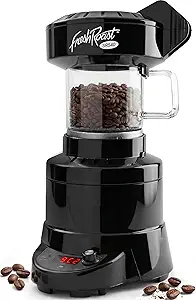 |
| Best Seller A high-volume bestseller chosen again and again | JIAWANSHUN Home Coffee Roaster FBA066 |  |
Sandbox Smart R1 Home Coffee Roaster
| Batch size | 100–150 g |
|---|---|
| Heat type | Electric direct-fire |
| Roast time | About 15 minutes per batch |
| Built-in profiles | 16 roast curves |
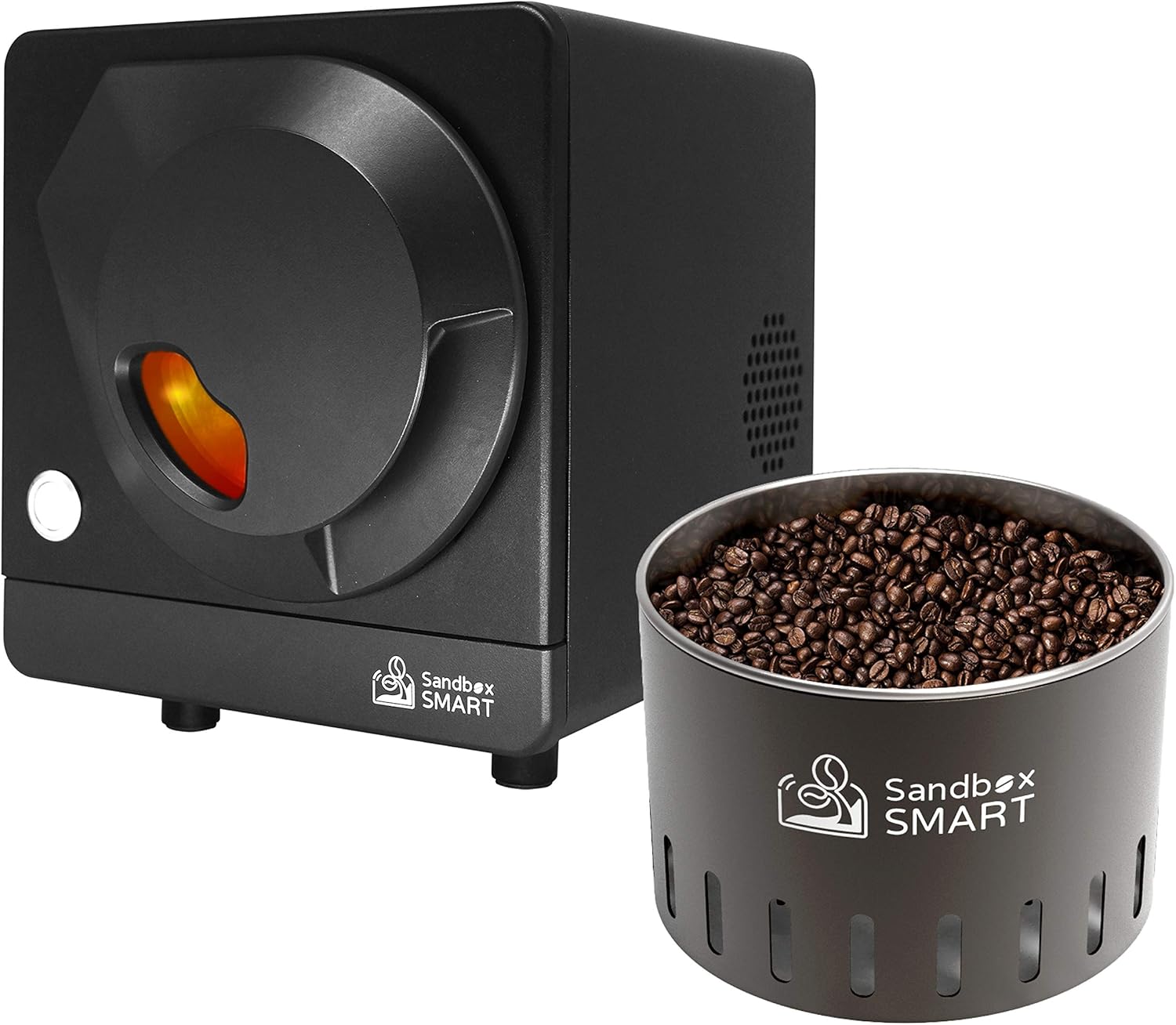
The R1 Home Coffee Roaster is a countertop electric direct-fire machine for small-batch home roasting, designed to handle about 100–150 g per roast in roughly 15 minutes. It pairs app control with 16 built-in roast curves and the ability to save custom profiles and community recipes, so you can reproduce dark roast curves or experiment manually using adjustable power and fan speed. Practical extras include a pull-out drawer that collects silverskin and a matching cooling tray to speed cooling and reduce mess. For users chasing darker roasts, the manual mode and power/fan adjustments let you push development while the app history helps repeat successful runs. Limitations are its small batch size, which suits home use but means more frequent cycles if you roast for groups, and a modest 1-year warranty; also the machine is a direct-fire design, which may require practice to hit exact darker roast endpoints compared with larger drum roasters.
Best for: Home roasters who want a compact, repeatable machine for experimenting with and dialing in dark roast profiles while keeping cleanup simple.
Less Ideal for: People who need to roast large volumes at once or who prefer industrial-style drum roasters for very consistent large-batch dark roasts.
- App control with saved roast profiles and community recipes for repeatable results
- 16 built-in roast curves covering light to dark roast points
- Manual power and fan-speed controls for fine tuning roast development
- Dedicated cooling tray and drawer for silverskin collection simplify cleanup and cooling
- Small 100–150 g batch size not suited for roasting large quantities
- Direct-fire design requires user practice to consistently hit exact dark roast endpoints
Verdict: Choose the R1 if you want a small, app-driven home roaster that makes it easy to develop and repeat dark roast profiles.
Fresh Roast SR800 Coffee Roaster

| Roast capacity | 6–8 oz (170–226 g) per batch |
|---|---|
| Heat settings | 9 levels |
| Fan settings | 9 levels |
| Timer | Adjustable via control knob |
| Display | Real-time digital temperature |
The Fresh Roast SR800 is a compact, convection-style home roaster aimed at giving you hands-on control over roast profiles. You load 6–8 ounces of green beans into the clear roasting chamber, then use the single push-turn knob to set heat, fan speed, and time across nine levels while watching the real-time temperature on the digital display. Roasts finish quickly—typically under ten minutes—and the built-in cooling sequence captures chaff and brings beans down fast so you can stop the roast at your preferred color. The SR800 is useful for experimenting with darker roasts because the granular heat and fan adjustments let you push longer roast times and manage airflow to influence development and surface oils. Trade-offs are its small single-batch capacity and the learning curve to dial in repeatable profiles, so it suits users who want performance and control rather than drop-in convenience or large batch output.
Best for: Buyers who prioritize hands-on control and want to experiment with roast development for dark roasts and specialty profiles in small batches.
Less Ideal for: People who need large-volume roasting, fully automated preset profiles, or a plug-and-play solution with minimal learning curve.
- Precise manual controls with 9 heat and 9 fan settings for fine-tuning roast development.
- Real-time digital temperature display for monitoring bean temperature during the roast.
- Fast roast cycle finishes in under 10 minutes, enabling frequent small-batch experimentation.
- Clear glass chamber lets you watch color changes and judge roast level visually.
- Built-in cooling process and chaff capture speed post-roast handling.
- Small 6–8 oz batch capacity limits output for frequent large-quantity roasting.
- Requires practice to create consistent dark-roast profiles from roast to roast.
Verdict: If you want fast, small-batch control to dial in dark roasts, the SR800 gives performance-minded home roasters the manual adjustments and temperature feedback they need.
LEONEBEBE Home Coffee Roaster 300

| Capacity | 0.75 kg |
|---|---|
| Wattage | 1200 watts |
| Voltage | 110 volts |
The LEONEBEBE Home Coffee Roaster is a countertop electric machine that helps beginners roast green coffee beans and small nuts without a stovetop. You load the drum, set the temperature with the dial, and the internal stirring bar keeps beans moving for more even heating while a glass lid with ventilation holes reduces smoke and lets you watch color development. The unit handles small to medium batches—manufacturer lists 0.75 kg capacity but recommends 0.7–1.1 lb for best circulation—and reaches roast in roughly 30 minutes, making it practical for regular home use. Controls are simple and cleanup is easier thanks to a nonstick interior, but it lacks digital profiles or automated roast programs so consistency depends on user attention. At 1200 watts it heats quickly, yet the compact footprint and built-in cooling stirring after heat cut-off help manage batch turnaround in a kitchen. For someone dialing in dark roasts you get manual temperature control and visible color feedback, though you should expect a learning curve to hit consistent dark profiles without logging time and temps.
Best for: Home roasters who want a practical, hands-on machine to experiment with darker roast levels and produce multiple cups per batch without complex electronics.
Less Ideal for: Avoid this if you need automated, repeatable roast profiles, precise logging, or professional-level smoke control for indoor commercial use.
- Adjustable temperature dial for light-to-dark control.
- Stirring bar promotes even roast and reduces hot spots.
- Glass lid with ventilation holes limits smoke and lets you monitor color.
- Large single-batch capacity suitable for several pots of coffee per roast.
- No digital controls or preset roast profiles so repeatability relies on manual tracking.
- Limited smoke extraction — indoor use may still need kitchen ventilation.
- No built-in degassing/cooling tray beyond continued stirring so post-roast handling is manual.
Verdict: A simple, high-capacity countertop roaster that gives hands-on temperature control and visible feedback—good for hobbyists chasing dark roasts without fancy automation.
GIVEROO 500g Coffee Bean Roaster

| Capacity | 1.7 pounds |
|---|---|
| Wattage | 800 watts |
| Voltage | 110 volts |
This GIVEROO countertop roaster is a compact electric machine aimed at small-batch home and light commercial use. It heats from 0 to 240°C and uses an automatic auger plus a 45-degree roasting chamber to keep beans moving for more even color development, while the transparent glass lid lets you watch progression. The unit includes a timer and an 800 W heater, and the nonstick roasting pot simplifies cleanup. It is practical for roasting single-origin beans or small dark roast batches of about 400 to 500 g for a consistent, repeatable roast profile, and the smoke reduction features and built-in safety help for indoor use. Limitations include the recommendation to roast at least ~400 g for evenness, which reduces flexibility for very small test batches, and the glass and mechanical parts will require careful handling and occasional manual clearing if beans jam. Expect basic controls rather than precise, app-driven profiling or enterprise-grade ventilation for heavy commercial use.
Best for: Buyers who want an affordable countertop roaster capable of consistent small-batch dark roasts and who value visible control and straightforward operation over advanced profiling features.
Less Ideal for: People who need precise digital roast profiling, very small sample roasting, or high-volume commercial roasting should consider other models built for those needs.
- Automatic auger keeps beans moving for more even roasts
- Transparent glass cover allows visual monitoring during roasting
- 800 W heater with adjustable 0–240°C range supports a wide range of roast levels
- Reasonable capacity for home dark-roast batches (optimum 400–500 g)
- Not ideal for very small sample roasts since evenness drops below ~400 g
- Glass lid and stirring parts need careful handling and can require manual clearing if beans jam
- Controls are basic with no app connectivity or advanced profiling
Verdict: A budget-friendly home roaster that delivers repeatable dark roasts for small batches by combining visible roasting, an automatic auger, and a wide temperature range.
Nuvo Eco Ceramic Handy Roaster

| Material Type | Ceramic, Cowhide |
|---|---|
| Capacity | 70 g |
| Model Number | NV-1CHR |
The Nuvo Eco Ceramic Handy Roaster is a compact, 100% ceramic handheld roaster intended for small-batch home coffee roasting. Its waffle-shaped interior and rear vent hole promote more even heat exposure and allow you to hear the beans as they pop, giving hands-on feedback during roast. You load green beans (the listing suggests 30 to 70 g, with 30 g producing the most consistent results) and agitate the roaster over direct heat or a stovetop to move the beans through the heated cavity. Because it is fully ceramic with a heat-resistant glaze and a cowhide grip, it holds heat well and resists flame damage compared with thin metal pans, which helps when pushing toward darker roasts. The small capacity means you can experiment roast profiles quickly, but it is not suited to larger quantities or automated temperature control, so repeatable results require practice and close attention. For someone focused on reliability and simple, durable construction, this roaster offers a low-maintenance, long-lasting option for hands-on dark roasting trials.
Best for: Buyers who want a simple, durable, hands-on tool to reliably experiment with dark roasts in very small batches and value long-lasting construction over automation.
Less Ideal for: People who need to roast larger quantities, want precise digital temperature control, or prefer an automated home roaster that produces consistent batches with minimal user intervention.
- All-ceramic construction resists direct-heat wear and provides stable heat retention
- Waffle-shaped interior promotes more uniform bean contact for even roasting
- Small batch size lets you test dark roast profiles quickly with minimal waste
- Rear vent hole gives audible feedback (bean popping) to help judge roast progress
- Very small capacity limits batches to about 30–70 g, not suitable for larger households
- No temperature control or automation, requires manual attention and practice
Verdict: For reliable, low-maintenance small-batch dark roast experiments, this rugged ceramic handheld roaster is a durable, hands-on choice.
Fresh Roast SR540
| Item Form | Whole Bean |
|---|---|
| Included Components | Chaff Basket, Glass Roasting Chamber |
| Model Number | SR540 |
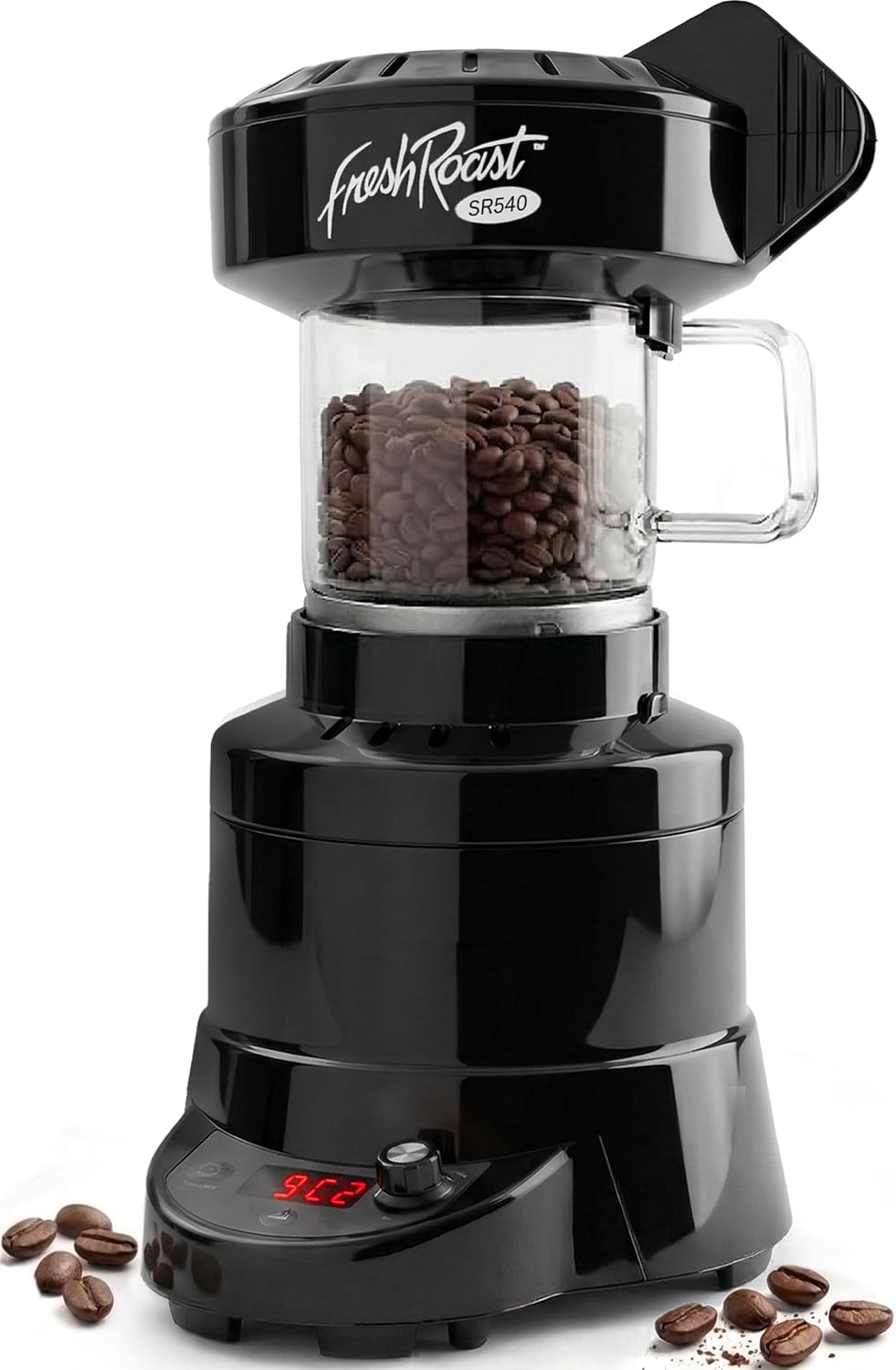
The Fresh Roast SR540 is a countertop coffee roaster designed for small-batch, speed roasting of green beans. You load about 3 to 4 ounces of beans into the glass roasting chamber, set one-knob controls for heat and fan across nine levels, and watch the roast progress via the real-time temperature display and clear chamber. Its convection fan and variable heat let you push toward darker roast profiles in under ten minutes, and the included chaff basket and integrated cool-down workflow simplify cleanup and finishing. The unit is compact and straightforward enough for a novice to use while still offering enough manual control for experimentation and repeatable results. Expect limited capacity per batch, so producing larger quantities requires multiple cycles, and the compact design can be a bit noisy during operation. For someone prioritizing daily fresh small-batch dark roasts and hands-on control, the SR540 provides an accessible, reliable way to roast at home.
Best for: Buyers who want hands-on control and freshly roasted daily small batches and who value real-world feedback from other users before committing.
Less Ideal for: Those who need to roast large volumes at once or want a fully automated, app-driven roaster with preset profiles.
- True small-batch capacity good for daily fresh roasts
- Nine heat levels and nine fan speeds for precise manual control
- Real-time temperature display and clear chamber to monitor color development
- Integrated cool-down and chaff basket simplify finishing and cleanup
- Limited roast capacity requires repeated batches for larger quantities
- Can be noisy during roasting cycles
Verdict: Choose the SR540 if you want a compact, manual home roaster that gives clear visual and temperature control for consistent dark roasts in small daily batches.
JIAWANSHUN Home Coffee Roaster FBA066
| Capacity | 500g/1.1lb recommended (300–500g for even results) |
|---|---|
| Temperature range | 100–240 C |
| Wattage | 1200 W |
| Voltage | 120 volts |
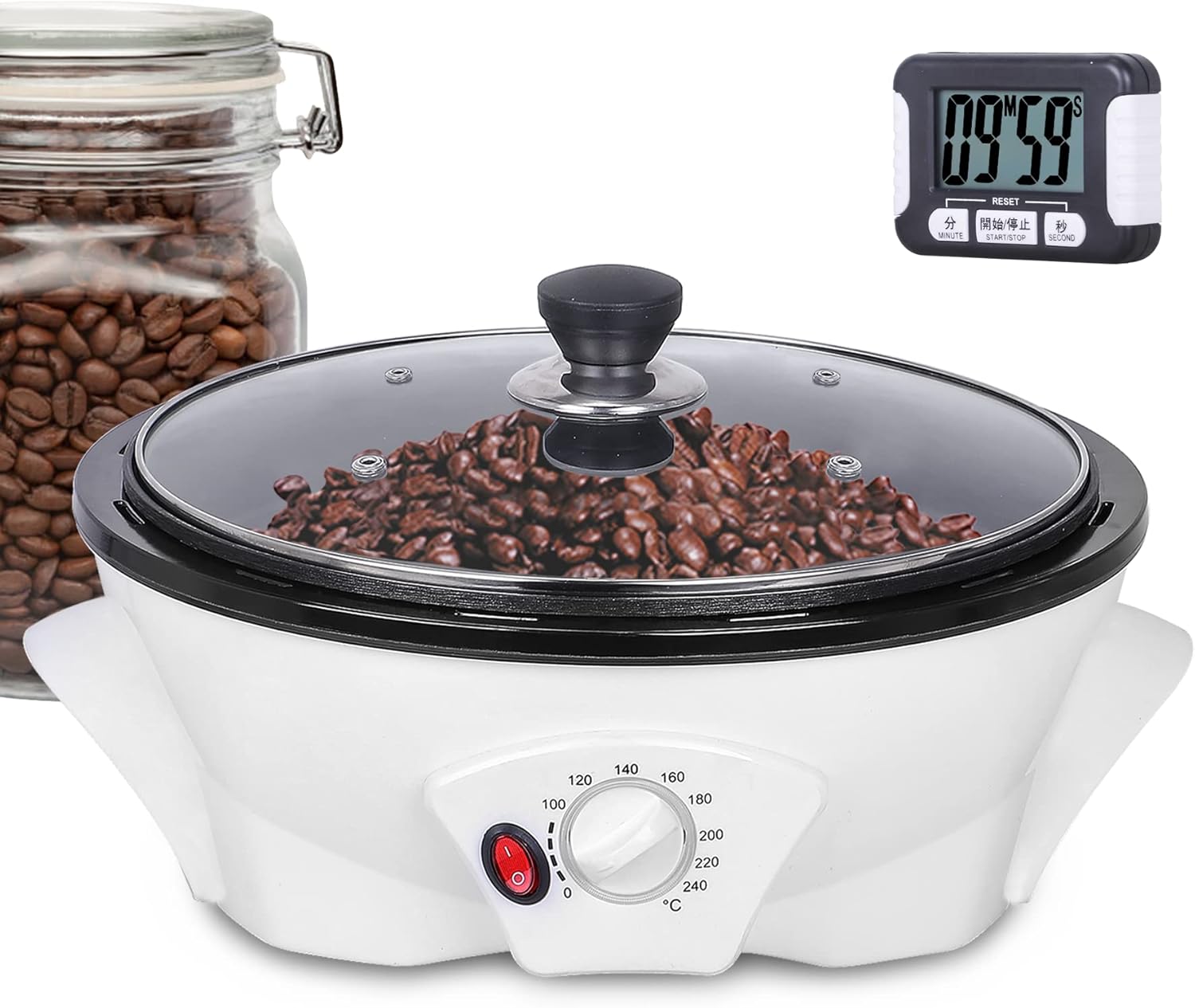
This JIAWANSHUN electric roaster is a simple small-batch machine aimed at home users who want to roast beans from green to dark. It offers 100 to 240 C temperature adjustment, a built-in timer, and an automatic stirring rod that rotates the batch for more even heating, and the clear glass lid with ventilation holes makes it easy to monitor color development. Practical benefits include a recommended 300–500 g batch size for best uniformity, a 1200 W heater for reasonably quick roast cycles, and a honeycomb nonstick interior that wipes clean. The unit is also versatile enough to roast nuts and seeds. Important limitations are its modest recommended capacity for truly consistent dark roasts at scale and a plastic/glass construction that feels consumer-grade rather than commercial; careful sorting of beans is advised to avoid jamming the stirrer. For someone focused on reliably taking beans through medium to dark roast profiles at home, this roaster provides straightforward controls and visible feedback, but it is not a replacement for larger, professional machines.
Best for: Home coffee enthusiasts who want a low-effort way to roast small batches to medium and dark profiles and who prefer visible, controllable roasts over complex, professional equipment.
Less Ideal for: People who need high-volume or commercial-grade roasting capacity or those seeking a heavy-duty metal build for continuous daily use.
- Adjustable 100–240 C temperature range for custom roast levels
- Built-in timer and one-key operation simplify repeatable roasts
- Automatic stirring rod promotes more even heating across the batch
- Clear glass lid lets you watch color development during roasting
- Nonstick honeycomb interior is easy to wipe clean after use
- Recommended batch size is modest for fully even dark roasts in larger quantities
- Plastic and glass construction is consumer-grade rather than commercial
Verdict: A straightforward, visible small-batch roaster that gives risk-averse home users easy temperature and timer control to reach consistent dark roasts without complex setup.
Choosing the Right Home Coffee Roaster for Dark Roast: Key Factors to Consider
Temperature Stability and Control
Temperature stability matters because dark roasting requires sustained heat through second crack and into deeper development without runaway spikes. Look for roasters with accurate sensors and responsive heating elements to avoid sudden tipping or underdevelopment. Consistent PID or thermostatic control helps you reproduce roast curves from one batch to the next.
A roaster that lets you monitor and adjust temperature in real time makes it easier to tune late-stage development and to back off heat when oils begin to appear. For dark roast work, the ability to apply steady, measured heat near the end of the roast is more important than aggressive initial power.
Airflow and Chaff Management
Airflow affects how heat is transferred and how evenly beans roast. For dark roasts, stronger airflow helps carry away chaff and reduce hotspots that can create bitterness or uneven color. Adjustable airflow gives you control over bean agitation and surface drying during long development stages.
Efficient chaff collection reduces fire risk and simplifies cleanup, which becomes more important when roasting oily beans. If a roaster lacks good airflow design or an accessible chaff tray, you will spend more time maintaining the machine and less time refining profiles.
Batch Size and Capacity
Batch size determines whether a roaster fits your routine. Smaller batches are quicker and allow frequent experimentation, while larger batches reduce per-cup effort if you drink a lot of dark roast coffee. Capacity also influences how heat behaves in the drum or chamber; some machines perform better near their rated loads than at very small quantities.
Choose a capacity that matches how often you roast and how much coffee you consume between fresh roasts. For consistent dark-roast results, pick a machine whose thermal design performs predictably at your typical batch weight.
Cooling and Roast Termination
Rapid and even cooling stops the roast at the right point and prevents carryover cooking that can push a roast darker than intended. A good cooling system is essential after lengthy dark-roast cycles because beans can retain heat and continue developing if not cooled promptly.
Look for roasters with active cooling fans, accessible cooling trays, and designs that separate hot air from the beans quickly. The easier and faster you can arrest the roast, the more consistent your final flavor profile will be across batches.
Programmability and User Control
Programmable profiles, roast curve logging, and manual intervention options all help you dial in dark roast profiles. Being able to replicate a successful roast curve reduces trial-and-error and makes it easier to tweak development times or heat application between first and second crack.
If you prefer hands-on roasting, prioritize models with responsive manual controls and clear feedback. If you like to automate and repeat profiles, look for machines that store multiple programs and export roast data for later analysis.
Maintenance and Ease of Cleaning
Dark roasts produce more surface oils and chaff, which increases cleaning frequency and the potential for buildup. Easy access to chaff trays, removable parts, and smooth internal surfaces reduce maintenance time and help preserve machine performance.
Consider how often filters or trays need emptying and whether parts are dishwasher-safe or require tool-free removal. Lower maintenance overhead keeps the roaster reliable and reduces the chance of rancid oil residue affecting future batches.
How Roast Development Changes at Darker Levels
As roast degree deepens, chemical changes accelerate and surface oils appear, which alters perceived bitterness, acidity, and body. Dark roasts tend to mask origin characteristics and emphasize roast-derived flavors, so control over the final minutes of the roast becomes crucial for shaping the cup.
Longer development times increase the risk of tipping or uneven caramelization, so stability and even heat distribution are essential. Understanding how first and second crack behave on your chosen machine helps you decide when to reduce or increase heat to hit the desired flavor balance.
- Second crack signals entry to darker flavor territory and is a key timing marker.
- Surface oils indicate advanced development but also increase cleanup needs.
- Late-stage heat management determines whether a roast becomes syrupy, smoky, or burned.
Setup and Ventilation for Safe Dark Roasting
Dark roasting releases more smoke and oils, so place your roaster in a well-ventilated area. If you roast indoors, position the machine near a window or use a hood system to manage smoke and odors. Ensure clearances around the unit to prevent heat buildup.
Regularly empty chaff bins and keep a fire extinguisher or suitable suppression method nearby as a precaution. Proper ventilation and routine maintenance reduce fire risk and help maintain consistent roast profiles by preventing clogged airflow paths.
- Run ventilation while roasting to remove smoke.
- Keep the workspace free of loose combustible materials.
- Empty chaff after every session to avoid accumulation.
Adjusting Profiles for Dark Roast Flavor Goals
Decide whether you want a smoky, bittersweet profile or a richer, chocolaty one and adjust late-stage heat and development time accordingly. Reducing airflow late in the roast can increase body but may raise the chance of uneven development; increasing airflow can cool the bean surface and reduce scorching.
Small, measured changes to heat and timing between first and second crack yield more predictable results than large, abrupt adjustments. Keep notes on roast curves, environmental conditions, and batch weight to replicate successful runs.
- Use shorter, hotter development for smoky intensity.
- Use gentler heat with longer development for fuller body and more nuanced flavors.
- Record roast parameters to build repeatable profiles.
Cleaning Tips for Oily, Dark-Roasted Beans
Because dark-roasted beans shed more oils, schedule more frequent deep cleanings. Wipe accessible surfaces after each session and periodically remove internal panels or drums to clear oil buildup in hard-to-reach areas.
Inspect and clean chaff trays and any filters after each roast. For stubborn oil buildup, use recommended degreasers and follow the manufacturer's maintenance guidelines to avoid damaging components.
- Wipe oils from housings after each roast.
- Empty and vacuum chaff collection areas regularly.
- Perform a monthly deeper clean if you roast frequently.
Accessories That Help Dark Roasters
A reliable scale, a thermometer for room temperature monitoring, and a roast probe or logging device can make a big difference when dialing in dark roasts. Good tools let you correlate roast behavior with environmental factors and batch weight for finer control.
A dedicated cooling tray or an additional fan can improve roast termination times, and a washable chaff collector reduces cleanup time. Consider accessories that enhance consistency rather than novelty bells and whistles.
- Digital scale for precise batch weights.
- External cooling aid to speed roast termination.
- Roast logging tools for saving and comparing profiles.
How We Chose the Best Home Coffee Roaster for Dark Roast
We prioritized machines that give home roasters the control and durability needed to produce repeatable dark roasts. Key filters included accurate temperature control and stable heating elements, because higher end temperatures and predictable ramps are essential for reaching and maintaining dark roast stages without sudden tipping. Roast capacity and airflow were assessed to ensure machines could handle typical home batch sizes while moving chaff and heat effectively. Build quality and cooling capability were required to avoid overheating and to allow timely roast termination. We also considered user control options, such as manual adjustments and programmable profiles, since dark roasting benefits from precise timing and the ability to tune late-stage heat application. Ease of cleaning and chaff collection were included because oily beans and extended roast cycles increase maintenance needs. We excluded hobbyist devices that lack temperature feedback or consistent airflow, and we did not include commercial-scale equipment unsuitable for home kitchens. The final selections balance consistent heat delivery, airflow management, roast programmability, capacity appropriate for home use, and reasonable cleanup demands.
Our full evaluation process is outlined in our review methodology.
FAQ
How long should I expect a dark roast to take on a home roaster?
Dark roasts usually take longer development after first crack, so overall roast times vary depending on batch size and machine power. Expect longer total roast times than lighter profiles and focus on consistent ramp rates rather than absolute time.
Can I dark roast in a small-capacity home roaster?
Yes, small-capacity roasters can produce excellent dark roasts provided the machine maintains stable temperature and airflow at lower loads. Some units perform best near their rated capacity, so verify how the roaster behaves at the batch sizes you plan to use.
Will dark roasting make my beans oily and harder to store?
Dark roasting brings more surface oils to the bean, which can speed up staling and make beans stickier. Store roasted beans in airtight containers away from heat and light and use them sooner than lighter roasts for best freshness.
How often should I clean the roaster when doing dark roasts?
You should empty chaff collection areas after every session and perform surface wiping regularly. For frequent dark roasting, schedule deeper internal cleanings monthly or as soon as you notice significant oil buildup.
Do I need any special ventilation for dark roasting at home?
Good ventilation is important because darker roasts produce more smoke and odor. Use a window, exhaust fan, or local hood to remove smoke and prevent buildup of residue in your kitchen.
Final Verdict
When selecting a home coffee roaster for dark roast, prioritize stable temperature control, strong airflow, and effective cooling. These elements determine whether you can reliably reach and manage late-stage development without producing off flavors. Balance batch capacity and maintenance needs against how often you roast. If you want repeatable dark roasts, choose a machine with clear controls and good chaff management so you can focus on refining profiles rather than constant upkeep.