
Note: This article contains affiliate links. If you click on these links and make a purchase, we may earn a small commission at no extra cost to you. This helps support our research and content. Read our full affiliate disclosure here.
If you want to move beyond store-roasted beans, choosing the right home coffee roaster matters for flavor, consistency, and convenience. A well-matched roaster gives you control over roast profile, predictable batch-to-batch results, and an efficient way to experiment with origin and technique. This guide covers seven shortlisted coffee roasters priced under $500 that suit hobbyists and serious home roasters alike. We evaluated each machine for roast consistency, temperature and airflow control, build quality, and ease of cleaning and maintenance. Read on to compare key features and find the model that fits your workflow.
Top Picks at a Glance
| Best Overall The best all-around choice for most situations | Precision Electric Coffee Roaster PKF-500 |  |
| Best Quality Built to a higher standard if you want something more solid | MAGO MAGA Roma Pro Coffee Roaster |  |
| Best Value The sweet spot between price and what you get | GIVEROO 500g Coffee Roaster |  |
| Best Budget The cheapest option that still gets the job done reliably | JIAWANSHUN Home Coffee Roaster FBA066 |  |
| Top Rated A top-rated pick with lots of positive feedback | Nuvo Eco Ceramic Handy Roaster NV-1CHR |  |
| Most Popular A crowd favorite that many people choose with confidence | Fresh Roast SR540 Coffee Roaster | 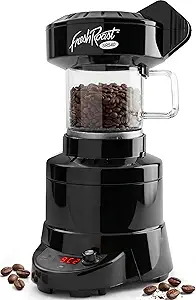 |
| Best Seller A high-volume bestseller chosen again and again | Fresh Roast SR800 Coffee Roaster |  |
Precision Electric Coffee Roaster PKF-500

| Capacity | 16 ounces |
|---|---|
| Voltage | 110 volts_of_alternating_current |
| Power | 1000W |
| Operation Mode | Fully Automatic |
| Human Interface Input | Touchscreen |
This countertop electric roaster handles about 350–400 g (roughly 1 pound) of green beans and offers automatic, assisted, and manual roast modes so beginners and more experienced home roasters can both get usable results. The drum-style heat transfer, touchscreen controller, observation window, and sample spoon let you monitor and tweak roast development in real time, while the included chaff collector and external smoke filter with vent pipes help manage smoke and cleanup during light to medium roasts. The unit is built from stainless steel and ships with a controller, filter, observation spoon, two smoke pipes, and other accessories stored in the bean tray. Practical limits to expect are the 1,000 W power and the stated indoor-use orientation, so very large batches or heavy commercial schedules are outside its intended use, and you will still need to vent the exhaust outdoors for cleaner indoor air. For a home roaster under $500 it packs a thoughtful feature set that supports repeatable small-batch roasting without a steep learning curve.
Best for: Home coffee enthusiasts who want a capable, versatile roaster that supports learning and small-batch experimentation without a steep setup or commercial footprint.
Less Ideal for: People who need high-volume or continuous commercial roasting or who cannot provide a way to vent exhaust outdoors.
- Supports automatic, assisted, and manual roast modes for flexible control
- Drum heat transfer with observation window and sample spoon for real-time monitoring
- Includes smoke filter, vent pipes, and chaff collector to reduce indoor smoke and mess
- 1-pound batch capacity suitable for regular home roasting sessions
- Designed for home/small-scale use only and not suited for continuous commercial roasting
- Requires outdoor venting for best smoke control despite included filter
Verdict: A feature-rich home roaster under $500 that balances automatic convenience and manual control for reliable 1-pound small-batch roasting.
MAGO MAGA Roma Pro Coffee Roaster

| Capacity | 0.3 kg |
|---|---|
| Power Source | AC adapter |
| Operation Mode | Semi-Automatic |
| Coffee Input Type | green coffee beans |
The Roma Pro is a compact hot-air coffee bean roaster aimed at home enthusiasts who want repeatable, small-batch roasts. It accepts green beans up to 300 g and offers both automatic profiles for straightforward roasting and a manual mode for hands-on temperature control, all shown on a clear digital display with a °C/°F switch and timer. The unit includes a double-layer glass viewing window and an upgraded bean bin door switch for more reliable operation, plus an efficient chaff collector and auto-cooling that speed the cool-down phase and reduce smoke during roasting. Practical benefits include consistent small-batch output, easy monitoring through the window and display, and a reusable filter for simple cleanup. Limitations are inherent to its category: it is designed for countertop home use and 300 g batches, so it is not suited for high-volume or commercial roasting, and users seeking full professional-grade profile automation may find some manual tweaking necessary to dial in specific roast curves.
Best for: Home coffee enthusiasts who prioritize roast performance and control and want to experiment with profiles and small-batch consistency without moving to commercial equipment.
Less Ideal for: People who need high-volume roasting for resale or cafes or those who want a combined roaster-and-brewer appliance.
- Supports both auto and manual roasting modes for flexible control
- Digital display with timer and °C/°F switch for precise monitoring
- 300 g batch capacity suitable for regular home use
- Double-layer glass window and auto-cooling let you watch and lock roast quickly
- Efficient chaff collector and ultra-low smoke design reduce ventilation needs
- 300 g capacity limits throughput for users who need larger batches
- Not intended as a coffee maker so you need separate brewing equipment
Verdict: If you want a performance-focused home roaster that delivers consistent, small-batch results with both automated convenience and manual control, the Roma Pro is a strong pick under $500.
GIVEROO 500g Coffee Roaster

| Wattage | 800 watts |
|---|---|
| Voltage | 110 volts |
| Capacity | 1.7 pounds |
This GIVEROO roaster is a straightforward small-batch machine aimed at home users and light commercial use. It roasts up to about 1.7 pounds (800g) capacity with a recommended optimum batch of 400–500g and uses an automatic auger to keep beans moving for more even color development. The glass lid lets you watch the roast while the 0–240°C temperature range and timer let you tailor roast profiles. The nonstick roasting chamber and simple controls make cleanup and repeatable use easy, and the unit is relatively quiet with a built-in smoke reduction system for indoor use. Practical limits include a suggestion to avoid very small batches for evenness and occasional jamming with small or defective beans that must be cleared manually. For someone who wants a plug-and-play way to roast modest batches at home or for a small cafe, it covers the essentials without advanced profiling features or ventilation integration.
Best for: Buyers who want a practical, plug-and-play roaster to produce consistent small-batch roasts for home use or a small café without needing advanced profiling tools.
Less Ideal for: People who need precision roast profiling, integrated smoke extraction, or frequent single-cup microbatches under 400g should consider other solutions.
- Transparent glass cover lets you monitor beans during the roast
- Wide temperature range up to 240°C and built-in timer for basic roast control
- Automatic auger provides continuous bean movement for more even roasting
- Relatively large commercial-standard capacity suitable for 400–500g optimal batches
- Nonstick roasting chamber and simple controls simplify cleaning and repeat use
- Smaller batches under about 400g can roast unevenly
- May jam with small or defective beans and requires manual clearing
- Lacks advanced profiling, software control, or dedicated exhaust integration
Verdict: A hands-on, high-capacity home roaster that delivers even results for practical buyers who prioritize batch throughput and simple controls over advanced profiling.
JIAWANSHUN Home Coffee Roaster FBA066
| Capacity | 800g (recommended 300-500g) |
|---|---|
| Wattage | 1200 W |
| Voltage | 120 volts |
| Temperature range | 100-240℃ |
| Special features | Timer, Automatic mixing stirrer |
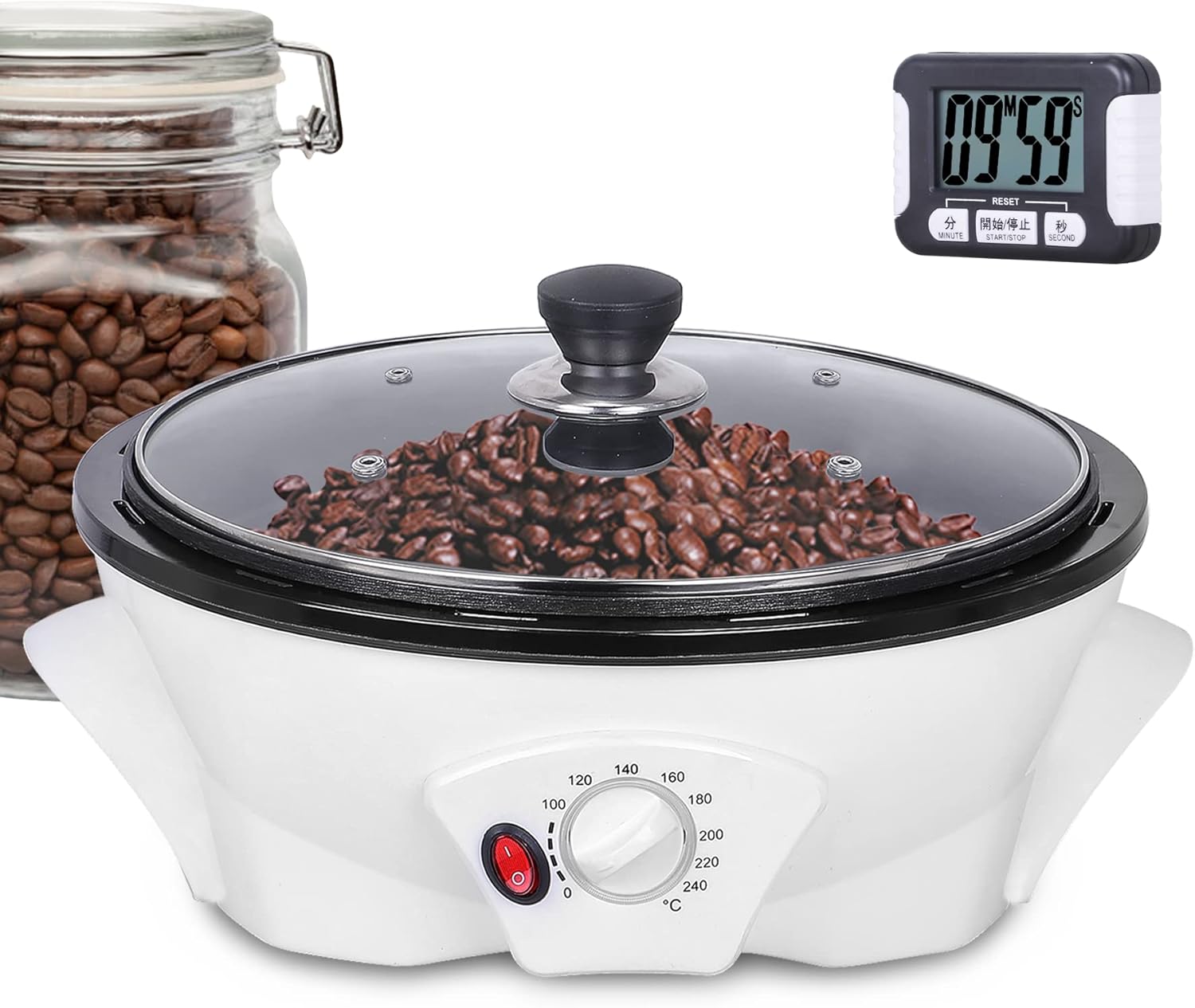
This JIAWANSHUN roaster is a straightforward countertop machine for roasting small batches of beans at home. It offers temperature control from 100 to 240 C and a built-in timer, letting you run light, medium, or dark profiles by adjusting time and heat; an automatic mixing stirrer helps keep beans turning for more even roasting. The clear glass lid and ventilation holes make it easy to watch color development, and the honeycomb nonstick interior wipes clean without scrubbing. With a recommended batch size of 300 to 500 g (800 g capacity listed), it suits hobbyists who want to roast several cups at once without learning commercial equipment. The unit is 1200W, so it heats quickly, but it is a basic appliance with manual control rather than software-guided profiles, and very small or defective beans can jam the stirrer if not removed. For the price it delivers accessible, hands-on roasting but lacks advanced automation and data logging found on higher-end machines.
Best for: Buyers on a budget who want a hands-on, small-batch roaster to experiment with home roasting without investing in commercial gear.
Less Ideal for: People who want fully automated roast profiles, precise digital logging, or large-scale commercial roasting should look at more advanced machines.
- Adjustable temperature range up to 240 C for light to dark roasts
- Built-in timer and one-key operation for simple, repeatable batches
- Automatic mixing stirrer promotes more even roasting
- Transparent glass lid with ventilation lets you monitor progress
- Nonstick honeycomb interior is easy to clean
- Manual controls only, no digital profiling or data logging
- Stirring rod can jam if very small or defective beans are present
Verdict: A budget-friendly, hands-on small-batch roaster that gives home coffee fans adjustable heat and a timer to learn roasting without a large investment.
Nuvo Eco Ceramic Handy Roaster NV-1CHR

| Material Type | Ceramic, Cowhide |
|---|---|
| Capacity | 70 g |
| Model Number | NV-1CHR |
The Nuvo Eco Ceramic Handy Roaster is a simple, manual coffee bean roaster made entirely of heat-resistant glazed ceramic with a cowhide grip. It is intended for small home batches—manufacturer guidance suggests 30 g yields the most consistent results, while it can hold up to 70 g. The waffle-like interior and rear vent help promote even heating and allow you to hear beans pop as they roast, giving tactile feedback during the process. Because it is ceramic, heat is retained and distributed steadily, which can help produce uniform color development without the rapid temperature swings of metal pans. Cleaning is straightforward since it is a single-piece ceramic vessel, and the compact form makes it easy to store. Trade-offs are its very small batch size and manual operation, which require attention and some technique to get repeatable roasts; it is not suited for larger households or anyone who wants automated profiles. Overall it is a dependable, low-tech option for someone wanting to experiment with small-batch home roasting on a budget.
Best for: Buyers who prioritize a simple, reliable, low-maintenance tool for experimenting with small-batch home coffee roasting and who value consistent heat behavior over automation.
Less Ideal for: People who need larger batches, automated roast control, or a speedier roast workflow should consider drum or electric roasters instead.
- All-ceramic construction provides steady heat retention and even roasting.
- Waffle-shaped interior promotes more uniform bean contact and heat distribution.
- Compact, single-piece design is easy to clean and store.
- Small batch size is good for experimenting and tweaking roast profiles.
- Very small maximum capacity limits batch throughput for multiple servings.
- Fully manual process requires attention and some learning to get consistent results.
Verdict: A dependable, all-ceramic handheld roaster for hobbyists who want steady heat and repeatable small-batch home roasts.
Fresh Roast SR540 Coffee Roaster
| Model Number | SR540 |
|---|---|
| Included Components | Chaff Basket, Glass Roasting Chamber |
| Roast Capacity | 3–4 oz (about 120 g) |
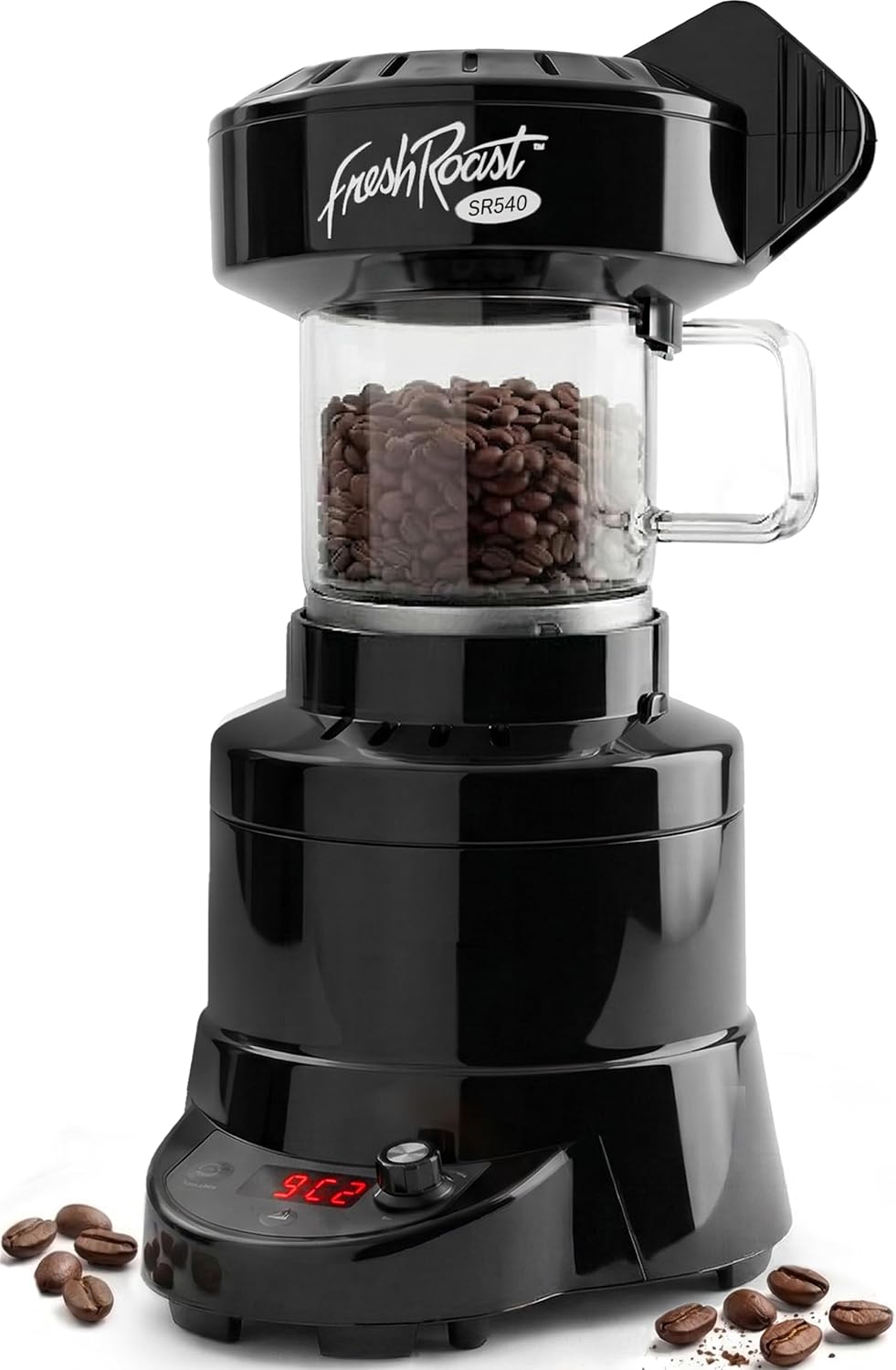
The Fresh Roast SR540 is a compact countertop coffee roaster aimed at small-batch home roasting. You load 3–4 ounces of green beans into the clear glass roasting chamber, then use a single push-turn knob to set one of nine heat levels, nine fan speeds, and a timer while watching a real-time temperature display. The SR540 roasts quickly—typically under ten minutes—and integrates a cooling cycle and chaff basket so roasting and cooling happen in one workflow. Its clear chamber makes it easy to watch color development for hands-on control, and the variable fan/heat combo lets you nudge development toward lighter or darker profiles. Limitations include the small batch size, which means multiple cycles for larger quantities, and the unit is a straightforward manual-style roaster rather than an automated profile recorder, so repeatable results require practice. Noise and bean agitation are noticeable compared with larger drum roasters, but that is normal for this class. For daily fresh small-batch roasting it delivers precise, fast roasts with visible control over the process.
Best for: Buyers who want to roast small, frequent batches at home and prefer visible, hands-on control to tune roast profiles rather than automated presets.
Less Ideal for: People who need to roast larger volumes at once, prefer fully automated profile-based roasting, or want a near-silent commercial-style machine.
- True small-batch capability for fresh daily roasts (3–4 oz).
- Nine heat levels and nine fan speeds with a real-time temperature display for hands-on control.
- Integrated cooling and included chaff basket simplify the roast-to-cool workflow.
- Clear glass chamber lets you monitor bean color and development visually.
- Small capacity requires repeated batches to roast larger amounts.
- Manual controls mean consistent repeatability takes practice and note-keeping.
Verdict: If you want fast, visible, small-batch home roasting with granular heat and fan control, the SR540 is a capable, practice-friendly choice.
Fresh Roast SR800 Coffee Roaster

| Roast capacity | 6–8 oz (170–226 g) per batch |
|---|---|
| Control settings | 9 heat levels, 9 fan speeds |
| Timer | Adjustable via push-turn knob |
| Display | Real-time temperature readout |
The Fresh Roast SR800 is a compact home coffee roaster designed to take green beans to drinkable roasts in under 10 minutes. You load 6 to 8 ounces of beans into the clear glass roasting chamber, then use the single push-turn knob to set one of nine heat levels, nine fan speeds, and the timer while watching real-time temperature on the display. The convection-based speed roast system and visible chamber make it easy to monitor color development, and the built-in three-stage cool-down captures chaff and stops the roast quickly for consistent results. Beginners will appreciate the simple single-control interface and preset feel, while more experienced users can tweak heat and fan settings to dial in profiles. Trade-offs are its small batch size, which requires multiple runs for larger households, and the learning curve needed to reproduce exact roasts across batches. For home users who want fresh, customizable roasts without a steep learning curve, the SR800 is a capable, straightforward choice.
Best for: Buyers who value fresh, cafe-style coffee at home and prefer a straightforward, adjustable machine that balances ease of use with hands-on control.
Less Ideal for: People who need to roast large volumes in a single session or who want a fully automated profiling roaster with preloaded roast curves.
- Adjustable heat and fan with nine settings for each provide real control over roast development
- Clear glass chamber lets you watch beans change color for visual roast control
- Quicker roast cycles roast 6–8 oz in under 10 minutes for same-day freshness
- Built-in cool-down and chaff capture improve safety and consistency
- Limited to 6–8 oz batches, so not ideal for brewing large quantities at once
- Requires practice to reproduce identical results between batches
Verdict: The SR800 is a compact, hands-on home roaster that delivers fast, visible control for anyone wanting fresh small-batch coffee.
Choosing the Right Coffee Roaster: Key Factors to Consider
Roast Consistency and Repeatability
Consistent roast profiles are the foundation of predictable flavor. Machines with stable heating elements and minimal temperature drift let you reproduce a roast from batch to batch, which is essential once you dial in a profile you like.
Look for roasters with either responsive electronic controls or stable manual settings. Repeatability reduces wasted batches and makes it easier to learn how changes in time and temperature affect flavor.
Temperature and Control Fidelity
How precisely a roaster holds and reports temperature affects how well you can manage development phases like Maillard and first crack. Digital readouts and even simple thermometer ports can be useful, but the underlying control system must respond predictably to adjustments.
Consider whether you need programmable profiles or just reliable manual control. Programmable units are helpful for reproducible multi-stage roasts, while simpler controllers can still yield excellent results for hands-on roasters who monitor color and sound.
Airflow, Cooling, and Chaff Management
Airflow influences heat transfer and the speed of the roast. Adjustable airflow helps balance temperature rise with bean development and can reduce uneven roasts. A good cooling system is necessary to stop the roast quickly and retain the targeted profile.
Chaff collection matters for both cleanliness and fire safety. Models with built-in chaff trays or effective extraction minimize post-roast cleanup and reduce airborne debris during operation.
Capacity and Batch Size Suitability
Choose a roaster whose batch capacity matches how much coffee you consume and how often you want to roast. Small batches are ideal for experimenting and preserving freshness, while larger batches reduce the frequency of roasting but can be harder to roast evenly.
Factor in the practical daily yield after trimmings and post-roast cooling. Also consider footprint and where you will place the machine, since larger capacity devices tend to occupy more counter space and require better ventilation.
Build Quality, Safety, and Documentation
Durable materials and solid assembly affect how long a roaster will hold calibration and resist heat-related wear. Safety features such as thermal cutoffs, stable housings, and straightforward venting reduce risk during operation.
Clear user manuals and accessible replacement parts make maintenance and troubleshooting easier. Good documentation also shortens the learning curve for newcomers to home roasting.
Ease of Cleaning and Maintenance
Regular maintenance preserves roast quality and extends machine life. Models that disassemble easily for chaff removal and have accessible heating elements speed up cleaning and reduce chances of buildup that alters heat transfer.
Consider how often filters or parts need replacement and how easy those parts are to access. Time spent cleaning should be reasonable relative to how frequently you plan to roast.
How Roast Profiles Affect Flavor
Roast profile dictates the balance of acidity, sweetness, and body. Fast, high-heat roasts emphasize body and caramelization, while slower profiles can bring out acidity and nuanced origin characteristics. Understanding how time and temperature steps influence these outcomes helps you choose a machine with the control you need.
When exploring profiles, track simple markers such as yellowing, first crack, and the length of the development phase. Machines that allow steady progression through these stages make it easier to learn how small adjustments change cup results.
- Faster roast = more body, less origin clarity
- Slower roast = more acidity and subtle aromatics
- Short development phase concentrates roast flavors
- Long development often increases sweetness and complexity
Ventilation and Where to Use a Roaster at Home
Proper ventilation is critical for indoor roasting due to smoke and airborne chaff. Place your roaster near a window, range hood, or in a well-ventilated garage. Avoid small, enclosed rooms without airflow.
Some machines produce minimal visible smoke at lighter roasts, but darker roasts will generate more. Consider local building rules, and be mindful of smoke alarms when choosing placement.
- Use near a window or exhaust fan when possible
- Avoid carpeting or soft furnishings nearby
- Allow clearance above and around the unit for safe operation
Sample Workflow for a Home Roast Session
A consistent workflow reduces error and helps you compare results across batches. Start by preheating the roaster to the same baseline temperature, measure beans by weight, and record the start time and key events like first crack. After roasting, use the fastest effective cooling method to halt development.
Keeping a roast log that captures time, temperature readings, and sensory notes will accelerate learning. Small systematic changes from one roast to the next reveal the relationship between machine settings and cup quality.
- Preheat for thermal stability
- Weigh green beans for repeatable batch sizes
- Note times for key stages (color change, first crack)
- Cool quickly and rest roasted beans before cupping
Maintaining and Troubleshooting Common Issues
Regularly empty chaff trays and wipe accessible surfaces to prevent buildup that affects airflow and heat transfer. Check for loose panels or vents that might create hot or cold spots during a roast.
If you notice uneven roasts, try smaller batches, slower heat ramps, or altering airflow where adjustable. Calibration drift can often be resolved by checking temperature sensors and ensuring the machine is allowed to reach steady-state before loading beans.
- Empty chaff after each session
- Inspect vents and fans for blockage
- Use smaller test batches when troubleshooting
- Keep a basic tool kit for tightening screws and cleaning
Sourcing Green Beans and Freshness Considerations
Green-bean quality and moisture content significantly influence roast behavior. Fresher, properly dried beans typically roast more predictably. Learn to adjust heat curves based on bean density and origin.
Store green beans in a cool, dry place and roast in quantities that match your consumption to keep roasted coffee fresh. Small-batch roasting is the most practical way to enjoy peak flavor.
- Track farm origin and processing method for flavor expectations
- Adjust roast speed for dense or high-altitude beans
- Roast only what you will consume within a few weeks for best flavor
How We Chose the Best Coffee Roaster
We focused on machines that deliver repeatable roasts, straightforward control, and safe operation for at-home use. Our editorial filters prioritized roast consistency, the fidelity of temperature and airflow controls, and the practicality of batch capacity for typical home use. Build quality and thermal stability mattered because they determine how well a roaster holds set points during a roast. Usability was judged by how intuitive the controls are, plus the clarity of monitoring options such as digital readouts or simple visual cues. Maintenance and cleanup were included since frequent cleaning affects both roast quality and long-term reliability. Finally, we considered manufacturer documentation and safety features to ensure users can operate the machine confidently. We excluded commercial or prosumer machines designed for continuous, high-volume production and any roaster that lacks basic safety certifications. Units that require extensive modification to be safe for home use were not considered. The criteria we applied align with the scoring metrics below and reflect what matters most to home roasters balancing precision, capacity, and ease of ownership.
Our full evaluation process is outlined in our review methodology.
FAQ
How much coffee can I roast at once with a home roaster under $500?
Most consumer roasters in this price range handle small to moderate batches, typically between 100 and 500 grams. Choose a capacity that matches how often you want to roast and how much roasted coffee you use between sessions.
Do I need to monitor the roast the entire time?
You usually need to watch key phases such as color change and first crack, but many roasters offer stable controls that reduce hands-on adjustments. Programmable profiles or reliable presets can cut down active monitoring without sacrificing control.
How often should I clean my roaster?
Empty chaff trays after every roast and perform a deeper cleaning of vents and accessible parts every few weeks depending on use. Regular cleaning prevents airflow restriction and maintains consistent heat transfer.
Can I roast darker profiles safely at home?
Yes, darker profiles are possible, but they produce more smoke and chaff and require better ventilation and attention to cooling. Use a well-ventilated area and be prepared for more frequent cleaning when roasting to dark levels.
Will different bean origins require different settings?
Often they will. Bean density, moisture, and processing method change how quickly beans absorb heat. Expect to tweak temperature ramps and airflow to highlight desired characteristics from different origins.
Final Verdict
When selecting a home coffee roaster under $500, prioritize machines that deliver steady temperature control, effective airflow, and an appropriate batch capacity for your routine. Tradeoffs are common: compact units are easier to store and clean but may limit batch size, while larger machines offer more control at the cost of footprint and possibly greater maintenance. Focus on roast consistency and ease of use first, then consider capacity and cleaning accessibility. With a clear sense of your typical batch size and how much control you want over profiles, you can pick a roaster that helps you learn quickly and produce reliably tasty results.