
Note: This article contains affiliate links. If you click on these links and make a purchase, we may earn a small commission at no extra cost to you. This helps support our research and content. Read our full affiliate disclosure here.
Choosing the right color printer affects the look of your documents, photos, and marketing materials. You want accurate color, reasonable operating costs, and dependable day-to-day performance without surprises. This guide shortlists top color printers across common home and small-office needs and explains the practical tradeoffs so you can pick the model that matches how you print. We evaluated machines for image and document quality, ongoing supply costs, and real-world ease of use. Read on for our top selections and the criteria we used to evaluate them.
Top Picks at a Glance
| Best Overall The best all-around choice for most situations | HP OfficeJet Pro 8125e | 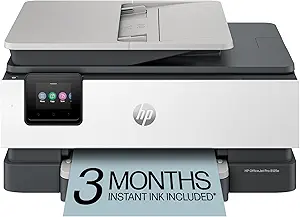 |
| Best Quality Built to a higher standard if you want something more solid | Epson EcoTank Photo ET-8550 |  |
| Best Value The sweet spot between price and what you get | Canon PIXMA G3270 MegaTank |  |
| Best Budget The cheapest option that still gets the job done reliably | HP DeskJet 2955 All-in-One Printer |  |
| Top Rated A top-rated pick with lots of positive feedback | Xerox C245 Color Multifunction Printer |  |
| Most Popular A crowd favorite that many people choose with confidence | Canon PIXMA TR4720 |  |
| Best Seller A high-volume bestseller chosen again and again | Epson EcoTank ET-2800 |  |
HP OfficeJet Pro 8125e

| Printer Type | HP Thermal Inkjet |
|---|---|
| Print Output Type | Color |
| Maximum Sheet Capacity | 225 |
| Duplex | Automatic (standard) |
| Printer Connectivity Type | Apple AirPrint; Ethernet networking; USB; Wireless (Wi-Fi); Wireless direct printing |
The HP OfficeJet Pro 8125e is a compact all-in-one inkjet that handles everyday color documents, reports and occasional photo prints while supporting scanning and copying via its flatbed and single-sided ADF. It prints at up to 10 ppm color and 20 ppm black with a high maximum resolution for sharp documents, and automatic two-sided printing plus a 225-sheet tray make it suitable for steady home-office workloads. Connectivity is flexible with dual-band Wi‑Fi, AirPrint, Ethernet and USB, and the HP app lets you print and scan from a phone. AI-driven formatting tools reduce wasted pages when printing web content, and inclusion of a three-month Instant Ink trial simplifies ink management for frequent users. Trade-offs are typical for consumer inkjets: color photo quality can vary with paper choice, running costs depend on cartridge usage and subscription choices, and some advanced business features require HP+ activation. Setup and routine tasks are user-friendly, making it a pragmatic pick for mixed printing needs.
Best for: Buyers who want a versatile, user-friendly color printer for a home office that balances decent speed, automatic duplexing and mobile printing without needing heavy commercial features.
Less Ideal for: Those who need the lowest-cost-per-page printing for very high monthly volumes or professional photo labs that require top-tier color accuracy and specialized paper handling.
- All-in-one functions with flatbed and ADF for scanning and copying
- Automatic duplex printing and 225-sheet input for larger print jobs
- Multiple connectivity options including dual-band Wi‑Fi, Ethernet and AirPrint
- High maximum print resolution for detailed document and photo prints
- Includes 3-month Instant Ink trial to simplify ink replacement initially
- Long-term ink costs depend on cartridge consumption and subscription choices
- Some advanced cloud or business features require HP+ activation
Verdict: A balanced, feature-rich all-in-one that fits home and small office users who want reliable color printing, duplexing and easy mobile connectivity.
Epson EcoTank Photo ET-8550

| Printer Type | Inkjet |
|---|---|
| Other Special Features of the Product | Refillable Ink Tank |
| Maximum Media Size | 13 x 19 inch |
| Color Pages per Minute | 12 pages_per_minute |
| Maximum print Resolution Color | 1440 dots_per_inch |
The Epson EcoTank Photo ET-8550 is a cartridge-free wide-format inkjet all-in-one designed for photo enthusiasts and small studios. It uses a 6-color Claria ET Premium ink set and a high-accuracy printhead to deliver sharp, high-resolution prints and borderless photos up to 13 x 19 inches, while the refillable ink tanks dramatically extend time between replacements. Typical use cases include printing lab-quality photos, proofing graphics, and producing mixed office/photo jobs; it also scans and copies. Notable features include USB and wireless mobile control, auto duplex printing, and support for heavier media up to about 1.3 mm. Practical benefits are low ongoing ink cost, reduced cartridge waste, and the ability to print large-format photos at home. Important limitations are relatively modest color-page-per-minute speeds compared with photo-specialty devices and a substantial desktop footprint and weight that require a dedicated workspace. The printer is best when image quality and low running cost matter more than the fastest throughput or smallest footprint.
Best for: Buyers who prioritize high-quality color and photo output with low long-term ink cost and are willing to give the printer a dedicated spot in a home studio or small office.
Less Ideal for: Users who need a compact, lightweight printer for occasional home use or those who prioritize maximum page-per-minute speed for heavy office document workloads.
- Cartridge-free EcoTank system cuts running cost and reduces waste
- Six-color Claria ET Premium inks for improved photo color and gradation
- Supports wide-format borderless printing up to 13 x 19 inches
- Auto duplex and scanning/copying add everyday versatility for mixed jobs
- Large footprint and heavier than typical home printers
- Not the fastest printer for high-volume color document throughput
Verdict: Choose the ET-8550 if you want wide-format, lab-quality color prints with very low running costs from a cartridge-free EcoTank system.
Canon PIXMA G3270 MegaTank

| Printer Type | Inkjet |
|---|---|
| Printer Connectivity Type | USB, Wi‑Fi |
| Maximum print Resolution Color | 4800 x 1200 dots_per_inch |
| B&W Pages per Minute | 11 |
| Color Pages per Minute | 6 |
The Canon PIXMA G3270 is a wireless MegaTank all-in-one inkjet that targets low-cost, high-volume color printing for home and small office users. It uses refillable ink bottles that Canon rates for very high page yields, so routine running costs are much lower than cartridge-based machines. You get borderless photo support, a 1.35" LCD for on-device control, and both USB and Wi-Fi connectivity with mobile printing support for smartphones and tablets. Print quality is strong for photos and documents at up to 4800 x 1200 dpi, while text prints faster in black (about 11 ppm) than in color (about 6 ppm). Paper handling is modest with a single 100-sheet tray and simplex (single-sided) printing only, so it is best where large duplex workflows are not required. Setup and ink filling are straightforward, and the included inks and print heads let you start with a long initial yield, but the unit is relatively large and lacks automatic double-sided printing and an automatic document feeder. For buyers who prioritize low cost per page and color photo capability, the G3270 delivers practical value without fancy office features.
Best for: Buyers who want to minimize ongoing ink costs and need reliable color and photo printing for a home or small office without enterprise features.
Less Ideal for: Users who require automatic duplexing, high-capacity trays, or ADF scanning for heavy multi-page office workflows should look elsewhere.
- Refillable MegaTank ink bottles provide a very low cost per page and long initial yield
- High maximum print resolution (4800 x 1200 dpi) for detailed color prints and photos
- Wi-Fi and USB connectivity plus mobile device compatibility for easy printing from phones and tablets
- Compact all-in-one functionality lets you print, scan, and copy from a single machine
- No automatic duplex (double-sided) printing
- Single 100-sheet tray limits paper capacity for heavy office use
- Slower color print speed compared with monochrome pages
Verdict: Choose the PIXMA G3270 when your priority is very low ink cost and high-quality color prints for home or small-office use.
HP DeskJet 2955 All-in-One Printer

| Printer Type | HP Thermal Inkjet |
|---|---|
| Maximum Sheet Capacity | 60 |
| Color Pages per Minute | 5.5 pages_per_minute |
| B&W Pages per Minute | 7.5 pages_per_minute |
| Printer Connectivity Type | Apple AirPrint; USB; Wireless (Wi-Fi); Wireless direct printing; Mopria |
The HP DeskJet 2955 is a compact wireless all-in-one aimed at everyday home printing tasks like letters, schoolwork, recipes, and occasional photos. It prints in color, copies and scans on a flatbed, and connects via USB, AirPrint, Mopria or HP's app for mobile printing and simple setup. Notable features include a 60-sheet input tray, manual duplex support, an icon LCD for basic controls, and an included three-month trial of HP Instant Ink for automated cartridge delivery. Print quality can be reasonable for documents and casual photos thanks to HP's optimized color resolution, though it is not designed for high-volume or photo-studio work. Print speeds are modest at around 7.5 ppm black and 5.5 ppm color, so larger jobs will take time, and manual duplex means two-sided printing requires user intervention. Its small footprint and recycled-plastic construction make it a practical pick for tight spaces or eco-minded buyers, while wireless reliability helps keep it simple for phone and tablet printing.
Best for: Buyers looking for an affordable, space-saving color all-in-one for everyday home documents and occasional photo prints who prioritize simple wireless setup and low upfront cost.
Less Ideal for: Users who need fast, high-volume output, professional-quality photo printing, or automatic two-sided printing should consider higher-end models instead.
- All-in-one functionality: print, copy and scan in a compact unit.
- Multiple wireless options including AirPrint and HP app simplify mobile printing.
- Compact 60-sheet tray fits small home workspaces.
- Includes 3-month Instant Ink trial for convenient ink delivery.
- Made with recycled plastics and ENERGY STAR certified for lower environmental impact.
- Modest print speeds not ideal for high-volume printing.
- Duplex printing is manual rather than automatic.
Verdict: A budget-friendly, compact color all-in-one that delivers easy wireless printing and basic scan/copy features for everyday home use.
Xerox C245 Color Multifunction Printer

| Printer Type | Laser |
|---|---|
| Color Pages per Minute | 26 pages_per_minute |
| Printer Connectivity Type | Ethernet, USB, Wi-Fi |
| Duplex | Automatic |
| Maximum print Resolution Color | 2400×600 dots_per_inch |
The Xerox C245 is a compact color laser multifunction designed for small offices and home professionals who need dependable everyday color output. It delivers up to 26 pages per minute in color and black-and-white, handles common media including envelopes and labels, and includes a 50-sheet document feeder for routine scanning and copying tasks. Built-in Wi‑Fi, Ethernet and USB plus mobile support for Apple AirPrint and Mopria make it straightforward to print from phones and laptops, and setup via the Xerox Easy Assist app simplifies installation. The C245 also offers automatic two-sided printing, a color touchscreen for basic controls, and Energy Star and EPEAT efficiency features to reduce operating cost. Important limits are its modest paper capacity and relatively high power draw compared with small inkjets, so it is best for users who value laser durability and color output over large-volume paper handling or the lowest energy use. For reliability-focused buyers it provides solid, business-oriented features in a small footprint.
Best for: Buyers who prioritize reliable, business-quality color printing and straightforward wireless setup for a small office or home-professional workflow.
Less Ideal for: Those who need high-capacity paper trays for heavy daily print volumes or the lowest possible energy use should consider larger workgroup models or efficient inkjet alternatives.
- Consistent 26 ppm color and black-and-white printing for steady throughput
- Automatic duplexing and 50-sheet feeder streamline common office workflows
- Wi‑Fi, Ethernet, USB and mobile printing support for flexible connectivity
- Intuitive touchscreen and guided Xerox Easy Assist app make setup and basic operation simple
- Maximum tray capacity is limited to 50 sheets which may require frequent refilling for heavier workloads
- Power consumption is relatively high at listed operating wattage
Verdict: Choose the C245 when you want a compact, reliable color laser multifunction that delivers consistent business-quality color and easy wireless printing.
Canon PIXMA TR4720

| Printer Type | Inkjet |
|---|---|
| Maximum print Resolution Color | 4800 x 1200 dots_per_inch |
| B&W Pages per Minute | 8.8 |
| Color Pages per Minute | 4.4 |
| Printer Connectivity Type | USB, Wi-Fi |
The Canon PIXMA TR4720 is a small-home-office all-in-one inkjet designed for everyday color and black-and-white printing plus scanning, copying, and faxing. It connects over Wi-Fi or USB and supports mobile printing through Canon's apps for direct printing from smartphones. Notable features are an automatic document feeder for multi-page scanning, automatic two-sided printing to save paper, a front-loading 100-sheet tray, and support for borderless photos up to letter size. Print quality uses Canon's hybrid ink system, which produces sharp black text and reasonably vivid color prints for documents and casual photos. Speeds are modest at about 8.8 ipm for black and 4.4 ipm for color, so expect slower jobs compared with higher-end models. The TR4720 is compact and energy efficient for a desktop unit, but it is not aimed at heavy-volume or professional photo work and uses Canon CL-276/PG-275 cartridges which may raise ongoing ink costs for frequent color printing. Its simple LCD and app controls make day-to-day tasks straightforward for typical home and small office use.
Best for: Buyers who want a compact, easy-to-use home or small-office color printer that handles occasional photo prints, multi-page scanning, and duplex document jobs without complex setup.
Less Ideal for: Users who need fast, high-volume color output or professional-grade photo printing should consider higher-capacity or photo-focused printers.
- All-in-one functionality: print, scan, copy and fax in one compact unit.
- Auto document feeder and automatic duplexing speed common office tasks and save paper.
- Front-loading 100-sheet tray with borderless printing up to 8.5" x 11" for casual photo printing.
- Wireless and USB connectivity with Canon Print app support for mobile printing.
- Relatively slow color print speed compared with higher-tier color printers.
- Uses standard Canon CL-276/PG-275 cartridges which can be costly for heavy color use.
Verdict: Choose the PIXMA TR4720 if you want an affordable, space-saving all‑in‑one that delivers reliable everyday color documents and basic borderless photos.
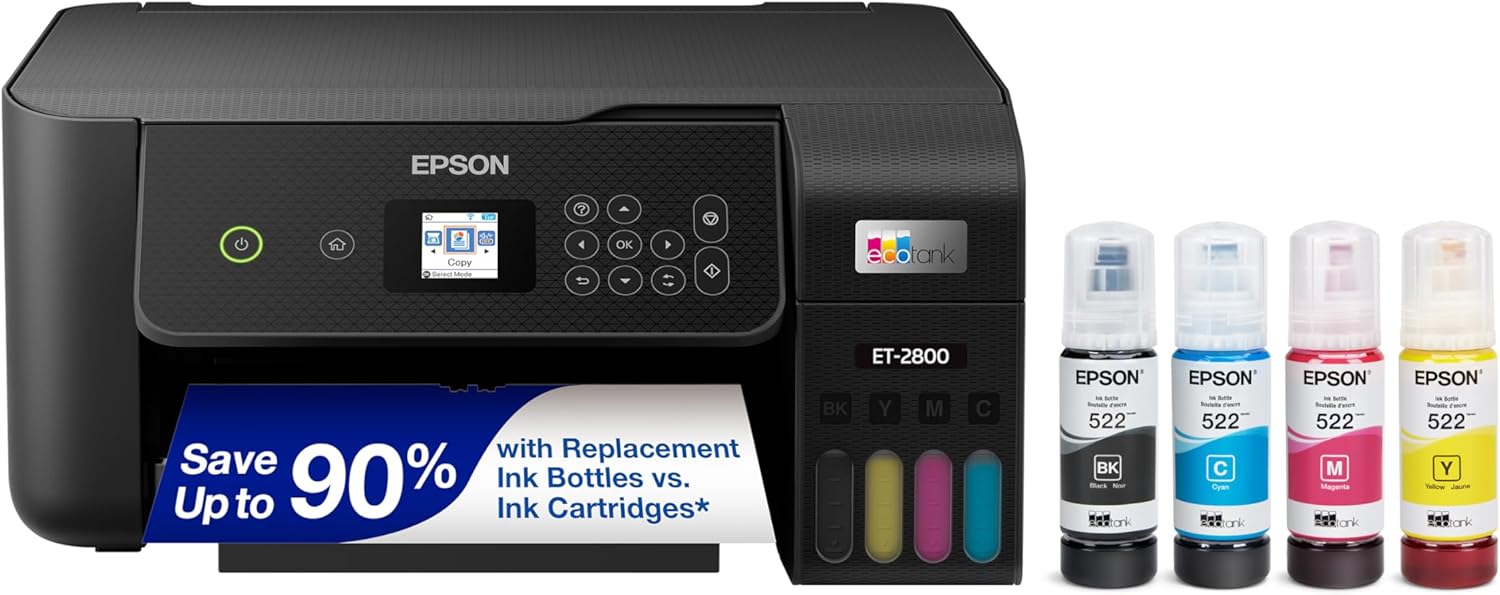
Epson EcoTank ET-2800
| Printer Type | Inkjet |
|---|---|
| Printer Connectivity Type | USB, Wi-Fi |
| Maximum print Resolution Color | 5760 x 1440 dpi |
| B&W Pages per Minute | 10 |
| Maximum Sheet Capacity | 100 |
The Epson EcoTank ET-2800 is a home-focused all-in-one inkjet that replaces cartridges with large refillable ink tanks, letting you print for months between bottle refills. It handles everyday tasks—color and black text printing, flatbed scanning and copying—and connects via Wi‑Fi or USB with app and voice printing support for quick mobile jobs. The PrecisionCore-based print engine delivers sharp text and good photo color at a high maximum print resolution, while the included ink set is rated to print thousands of pages, reducing the frequency and cost of replacements. Practical benefits include a simple LCD for basic controls, a single paper tray with up to 100-sheet capacity, and borderless photo options for small prints. Limitations are modest print speeds compared with office machines and no automatic duplexing, so expect manual two-sided printing for documents; the unit is best for steady home use rather than heavy volume office workflows. Epson recommends genuine ink to maintain performance and warranty coverage.
Best for: Buyers who want a low-maintenance home color printer that minimizes ongoing ink costs and prioritizes reliability and simple wireless printing.
Less Ideal for: Users who need fast duplexing, heavy daily office throughput, or advanced finishing options should consider more office-oriented models.
- Cartridge-free EcoTank system that greatly reduces how often ink must be replaced
- High-resolution output suitable for crisp text and detailed color prints
- Wireless, app and voice printing for convenient mobile workflows
- Included high-yield ink bottles can print thousands of pages before replacement
- Simple LCD and straightforward controls make setup and daily use easy
- No automatic duplex printing so two-sided jobs require manual page flipping
- Relatively modest color print speed compared with higher-end multi-function printers
Verdict: Choose the ET-2800 if you want a reliable, low-cost-to-run home color all-in-one with refillable tanks and easy wireless printing.
Choosing the Right Color Printer: Key Factors to Consider
Print Quality and Color Accuracy
Print quality determines how professional your documents and photos look. Look beyond nominal dpi numbers and consider printer technologies such as inkjet versus laser, color gamut, and whether the printer supports photo-specific modes. For documents, sharp text and consistent color fills matter. For photos, pay attention to color gradation, shadow detail, and whether the machine can reproduce skin tones and saturated colors without oversaturation.
A printer that offers adjustable color management, ICC profile support, or fine-tuned photo presets gives you more control over output. If you plan to print images regularly, test or review sample photo prints when possible to verify the real-world color rendering.
Operating Cost and Consumables
Long-term cost is often the largest expense for a color printer. Compare yield estimates for cartridges or toners and calculate cost per page for both color and black prints. Some devices use individual color cartridges so you only replace the depleted color, while others use combined color cartridges that increase waste. High-yield or subscription supplies can lower ongoing costs but may require higher upfront spending.
Consider how frequently you print and whether you mostly print color or black documents. Machines with lower upfront cost can be more expensive over time if their consumables are pricey. Also check for compatibility with third-party supplies if that matters to your budget, keeping in mind potential tradeoffs in warranty and print consistency.
Print Speed and Duty Cycle
Speed affects productivity, especially in home offices that handle bursts of printing. Look at realistic mixed-color pages-per-minute ratings rather than optimistic simplex black numbers. Duty cycle gives a sense of how many pages the device can handle monthly without increased risk of wear. Match the printer's stated duty cycle to your expected monthly volume to avoid premature maintenance.
Remember that high-resolution photo mode and duplex printing slow throughput. If you frequently print high-resolution images, prioritize models that maintain quality at acceptable speeds. For occasional photo printing, speed is less critical than image quality.
Connectivity and Workflow
Modern printers offer many connectivity options that affect convenience. Wireless printing, AirPrint, Mopria, and cloud printing make it easy to print from phones and tablets. Wired Ethernet is useful in multi-user small-office setups. Look for robust driver support and a mobile app that handles scanning, cloud uploads, and supply ordering efficiently.
Consider security features if the printer will be on a business network, such as user authentication, secure printing, and regular firmware updates. Also evaluate how easy it is to scan to email or network folders if you plan to use scanning features frequently.
Paper Handling and Media Support
Paper capacity and tray configuration impact how often you need to reload paper. Choose a printer with enough input capacity for your typical print jobs, or one that accepts an add-on tray if you expect heavy use. Duplex units save paper and are standard on many models, but check for reliable automatic duplexing if you plan to use it frequently.
Media support matters for creative work. Verify the printer accepts the sizes and weights you need, such as thicker photo paper, envelopes, labels, and cardstock. A straight-through or specialty bypass feed reduces jams when printing heavy media.
Maintenance and Reliability
Consider how easy routine maintenance is and what common failures look like. Self-cleaning cycles, replaceable printheads, and clear user-replaceable parts can reduce downtime. Look for straightforward access to consumables and clear error reporting in the control panel or app.
Longevity matters: machines with robust build quality and better support experience fewer service interruptions. If the printer will be used for important business tasks, prioritize models with better-reviewed reliability and accessible service options.
Matching a Printer to Your Printing Habits
Think about how often and what you print. Occasional photo printing has different demands than high-volume color document work. Match the device to your highest-priority use case so you do not overpay for features you will not use or miss capabilities you need.
If you mostly print text with occasional color accents, prioritize sharp text reproduction and low black operating cost. If you print brochures or photos regularly, emphasize wide color gamut, good photo modes, and media handling for heavier papers.
- Low monthly volume: prioritize compact units and low standby draw
- Moderate volume: balance yield and speed with mid-size paper trays
- High volume: look for high-yield supplies and larger input capacities
Inkjet Versus Color Laser: Practical Differences
Inkjet printers typically excel at photo output and smooth color blends, while color laser printers usually deliver faster text and lower maintenance for high-volume color documents. Consider the tradeoff between initial hardware cost and long-term supplies efficiency.
For glossy photos and fine gradients, choose an inkjet with photo-optimized modes. For frequent color reports and flyers, a color laser often gives sharper text and faster throughput with less frequent consumable replacement.
- Inkjet: better photo quality, flexible media handling, potential ink drying/clogging issues
- Color laser: faster for documents, typically higher monthly duty cycles, better toner longevity
Setup, Space, and Energy Use
Consider physical dimensions, access to power, and where the printer will sit. Some multi-function color printers are deep and require clearance for the scanner lid. Ensure the chosen unit fits your workspace and allows easy access for replacing cartridges and clearing jams.
Energy consumption can vary. Look for devices with efficient standby modes and quick wake-up times to avoid delays. If the printer will be on a workbench or close to living space, noise levels during printing may also matter.
- Measure the footprint and clearance before buying
- Check manufacturer standby and active power specifications
- Consider quieter models for shared or open-plan spaces
Scanning and Multi-Function Features
Many color printers include scanning and copying features that expand usefulness. A good scanner can replace a separate device for most home and small-office tasks, but scanning quality varies widely. Look at resolution, color accuracy, and feeder options for multi-page scans.
Automatic document feeders speed scanning for large jobs, while flatbed scanners handle delicate or odd-sized originals. If scanning is central to your workflow, prioritize models with reliable feeders and robust scanning software.
- ADF for batch scanning and copying
- Flatbed for fragile or bound originals
- Check OCR and cloud upload options in the scanning app
Photo Printing Tips
For the best photo results, use manufacturer-recommended photo papers and choose the appropriate print mode. Matte, luster, and glossy papers all produce different results, and heavier weight stock often reduces curling and shows better color depth.
Calibrate your workflow when possible. Adjust printer color profiles or use ICC profiles for specific paper types to get more accurate output. Let prints dry fully and avoid stacking fresh glossy outputs to prevent smearing.
- Select paper type in printer driver for best color rendering
- Use higher resolution modes for detailed images
- Allow ink to dry before handling glossy photos
How We Chose the Best Color Printer
We evaluated color printers with an eye toward real-world home and small-office use. Primary criteria included print quality for both text and photos, measured by color accuracy and resolution capability; running costs, using typical ink or toner yield estimates and per-page cost; and speed, considering realistic pages-per-minute figures for mixed color and black prints. We also scored reliability and maintenance needs, looking at expected time between common service tasks and the ease of replacing consumables. Connectivity and workflow mattered as well, including wired and wireless options, mobile printing support, and the responsiveness of driver and app features. Usability factors such as paper handling, tray capacity, and intuitive control panels were considered because they affect daily operation. We excluded models that focus exclusively on one niche, such as high-volume enterprise presses or dye-sub photo kiosks, since they are not representative of typical home or small-business needs. The resulting shortlist prioritizes balanced machines that perform well across the criteria above and suit a variety of printing habits.
Our full evaluation process is outlined in our review methodology.
FAQ
How do I estimate the real cost per page for a color printer?
Estimate cost per page by dividing the price of replacement cartridges or toner by the manufacturer yield and then adding a small allowance for maintenance. Use both color and black yields for mixed printing and compare per-page totals rather than sticker prices.
Is it better to get a multifunction color printer if I only need occasional scans?
Multifunction units add convenience and usually save space, but they can be slightly more expensive and larger. If you only scan occasionally and space is limited, a simple printer may suffice. For regular scanning, an MFP with a reliable feeder is often the better choice.
How often do color printers need maintenance or cleaning?
Maintenance frequency depends on usage and technology. Inkjets used infrequently may need periodic head-clean cycles to avoid clogs. Laser printers have fewer day-to-day maintenance tasks but may need toner handling and occasional fuser or drum attention. Regular use and following manufacturer maintenance prompts reduces issues.
Can I use third-party ink or toner to save money?
Third-party supplies are available and often cheaper, but quality and reliability vary. They can affect color consistency and may create warranty concerns. If cost is a priority, research reputable third-party suppliers and consider the tradeoffs in output and support.
What features matter most for photo printing at home?
For home photo printing, prioritize wider color gamut, good droplet control or toner halftoning, support for heavier photo paper weights, and photo-specific print modes. Also consider whether the printer supports borderless prints and has driver controls for color profiles.
Final Verdict
Prioritize the features that match how you print most often. If photo quality is the priority, focus on color accuracy, photo modes, and media support. If you print lots of color documents, give weight to operating cost, speed, and robust paper handling. Tradeoffs are inevitable: faster, higher-capacity models often cost more to buy but may lower downtime and consumable frequency. Choose the machine that balances print quality and operating cost for your monthly volume to get the best long-term value.