
Note: This article contains affiliate links. If you click on these links and make a purchase, we may earn a small commission at no extra cost to you. This helps support our research and content. Read our full affiliate disclosure here.
If you run a cafe, juice bar, or busy kitchen, the right Commercial Orange Juicer can make service smoother and cut ingredient waste. Commercial models emphasize extraction speed, consistent yield, and designs that withstand repeated use. This guide presents our five top picks narrowed from many options to suit professional workloads. We evaluated each juicer on extraction efficiency, reliability under heavy cycles, and serviceability. Read on to find the juicers shortlisted for professional use and the practical criteria that will help you pick the right unit for your operation.
Top Picks at a Glance
| Best Overall The best all-around choice for most situations | Hamilton Beach Commercial FreshMark HCJ967R |  |
| Best Budget The cheapest option that still gets the job done reliably | Eurolux Cast Iron Manual Juicer |  |
| Top Rated A top-rated pick with lots of positive feedback | Sunkist J-1 Commercial Juicer |  |
| Most Popular A crowd favorite that many people choose with confidence | Zulay Kitchen Cast Iron Juicer |  |
| Best Seller A high-volume bestseller chosen again and again | Hamilton Beach Commercial 932 Juicer |  |
Hamilton Beach Commercial FreshMark HCJ967R

| Wattage | 160 watts |
|---|---|
| Power Source | Electric |
| Voltage | 120 volts |
| Controller Type | On/Off Sealed Push-Button |
| Included Components | 3 Reamer Sizes, Plastic Strainer, Stainless-Steel Juice Bowl |
The Hamilton Beach Commercial FreshMark HCJ967R is built for high-volume citrus work in restaurants, juice bars, and hospitality settings. Its brushless induction motor runs quietly and is designed for long life, while the cast aluminum base and stainless-steel bowl handle repeated use without flex. Three reinforced interchangeable reamers let you switch quickly between limes, lemons, oranges and grapefruits, and the 8.5-inch open spout clears tall glasses and pitchers so you can juice directly into service containers. Sealed on/off push-button control and removable reamers and bowl parts make cleaning and sanitation straightforward, and the heavy-duty construction reduces tipping during operation. Expect a straightforward, single-purpose machine that prioritizes durability and throughput rather than multi-function features; it does not puree or extract non-citrus fruit and is sized for countertop commercial use. If you need a reliable, fast citrus juicer for steady service, the HCJ967R delivers consistent juice with minimal fuss.
Best for: Buyers who need a dependable, high-throughput citrus juicer for commercial or heavy home use and value quiet, durable operation and easy cleaning.
Less Ideal for: Consumers looking for a multi-purpose juicer, compact travel units, or lightweight occasional-use machines should consider alternatives.
- Brushless induction motor for quiet, long-lasting operation
- Heavy-duty metal housing and stainless-steel bowl for commercial durability
- Three reinforced interchangeable reamers for different citrus sizes
- 8.5-inch extra-tall open spout fits glasses and pitchers for direct juicing
- Removable reamers and dishwasher-safe bowl parts for easier cleaning
- Single-purpose citrus juicer with no functionality for other fruit types
- Relatively heavy countertop footprint intended for commercial spaces
Verdict: A tough, quiet commercial citrus juicer that reliably delivers fast, direct-to-glass juicing for busy foodservice environments.
Eurolux Cast Iron Manual Juicer

| Material | Stainless Steel Cast Iron |
|---|---|
| Capacity | 15 ounces |
| Power Source | Manual |
| Special Features | Easy to Clean, Portable, Rust Resistant |
This Eurolux cast-iron manual juicer is a commercial-style hand press built for frequent use where electricity is unnecessary. You place a halved fruit face-down in the removable stainless steel cup, pull the long lever to press, and collect juice in the cup below, which makes it straightforward for countertop service or small batch production. The cast-iron frame and stainless-steel parts give a solid, durable feel that stands up to continuous pressing, and rubber feet help keep the unit stable during operation. Disassembly for cleaning is practical because the fruit-contact parts are removable and dishwasher safe. The unit is manual, so it delivers reliable pressure and control without motor maintenance, but it is heavy and intended for a permanent countertop spot rather than frequent transport. Capacity is modest at about 15 ounces per collection cup, so very high-volume operations will need frequent emptying or a different workflow.
Best for: Small cafes, juice bars, or home cooks who want a budget-friendly, heavy-duty manual press that delivers strong, consistent extraction without electricity.
Less Ideal for: Large commercial kitchens or high-volume operations that need continuous, hands-free juicing and larger collection capacity should choose a motorized commercial juicer instead.
- Commercial-grade cast-iron construction for durability under heavy use
- Removable stainless-steel cup and parts that are dishwasher safe for easier cleaning
- Long lever design reduces effort needed to extract juice
- Rubber suction feet help keep the press stable on countertops
- Heavy and bulky, making it impractical to move frequently
- 15 ounce collection capacity requires frequent emptying in busy settings
Verdict: A rugged, low-cost commercial-style manual press that gives dependable, motor-free juicing for small-scale or budget-conscious operations.
Sunkist J-1 Commercial Juicer
| Wattage | 200 watts |
|---|---|
| Power Source | Corded Electric |
| Material | Chrome-plated steel, corrosion-proof white plastic |
| Blade Material | Stainless Steel |
| Capacity | 20 gallons |
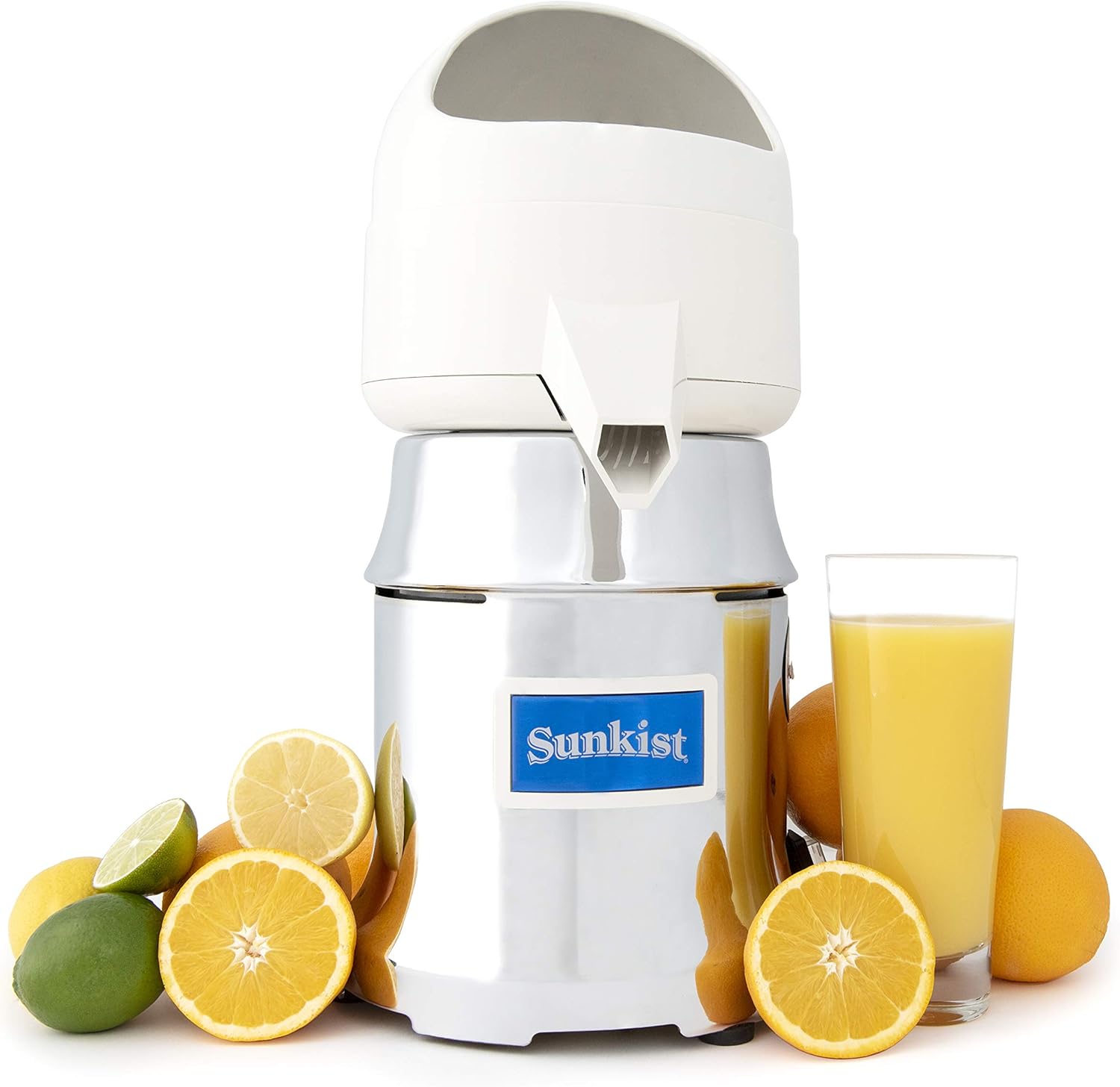
The Sunkist J-1 Commercial Juicer is a heavy-duty citrus press built for continuous use in commercial settings. It uses a corded 200-watt motor and three interchangeable extracting bulbs to handle different fruit sizes while chrome-plated steel and corrosion-proof plastic construction keep the unit durable and easy to clean. The juicer is typically used on a countertop to press large batches of oranges or other citrus, producing high throughput up to the stated 20-gallon capacity suited to busy cafes, concession stands, and juice bars. Notable practical features include dishwasher-safe components and stainless steel blade elements that simplify maintenance. The machine's weight and build give it stable operation and consistent extraction pressure, but it is a single-purpose citrus press so it lacks multifunction features found on general juicers. Buyers should plan for a dedicated station and routine cleaning to maintain long-term reliability in heavy use environments.
Best for: Buyers who need a dependable, purpose-built citrus press for steady commercial production and prioritize consistent extraction and low-maintenance cleaning routines.
Less Ideal for: Home users with occasional juicing needs or operators who want a multi-function juicer that handles non-citrus produce should consider a different appliance.
- Commercial-grade construction with chrome-plated steel and corrosion-resistant plastic for durability
- Three interchangeable extracting bulbs to accommodate different citrus sizes
- Dishwasher-safe parts and stainless steel blade material for easier cleaning and maintenance
- Designed for continuous high-throughput use with a stated 20-gallon capacity
- Single-function citrus press without additional juicing modes or attachments
- Relatively heavy and bulky which requires a dedicated counter space
Verdict: A rugged, purpose-built citrus press engineered for reliable, high-volume commercial orange juicing.
Zulay Kitchen Cast Iron Juicer

| Capacity | 0.6 liters |
|---|---|
| Material | Cast Iron & Stainless Steel |
| Special Features | Manual |
| Power Source | Manual |
This cast iron juicer is a lever-style, manual press built for repeated commercial or heavy home use. You place a halved citrus fruit in the 5-inch bowl, pull the long cast iron arm down and the stainless-steel cone and detachable strainer capture juice while keeping seeds out. The machine's weight and rubberized feet make it stable during high-pressure presses, and the cast iron construction plus stainless components feel durable enough for bar or small-shop workflows. Cleaning is simplified by removable strainers but the unit is hand-wash only, and at roughly 15 pounds it is not meant to be moved frequently. The mechanical leverage makes short work of thick-skinned fruits, producing consistent yield without electricity, which is handy behind busy bars or juice stations. Limitations to consider are the single-purpose design and required counter space and weight, so it is best where volume and durability matter more than portability or multi-functionality.
Best for: Buyers who want a proven, durable manual press for frequent juicing in a bar, cafe, or busy home kitchen and who value reliability and consistent extraction over portability.
Less Ideal for: If you need a lightweight, compact, or electric juicer for occasional countertop use or frequent transport, this heavy manual press is not a good fit.
- Heavy cast iron build for commercial-level durability
- Long lever provides strong mechanical advantage for high juice yield with minimal effort
- Detachable stainless-steel strainer keeps seeds out and simplifies cleaning
- Rubberized feet and weight provide stable, slip-free operation during use
- Hand wash only and not dishwasher-safe
- Heavy weight makes it less portable and requires dedicated counter space
Verdict: Choose this cast iron press when you need a no-electric, rugged manual juicer that delivers consistent commercial-grade extraction and stability.
Hamilton Beach Commercial 932 Juicer

| Power Source | Manual |
|---|---|
| Wattage | 800 watts |
| Capacity | 8 fluid ounces |
| Material | Metal |
| NSF Certified | Yes |
The Hamilton Beach Commercial 932 is a sturdy manual citrus juicer designed for restaurants and high-volume use. Its long extractor arm multiplies force to deliver high juice yield quickly while minimizing skin oil and pulp in the cup, and the metal construction with enamel finish resists corrosion from acidic fruit. Removable stainless steel strainer cone and a funnel simplify cleaning and make it easier to sanitize between uses, and the sure-grip feet keep the unit steady during operation. Because it is manual, it requires no power and avoids motor failures, but it does rely on physical effort and takes up counter space compared with compact electric models. NSF certification and heavy-duty gears speak to its suitability for commercial kitchens, though the unit is heavier and intended for a fixed station rather than portable home use. Overall it performs reliably for continuous juicing tasks where durability and sanitary design matter most.
Best for: Buyers who need a reliable, sanitary juicer for frequent commercial or high-volume use and prioritize durability and proven performance over portability.
Less Ideal for: People seeking a lightweight, portable, or fully electric countertop juicer for occasional home use should consider other options.
- Commercial-grade metal construction and enamel finish resist citrus corrosion
- High mechanical force for maximum juice extraction with minimal pulp and skin oil
- Removable stainless steel strainer cone and funnel for easier cleaning and sanitizing
- Sure-grip feet and heavy-duty gears provide stable, dependable operation
- NSF certification indicates suitability for foodservice environments
- Manual operation requires physical effort and is less convenient than electric juicers
- Relatively heavy and designed for a fixed counter location
Verdict: Choose the 932 when you want a tough, NSF‑rated manual juicer built for heavy commercial use and maximum juice extraction.
Choosing the Right Commercial Orange Juicer: Key Factors to Consider
Extraction Yield
How much juice a machine extracts from each orange directly affects ingredient cost and portion consistency. Higher yield reduces waste and lowers the per-serving fruit requirement.
Yield is influenced by the juicer type, the reamer or press geometry, and how completely the machine compresses or tears the fruit. In a commercial setting, predictable yield per orange helps with inventory planning and pricing.
Throughput and Cycle Speed
Throughput measures how many oranges the juicer can process in a given time. Fast cycle speed reduces customer wait times during peak service hours.
Consider both single-serve cycle duration and the machine's sustained performance under continuous use. A unit that is fast for a few cycles but overheats or stalls under load will hurt service flow.
Ease of Cleaning and Sanitizing
Juicers handle acidic, perishable produce, so frequent cleaning is mandatory to prevent bacterial growth and flavor transfer. Machines with tool-free disassembly and few small crevices cut cleaning time and lower labor costs.
Look for components that are dishwasher-safe or can be rinsed quickly, plus accessible surfaces that resist staining and pitting from citric acid.
Build Quality and Corrosion Resistance
Commercial environments are hard on equipment. Stainless steel or durable polymer components resist corrosion from citrus acids and frequent washdowns.
Robust construction reduces vibration and mechanical wear, extending service life and maintaining consistent extraction mechanics over time.
Serviceability and Parts Availability
Even well-built juicers need maintenance. Units designed for easy access to wear parts such as seals, shafts, and motors reduce downtime when repairs are required.
Check that common replacement parts are standardized and that routine maintenance tasks do not require sending the machine to a repair center.
Noise, Vibration, and User Comfort
Noise and vibration affect staff comfort and the customer experience, especially in front-of-house applications. Lower vibration reduces component stress and helps maintain alignment for consistent extraction.
Consider mounting, rubber feet, and motor balancing as features that improve day-to-day usability in busy service areas.
Types of Commercial Orange Juicers
Commercial orange juicers generally fall into a few design groups, each with distinct pros and operational considerations. Manual reamers are rare in commercial settings because they are labor intensive, while automatic reamer-style machines and pneumatic or hydraulic press units are common for higher-volume operations.
Automatic reamer units are compact and fast, offering a balance of speed and footprint. Press-style machines compress halves against a screen or plate to extract more juice at lower pulp and oil levels, which can be helpful depending on the menu.
- Automatic reamers: quick cycles, compact footprint, easier cleaning.
- Press systems: higher extraction yield, gentler on some fruit varieties, may require larger footprint.
- Hybrid designs: aim to combine speed with improved yield; inspect maintenance needs.
Sanitation Best Practices
Establish a routine that includes disassembly and sanitizing of food-contact parts after each shift. Use food-safe detergents and follow local health code dwell times for sanitizers.
Rinse fruit residue immediately to prevent sticky buildup and odor. Keep spare wearable parts on hand so you can swap components quickly during service without interrupting production.
- Schedule full disassembly and sanitizing daily if running high volumes.
- Inspect seals and gaskets for acid damage weekly and replace as needed.
- Document cleaning steps so staff follow a consistent process.
Sizing for Your Operation
Estimate peak-period demand to size the juicer appropriately. A small unit may be fine for low-volume cafes but will struggle in a brunch-focused restaurant or a juice bar with steady traffic.
Factor in prep time for halving fruit and any staging needs. In some operations, multiple smaller units can offer redundancy so one failure does not halt service.
- Calculate expected oranges per hour during peak service.
- Consider redundancy and service windows when choosing capacity.
- Account for counter space and power supply needs.
Installation and Ventilation
Place commercial juicers on stable, level surfaces and ensure vibrations are damped by rubber feet or isolation pads. Verify electrical requirements and provide a dedicated circuit if recommended by local codes.
Although citrus juicers are not high-heat equipment, good airflow and a clean location prevent motor strain and simplify cleaning routines.
- Use anti-slip pads or mounts in high-throughput stations.
- Keep the area clear of splashes and fruit waste to reduce pests and odor.
- Adhere to local code for appliance spacing and electrical hookups.
Operating Tips to Maximize Lifetime
Rotate fruit feed to avoid repeated impact on the same components and follow recommended duty cycles. Allow motors to cool if a machine is not rated for continuous heavy duty.
Regularly lubricate moving parts where specified by the manufacturer and replace wear items on a schedule to avoid sudden failures during service.
- Follow specified duty cycle limits to prevent overheating.
- Keep a maintenance log for lubrication and part replacement intervals.
- Train staff on correct fruit preparation to reduce strain on mechanisms.
How We Chose the Best Commercial Orange Juicer
We shortlisted Commercial Orange Juicers based on criteria that matter in professional settings. First, extraction yield and consistency were primary: we prioritized machines that get the most juice per fruit with predictable output per cycle. Second, cycle durability and duty rating were assessed, looking for units designed for continuous operation during rush periods. Third, ease of cleaning and disassembly was considered because frequent sanitizing is essential in foodservice. Fourth, serviceability and parts availability were weighed so any needed repairs or replacements are straightforward. Fifth, build materials and corrosion resistance were evaluated to ensure long-term performance in wet, acidic environments. We excluded countertop consumer models and any units rated for occasional home use. We also filtered out designs that require specialized tools for routine cleaning or that lack clear maintenance guidance. The final picks reflect machines that balance high yield, uptime, and practical upkeep for professional kitchens and juice-focused operations.
Our full evaluation process is outlined in our review methodology.
FAQ
How often should a commercial orange juicer be sanitized?
Sanitize food-contact parts daily when used for high-volume service and after each shift at minimum. Rinse surfaces between batches and follow local health code requirements for sanitizer concentration and contact time.
Can a commercial juicer handle different orange sizes?
Most commercial orange juicers accommodate a range of citrus sizes, but yield and cycle time can vary. Some units include adjustable cones or inserts to improve extraction on small or large fruit.
What maintenance tasks prevent downtime?
Routine tasks include inspecting and replacing gaskets, lubricating specified bearings, checking motor brushes if applicable, and cleaning screens or filters frequently to prevent clogging.
Are commercial juicers noisy for front-of-house placement?
Noise levels vary by design and motor size. Many units produce moderate noise; look for models with vibration damping and balanced motors if quiet operation is important.
How can I judge if a juicer offers good extraction yield?
Compare the average number of oranges needed per liter or per serving during a trial period. Machines with higher compression or pressing mechanisms typically yield more juice per fruit.
Final Verdict
Choosing the right Commercial Orange Juicer comes down to balancing yield, throughput, and practical upkeep. Prioritize machines that deliver consistent extraction and are easy to disassemble for cleaning if you run frequent service periods. Durability and accessible parts support long-term uptime and lower unexpected downtime. For most professional operations, focus on units rated for continuous duty that match your peak demand. If sanitation or staff comfort is a concern, give extra weight to models with tool-free cleaning and low vibration. That approach will help you pick a juicer that keeps service moving while controlling waste and maintenance burdens.