
Note: This article contains affiliate links. If you click on these links and make a purchase, we may earn a small commission at no extra cost to you. This helps support our research and content. Read our full affiliate disclosure here.
Picking the right dual-zone wine cooler matters if you store both reds and whites or want short-term aging without dedicating separate units. Under $500 there are models that balance temperature accuracy, storage layout, and everyday usability. In this guide we shortlist the top options in this price tier and explain the practical tradeoffs you should expect. We evaluated units for how well they maintain separate zones, how much usable bottle capacity they offer, and which features reduce day-to-day hassle. Read on to find a compact cooler that fits your space and keeps bottles at their best.
Top Picks at a Glance
| Best Overall The best all-around choice for most situations | NutriChef Dual-Zone Wine Cooler PKCWCDS275 |  |
| Best Quality Built to a higher standard if you want something more solid | BODEGA Dual-Zone Wine Fridge |  |
| Best Value The sweet spot between price and what you get | BODEGA 24-Bottle Wine Cooler |  |
| Best Budget The cheapest option that still gets the job done reliably | NutriChef 24-Bottle Dual Zone Wine Fridge |  |
| Top Rated A top-rated pick with lots of positive feedback | ICEVIVAL Dual Zone Wine Fridge |  |
| Most Popular A crowd favorite that many people choose with confidence | Tylza 15" Dual Zone Wine Fridge |  |
| Best Seller A high-volume bestseller chosen again and again | Ivation 33-Bottle Dual Zone Wine Cooler |  |
NutriChef Dual-Zone Wine Cooler PKCWCDS275

| Capacity | 27 Bottle |
|---|---|
| Temperature Range | 41°F to 64°F |
| Cooling Method | Compressor |
| Voltage | 120 |
| Installation Type | Freestanding |
The NutriChef PKCWCDS275 is a compact dual-zone wine cooler designed to store and chill up to 27 standard bottles while offering separate temperature control and quiet compressor cooling. Its digital touch panel and LED display make selecting and monitoring temperatures simple, and the internal circulation fan helps maintain consistent conditions across the two zones. Polished chrome racks and an interior LED light give a tidy presentation, and the recessed handle and glass door suit countertop or freestanding placement in kitchens or offices. Practical buyers will appreciate the narrow footprint that fits in tight spaces and the manual defrost design that keeps electronics straightforward. Expect modest energy use and a basic feature set: there is no advanced humidity control or high-efficiency rating, and the unit uses a manual defrost and a one-key lock rather than premium security features. For someone after a straightforward, space-saving dual-zone cooler that looks clean and keeps bottles at serving or storage temperatures, this model performs well within its class.
Best for: Buyers who want a practical, space-conscious dual-zone cooler to store a modest collection and reliably keep reds and whites at separate serving temperatures.
Less Ideal for: Collectors seeking long-term cellar conditions, precision humidity control, or the highest energy efficiency should consider larger or more advanced cellar units instead.
- True dual-zone control with adjustable 41°F–64°F range for different wine types
- Compact freestanding design fits in narrow spaces and on countertops
- Digital touch controls and LED display for easy temperature management
- Quiet compressor operation with internal circulation fan for even cooling
- Manual defrost system requires occasional user maintenance
- No advanced humidity control or high energy-efficiency certification listed
Verdict: A compact, no-frills dual-zone cooler that reliably stores about two dozen bottles and keeps reds and whites at separate serving temperatures.
BODEGA Dual-Zone Wine Fridge

| Capacity | 3.2 cubic feet |
|---|---|
| Bottle capacity | Holds 30 bottles |
| Temperature range | 41°F–72°F |
| Cooling method | Compressor |
| Installation | Freestanding/Built-In/Undercounter |
This compact 15-inch wine fridge gives you two independently controlled zones so red and white bottles can be stored at different serving temperatures, with a digital LED panel for 1°F adjustments and temperature memory. It uses compressor cooling and front-vent airflow, which speeds recovery after door openings and makes it suitable for undercounter installation. Five removable wood-look shelves let you rearrange for larger bottles or champagne, and the double-glazed tempered glass door with UV protection and blue LED lighting helps preserve and display the collection. Practical extras include an automatic lock with key, adjustable feet for leveling, and a quiet operation that the listing cites around low 40s dB. Expect reliable cooling and flexible placement, though a 30-bottle capacity and 3.2 cu ft interior are best for small collections rather than large cellars, and built-in installation requires the front vent remain unobstructed. For someone fitting a compact built-in dual-zone cooler, this model balances features and footprint well.
Best for: Buyers who need a compact built-in dual-zone cooler to store a modest collection and prioritize precise temperature control and quiet compressor performance in a small footprint.
Less Ideal for: Collectors who need high-capacity storage or large-format bottle capacity should look at larger dedicated cellar units instead.
- True dual-zone control with 41°F–72°F range and 1°F adjustment increments
- Compressor cooling with front vent allows built-in or freestanding installation
- Double-glazed tempered glass with UV protection and interior LED lighting
- Five removable shelves let you fit different bottle sizes including champagne
- Security lock, temperature memory, and adjustable leveling feet for stable installation
- 3.2 cu ft capacity holds about 30 bottles, which is small for larger collections
- Built-in use requires keeping the front vent clear which can limit placement flexibility
Verdict: A compact built-in-ready dual-zone cooler that delivers precise temperature control and strong cooling performance for small to medium wine collections.
BODEGA 24-Bottle Wine Cooler
| Configuration | 24 Bottle Wine Cooler Refrigerator |
|---|---|
| Cooling Method | Compressor |
| Defrost System Type | Frost Free |
| Number Of Shelves | 6 |
| Voltage | 115 volts |
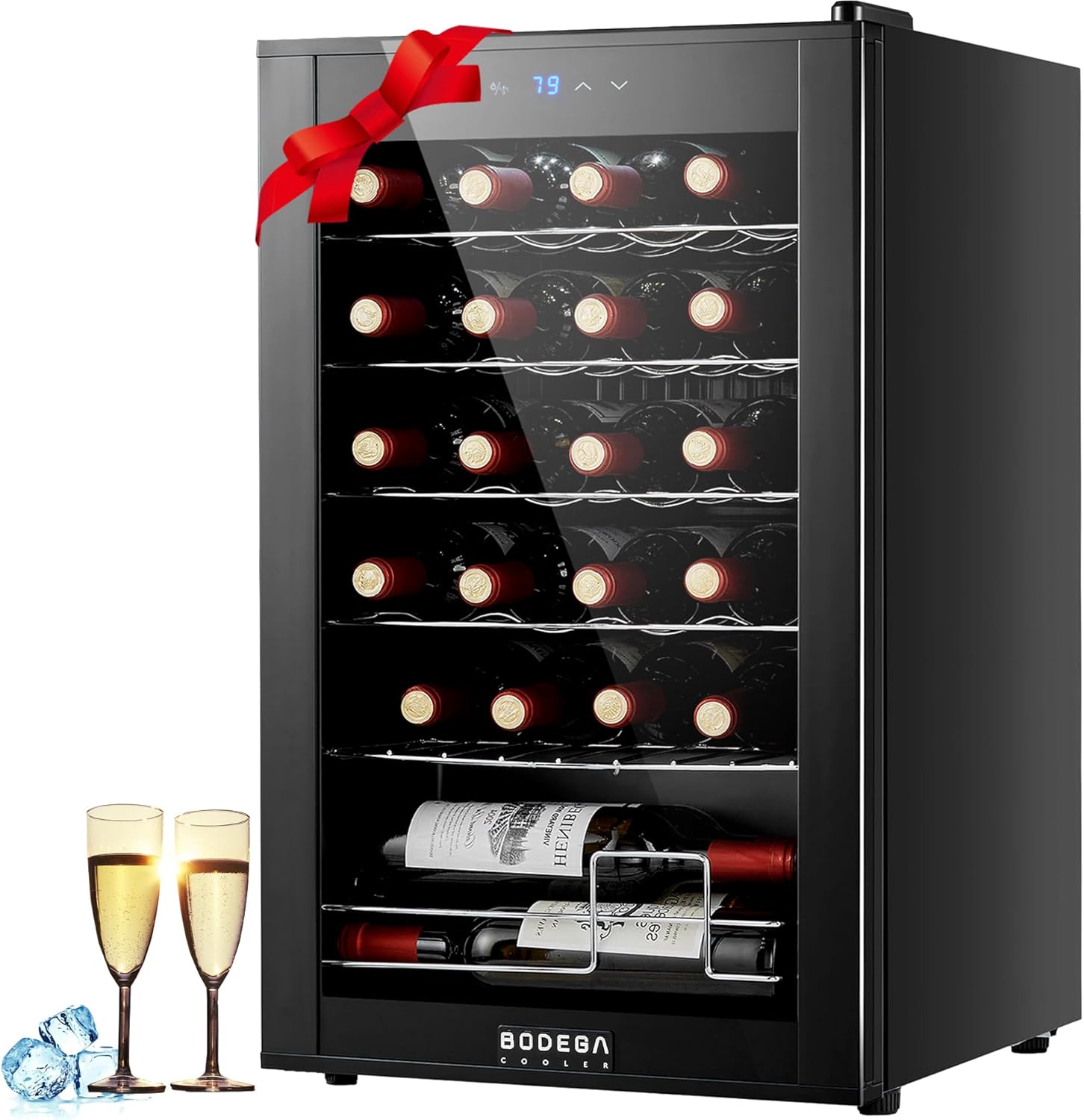
This BODEGA 24-bottle wine cooler is a compact freestanding fridge that uses a compressor cooling system to reach and hold cellar-style temperatures between about 41 and 64.4°F. It is set up primarily as a single-zone cooler with six removable chrome-plated metal shelves, a digital panel on the door for temperature changes without opening the unit, and a double-layer UV-protected glass door that helps limit light exposure. The compressor gives faster, wider-range cooling than thermoelectric models, and the unit runs quietly enough for kitchens, home bars, or bedrooms while offering automatic defrost cycles for low maintenance. Practical touches include leveling feet, a built-in handle, white LED interior lighting, and a lockable door. The main limitation is that this model is single zone, so it cannot maintain separate temperatures for reds and whites at the same time, which matters if you want true dual-zone storage under one roof. For buyers seeking straightforward, reliable compressor performance and a modest footprint, this cooler is an efficient choice; those who need independent dual-temperature control should look at dual-zone models instead.
Best for: Buyers who prioritize a compact, reliable compressor cooler that holds a moderate collection at consistent cellar temperatures and values quiet operation and easy maintenance.
Less Ideal for: Collectors who need true dual-zone storage to keep red and white wines at different serving temperatures or those requiring built-in under-counter installation.
- Compressor cooling for faster and wider-range temperature control than thermoelectric units
- Digital door-mounted temperature panel lets you adjust settings without opening the fridge
- UV-protected double glass door reduces light exposure to stored bottles
- Six removable chrome-plated shelves maximize flexible bottle storage for 24 standard bottles
- Automatic defrost cycle and quiet operation reduce maintenance and noise disruption
- Single-zone design cannot hold two different temperatures for reds and whites simultaneously
- Not specifically designed as an under-counter built-in unit
Verdict: Choose this unit if you want a compact, budget-friendly compressor wine cooler that reliably holds cellar temperatures for a 24-bottle collection.
NutriChef 24-Bottle Dual Zone Wine Fridge
| Capacity | 75.4 liters |
|---|---|
| Bottle capacity | 24 bottles |
| Temperature range | 41°F to 64°F |
| Power | 120 volts |
| Cooling method | Compressor |
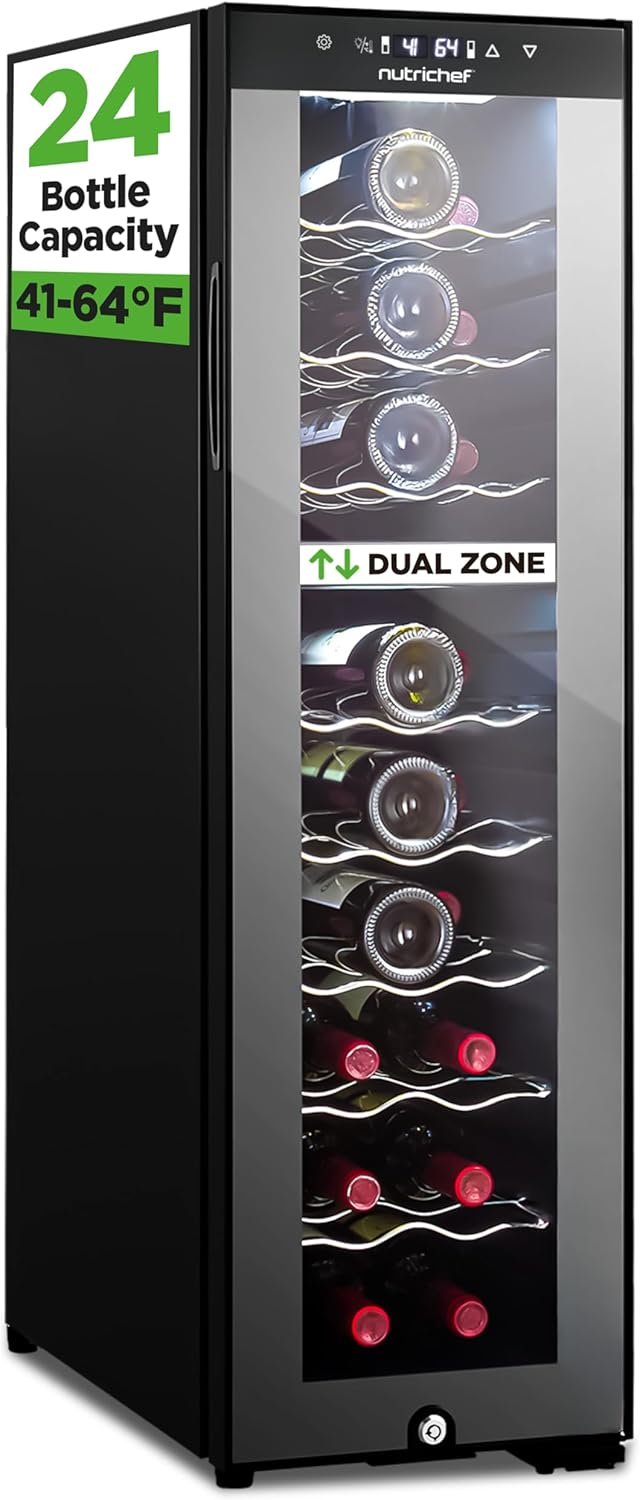
This NutriChef dual-zone wine fridge is a compact, budget-friendly option for casual collectors who need separate temperatures for reds and whites. It holds up to 24 standard bottles on polished chrome racks and uses a compressor with an internal circulation fan to keep temperatures stable between 41°F and 64°F. The glass door with airtight seal, recessed handle, and interior LED lighting give it a tidy, modern look, while the digital touch panel makes switching between Fahrenheit and Celsius simple. In real use it is best placed freestanding on the floor or a sturdy countertop; the unit is relatively narrow so it fits in tighter spaces. Noise is kept low thanks to the compressor design, but as with any compressor cooler it will run intermittently. The manual defrost and basic 1-year warranty reflect its value positioning, so buyers expecting premium insulation, advanced vibration control, or long warranty coverage should temper expectations. For the price it delivers straightforward temperature control and a small footprint for mixed collections.
Best for: Buyers looking for an affordable, space-saving dual-zone cooler to store a modest mixed wine collection and who prioritize straightforward temperature control over premium features.
Less Ideal for: Collectors who need large capacity, professional-grade temperature stability, or extended warranty coverage should consider higher-end models instead.
- Dual-zone cooling with adjustable 41°F to 64°F range for storing reds and whites
- Compact freestanding design fits tight spaces while holding up to 24 bottles
- Digital touch display with Celsius or Fahrenheit and interior LED lighting
- Quiet compressor operation with internal circulation fan for stable temperatures
- Manual defrost and only a 1-year warranty, which is modest compared with premium models
- Narrow capacity and fewer advanced features like vibration isolation or long-term insulation
Verdict: A compact, budget-focused dual-zone cooler that delivers usable temperature control for modest mixed wine collections under $500.
ICEVIVAL Dual Zone Wine Fridge

| Capacity | 3.6 cubic feet |
|---|---|
| Size | 15 Inch-Dual Zone 29 Bottles |
| Cooling Method | Compressor |
| Defrost System Type | Frost Free |
| Installation Type | Undercounter |
This ICEVIVAL 15-inch dual-zone wine fridge stores up to about 29 bottles across two independently controlled temperature zones so you can keep reds and whites at serving temps in the same unit. It uses a quiet compressor cooling system and frost-free operation to provide steady temperatures in the 40 to 65°F range, while a double-pane UV-resistant glass door helps protect bottles from light. The unit is intended for undercounter or freestanding installation and includes six removable wooden shelves that slide to reduce vibration and simplify bottle access. A digital touch panel and LED display make precise temperature adjustments straightforward. Practical benefits include flexible placement, reduced temperature swings compared with thermoelectric coolers, and easy organization with adjustable shelving. Important limitations are its compact 15-inch footprint, which constrains large-format bottle storage, and the trade-off of a compressor fridge is slightly higher energy use compared with passive cellaring. For buyers seeking a reliable, space-saving dual-zone solution, this model balances temperature control and convenience.
Best for: Buyers who prioritize dependable temperature stability and light protection in a compact undercounter or freestanding wine cooler and want separate zones for mixed collections.
Less Ideal for: Collectors who need high-capacity storage or frequent accommodation of magnum and oversized bottles should look at larger capacity models.
- True dual-zone thermostat for storing reds and whites at different temperatures
- Compressor cooling with frost-free operation for consistent temperature control
- UV-resistant double-pane glass door protects wine from light and improves insulation
- Removable wooden sliding shelves reduce vibration and simplify bottle organization
- Compact 15-inch width limits storage of large or oversized bottles
- Compressor design results in higher annual energy consumption compared with passive options
Verdict: A reliable, space-saving dual-zone compressor wine fridge that keeps reds and whites at stable serving temperatures for buyers who need dependable everyday storage under $500.
Tylza 15" Dual Zone Wine Fridge

| Capacity | 3.6 cubic feet / 30 bottles |
|---|---|
| Temperature Range | Upper 40-55°F, Lower 55-65°F |
| Installation Type | Built-In or Freestanding |
| Cooling Method | Compressor (Rotary Scroll) |
| Shelves | 6 beech wood removable shelves |
This compact 15-inch wine fridge offers a true dual-zone layout with separate temperature ranges for red and white storage, making it useful for small collections or under-counter installation. It uses a compressor cooling system with rotary scroll compressor technology and features six beech wood shelves, low-E tempered glass door, touch controls and a key lock for security. The unit supports thermostat control, automatic defrost and a memory function that restores the last temperature after a power interruption, and two LED light-timing options help avoid long light exposure. In practice it cools quickly and runs quietly thanks to vibration-suppressing feet and an anti-shake design, though like most compact compressors it produces some background noise and benefits from the 24-hour leveling/post-delivery rest recommendation. The removable shelves let you fit larger bottles, but the 30-bottle capacity limits it to modest collections. For buyers who want a space-saving built-in look with separate zones for different wines, this is a practical, feature-rich option; those needing large cellar capacity or the absolute quietest thermoelectric operation should look elsewhere.
Best for: Buyers who want a compact under-counter wine cooler with separate temperature zones and practical features for a modest personal collection and who value verified performance and reliability.
Less Ideal for: Those who need large long-term cellar capacity or a completely silent, vibration-free wine storage solution.
- Dual-zone temperature control for storing reds and whites at separate ranges
- Compact built-in or freestanding design fits under counters
- Six removable beech wood shelves allow flexible bottle arrangements
- Touch controls, temperature memory after power loss, and key lock add convenience and security
- Compressor cooling with anti-shake feet delivers efficient cooling and relatively low noise
- 30-bottle capacity is small for serious collectors
- Compressor units produce some background noise compared with thermoelectric coolers
Verdict: A feature-packed 15-inch built-in wine cooler that gives small collectors separate temperature zones and secure, reliable cooling in a compact footprint.
Ivation 33-Bottle Dual Zone Wine Cooler

| Capacity | 3.2 cubic feet |
|---|---|
| Bottle Capacity | 33 bottles |
| Temperature Range (Upper) | 54 – 64°F |
| Temperature Range (Lower) | 41 – 57°F |
| Power | 115V, 65W |
The Ivation 33-Bottle Dual Zone Wine Cooler is a compact freestanding cellar designed to store both red and white wines at their ideal serving or short-term aging temperatures. Its compressor cooling system and inverter help maintain stable temperatures across two independently controlled zones (upper 54–64°F, lower 41–57°F), and a digital touch display makes adjustments straightforward. Wire shelves are removable to fit larger bottles and the double-paned UV-resistant glass door with airtight gasket protects wines from light and helps insulation. The unit runs quietly with low vibration to avoid disturbing sediment and includes an internal LED light and a keyed door lock for security. Practical downsides are the limited 3.2 cu ft capacity if you plan a large collection and the wired shelving rather than wooden shelves preferred by many collectors, but for the price it delivers solid temperature stability and useful features for mixed collections.
Best for: Buyers who prioritize temperature performance and stability for mixed red and white collections and want a reliable compressor unit that fits in a kitchen or apartment.
Less Ideal for: Those needing a high-capacity wine cellar or a premium display unit with wooden shelving and built-in custom racking should consider larger or higher-end models.
- Dual independent temperature zones for storing reds and whites at different temps
- Compressor cooling with inverter for stable, low-vibration operation
- UV-resistant double-paned glass door and airtight gasket to protect wine from light and maintain internal conditions
- Touch control digital display with LED interior light and a keyed door lock for convenience and security
- 3.2 cubic foot capacity may be small for larger collections
- Wire shelves instead of wooden or beech-style shelving preferred by some collectors
Verdict: If you want dependable compressor cooling and independent temperature control for a mixed red and white collection under $500, this Ivation cooler delivers strong performance in a compact freestanding package.
Choosing the Right Dual-Zone Wine Cooler: Key Factors to Consider
Temperature Control Accuracy
Accurate temperature control ensures wines are stored at their ideal service or cellaring temperature. Look for units with precise digital thermostats and the ability to set temperature in single-degree increments where possible. Consistency matters more than absolute low temperature because fluctuations stress wine and accelerate aging.
Temperature accuracy also affects how you allocate bottles between zones. If the cooler consistently holds target temps, you can safely store long-term bottles in the lower zone and keep daily-drink whites or rosés in the upper zone without worry.
Zone Independence
True dual-zone function means each compartment has its own thermostat and cooling circuit, or at least an effective method for preventing heat transfer between zones. This matters when storing wines that need different temperatures simultaneously, such as full-bodied reds alongside chilled whites.
If zones are not independent, adjusting one area may shift the other and force compromise on optimal serving temps. Confirm that the cooler advertises independent controls and uses internal baffling or separate evaporators to maintain separation.
Usable Bottle Capacity
Manufacturers often state maximum bottle counts based on factory-standard Bordeaux bottles laid flat. Real-world bottle capacity depends on shelf spacing, the presence of adjustable shelves, and whether larger-format bottles like Burgundy or sparkling are accommodated. Consider how many bottles you actually plan to store and whether you need flexible shelf layouts for mixed sizes.
Also account for door storage and vertical space lost to temperature-control components. A unit with fewer advertised bottles but adjustable shelving may be more practical than a rigid layout with a higher count.
Noise and Vibration
Noise level matters if the cooler will sit in a living area, kitchen, or home office. Compressor-based coolers are generally louder and can introduce vibration that disturbs sediment in aged bottles. Thermoelectric models are quieter and produce less vibration but may struggle with ambient heat.
Evaluate where the cooler will live and prioritize low-vibration designs for long-term storage. Look for user-reported decibel ranges and anti-vibration shelving or mounting details when possible.
Build Quality and Door Design
Solid build materials and a well-sealed door preserve internal climate and reduce energy use. Glass doors are convenient for display but require good UV protection and tight seals to prevent light and heat ingress. Hinges, door handles, and gasket quality affect how well the cooler maintains temperature over time.
Consider whether a reversible door is necessary for installation, and whether the interior finish and shelf materials are durable and easy to clean.
Controls and User Interface
Clear, accessible controls make adjusting temperatures and modes straightforward. Digital displays with touch controls or physical buttons should be responsive and show both zone temps at a glance. Some units include lock functions, alarms, or child locks that add convenience and safety.
Good controls reduce the risk of accidental changes and make it easier to fine-tune storage conditions for different bottle types.
Where to Place a Dual-Zone Wine Cooler
Placement affects cooling performance and longevity. Install the cooler away from direct sunlight, heat sources, and high-humidity areas to prevent the compressor from working harder than necessary. Ensure there is adequate clearance around the unit for ventilation if the cooler requires rear or top airflow.
If you plan to use the unit for medium-term storage, choose a stable location where temperature swings are minimal. In tight spaces, check for reversible doors and confirm the hinge side allows full shelf extension.
- Leave recommended clearance for ventilation as specified in the manual.
- Avoid locations near ovens, dishwashers, or sunny windows.
- Place on a level surface to prevent vibration and rattling.
Thermoelectric Vs Compressor Cooling in This Price Range
Both cooling methods appear in sub-$500 dual-zone coolers and each has tradeoffs. Thermoelectric units are quieter and introduce less vibration, which is helpful if the cooler sits in a living space or near a TV. However, they are less effective in warm ambient conditions and may struggle to reach low set points when room temperature is high.
Compressor-driven systems are more powerful and better at maintaining distinct temperatures across two zones, especially if you have many bottles or keep the cooler in warmer rooms. They typically use more energy and can produce more noise and vibration, so look for models with vibration-damping features if you prefer compressors.
- Thermoelectric: quiet, low vibration, limited cooling range.
- Compressor: stronger cooling, better for varied temps, more noise.
Shelf Types and Configurations
Shelving determines how you organize bottles and how many different shapes fit. Wooden shelves cradle bottles and damp vibration, while wire shelves can offer more airflow but sometimes allow rolling. Removable or sliding shelves make accessing bottles easier and reduce the need to remove many items to reach a single bottle.
Think about how often you rotate bottles. If you frequently pull from the middle, prefer smooth slide-out shelves. For long-term storage you may prioritize stable cradling to minimize movement.
- Wood shelves absorb vibration and look traditional.
- Wire shelves improve airflow and often increase advertised capacity.
- Slide-out shelves simplify access to bottles stored deep inside.
Energy Use and Operating Costs
Energy consumption varies with cooling method, insulation quality, and how often the door is opened. Compressor units typically consume more electricity but maintain tighter control, while thermoelectric models are less power-hungry but may run longer in warm rooms. Look for units with good door seals and efficient compressors to lower ongoing costs.
If you plan to run the cooler continuously, minor differences in wattage compound over months and years. Consider usage patterns and where the cooler will operate year-round when weighing models.
- Minimize door openings to conserve energy.
- Good insulation reduces compressor runtime.
- Consider ambient room temperature when estimating operating costs.
Installation and Maintenance Tips
Allow the cooler to settle upright for several hours after delivery before switching it on. Level the unit carefully to avoid rack misalignment and excess vibration. Keep vents clear and dust the condenser or vents periodically to maintain cooling efficiency.
Regularly check door gaskets for wear and clean interior surfaces with mild detergent. If humidity control is important, occasionally monitor the internal humidity and wipe pooled condensation to prevent mold or odors.
- Level the unit and provide ventilation clearance.
- Clean condenser and vents per the manual schedule.
- Inspect door seals and shelves for wear and alignment.
How We Chose the Best Dual-Zone Wine Cooler
We focused on criteria that matter for owners who need a reliable dual-zone cooler without spending more than $500. First, temperature accuracy and stability were primary filters. We prioritized units with independent thermostats for each zone and consistent reported performance over multiple temperature set points. Second, usable capacity and shelf layout were decisive since advertised bottle counts can be misleading; we favored efficient shelf spacing and adjustable shelving that accommodate different bottle shapes. Third, vibration and noise levels were assessed because excessive vibration can disturb sediments and high noise reduces kitchen or living-room comfort. Fourth, energy use and cooling method were reviewed to ensure practical operating costs and consistent performance in typical indoor conditions. We also considered control clarity and build quality to minimize maintenance and make everyday use straightforward. Excluded from the list were single-zone coolers, units with non-independent zones, and any products lacking documented temperature control or clear shelf configuration details. We did not include specialty or commercial-grade units that fall outside the under $500 target. These filters produced a concise list of practical, user-friendly dual-zone options.
Our full evaluation process is outlined in our review methodology.
FAQ
Can I store both reds and whites in a dual-zone cooler under $500?
Yes. Dual-zone coolers are designed to hold separate temperatures for reds and whites, but performance varies. Choose a unit with independent controls and stable temperature hold to keep different styles at their ideal serving temps.
Is a thermoelectric cooler adequate for long-term wine storage?
Thermoelectric units are quieter and produce less vibration but are sensitive to ambient room temperature. They are suitable for short- to medium-term storage in a cool room but may not be ideal for long-term cellaring, especially in warm environments.
How many bottles will actually fit in a listed capacity?
Advertised capacity often assumes standard Bordeaux bottles laid flat. Real capacity depends on shelf spacing, bottle shape, and whether shelves are adjustable. Expect effective capacity to vary and prioritize usable layout over headline numbers.
Do dual-zone coolers need special ventilation?
Some models require rear or top clearance for airflow. Proper ventilation prevents overheating and reduces compressor runtime. Always follow the manufacturer's clearance guidelines for the installation location.
Will vibration damage wine over time?
Persistent vibration can disturb sediment and accelerate undesirable reactions, especially for older or long-aged bottles. If you plan to store wine long term, favor designs with low vibration or vibration-damping shelving.
Final Verdict
For buyers seeking dual-zone cooling under $500, prioritize stable temperature control and genuine zone independence over headline capacity. Decide whether quiet operation or stronger compressor performance is more important based on where the unit will live. Pay attention to shelf configuration and door quality because these determine how many useful bottles you can store and how easy the cooler is to use. Tradeoffs are inevitable in this price range, so match the cooler's strengths to your needs: choose low-vibration models for living areas and quiet service, or stronger compressors if you need tight control in a warmer room. With clear priorities you can confidently pick a practical dual-zone cooler that preserves both reds and whites.