
Note: This article contains affiliate links. If you click on these links and make a purchase, we may earn a small commission at no extra cost to you. This helps support our research and content. Read our full affiliate disclosure here.
If you want faster print speeds and crisper motion control for functional parts, a CoreXY 3D printer is a strong next step. CoreXY kinematics reduce moving mass on the print head and let you push higher acceleration without sacrificing detail, which matters when printing mechanical parts, prototypes, or batch runs for small projects. This guide shortlists seven top CoreXY 3D printers across common build volumes and feature sets, and explains the practical tradeoffs in speed, frame rigidity, and extruder choice. Below you will find our picks followed by clear evaluation criteria so you can match a printer to the way you print.
Top Picks at a Glance
| Best Overall The best all-around choice for most situations | FLASHFORGE Creator 5 Pro |  |
| Best Quality Built to a higher standard if you want something more solid | Bambu Lab P2S Combo |  |
| Best Value The sweet spot between price and what you get | ELEGOO Centauri Carbon 2 |  |
| Best Budget The cheapest option that still gets the job done reliably | FLASHFORGE Adventurer 5M |  |
| Top Rated A top-rated pick with lots of positive feedback | Original Prusa CORE One+ kit |  |
| Most Popular A crowd favorite that many people choose with confidence | Creality K1C CoreXY 3D Printer |  |
| Best Seller A high-volume bestseller chosen again and again | Bambu Lab P1S 3D Printer |  |
FLASHFORGE Creator 5 Pro

| Nozzle max temperature | 320°C |
|---|---|
| Chamber temperature | 65°C |
The FLASHFORGE Creator 5 Pro is a CoreXY desktop printer designed for multi‑material and engineering-grade printing. It uses four preloaded, preheated toolheads and a FlashSwap toolchanger so you switch heads instead of reloading filament, which speeds up multi‑material workflows and reduces downtime. The machine supports a wide range of filaments including PLA, PETG, TPU, ABS and many carbon‑fiber and high‑temperature nylons, aided by a 320°C hardened nozzle and a 65°C actively heated chamber to reduce warping on large parts. An adaptive airflow cooling system helps with bridging and overhangs on low‑temp materials, while Flow Dynamics Calibration adjusts extrusion behavior to maintain consistent results as conditions change. Practical benefits include faster multi‑material prototyping, better layer bonding for engineering parts, and a mostly enclosed build area for cleaner prints. Important tradeoffs are the printer's complexity and size that may require learning and upkeep, and the need for proper ventilation and material handling when printing high‑temperature or composite filaments.
Best for: Buyers who want a versatile CoreXY printer capable of reliable multi‑material and engineering part production and are willing to invest time learning calibration and material handling.
Less Ideal for: Casual hobbyists on a tight budget or those who need a compact, plug‑and‑play machine for only occasional PLA prints.
- Four independent preheated toolheads with a toolchanger for fast multi‑material swaps
- Supports a broad range of engineering and composite filaments including high‑temperature nylons and carbon‑fiber blends
- 320°C hardened nozzle and 65°C active chamber improve layer adhesion and reduce warping on large prints
- Adaptive airflow and flow calibration systems that help produce cleaner overhangs and consistent extrusion
- Higher machine complexity increases setup, tuning, and maintenance effort
- Size and enclosure require a dedicated workspace and attention to ventilation for high‑temp materials
Verdict: Choose the Creator 5 Pro if you need a CoreXY workhorse that speeds multi‑material workflows and handles demanding engineering filaments with repeatable results.
Bambu Lab P2S Combo

| Print speed | Up to 600 mm/s |
|---|---|
| Filament drying temp | Up to 65 °C |
| Bundled items | P2S printer + AMS 2 Pro |
| Error detection | AI failure detection |
The Bambu Lab P2S Combo pairs a high-speed CoreXY P2S printer with the AMS 2 Pro accessory to deliver fast, reliable prints and multi-color/multi-material workflows. The P2S focuses on speed and precision, claiming up to 600 mm/s printing with a PMSM servo extruder and active flowrate compensation for consistent layer quality and sharp corners. The AMS 2 Pro adds seamless multi-spool handling and on-board filament drying up to 65 C, which is useful when switching materials or printing long jobs. Practical touches include quick-swap nozzles, automatic calibration and AI failure detection that simplify setup and reduce failed prints, and an adaptive airflow system that balances cooling for overhangs with a warm chamber for engineering filaments. Expect a compact but relatively heavy machine that is ready-to-print quickly and integrates with Bambu Studio and MakerWorld for model access. Limitations include that multi-color printing requires the combo with AMS 2 Pro rather than the base P2S alone, and achieving top speeds depends on tuned profiles and appropriate filament choice.
Best for: Buyers who prioritize print speed and precision and want a near-turnkey CoreXY system that scales from rapid prototyping to demanding engineering prints with multi-material flexibility.
Less Ideal for: Casual hobbyists who only need occasional single-color prints or buyers seeking the lowest-cost entry-level machine should consider simpler, less expensive printers instead.
- Extremely high peak print speeds (up to 600 mm/s) for fast throughput
- PMSM servo extruder with active flowrate compensation for improved dimensional accuracy
- AMS 2 Pro adds reliable multi-spool handling and integrated filament drying to prevent moisture issues
- Automatic calibration, quick-swap nozzles and AI failure detection reduce setup time and failed prints
- Adaptive Airflow System and carbon filter provide better cooling control and cleaner exhaust during prints
- Multi-color/multi-material printing requires purchasing the AMS 2 Pro combo rather than the printer alone
- Top advertised speeds require optimized settings and suitable filament to maintain print quality
Verdict: Choose the P2S Combo when you need a high-speed CoreXY setup with factory-quality extrusion control and built-in multi-spool drying for fast, reliable multi-material production.
ELEGOO Centauri Carbon 2

| Build volume | 256 x 256 x 256 mm |
|---|---|
| Max nozzle temp | 350°C |
| Motion type | CoreXY |
| Max speed | Up to 500 mm/s |
The Centauri Carbon 2 is a CoreXY FDM printer built for speed and multicolor work, combining a rigid die-cast aluminum frame, dual high-torque steppers, and the CANVAS multicolor system. It prints up to 500 mm/s with aggressive acceleration while using automatic calibration, bed leveling, and continuous print sensing so you can start a job and monitor progress with minimal fiddling. The CANVAS module supports instant color switching, RFID filament detection, and auto-refill/tangle prevention, which makes multicolor prints and material swaps far less error-prone than piecing together manual extruder solutions. Temperature control to 350°C and support for PLA, ABS, TPU and engineering filaments expand material choices, and integrated vibration compensation helps preserve detail at higher speeds. Trade-offs are typical for very fast CoreXY machines: users should expect a learning curve dialing in top-speed profiles and potentially more frequent tuning for highest-velocity prints, and large multicolor setups add mechanical and firmware complexity compared with single-extruder systems.
Best for: Buyers who prioritize fast CoreXY throughput and want an integrated multicolor ecosystem that minimizes manual filament handling and setup time.
Less Ideal for: If you need the simplest, lowest-maintenance single-extruder printer for occasional hobby prints, this high-speed multicolor system is more complex than necessary.
- High-speed CoreXY motion capable of up to 500 mm/s for faster print turnaround
- Integrated CANVAS multicolor system with instant color switching and anti-tangle features
- Fully automated calibration, auto leveling, and continuous print monitoring reduce setup time
- Rigid die-cast aluminum frame and active vibration compensation improve stability at speed
- High-temperature hotend (up to 350°C) and broad material support for engineering filaments
- Top speed requires careful tuning and may need slower profiles for consistent top-quality results
- Multicolor hardware and firmware add system complexity compared with single-extruder printers
Verdict: Choose the Centauri Carbon 2 when you need a speedy CoreXY printer with a built-in multicolor ecosystem to accelerate multicolor and engineering-material workflows.
FLASHFORGE Adventurer 5M
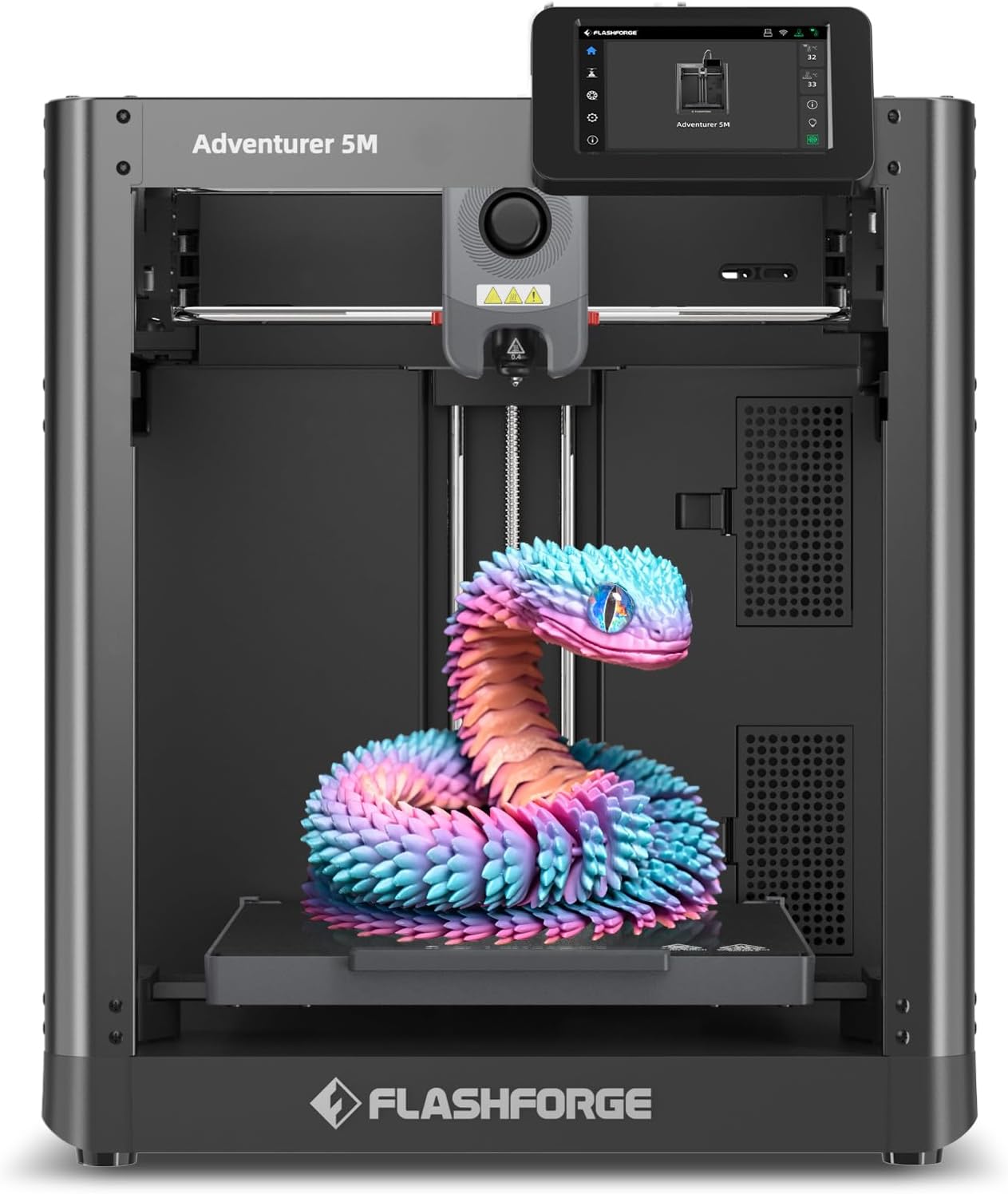
| Build Volume | 220 x 220 x 220 mm |
|---|---|
| Max Extruder Temp | 280°C |
| Travel Speed | 600 mm/s |
| Platform Type | Double-Sided PEI Platform |
| Structure | All-metal Core XY Structure |
The FlashForge Adventurer 5M is a CoreXY desktop printer built for faster prototyping and higher throughput than typical hobby machines. It uses a one-button automatic bed leveling system and a 280°C direct drive extruder with quick 3-second detachable nozzles, which makes nozzle swaps and setup simpler for routine prints. The printer emphasizes speed with a 600 mm/s travel rate and high acceleration, plus a high-flow nozzle option and vibration compensation to preserve detail at faster settings. Its double-sided PEI platform and multiple nozzle sizes help with part removal and feature tuning, and the Flash Maker app enables remote monitoring and basic job control. Trade-offs are typical for speed-focused machines: you will need to tune print settings and keep up with maintenance like nozzle and bed cleaning to avoid artifacts, and high-speed printing can amplify stringing or layer adhesion issues with some filaments. The Adventurer 5M is suited to rapid prototyping and users who prioritize print throughput while still wanting a ready-to-run desktop package.
Best for: Buyers who need a CoreXY machine for fast prototyping and want a mostly ready-to-print desktop unit that reduces manual leveling and speeds up nozzle changes.
Less Ideal for: Those who prioritize out-of-the-box perfect prints with minimal tuning or who only print very large parts infrequently should consider simpler, slower models.
- CoreXY all-metal structure for higher speed and stability
- One-button automatic bed leveling for easier first-layer setup
- Max 280°C direct drive extruder with quick-change nozzle for faster material swaps
- High travel speed (600 mm/s) and high acceleration for reduced print times
- Double-sided PEI platform simplifies part removal
- High-speed tuning required to get clean results across different filaments
- Advanced settings and maintenance needed to avoid print artifacts
Verdict: Choose the Adventurer 5M when you want a CoreXY desktop printer that prioritizes high-speed prototyping with convenient auto-leveling and quick-change nozzles.
Original Prusa CORE One+ kit

| Build volume | 250 x 220 x 270 mm |
|---|---|
| Filament diameter | 1.75 mm |
| Layer height | 0.05-0.30 mm |
| Max nozzle temperature | 290 °C |
| Max chamber temperature | 55 °C |
The Prusa CORE One+ kit is a DIY CoreXY 3D printer designed for users who want a robust, high-speed machine with strong temperature control and long-term serviceability. You assemble the printer from a kit using Prusa's photographic guide, which is intended to teach you the machine while producing a factory-quality result; typical build time is 15–20 hours. In use the enclosed steel exoskeleton and active chamber heating let the printer reliably handle PLA, PETG and advanced filaments like ASA, ABS, PC and nylons by reducing warping and maintaining stable temperatures up to 55°C. The Nextruder direct-drive, high-flow 0.4 mm nozzle and Input Shaper–tuned profiles trade off nothing in detail while increasing speed, and PrusaSlicer profiles for 200+ filaments simplify setup. Practical strengths include dual filament sensors, a 3.5-inch color display, offline operation for privacy, and a design aimed at easy maintenance and long life. The main compromises are the hands-on assembly requirement and the kit format, which adds upfront time compared with a plug-and-play machine.
Best for: Buyers who prioritize a reliable, serviceable CoreXY printer that can handle advanced materials and be maintained for years, and who are willing to invest assembly time to get a durable, farm-ready machine.
Less Ideal for: Users who want an out-of-the-box desktop printer with minimal setup time or who need the lightest possible desktop option for very tight spaces.
- Enclosed all-steel frame and active chamber heating stabilize prints for advanced materials
- High-flow Nextruder direct-drive with 360° cooling and Input Shaper tuned profiles for quality at speed
- Extensive factory-tested PrusaSlicer profiles covering 200+ filaments for easier setup
- Offline-capable design and removable Wi‑Fi module for secure, private operation
- Designed for serviceability with straightforward part replacement and long-term firmware support
- Ship‑to‑use kit requires a significant 15–20 hour assembly that may deter buyers wanting plug-and-play
- Heavier, industrial-oriented build increases footprint and may not suit very small workspaces
Verdict: Choose the CORE One+ if you want a factory-backed, serviceable CoreXY kit that delivers fast, repeatable results with advanced materials and long-term reliability.
Creality K1C CoreXY 3D Printer

| Printing speed | 600 mm/s |
|---|---|
| Acceleration | 20000 mm/s² |
| Extruder | Direct extruder with tri-metal nozzle |
| Noise (silent mode) | ≤45 dB |
The Creality K1C is a CoreXY desktop printer built around speed and practical usability. It uses a high-acceleration CoreXY motion system rated to 600 mm/s and 20000 mm/s² to cut print times compared with typical hobby printers, while a dynamically balanced printhead and one-tap auto calibration help maintain surface quality. The direct extruder with a tri-metal nozzle is aimed at reliably feeding abrasive and high-temperature materials such as carbon-fiber filaments and simplifies nozzle swaps. An onboard AI camera provides continuous monitoring and time-lapse capability, and a filtration system with activated carbon reduces odors during long prints; the unit also offers a quiet mode that keeps noise under about 45 dB. In practice this is a machine for users who want faster prototyping without wrestling with repeated manual leveling or frequent clogs, though high-speed printing will still require tuned slicer settings and good filament to avoid artifacts. The K1C balances productivity features with practical shop-friendly additions like filtration and monitoring, making it a capable choice for serious hobbyists and small workshops.
Best for: Buyers who prioritize faster prototyping and want built-in monitoring and easy calibration for more reliable prints without constant manual interventions.
Less Ideal for: Users seeking a simple entry-level hobby printer with minimal setup or those who prefer to tweak every hardware parameter manually for experimental builds.
- High-speed CoreXY motion system for much faster print turnaround
- Direct extruder with tri-metal nozzle designed for reliable feeding of abrasive filaments
- One-tap auto-leveling reduces setup time and bed-level frustration
- Built-in AI camera for real-time monitoring and time-lapse recording
- Effective filtration and a quiet mode to control odors and noise during prints
- High speeds and acceleration demand careful slicer tuning and quality filament to avoid print artifacts
- Lacks detailed specs in the listing about build volume and heated bed features buyers often compare
Verdict: Choose the K1C if you need a fast CoreXY printer with auto-leveling and onboard monitoring to speed prototyping while minimizing setup fuss.
Bambu Lab P1S 3D Printer
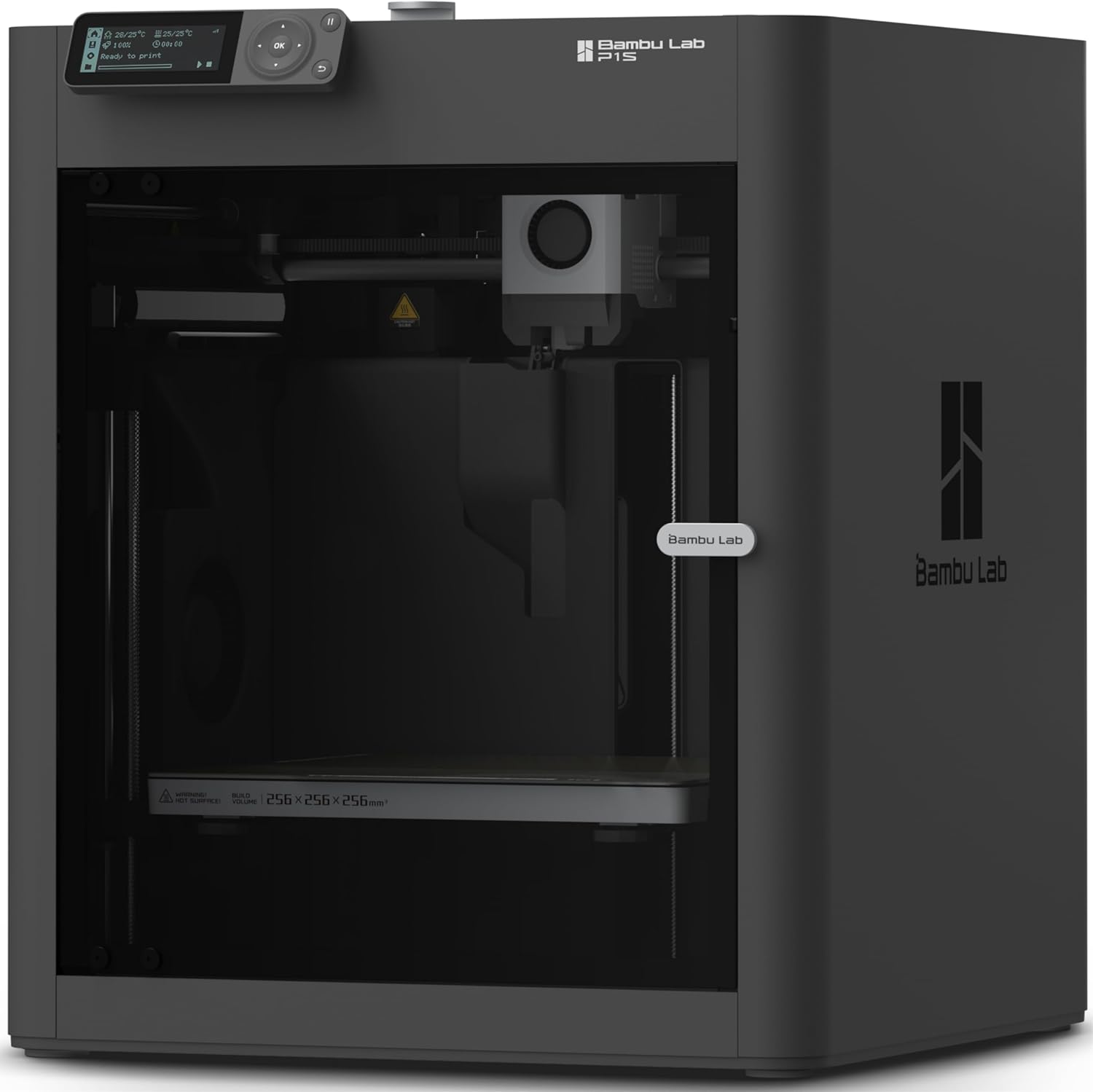
| Build Volume | 256 × 256 × 256 mm |
|---|---|
| Max Speed | 500 mm/s |
| Max Acceleration | 20 m/s² |
| Supported Filaments | PLA, PETG, TPU, PVA, PET, ABS, ASA; capable: PA, PC |
The Bambu Lab P1S is a ready-to-use CoreXY FDM printer that prioritizes speed and ease of use for mainstream makers. It ships with an enclosed frame, automatic bed leveling, and a direct-drive extruder that broadens material compatibility to handle flexible and tougher filaments. The machine targets fast prints with published top speeds up to 500 mm/s and high acceleration, which shortens print times for both small prototypes and larger parts within its 256 × 256 × 256 mm build cube. A built-in camera supports time-lapse recording and monitoring, and the printer integrates with MakerWorld model libraries to simplify producing designs. Setup is straightforward and Bambu Lab positions the P1S for quick first prints in about 15 minutes, helping less technical users get started. Important limitations are that multi-color printing requires the separate AMS accessory and some advanced high-temp or fiber-reinforced filaments are not recommended, so industrial materials are out of scope. The P1S is a practical choice when you want fast, reliable CoreXY performance without an arduous setup process.
Best for: Buyers who want a fast, user-friendly CoreXY printer that delivers reliable results with minimal setup and broad filament support for everyday desktop projects.
Less Ideal for: Users who need factory-quality multi-color printing out of the box or who plan to print high-temperature, fiber-filled industrial composites should consider other specialized systems.
- Enclosed CoreXY design improves stability and supports printing with more temperature-sensitive filaments
- High published top speed and acceleration for significantly faster print turnaround
- Direct-drive extruder increases compatibility with flexible filaments
- Automatic bed leveling and quick setup reduce the learning curve for new users
- Built-in camera and MakerWorld integration simplify monitoring and accessing ready models
- Multi-color or multi-material printing requires purchasing the separate AMS accessory
- Not recommended for carbon or glass fiber reinforced filaments and some very high-temp engineering plastics
Verdict: The P1S is the go-to CoreXY choice for risk-averse buyers who want a fast, enclosed printer that is easy to set up and reliable for everyday filament projects.
Choosing the Right CoreXY 3D Printer: Key Factors to Consider
Frame Rigidity and Construction
A rigid frame is the foundation of accurate CoreXY printing. Stiffness reduces vibration and front-to-back deflection during rapid direction changes, which directly improves dimensional accuracy and surface finish when printing at higher accelerations.
Look for solid aluminum extrusion, plate-style frames, or well-supported gantry designs. Joints and fasteners should be accessible and lockable to prevent gradual loosening. Frame rigidity matters more for CoreXY machines than for slower Cartesian setups because the kinematic advantages are only useful when the structure can handle the resulting forces.
Motion Components and Belt Drive
Linear guides, rails, and belt systems determine how smoothly the axes move. High-quality linear rails or hardened rods with good bearings reduce play and banding. Belt quality, tensioning methods, and pulley alignment influence positional repeatability, particularly with long acceleration profiles.
Check whether the design allows easy belt access and reliable tension adjustment. Consider the type of idlers and pulleys used; metal pulleys and well-supported idlers typically outlast cheaper plastic alternatives. Proper motion hardware reduces maintenance frequency and helps maintain print accuracy over time.
Extruder Type and Hotend Compatibility
The extruder and hotend combination affects material flexibility, clog resistance, and retraction behavior. Direct-drive extruders improve flexible filament handling, while Bowden-style setups can enable lighter carriage mass and higher acceleration but make soft filaments harder to print.
Verify hotend temperature range and whether the printer supports common all-metal hotends for higher-temperature filaments. Interchangeable or upgradeable hotends and extruders add future-proofing; look for accessible filament paths and straightforward feeder mounting to reduce downtime when experimenting with new materials.
Electronics, Firmware, and Motion Control
Electronics and firmware determine how well a CoreXY machine translates profile settings into stable motion. A board that supports high microstepping, quiet stepper drivers, and thermal protections is important for high-speed, reliable printing. Firmware should offer easy tuning for acceleration, jerk, and pressure advance or linear advance features.
Open-source firmware or widely supported closed firmware makes tweaks and community assistance more accessible. Good motion control reduces ringing and under-extrusion at higher speeds and lets you safely exploit the CoreXY kinematics.
Build Volume, Bed Leveling, and Access
Build volume determines what parts you can print in one piece. For CoreXY printers, the usable build area and platform accessibility both matter because some designs trade front access for structural bracing. Consider the maximum Z height and whether the bed is removable or has a flexible surface for part removal.
Automatic bed leveling systems that probe the bed at multiple points save time and improve first-layer consistency, especially when you want to print multiple parts without frequent adjustments. Accessibility for maintenance and filament changes reduces downtime in regular use.
Serviceability and Community Support
Serviceability affects how quickly you can recover from jams, replace wear items, or upgrade components. Designs with modular electronics, swappable hotends, and standardized fasteners are easier to maintain. Availability of spare parts and clear documentation reduces the time spent troubleshooting.
Community support and active user forums provide practical tips, firmware updates, and proven upgrades. A product with a healthy community typically yields more tested profiles and troubleshooting advice, which matters when you push a CoreXY printer to higher speeds.
Why CoreXY Kinematics Matter
CoreXY systems use two motors to control X and Y motion in a coordinated belt architecture that keeps the print head lightweight. This arrangement lowers moving mass on the carriage, enabling higher acceleration and faster average print speeds without the same amount of inertia-driven errors you see on heavy-carriage Cartesian machines.
For buyers, the practical benefit is shorter print times for many geometries and better preservation of detail at speed. However, the advantages rely on a well-built frame and precise belt routing; a poorly executed CoreXY can amplify vibration rather than reduce it.
- Lower carriage mass enables higher acceleration
- Coordinated motor motion reduces stepper load on single axes
- Requires precise belt routing and a rigid frame to realize benefits
Balancing Speed and Print Quality
Pushing speed requires tuning several interdependent settings like acceleration, jerk, extrusion multiplier, and temperature. High speeds can cause under-extrusion if the hotend cannot melt filament fast enough, and they increase the risk of ringing if the structure is not stiff.
A conservative approach is to test incremental speed increases while monitoring surface finish and dimensional accuracy. Use calibration test prints that stress corners and thin walls to judge when quality begins to suffer.
- Tune acceleration and pressure advance gradually
- Watch for under-extrusion that indicates hotend throughput limits
- Use calibration prints to find optimal speed-quality tradeoffs
Choosing the Right Bed and Surface
The print surface affects adhesion, removal, and first-layer quality. Heated beds expand the range of usable filaments and reduce warping on larger prints. Consider whether the bed is fixed or removable and whether a flexible spring steel sheet or magnetic system is supported for easy part removal.
Surface materials like PEI, glass, or specialty build sheets each have pros and cons in adhesion and durability. Pick a surface that matches the filaments you plan to use most often and that simplifies part removal for high-throughput work.
- Heated bed recommended for ABS and engineering filaments
- Flexible sheets aid part removal and reduce risk of damage
- Surface choice should align with common filament selections
Upgrades That Extend Capability
Common upgrades on CoreXY machines include better linear rails, all-metal hotends, upgraded extruders, and silent stepper drivers. These changes can improve longevity, expand material compatibility, and reduce noise without changing the fundamental motion system.
Plan upgrades around items that are easy to swap and well-documented. Prioritize upgrades that address immediate limitations you encounter, such as hotend throughput for frequent high-temperature printing or stiffer bed mounts if you see wobble in tall prints.
- Start with hotend and extruder improvements for material range
- Consider stepper driver upgrades for quieter operation
- Structural upgrades should focus on easy-to-replace parts
Safety and Thermal Considerations
Thermal management and safety features matter for long or unattended prints. Reliable thermistor or thermocouple readings, thermal runaway protection, and proper wire routing reduce fire risk. Enclosures help control temperature for high-temperature filaments but also require adequate cooling for electronics.
Check for clear fusing, proper mains separation, and accessible emergency stop options. Good documentation on safety practices and firmware protections is a practical plus when running printers for extended jobs.
- Ensure firmware supports thermal runaway protections
- Use proper fusing and safe mains wiring practices
- Enclosures help with high-temp filaments but need ventilation for electronics
How We Chose the Best CoreXY 3D Printer
We prioritized machines that demonstrate reliable CoreXY motion fundamentals and real-world usability. Key selection filters included frame stiffness and mechanical layout, because a rigid, well-squared frame directly reduces layer artifacts at high speeds. We looked for robust motion components such as quality linear rails or well-machined V-slot assemblies and durable belt drive systems, since belt stretch and play are common failure points on fast printers. Extrusion hardware and hotend compatibility were weighed for filament flexibility and print repeatability. Electronics and firmware capability were assessed to ensure smooth acceleration control and thermal safety. Build volume and bed leveling options were included to cover typical desktop and small-shop needs. We excluded experimental rigs lacking stable firmware or minimal community support, machines without proper thermal protections, and units that prioritized novelty over core mechanical reliability. Our evaluation focused on measurable specs and user-impacting features rather than marketing claims, and favored printers that make it straightforward to achieve consistent dimensional accuracy at higher throughput.
Our full evaluation process is outlined in our review methodology.
FAQ
Are CoreXY printers faster than other kinematic systems?
Often. CoreXY designs reduce carriage mass and let you push higher accelerations, which can shorten print times. Actual speed gains depend on frame rigidity, motion components, and hotend throughput.
Do CoreXY machines require special maintenance?
They require the same base maintenance as other 3D printers plus careful belt inspection and tensioning. Belt alignment and pulley wear are common service items because the belts drive coordinated motion.
Is a direct-drive extruder better for CoreXY printers?
It depends on the intended filament. Direct-drive setups handle flexible filaments better, while lighter carriage mass with remote or Bowden feeding can enable higher acceleration. Choose based on the materials you use most.
How important is automatic bed leveling on a CoreXY?
Automatic bed leveling is very helpful, especially for larger beds or frequent material changes. It reduces first-layer variability and saves manual adjustments, making high-throughput printing more consistent.
Can I upgrade a CoreXY printer to print higher-temperature materials?
Usually yes, by installing an all-metal hotend, ensuring the bed can reach necessary temperatures, and confirming the electronics can handle the thermal load. Good thermal management and firmware settings are also necessary.
Final Verdict
Focus on frame rigidity, motion quality, and extrusion capability when choosing a CoreXY 3D printer. Prioritize a well-supported motion system and a hotend that matches the filaments you plan to use, since these elements most directly affect speed and part accuracy. Consider upgrade paths and serviceability so the printer can evolve with your needs. Balance the desire for high throughput against the need for consistent dimensional results; a slightly lower top speed with better stability often yields more usable parts. Use the evaluation criteria here to pick the machine that matches your workflow and printing priorities.