
Note: This article contains affiliate links. If you click on these links and make a purchase, we may earn a small commission at no extra cost to you. This helps support our research and content. Read our full affiliate disclosure here.
If you want frequent cold-press juices without spending extra time on cleanup, choosing an easy-to-clean slow masticating juicer matters. These models use low-speed augers to extract juice gently, which preserves nutrients but can also trap fibrous pulp in narrow chambers. An easy-to-clean design saves minutes after every use, making daily juicing realistic instead of a weekend-only activity. This guide covers seven shortlisted slow masticating juicers selected for low maintenance and reliable juice yield. We focus on how simple the teardown is, how thoroughly residue is removed, and how much usable juice you get. Use the evaluation criteria below to match a pick to your routine and cleanup tolerance, then move on to the product list for our top options.
Top Picks at a Glance
| Best Overall The best all-around choice for most situations | Ninja NeverClog Cold Press Juicer JC151 |  |
| Best Quality Built to a higher standard if you want something more solid | Hurom H70 Slow Juicer |  |
| Best Value The sweet spot between price and what you get | TUUMIIST Cold Press Juicer TM-580SJ |  |
| Best Budget The cheapest option that still gets the job done reliably | Ama pear Cold Press Juicer |  |
| Top Rated A top-rated pick with lots of positive feedback | anybear SJ081 Cold Press Juicer |  |
| Most Popular A crowd favorite that many people choose with confidence | Jocuu Slow Masticating Juicer |  |
| Best Seller A high-volume bestseller chosen again and again | EanOruus 3-in-1 Masticating Juicer E-18 |  |
Ninja NeverClog Cold Press Juicer JC151

| Maximum Power | 150 watts |
|---|---|
| Number of Speeds | 2 |
| Power Source | Corded Electric |
| Capacity | 24 fluid ounces |
| Included Components | 24 oz juice jug, 36 oz pulp container, 2 pulp filters |
The Ninja NeverClog JC151 is a masticating cold press juicer designed to extract juice from fibrous fruits and vegetables with minimal clogging. Its 150-watt high-torque motor drives an auger that slowly crushes produce to preserve nutrients and reduce foam, while two interchangeable pulp filters let you choose less pulp for smoother juice or more pulp for thicker, fiber-forward drinks. The included 24 oz juice jug and 36 oz pulp container make batch juicing straightforward for families or meal prep, and the one-touch controls with a reverse function help clear jams and improve extraction. Cleanup is easier than many slow juicers because juice-contact parts are dishwasher safe and the unit is built for simple assembly. Trade-offs are moderate motor power compared with some heavy-duty masticating machines and a somewhat larger footprint than the most compact models, but for everyday home use the JC151 balances performance, ease of use, and washability effectively.
Best for: Buyers who want a reliable, easy-to-clean slow juicer for regular home use that handles leafy greens and fibrous produce and makes batch juice prep practical.
Less Ideal for: Those seeking a commercial-strength juicer for heavy daily use or shoppers prioritizing the absolute smallest countertop footprint should consider other options.
- High-torque 150W auger extracts juice from fibrous produce with reduced clogging
- Two interchangeable pulp filters let you control juice texture
- Large 24 oz juice jug and 36 oz pulp container support batch juicing
- All juice-contact parts are dishwasher safe for easier cleanup
- 150W motor is less powerful than some commercial-grade masticating juicers
- Not the smallest countertop footprint compared with ultra-compact models
Verdict: Choose the Ninja JC151 if you want a practical, easy-to-clean cold press juicer that reliably handles fibrous produce and gives simple pulp control for everyday home juicing.
Hurom H70 Slow Juicer

| Wattage | 150 watts |
|---|---|
| Power Source | Corded Electric |
| Special Features | Easy to Clean |
| Material | Plastic |
The Hurom H70 is a slow masticating juicer built around a strainer-free Easy Clean chamber and a large self-feeding hopper to reduce prep and messy filters. It juices fruits and vegetables at low speed using a two-part auger system that separates pulp without a fine mesh, so parts detach and rinse in seconds rather than requiring scrubbing. The wide inlet accepts larger pieces, letting you drop in whole or halved apples and other produce during a run, which speeds prep for daily use. At 150 watts it balances power with quiet operation and is small enough to sit easily on a countertop or be stored away. The design emphasizes high juice yield and smooth texture, making it well suited for leafy greens, hard vegetables, and softer fruits when using the appropriate screen. The main limitations are plastic construction and hand-wash only care, so it is not the most heavy-duty metal option and still requires some regular disassembly; the 14.8 pound weight also means it is not ultra-light for frequent repositioning. For buyers who prioritize easy cleanup and maximum juice from produce, the H70 delivers a streamlined, high-yield experience.
Best for: Buyers who want a performance-focused slow juicer that minimizes cleanup time and maximizes juice yield for daily fruit and vegetable juicing.
Less Ideal for: Users seeking a heavy-duty, all-metal commercial machine or those who need dishwasher-safe parts for fully hands-off cleaning.
- Strainer-free Easy Clean chamber reduces time spent scrubbing and speeds post-juicing cleanup.
- Large self-feeding hopper accepts bigger produce pieces to minimize prep.
- Two-part auger system designed for higher juice yield and smoother texture.
- Compact, space-conscious footprint suitable for countertop use.
- Mostly plastic construction and hand-wash-only parts limit durability compared with metal-bodied units.
- Not the lightest unit to move frequently due to its nearly 15 pound weight.
Verdict: If you want a high-yield, easy-to-clean slow juicer that speeds prep with a wide hopper, the Hurom H70 is a top choice.
TUUMIIST Cold Press Juicer TM-580SJ
| Maximum Power | 300 watts |
|---|---|
| Wattage | 300 |
| Number of Speeds | 55 |
| Power Source | AC |
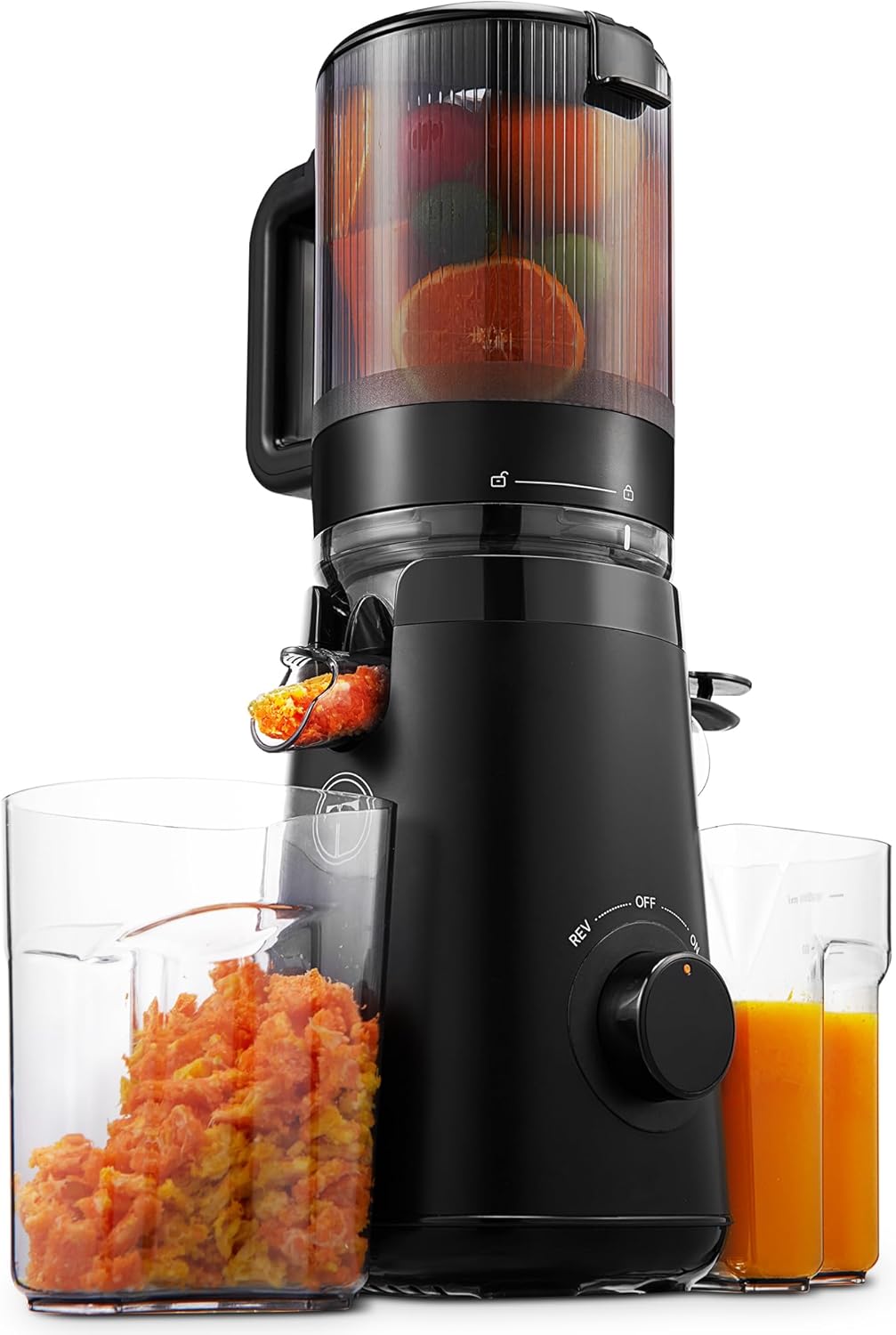
The TUUMIIST TM-580SJ is a masticating cold-press juicer built for extracting high yields from whole fruits and vegetables without extensive prep. It uses a 300 W motor and a slow 55 RPM auger to press produce gently, which preserves nutrients and produces less foam and separation than high-speed centrifugal machines. The extra-large 5.8 inch feed chute accepts larger pieces or whole fruits so you can skip a lot of cutting, and the no-mesh-filter design simplifies juice collection and clean up. Assembly is straightforward and the included cleaning brush plus mostly detachable parts make a quick rinse or dishwasher-safe wash possible. On the downside the unit is relatively tall and moderately heavy for countertop use, and ABS plastic construction is not as premium-feeling as metal-bodied rivals. For everyday juicing the TM-580SJ balances yield, ease of use, and simple cleaning, but buyers seeking the quietest operation or the most durable materials may look to higher-end models.
Best for: Buyers who prioritize high juice yield, easy cleaning, and minimal fruit prep for regular home juicing sessions.
Less Ideal for: Those who want a compact travelable unit or a metal-bodied commercial-grade juicer for heavy daily use.
- Large 5.8" feed chute reduces pre-cutting for faster prep
- Slow 55 RPM extraction boosts nutrient retention and juice yield
- No mesh filter design simplifies juice flow and cleaning
- Includes cleaning brush and several detachable parts that are dishwasher-safe
- ABS plastic construction feels less premium than metal alternatives
- Relatively tall and heavier than some compact juicers
Verdict: A practical slow-press juicer that maximizes yield and minimizes prep and cleaning for everyday home use.
Ama pear Cold Press Juicer

| Maximum Power | 150 watts |
|---|---|
| Power Source | ac |
| Voltage | 110 volts_of_alternating_current |
| Number of Speeds | 108 |
| Capacity | 3.5 liters |
This Ama pear cold press juicer is a single-auger, slow masticating juicer built to extract juice from whole fruits and vegetables with minimal prep. It uses a 150W brushless copper motor running at about 55 RPM to press and squeeze produce for higher yield and smoother texture while keeping noise below 65 dB. The 6-inch wide feed chute accepts larger items so you can often avoid chopping, and a one-button control plus a reverse function makes operation simple and helps clear clogs. Practical touches include a removable strainer, a cleaning brush, and a straightforward assembly that keeps routine cleaning quick. Safety features stop the motor when the lid is opened. On the downside, the unit is a basic home model with modest power compared with heavy-duty commercial machines and its many plastic parts mean you should follow the care instructions to preserve longevity. For buyers focused on easy cleanup and steady, low-speed extraction at a budget-friendly level, this juicer offers a sensible balance of convenience and performance.
Best for: Buyers who want an affordable, easy-to-clean slow juicer that handles whole fruits with minimal chopping and prioritizes quiet, steady extraction for daily home use.
Less Ideal for: Those who need high-capacity or commercial-grade juicing for large volumes or want a primarily metal, heavy-duty machine.
- 6-inch wide feed chute reduces prep by fitting larger fruits and vegetables whole
- Slow masticating action and reverse function yield smoother juice with drier pulp
- Quiet operation (under 65 dB) suitable for morning use
- One-button control and removable parts simplify assembly and cleaning
- Mostly plastic construction may wear faster than metal-bodied models
- 150W motor is adequate for home use but not for heavy commercial throughput
Verdict: A budget-friendly slow masticating juicer that makes whole-fruit extraction and cleanup easy for daily home use.
anybear SJ081 Cold Press Juicer

| Wattage | 350 watts |
|---|---|
| Special Features | Powerful Motor |
| Material | ABS, Polycarbonate, Stainless Steel |
| Product Care Instructions | Hand Wash Only |
The anybear SJ081 is a slow masticating juicer built for everyday home use that doubles as a nut milk maker and sorbet press. Its dual-stage auger and 350W high-torque motor extract juice slowly to reduce oxidation and improve yield, while the 4.9-inch feed chute accepts larger pieces so you spend less time chopping. Practical conveniences include a one-piece stainless steel filter that rinses clean, an included brush, an anti-blockage reverse function to clear jams, and simple three-step assembly for fast cleanup. Materials are BPA-free and aimed at neutral taste and durability, and the unit runs quietly enough for morning routines. Limitations are typical for slow juicers: it is not as fast as centrifugal models and may require occasional reverse cycles with very fibrous produce, and cleanup still requires hand washing of components.
Best for: Buyers who prioritize a reliable, nutrient-preserving slow juicer that is straightforward to assemble, runs quietly, and is designed for regular home use with easier-than-average cleaning.
Less Ideal for: People who need the fastest possible juicing for very large volumes or who prefer fully dishwasher-safe components should consider other styles.
- Dual-stage auger and slow extraction preserve nutrients and improve juice yield
- Large 4.9-inch feed chute reduces prep time by fitting bigger fruit and vegetable pieces
- One-piece stainless steel filter and included brush make rinsing and cleaning quicker
- Anti-blockage reverse function clears jams without disassembly
- Quiet high-torque 350W motor handles hard produce with minimal noise
- Requires hand washing of parts rather than dishwasher-safe cleaning
- Slower throughput than centrifugal juicers, so longer run time for large batches
Verdict: If you want a dependable slow juicer that preserves nutrients, minimizes prep, and is easier to clean than many masticating models, the anybear SJ081 is a solid choice.
Jocuu Slow Masticating Juicer

| Wattage | 150 watts |
|---|---|
| Number of Speeds | 2 |
| Power Source | Corded Electric |
| Material | Plastic |
| Blade Material | Stainless Steel |
The Jocuu Slow Masticating Juicer is a single-auger cold-press machine meant for home juicing of both soft and hard produce. It uses a low-speed spiral auger with two modes to reduce oxidation and separate juice from pulp for higher yield, and it includes an auto-reverse function to clear clogs. Practical features for daily use include a small feeder chute for safer operation, dishwasher-safe detachable parts and a cleaning brush that speed cleanup, and a motor protection chip that automatically shuts the unit off after extended runs. At 150 watts the motor runs quietly so it is suitable for morning routines, and the juicer ships with a BPA-free construction and stainless steel blade components. Limits to note are the compact feed opening and modest capacity, so larger fruits may need pre-cutting and continuous large-batch juicing will require pauses. The unit is well suited to buyers prioritizing easy cleaning and quiet operation over high throughput.
Best for: Buyers who want a quiet, easy-to-clean slow juicer that preserves juice quality and is simple to maintain, with reassurance from visible customer feedback and safety features.
Less Ideal for: Those who plan to juice large volumes frequently or want a wide feed chute for whole fruits should consider higher-capacity or commercial-style models instead.
- Two-speed spiral system preserves nutrients and handles both soft and hard produce
- Detachable parts are dishwasher safe and include a cleaning brush for easy cleanup
- Auto-reverse function helps prevent and clear clogs
- Quiet 150-watt motor suitable for early-morning use
- Safety-minded small feeder chute reduces risk and limits seeds entering the juice
- Small feeding chute and compact capacity require cutting larger produce into pieces
- Automatic 20-minute shutoff can interrupt long extraction sessions
Verdict: If you want a quiet, low-oxidation masticating juicer that is simple to disassemble and clean, the Jocuu delivers reliable everyday performance.
EanOruus 3-in-1 Masticating Juicer E-18

| Capacity | 100 fluid ounces |
|---|---|
| Maximum Power | 250 watts |
| Power Source | ac |
| Voltage | 110 volts |
The EanOruus E-18 is a slow masticating juicer designed for multi-purpose home use, converting whole fruit and vegetables into juice, making nut milks and even producing frozen fruit sorbets with interchangeable strainers. Its 6.5-inch extra-wide chute and 100 oz hopper reduce prep and refilling, letting you feed larger pieces or batch-press for a family or meal prep session. The 250W AC brushless motor runs quietly and includes overheat protection and auto-reverse to help clear jams, which is useful with fibrous produce and nuts. Most detachable parts are made from polycarbonate and the unit supports hand-washing, with a detachable pulp outlet that simplifies cleanup compared with permanently attached designs. Important limitations are hand-wash-only care and plastic auger/blade parts rather than metal, which may matter for buyers preferring dishwasher-safe or stainless components. Overall this model aims for high yield and low noise while prioritizing easy access for cleaning and heavy-duty daily use.
Best for: Buyers who prioritize a quiet, high-yield masticating juicer that minimizes prep and is built for regular household use while preferring straightforward disassembly for cleaning.
Less Ideal for: Those who need fully dishwasher-safe components, prefer metal augers/blades, or want a compact single-serve countertop juicer should consider other options.
- Extra-large 6.5-inch chute and 100 oz hopper reduce prep time and allow batch juicing
- Whisper-quiet 250W AC brushless motor suited for daily heavy-duty use
- Auto-reverse and overheat protection help prevent and clear jams
- Detachable pulp outlet and removable parts make cleaning easier than sealed designs
- Removable parts require hand washing only and are not dishwasher-safe
- Key wear parts are plastic rather than metal, which may feel less premium to some buyers
Verdict: Choose the EanOruus E-18 if you want a quiet, high-capacity slow juicer that speeds prep and simplifies cleaning for regular household juicing.
Choosing the Right Easy-to-Clean Slow Masticating Juicer: Key Factors to Consider
Teardown Simplicity
How easy the juicer is to take apart directly affects how often you will actually clean it. A design with a minimal number of large, snap-apart components reduces fiddly steps and shortens the process.
Look for clearly marked release tabs, parts that separate without tools, and an internal layout that exposes the auger and screen fully. When pieces separate into large, easy-to-rinse sections, you are more likely to rinse immediately after use rather than let pulp dry and harden.
Filter And Screen Access
The juicer screen is the component that typically traps most residues and requires the most brushing. Screens that are removable as a single unit and have smooth edges or integrated cleaning brushes will cut cleaning time significantly.
If the screen has deep mesh or tiny perforations, expect some brushing to be necessary. Consider whether replacement screens are easy to obtain and whether the design allows simple, effective scrubbing without damaging delicate mesh.
Material And Finish
Materials influence both cleanliness and longevity. Nonporous plastics and food-grade stainless surfaces resist staining and odor retention, while matte or textured finishes can trap pulp more readily.
Choose BPA-free food-contact plastics or stainless components for parts that touch produce. Smooth, glossy surfaces rinse cleaner, and heat-resistant plastics tolerate brief dishwasher cycles, which can speed maintenance for busy households.
Auger Design And Clogging Risk
Auger geometry and rotation speed determine how the machine handles fibrous or leafy produce. Augers designed to shear and compress fiber efficiently produce drier pulp and reduce the chance of clogging, which in turn reduces the need for frequent disassembly mid-cycle.
A slightly slower, high-torque motor with a well-matched auger tends to push fiber through consistently. If you plan to juice tough greens or wheatgrass, prioritize designs that channel pulp away from the screen rather than accumulate it at choke points.
Dishwasher Compatibility
Some components may be rated for the dishwasher, which lowers the barrier to thorough cleaning. However, not all parts are safe for high-heat cycles, so check which pieces are dishwasher-safe and which should be hand-washed.
Even when dishwasher-safe, parts with nooks and mesh still benefit from a quick pre-rinse. Relying entirely on the dishwasher can lead to buildup over time if pieces are not regularly inspected and manually brushed.
Storage And Drying
Where and how you dry parts after cleaning affects long-term hygiene and odor. Juicers that disassemble into compact pieces fit into dish racks more easily and air-dry faster than machines with awkward shapes.
Consider whether the design enables upside-down drying of screens and covers to let water drain fully. Units that leave trapped water in cavities can develop mildew or off-odors, which increases maintenance.
Daily Cleanup Routine That Saves Time
A consistent post-juicing routine turns a potentially long chore into a brief five- to ten-minute task. Start with an immediate cold-water rinse to remove most loose pulp before it dries. For many designs, running water while rotating the auger or tapping the screen will dislodge surface residue.
Keep a dedicated small brush near the juicer for the screen and the auger shaft. Wiping the exterior and rinsing removable containers right away prevents sticky buildup. If parts are dishwasher-safe, rinse and place them on the top rack to finish sanitizing while you put ingredients away.
- Rinse immediately after use to prevent dried pulp
- Use a small brush for the screen and crevices
- Air-dry parts upside down to prevent trapped water
How Pulp Dryness Affects Maintenance
Pulp dryness after extraction is a good proxy for extraction efficiency and cleanup. Drier pulp means less wet residue clinging to screens and chambers, which simplifies brushing and rinsing. Machines that produce wetter pulp often require more thorough cleaning and can smell if left overnight.
If your routine includes frequent leafy greens or fibrous roots, pick a design that consistently produces dry pulp. That reduces the frequency of deep scrubs and lessens the chance of needing to disassemble mid-session to clear clogs.
- Drier pulp equals easier cleanup and less odor risk
- Wetter pulp increases brushing time and potential mess
Tools And Accessories That Make Cleaning Easier
A small, stiff-bristled brush sized to the screen makes the biggest difference. Some manufacturers include a shaped brush that fits the mesh; similar aftermarket brushes work if not. A narrow bottle brush helps clear the auger channel and feed chute.
Microfiber cloths are useful for wiping exteriors and removing fine splatters. A shallow soak tub with warm, soapy water is helpful for soaking screens and tough residues before brushing. Keep spare dishcloths and a drying rack nearby to streamline the process.
- Stiff brush for screens
- Bottle brush for auger channels
- Shallow soak tub for stubborn pulp
Routine Maintenance To Prevent Odors And Wear
Beyond daily rinsing, schedule a weekly deeper clean that inspects seals, gaskets, and areas where pulp may hide. Remove and dry all parts thoroughly, and check for small tears or wear in flexible seals that can trap moisture and accelerate odors.
Occasional light descaling or food-safe vinegar rinses can remove lingering residues if you notice odor buildup. Replace worn seals or screens promptly; a compromised gasket increases the effort required to achieve a clean machine and accelerates wear on the motor.
- Weekly deep clean of seals and gaskets
- Address odors with targeted rinses
- Replace worn parts to keep cleaning time low
Adjusting Technique To Reduce Cleanup
How you prepare produce affects mess and cleaning. Trim large woody stems, cut items into appropriately sized pieces to prevent overloading, and alternate soft and hard ingredients to help channel pulp through the machine more evenly.
Avoid overstuffing the feed chute, which can force more fibrous material into tight spaces. Slower, steady feeding often results in less clogging and less need to stop mid-cycle to clear the unit.
- Cut produce to recommended sizes
- Alternate soft and hard ingredients
- Feed steadily rather than forcefully
How We Chose the Best Easy-to-Clean Slow Masticating Juicer
We selected slow masticating juicers that minimize time and effort spent cleaning while still delivering consistent cold-press extraction. Priorities included how readily the unit disassembles for rinsing, presence of dishwasher-safe parts, and design choices that reduce crevices where pulp and fiber collect. We also considered extraction efficiency to ensure easy cleanup did not come at the cost of poor yields or excessive pulpy waste. Additional evaluation dimensions covered the durability and material choices for parts that contact produce, such as BPA-free plastics and hard-wearing augers, plus how accessible filters and screens are for brushing. We factored in motor speed and torque because underpowered units can clog and require more frequent disassembly. Noise and vibration levels were also noted when they affected everyday usability and the likelihood of users avoiding frequent cleaning. We excluded centrifugal and twin-gear machines to keep comparisons focused on single-augur slow masticating designs. Units with permanently attached, hard-to-access screens or with excessive small parts that complicate routine washing were deprioritized. The result is a curated group that balances quick maintenance with solid juice performance.
Our full evaluation process is outlined in our review methodology.
FAQ
How long should full cleanup take for an easy-to-clean slow masticating juicer?
For a well-designed easy-to-clean model, a quick rinse and brush should take five to ten minutes. A more thorough weekly clean that inspects screens and seals typically takes 15 to 30 minutes.
Are dishwasher-safe parts worth the tradeoff?
Dishwasher-safe parts save hands-on time, but they still need a pre-rinse and occasional brushing. Also verify which parts are rated for the dishwasher to avoid warping or premature wear.
Will juicing greens make cleanup significantly harder?
Leafy greens can produce more stringy residue, which may require extra brushing of the screen and feed chute. Choosing an auger and screen design that handles fiber well reduces the extra effort.
Can I soak screens to speed up cleaning?
Yes. A brief soak in warm, soapy water loosens trapped pulp and makes brushing faster. Avoid prolonged soaking of any rubber seals to prevent deterioration.
How often should I replace screens or gaskets?
Replacement intervals depend on use, but inspect screens and gaskets monthly for wear or tears. Replace any part showing damage or persistent staining that does not respond to cleaning.
Final Verdict
Prioritize a juicer that balances easy access to the auger and screen with extraction efficiency. If you plan daily use, focus on teardown simplicity, removable screens, and materials that rinse clean or tolerate dishwasher cycles. Expect tradeoffs between streamlined cleaning and advanced features; choose the design that matches how often you will juice and how much time you will spend maintaining it. Ultimately, pick a unit that you will actually keep clean. Faster cleanup promotes more consistent use, better hygiene, and a lower likelihood of odors or mechanical issues over time.