
Note: This article contains affiliate links. If you click on these links and make a purchase, we may earn a small commission at no extra cost to you. This helps support our research and content. Read our full affiliate disclosure here.
Picking the right home kitchen knife sharpener makes a big difference in how well your knives cut and how safe they are to use. Whether you have thin chef knives, serrated blades, or heavier utility knives, a sharpener that maintains proper edge angle and removes metal predictably will keep prep fast and reduce accidents. This guide shortlists seven top-performing home kitchen knife sharpeners selected for real-world home use. We'll evaluate each on ease of use, edge consistency, and long-term care so you can choose the best match for your kitchen routine.
Top Picks at a Glance
| Best Overall The best all-around choice for most situations | Work Sharp MK2 Knife Sharpener |  |
| Best Quality Built to a higher standard if you want something more solid | Chef'sChoice Trizor 15XV |  |
| Best Value The sweet spot between price and what you get | Lantana Smart Sharp Knife Sharpener |  |
| Best Budget The cheapest option that still gets the job done reliably | Amazon Basics 4-in-1 Knife Sharpener |  |
| Top Rated A top-rated pick with lots of positive feedback | AccuSharp Knife Sharpener ACCU-001C |  |
| Most Popular A crowd favorite that many people choose with confidence | KitchenIQ Edge Grip 2-Stage Sharpener |  |
| Best Seller A high-volume bestseller chosen again and again | KITCHELLENCE 3-Stage Knife Sharpener |  |
Work Sharp MK2 Knife Sharpener

| Included components | Abrasive Belts, Knife Sharpener |
|---|---|
| Material Type | Plastic |
| Grit Type | Medium |
| Model Number | WSKTS2 |
The Work Sharp MK2 is an electric sharpening system that uses flexible abrasive belts to reshape and hone edges on a wide range of blades, from kitchen knives to axes and scissors. It is typically used on a countertop or workbench with the belt conforming to the blade edge while an adjustable edge guide keeps the angle steady; the two-speed motor gives extra power for heavier jobs like lawnmower blades or axes and a lower speed for finer knife work. The flexible belts let you treat curved and serrated edges better than fixed-wheel systems, and included abrasive belts make it ready to use out of the box. Practical benefits include fast material removal when a blade is very dull and consistent, repeatable angles thanks to the guided system. Important limitations are that it is a powered grinder rather than a polishing stone, so users seeking a razor finish will likely need stropping or finer abrasives afterward, and the unit takes some practice to control pressure and angle for delicate blades. Replacement belts are required over time for sustained performance.
Best for: Buyers who want a versatile, fast electric sharpener that handles kitchen knives plus outdoor and workshop tools and value repeatable, easy-to-learn sharpening for everyday use.
Less Ideal for: Users who only need a manual honing or polishing solution for achieving the absolute finest razor edge or who prefer a purely stone-based sharpening workflow.
- Flexible abrasive belts conform to curved and serrated edges for broad tool compatibility
- Two-speed motor provides higher power for heavy-duty tools and a gentler speed for knives
- Edge guide helps maintain consistent sharpening angles for repeatable results
- Ships with abrasive belts so the unit is usable immediately
- Produces a ground edge that may require stropping or finer finishing for a razor-polish finish
- Takes practice to control pressure and angle on delicate or thin blades
Verdict: Choose the Work Sharp MK2 if you want a quick, versatile electric sharpener that reliably restores edges on kitchen knives and a wide range of tools.
Chef'sChoice Trizor 15XV

| Material Type | Diamond |
|---|---|
| Grit Type | Fine |
| Stages | Three |
The Chef'sChoice Trizor 15XV is a three-stage electric sharpener built for cooks who want a razor edge quickly and consistently. You run the blade through stage 1 to reshape the edge with medium diamond abrasives, stage 2 uses finer diamonds to hone, and stage 3 employs patented stropping disks to polish and prolong the finish—useful for both straight-edge and serrated blades. Precision angle guides and flexible spring guides take the guesswork out of holding consistent 15-degree angles, and the all-diamond abrasives cut fast so a dull knife can be reprofiled in around a minute and touch-ups take seconds. The unit is straightforward to operate and well suited to frequent home kitchen use where repeatable performance matters. It is a dedicated 15-degree class sharpener, so buyers seeking different primary angles or full manual control may prefer other systems; the device is also a countertop appliance that requires storage space. For someone focused on blade performance and fast results, the Trizor 15XV delivers professional-style edges with minimal effort.
Best for: Buyers who prioritize razor-sharp, performance-driven edges and want a fast, low-skill way to reprofiling and maintaining kitchen knives for precise slicing.
Less Ideal for: Those who prefer manual whetstone sharpening for full control over angles or users who need a multi-angle, travel-friendly sharpening solution.
- 100% diamond abrasives for fast, aggressive material removal and durable cutting action
- Three-stage process (sharpen, hone, strop) produces a polished, long-lasting 15-degree edge
- Precision angle and spring guides remove user guesswork for consistent results
- Works with both straight-edge and serrated knives and can convert 20-degree edges to 15-degree
- Designed specifically for 15-degree edges so it is less suitable if you prefer other primary angles
- Takes up counter or cabinet space as a dedicated electric unit
Verdict: If you want fast, repeatable professional-style 15-degree edges with minimal effort, the Trizor 15XV is the performance-focused home sharpener to choose.
Lantana Smart Sharp Knife Sharpener
| Material Type | Ceramic, Metal, Tungsten Carbide |
|---|---|
| Grit Type | Coarse, Fine, Extra Fine |
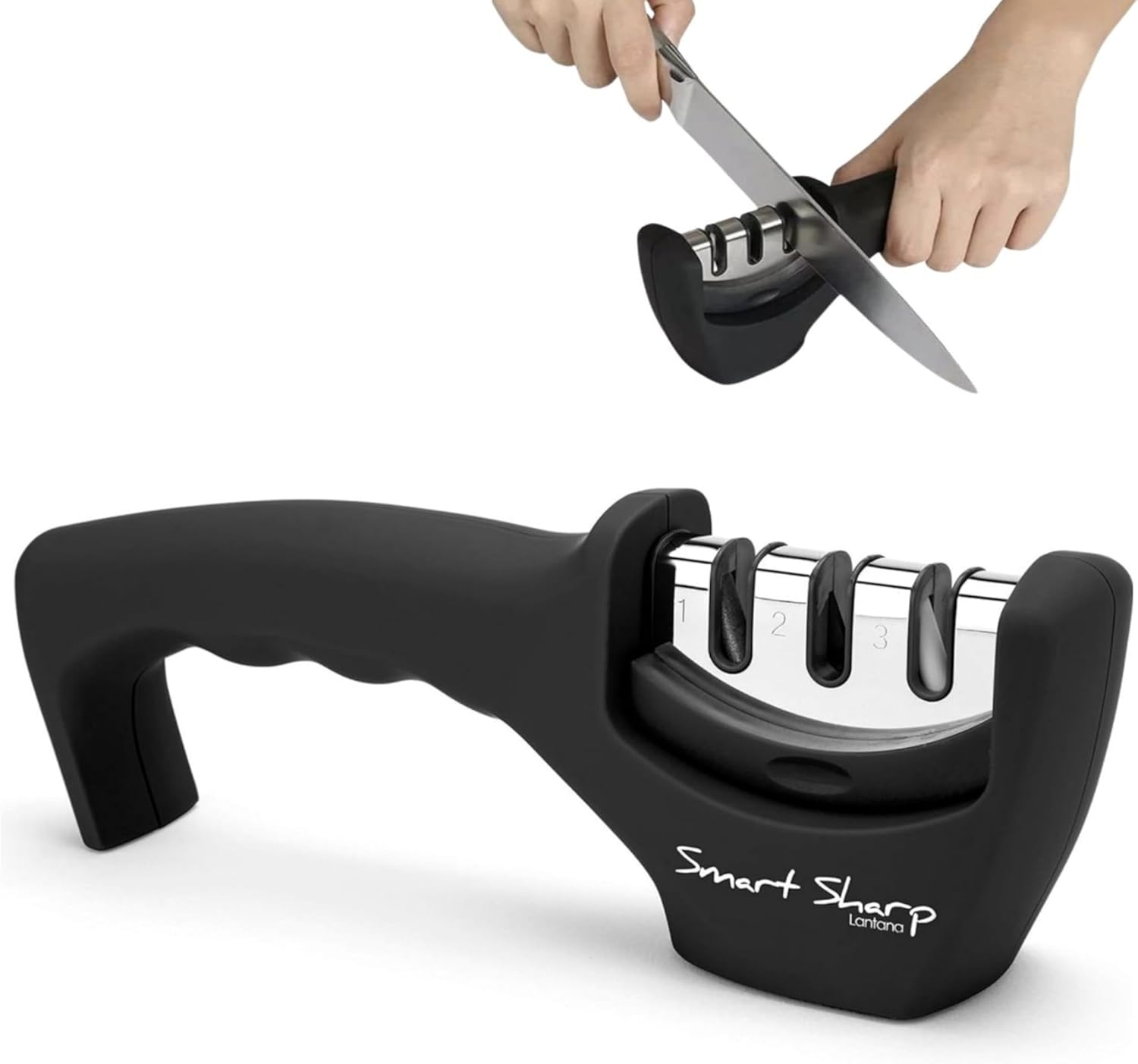
The Lantana Smart Sharp is a compact three-stage manual sharpener that walks a user through prepare, sharpen and hone stages to revive dull kitchen knives. It uses tungsten carbide for coarse reshaping, ceramic for finer sharpening, and an extra-fine stage to polish the edge, and its ergonomic handle plus non-slip rubber base keep the unit stable on a countertop while you pull blades through the slots. It works well for everyday straight-edged kitchen knives and many wide serrated blades, making routine maintenance quick and simple without a sharpening stone or power tool. The unit is portable, easy to store, and includes instructions and an online demo to help first-time sharpeners get consistent results. Limitations are that it is not suitable for ceramic blades, scissors, or micro-serrated knives and it does basic edge restoration rather than precision re-profiling for high-end specialty blades.
Best for: Home cooks who want a simple, low-effort way to keep everyday kitchen knives sharp without learning stone techniques or buying a motorized sharpener.
Less Ideal for: Users seeking professional-level re-profiling, owners of ceramic or specialty serrated tools, or those who prefer precision sharpening with stones or guided jigs.
- Three-stage system (coarse, fine, extra fine) for stepwise edge restoration
- Ergonomic comfort handle and non-slip rubber base for stable, safe use
- Portable, compact design that is easy to store or move around the kitchen
- Includes instructions and a demonstration video to help new users get consistent results
- Not suitable for ceramic knives, scissors, or micro-serrated edges
Verdict: A compact, easy-to-use three-stage manual sharpener that quickly restores household straight-edged knives for practical everyday use.
Amazon Basics 4-in-1 Knife Sharpener
| Material Type | Metal, Plastic |
|---|---|
| Grit Type | Coarse, Medium, Fine |
| Included Components | Knife Sharpener |
| Item Type Name | 4-in-1 Knife Sharpener with Safety Glove |
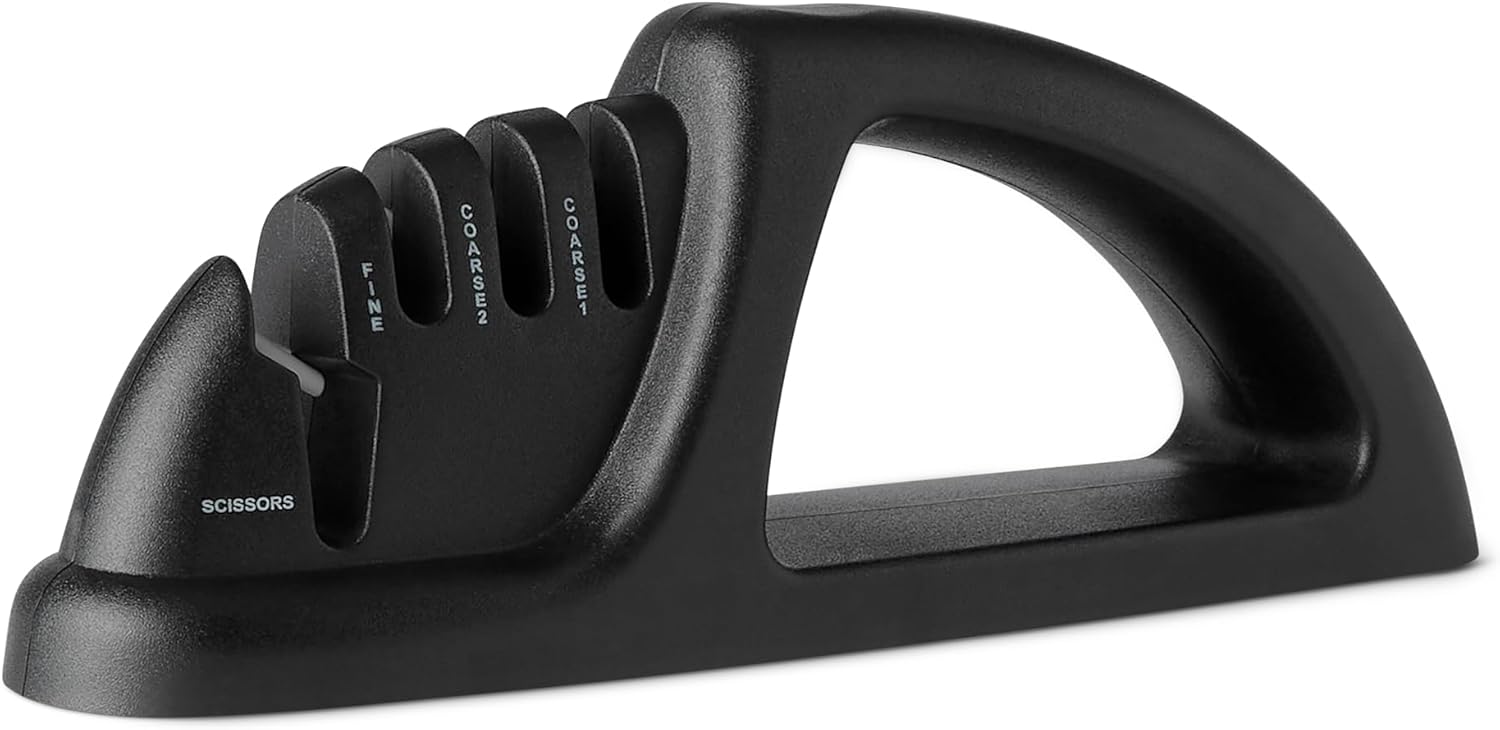
This Amazon Basics 4-in-1 Knife Sharpener is a simple manual tool for restoring edge on straight-edge kitchen, pocket, and hunting knives and for sharpening scissors. It uses three sequential sharpening stages—coarse, medium, and fine—so you can remove nicks, reprofile an edge, and then polish it, while a dedicated scissor slot handles shears. The unit's non-slip silicone base keeps it steady during use, and the included cut-resistant glove helps protect your hand when pulling blades through the slots. It is lightweight, easy to clean with a rinse, and suitable for occasional home use or to refresh dull blades between professional sharpenings. Limitations: it does not work on serrated knives and, as a manual pull-through system, it offers less precision than guided or electric sharpeners for advanced edge work. For buyers on a tight budget who need a low-effort way to maintain everyday knives, this delivers good value.
Best for: Buyers looking for a low-cost, no-fuss tool to keep everyday straight-edge knives and scissors reasonably sharp between professional sharpenings.
Less Ideal for: Anyone needing precision angle control for high-end knives or a solution for serrated blades should consider guided or electric sharpeners instead.
- Three-stage sharpening (coarse, medium, fine) covers edge repair through polishing
- Dedicated scissor slot for sharpening shears
- Non-slip silicone base improves stability during use
- Includes cut-resistant glove for safer handling
- Easy to rinse clean after use
- Not compatible with serrated blades
- Manual pull-through design offers less precision than guided or electric sharpeners
Verdict: An inexpensive, easy-to-use three-stage sharpener that keeps ordinary straight-edge knives sharp without the complexity or cost of guided or electric systems.
AccuSharp Knife Sharpener ACCU-001C

| Material Type | Acrylonitrile Butadiene Styrene |
|---|---|
| Grit Type | Coarse |
| Included Components | Sharpener |
| Model Number | ACCU-001C |
The AccuSharp ACCU-001C is a simple, durable pull-through sharpener designed to restore and hone a wide range of kitchen and outdoor knives quickly. You grip its ergonomic handle, draw the blade once or twice through the tungsten carbide sharpening slot and you typically get a usable edge in about ten seconds, which makes it a handy tool for busy home cooks. The reversible, diamond-honed carbide blades provide aggressive cutting action for fast material removal and the full-length finger guard improves safety during use. Construction from ABS plastic keeps it lightweight and the unit is dishwasher-safe for easy cleaning. It is not a precision sharpening system for reprofiling premium blades or setting exact angles, so users seeking razor-shop refinement or ceramic stone-level control will want a different tool. For everyday maintenance, serrated and straight blades are both accommodated and most owners report years of service before blade replacement is needed.
Best for: Buyers who prioritize a dependable, low-effort way to keep everyday kitchen knives and outdoor blades sharp will appreciate this tool for routine maintenance and quick touch-ups.
Less Ideal for: Users who want a professional sharpening system for exact bevel control or those restoring heavily damaged or high-end blades should choose a whetstone or guided sharpening system instead.
- Very fast edge restoration—most blades sharpened in about ten seconds
- Diamond-honed tungsten carbide blades reverse for extended life
- Ergonomic handle and full-length guard improve grip and safety
- Dishwasher-safe ABS body for easy cleaning and low maintenance
- Not suitable for precision angle setting or professional-level reprofiling
Verdict: A compact, no-fuss sharpener that reliably restores a usable edge fast, ideal for owners who value straightforward, long-lasting maintenance.
KitchenIQ Edge Grip 2-Stage Sharpener

| Material Type | Plastic |
|---|---|
| Grit Type | Fine |
| Model Number | 50009 |
| Included Components | Complete |
The KitchenIQ Edge Grip 2-Stage Sharpener is a small, manual pull-through tool that resets and hones kitchen knives without complex setup. Use the carbide slot first to quickly re-establish a dull or damaged edge, then finish with the ceramic rod stage to polish and refine the blade. The unit is designed for easy, repeatable pulls thanks to pre-set sharpening angles and a patented V-Grip that lets you brace the sharpener on a countertop edge to protect surfaces and stabilize longer blades. A soft-grip handle and non-slip rubber feet add steadiness when using it on flat surfaces. Its compact plastic housing makes it easy to store in a drawer or take camping. Limitations: it is a basic fixed-angle sharpener so it cannot change edge angles or replace professional stone or guided systems, and repeated aggressive use on high-value knives can remove more metal than refinishing methods.
Best for: Buyers who want a low-effort, proven way to restore and maintain kitchen knives at home using a simple pull-through tool and clear steps, guided by broad user feedback.
Less Ideal for: Owners seeking precise angle control, professional-level re-profiling, or a heavy-duty workshop sharpener should consider stones or adjustable systems instead.
- Two-stage design with carbide for quick edge setting and ceramic rods for polishing
- Patented V-Grip lets you use the edge of a countertop safely and stabilizes longer blades
- Pre-set sharpening angles make it straightforward for beginners to get consistent pulls
- Compact, lightweight design stores easily in a drawer or kit for trips
- Fixed-angle pull-through design cannot adjust to different bevel angles or replicate professional honing techniques
- Plastic construction is lightweight but less durable than metal-bodied sharpeners
Verdict: Choose this compact two-stage pull-through sharpener if you want a quick, easy, and stable way to restore everyday kitchen knives without learning stones or angle guides.
KITCHELLENCE 3-Stage Knife Sharpener
| Material Type | Plastic |
|---|---|
| Included Components | Yes |
| Item Type Name | 4-in-1 Kitchen Knife Accessories |
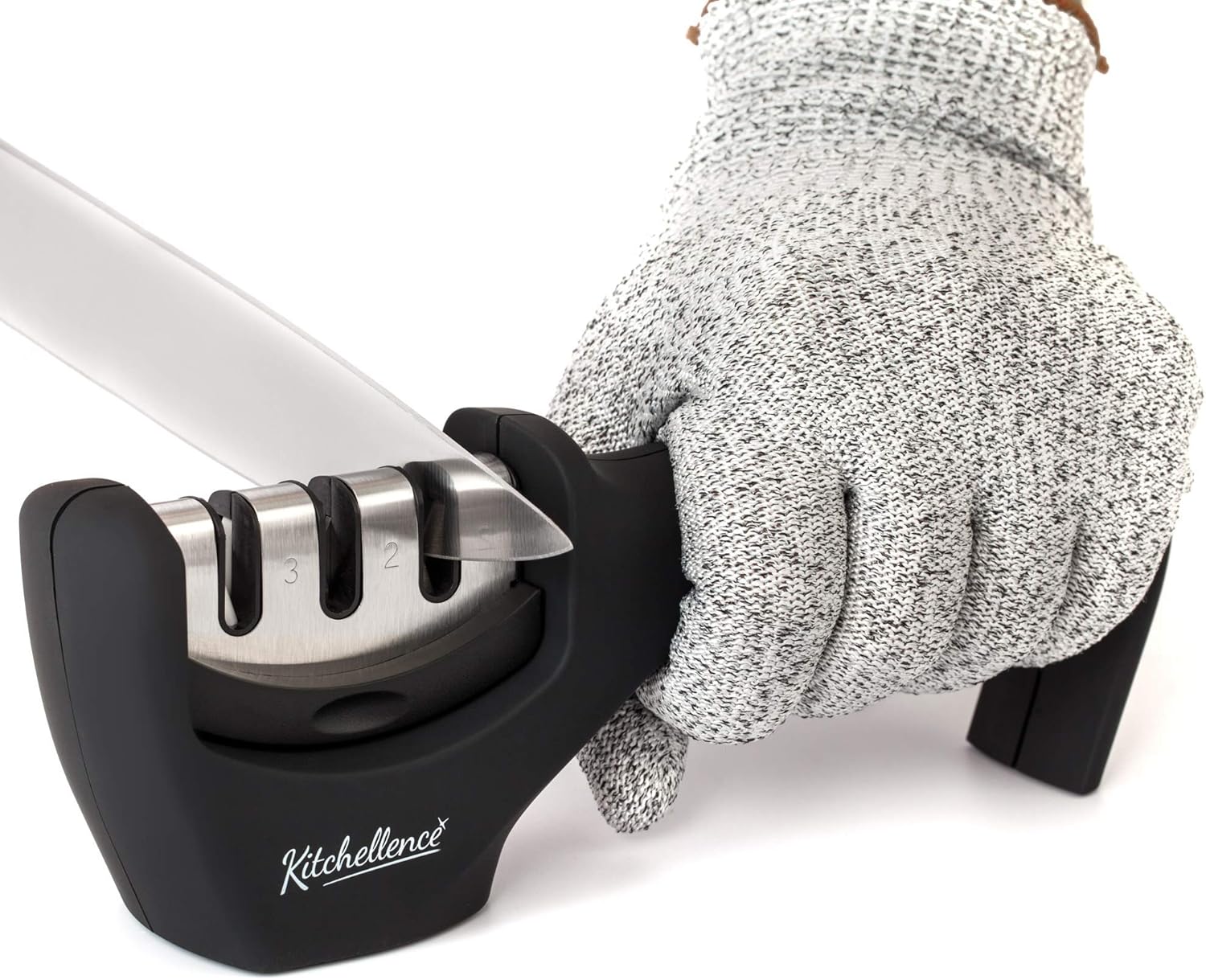
This compact 3-stage sharpener restores damaged blades, sharpens edges, and polishes a fine bevel with a simple pull-through process that works for both right- and left-handed users. The first slot uses a diamond rod to realign and repair nicks, the second restores the V-shape for cutting, and the third polishes to a finished edge, so it covers a wide range of routine maintenance tasks without tools or electricity. The molded ABS base and ergonomic handle give a secure grip and the non-slip feet help keep the sharpener steady during use, and the included cut-resistant glove is a useful safety addition for inexperienced users. It is lightweight and portable, so it is easy to store in a drawer or keep at the countertop for quick touch-ups, but it lacks adjustable angle settings and is not intended for professional reprofiling or serrated-edge sharpening. For everyday home kitchens this kit makes dull knives safe and effective again with minimal fuss.
Best for: Buyers who want a safe, simple way to refresh household kitchen knives without tools or a learning curve and who prioritize predictable, low-risk results.
Less Ideal for: Users who need adjustable-angle sharpening, frequent professional-grade reprofiling, or who regularly service serrated or specialty blades should look for a different tool.
- Three-stage system (diamond repair, sharpening, polishing) covers common edge restoration needs
- Ergonomic handle and non-slip base provide stable, one-handed operation
- Includes cut-resistant glove for added user safety
- Lightweight ABS construction is durable and easy to store
- No angle adjustment limits precision for advanced sharpening
- Not suitable for sharpening serrated blades or professional reprofiling
Verdict: A compact, safety-minded three-stage sharpener that reliably restores everyday kitchen knives for risk-averse home cooks.
Choosing the Right Home Kitchen Knife Sharpener: Key Factors to Consider
Supported Blade Types
Not all sharpeners handle every blade profile. Look for devices that explicitly support common kitchen knives, such as straight-edge chef knives, paring knives, and utility blades. If you use serrated knives or ceramic blades, verify the sharpener can service those edges or plan to keep a specialist tool for serrations.
Choosing a sharpener that matches your blade types reduces the risk of damage from inappropriate abrasives or angle setups. Supported blade types also influence the abrasive selection and the sharpening sequence, so matching capability to your collection saves time and preserves blade geometry.
Angle Control And Guided Systems
Consistent edge angle is the single biggest factor in predictable sharpening results. Guided systems lock the blade at a preset angle or provide a physical guide that helps even beginners maintain the correct bevel.
If you prefer more control, look for systems with multiple angle settings to accommodate Western and Asian-style edges. For casual home cooks, a simple guided-angle sharpener that sets a common kitchen angle offers the best mix of consistency and minimal setup.
Abrasive Materials And Grit Stages
Different abrasive media remove metal at different rates and produce different finishes. Coarse stages remove nicks and reprofile edges faster but sacrifice material; finer grits polish and refine the edge for better cutting performance and longevity.
Consider a sharpener with multiple grit stages or replaceable abrasive components so you can progress from repair to polish. The type of abrasive matters too: ceramic, diamond, and carbide each behave differently on harder steels, so choose a media that matches the common hardness of your kitchen knives.
Motorized Versus Manual Operation
Motorized sharpeners speed up the process and reduce physical effort, while manual or guided pull-through models give more tactile feedback and control. Motorized units can be helpful for restoring very dull knives quickly but may remove more metal if used improperly.
Decide based on how often you sharpen and how comfortable you are with technique. Manual guided sharpeners are often adequate for routine maintenance and are easier to store, whereas motorized models suit users who want repeatable speed with minimal technique learning.
Safety And Stability
A sharpener that moves or lacks guards raises the risk of slips and accidental cuts during use. Look for features such as non-slip bases, finger guards, and secure blade slots that keep the blade steady while you work.
Stable, well-designed safety features matter most in busy home kitchens or if multiple household members will use the tool. They help prevent user error and reduce the chance of damaging the blade during sharpening.
Maintenance, Replacement Parts, And Lifespan
Sharpeners require occasional upkeep, from cleaning abrasive debris to replacing worn stones or wheels. Evaluate how easy it is to access and swap consumable parts and whether the manufacturer documents abrasive grit and replacement intervals.
A unit with readily available replacement components and simple cleaning steps will stay useful longer and cost less to maintain in the long run. Consider whether you prefer a low-maintenance pull-through device or a system with replaceable elements that can be refreshed over time.
When To Resharpen Versus Reprofile
Regular maintenance sharpening keeps knives cutting cleanly without removing excessive metal. Light honing or a quick pass through a fine stage is usually enough to restore a working edge between full sharpening cycles.
Reprofiling or using a coarse stage is only necessary when the edge has a roll, chips, or has been ground to the wrong angle. Reserve aggressive removal for infrequent repairs to preserve blade life.
- Hone weekly or when slicing feels less smooth
- Use finer grits for routine touch-ups
- Reprofile only for chips, major dulling, or angle correction
Caring For Sharpening Abrasives
Abrasives collect metal particles as you sharpen, which reduces effectiveness and can contaminate finishes. Clean stones and wheels per manufacturer guidance, typically with water, a mild cleaner, or a dressing tool.
Replace or dress abrasives when they no longer cut evenly. Keeping abrasives clean extends their useful life and ensures consistent results.
- Rinse ceramic rods after use and dry thoroughly
- Diamond plates may require occasional flattening or cleaning
- Store abrasive components in a dry place away from kitchen splatter
Safe Sharpening Technique For Home Use
Keep blades steady and apply consistent, light pressure. For guided systems, let the device control angle and pace. For manual stones, maintain the chosen bevel angle and use full, even strokes.
Always move the blade away from your hands and keep fingers clear of the cutting edge. Work on a stable surface and secure any tool that relies on a base or clamp to prevent slips.
- Begin with coarse grit only when needed
- Finish with a fine stage or strop for a polished edge
- Test sharpness safely with a tomato or paper, not by touch
Integrating A Sharpener Into Your Kitchen Routine
Establish a simple schedule based on how often you cook and the types of food you prepare. High-acid or hard ingredients and frequent chopping will dull blades faster and may justify more regular touch-ups.
Keep the sharpener accessible but stored safely. A compact, easy-to-use device is more likely to be used than one tucked away in a cupboard.
- Touch up before big meal prep sessions
- Store consumables and accessories together for convenience
- Train household members on safe use to maintain consistent care
Understanding Edge Angles And Kitchen Tasks
Different tasks benefit from different edge angles. Narrower angles slice more cleanly and are favored for delicate work, while slightly steeper angles resist chipping and suit heavier tasks.
Choose a sharpener that supports angles matching the work your knives do most often to get the best balance between sharpness and durability.
- Thin slicing favors lower angles
- General all-purpose knives often sit in a mid-range angle
- Heavier cutting and harder steels may need higher-angle settings
How We Chose the Best Home Kitchen Knife Sharpener
We focused on tools and devices sized and specified for everyday home kitchen use, prioritizing safe, repeatable results over pro-only features. Selection criteria emphasized sharpening performance across common kitchen steels, user safety features, and overall durability. We prioritized models that supported multiple edge types or had guided-angle systems to minimize user error. Ease of use and maintenance were important: we included only sharpeners with straightforward cleaning and accessible replacement parts or abrasives. Portability and storage footprint were considered for smaller kitchens. We excluded specialty stone-only setups intended for experienced sharpeners, motorized units designed for industrial use, and any device lacking clear angle guidance or safety guards. The final picks represent tools that balance dependable edge restoration, user safety, and practical upkeep for typical home cooks.
Our full evaluation process is outlined in our review methodology.
FAQ
How often should I sharpen my kitchen knives at home?
It depends on use, but many home cooks touch up edges weekly and perform a full sharpening every few months. Frequency depends on cutting tasks, steel hardness, and how aggressively you use the knife.
Can I sharpen serrated knives with a typical home sharpener?
Not all home sharpeners handle serrations. Some models include a rod or specialist slot for serrated edges, but small diameter rods or professional servicing may be needed for deep serrations.
Is a motorized sharpener better than a manual one?
Motorized sharpeners are faster and reduce physical effort, but they can remove more material if misused. Manual guided systems give more control and are often sufficient for routine home maintenance.
Will sharpening damage my knives over time?
Sharpening removes metal, so overly frequent aggressive sharpening shortens blade life. Using appropriate grit progression and only reprofiling when necessary preserves the cutting edge longer.
How can I tell when a stone or abrasive needs replacing?
When it cuts unevenly, leaves visible glaze of metal, or no longer refines the edge after repeated passes, the abrasive likely needs cleaning, dressing, or replacement. Regular inspection after use helps spot issues early.
Final Verdict
Prioritize a sharpener that matches the blade types you own, offers consistent angle control, and includes safety features that suit everyday kitchen use. Balance abrasive selection and operation mode with how often you sharpen and how much control you want over edge reprofiling. Choose a tool that you are comfortable using regularly and that makes maintenance simple. That approach preserves blades, improves cutting performance, and reduces the chance of damage or injury during routine kitchen prep.