
Note: This article contains affiliate links. If you click on these links and make a purchase, we may earn a small commission at no extra cost to you. This helps support our research and content. Read our full affiliate disclosure here.
If you print regularly, ink costs quickly eclipse the price of the printer. Picking an inkjet printer with cheap ink matters because lower per-page costs let you print more documents, photos, and labels without budget surprises. You want a machine that balances low-cost refill options or efficient cartridges with dependable output and straightforward maintenance. This guide shortlists seven top choices that prioritize inexpensive ink and practical features for home and small-office use. We evaluated each unit for ink efficiency, print quality, and everyday reliability so you can choose the right low-running-cost printer for your needs. Read on for the core criteria and decision points that shaped our selections.
Top Picks at a Glance
| Best Overall The best all-around choice for most situations | Canon PIXMA G3270 MegaTank |  |
| Best Quality Built to a higher standard if you want something more solid | Epson EcoTank Photo ET-8500 |  |
| Best Value The sweet spot between price and what you get | Brother INKvestment Tank MFC-T580DW |  |
| Best Budget The cheapest option that still gets the job done reliably | HP DeskJet 2955 All-in-One Printer |  |
| Top Rated A top-rated pick with lots of positive feedback | Epson EcoTank ET-2800 |  |
| Most Popular A crowd favorite that many people choose with confidence | Brother MFC-J4335DW INKvestment Tank |  |
| Best Seller A high-volume bestseller chosen again and again | Canon PIXMA TS6520 |  |
Canon PIXMA G3270 MegaTank

| Print speed (B/W) | 11 ppm |
|---|---|
| Print speed (Color) | 6 ppm |
| Maximum print resolution | 4800 x 1200 dpi |
| Connectivity | USB, Wi‑Fi |
| Input capacity | 100 sheets |
The Canon PIXMA G3270 is a compact MegaTank inkjet intended for home and small office use that emphasizes very low running costs. It uses refillable ink bottles and Canon says a single set can print thousands of pages, which makes the printer well suited for heavy black‑and‑white or occasional color jobs. Setup and everyday use center on the rear paper tray, 1.35" LCD for status, and Wi‑Fi or USB connectivity so you can print from phones, tablets or a PC. Print quality is good for photos and documents with a maximum resolution up to 4800 x 1200 dpi, and copy/scan functions add basic versatility. Speed is moderate at about 11 ppm black and 6 ppm color, and it only does simplex single‑side printing. Practical tradeoffs are the 100‑sheet input capacity and simple duplex limitation, which may slow high‑volume workflows, and the footprint is larger than the smallest home printers. If you want very low cost per page and reliable everyday printing with an integrated refill system, this model delivers that balance without complex setup or maintenance demands.
Best for: Buyers who want the lowest ongoing ink cost and dependable everyday printing for a home or small office will appreciate this printer's refillable tank design and simple wireless setup.
Less Ideal for: Large offices or users who need fast duplexing and very high daily throughput should consider higher‑capacity or true duplex models instead.
- Very low cost per page using refillable MegaTank ink bottles
- Wireless and USB connectivity with mobile printing support
- High maximum print resolution suitable for photos and crisp text
- Includes set of ink bottles and print heads for out‑of‑box printing
- No automatic duplex (single‑side printing only)
- 100‑sheet input capacity may be small for heavy office loads
Verdict: Pick the PIXMA G3270 if your main priority is drastically lower ink costs and reliable all‑in‑one printing for a home or small office.
Epson EcoTank Photo ET-8500

| Printer Type | Inkjet |
|---|---|
| Maximum print Resolution Color | 4800 x 1200 dpi |
| Maximum Print Resolution Black and White | 5760 x 1440 dpi |
| Printer Connectivity Type | Ethernet, USB, Wi-Fi |
| Color Pages per Minute | 12 pages_per_minute |
The Epson EcoTank Photo ET-8500 is a cartridge-free all-in-one geared toward photo enthusiasts and small offices that need low ongoing ink costs. It uses a six-color Claria ET Premium ink system with large refillable bottles, letting you print many photos and documents before refilling and significantly reducing per-page ink expense. The printer handles borderless photos up to 13 x 19 inches, accepts heavier media through a straight-through feeder, and offers a 4.3-inch color touch panel for straightforward, PC-free control. Connectivity includes Wi-Fi, Ethernet, USB and SD card support plus mobile printing via Epson apps, and it also scans and copies with a high-resolution flatbed scanner. Print quality and resolution are strong for color photos and graphics, and automatic duplexing and multiple paper options add everyday convenience. Trade-offs are a relatively small paper capacity and a larger footprint and power draw than compact consumer printers, so it is less suited to tight desks or very high-volume document workflows.
Best for: Buyers who prioritize high-quality photo and graphics printing with very low ongoing ink costs and who are willing to trade some desk space for professional media handling.
Less Ideal for: Users who need a compact, low-power printer for light desktop document printing or who require large sheet capacities for heavy-duty office output.
- Refillable 6-color EcoTank system dramatically lowers ink cost per page
- High-resolution print engine (up to 5760 x 1440 dpi) for detailed photo and graphics output
- Borderless printing up to 13 x 19 inches and straight-through feed for thick media
- Multiple connectivity options including Wi‑Fi, Ethernet, USB and SD card with a 4.3-inch touch display
- Small input/output tray capacity limits continuous large print jobs
- Bulky footprint and higher power consumption compared with compact printers
Verdict: Choose the ET-8500 if you want pro-level photo prints while keeping ink costs low through high-capacity refillable bottles.
Brother INKvestment Tank MFC-T580DW

| Functions | Print / Copy / Scan |
|---|---|
| Auto Duplex | Yes |
| Paper Tray Capacity | 150 sheets |
| Max ISO Print Speed | 16 ppm (black) / 9 ppm (color) |
The Brother INKvestment Tank MFC-T580DW is a home/home-office all-in-one that focuses on low running costs through refillable ink tanks and high-yield ink bottles. It prints, copies, and scans with automatic duplexing and a 150-sheet tray, and connects via Wi-Fi or USB with mobile printing through the Brother Mobile Connect app. The spill-free refill bottles and keyed tank ports make refilling fast and error-resistant, and Brother claims up to three years of ink in-box—practical for moderate monthly printing without frequent cartridge purchases. Print speeds are modest (up to 16 ppm black and 9 ppm color), so it handles everyday documents and photos but is not built for heavy production. The 1-line LCD keeps operation simple but limits on-device navigation compared with larger control panels. Expect reliable color and black output when using Brother Genuine BTD180 bottles, and a lower cost per page versus cartridge-based models, though upfront size and weight are larger than the smallest desktop printers. For buyers prioritizing affordable ink and straightforward maintenance, this model offers a compelling balance of features and value.
Best for: Buyers who prioritize low ongoing ink costs and simple maintenance for home or small office use will appreciate this printer’s refillable tank design and mobile-friendly setup.
Less Ideal for: Users who need high-volume, high-speed production printing or advanced on-printer controls should consider more robust office-class models.
- Refillable, spill-free ink tank system that reduces cartridge waste and lowers long-term ink costs
- Includes up to three years of ink in-box for extended printing without replacements
- Automatic duplex printing and a 150-sheet tray support routine home and small office workflows
- Wireless connectivity plus Brother Mobile Connect app for easy mobile printing and setup
- Print speeds are modest, so large print jobs will take longer than faster office models
- Basic 1-line LCD limits on-device menu control and previewing
Verdict: Choose this Brother if you want a compact all-in-one that delivers much lower ink costs through refillable tanks and multi-year ink in-box.
HP DeskJet 2955 All-in-One Printer

| Printer Type | HP Thermal Inkjet |
|---|---|
| Maximum Media Size | 8.5 x 11.69 in |
| Maximum Sheet Capacity | 60 |
| Color Pages per Minute | 5.5 pages_per_minute |
| B&W Pages per Minute | 7.5 pages_per_minute |
The HP DeskJet 2955 is a small, budget-friendly all-in-one designed for everyday home printing, copying, and flatbed scanning. It handles basic color documents and photos at modest speeds (up to about 7.5 ppm black and 5.5 ppm color) and accepts standard HP 68 cartridges, with a three-month trial of HP Instant Ink included to help lower initial ink costs. Setup and mobile printing are straightforward thanks to the HP app, AirPrint and Mopria support, and the printer uses dual-band Wi-Fi with wireless direct printing for phones and tablets. Its 60-sheet input tray and manual duplexing keep the machine simple and compact for occasional users, while AI-driven formatting aims to reduce wasted pages when printing web content. Trade-offs include limited paper capacity, slower speeds compared with higher-end models, and manual duplex only, so it is not suited to busy home offices that need high-volume or fast duplex workflows.
Best for: Shoppers who prioritize a low upfront cost and simple home printing setup will like this as a primary printer for occasional documents, schoolwork, and photos.
Less Ideal for: Not a good choice for users who print large monthly volumes, need fast page throughput, or require automatic duplex for heavy double-sided jobs.
- Compact all-in-one: print, copy, scan in a small footprint
- Easy mobile and wireless printing via HP app, AirPrint and Mopria
- Includes 3-month Instant Ink trial to reduce short-term ink costs
- Accepts common HP 68 cartridges for easy replacement and wide availability
- Manual duplex only, no automatic two-sided printing
- 60-sheet input tray limits batch printing volume
Verdict: A compact, budget-oriented all-in-one that keeps ink costs down initially with an Instant Ink trial, making it a smart pick for frugal home users with light print needs.
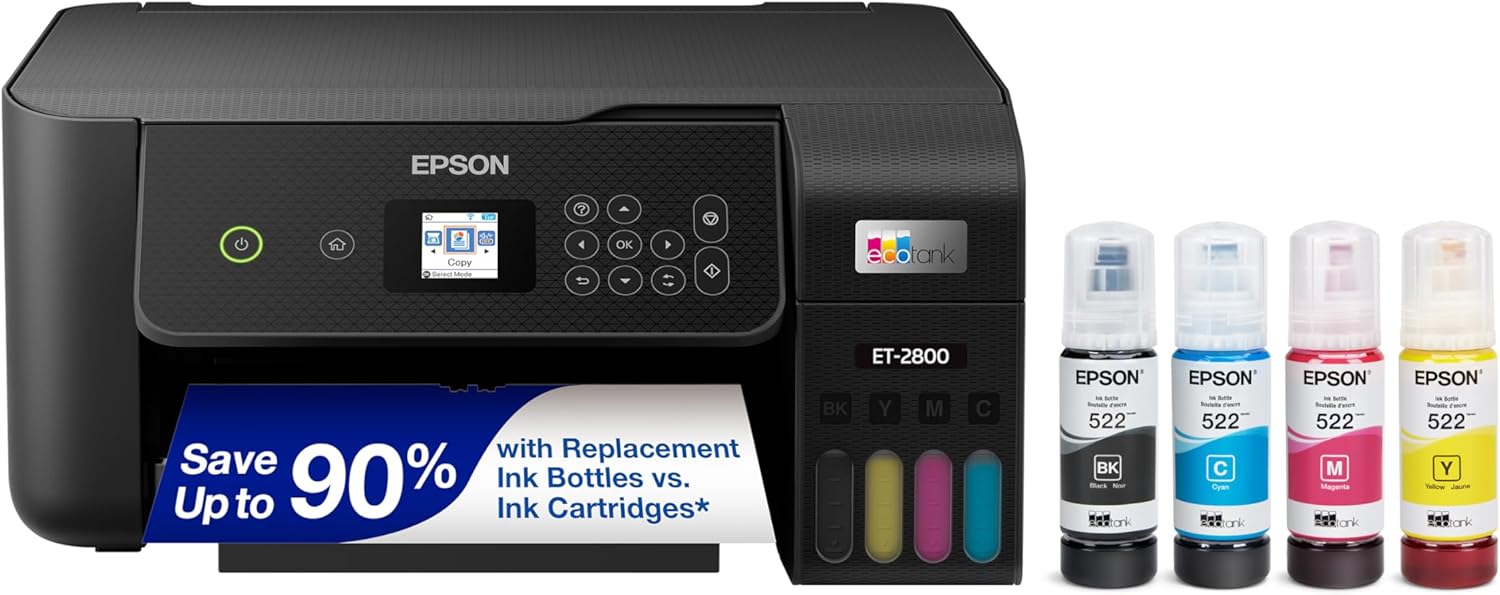
Epson EcoTank ET-2800
| Printer Type | Inkjet |
|---|---|
| Print Speed B&W | 10 pages_per_minute |
| Print Speed Color | 5 pages_per_minute |
| Connectivity | USB, Wi-Fi |
| Maximum Print Resolution Color | 5760 x 1440 dpi |
The ET-2800 replaces disposable cartridges with refillable EcoTank bottles, letting you print long runs without frequent cartridge swaps and reducing running costs. It prints up to about 10 pages per minute for black and 5 ppm for color, and uses PrecisionCore Micro Piezo heat-free print technology to deliver sharp text and reasonably detailed color prints. The unit includes a flatbed scanner, an LCD for basic control, and wireless plus USB connectivity with voice-activated printing support, so it fits typical home workflows like homework, documents, and occasional photos. Its main practical benefit is very low ink cost and less maintenance around cartridge changes, with replacement bottle yields marketed as equivalent to roughly 90 cartridges. Limitations include simplex-only printing (no automatic duplex) and modest photo color speed, and the scanner and copy resolutions are adequate but not pro-grade. You should also plan to use genuine Epson ink to maintain performance and warranty coverage.
Best for: Buyers who prioritize low ongoing ink costs and a reliable, low-maintenance home printer for documents, schoolwork, and occasional photos.
Less Ideal for: Users who need automatic two-sided printing, high-volume office throughput, or professional photo-quality scans and prints.
- Cartridge-free EcoTank system greatly reduces ink replacement frequency and cost
- PrecisionCore Micro Piezo printhead for sharp text and decent photo detail
- Wireless and USB connectivity with app control and voice printing support
- Includes flatbed scanner and basic LCD for on-device control
- High-capacity ink bottles reduce cartridge waste and upkeep
- No automatic duplex (two-sided) printing
- Color print speed is relatively slow compared with higher-end models
Verdict: If you want a dependable home all-in-one that slashes ink costs by using refillable high-capacity tanks, the EcoTank ET-2800 is a practical, reliability-focused choice.
Brother MFC-J4335DW INKvestment Tank

| Printer Type | Inkjet |
|---|---|
| Functions | Print, Copy, Scan, Fax |
| Duplex | Automatic |
| Connectivity | USB, wireless |
| Maximum Sheet Capacity | 150 |
The Brother MFC-J4335DW is a compact all-in-one inkjet designed for home offices and small businesses that need low-cost, low-maintenance printing. Its INKvestment Tank system uses front-loading cartridges that feed an internal tank, allowing higher ink capacity and longer intervals between replacements; Brother claims up to one year of ink in the box. You get automatic duplex printing, a 20-sheet ADF for multi-page scans and copies, a 150-sheet adjustable paper tray, and wireless/cloud printing via the Brother Mobile Connect app with optional Alexa integration for ink alerts and reordering. Print speeds are practical for everyday tasks at up to 20 ppm mono and 16 ppm color, and the 1.8-inch color display simplifies local control. Image resolution is modest at 600 dpi, so it is best for documents, photos for casual use, and general office printouts rather than high-detail photo work. Setup and routine use lean toward convenience and lower ongoing ink spend, though replacement high-yield Brother cartridges are recommended to realize the best per-page savings.
Best for: Buyers who prioritize low ongoing ink cost and reliable, everyday document printing with the reassurance of a proven product and solid user feedback.
Less Ideal for: Users who need pro-level photo quality or advanced wired network features should consider other models tailored for high-resolution or enterprise connectivity.
- INKvestment Tank design delivers higher ink capacity and less frequent cartridge swaps
- Includes up to one year of starter ink for extended initial use
- Automatic duplex and 20-sheet ADF streamline multi-page tasks
- Wireless, cloud and mobile app connectivity with Alexa support for easy printing and ink alerts
- 150-sheet adjustable tray handles typical home office paper loads
- Maximum print resolution is limited to 600 dpi which is not optimal for high-detail photo prints
- Only one USB port and no Ethernet limits wired connectivity options
Verdict: Choose the MFC-J4335DW if you want an all-in-one that keeps ink costs low through a high-capacity INKvestment Tank and includes long-lasting starter ink for worry-free everyday printing.
Canon PIXMA TS6520

| Printer Type | Inkjet |
|---|---|
| Duplex | Automatic |
| Printer Connectivity Type | USB, Wi‑Fi |
| Color Pages per Minute | 9 pages_per_minute |
| Compatible Cartridge | PG-295 & CL-286 |
The Canon PIXMA TS6520 is a small home/office all-in-one that handles everyday documents and occasional photo printing without fuss. It uses a two-cartridge hybrid ink system (pigment black plus dye color) to deliver sharp text and vivid color for schoolwork, recipes, and casual photos, and the built-in flatbed scanner covers basic copy and scan tasks. Setup is straightforward via Wi-Fi, the Canon PRINT app, Apple AirPrint or Mopria, and the 1.42" OLED display makes status and ink levels easy to check. Auto duplexing and borderless printing up to letter size help save paper and support lightweight photo projects. Expect modest sheet capacity and no automatic document feeder, so it is not built for high-volume copying or batch scanning. Print speeds are reasonable for home use, and dual-band Wi-Fi helps keep mobile printing reliable. For buyers focused on dependable, low-complexity performance, the TS6520 delivers solid output with familiar Canon cartridge compatibility, but it is not targeted at heavy office workflows.
Best for: Buyers wanting a simple, dependable all-in-one for home, student, or light hybrid-work printing who prioritize easy setup and consistent wireless printing.
Less Ideal for: Do not choose this if you need high-volume printing, frequent multi-page scanning, or an office-grade feed and finishing workflow.
- Two-cartridge hybrid ink system for crisp text and good color photos
- Automatic duplex printing saves paper and speeds typical workflows
- Compact footprint and easy setup for home or small workspaces
- Reliable wireless printing with dual-band Wi-Fi and mobile app support
- Only a single paper tray with very small sheet capacity limits longer print runs
- No automatic document feeder so multi-page scanning and copying is manual
- Starter ink tanks mean replacement cartridges may be needed sooner than with high-capacity systems
Verdict: A compact, user-friendly all-in-one that gives reliable everyday printing and good photo quality while keeping setup and wireless printing simple for risk-averse buyers.
Choosing the Right Inkjet Printer with Cheap Ink: Key Factors to Consider
Ink Cost Per Page
Ink cost per page directly determines how expensive printing will be over time. Look at the manufacturer stated yield and calculate cost per black-and-white and color page based on cartridge sizes commonly offered. A low up-front printer price means little if cartridges have low yields or high unit costs.
Consider typical monthly print volumes you expect and multiply by per-page costs to estimate monthly running expenses. Make sure to account for occasional color prints even if most output is black-and-white, since color cartridge maintenance and partial usage patterns can affect overall costs.
Cartridge Capacity and Refill Options
Cartridge capacity affects how often you need replacements and whether high-yield options are available. Models that offer XL or high-yield cartridges can reduce per-page cost significantly versus standard cartridges.
Also check for manufacturer-supported refillable tanks or third-party refill programs if you plan to use lower-cost consumables. Refillable systems usually lower long-term costs but require more user involvement and attention to fill levels and proper handling to avoid damage.
Print Quality for Intended Use
Cheap ink is only valuable if print quality meets your needs. For text-heavy documents, sharp dark blacks and consistent toner flow matter most. For photos or marketing materials, color accuracy, gradation, and fine detail become important.
Assess sample printouts or published sample images and determine whether any quality tradeoffs are acceptable for the cost savings. In many home and office cases, a modest drop in photo fidelity is acceptable to achieve much lower running costs for everyday documents.
Maintenance and Clog Resistance
Inkjet nozzles can clog if the printer sits unused for long periods, creating costly service needs. Models engineered with automatic maintenance cycles, robust head designs, or easy manual cleaning routines reduce the chance of downtime and wasted ink.
Consider how often you print and whether you can run periodic maintenance cycles. If you plan to print infrequently, choose a design known for clog resistance or one that uses refillable tanks where clogging is less common.
Paper Handling and Duty Cycle
Paper capacity, supported paper sizes, and recommended monthly duty cycle matter because frequent refilling or paper jams add time and indirect cost to printing tasks. A printer with a small tray may be fine for light personal use but will become inconvenient in a busy home office.
Match the duty cycle to your expected monthly pages. If you print high volumes, pick models with larger trays, automatic document feeders, or duplexing to save time and reduce manual intervention.
Connectivity and Usability
Easy connectivity lowers the friction of printing and reduces wasted time. Look for reliable Wi-Fi implementations, USB or Ethernet options where needed, and mobile printing support if you frequently print from phones or tablets.
Usability also includes setup simplicity, on-device controls, and driver support. A printer with confusing menus or flaky wireless behavior can increase the hidden cost of ownership even when ink is inexpensive.
Understanding True Running Cost
Sticker price is only part of the story. The true cost of owning an inkjet printer is a combination of cartridge price, yield, maintenance, and how often you print. A model with cheap cartridges may still cost more if yields are low or if it requires frequent head cleaning.
To estimate running cost, calculate monthly pages and multiply by the per-page cost derived from cartridge retail price and published yield. Include occasional maintenance cycles and replacement parts in longer-term projections.
- Calculate both black-and-white and color per-page costs.
- Factor in OEM versus third-party refill economics.
- Account for maintenance cycles and potential head replacements.
Refillable Tank Systems Versus Cartridges
Refillable tank printers often offer the lowest per-page ink costs because they ship with large reservoirs and economical bottled ink. They require different user habits, such as monitoring ink levels and performing occasional top-ups.
Cartridge-based systems can be simpler to manage and less messy, and high-yield cartridges narrow the cost gap. If you prefer convenience and minimal handling, high-yield cartridges may be the better compromise.
- Tanks: best for steady high-volume printing and the lowest long-term costs.
- Cartridges: better for lower-volume users who prefer plug-and-play simplicity.
How Print Volume Changes Your Choice
Monthly printing volume is the single biggest determinant of which low-ink-cost approach makes sense. Light users often benefit from a modest cartridge model with reasonable per-page costs, while medium to heavy users save most with refill tanks or XL cartridges.
Estimate conservative and peak printing months to avoid underestimating needs. If volume spikes seasonally, pick a solution that scales with XL cartridges or easy refill options to prevent sudden cost increases.
- Under 100 pages per month: cartridge models with solid standby performance may be fine.
- 100 to 500 pages: look for high-yield cartridges or small tanks.
- Over 500 pages: consider a refillable tank system for lowest running costs.
Paper and Media Considerations
Cheap ink does not guarantee quality on all papers. Lower-grade papers can absorb ink and produce dull colors or feathered edges. For business documents, standard office paper is usually adequate, but photos and marketing materials need coated or photo papers to look their best.
Check the printer's supported media types and whether it offers dedicated photo trays or borderless photo printing. Using the correct paper for the job preserves both image quality and ink economy.
- Match media to output: standard paper for text, heavier coated stock for images.
- Borderless photo printing uses more ink; expect higher per-photo costs.
Warranty, Support, and Long-Term Reliability
A low ink cost strategy only pays off if the printer lasts and remains serviceable. Consider warranty length and the ease of obtaining support or replacement parts. Durable construction and a good service path reduce the likelihood of a short-lived machine that wastes ink and time.
Also review whether the manufacturer documents maintenance procedures clearly. Transparent guidance simplifies user servicing and can extend useful life while keeping running costs low.
- Longer warranty periods add protection against early failures.
- Accessible service guides and user-replaceable parts lower downtime and repair cost.
How We Chose the Best Inkjet Printer with Cheap Ink
We focused on practical, measurable factors that determine a printer's true cost of ownership and daily usability. Primary filters required each candidate to offer either low-yield official cartridges priced for economy, high-yield cartridge options, or support for affordable refill systems. We prioritized models with clear published page-yield estimates and reliable duty-cycle guidance so running costs could be assessed realistically. Key evaluation criteria were ink cost per page, cartridge capacity and availability, print quality for both text and photos, and maintenance requirements including ease of nozzle cleaning and user-servicable parts. We also considered connectivity and paper handling since inefficient workflows raise indirect costs. Units with frequent clogging, opaque refill procedures, or poor long-term support were excluded. We omitted printers that rely solely on expensive single-use cartridges or have no viable low-cost refill path. We compared publicly available manufacturer specifications, commonly reported page-yield figures, and vendor-neutral performance indicators to judge long-term affordability and reliability. The result is a shortlist focused on low running costs without sacrificing everyday performance.
Our full evaluation process is outlined in our review methodology.
FAQ
How do I calculate the real ink cost per page?
Divide the cartridge or bottle price by the published page yield to get a baseline cost per page. For color printing, combine the costs of the cartridges used during typical color jobs. Remember to factor in maintenance cycles and any service-related ink use.
Are refillable tanks always the cheapest option?
Often they offer the lowest per-page cost, especially for medium to high volumes, but they require more hands-on maintenance and initial setup. For very low-volume users, high-yield cartridges may be more convenient and still economical.
Will cheaper third-party ink damage the printer?
Third-party ink quality varies. Reliable third-party supplies can work fine, but poor-quality ink may clog nozzles or produce inconsistent color. If you consider third-party options, choose suppliers with good reviews and a return policy.
How does infrequent printing affect inkjet ownership?
Infrequent printing increases the risk of nozzle clogging and may waste ink in cleaning cycles. If you print rarely, prioritize models known for clog resistance or plan a small weekly print job to keep ink flowing.
Do draft or economy modes significantly lower ink use?
Yes, draft and economy modes reduce ink deposition and can lower per-page costs for text documents. However, they also reduce print density and may not be suitable for high-quality prints or photo output.
Final Verdict
When choosing an inkjet printer with cheap ink, focus on realistic running costs rather than just the upfront price. Prioritize models with verified page yields, high-capacity cartridges or refillable tanks, and a maintenance design that matches how often you print. Balance ink economy against required print quality and workflow needs. Ultimately, match the ink approach to your monthly volume and tolerance for hands-on maintenance. That tradeoff determines whether refillable tanks, high-yield cartridges, or a simpler cartridge model will be the most cost-effective and reliable choice for your situation.