
Note: This article contains affiliate links. If you click on these links and make a purchase, we may earn a small commission at no extra cost to you. This helps support our research and content. Read our full affiliate disclosure here.
Picking the right juicer for home use affects how often you actually make fresh juice and how much time you spend cleaning up afterward. A good home juicer should extract the most liquid and nutrients from fruits and vegetables while fitting your kitchen space and daily routine. This guide shortlists the top options for home use and evaluates them on extraction efficiency, ease of cleaning, noise, and durability so you can pick a machine that matches how you plan to use it. Read on for practical buying guidance and the criteria we used to choose these picks.
Top Picks at a Glance
| Best Overall The best all-around choice for most situations | Ninja NeverClog Cold Press Juicer JC151 |  |
| Best Quality Built to a higher standard if you want something more solid | Hurom H70 Slow Juicer |  |
| Best Value The sweet spot between price and what you get | GDOR Centrifugal Juicer GS378 |  |
| Best Budget The cheapest option that still gets the job done reliably | Elite Gourmet Citrus Juicer ETS623 |  |
| Top Rated A top-rated pick with lots of positive feedback | Whuto Cold Press Juicer ZM1913M |  |
| Most Popular A crowd favorite that many people choose with confidence | BLACK+DECKER Citrus Juicer CJ625 |  |
| Best Seller A high-volume bestseller chosen again and again | Juilist Centrifugal Juicer AMR526 |  |
Ninja NeverClog Cold Press Juicer JC151

| Maximum Power | 150 watts |
|---|---|
| Number of Speeds | 2 |
| Power Source | Corded Electric |
| Capacity | 24 fluid ounces |
| Included Components | 24 oz juice jug, 36 oz pulp container, 2 pulp filters, auger, Inspiration Guide |
The Ninja NeverClog JC151 is a slow masticating juicer built to handle fibrous fruits and vegetables with its 150-watt high-torque auger and NeverClog cold press design. It extracts juice at low speed to reduce foam and preserve nutrients, and comes with two interchangeable pulp filters so you can choose a smoother juice or a thicker, fiber-forward result. Practical touches include a 24 oz juice jug and 36 oz pulp container for making multiple servings, a reverse function and two one-touch programs to help clear jams and maximize yield, and dishwasher-safe juice-contact parts that simplify cleanup. The unit is compact enough for most countertops and includes an anti-drip lever to reduce mess while pouring. Limitations are its modest 150W power compared with larger commercial masticators and the single-speed motor control beyond the simple program buttons, which may lengthen processing time for very large batches. For everyday home use it balances yield, ease of use, and cleanability effectively.
Best for: Home cooks who want a reliable, nutrient-focused cold press juicer that handles leafy greens and fibrous produce and values easy cleanup and batch capacity.
Less Ideal for: Users needing a heavy-duty, high-throughput juicer for commercial use or those who want advanced speed controls and faster processing of very large quantities.
- High-torque 150W auger designed to handle fibrous produce like kale, celery, and carrots
- Two interchangeable pulp filters let you control juice texture from smooth to pulpier
- Larger 24 oz juice jug and 36 oz pulp container reduce interruptions for batch juicing
- Dishwasher-safe juice-contact parts and straightforward assembly speed up cleanup
- Anti-drip lever and reverse function help prevent spills and clear jams during use
- 150W motor is modest for a masticating juicer and may be slower on very large or dense loads
- Limited speed control beyond the two one-touch programs reduces fine-tuning for certain ingredients
Verdict: Choose the Ninja JC151 if you want an easy-to-clean, nutrient-preserving cold press juicer that handles fibrous produce and small-batch juicing for everyday home use.
Hurom H70 Slow Juicer

| Wattage | 150 watts |
|---|---|
| Power Source | Corded Electric |
| Material | Plastic |
| Blade Material | Plastic |
The Hurom H70 is a single-auger masticating juicer built to extract high-yield, low-pulp juice from fruits and vegetables with minimal prep. It uses a slow squeeze auger and a strainer-free Easy Clean chamber that filters pulp without a mesh screen, so parts detach and rinse quickly for fast cleanup. The wide self-feeding hopper accepts larger pieces and reduces chopping, and the front-facing gauge lets you monitor juice volume as you work. In practice the H70 runs quietly and steadily, producing smooth juice and leaving relatively dry pulp, which is great for anyone prioritizing yield and texture. At 150 watts it handles leafy greens and harder produce like carrots and beets, though throughput is naturally paced by the low-speed auger so large batch jobs take longer than centrifugal machines. The unit is mostly plastic which keeps it lightweight and portable but buyers wanting all-metal components should look elsewhere. For home users focused on performance and easy maintenance, the H70 balances extraction efficiency with straightforward daily use.
Best for: Buyers who prioritize maximum juice yield and smooth texture and want a machine that is easy to clean and fits on a typical kitchen countertop for regular home use.
Less Ideal for: People who need very fast, high-volume juicing for commercial use or who prefer heavier all-metal appliances for long-term durability should consider other options.
- Strainer-free Easy Clean chamber that detaches and rinses quickly
- Large self-feeding hopper reduces prep and lets you add produce while juicing
- Slow masticating auger yields more juice with less pulp and quieter operation
- Front-facing gauge for easy monitoring of juice level
- Plastic-heavy construction may feel less durable than metal-bodied models
- Lower-speed extraction means slower throughput for large batches
Verdict: Choose the H70 if you want a quiet, high-yield cold-press juicer that delivers smooth juice and hassle-free cleanup for regular home use.
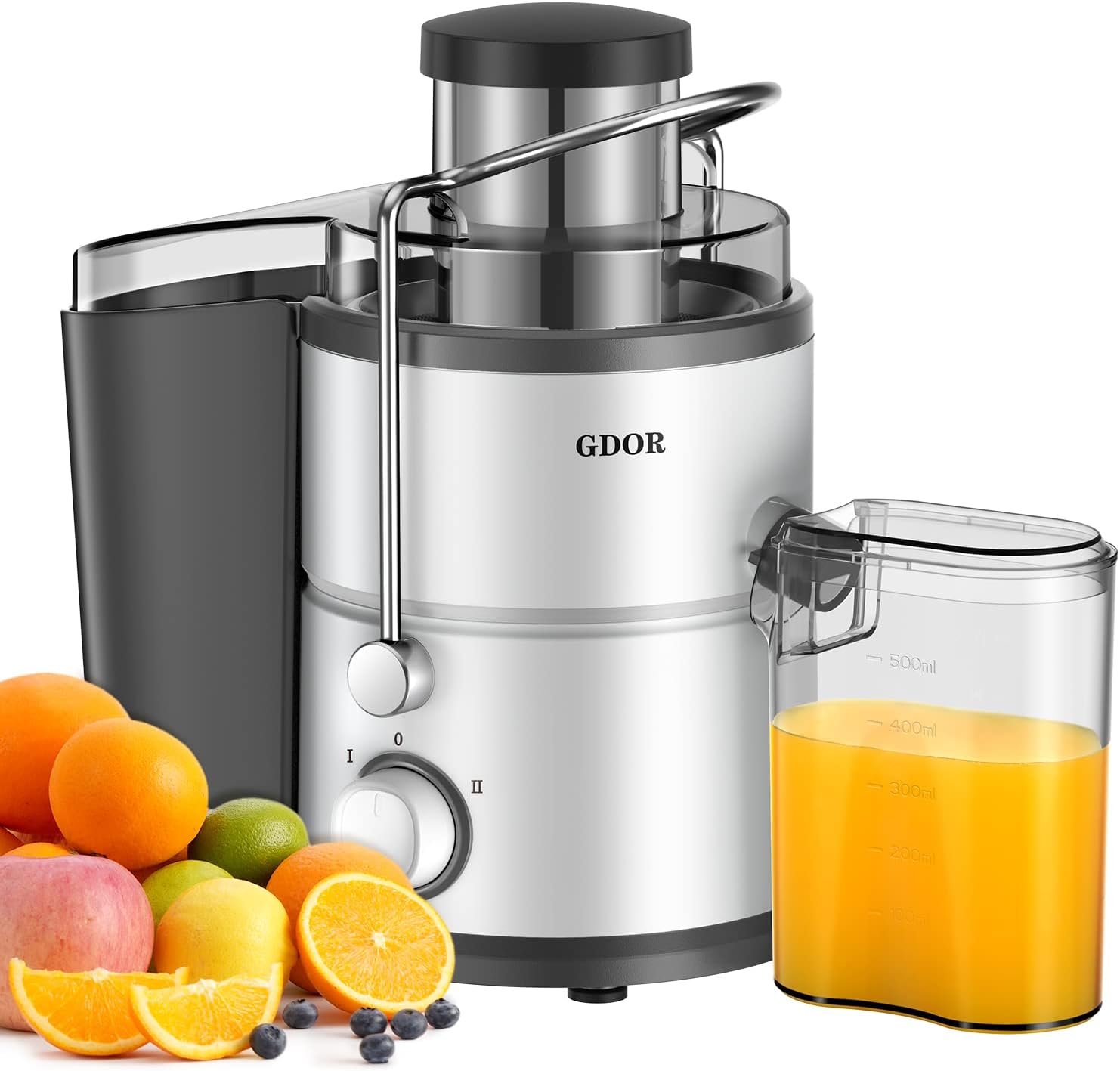
GDOR Centrifugal Juicer GS378
| Maximum Power | 800 watts |
|---|---|
| Number of Speeds | 2 |
| Power Source | ac |
| Voltage | 120 volts |
| Special Features | Built in Froth Separator, Overheat Protection |
The GDOR Centrifugal Juicer GS378 is a countertop centrifugal juicer designed to speed up everyday juicing with an 800W motor and a 3-inch wide chute that accepts whole or lightly trimmed produce. It uses a dual-speed dial — a lower setting for soft fruits and a high setting for harder items — so you can juice oranges and tomatoes or apples and carrots more effectively. The set includes a 17 oz juice jug with an integrated foam separator to reduce froth and an anti-drip spout to keep counters cleaner. Safety features such as a locking arm, micro switch protection, overload/overheat auto-shutdown, and non-slip feet make operation stable and straightforward. Most removable parts are dishwasher-safe and a cleaning brush is included, which simplifies cleanup after use. Note that as a centrifugal model it favors speed over maximum yield from leafy greens and may produce more foam and heat than slow-masticating machines, so if you prioritize cold-pressed yields this is not the style to pick.
Best for: Home cooks who want a fast, low-effort juicer that handles whole fruit and common vegetables with minimal prep and straightforward controls.
Less Ideal for: Buyers seeking the highest possible juice yield from leafy greens or the coldest, lowest-foam extraction should consider a slow masticating juicer instead.
- Powerful 800W motor for fast extraction
- 3-inch wide feed chute reduces prep by allowing whole or large pieces
- Dual-speed control adapts to soft and hard produce
- Built-in foam separator and anti-drip spout for cleaner pours
- Safety features including locking arm and overheat protection
- Centrifugal design is less efficient on leafy greens and may yield less juice than slow juicers
- Can generate more foam and heat during high-speed extraction
Verdict: Pick this juicer if you want fast, user-friendly home juicing with a wide chute and reliable safety features.
Elite Gourmet Citrus Juicer ETS623

| Maximum Power | 40 watts |
|---|---|
| Capacity | 24 oz (3 cups) |
| Power Source | Corded Electric |
| Special Features | Quiet Motor |
The Elite Gourmet ETS623 is a small, no-frills electric citrus juicer designed for everyday home use. It uses a 40-watt motor and an auto-reversing reamer to extract juice from oranges, lemons, limes, and grapefruits with simple push-down operation, and the 24-ounce container collects about 2–3 servings at once. Built-in pulp and seed filtration produces smoother juice, and the easy-pour spout plus ergonomic handle make serving straightforward. Detachable parts are top-rack dishwasher safe for quick cleanup, and the compact footprint fits tight counters, dorms, or RV kitchens. Expect quieter operation than bargain 25W models thanks to the quieter motor, but as a focused citrus machine it cannot process whole noncitrus fruits or make vegetable juices. Materials are stainless steel and BPA-free, and the unit is ETL listed for safety. For buyers wanting an affordable, simple way to get fresh citrus juice without extra features, this provides solid performance in a small package.
Best for: Buyers on a tight budget who want a straightforward, space-saving machine to make fresh citrus juice at home a few times a week.
Less Ideal for: People seeking an all-purpose juicer for leafy greens, root vegetables, or high-volume cold-press juicing should look at centrifugal or masticating models instead.
- 40W motor with auto-reversing reamer for efficient citrus extraction
- 24 oz (3-cup) container suitable for small batches
- Built-in pulp and seed filter for smoother juice
- Detachable parts are top-rack dishwasher safe for easier cleanup
- Compact footprint fits small kitchens, dorms, and RVs
- Limited to citrus fruits and not suitable for whole noncitrus or vegetable juicing
- Some plastic parts require hand washing for longest life despite dishwasher-safe claim
Verdict: A compact, affordable citrus-only juicer that delivers efficient, easy-to-clean fresh juice for budget-minded home users.
Whuto Cold Press Juicer ZM1913M

| Maximum Power | 200 watts |
|---|---|
| Power Source | Corded Electric |
| Voltage | 120 volts |
| Number of Speeds | 2 |
| Material | Stainless Steel |
The Whuto Cold Press Juicer ZM1913M is a compact single-auger masticating machine built for slow, nutrient-preserving extraction at home. It accepts whole fruits and vegetables through a wide feed chute and uses an upgraded spiral auger and dual mesh filtering to increase juice yield and reduce pulp, while two speed settings let you slow-press leafy greens or run harder produce. The stainless steel body, safety-lock lid and anti-vibration suction feet make it stable and feel factory-quality on the counter, and most removable parts are dishwasher-safe for straightforward cleanup. The unit also supports non-juice uses like nut milk or frozen treats, adding versatility beyond basic juice. Limitations to keep in mind are the modest 200-watt motor, which means slower processing for very hard produce, and the overall throughput is lower than centrifugal models, so juicing large volumes takes more time. For everyday home use where juice quality and reliability matter more than speed, this model offers a thoughtful, safe design and easy maintenance.
Best for: Buyers who prioritize reliable, high-quality cold-pressed juice and a sturdy, safety-minded appliance for daily home use.
Less Ideal for: Anyone who needs very fast juicing or regularly processes large batches for parties or commercial use should choose a higher-throughput centrifugal or commercial model.
- Masticating single-auger extraction preserves nutrients and increases juice yield
- Wide feed chute accepts whole fruits and vegetables to reduce prep time
- Stainless steel body with safety-lock lid and anti-vibration feet for stable, durable operation
- Most removable parts are dishwasher-safe for easier cleaning
- 200-watt motor provides slower processing and lower throughput compared with high-power centrifugal juicers
- Not ideal for very large-volume juicing sessions due to slower output
Verdict: Choose this compact masticating juicer if you want a reliable, safety-focused machine that emphasizes nutrient-rich cold-pressed juice over speed.
BLACK+DECKER Citrus Juicer CJ625

| Wattage | 150 watts |
|---|---|
| Power Source | Corded Electric |
| Voltage | 120 volts |
| Special Features | Auto-Reversing |
| Material | Plastic |
The BLACK+DECKER CJ625 is a simple countertop citrus juicer that squeezes lemons, limes, and oranges into a clear pitcher for recipe use or drinking. It uses two cone sizes and an auto-reversing reamer to extract more juice from each fruit, while the removable pulp basket lets you dial in how much pulp remains. The pitcher has measurement marks and an easy-pour spout so you can juice directly into a glass or bowl without extra strainers. Its plastic construction keeps the unit lightweight and the removable parts are dishwasher-safe for quick cleanup. The motor is built for routine home use rather than heavy commercial workloads, and the overall design favors straightforward operation over advanced features like multiple speed settings or cold-press extraction. If you want a no-fuss, reliable citrus juicer that handles everyday use and is easy to clean, this model delivers consistent results without complexity.
Best for: Buyers who want a straightforward, easy-to-use citrus juicer backed by many customer reviews and who prioritize reliable everyday performance and easy cleanup.
Less Ideal for: If you need a juicer for heavy daily commercial use or prefer cold-press/masticating extraction methods, this is not the best choice.
- Auto-reversing reamer for improved juice extraction
- Adjustable pulp basket to control pulp level
- Clear pitcher with measurement marks and drip-free spout
- Dishwasher-safe removable parts for easy cleanup
- Designed for household use rather than heavy or commercial juicing
- Plastic body may feel less durable than metal alternatives
Verdict: A dependable, easy-to-clean countertop citrus juicer that delivers efficient extraction and simple operation for home use.
Juilist Centrifugal Juicer AMR526

| Feed chute | 3" |
|---|---|
| Number of Speeds | 3 |
| Maximum Power | 800 watts |
| Capacity | 400 ml |
| Material | Stainless Steel |
The Juilist Centrifugal Juicer AMR526 is a countertop centrifugal machine intended for quick home juicing of fruits and many vegetables. It accepts whole or large pieces via a 3" wide feed chute, uses a stainless-steel cutting disc and micro-mesh filter, and offers three speed settings plus a pulse-like high setting so you can match speed to soft or hard produce. The motor is optimized for fast extraction—advertised up to 800W peak—and the compact footprint makes it easy to store on a crowded counter. Included accessories like a cleaning brush and dishwasher-safe parts simplify cleanup, and built-in safety features such as a double lock and overheat protection add reassurance. Expect good yields and short run times for common produce, though the centrifugal design is less effective on leafy greens and very fibrous items, and the small juice capacity means frequent emptying for larger batches. Noise and foam are typical for high-speed juicers, and the unit recommends avoiding frozen items and very hard produce. For routine daily juices from apples, carrots, oranges, and similar fruits, it delivers convenient, fast results with minimal fuss.
Best for: Home cooks who want fast, low-effort fresh juice from common fruits and firm vegetables and who prioritize straightforward operation and dishwasher-cleanable parts.
Less Ideal for: Anyone focused on extracting maximum juice from leafy greens or who needs large batch juicing for parties or frequent heavy use should consider a masticating or commercial-style juicer instead.
- 3" wide feed chute reduces prep by fitting larger pieces or halved fruit
- Three speed settings plus high pulse let you match speed to soft or hard produce
- Stainless-steel cutting disc and micro-mesh filter aim for higher juice yield
- Dishwasher-safe parts and included brush make cleanup straightforward
- Safety lock and overheat protection add reliable user safety
- Centrifugal design is less effective on leafy greens and very fibrous vegetables
- 400 ml capacity requires emptying for multi-serving batches
- High-speed operation generates typical centrifugal noise and foam
Verdict: A compact, easy-to-use centrifugal juicer that delivers fast, convenient juice for everyday fruit and firm-vegetable juicing.
Choosing the Right Juicer for Home Use: Key Factors to Consider
Extraction Efficiency
A juicer's extraction efficiency determines how much juice you get from a given amount of produce and how dry the leftover pulp is. Higher extraction reduces waste and lowers the per-serving cost of fresh juice. For home use, efficient extraction means fewer trips to the grocery store and better nutrient yield, especially when juicing leafy greens and fibrous root vegetables.
Efficiency is tied to the machine's mechanism. Centrifugal models spin rapidly to separate juice, while masticating or cold-press designs crush and press produce at lower speeds. Consider the types of ingredients you plan to juice most often and prioritize machines that reliably extract from those items.
Ease of Cleaning
If a juicer is difficult or time-consuming to clean, you are less likely to use it regularly. Look at how many parts come into contact with juice, whether they are dishwasher-safe, and how accessible the filter or strainer is for brushing out pulp. Quick-release components and smooth surfaces reduce buildup and simplify daily maintenance.
Also consider how fine the juicing screen is. Finer screens often require more scrubbing. For busy households, a design that minimizes small crevices and has an intuitive assembly/disassembly process will save time and encourage consistent use.
Build Durability and Materials
Durability matters for a home appliance you expect to use multiple times per week. Metal gears, reinforced feed chutes, and sturdy motors extend lifespan compared with thin plastics. Check for solid housings and quality seals that resist staining and odor retention from acidic ingredients.
Warranty terms and the availability of replacement parts are practical indicators of expected longevity. For frequent juicers, prioritize machines with robust motor designs and metal or BPA-free high-grade plastic components that stand up to repeated cleaning.
Noise and Vibration
Noise level is a real-world consideration for early-morning or shared-space use. High-speed centrifugal units tend to be louder than low-speed masticating models. Excessive vibration can cause the machine to move on the counter and create more cleanup work.
If you live with others or prefer to juice without waking household members, choose quieter designs. Also look for non-slip feet and balanced constructs that keep operation stable during processing.
Capacity and Daily Throughput
Capacity and throughput affect how quickly you can produce multiple servings. Machines with larger feed chutes reduce prep time because you can process whole or halved items without extensive chopping. Higher-throughput units are useful if you make several servings at once or prep juice for the week.
Balance throughput with extraction quality—some high-speed units are fast but less efficient on certain ingredients. For typical home routines, aim for a machine that processes your common produce in reasonable time without sacrificing juice yield.
Centrifugal Versus Masticating: Which Fits Your Routine
The main mechanical choice for home juicers is between centrifugal and masticating actions. Centrifugal machines spin at high speeds and typically produce juice quickly with minimal prep, while masticating or slow-press units crush and press at low speeds to yield more juice from greens and fibrous roots.
For someone who values speed and minimal prep, a centrifugal juicer can be appealing. If you prioritize nutrient retention, quieter operation, and better extraction from leafy greens, a masticating model often makes more sense despite a slower throughput.
- Centrifugal: faster, good for hard fruits, typically louder
- Masticating: slower, better for leafy greens and wheatgrass, often gentler on nutrients
Countertop Footprint and Storage
Consider where the juicer will live when not in use. Some home juicers have a compact footprint and are easy to tuck under cabinets or store in a pantry, while others are taller or wider and may need permanent counter space. Measure your intended storage spot and account for the machine's height with the lid on and feed chute attached.
A smaller model is useful for kitchens with limited counter space, but keep in mind a compact design can limit feed-chute size and throughput. If you plan to juice frequently, opting for a slightly larger machine you will use regularly is often a better tradeoff than never using a stored-away appliance.
- Measure cabinet height if you plan to store the machine on a shelf
- Consider feed-chute size versus how much prep you want to do
Maintenance Tips to Extend Lifespan
Regular cleaning after every use prevents staining, sour odors, and mechanical wear. Rinse components immediately and use a small brush to clear the juicing screen. Allow parts to dry completely before reassembly to avoid mold or odor buildup.
Inspect seals and gaskets periodically and replace worn parts. Avoid processing very hard items not intended for your machine, such as unpeeled nuts or large seeds, to prevent motor strain. Following the manufacturer-recommended duty cycle and rest intervals helps preserve motor life for frequent home use.
- Rinse and brush the juicing screen right away
- Rotate rest intervals for high-volume sessions to avoid overheating
Best Produce Prep Practices
Prep affects both extraction and wear. For many juicers, removing large pits, thick peels, and very hard cores improves juice quality and protects internal components. Leafy greens often benefit from being layered with a firmer fruit or vegetable to help the machine feed consistently.
Cut produce into sizes recommended by the manufacturer to reduce jamming and speed processing. For machines with small feed chutes, plan quick prep steps to halve or quarter items rather than attempting awkward fits that can cause clogging.
- Remove pits and very hard seeds before juicing
- Layer soft greens with firmer produce to improve feeding
Nutrient Retention and Heat Exposure
Low-speed masticating juicers generally produce less heat during operation than high-speed centrifugal units. Lower operating temperatures can help preserve heat-sensitive vitamins and enzymes. If you are focused on maximum nutrient retention or plan to store juice for a day, choose a machine and process that minimize heat buildup.
Also consider oxidation. Faster processing can introduce more air, which may accelerate oxidation and change flavor over time. Drinking juice soon after extraction or refrigerating it quickly slows nutrient degradation.
- Prefer low-speed extraction for leafy greens and long storage
- Refrigerate juice promptly to slow oxidation
How We Chose the Best Juicer for Home Use
We focused on features and performance that matter to home juicing: extraction efficiency, ease of cleaning, build durability, user safety, and capacity for the typical household serving size. Extraction efficiency measures how much juice and pulp separation a machine produces across common fruits and vegetables. Ease of cleaning covers how many parts disassemble, dishwasher safety, and the effort required to remove pulp. Durability and materials look at motor design, housing construction, and warranties to estimate long-term reliability for regular home use. Noise and vibration were weighed for daily-use comfort, especially for early-morning routines. Capacity and throughput consider how quickly a device can process whole fruits or leafy greens for 1 to 4 servings. We excluded commercial machines and single-use novelty devices that are impractical for routine home use. Models missing clear safety features or with a pattern of short lifespans based on owner reports were not considered. The final list balances measurable extraction and real-world convenience rather than marketing claims alone.
Our full evaluation process is outlined in our review methodology.
FAQ
How often should I clean my juicer after use?
You should rinse and disassemble juicer parts immediately after each use and clean thoroughly within a few hours. Prompt cleaning prevents pulp from drying into crevices and reduces odors or staining.
Can I juice leafy greens and wheatgrass in a home juicer?
Many home juicers can handle leafy greens, but extraction performance varies. Low-speed masticating machines perform better on leafy greens and wheatgrass than high-speed centrifugal types.
Is it better to drink juice right away or can I store it?
Fresh juice is best consumed soon after extraction for flavor and nutrient content. If you need to store it, refrigerate in an airtight container and consume within 24 to 48 hours to minimize oxidation and nutrient loss.
What maintenance extends a juicer's lifespan?
Regular cleaning, avoiding inappropriate hard ingredients, replacing worn seals, and following duty-cycle recommendations will extend lifespan. Inspect components periodically and allow the motor to rest during long juicing sessions.
Do juicers require special assembly skills?
Most home juicers use intuitive assemblies with a few parts that click or screw together. Reviewing the manual once and practicing a few assembly cycles makes daily use quick and straightforward.
Final Verdict
Choose a juicer for home use by balancing extraction efficiency, cleaning effort, and how you plan to prep produce. If you prioritize maximum yield from leafy greens and minimal oxidation, favor lower-speed, slow-press designs. If speed and minimal prep are most important, a faster centrifugal option may fit your routine. Prioritize ease of cleaning and durable construction for a machine you will use regularly. Consider countertop space and daily throughput needs so you pick a unit that matches your household habits and encourages consistent fresh-juice preparation.