
Note: This article contains affiliate links. If you click on these links and make a purchase, we may earn a small commission at no extra cost to you. This helps support our research and content. Read our full affiliate disclosure here.
If you drink a lot of vegetable juice or want to add more veggies to your day, the right vegetable juicer makes a big difference in yield, flavor, and cleanup time. You need a machine that handles leafy greens and fibrous roots without clogging, preserves nutrients with minimal heat, and fits neatly on your countertop. This guide shortlists the top vegetable juicers available for home kitchens and evaluates them on extraction efficiency, durability, and user-friendliness. Read on for a concise look at the features that matter most and a preview of the evaluation criteria used to choose these picks.
Top Picks at a Glance
| Best Overall The best all-around choice for most situations | Breville Juice Fountain Plus JE98XL |  |
| Best Quality Built to a higher standard if you want something more solid | Hurom H330 Cold Press Juicer |  |
| Best Value The sweet spot between price and what you get | nutribullet Juicer NBJ50100 |  |
| Best Budget The cheapest option that still gets the job done reliably | GDOR Centrifugal Juicer GS378 |  |
| Top Rated A top-rated pick with lots of positive feedback | XTKKGFBIR SJ-068 Cold Press Juicer |  |
| Most Popular A crowd favorite that many people choose with confidence | Hamilton Beach Big Mouth Juicer |  |
| Best Seller A high-volume bestseller chosen again and again | Juilist Centrifugal Juicer AMR526 |  |
Breville Juice Fountain Plus JE98XL

| Wattage | 850 watts |
|---|---|
| Number of Speeds | 2 |
| Power Source | Corded Electric |
| Capacity | 1 liters |
The Breville Juice Fountain Plus JE98XL is a centrifugal juicer built for fast, everyday vegetable and fruit juicing. Its 3-inch wide chute reduces prep time by letting you feed many whole fruits and larger pieces without chopping, and the two-speed control lets you choose low for soft greens and high for harder roots. The titanium-reinforced disc and stainless steel micro mesh filter work together to extract juice efficiently, while the included 35.2 fl oz jug with integrated froth separator helps deliver clearer juice with less foam. Cleanup is straightforward since several parts are dishwasher safe and the pulp container detaches for easy emptying, and the cord wraps under the base for compact storage. Because it is a centrifugal design driven by an 850 W motor, it juices quickly but can produce more foam and slightly less yield from leafy greens compared with slower masticating machines. For home cooks who want fast, reliable vegetable juicing with minimal prep, it strikes a good balance of speed, capacity, and convenience.
Best for: Home cooks who want a fast, no-fuss vegetable and fruit juicer that minimizes prep time and offers straightforward cleanup while delivering consistently quick results.
Less Ideal for: People focused on maximum juice yield from leafy greens or very quiet operation should consider slow masticating models instead.
- Extra-wide 3-inch chute cuts prep time by accommodating larger pieces and some whole fruits
- Two-speed control tailors performance for soft greens or harder vegetables
- Titanium-reinforced disc and stainless steel micro mesh filter for efficient extraction
- Included juice jug with froth separator reduces foam for clearer pours
- Many removable parts are dishwasher safe and the unit stores cord under the base
- Centrifugal design can produce more foam and lower yield on leafy greens compared with masticating juicers
- Louder operation than slow juicers during high-speed use
Verdict: Choose the JE98XL if you want a fast, easy-to-use vegetable juicer that reduces prep time with a wide chute and delivers quick cleanup and consistent daily performance.
Hurom H330 Cold Press Juicer

| Capacity | 2 liters |
|---|---|
| Power | 150 Watts |
| Auger Speed | 50 RPM |
| Material | Plastic; stainless steel blade |
The Hurom H330 is a single-auger, cold-press juicer built for making larger batches of vegetable and mixed-fruit juices without constant prep. Its 2-liter hopper accepts whole apples, carrots, celery, and leafy greens so you can load a recipe, press start, and step away while the 50 RPM auger gently squeezes produce to minimize heat and oxidation. The unit includes fine and coarse strainers for low-pulp or fuller textured juice and can be used for nut milk and blended-style smoothies with the proper screens. In practice it produces noticeably drier pulp and quieter operation than centrifugal machines, and Hurom claims juice stays fresher up to 72 hours. Cleanup is straightforward thanks to removable parts and a cleaning brush, and safety features like an automatic shut-off when the lid opens add reassurance. At 150 watts and a relatively heavy build, it is a robust countertop appliance but not as compact as small personal juicers and it requires hand washing of parts. Its strengths are yield, nutrient-preserving extraction, and hands-off batch capability, while footprint and manual cleaning are the main compromises.
Best for: Buyers who prioritize extraction performance and high juice yield for vegetables and family-size batches and want a mostly hands-off cold-press process.
Less Ideal for: Those who need a very compact, lightweight machine for occasional single servings or who prefer dishwasher-safe parts for zero-hand-wash cleanup.
- Large 2-liter self-feeding hopper for batch juicing without pre-cutting produce
- Slow 50 RPM auger that reduces heat and oxidation for higher nutrient retention
- Multiple strainers for low-pulp or fuller-texture juice and additional uses like nut milk
- Quiet motor and safety shut-off for early-morning or family use
- Removable parts and included cleaning brush make disassembly and cleaning faster than many masticating units
- Requires hand washing of components rather than dishwasher-safe parts
- Relatively heavy and sizable countertop footprint compared with compact juicers
Verdict: Choose the Hurom H330 if you want a performance-focused cold-press juicer that batches whole produce with high yield and nutrient-preserving slow extraction.
nutribullet Juicer NBJ50100

| Maximum Power | 800 watts |
|---|---|
| Number of Speeds | 2 |
| Capacity | 1.5 liters |
| Power Source | Corded Electric |
The NutriBullet Juicer is a fast centrifugal machine built to turn whole fruits and vegetables into juice with minimal prep. Its 3" feed chute accepts whole pieces so you spend less time chopping, and the 800W motor with two speeds handles both soft and hard produce. Juice collects in a 27 oz sealing pitcher with a froth separator and no-drip spout for easier pouring and short-term storage, while the large 1.5L pulp basin lets you process multiple items before stopping to empty. Most removable parts are dishwasher-safe and the stainless steel sieve is durable for repeated use. Expect typical centrifugal juicer results: quick extraction and lighter, frothier juice with some pulp and fiber left behind compared with slow masticating units. It is a good pick when speed and easy cleanup matter most, though it will not preserve nutrients as long as low-speed juicers and can be noisier during operation.
Best for: Buyers who prioritize speed, low prep time, and easy cleanup for everyday vegetable and fruit juicing.
Less Ideal for: Those seeking maximum nutrient retention, very smooth juice with minimal foam, or the quietest possible operation should consider a slow masticating juicer instead.
- 3" wide feed chute reduces prep by allowing whole fruits and vegetables
- 800W motor with dual speeds handles both soft and hard produce
- Large 1.5L pulp basin lets you juice several items before emptying
- Sealing 27oz pitcher with froth separator and no-drip spout for easy pouring and short-term storage
- Most removable parts and stainless steel sieve are dishwasher-safe for easier cleanup
- Centrifugal design produces more froth and less fiber retention than slow juicers
- Can be louder than masticating juicers during operation
Verdict: Choose this NutriBullet Juicer when you want fast, low-prep vegetable and fruit juicing with easy cleanup.
GDOR Centrifugal Juicer GS378
| Maximum Power | 800 watts |
|---|---|
| Number of Speeds | 2 |
| Power Source | ac |
| Voltage | 120 volts |
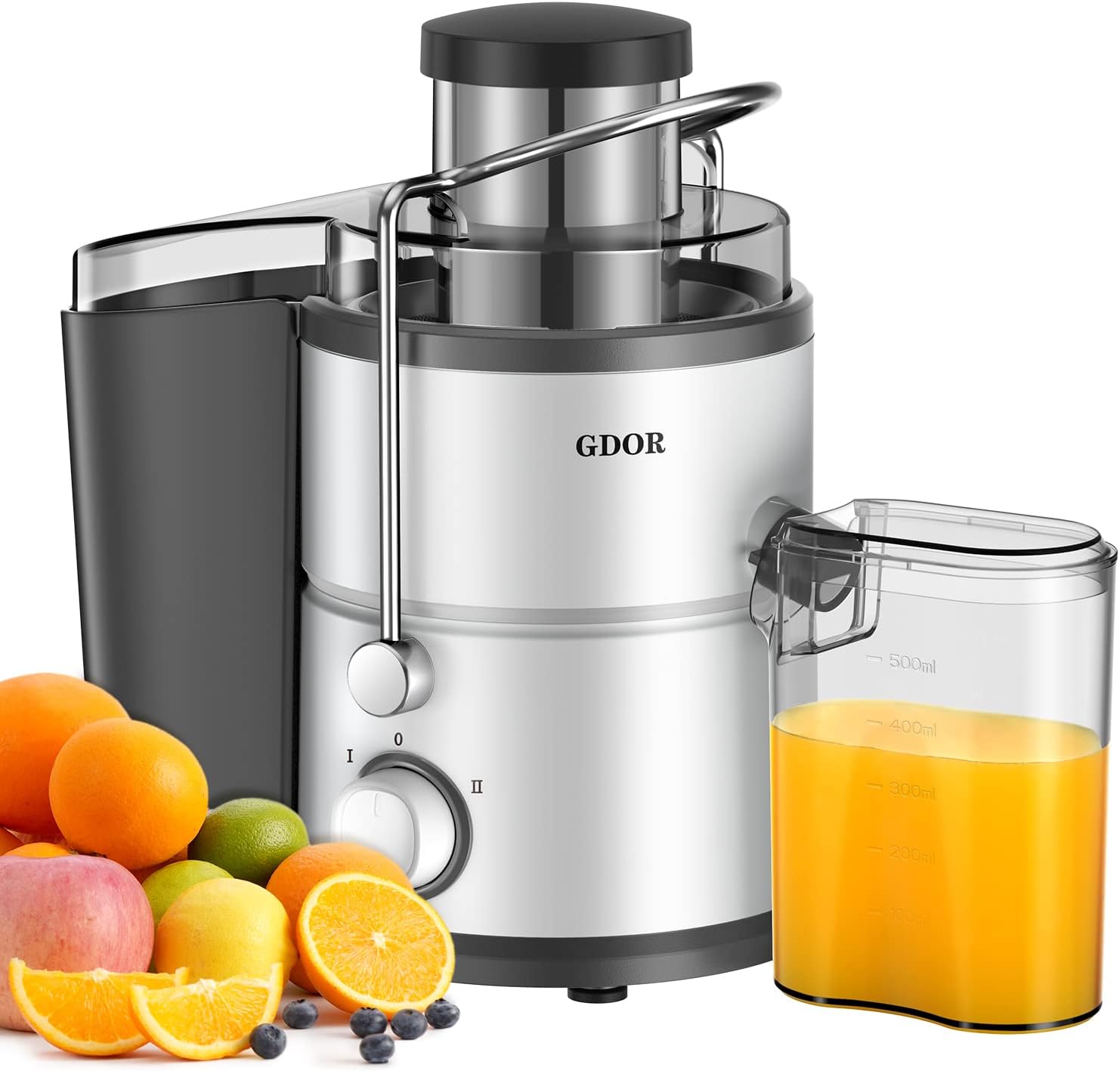
The GDOR Centrifugal Juicer GS378 is a budget-friendly countertop juicer that aims to make quick, everyday vegetable and fruit juices. It uses an 800W centrifugal motor and a 3-inch feed chute so you can juice whole produce without much pre-cutting, while a dual-speed knob covers soft and hard vegetables. Its removable juice jug includes a built-in foam separator to reduce froth and an anti-drip spout keeps counters cleaner. Safety features such as a locking arm, micro switch protection, and overheat shutoff add reliability during frequent use. The unit is mostly plastic with stainless steel blades and comes with a cleaning brush; parts are claimed to be dishwasher safe for easier cleanup. Expect typical centrifugal results: fast extraction and reasonable yield for carrots, celery, and apples, but more foam and less pulp control than slow cold-press models. For buyers focused on value, this model balances speed, a wide chute, and safety at a low price, though it will not match masticating juicers for nutrient retention or quiet operation.
Best for: Home cooks who want a low-cost, fast juicer for everyday vegetable and fruit juices and who prioritize convenience and speed over maximum nutrient extraction.
Less Ideal for: People who want the quietest operation, highest juice yield, or the best nutrient retention from leafy greens should consider slow masticating juicers instead.
- 800W motor provides fast extraction for vegetables and fruits
- 3-inch wide feed chute reduces prep by allowing whole pieces
- Dual-speed control handles both soft and hard produce
- Built-in foam separator and anti-drip spout improve pouring and reduce mess
- Multiple safety features including locking arm and overheat protection
- Centrifugal design produces more foam and less fine-pulp control than masticating juicers
- Mostly plastic construction may feel less durable than higher-end models
Verdict: A practical, inexpensive centrifugal juicer that delivers fast, no-fuss vegetable and fruit juices for budget-minded buyers.
XTKKGFBIR SJ-068 Cold Press Juicer

| Capacity | 1.8 liters |
|---|---|
| Maximum Power | 400 watts |
| Number of Speeds | 1 |
| Feed Chute | 6-inch XL |
The SJ-068 is a 3-in-1 cold press masticating juicer aimed at steady, high-yield extraction for home use. It uses a 400W motor driving a slow 55 RPM auger to press fruits, vegetables, leafy greens, and nuts with minimal heat, and the 6-inch wide chute reduces prep by accepting larger pieces. Dual fine-mesh strainers and a large 80 oz juice container produce smoother juice with less pulp and foam, and a reverse function helps clear small jams. Detachable BPA-free components and a quick-clean design make post-use care easier, and many removable parts are dishwasher-safe. Practical limits include a single fixed speed (typical for slow juicers), so it is not for users who need variable-speed control or very high throughput, and the unit is relatively large on the counter. Safety lock features and a robust motor make it suited to regular use, while the included accessories — pulp cup, juice cups, cleaning brush — cover common setup and maintenance tasks.
Best for: Home cooks who prioritize consistent, reliable cold-press extraction and want a low-maintenance machine that reduces prep time and handles leafy greens and nuts well.
Less Ideal for: Buyers seeking a compact travel-friendly juicer or those who need adjustable speed settings for specialized textures should look elsewhere.
- Slow 55 RPM masticating action for higher juice yield and nutrient retention
- 6-inch wide feed chute reduces chopping and speeds prep
- Dual fine-mesh strainers produce smoother juice with less pulp and foam
- Reverse function helps clear jams and keeps the auger moving
- Dishwasher-safe BPA-free parts and included cleaning brush simplify cleanup
- Single-speed operation limits control for different ingredient textures
- Relatively large footprint compared with compact juicers
Verdict: Choose the SJ-068 if you want a dependable cold-press juicer that delivers high-yield, smooth vegetable and leafy-green juices with minimal prep and easy cleanup.
Hamilton Beach Big Mouth Juicer

| Maximum Power | 800 watts |
|---|---|
| Number of Speeds | 1 |
| Power Source | Corded Electric |
| Material | Plastic, Stainless Steel |
| Capacity | 5 pounds |
The Hamilton Beach Big Mouth Juicer is a centrifugal extractor built to speed up everyday juicing by letting you feed whole or large pieces of produce through its 3 inch chute. Its 800 W motor spins a stainless steel strainer basket to separate juice from pulp quickly, making it useful for apples, carrots, celery, cucumbers and many leafy greens when used in short bursts. Removable, dishwasher-safe parts plus an included cleaning brush make cleanup straightforward after a session, and the large pulp bin reduces how often you need to empty it. It has a single speed knob and motor overload protection, so it is simple to operate but not adjustable for different produce textures. The design favors throughput and ease over slow cold-press extraction, so juice may be slightly frothier and less shelf-stable than juice from a masticating juicer. Backed by a three-year warranty and widely owned, it is a practical choice if you want fast, low-fuss vegetable and fruit juicing for daily use.
Best for: Buyers who want a reliable, high-throughput juicer for everyday vegetable and fruit juices and value ease of use, quick cleanup, and broad social proof from many existing owners.
Less Ideal for: People seeking the quietest, least-foamy, cold-pressed juice or those who prioritize adjustable speeds and very long shelf life for juice should consider a masticating model instead.
- 3-inch feed chute accepts whole fruits and large produce to reduce prep time
- 800-watt motor delivers high-speed extraction for fast juice yield
- Removable parts are dishwasher safe and included brush simplifies cleaning
- Large pulp bin holds a lot of fiber so you can juice more between emptying
- Single speed centrifugal design can produce froth and more heat than slow juicers
Verdict: A fast, easy-to-use centrifugal juicer that handles whole produce and simplifies cleanup, making it a go-to choice for regular vegetable juicing.
Juilist Centrifugal Juicer AMR526

| Maximum Power | 800 watts |
|---|---|
| Wattage | 400 watts |
| Feed Chute | 3" |
| Number of Speeds | 3 |
| Material | Stainless Steel |
The Juilist centrifugal juicer is a countertop machine built for fast, everyday vegetable and fruit juicing. It uses a high-speed motor (advertised up to 800 watts peak, 400 watts running) and a 3-inch wide feed chute so you can juice many whole pieces with less prep, while three speed settings let you match speed to soft or hard produce. The stainless steel cutting disc and micro-mesh filter aim to increase yield, and included accessories like a cleaning brush plus dishwasher-safe parts make cleanup straightforward. Safety features such as a double lock arm and automatic overheat protection add reassurance during use. Because it is a centrifugal model, expect relatively louder operation and a bit more foam compared with slow masticating juicers, and it is not recommended for fibrous, low-juice vegetables or frozen items. For routine vegetable juices and mixed fruit-vegetable blends where speed and convenience matter, this unit delivers a reliable, easy-to-use option that is simple to maintain.
Best for: Buyers who want a straightforward, reliable juicer that prioritizes speed, easy cleanup, and built-in safety for regular vegetable and mixed-fruit juicing.
Less Ideal for: People seeking the quietest machine, the highest long-term juice yield for leafy greens, or a juicer optimized for sugar cane, frozen produce, or very fibrous ingredients.
- 3-inch wide feed chute reduces chopping and speeds prep
- Three speed settings let you adjust for soft or hard produce
- Stainless steel cutting disc and micro-mesh filter for better juice yield
- Dishwasher-safe parts and included brush simplify cleaning
- Safety features include double lock arm and automatic overheat protection
- Centrifugal design tends to be louder and produces more foam than slow juicers
- Not suitable for very fibrous or frozen produce
Verdict: A fast, easy-to-use centrifugal juicer that suits risk-averse buyers who want safe, low-maintenance vegetable and mixed-fruit juicing.
Choosing the Right Vegetable Juicer: Key Factors to Consider
Extraction Method
Different juicers use different extraction methods, and that choice affects yield, nutrient retention, and the machine's ability to handle specific vegetables. Centrifugal units spin at high speed to shred produce and separate juice quickly, which is useful for hard vegetables but can introduce heat and foam. Masticating or slow cold-press styles crush and press produce more gently, often yielding more juice from leafy greens and tender stems while producing less foam and heat.
Understanding the extraction method helps you match a juicer to your typical produce. If you mainly use fibrous roots and hard vegetables, a high-speed option may be faster. If your routine relies heavily on wheatgrass, spinach, or soft stems, a slow-pressing design will usually give better yield and nutrient preservation. Consider how often you will juice and whether extraction speed or final juice quality is more important for your routine.
Yield and Waste
Yield determines how much usable juice you get from the same amount of vegetables and directly affects cost and prep time. Machines that press or chew more thoroughly leave drier pulp and extract more liquid, which is especially important for low-juice vegetables like celery, beetroot, and leafy greens.
Look for specifications or manufacturer guidance about expected pulp dryness and typical yield ratios for vegetables. Also consider whether the device can continuous-feed multiple types of produce without frequent stoppages, since machines that combine fruits and vegetables efficiently will save time and reduce effort when preparing mixed juices.
Cleaning and Maintenance
Juicers require regular cleaning to prevent residue buildup and bacterial growth. Ease of cleaning affects how often you will actually use the machine—fussy teardown and tiny parts discourage daily juicing. Removable parts that are dishwasher-safe or rinse-clean easily will save time. Brushes, wide chutes, and simple assemblies speed up cleanup.
Maintenance also covers periodic component checks like seals, screens, and augers. Consider how easy it is to access and replace wear items, how long seals typically last, and whether the design traps fibers in hard-to-reach crevices. A model designed for straightforward upkeep will have fewer surprises and longer useful life.
Performance with Leafy Greens
Leafy greens are among the most challenging ingredients for many juicers because they have less free liquid and tend to wrap around fast-spinning parts. If you depend on spinach, kale, or wheatgrass, prioritize a machine with proven leafy-green performance.
Features that improve green handling include a low-speed auger that slowly compresses fibers, a two-stage masticating process, or specialized screens and paddles to reduce clogging. Good leafy-green performance yields more juice, reduces the need to add fruit for moisture, and prevents frequent stops during a session.
Size, Speed, and Noise
A juicer's footprint and operating noise influence where and when you will use it. Compact models are handy for small kitchens but may sacrifice hopper size or motor power. High-speed units are faster but louder and may heat juice slightly, while slow-pressing machines are quieter and gentler but take more time per batch.
Think about kitchen space, whether you juice early in the morning when others sleep, and how much throughput you need. The right balance between speed and noise will depend on your daily routine and tolerance for operational sound.
Pulp Management and Versatility
The way a juicer handles pulp affects convenience and recipe flexibility. Some machines produce dry, compact pulp that is easy to dispose of or reuse in cooking, while others leave wetter pulp that can be messy. A well-designed pulp container with large capacity reduces the need to stop and empty during longer sessions.
Versatility covers the range of vegetables a juicer can process smoothly, from hard roots to delicate herbs. If you plan to make a variety of vegetable juices, look for adjustable settings, multiple screens, or accessories that expand function without complicating cleanup.
Common Vegetable Juicing Techniques
Vegetable juicing works best when you match prep and technique to the machine. Hard vegetables like carrots and beets benefit from uniform chopping so the juicer can process them evenly. Leafy greens are easiest when bunched compactly or rolled into cylinders to feed steadily into the auger or chute.
Layering produce also helps. Start with firmer items to create a flow, then add leafy greens or soft stems to be pressed by the machine's momentum. If your juicer has multiple speed or attachment options, experiment to find the order that minimizes clogging and maximizes extraction.
- Chop large roots and dense vegetables into pieces suited to the chute size.
- Feed greens in bundles to avoid wrapping and improve extraction.
- Alternate between hard and soft items to keep material moving through the feed path.
How to Reduce Foam and Oxidation
Foam and oxidation can change texture and cause faster nutrient loss in vegetable juice. To minimize these effects, use a slow extraction method when possible, since lower speeds reduce air incorporation. Straining juice through a fine mesh or letting it settle briefly in the fridge can separate foam before serving.
Using chilled produce and cold prep surfaces helps as well, because lower temperature slows enzymatic reactions that cause browning. If you plan to store juice, fill containers to the brim to limit air exposure and keep refrigerated to preserve color and flavor.
- Prefer slow-press extraction to reduce foam formation.
- Chill produce before juicing and store juice in cold, airtight containers.
- Let freshly made juice settle briefly and skim foam before serving.
Pulp Uses and Waste Reduction
Dry pulp left after juicing can be an asset rather than garbage. Vegetable pulp works well in soups, veggie burgers, muffins, and garden compost, providing fiber and reducing food waste. Some pulps are suited to baking when rehydrated and mixed into batters, while more fibrous material can be added to stocks for body.
To make pulp easier to reuse, press excess liquid from it, then store in the refrigerator for a short time or freeze in measured portions for later recipes.
- Incorporate pulp into savory muffins, fritters, or veggie burgers.
- Use fibrous pulp as a flavor base for stocks and soups.
- Freeze surplus pulp in portions for later cooking use.
Countertop Space and Installation Tips
Measure the intended spot before choosing a machine. Some juicers require more vertical or lateral clearance when assembled, while others can remain partially disassembled for storage. If you have limited counter space, consider a compact design or one that disassembles quickly for cabinet storage.
Also plan for cord length and proximity to a sink for faster cleanup. A small mat or tray under the juicer can collect drips and protect your countertop finish.
- Verify assembled dimensions and storage needs before purchasing.
- Keep a dedicated cleaning station nearby to speed post-juice cleanup.
- Use a drip tray or mat to protect surfaces during extraction.
Maintenance Checklist for Long-Term Reliability
Regular maintenance ensures consistent performance. Rinse screens and strainers immediately after use to prevent clogging. Inspect seals and gaskets for wear, and follow manufacturer intervals for part replacement if indicated. Tighten fasteners and check for unusual vibrations during operation, which can signal misalignment or worn components.
Storing parts dry and cleaning them thoroughly prevents odor buildup and extends service life. Keep a small brush handy for mesh screens and crevices that traps fiber.
- Rinse and brush screens immediately after juicing.
- Inspect seals and replace worn gaskets as needed.
- Store parts dry and perform periodical checks for vibration or unusual noises.
How We Chose the Best Vegetable Juicer
We narrowed the field by prioritizing the attributes that most affect real-world vegetable juicing. Extraction efficiency and yield were central because vegetables often have lower juice content than fruits, so machines that extract more liquid from the same produce are better for cost and convenience. Ease of cleaning and maintenance was another primary filter since juicing can be a daily habit; units that disassemble quickly and resist clogging reduce friction. Durability and build quality were assessed by examining materials, motor and gear design, and common failure points that affect long-term reliability. Versatility across vegetable types and the juicer's ability to handle leafy greens, soft stems, and hard roots without frequent jams was considered. Noise and motor heat were evaluated because excessive heat can degrade delicate nutrients and noisy motors can limit usage times. We excluded single-use or countertop gadgets without replaceable parts, machines that cannot consistently process common vegetables, and models that require specialized commercial hookups. The final list reflects machines that balance high yield, straightforward upkeep, robust construction, and gentle extraction for nutrient retention.
Our full evaluation process is outlined in our review methodology.
FAQ
Can I juice leafy greens without adding fruit?
Often yes. Slow-pressing juicers and masticating machines are usually able to extract good yields from leafy greens alone, while high-speed centrifugal models may need a small amount of softer produce to help move material through the machine.
How long does fresh vegetable juice last in the fridge?
Vegetable juice typically stays freshest for 24 to 72 hours when stored cold in airtight containers. Nutrient levels and flavor decline over time, so drinking soon after juicing preserves the best taste and nutrition.
Is a slow juicer always better than a centrifugal one?
Not always. Slow juicers generally yield more from greens and produce less foam, but they are slower to operate. Centrifugal units are faster and can be better for hard vegetables if you value speed and throughput over maximum extraction efficiency.
How do I prevent clogging when juicing root vegetables?
Cut root vegetables into uniform pieces and feed them steadily rather than in large chunks. Alternate with softer items or greens to maintain feed pressure, and pause to clear the chute if fibers begin to wrap.
Can I use celery and beet pulp in recipes?
Yes. Celery and beet pulp can be reused in soups, baked goods, and veggie patties after removing excess moisture. They add fiber and reduce kitchen waste when incorporated into cooked dishes.
Final Verdict
Choose a vegetable juicer that matches the kinds of produce you use most often. Prioritize extraction method and yield if you want the most juice per pound of vegetables, and emphasize leafy-green performance if you rely on spinach, kale, or wheatgrass. Balance ease of cleaning and maintenance against speed and countertop footprint to find a machine you will actually use regularly. With those tradeoffs in mind, focus on durable construction, straightforward upkeep, and proven extraction for consistent results.