
Note: This article contains affiliate links. If you click on these links and make a purchase, we may earn a small commission at no extra cost to you. This helps support our research and content. Read our full affiliate disclosure here.
If you need a compact, easy-to-use machine for quick repairs, hemming, or light craft projects, a mini portable sewing machine can be a practical addition to your home toolkit. These machines save space, travel well, and are designed for straightforward tasks without the setup and complexity of a full-size machine. This guide shortlists six top mini portable sewing machines selected for common at-home tasks and beginner-friendly use. We evaluate each pick for stitch quality, portability, and ease of use so you can find the right small machine for mending, quick alterations, or on-the-go crafting.
Top Picks at a Glance
| Best Overall The best all-around choice for most situations | SINGER Stitch Quick+ 01774 |  |
| Best Quality Built to a higher standard if you want something more solid | Verdanika Mini Sewing Machine 725 |  |
| Best Value The sweet spot between price and what you get | CraftBud Mini Sewing Machine |  |
| Best Budget The cheapest option that still gets the job done reliably | ZMJY Mini Handheld Sewing Machine |  |
| Most Popular A crowd favorite that many people choose with confidence | Magicfly Mini Sewing Machine MF600 |  |
| Best Seller A high-volume bestseller chosen again and again | SINGER Stitch Sew Quick |  |
SINGER Stitch Quick+ 01774

| Power Source | aa batteries |
|---|---|
| Model Number | 01774 |
| Item Type Name | Hand Held Mending Machine |
The SINGER Stitch Quick+ is a portable mending machine built for fast fixes and simple craft projects. It runs on AA batteries (or an optional AC adapter) and can be used handheld for spot repairs or placed on a table for continuous stitching, with a safety toggle that locks stitches for more secure seams. The unit uses a two-thread stitching mechanism and includes a built-in bobbin winder, thread cutter, spool pin that fits varied spool sizes, and a tension dial so you can adjust stitch quality for different fabrics. The bundled kit supplies needles, threaded bobbins, needle threader and other small notions stored in a built-in compartment, which makes it ready to use out of the box. Practical benefits are its slim ergonomic shape for one-handed control and the ability to handle denim, knit and woven fabrics for emergency repairs or small projects. Limits are its simple construction and lightweight plastic body, so it is not a replacement for a full-size sewing machine and heavier or prolonged jobs may outgrow its capabilities.
Best for: Buyers wanting a compact, ready-to-use portable mender for emergency repairs, travel, and small craft projects who prioritize convenience and portability over heavy sewing capability.
Less Ideal for: People who need a machine for regular garment construction, large projects, or professional sewing should choose a full-size sewing machine instead.
- Cordless AA battery operation with optional AC adapter keeps it portable
- Two-thread stitch and tension dial produce more secure, adjustable stitches
- Built-in bobbin winder, thread cutter, and storage compartment for accessories
- Compact ergonomic design allows handheld or tabletop use for quick repairs
- Lightweight plastic construction and simple mechanism limit heavy-duty or continuous sewing
Verdict: Choose the Stitch Quick+ if you want a truly portable, ready-to-use mini sewing machine for quick repairs and small craft jobs.
Verdanika Mini Sewing Machine 725

| Stitch options | 12 |
|---|---|
| Speed control | 2-speed |
| Tension levels | 9-level |
| Power source | AC |
The Verdanika 725 is a small, portable sewing machine aimed at beginners and quick repairs, offering 12 built-in stitch patterns and two-speed operation for controlled or faster stitching. Its compact footprint and internal metal frame make it stable enough for common fabrics like cotton, denim, and polyester while remaining easy to store or move. The machine uses simple dial controls, a 9-level tension adjustment, reverse stitch, automatic bobbin winding, and an LED work light, which together speed setup and help deliver neater seams without a steep learning curve. You can run it with the included foot pedal for hands-free control or with the power switch for short tasks, and the starter kit supplies basic presser feet, needles, bobbins, and threads so you can start right away. Expect good performance on garment repairs, craft projects, and light to moderate sewing; heavier industrial work or large quilting projects are beyond its intended scope and require a more powerful machine.
Best for: Buyers who want a portable, easy-to-use machine for mending, small garment projects, and hobby sewing where controlled speed and a simple setup matter.
Less Ideal for: Those who need a heavy-duty or high-capacity machine for professional tailoring, large quilts, or continuous long sewing sessions should look at full-size, higher-power models.
- Compact and portable design with an internal metal frame for better stability
- 12 stitch patterns plus 2-speed control let you switch between precise slow sewing and faster stitching
- Includes foot pedal and power switch options for flexible control
- Automatic bobbin winder and built-in LED light simplify setup and working in low light
- Comes with a starter kit of presser feet, needles, bobbins, and thread to begin sewing immediately
- Not powerful enough for heavy industrial fabrics or extended high-volume sewing
- Plastic external housing may feel less durable than full-size machines
Verdict: A portable beginner-focused sewing machine that delivers controlled, reliable performance for repairs and small projects without the bulk of a full-size unit.
CraftBud Mini Sewing Machine

| Power Source | Battery Powered |
|---|---|
| Included Components | Basic Set |
| Unit Count | 1 Count |
The CraftBud Mini Sewing Machine is a compact beginner-friendly machine aimed at simple mending and small craft projects. It runs on batteries or an AC adapter, offers adjustable dual-speed control with a foot pedal, and includes a built-in light and an expandable extension table for slightly larger fabric pieces. The kit bundles a 48-piece accessory set and an illustrated guide with 10 starter projects, which helps newcomers learn basic stitches and small projects without hunting for extras. Practical benefits include portability for quick repairs, simple setup for young users, and the spare parts and patterns in the kit to get started right away. Important limitations are its plastic construction and reduced power compared with full-size machines, so heavy fabrics, long seams, or industrial tasks will feel slow or may not feed reliably. Controls are straightforward but lack advanced stitch selection and customization. For straightforward home sewing, practice, and kids learning to sew, it covers the essentials in a small, easy-to-store package.
Best for: Buyers who want a compact, no-frills machine for learning, quick repairs, and small craft projects and who value portability and a ready-to-use kit.
Less Ideal for: Those who need a machine for heavy fabrics, long seams, frequent garment sewing, or advanced stitch features should choose a full‑size, more powerful machine instead.
- Dual power option (battery or AC) makes it portable and usable without nearby outlets
- Adjustable speed and foot pedal give control suitable for beginners and kids
- Built-in light and extension table improve visibility and handling of small projects
- Included accessory kit and illustrated project book help new sewers start immediately
- Plastic, lightweight build limits durability and heavy-fabric performance
- Limited stitch options and lower power compared with full-size machines
Verdict: A compact, ready-to-use beginner machine that prioritizes portability and ease of use for simple sewing and learning.
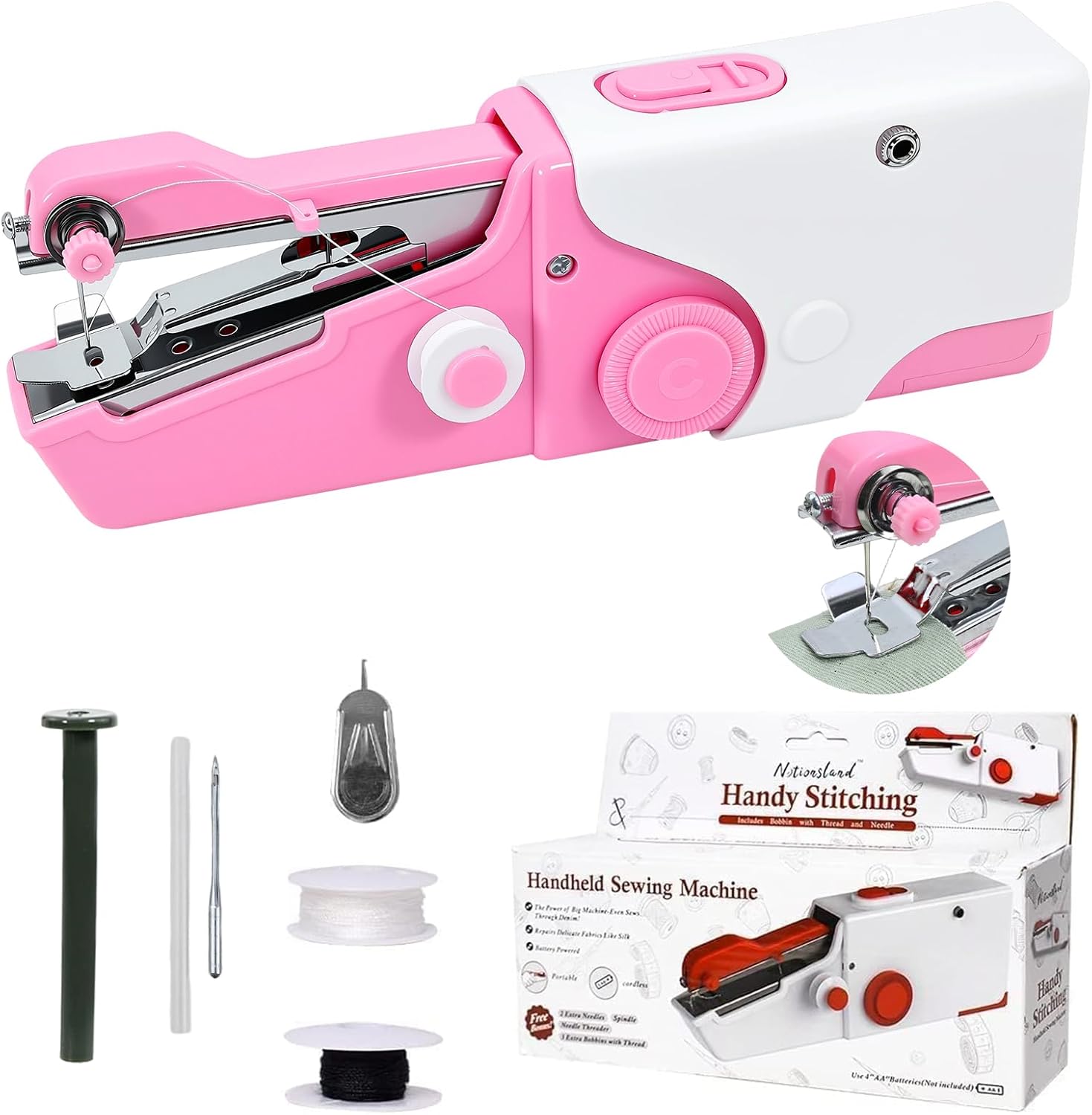
ZMJY Mini Handheld Sewing Machine
| Power Source | USB / 4 x AA Batteries |
|---|---|
| Recommended Fabric Thickness | ≤ 1.8 mm |
| Included Components | Needle, USB cable, fabric squares, user manual |
| Material | Plastic |
This mini handheld sewing machine is built for fast, on-the-spot mending and beginner craft work. It runs on either 4 AA batteries or the included USB cable, so you can stitch cordless while traveling or plug in for longer sessions at home. The unit is very small and lightweight with a simple single-button operation and an easy threading path, making it easy for novices or kids (with supervision) to fix hems, seams, buttons, and small tears on lightweight fabrics. The package includes basic accessories such as needles, pre-wound bobbins and fabric squares so you can start right away. Expect reliable results on thin materials up to about 1.8 mm thickness, but it is not intended for heavy fabrics, thick seams, or heavy-duty sewing tasks. Because of its tiny form factor the stitch length and power are limited, so precision on tricky curves or dense layers can be challenging. For quick wardrobe fixes and small craft projects this is a practical, portable option; for regular garment construction or heavy fabrics a standard machine will perform better.
Best for: Buyers looking for an inexpensive, ultra-portable sewing solution for occasional mending, travel repairs, or beginner craft projects who prioritize convenience over heavy-duty performance.
Less Ideal for: People who need a machine for regular garment construction, thick fabrics, or professional-quality sewing should choose a standard tabletop sewing machine instead.
- Dual power options: USB for continuous use or 4 AA batteries for cordless portability.
- Very compact and lightweight for travel, dorms, or quick home repairs.
- Simple single-button operation and easy threading suited to beginners.
- Includes a starter kit with needles, pre-wound bobbins and fabric patches so you can begin immediately.
- Limited to lightweight fabrics up to about 1.8 mm and not suitable for heavy or multiple-layer sewing.
- Small stitch mechanism offers less control and durability than full-size machines.
Verdict: A cheap, grab-and-go handheld that makes fast repairs and beginner sewing projects easy when you need portable, no-fuss stitching.
Magicfly Mini Sewing Machine MF600

| Power Source | Battery Powered |
|---|---|
| Model Number | MF600 |
| Item Type Name | Mini Portable Sewing Machine |
The Magicfly MF600 is a small, portable sewing machine that runs on battery power or AC and offers a simple, one-stitch design aimed at basic mending and beginner projects. It includes dual-speed control so you can switch between slow and fast stitching, a built-in light for working in low light, a foot pedal and push-button operation, and an extension table to support slightly larger pieces. The package also supplies an extensive beginner kit with extra bobbins, needles, scissors and common tools, and the unit ships pre-threaded so you can start quickly. Practical benefits include easy setup, portability for quick repairs or travel, and a low learning curve for new sewers. Limitations are its single fixed stitch with no reverse or adjustable stitch width, modest build materials, and limited durability expectations compared with full-size machines, so it is not suited for heavy fabrics or intensive use.
Best for: Buyers who want an affordable, easy-to-use portable machine for quick repairs, craft projects, and learning to sew with minimal setup and tools.
Less Ideal for: Those who need a machine for heavy-duty fabrics, professional garment construction, or advanced stitch options should choose a full-size or feature-rich model instead.
- Dual power operation (battery or AC) for use away from an outlet
- Dual-speed control and foot pedal for basic speed management
- Includes extension table and a comprehensive beginner sewing kit
- Built-in light and pre-threaded setup speed initial learning and small repairs
- Single fixed stitch type with no reverse stitching or adjustable stitch width
- Lightweight plastic construction not intended for heavy or continuous sewing
- Limited to basic household mending rather than advanced garment work
Verdict: A lightweight, beginner-friendly mini machine that delivers portable, no-frills sewing and a full starter kit for quick repairs and learning.
SINGER Stitch Sew Quick

| Power Source | Battery Powered |
|---|---|
| Included Components | Machine, Bobbins, Needles, Threader |
| Number of Items | 1 |
The SINGER Stitch Sew Quick is a cordless, single-thread handheld mending machine made for quick fixes on clothing, curtains, bedding and craft projects. It runs on four AA batteries (not included) and comes with bobbins, needles, a thread spindle and a needle threader so you can start minor repairs immediately. In use it feeds a single thread to stitch hems, mend small tears or baste when taking items to a sewing machine would be inconvenient; its lightweight, portable design makes it easy to move around a garment or work on drapes without removing them. Practical benefits include simple setup, included accessories, and cordless freedom for fast spot repairs. Important limitations are the single-thread feed and best performance on lightweight fabrics, so it is not a substitute for a full sewing machine when you need durable, professional seams or when working with heavy fabrics like thick denim or leather. Expect moderate stitch strength and basic stitch control suited to temporary fixes and quick alterations.
Best for: Buyers who want a simple, low-effort tool for quick home repairs and temporary hemming without the complexity of a full machine.
Less Ideal for: People who need strong, permanent seams or who regularly sew heavy fabrics or high-volume projects should choose a conventional sewing machine instead.
- Truly portable cordless operation for repairs anywhere
- Includes bobbins, needles, thread spindle and needle threader to get started
- Compact and lightweight for easy handling on garments and drapes
- Single-thread feed limits stitch strength compared with a full sewing machine
- Performs best on lightweight fabrics and is not ideal for heavy-duty sewing
Verdict: A handy, truly portable mini mender that lets risk-averse users quickly fix lightweight fabric problems without needing a full sewing machine.
Choosing the Right Mini Portable Sewing Machine: Key Factors to Consider
Stitch Quality And Consistency
A mini portable sewing machine must still deliver even, balanced stitches for seams to hold and hems to look neat. Poor stitch tension or skipped stitches will make repairs fail or require rework, which defeats the point of a quick, portable unit.
Look for clear tension controls, several basic stitch options, and a straight, reliable feed path. For users planning to mend garments regularly, stitch consistency across lightweight and medium-weight fabrics is crucial and will determine whether the machine meets daily needs.
Portability And Storage
True portability is about more than a small footprint; weight, compactness, and how easily the machine is carried matter too. If you plan to move the machine between rooms, take it to classes, or store it in a closet, choose a unit that is light enough to lift easily and small enough to slide into storage.
Consider whether the machine has a built-in handle or a travel case, and whether any detachable parts are easy to stow. Portability also affects where you can use the machine, so check power options and how quickly it can be set up and packed away.
Ease Of Use And Setup
Many buyers of mini portable sewing machines value simplicity. Clear threading paths, intuitive stitch selection, and straightforward bobbin access reduce frustration, especially for beginners. A machine with poor ergonomics or complicated setup will slow down basic tasks.
Look for labeled controls, quick-change bobbin systems, and simple tension adjustment. A machine that includes basic extras like a seam ripper, spare needles, or a simple manual can speed learning and reduce initial friction for novice sewers.
Power Source And Performance
Mini machines vary in how they are powered and how much fabric they can handle. Understand whether the unit plugs into mains power, runs on batteries, or supports both. Battery operation increases portability but may reduce sustained power and speed.
Evaluate whether the motor provides enough torque for the fabrics you plan to sew. For occasional repairs and lightweight fabrics, modest power is usually sufficient, but for slightly thicker seams or layered hems you will want a bit more motor strength to avoid stalling.
Build Quality And Long-Term Reliability
Since these machines are meant to be used periodically and moved often, construction quality and materials affect longevity. Cheaply made units may suffer from loose fasteners, imprecise feed dogs, or fragile tension mechanisms that degrade quickly.
Prioritize machines with a solid feel, well-aligned components, and metal where it matters for moving parts. Regular maintenance access and replaceable needles or feed components help extend useful life and keep the machine working reliably.
Best Uses For A Mini Portable Sewing Machine
Mini portable sewing machines are designed for light repairs, quick alterations, and basic craft projects. They are ideal for hemming pants, fixing seams, sewing on buttons, and creating simple fabric accessories where speed and convenience matter more than advanced features.
These machines work well in small living spaces, dorm rooms, or as a travel backup for workshops and classes. They are not intended for continuous heavy-duty sewing, but they excel at saving time on routine household sewing tasks.
- Hemming and seam repairs
- Patchwork and small craft projects
- Button replacement and small alterations
- Portable workshop or classroom use
Threading, Bobbin Winding, And Basic Maintenance
Mastering basic threading and bobbin winding keeps a mini sewing machine performing reliably. Start by following the threading path, keeping thread tension moderate, and choosing the right needle and thread weight for the fabric.
Regular maintenance includes removing lint from the bobbin area, occasionally oiling moving metal parts per the manual, and checking needle condition. Carry a small kit with spare needles, thread, and a seam ripper to avoid interruptions during projects.
- Follow the manual for correct threading sequence
- Clean lint and debris from feed dog and bobbin case weekly with light use
- Replace needles at first sign of bending or skipped stitches
How To Assess Fabric Compatibility
Although compact machines handle most lightweight fabrics comfortably, their ability to sew medium-weight materials varies. Start with test scraps to confirm tension settings and stitch length before working on a garment. Use a stronger needle and slower speed for layered fabrics.
Avoid expecting a mini portable to replace a full-size machine for heavy denim, thick canvas, or leather. For regular work on thicker materials, a sturdier machine designed for those fabrics will be necessary.
- Test with scrap fabric of the same weight as the project
- Adjust stitch length and tension when stitching through seams
- Use appropriate needle type for fabric to prevent skipped stitches
Power Options And Practical Considerations
Check whether a mini machine runs on batteries, plugs into a wall outlet, or supports both. Battery operation increases flexibility but may limit run time and torque. Dual-power machines offer the convenience of portability with the option for higher performance when plugged in.
Also consider how the machine behaves under load. A modestly powered motor is fine for short sessions, but frequent sewing of layered seams will benefit from a stronger motor or mains power.
- Battery vs mains: tradeoffs between portability and sustained power
- Look for stable foot controls or accessible speed dials
- Consider how noise and vibration affect usability in shared spaces
Accessories That Make A Difference
Useful accessories include extra needles in multiple sizes, a variety of presser feet, spare bobbins, and a simple carrying case. These extras reduce downtime and expand what you can do with a compact machine.
A small LED work light and an easy-to-read manual also improve the user experience, especially for beginners using the machine in different lighting conditions or locations.
- Spare needles and bobbins
- Compact carrying case or storage bag
- Basic presser feet and a small LED light
How We Chose the Best Mini Portable Sewing Machine
We shortlisted mini portable sewing machines by focusing on features that matter for compact, everyday use. Primary evaluation criteria included stitch quality and consistency, because even small machines must produce reliable seams for repairs and garments. Portability and weight were assessed to ensure the machines are genuinely easy to move, store, or carry for travel and craft events. Ease of use was measured by the clarity of controls, threading simplicity, and how well the machine supports users with limited sewing experience. Power and speed were considered to confirm the machine can handle layered fabrics or brief bursts of activity without bogging down. Build quality and durability were used to judge long-term reliability for home use. We excluded heavy-duty floor models, industrial machines, and units designed exclusively for quilting or embroidery, as those fall outside the compact portable scope. Overall, we prioritized machines that balance practical stitch performance with small size, intuitive controls, and dependable construction.
Our full evaluation process is outlined in our review methodology.
FAQ
Can a mini portable sewing machine handle denim or thick seams?
Usually not for regular heavy-duty work. Mini machines can manage a few thin denim layers or light seams if you use the correct needle and sew slowly, but they are not designed for continuous heavy fabrics.
Are mini portable machines good for beginners?
Often yes. Many compact machines prioritize simple threading, basic stitch options, and intuitive controls, making them suitable for new sewers practicing hems, mending, and simple projects.
How long do batteries last in battery-powered mini machines?
Battery life varies by model and usage. Expect shorter runtimes under continuous sewing or when stitching through thicker fabrics. For frequent use, mains power or rechargeable options provide more consistent performance.
What maintenance does a mini sewing machine need?
Regular cleaning of lint from the bobbin area, occasional oiling of metal moving parts if recommended, timely needle changes, and keeping spare bobbins on hand will keep the machine running smoothly.
Can I use a regular sewing needle with a mini portable machine?
Mini machines typically accept standard domestic needles, but check the manual for compatible needle sizes. Using the wrong needle can cause skipped stitches or damage the fabric.
Final Verdict
When choosing a mini portable sewing machine, prioritize stitch quality, ease of use, and true portability over bells and whistles. Accept the tradeoff that compact machines are best for light repairs, quick hems, and craft projects rather than continuous heavy-duty sewing. Focus on models with clear threading, solid build components, and adequate power for the fabrics you plan to work with. With the right balance of portability and performance, a mini portable sewing machine can be a highly useful tool for everyday mending and small-scale sewing tasks.