
Note: This article contains affiliate links. If you click on these links and make a purchase, we may earn a small commission at no extra cost to you. This helps support our research and content. Read our full affiliate disclosure here.
Picking the right printer for photos and documents matters because you want both vivid images and reliable text output without constant downtime or surprise costs. Whether you regularly print family photos, marketing materials, or multipage reports, the ideal printer combines color fidelity, paper handling, and economical ink or toner use. This guide shortlists the top printers across common home and small-office needs and explains the tradeoffs that matter. We evaluated options for print quality, speed, and operating cost so you can pick the model that fits your workflow and output expectations.
Top Picks at a Glance
| Best Overall The best all-around choice for most situations | Epson Expression Premium XP‑7100 |  |
| Best Quality Built to a higher standard if you want something more solid | Canon PIXMA PRO-200S |  |
| Best Value The sweet spot between price and what you get | Brother Work Smart 1360 MFC-J1360DW | 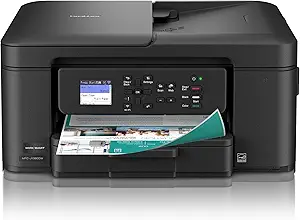 |
| Best Budget The cheapest option that still gets the job done reliably | HP DeskJet 2955 All-in-One |  |
| Top Rated A top-rated pick with lots of positive feedback | HPRT CP4100 4×6 Photo Printer |  |
| Most Popular A crowd favorite that many people choose with confidence | Canon PIXMA TR4720 |  |
| Best Seller A high-volume bestseller chosen again and again | Epson EcoTank ET-2800 |  |
Epson Expression Premium XP‑7100

| Printer Type | Inkjet |
|---|---|
| Maximum print Resolution Color | 4800 dpi |
| Maximum Copies Per Run | 60 |
| Maximum Sheet Capacity | 30 |
| Printer Connectivity Type | Wireless |
The Epson Expression Premium XP‑7100 is a compact all‑in‑one inkjet aimed at home users who want good photo and everyday document printing in one machine. It uses five Claria premium inks including a photo black to produce high resolution prints up to 4800 dpi and supports borderless photos up to 8 x 10 inches. Everyday tasks are easy thanks to a 30‑page auto document feeder, automatic two‑sided printing, a 4.3‑inch touchscreen, and direct printing from USB or SD cards. Wireless and Ethernet connectivity plus Wi‑Fi Direct let you print from phones and tablets without a computer. The practical tradeoffs are modest photo print speed for high‑quality images and the requirement to use Epson Genuine cartridges for best results and warranty coverage. For balanced home use you get versatile media handling, good photo output, and straightforward scanning and copying in a relatively compact footprint.
Best for: Buyers who want a single home printer that reliably handles both family photos and everyday office tasks while favoring print quality and convenience over fastest photo throughput.
Less Ideal for: Users who need the fastest possible photo or high‑volume color photo printing for professional workloads or who prefer third‑party ink options to reduce running costs.
- High maximum print resolution (4800 dpi) for detailed photos and sharp graphics
- Five‑color Claria Premium ink set including a photo black for improved photo tones
- 30‑page auto document feeder and automatic two‑sided printing speed routine document workflows
- 4.3‑inch touchscreen plus USB and SD card slots for printing directly from memory cards
- Wi‑Fi, Wi‑Fi Direct and Ethernet connectivity for flexible mobile and network printing
- Color photo throughput is relatively slow compared with basic document print speeds
- Printer requires Epson Genuine cartridges to avoid possible issues not covered by warranty
Verdict: A versatile home all‑in‑one that balances high‑quality photo printing and everyday document features for families and creative home users.
Canon PIXMA PRO-200S

| Maximum print resolution Color | 4800 x 2400dpi |
|---|---|
| Ink system | 8-color dye-based ink |
| Maximum media size | 13" x 19" (A3+) |
| Printer connectivity type | Wi-Fi |
| Duplex | Simplex |
The Canon PIXMA PRO-200S is a dedicated photo printer aimed at photographers and creatives who need vivid, gallery-quality color prints. It uses an 8-color dye-based ink set and supports borderless printing up to 13" x 19", which makes it suitable for large A3+ prints and panoramic output. The 3.0" color LCD and Wi-Fi connectivity simplify setup and daily operation, while Ethernet and USB offer wired workflow options. Color resolution is high (4800 x 2400 dpi) and the printer handles a wide range of paper sizes and types including square and panorama formats. Print speeds are moderate for a photo-focused device — an 8" x 10" bordered color print completes in under a minute, but plain document throughput is low compared with office lasers. Simplex-only printing and a single USB port keep the design straightforward but mean no automatic duplexing. Expect strong color saturation and smooth tonal transitions for photos, with practical connectivity and intuitive controls, balanced against slower general-purpose print performance and a primarily photo-oriented feature set.
Best for: Photographers and creative professionals who prioritize color fidelity and large-format photo output and want an easy-to-use desktop printer that handles a wide range of photo media.
Less Ideal for: Offices or users who need fast duplex document printing or high monthly page throughput should consider a dedicated office printer instead.
- Eight-color dye-based ink delivers vibrant, accurate color and smooth gradations for photographic prints
- Supports borderless printing up to 13" x 19" for A3+ and panorama output
- High maximum print resolution (4800 x 2400 dpi) for detailed photo reproduction
- Multiple connectivity options including Wi-Fi, Ethernet, and USB for flexible workflows
- 3.0" color LCD makes status checks and basic setup straightforward
- No automatic duplexing; prints only on one side
- Relatively slow page-per-minute speed for routine document printing
- Only one USB port may limit direct wired connections without a hub
Verdict: Buy this if you need a compact photo printer that produces vibrant, large borderless prints with excellent color reproduction.
Brother Work Smart 1360 MFC-J1360DW

| Printer Type | Inkjet |
|---|---|
| Functions | Print, Copy, Scan |
| Duplex | Automatic |
| Maximum Sheet Capacity | 150 |
| Connectivity | USB, Wi‑Fi |
The Brother Work Smart 1360 is a compact all‑in‑one inkjet that handles everyday photo and document tasks for home and small home‑office use. It prints, copies, and scans, and includes a 20‑sheet automatic document feeder, a 150‑sheet tray, automatic two‑sided printing, and a flatbed scanner for originals. Connection options include Wi‑Fi and USB with AirPrint and Mopria support, and the Brother Mobile Connect app makes mobile setup and cloud scanning straightforward. Print speeds are serviceable for mixed work—up to 16 ppm black and 9 ppm color—and print resolution is high on Windows, so text and casual photo prints look crisp. The printer ships with starter LC501 inks and supports higher‑yield genuine cartridges and a subscription refill option for convenience. Expect modest running costs typical of small color inkjets and average photo quality compared with dedicated photo printers; very large photo enlargements or heavy professional photo workloads will show those limits. For everyday photos, colorful reports, and consistent document work in a small footprint, it is a practical, feature‑balanced choice.
Best for: Buyers seeking a compact, no‑fuss color all‑in‑one that balances document productivity and occasional photo printing for a home or small home office.
Less Ideal for: Those who need pro‑level photo output, large-format photo prints, or the lowest possible cost‑per‑page for heavy color production should consider a dedicated photo printer or high‑yield office laser alternative.
- Automatic duplexing for two‑sided documents saves paper and time
- 20‑sheet ADF and 150‑sheet tray support short batch scanning and moderate printing runs
- Wi‑Fi, AirPrint, Mopria, and Brother Mobile Connect app enable easy mobile and cloud printing
- High maximum print resolution on Windows produces crisp text and better color detail than many basic inkjets
- Compact footprint fits small desks or home offices
- Not a dedicated photo printer so large high‑end photo prints lack professional color depth
- Starter ink cartridges have limited yields so first replacement may arrive sooner than expected
- Single USB 2.0 port limits wired peripheral flexibility
Verdict: A compact, practical all‑in‑one that delivers solid document performance and decent casual photo prints for home and small office users.
HP DeskJet 2955 All-in-One

| Printer Type | HP Thermal Inkjet |
|---|---|
| Maximum Media Size | 8.5 x 11.69 in |
| Maximum Sheet Capacity | 60 |
| Print Speed (B&W) | 7.5 pages_per_minute |
| Printer Connectivity Type | Apple AirPrint; USB; Wireless (Wi‑Fi); Wireless direct printing; Mopria |
The HP DeskJet 2955 is an entry-level all‑in‑one designed for simple home printing tasks like documents, schoolwork, and occasional photos. It prints in color, copies and scans on a flatbed, and connects via Wi‑Fi, wireless direct, AirPrint and USB so you can print from phones and computers. The 60‑sheet input tray and manual duplex support keep the unit compact but require more frequent paper handling and manual flipping for two‑sided pages. Print speeds are modest (around 7.5 ppm black, 5.5 ppm color) and the printer uses HP 68-series cartridges; a three‑month trial of Instant Ink is included which can lower running costs if you enroll. The HP app and AI print formatting help tidy web pages and phone prints for fewer wasted pages. Image quality is reasonable for casual photo prints but this model lacks the advanced photo‑printing features and paper handling of dedicated photo printers, so expect basic photo results rather than lab quality.
Best for: Buyers who want an inexpensive, space‑saving all‑in‑one for everyday home documents, schoolwork, and occasional photo prints and who prioritize low upfront cost over pro photo quality.
Less Ideal for: Photographers or users who need professional photo output, large monthly print volumes, or automated duplex and high‑capacity paper handling should choose a more capable printer.
- Compact all‑in‑one design with flatbed scanner for copying and scanning
- Multiple wireless options including AirPrint and wireless direct for phone printing
- Includes 3‑month Instant Ink trial to reduce short‑term ink costs
- HP app with AI formatting reduces wasted pages when printing web content
- Limited 60‑sheet input tray requires frequent refills for heavier use
- Manual duplex only, so two‑sided printing requires user intervention
- Not optimized for high‑quality photo prints compared with dedicated photo printers
Verdict: A compact, budget‑friendly all‑in‑one that handles everyday documents and occasional photos with easy mobile printing and a low upfront cost.
HPRT CP4100 4×6 Photo Printer

| Printer Type | Dye Sublimation |
|---|---|
| Maximum Media Size | 4 x 6 inch |
| Maximum Sheet Capacity | 108 |
| Print Resolution | 300×300 |
| Printer Connectivity Type | Wi-Fi (built-in hotspot) |
The HPRT CP4100 is a small dye sublimation 4×6 photo printer designed for quick, portable photo printing from smartphones and tablets. It connects via Wi‑Fi or its built‑in hotspot and uses the HEY Photo app to select, edit, and print images in about a minute each. The dye sublimation process and 300 dpi resolution produce smooth color gradients and a protective laminated finish that resists water, fingerprints, and scratches, which is useful for keepsakes and events. The unit ships with 108 sheets and two ribbons so you can start printing immediately, and replacement paper and ribbon are sold specifically for HPRT printers. The printer is straightforward to use for parties, travel memories, and small home projects, but it is limited to 4×6 output, simple simplex printing, and modest 1 ppm throughput, so it is not intended for high-volume photo lab work or document duplexing. For buyers prioritizing reliable, consistent 4×6 prints from phones with minimal setup, the CP4100 is a practical compact choice.
Best for: Buyers who want a dependable, plug‑and‑play solution for producing durable 4×6 prints from phones at home or small events and value consistent photo quality over speed.
Less Ideal for: Users who need multi‑size printing, fast throughput, duplex document printing, or a device for high-volume photo or document production should look elsewhere.
- Dye sublimation printing with 300 dpi yields smooth colors and laminated finish for durable photos
- Built-in Wi‑Fi hotspot plus home 2.4 GHz Wi‑Fi for easy smartphone connectivity without a router
- Includes 108 sheets of 4×6 photo paper and two ribbons so printing can begin immediately
- Compact, portable design suitable for home use and events
- Limited to 4×6 prints and simplex output, so it cannot produce larger photos or duplex documents
- Slow print speed (about 1 page per minute) makes it impractical for high-volume jobs
Verdict: Choose the CP4100 when you want an easy, reliable way to print long‑lasting 4×6 photos from your phone with minimal setup.
Canon PIXMA TR4720

| Printer Type | Inkjet |
|---|---|
| Printer Output Type | Color |
| Maximum print Resolution Color | 4800 x 1200 dpi |
| B&W Pages per Minute | 8.8 |
| Printer Connectivity Type | USB, Wi-Fi |
The Canon PIXMA TR4720 is a small, home-focused 4-in-1 inkjet that handles everyday documents and occasional photo printing. It connects via Wi-Fi or USB and works with the Canon Print app for mobile printing, plus it supports automatic duplex and a 100-sheet front tray for straightforward paper handling. The hybrid ink system yields sharp black text and acceptable color photos up to 8.5 x 11 inches, while the auto document feeder speeds multi-page scans and copies. Print speeds are modest — about 8.8 ipm for black and 4.4 ipm for color — so it is better suited to light office or home use than heavy production. Setup and cartridge replacement are simple and the two-line LCD gives basic status feedback, but photo color depth and professional photo quality will lag dedicated photo printers. Energy consumption is low and the unit supports faxing and borderless prints, which adds flexibility for home offices that still need paper workflows.
Best for: Buyers who want a reliable, space-efficient all-in-one for home or small-office use and who value straightforward setup, mobile printing, and helpful social proof when choosing a low-risk mainstream model.
Less Ideal for: Photographers or users who need fast, gallery-quality photo output or high monthly page volumes should consider a dedicated photo printer or a faster office model instead.
- All-in-one: print, scan, copy and fax in a compact footprint
- Auto duplex printing and 100-sheet front tray simplify two-sided jobs and everyday printing
- Wi-Fi and Canon Print app support easy mobile and cloud printing
- Auto document feeder speeds multi-page scanning and copying
- Hybrid inks produce sharp black text and usable borderless photos up to 8.5 x 11 inches
- Relatively slow color print speeds compared with higher-end models
- Photo color depth and accuracy do not match dedicated photo printers
Verdict: A compact, easy-to-use all-in-one that delivers dependable document printing and usable borderless photos for home and small-office users who want a low-risk, well-supported choice.
Epson EcoTank ET-2800
| Printer Type | Inkjet |
|---|---|
| Print Resolution | 5760 x 1440 dpi |
| Print Speed (B&W) | 10 ppm |
| Print Speed (Color) | 5 ppm |
| Connectivity | USB, Wi-Fi |
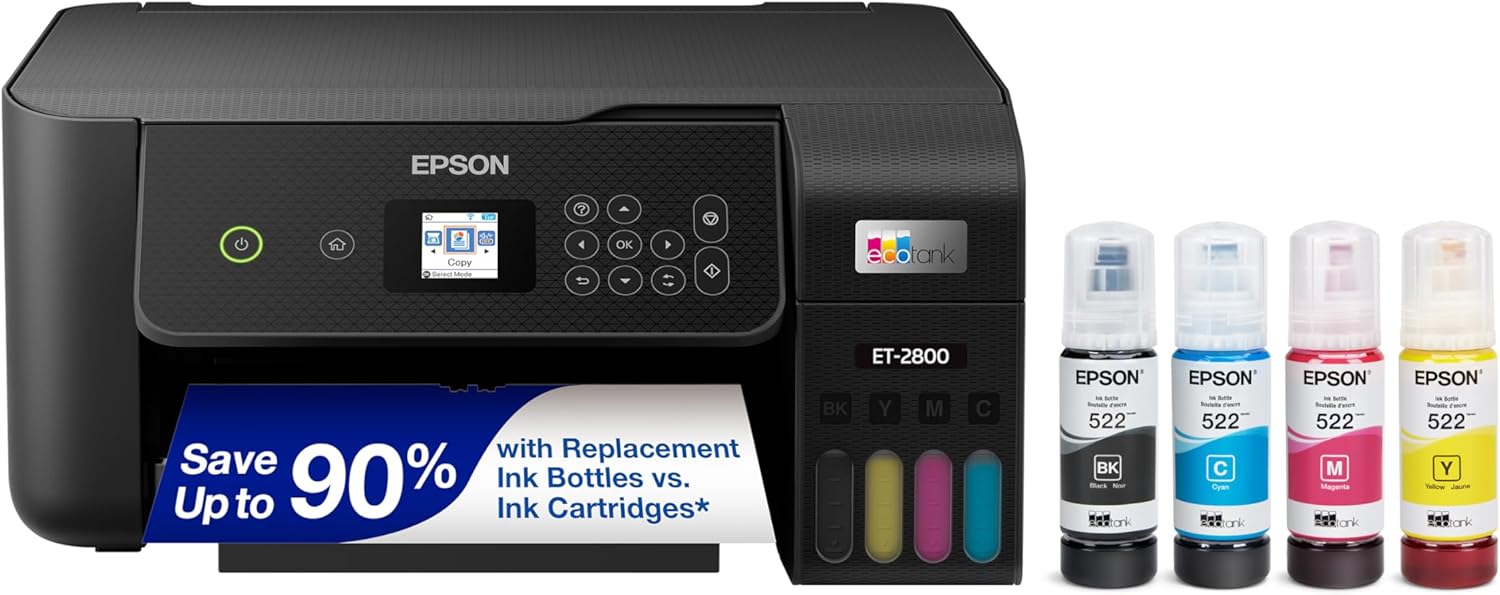
The Epson EcoTank ET-2800 is a home-focused all-in-one that replaces cartridges with refillable high-capacity ink tanks, letting you print long runs of documents and occasional photos without frequent ink swaps. It prints up to 10 pages per minute for black and 5 ppm for color, supports wireless and USB connectivity, and offers a flatbed scanner for copying and scanning tasks. The high-resolution print engine and Micro Piezo technology produce detailed text and good-looking color prints on standard photo papers, and the included ink yields thousands of pages before needing replacement, which lowers ongoing ink costs and waste. Setup and mobile printing are straightforward via the app, and the small color LCD makes basic operations simple. Limitations include no automatic duplexing and a modest photo speed, so it is not ideal for heavy two-sided office workflows or fast photo labs, and its single paper tray means managing paper changes for different sizes. For a risk-averse buyer it provides predictable, factory-quality prints and much lower ink maintenance compared with cartridge printers.
Best for: Buyers who want a low-maintenance home all-in-one that minimizes ink hassles and delivers reliable photo and document prints without frequent cartridge changes.
Less Ideal for: Users needing fast two-sided printing or a dedicated photo-lab speed workflow should consider models with duplexing and larger paper handling instead.
- Cartridge-free EcoTank system drastically reduces frequency of ink replacement
- Wireless and USB connectivity with mobile app control for easy home use
- High-resolution printing capable of detailed text and decent photo output
- Included ink set provides thousands of pages, lowering long-term running costs
- No automatic duplex (two-sided) printing
- Single paper tray requires manual paper swaps for different sizes
Verdict: Choose the EcoTank ET-2800 if you want reliable, cartridge-free home printing that cuts ink replacement and running costs while delivering solid photo and document quality.
Choosing the Right Printer for Photos and Documents: Key Factors to Consider
Print Quality for Photos
Photo print quality determines how true-to-life images look on paper. Look for wide color gamut and smooth tonal gradations so skin tones, skies, and fine details reproduce naturally. Resolution and halftone rendering affect clarity, but color management and ink set often make a bigger difference in perceived fidelity.
If you plan to crop and enlarge photos, choose a printer that handles subtle detail without introducing banding or posterization. Consider whether you need a printer with dedicated photo inks; these reduce metamerism and expand the printable color range, especially on glossy and luster papers.
Document Text and Graphics
For mixed use, document output must remain crisp and smudge-free. Text clarity depends on the printer's ability to render sharp edges and consistent black density, which matters for multi-page reports, invoices, and small-font legal text. Some photo-focused printers sacrifice text speed or use ink formulations that can smear on standard office paper.
Assess how the printer handles mixed pages that include both photos and fine-line graphics. Duplexing and fast first-page-out times also improve productivity for document-centric tasks.
Operating Cost and Consumables
Long-term cost is driven by cartridge or tank yields and the price of replacement inks or toners. Low upfront cost can be offset quickly by expensive consumables, especially if you print photos frequently. Consider yield per color, availability of high-yield or bulk options, and whether refillable tanks or high-capacity cartridges are supported.
Also consider the cost per page for mixed printing scenarios rather than relying solely on document or photo metrics. If photo prints dominate, look at per-photo cost on commonly used sizes. For hybrid users, evaluate a blended cost metric that reflects your expected mix of color photos and black text.
Paper Handling and Media Support
Versatile paper handling ensures the printer can manage photo papers, envelopes, labels, and different paper weights without frequent jams. Look for multi-purpose trays, a rear feed for specialty stock, and supported sizes up to the largest photo format you plan to print.
Duplex printing and adjustable paper thickness settings are useful for document work and heavier photo papers. Also consider the printer's maximum sheet capacity if you regularly run larger print jobs to avoid constant refilling.
Connectivity and Color Workflow
Modern connectivity options simplify printing from phones, tablets, and cloud services. Wireless printing, mobile apps, and Ethernet are helpful in shared environments. For photo work, support for color management, ICC profiles, and manual color adjustments gives better control over final output.
Also assess compatibility with your preferred editing software and whether the printer offers easy driver updates. A stable workflow reduces reprints and wasted consumables when color tuning is needed.
When to Choose an Inkjet Vs Laser for Mixed Photo and Document Use
Inkjet printers generally excel at photo reproduction because they use multiple dye or pigment inks that produce a wider color range and smoother gradients. They handle glossy and specialty photo papers more readily and often include photo-optimized print modes.
Laser printers usually offer faster text output, sharper small-font rendering, and lower per-page costs for high-volume document work. Color lasers can produce acceptable graphics and charts but typically do not match the color depth and subtlety of a photo-capable inkjet.
If your workflow is half photos and half documents, evaluate how frequently you output each type. An inkjet with efficient pigment inks or a hybrid system with separate photo cartridges can be a practical compromise.
- Inkjet: better photo color and media flexibility
- Laser: faster text, lower document running cost
- Hybrid considerations: separate photo cartridges or refillable tanks improve long-term cost
Paper Types and Finishes: Matching Media to Output
Choosing the right paper finish affects the look and longevity of photo prints. Glossy and luster papers boost color saturation and contrast, while matte papers reduce glare and provide a different tactile feel. For documents, standard bond paper is fine, but heavier-weight or bright white paper improves perceived sharpness.
Some printers struggle with very thick photo board or canvas sheets, so confirm maximum paper weight and whether a straight-through rear feed is available for specialty media.
- Glossy/luster: higher saturation and contrast for photos
- Matte: less glare, better for framing under glass
- Heavy card stock: used for greeting cards and mounted prints
Color Management Basics for Better Prints
Accurate color requires consistent settings and, when possible, ICC profiles for the paper and printer combination. Calibrate monitor settings and use the printer driver profiles optimized for your chosen paper to reduce surprises between screen and print.
If color-critical work is important, look for printers that accept custom profiles and allow manual adjustments to color balance and saturation. Also consider a simple color calibration workflow so your edits translate predictably to paper.
- Use ICC profiles for each paper type
- Disable automatic color adjustments when using profiles
- Calibrate your monitor for closer on-screen matching
Maintenance and Longevity Considerations
Regular maintenance keeps both photo quality and document reliability high. Inkjet heads can clog if left unused for long periods, so factor in occasional test prints or maintenance cycles. Laser printers need periodic fuser and drum maintenance, but they are less sensitive to infrequent use.
Consider ease of access to consumables and whether the printer supports automated head cleaning or user-replaceable maintenance kits. A predictable maintenance routine reduces downtime and prevents print defects from escalating.
- Run occasional color prints to prevent inkjet clogging
- Keep spare consumables or a maintenance kit on hand for busy workflows
- Follow manufacturer guidance on cleaning cycles and storage
Workflow Tips for Mixed Photo and Document Jobs
Set up separate print presets for photos and for everyday documents to avoid manual driver adjustments every time you switch tasks. Use a photo preset with the appropriate paper type, color profile, and higher quality settings, while a document preset can prioritize speed and economy.
Batch similar jobs together. Print all photos in one session and documents in another to minimize media changes and reduce the chance of feeding errors. Label trays or keep dedicated paper loaded if you frequently switch between media types.
- Create and save print presets for each media type
- Batch print similar items to reduce media handling
- Store unused photo paper in a dry, cool place to retain surface coating
How We Chose the Best Printer for Photos and Documents
We prioritized criteria that reflect real-world photo and document printing needs. First, print quality for both images and text was essential, emphasizing color gamut, grayscale detail, and legible small text. Second, operating cost and consumable efficiency were evaluated, focusing on yield per cartridge or tank and typical cost per page for mixed photo and document usage. Third, paper handling versatility mattered, including support for different media sizes, photo papers, and duplexing capability. Fourth, connectivity and workflow features were considered, such as wireless printing, mobile/airprint support, and color management options. Fifth, print speed and reliability were included to reflect how quickly and consistently a printer performs during daily tasks. We excluded kiosks, large commercial production presses, and single-function devices that cannot handle standard photo media sizes. We also filtered out models with known reliability issues or lacking basic color-management features. The resulting picks balance image fidelity, readable document output, and predictable operating costs, with an emphasis on options suited for home users and small offices.
Our full evaluation process is outlined in our review methodology.
FAQ
Can a single printer produce high-quality photos and sharp text?
Often, yes. Many modern printers balance color reproduction and text clarity, but performance depends on the printer type and ink set. Inkjets with dedicated photo inks typically yield the best photos while still producing acceptable text.
How do I reduce the cost of printing photos at home?
Reduce costs by using high-yield cartridges or refillable tanks, choose economical print modes when perfect quality is not needed, and buy paper in bulk for sizes you use frequently. Also factor in the cost per photo based on your typical print sizes.
Is matte or glossy paper better for photo prints?
It depends on the desired look. Glossy paper boosts saturation and contrast, making colors pop, while matte paper minimizes reflections and can be better for display under glass or for a more subdued aesthetic.
How often should I run maintenance prints on an inkjet?
If you print infrequently, run a short color or nozzle-check print once every one to two weeks to keep heads from drying. Many printers also provide an automatic maintenance cycle you can initiate through the settings.
Does duplex printing affect photo quality?
Duplex printing is primarily for documents and can reduce throughput for heavy media. Printing photos on both sides is unusual because photo papers and coatings are not typically designed for double-sided photo output and may cause curling or smudging.
Final Verdict
Choose a printer that matches your primary use case and be explicit about the tradeoffs. If photo fidelity is the priority, favor an inkjet with robust color controls and photo ink options. If document speed and low per-page cost are more important, a laser or pigment-based system will serve you better. Prioritize print quality metrics, paper handling, and operating cost based on whether you print mostly photos, mostly documents, or an even mix. With a clear workflow and appropriate consumables, you can get consistent, satisfying results from a single hybrid printer.