
Note: This article contains affiliate links. If you click on these links and make a purchase, we may earn a small commission at no extra cost to you. This helps support our research and content. Read our full affiliate disclosure here.
If you need a reliable Printer without spending a lot, the right under-$200 model can handle homework, invoices, and occasional photos without fuss. You want straightforward setup, low ongoing ink or toner costs, and enough speed and paper handling to keep up with daily tasks. This guide shortlists the top 7 Printers under $200 that meet those needs and explains the practical tradeoffs between speed, consumable costs, and connectivity. Below you will find our top picks followed by clear buying guidance based on the most important performance and ownership factors.
Top Picks at a Glance
| Best Overall The best all-around choice for most situations | Canon PIXMA TR8620a |  |
| Best Quality Built to a higher standard if you want something more solid | Epson Expression Premium XP-7100 |  |
| Best Value The sweet spot between price and what you get | Brother HL-L2405W Laser Printer |  |
| Best Budget The cheapest option that still gets the job done reliably | HP DeskJet 2955 All-in-One |  |
| Top Rated A top-rated pick with lots of positive feedback | KODAK Dock Plus PD460 |  |
| Most Popular A crowd favorite that many people choose with confidence | Canon PIXMA TR4720 |  |
| Best Seller A high-volume bestseller chosen again and again | Epson EcoTank ET-2800 |  |
Canon PIXMA TR8620a

| Printer Type | Inkjet |
|---|---|
| Maximum print Resolution Color | 4800 x 1200 dpi |
| Color Pages per Minute | 10 pages_per_minute |
| B&W Pages per Minute | 15 pages_per_minute |
| Duplex | Automatic |
The Canon PIXMA TR8620a is a compact wireless all-in-one inkjet aimed at home and small office users who need printing, scanning, copying and faxing in a single machine. It handles everyday document jobs and photos with a five-ink system and up to 4800 x 1200 dpi optical resolution for detailed color output, while automatic duplexing and a 20-sheet ADF speed routine paper workflows like double-sided reports and multi-page scans. Setup and mobile printing are straightforward thanks to wireless connectivity, USB, and a touchscreen control, and the printer supports common media up to 8.5 x 14 inches and borderless photo printing. Practical limits include modest 10 ppm color / 15 ppm black speeds and a mixed paper capacity split between cassette and rear feed rather than a large single tray, so it is best for moderate monthly volumes rather than heavy-duty office throughput. Energy use is low and useful features like Micro SD and voice integration add convenience for casual photo printing and smart reorders.
Best for: Buyers who want a capable, feature-rich home office printer that can handle occasional photo printing and regular document tasks without needing high monthly volume.
Less Ideal for: Users who print large quantities daily or need the fastest color throughput should consider higher-capacity or laser models instead.
- All-in-one functions with scanning, copying, fax and a 20-sheet ADF for multi-page jobs
- Five individual ink tanks and up to 4800 x 1200 dpi for high-quality photo and color prints
- Automatic duplex printing saves time and paper for two-sided documents
- Wireless printing, touchscreen control and Micro SD slot for flexible mobile and local workflows
- Relatively slow color print speed at about 10 pages per minute compared with laser alternatives
- Paper handling is split between a cassette and rear feed, limiting large uninterrupted print runs
Verdict: A versatile, feature-packed home office inkjet that balances photo-quality output and everyday document convenience for moderate use under $200.
Epson Expression Premium XP-7100

| Printer Type | Inkjet |
|---|---|
| Maximum print Resolution Color | 4800 dpi |
| Maximum Copy Speed Black and White | 15.8 pages_per_minute |
| Printer Connectivity Type | Wireless |
| Number of Trays | 1 |
The Epson XP-7100 is a compact all-in-one inkjet aimed at home users who want better photo quality without a pro price. It uses a five-color Claria ink set including a photo black to produce vivid, borderless photos up to 8 x 10 inches while also handling everyday document jobs. The 30-page automatic document feeder and automatic two-sided printing speed routine copy and scan tasks, and the 4.3-inch touchscreen plus USB/SD card slots make direct photo printing easy. Connectivity covers wireless printing, Wi-Fi Direct and Ethernet for flexible setup with laptops, phones and tablets. Expect good photo detail at high dpi settings, though color photo draft speeds are faster than full-quality prints and color PPM is low. The printer requires Epson genuine cartridges for best results and long-term reliability, which can raise running costs compared with pigment-based office models. For buyers prioritizing photo output and versatile media handling in a compact home printer, the XP-7100 delivers practical features and solid image quality.
Best for: Buyers who want above-average home photo quality and flexible media/connection options while still keeping the printer compact and easy to use.
Less Ideal for: Users who need high-volume, fast color document throughput or the lowest possible ink cost per page should consider dedicated office or laser alternatives.
- Five-color Claria ink set with dedicated photo black for improved photo color and detail
- Borderless photo printing up to 8 x 10 inches for photo projects and scrapbooks
- 30-page automatic document feeder and automatic duplex to speed multi-page tasks
- 4.3-inch touchscreen plus USB and SD card slots for direct printing without a computer
- Wireless, Wi‑Fi Direct and Ethernet connectivity for flexible device printing
- Color page per minute rate is very low for full-quality photo printing
- Requires Epson genuine cartridges which can increase ongoing ink costs
Verdict: Choose the XP-7100 when you want a compact home all-in-one that prioritizes photo quality and flexible media handling under $200.
Brother HL-L2405W Laser Printer

| Printer Type | Laser |
|---|---|
| Printer Output Type | Monochrome |
| Maximum Copy Speed Black and White | 30 pages_per_minute |
| Maximum Print Resolution Black and White | 1200 x 1200 dots_per_inch |
| Maximum Sheet Capacity | 250 |
The Brother HL-L2405W is a small, no-frills monochrome laser printer built for home and home-office use. It prints one-sided black-and-white documents quickly—up to 30 ppm—with a 250-sheet input tray that reduces refill frequency and a manual feed slot for envelopes and specialty paper. Dual-band Wi-Fi and a USB 2.0 port make it easy to connect from laptops and mobile devices, and the Brother Mobile Connect app simplifies remote printing, supply orders, and toner monitoring. Print quality is sharp at 1200 x 1200 dpi for typical text and business documents, and the in-box starter toner covers initial use. Expect manual duplexing if you need double-sided pages and standard factory supplies for replacement (TN830/TN830XL). The unit is compact and reasonably power efficient for its class, but it is single-function print only and lacks automatic duplex and scanning features that multifunction users may want.
Best for: Buyers who want a compact, reliable black-and-white printer that emphasizes speed, low running hassle, and straightforward wireless/mobile connectivity for home or small office use.
Less Ideal for: People who need an all-in-one device with scanning or automatic duplexing or those who require color printing for graphics and photos.
- Fast monochrome print speed up to 30 ppm for quick document output
- 250-sheet tray reduces how often you refill paper
- Dual-band Wi-Fi plus USB makes connecting phones and computers straightforward
- 1200 x 1200 dpi resolution produces crisp text and business prints
- Print-only device with no scanner or automatic duplexing
- Manual duplex required for double-sided printing
Verdict: Choose the HL-L2405W if you need a fast, compact monochrome laser that delivers reliable text printing and easy wireless mobile connectivity under $200.
HP DeskJet 2955 All-in-One

| Printer Type | HP Thermal Inkjet |
|---|---|
| Scanner Type | Flatbed |
| Maximum Sheet Capacity | 60 |
| B&W Pages per Minute | 7.5 pages_per_minute |
| Printer Connectivity Type | Apple AirPrint; USB; Wireless (Wi‑Fi); Wireless direct printing; Mopria |
The HP DeskJet 2955 is a basic home all‑in‑one that handles everyday color and black‑and‑white documents, scanning and copying from its flatbed scanner. It connects via dual‑band Wi‑Fi, wireless direct, AirPrint and USB so printing from phones or laptops is straightforward, and the HP app simplifies scanning and setup. The 60‑sheet input tray and manual duplex support make it suitable for light household tasks like school worksheets, recipes, or occasional invoices, while HP AI formatting can tidy web pages before printing to avoid wasted pages. Print speeds are modest — roughly 7.5 ppm black and 5.5 ppm color — and the included three‑month Instant Ink trial eases initial ink costs. Expect typical inkjet photo quality on select papers but not high‑volume throughput; manual duplexing and a small tray mean frequent refill for heavier use. The machine is compact and energy efficient, but buyers who need fast office throughput, automatic duplex, or high-capacity trays should look elsewhere.
Best for: Buyers on a tight budget who need an inexpensive, compact multifunction printer for occasional home printing, scanning, and copying and value easy mobile printing and low upfront ink cost.
Less Ideal for: Small businesses or home offices that require fast, high‑volume printing, automatic duplex, or larger paper capacity should choose a more robust office model.
- Compact footprint fits small home workspaces
- Wireless, AirPrint and USB connectivity for easy mobile and laptop printing
- Includes 3‑month Instant Ink trial to lower initial ink cost
- Flatbed scanner and copy functions for basic scanning and copying needs
- Made with recycled plastics and ENERGY STAR certified for lower energy use
- Manual duplex only, no automatic two‑sided printing
- 60‑sheet input tray is small for heavier print volumes
- Modest print speeds compared with office‑oriented models
Verdict: A budget‑minded compact all‑in‑one that covers basic home printing, scanning, and copying with easy mobile connectivity and lower initial ink cost.
KODAK Dock Plus PD460

| Printer Type | 4PASS Dye Sublimation |
|---|---|
| Maximum Media Size | 4 x 6 inches |
| Printer Connectivity Type | Bluetooth, Docking |
| Hardware Interface | USB Type C |
| Maximum Sheet Capacity | 20 |
The KODAK Dock Plus is a small desktop photo printer built for quick, dependable 4×6 prints from smartphones. It docks compatible iPhones and Android phones for a stable connection and charges the device while printing, and uses KODAK's 4PASS dye-sublimation process that lays down three color layers plus a protective laminate to make prints that resist fingerprints, water, and fading. Setup is straightforward: power the unit, pair over Bluetooth or dock your phone, edit in the KODAK Photo Printer app, and print — a finished 4×6 photo takes roughly a minute. Paper and cartridge go in the same all-in-one cartridge for simple refills, and the printer accepts 4×6 glossy media with a small internal tray. The trade-offs are speed and capacity — it prints about one page per minute and holds limited sheets, so it is best for occasional home use rather than high-volume events. Connectivity is basic (Bluetooth and USB-C) and it is print-only, so no scanning or copying features are available. For a user who values consistent, durable 4×6 prints from a smartphone without a steep learning curve, it is a practical choice under $200.
Best for: Buyers who want reliable, long-lasting 4×6 photo prints from a smartphone and prefer a simple, low-maintenance desktop printer for home memory keeping.
Less Ideal for: People who need fast high-volume printing, larger print sizes, or multifunction office features should look at higher-capacity or all-in-one printers.
- Genuine 4PASS dye-sublimation with laminated finish for durable, fade-resistant 4×6 photos
- Integrated phone dock that stabilizes connection and charges while printing
- Simple app-driven workflow for editing and printing from iOS and Android
- All-in-one cartridge design makes paper and ink refills easy
- Slow print speed around one print per minute and small sheet capacity limits throughput
- Print-only device with no scanning, copying, or larger paper size support
Verdict: If you want an easy, reliable home station for durable 4×6 smartphone prints, the Dock Plus delivers laminated, long-lasting photos with minimal fuss.
Canon PIXMA TR4720

| Printer Type | Inkjet |
|---|---|
| Maximum print Resolution Color | 4800 x 1200 dots_per_inch |
| B&W Pages per Minute | 8.8 |
| Color Pages per Minute | 4.4 pages_per_minute |
| Printer Connectivity Type | USB, Wi-Fi |
The Canon PIXMA TR4720 is a space-saving 4-in-1 inkjet aimed at basic home and small office use. It handles everyday tasks — printing documents, scanning and copying single- or multi-page jobs via the built-in flatbed and 20-sheet auto document feeder — and also sends and receives faxes. Setup is straightforward using the Canon Print app and Wi-Fi connectivity, and the front-loading 100-sheet tray keeps paper handling simple. The hybrid ink system produces sharp black text and acceptable color prints and borderless photos up to letter size, though color photo speed and color page throughput are modest. Auto two-sided printing saves paper, and the 2-line LCD plus basic buttons make quick tasks easy without a computer. Expect moderate running costs because it uses Canon CL-276 and PG-275 cartridges, and print speeds are conservative at about 8.8 ipm black and 4.4 ipm color. For buyers who prioritize compactness, app-based mobile printing and essential office features in a budget package, the TR4720 delivers a reliable, no-frills experience.
Best for: Practical buyers who want a compact, app-friendly all-in-one for home or small office tasks and who value straightforward setup and reliable basic performance.
Less Ideal for: Users who need fast, high-volume color or professional photo printing should look at higher-capacity or photo-focused models instead.
- All-in-one functionality with print, copy, scan and fax in a compact footprint
- Automatic document feeder and automatic duplex printing for multi-page jobs
- Easy mobile printing and setup via the Canon Print app and Wi-Fi
- 100-sheet front paper tray simplifies daily paper handling
- Relatively slow color print speed and modest photo throughput compared with higher-end models
- Uses small consumer ink cartridges which can mean higher cost per page for heavy use
Verdict: If you want a compact, budget-friendly all-in-one with easy mobile printing and essential office features, the PIXMA TR4720 is a dependable choice under $200.
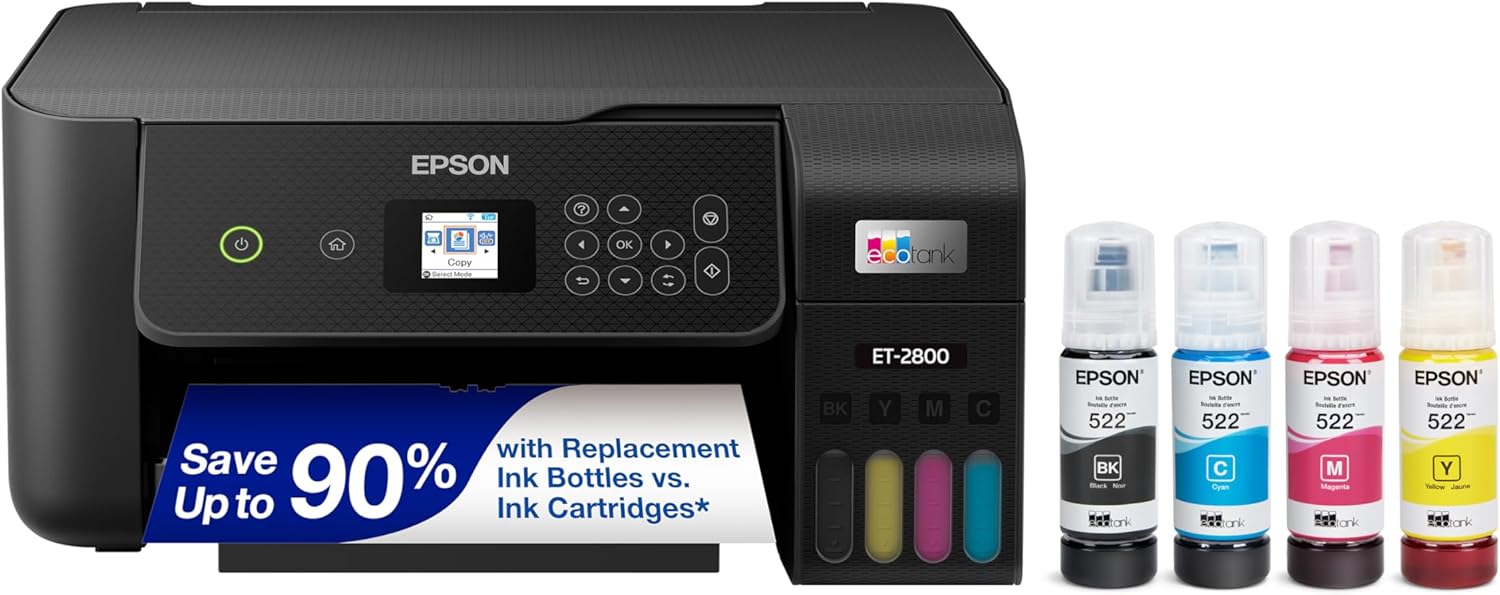
Epson EcoTank ET-2800
| Printer Type | Inkjet |
|---|---|
| Functions | Print, Copy, Scan |
| Connectivity | USB, Wi-Fi |
| Max Print Resolution Color | 5760 x 1440 dpi |
| Sheet Capacity | 100 |
The EcoTank ET-2800 replaces cartridges with refillable ink tanks to deliver long runs of home printing without frequent cartridge changes. It prints, copies and scans, connects via Wi‑Fi or USB, and supports mobile and voice-activated printing for quick document jobs from phones or tablets. Notable features include large-capacity ink bottles included in the box, Epson PrecisionCore print technology for sharp text and detailed color output, and a flatbed scanner for basic scanning and copying. Practical benefits are low ongoing ink cost and fewer interruptions to replace consumables, plus decent print resolution for photos and graphics. Limits to consider are modest color speeds (about 5 ppm), simplex-only printing so two-sided pages must be manually flipped, and a 100-sheet paper capacity that suits light-to-moderate home workloads rather than heavy office volumes. Setup is straightforward and the EcoTank approach reduces plastic waste compared with cartridges, but Epson recommends genuine ink to maintain performance.
Best for: Buyers who prioritize low running costs, simple maintenance, and a reliable home printer that minimizes refill interruptions and waste.
Less Ideal for: Those who need fast duplex printing, very high monthly page volumes, or a large paper tray for heavy office workloads should consider other options.
- Cartridge-free refillable ink tanks that greatly reduce how often you need to replace ink
- Includes high-capacity ink bottles that cover hundreds to thousands of pages
- Wireless and mobile printing with voice-activated support for convenient home use
- High optical resolution and PrecisionCore technology for sharp text and good photo detail
- No automatic duplexing so two-sided printing requires manual flipping
- Relatively slow color print speed compared with some compact inkjets
Verdict: If you want a low-cost-to-own, reliable home all-in-one under $200 that eliminates cartridges, the EcoTank ET-2800 is a sensible, risk-averse choice.
Choosing the Right Printer: Key Factors to Consider
Print Running Cost
Running cost is often the biggest part of owning a Printer, especially with frequent use. Calculate cost per page using cartridge or toner yield and manufacturer page estimates to compare likely monthly spend. Consider whether high-yield cartridges or third-party refill options are practical for your needs. Lower upfront prices can hide higher long-term costs if replacement supplies are expensive.
Also check whether the model supports duplex printing to halve paper usage on two-sided documents, and whether it accepts XL or high-yield consumables that reduce the frequency of replacements.
Print Speed and Duty Cycle
Print speed, usually measured in pages per minute for black and color, affects how quickly you clear small jobs and larger batches. For light home use, modest speeds are acceptable. For a small office or regular multi-page tasks, prioritize higher ppm numbers and realistic first-page-out times.
Duty cycle indicates the maximum monthly page volume a printer can handle. Match the duty cycle to your expected monthly print load to avoid excessive wear. Choose a model with a comfortable buffer above your normal usage rather than one that sits at its rated limit.
Connectivity and Compatibility
Modern Printers should offer flexible connectivity to fit your environment. Wi-Fi is essential for mobile printing from phones and tablets; Ethernet is valuable if multiple wired devices share a network. USB is still useful for a simple direct connection.
Verify that drivers or native support exist for your computer operating system and mobile platforms. Check for AirPrint or Mopria support if you rely on native mobile printing, and look into cloud-printing features only if they meet your privacy or workflow needs.
Paper Handling and Media Support
Paper tray capacity and the ability to handle different media types determine how much interruption you face during common tasks. A larger input tray reduces refills for multi-page print runs. Look for models that can accept envelopes, labels, and thicker media if you occasionally print photos or craft projects.
Automatic duplexing is a valuable time-saver and reduces paper consumption. Also consider whether a dedicated photo tray or straight-through feed is available for heavier media to avoid jams.
Print Quality and Color Needs
Determine whether you need crisp text only or higher-fidelity color output. For documents, laser-style sharpness or high-resolution inkjet text is generally sufficient. For photos and color marketing materials, look at dpi specifications and color handling features.
Be realistic about expectations from budget models. Many under-$200 Printers will do competent color for charts and snapshots, but they will not match dedicated photo printers. Evaluate sample print quality where possible.
Inkjet Vs Laser: Which Fits Your Workload
Inkjet and laser technologies each have strengths that affect running costs and output. Inkjet printers typically excel at color photos and mixed media, while laser printers deliver sharp black text and faster sustained monochrome output. Choose the technology that aligns with the majority of your printing tasks.
- Inkjet: better for occasional color photos and varied media
- Laser: lower per-page cost for high-volume black-and-white jobs
- Consider hybrid expectations: some inkjets offer low-cost pigment black cartridges for documents
Maximizing Supply Lifespan
Simple habits extend the life of cartridges and toners. Print a test page periodically to keep nozzles clear and use the printer's power management so cartridges do not dry out prematurely. Store spare cartridges sealed in a cool, dark place and install replacements promptly to maintain print quality.
- Use draft mode for internal documents to save ink
- Rotate color prints to avoid uneven nozzle use
- Enable sleep modes to reduce maintenance cycles
Setting Up for Reliable Wireless Printing
Wireless printing can be convenient but requires a stable network configuration. Place the printer within a good Wi-Fi signal zone and avoid congested dual-band conflicts. During setup, prefer manual entry of network credentials rather than WPS where possible for a more reliable connection. Keep firmware updated to fix connectivity bugs and security issues.
- Assign a static IP for shared office printers
- Use WPA2 or WPA3 security on your network
- Disable guest networks for device pairing during initial setup
Managing Print Security and Privacy
Even home and small office Printers can expose data if left default. Change default admin passwords, enable secure printing or PIN release if available, and disable remote access features you do not use. When sharing over a network, restrict permissions to necessary users and keep firmware patched to reduce vulnerability to attacks.
- Turn off cloud printing if you do not need it
- Require credentials for admin menus
- Regularly check firmware update notes for security fixes
How We Chose the Best Printer
We evaluated models that are regularly available new at or below the target budget and focused on attributes that materially affect ownership costs and day-to-day use. Primary criteria included print running cost per page and cartridge or toner yield, because long-term expense often outweighs upfront price. We assessed print speed for black and color documents under realistic workloads to identify units that keep small tasks moving without long waits. Connectivity and driver support were examined to ensure models worked well with common home and small office devices over Wi-Fi, Ethernet, or USB. Paper handling and media flexibility were checked to confirm each printer supports the typical mix of plain paper, envelopes, and occasional photo stock. We excluded specialty large-format units, industrial copiers, and models requiring proprietary third-party supply modifications. Products with unreliable wireless stacks, extremely low-yield consumables, or consistently poor user feedback on basic features were not included.
Our full evaluation process is outlined in our review methodology.
FAQ
How much should I expect to spend per page on an under-$200 printer?
It depends on the technology and cartridge yields. Laser monochrome models often cost less per black page than inkjets. Expect a wide range, so compare manufacturer yield estimates and consider high-yield options to lower ongoing spend.
Are all printers under $200 good for photos?
Not necessarily. Budget printers can produce acceptable snapshots, but true photo-quality prints usually require specialized photo printers or higher-end ink systems. If photos are a priority, look for high-resolution inkjets and paper handling suited to photo stock.
Can I print from my phone without installing drivers?
Many modern Printers support native mobile printing standards like AirPrint or Mopria, allowing direct printing from phones without separate drivers. If your device lacks native support, vendor apps can usually enable mobile printing though they may require an initial setup step.
Is duplex printing common in budget printers?
Automatic duplexing is available in a number of under-$200 models, particularly in laser and higher-end inkjet units. It is not universal, so check the specifications if two-sided printing is important for saving paper.
How do I know if a printer will fit my daily volume?
Compare the printer's recommended monthly duty cycle to your typical monthly page count. Pick a model with a duty cycle comfortably above your usual usage to avoid accelerated wear and unexpected failures.
Final Verdict
Focus on the two biggest ownership drivers when choosing a budget Printer: ongoing running cost and whether the technology suits your typical job mix. Prioritize models with acceptable per-page expenses, sufficient paper handling, and connectivity that matches how you print. Accept tradeoffs in color photo fidelity or top-end speeds at this price point, and choose the machine that aligns with your expected monthly volume and preferred media types. With those priorities clear, you can pick a dependable under-$200 Printer that balances upfront affordability with manageable long-term costs.