
Note: This article contains affiliate links. If you click on these links and make a purchase, we may earn a small commission at no extra cost to you. This helps support our research and content. Read our full affiliate disclosure here.
When you are on the road, on a trail, or navigating remote locations, safe drinking water is one of the most important comforts you can carry. Choosing the right water filter for travel affects how much gear you pack, how fast you can refill, and how confident you feel about hydration quality. This guide presents our shortlisted picks for travel water filters, each chosen for portability, reliability, and real-world performance. Below we cover the evaluation criteria we used and practical considerations like weight, filter life, and ease of use to help you match a filter to how and where you travel.
Top Picks at a Glance
| Best Overall The best all-around choice for most situations | LifeStraw Go Series 22oz |  |
| Best Quality Built to a higher standard if you want something more solid | GRAYL GeoPress 24 oz |  |
| Best Value The sweet spot between price and what you get | Sawyer MINI Water Filter SP128 |  |
| Best Budget The cheapest option that still gets the job done reliably | Potable Aqua Water Purification Tablets 50ct |  |
| Top Rated A top-rated pick with lots of positive feedback | LifeStraw Personal Water Filter |  |
| Most Popular A crowd favorite that many people choose with confidence | Brita Premium Filtering Bottle 26 oz |  |
| Best Seller A high-volume bestseller chosen again and again | Camco TastePURE RV Water Filter |  |
LifeStraw Go Series 22oz

| Capacity | 0.65 liters |
|---|---|
| Material Type | Plastic |
| Bottle Type | Reusable |
| Additional Features | Chlorine Reduction |
| Reusability | Reusable |
The LifeStraw Go Series 22oz is a travel-ready filter water bottle that combines a hollow fiber membrane and activated carbon to make questionable tap or outdoor water drinkable and better tasting. You fill the bottle, drink through the built-in straw, and the membrane blocks bacteria and parasites while the carbon stage reduces chlorine, odors and organic tastes. It is intended for backpacking, camping, travel or everyday use when you cannot rely on safe bottled water. The membrane is rated for a long life (up to about 4,000 L) so it suits frequent travelers, while the carbon cartridge needs more regular replacement when used on very poor sources. The bottle is BPA-free, dishwasher safe, and made with post-consumer recycled plastic, which cuts single-use waste. Note that the carbon filter's capacity is limited compared with the membrane and replacement parts are a consumable, so performance on very turbid or chemically contaminated water is constrained by filter life and type.
Best for: Travelers and outdoor users who want a lightweight, low-maintenance bottle that reliably protects against microbiological contaminants and improves tap water taste on the go.
Less Ideal for: People who need broad chemical or heavy-metal removal or who will be filtering consistently highly contaminated, industrial, or chemically polluted sources should choose a dedicated purifier or lab-tested system instead.
- Two-stage filtration removes bacteria, parasites and microplastics while improving taste.
- Long-life membrane rated up to ~4,000 L for extended travel use.
- BPA-free, reusable bottle made with 50% post-consumer recycled plastic reduces single-use waste.
- Dishwasher-safe plastic and simple fill-and-drink design make it easy to use and maintain.
- Activated carbon cartridge has much shorter life than the membrane and requires periodic replacement.
- Not designed to remove chemical pollutants or heavy metals beyond chlorine and some organic tastes.
Verdict: Choose the LifeStraw Go 22oz when you want a compact, travel-focused bottle that reliably removes microbes and microplastics while improving taste.
GRAYL GeoPress 24 oz
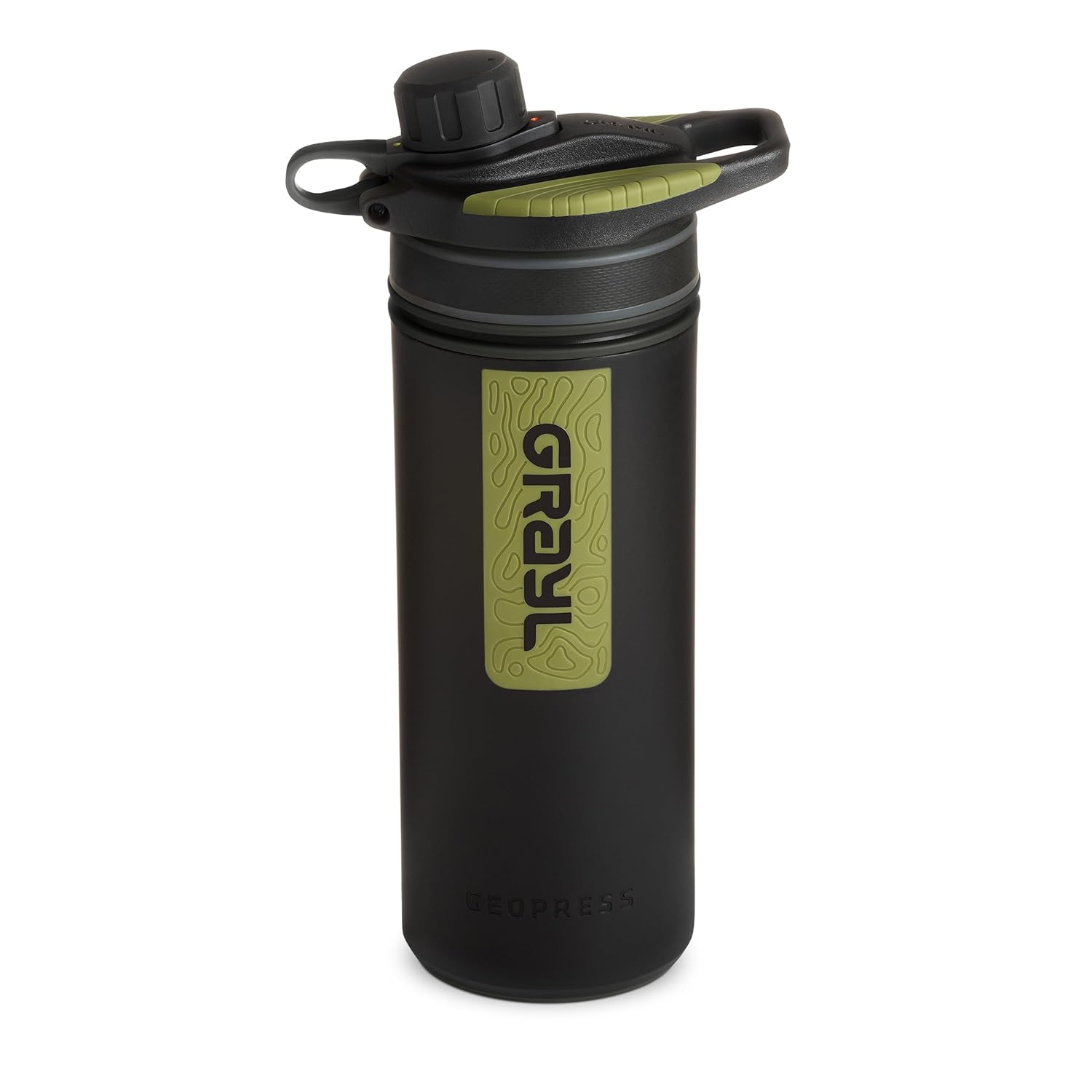
| Capacity | 24 fluid ounces |
|---|---|
| Purification Method | Electroadsorption, Activated Carbon |
| Maximum Flow Rate | 5 liters per minute |
| Supported Water TDS Level Maximum (PPM) | 300 |
| Product Shelf Life | 10 years |
The GRAYL GeoPress is a press-to-filter water bottle designed for travelers and outdoor users who need fast, reliable drinking water without pumps or batteries. It works by filling the outer cup with source water, inserting the inner press and pushing the purifier cartridge through the water to produce clean water in roughly 8 seconds at a flow rate up to 5 liters per minute. The cartridge uses electroadsorption plus activated carbon to remove viruses, bacteria, protozoa, particulates, PFAS, VOCs, heavy metals, pesticides, and odors, and it includes a one-way drink-mix valve so you can add electrolytes or flavor without fouling the filter. Practical touches like a RiverFlow spout, SoftPress pads, and a venting cap make pressing and chugging easier in the field, and the bottle disassembles for cleaning. Limitations are typical of cartridge systems: the replaceable cartridge is rated for a finite number of cycles (300 cycles / about 65 gallons for emergency spec) so you will need to carry spares on long trips, and the 24 oz capacity means more frequent refills compared with larger systems.
Best for: Travelers and performance-minded outdoor users who need rapid, proven pathogen removal and chemical filtration on the go and value speed and ease of use.
Less Ideal for: Those who need multi-liter daily capacity without frequent refills or users who prefer filter systems with indefinite-life components and no recurring cartridge cost.
- Purifies and filters in about 8 seconds, removing viruses, bacteria, and protozoa
- Activated carbon and adsorptive media reduce chemicals, PFAS, VOCs, heavy metals, flavors, and odors
- Fast flow RiverFlow spout and ergonomic SoftPress pads make pressing and drinking simple
- One-way valve supports electrolyte or drink mixes without contaminating the filter media
- Disassembles for cleaning and is made from BPA-free polypropylene
- Replaceable cartridge has limited lifecycle so spare cartridges are needed for extended trips
- 24 oz capacity requires frequent refills for group use or long outings
Verdict: If you want near-instant, travel-ready protection against viruses, bacteria, protozoa, and chemical contaminants in a single press-to-filter bottle, the GeoPress is a top-performing choice.
Sawyer MINI Water Filter SP128

| Purification Method | Hollow Fiber Membrane |
|---|---|
| Other Special Features | Removes bacteria, protozoa, and microplastics |
| Power Source | Manual Operation |
| Capacity | 100000 gallons |
The Sawyer MINI is a palm-sized, manual hollow-fiber filter built for on-the-go water purification. It can be used as a squeeze filter with the included 16-ounce pouch, as a straw to drink directly from sources, or attached to standard 28 mm disposable bottles and hydration pack tubing, which makes it convenient for trail, travel, and emergency scenarios. The 0.1 micron absolute membrane removes bacteria, protozoa, and microplastics to laboratory-tested levels and the manufacturer rates the filter for up to 100,000 gallons, so it gives long service life between replacements. The kit includes a cleaning plunger to help restore flow when the filter clogs, and the lightweight design keeps pack weight minimal. Limitations are that flow rate depends on squeeze pressure or gravity and very turbid water will require pre-filtering or backflushing more often, so expect slower output compared with pump or chemical systems in some conditions.
Best for: Buyers who want a lightweight, durable travel or hiking filter that delivers laboratory-grade particulate and microbial protection and prioritizes low weight, long service life, and flexible hookups.
Less Ideal for: People who need rapid high-volume water production or who routinely filter very turbid or sediment-heavy sources without carrying pre-filters or settling gear.
- 0.1 micron hollow-fiber membrane removes bacteria, protozoa, and microplastics
- Multiple use modes: squeeze pouch, straw, bottle adapter, or inline hydration pack connection
- Very light and compact for easy packing
- Rated up to 100,000 gallons for long service life
- Includes cleaning plunger to help maintain flow
- Flow rate and usable output depend on user squeezing or gravity rather than powered pumping
- Performance can slow with very dirty water and requires backflushing or pre-filtering
Verdict: A tiny, ultralight travel filter that delivers proven 0.1 micron protection and long life for hikers and travelers who value minimal weight and reliable microbial filtration.
Potable Aqua Water Purification Tablets 50ct

| Unit Count | 50 Count |
|---|---|
| Number of Items | 2 |
| Item Type Name | Chemical Water Treatment Tablets |
| Manufacturer | Wisconsin Pharmacal |
Potable Aqua packs a simple, proven solution for treating questionable water when a filter is impractical. The two-bottle set includes standard purification tablets that kill bacteria and Giardia and a PA Plus neutralizing tablet to remove chlorine taste and color after treatment. Use is straightforward: drop the tablet into the water, wait the specified time, then add the PA Plus to improve flavor. The compact glass bottles are easy to stash in a backpack, emergency kit, or travel pack, and the treatment works where pumps or filters might clog or be unavailable. The tablets do not require batteries or moving parts, so they are lightweight and long-lived on the shelf. Limitations are typical of chemical treatments: you must follow dosing and contact-time instructions, they do not remove particulates or chemical contaminants, and treated water may still taste different than filtered water for some users. For short trips, international travel to remote areas, and emergency kits, these tablets are a practical backup to a pump or filter.
Best for: Travelers and outdoor users who need a low-cost, lightweight backup for making biologically unsafe water drinkable when a filter is not available.
Less Ideal for: People who prioritize immediate clear-tasting water free of particulates or chemical contaminants or who need broad-spectrum contaminant removal should consider filtration systems or more comprehensive purification methods.
- Includes both disinfectant tablets and PA Plus neutralizer for better taste
- Compact, shelf-stable packaging suited to backpacks and emergency kits
- Effective against bacteria and Giardia without pumps or power
- Does not remove sediment, chemicals, or viruses
- Requires correct dosing and contact time for effectiveness
Verdict: A compact, budget-friendly emergency water treatment option that disinfects biological contaminants and improves taste when filters are not available.
LifeStraw Personal Water Filter

| Material Type | Plastic |
|---|---|
| Model Number | LSPHF038 |
| External Testing Certification | NSF |
| Unit Count | 1 Count |
| Included Components | Lifestraw Personal Water Filter |
The LifeStraw Personal Water Filter is an ultralight, single-user straw designed to let you drink directly from lakes, streams, or containers while blocking pathogens and particulates. It uses a membrane microfilter that laboratory testing shows removes nearly all bacteria and parasites and filters microplastics down to about 1 micron, making it useful for hiking, travel, and emergency kits. It requires no batteries or chemicals and fits easily in a pack or survival kit; you simply place the intake in a water source and sip through the mouthpiece. The unit is good for up to 4,000 liters (about 1,000 gallons) with proper use, and it carries NSF-tested claims for microbial reduction. Limitations are that it is a point-of-use straw for one person at a time, so it is not suitable for filling many bottles quickly or treating chemical contaminants and viruses in all situations. Regular backflushing and correct storage are needed to maintain flow over its rated lifetime.
Best for: Buyers who prioritize dependable, proven microbial protection for solo outdoor travel or emergency preparedness and want a simple, maintenance-light solution they can carry anywhere.
Less Ideal for: People needing to treat water for groups quickly, remove chemical contaminants, or produce large volumes of purified water should choose a pump, gravity system, or purifier designed for those needs.
- Highly effective microfiltration against bacteria and parasites as validated by EPA/NSF testing
- Extremely lightweight and packable for travel, hiking, and emergency kits
- Long rated lifetime of up to 4,000 liters with proper maintenance
- Requires no power or consumable chemicals to operate
- Single-user straw design not suited for quickly supplying multiple people
- Does not remove chemical pollutants or guarantee virus removal in all contexts
Verdict: Pick the LifeStraw when you need a proven, ultralight microbial filter you can trust for safe drinking water on solo travel and emergency kits.
Brita Premium Filtering Bottle 26 oz

| Capacity | 26 oz |
|---|---|
| Material Type | Plastic |
| Filter life | 40 gallons / ~2 months |
| Dishwasher safe | Top rack only |
The Brita Hard-Sided Premium Filtering Bottle is a reusable 26 oz plastic water bottle with a built-in activated carbon block filter that reduces chlorine taste and odor and captures some particulates while you drink. It is designed for on-the-go hydration with a one-handed push-button lid, enclosed straw, leakproof seal and a carrying loop that fits most cup holders. The included filter is rated for about 40 gallons or two months of typical use and is simple to rinse and install. Because the bottle is top-rack dishwasher safe, upkeep is straightforward, though you will need to replace filters regularly to maintain taste improvement. This is not a purifier and will not remove microbes or all contaminants, so it is best for improving municipal tap water flavor rather than treating questionable backcountry sources. Overall it offers convenient filtered water for travel, commuting, and daily use with minimal fuss, provided you accept the ongoing cost of replacement filters.
Best for: Travelers and commuters who prioritize better-tasting tap water and easy, low-effort filtration in a durable bottle with social-proof reliability.
Less Ideal for: People who need microbial or chemical purification for unsafe water sources or those seeking a zero-maintenance solution without recurring filter replacements.
- Built-in activated carbon filter reduces chlorine taste and odor while you drink
- One-handed push-button lid and enclosed straw for easy, spill-resistant sipping
- Leakproof design with carrying loop and cup-holder friendly shape for travel
- Top-rack dishwasher safe for simple cleaning
- Filter must be replaced every ~40 gallons which adds ongoing cost
- Not a water purifier and does not remove microbes or all contaminants
Verdict: A convenient travel-friendly bottle that reliably improves tap water taste on the go, making it an easy choice for travelers who want better-flavored water without bulky filters.
Camco TastePURE RV Water Filter

| Model Number | 40043 |
|---|---|
| Included Components | Adapter |
| Material Type | Polypropylene (PP) |
| External Testing Certification | NSF/ANSI 42, NSF/ANSI 53, NSF/ANSI 372 |
The Camco TastePURE RV Water Filter is an inline hose filter designed to give campers and boaters access to cleaner, better-tasting water from campground or city spigots. It uses a layered Hex-Flow 6-step filtration system — including GAC and KDF media and a 20-micron sediment layer — to reduce chlorine, bad tastes and odors while helping control bacterial and mold growth when not in use. The wide-body, high-flow design keeps water pressure usable for filling tanks, cooking and drinking, and the included flexible hose protector prevents kinks and strain at the connection. Certified to NSF/ANSI 42, 53 and 372 and made in the USA, it provides reassurance for buyers who prioritize tested performance and lead-free construction. Expect routine cartridge replacement over time and modest added bulk at the hose connection compared with tiny inline strainers, but for travelers who want dependable, certified filtration at campsites this filter is a practical, easy-to-install choice.
Best for: Campers, boaters, and families who want a reliable, certified inline filter to improve campground water taste and safety while minimizing worry on trips.
Less Ideal for: People who need the smallest possible inline footprint or who prefer a permanently installed under-sink system for home use should consider other options.
- Multi-stage Hex-Flow filtration (GAC + KDF + 20-micron sediment) reduces taste, odor, chlorine and sediment
- NSF/ANSI 42, 53 and 372 certifications and lead-free compliance provide independent verification
- High-flow wide-body design maintains usable water pressure for filling and drinking
- Includes flexible hose protector to prevent kinks and reduce strain on connections
- Adds bulk at the hose connection compared with simpler in-line filters
- Filter cartridges will require periodic replacement depending on water quality
Verdict: A certified, high-flow inline filter built for dependable campsite and marine drinking water improvement while traveling.
Choosing the Right Water Filter for Travel: Key Factors to Consider
Filtration Technology and Rated Protection
The type of filtration media determines what the device removes. Mechanical microfilters with submicron pore sizes block bacteria and protozoa, while activated carbon elements reduce taste, odor, and some chemicals. Some travel filters combine mechanical filtration with chemical treatment or UV to expand protection.
Understanding the filter's rated protection helps you choose the right tool for the water sources you will encounter. For most backpacking and travel scenarios, look for clear performance claims about bacteria and protozoa reduction plus any limits on viruses, which often require additional treatment.
Weight, Size, and Packability
When travel and mobility are priorities, every ounce counts. A compact, lightweight filter is easier to stash in a daypack or luggage and increases the odds you will actually bring it. Consider how the unit packs when empty: collapsible squeeze filters and straw-style options take up less space than rigid pump filters.
Also think about whether the filter integrates with your hydration system, bottles, or bladders. Accessories and adapters add weight and complication, so a travel-friendly filter should minimize extra components while remaining versatile enough for common bottle openings.
Flow Rate and Real-World Throughput
Flow rate influences how long it takes to refill bottles or drink on the go. Higher flow rates are more convenient for group use or filling large containers, while slower flow filters can be acceptable for solo travelers who prioritize compactness.
Flow can vary with water clarity, filter condition, and altitude. Filters that resist clogging and include backflush or cleaning options maintain usable flow longer, which matters when resupply of replacements is difficult.
Filter Life and Replacement Availability
Filter lifespan is usually stated in liters or gallons and determines how long a unit will perform before replacement. For extended trips or frequent travel, long service life reduces the need to carry spare cartridges. Replacement availability and standardized fittings are important if you expect to be away from supply sources for long periods.
Consider the cost-per-liter implicit in filter life and whether you can source replacements from common outdoor retailers or through general channels while traveling.
Ease of Use and Maintenance
A travel filter should be straightforward to operate in the field. Look for intuitive assembly, easy connections to bottles, and simple cleaning procedures. Backflushable filters or those that allow a clear cleansing routine extend usable life and reduce the chance you will discard a perfectly serviceable unit.
Maintenance also includes winter care if you travel in freezing conditions. Filters that tolerate freezing or have clear storage instructions will fare better in mixed-season itineraries.
Durability and Materials
Travel exposes gear to drops, pressure in luggage, and rough handling. Construction materials and design determine whether a filter will keep working after knocks and bumps. Metal or reinforced housings and abrasion-resistant hoses last longer than thin plastics.
Assess how seals and adapters are engineered, since leaks or cracked connections are common failure points that can render a filter useless when you need it most.
Types of Travel Water Filters
Travel water filters fall into several practical categories: straw-style filters for drinking directly from a source, pump filters that push water through media into a container, gravity bags that use weight to pull water through a filter, and inline or bottle-integrated filters that fit into your hydration setup. Each type balances convenience, pack weight, and capacity.
Straw-style filters are ultra-portable but are best for single users and short stops. Pump and bottle filters scale better for groups and faster refills. Gravity systems are low-effort but bulkier, while inline and integrated options offer seamless use with bottles and bladders.
- Straw-style: Minimal weight, direct drinking
- Pump: Faster flow, good for groups
- Gravity: Hands-free, higher volume
- Inline/Bottle: Integrates with hydration gear
How to Use a Travel Filter Safely
Start by collecting the cleanest water available. Avoid stagnant pools and look for flowing sources when possible. Pre-filtering cloudy or sediment-heavy water through a bandana or coffee filter reduces clogging and extends filter life.
Follow the manufacturer-recommended priming and cleaning steps. Regularly backflush or scrub according to guidance to maintain flow. Store filters dry when possible and keep seals and caps clean to prevent contamination.
- Choose flowing water over still pools
- Pre-filter turbid water to protect media
- Backflush or clean after heavy use
- Store dry in cool conditions between trips
Packing Strategies for Different Trip Types
For ultralight day hikes, prioritize straw or compact squeeze filters that weigh almost nothing and stow in a pocket. For multi-day or group travel, carry a pump or bottle-integrated filter that speeds refills and reduces shared handling.
If you will travel with checked luggage, protect rigid filters inside padding. For backpacking, keep filters near the top of the pack for quick access on water stops. Carry essential spare parts like O-rings or small adapters if the filters you choose have replaceable components.
- Day hikes: Go with minimal, lightweight options
- Multi-day: Favor throughput and durability
- Group travel: Choose higher flow solutions
- Carry small spares for critical seals and fittings
Maintenance and Winter Care
Cold conditions can damage filters as water trapped inside media freezes and expands. To avoid damage, drain and dry filters before exposure to freezing temperatures or use insulated storage. Some filters are specifically rated to withstand freezing if handled correctly.
Regular maintenance includes periodic deep cleaning and replacing cartridges per the stated service life. Keep a simple cleaning kit and a roll of compatible spare O-rings or tubing clips for remote trips.
- Drain and dry before freezing conditions
- Insulate filters in cold weather when in use
- Perform recommended deep cleaning cycles
- Carry replacement seals when traveling long-term
How Filtered Water Quality Varies by Source
Source water quality strongly influences how effective any travel filter feels. Fast-flowing mountain streams typically present fewer chemical contaminants than lakes near agricultural areas. Filters remove biological hazards reliably when used as intended but may not remove all chemical pollutants or heavy metals.
When traveling in areas with potential chemical contamination, pair mechanical filtration with activated carbon or use additional treatment methods to reduce tastes and odors. When in doubt, prefer sources upstream from human activity.
- Mountain streams: Generally lower chemical risk
- Still water: Higher sediment and algal risk
- Near agriculture: Consider chemical filtration
- Urban waterways: Avoid unless treated or well-filtered
How We Chose the Best Water Filter for Travel
We selected these travel water filters using a set of practical, trip-focused filters that reflect what travelers actually need. We prioritized filtration performance first, looking for technologies and pore size ratings that remove common biological contaminants and reduce turbidity. Portability was next, emphasizing overall packed weight, compact dimensions, and whether the unit fits common hydration setups. Flow rate and ease of use mattered for convenience on the trail or during transit. Filter life and replacement availability were evaluated because long-lasting cartridges reduce the need to carry spares. Durability and materials were considered to ensure the filter holds up to knocks, freezing conditions, and repeated use. Finally, we looked at maintenance and cleaning requirements to avoid filters that require frequent, complicated servicing. We excluded bulky gravity systems and inline home filters that are impractical for travel. We did not include devices that rely solely on single-use chemistries without reliable filtration ratings. Our picks focus on filters that balance protection, portability, and predictable service life.
Our full evaluation process is outlined in our review methodology.
FAQ
Can a travel water filter remove viruses?
Most mechanical travel filters are designed to remove bacteria and protozoa but not all viruses because viruses are much smaller. If you expect viral contamination risk, choose a solution that includes chemical treatment or UV disinfection in addition to filtration.
How often do I need to replace a travel filter cartridge?
Replacement intervals vary by model and usage and are usually stated in liters of treated water. Heavy use in silty or turbid water shortens life, while clean source water preserves capacity. Carry a plan for replacements on extended trips.
Is a pump filter better than a straw for travel?
It depends on your needs. Straws are lighter and ideal for solo, fast-moving travelers. Pumps provide higher flow and are better for groups or filling bottles quickly. Consider weight, group size, and expected daily water volume when choosing.
How do I prevent my filter from clogging on muddy water?
Pre-filter turbid water through a bandana or coffee filter to remove large particles. Regular backflushing and following cleaning routines will restore flow. Avoid heavily disturbed banks where sediment is suspended.
Can I use a travel filter with my hydration bladder?
Many travel filters offer inline or bottle-adapter options that work with common hydration bladders. Verify compatibility with your bladder's connector type and consider adapters if needed.
Final Verdict
Choose a travel water filter by matching protection level to the water sources you will encounter and by prioritizing the practical tradeoffs of weight, flow, and service life. Lightweight straw-style filters excel for solo day trips, while pump or bottle-integrated systems are better when throughput and group use matter. Always factor in maintenance needs and replacement availability when planning longer journeys. Aim for a filter that provides certified protection for biological contaminants, fits your packing and use patterns, and offers a realistic service life for the trips you take. With those priorities clear, you can pick a travel water filter that keeps your hydration reliable and hassle-free.