
Note: This article contains affiliate links. If you click on these links and make a purchase, we may earn a small commission at no extra cost to you. This helps support our research and content. Read our full affiliate disclosure here.
If you drink fresh juice regularly, the slow fruit juicer you choose affects flavor, nutrient retention, and daily cleanup. A well-matched slow juicer extracts more liquid from whole fruits while limiting heat and oxidation, so your juice tastes fresher and holds onto more vitamins. This guide shortlists the top seven slow fruit juicers for home use and evaluates them on practical factors like extraction efficiency, build quality, and how easy they are to maintain. Read on to find which features matter most for your routine and what to expect from the leading options.
Top Picks at a Glance
| Best Overall The best all-around choice for most situations | Ninja NeverClog Cold Press Juicer JC151 |  |
| Best Quality Built to a higher standard if you want something more solid | Hurom H70 Slow Juicer |  |
| Best Value The sweet spot between price and what you get | AMZCHEF Cold Press Juicer 1902B |  |
| Best Budget The cheapest option that still gets the job done reliably | NEWBULIG Cold Press Juicer |  |
| Top Rated A top-rated pick with lots of positive feedback | anybear Cold Press Juicer SJ054C |  |
| Most Popular A crowd favorite that many people choose with confidence | ACOQOOS AMJ-90 Slow Juicer |  |
| Best Seller A high-volume bestseller chosen again and again | EanOruus 3-in-1 Cold Press Juicer E-18 |  |
Ninja NeverClog Cold Press Juicer JC151

| Maximum Power | 150 watts |
|---|---|
| Number of Speeds | 2 |
| Capacity | 24 fluid ounces |
| Included Components | 24 oz juice jug, 36 oz pulp container, 2 pulp filters, auger |
The Ninja NeverClog JC151 is a slow masticating juicer built to handle fibrous fruits and vegetables without frequent clogging. It uses a 150-watt high-torque auger to extract juice at low speeds, and two interchangeable pulp filters let you choose between less pulp for smooth juice or more pulp for thicker, fiber-rich blends. The larger 24 oz juice jug and 36 oz pulp container make it practical for preparing multiple servings or meal-prep batches, while one-touch controls and a reverse function help clear jams and simplify operation. Cleanup is straightforward since juice-contact parts are dishwasher safe and the design is intended to be easier to disassemble than many centrifugal models. Expect quieter, higher-yield cold-pressed juice that preserves more nutrients, but note this is a dedicated slow juicer so it works more slowly than centrifugal models and is best suited to planned juicing sessions rather than quick single servings.
Best for: Buyers who want dependable cold-pressed juice with good yield from fibrous fruits and vegetables and who value larger batch capacity and cleaner extraction over speed.
Less Ideal for: If you need ultra-fast single-cup juicing, a compact centrifugal model or blender-based option will be a better match.
- High-torque 150W motor and auger designed to power through fibrous produce
- Two interchangeable pulp filters for customizable pulp level
- Large 24 oz juice jug and 36 oz pulp container for batch juicing
- Easy one-touch controls with reverse to reduce jams
- Dishwasher-safe juice-contact parts for simpler cleanup
- Slower processing speed compared with centrifugal juicers
- Not the best fit for users who need single-cup speed or on-demand juicing
Verdict: Choose the Ninja JC151 if you want a slow cold-press juicer that handles fibrous produce reliably and makes larger batches with customizable pulp control.
Hurom H70 Slow Juicer

| Wattage | 150 watts |
|---|---|
| Power Source | Corded Electric |
| Material | Acrylonitrile Butadiene Styrene (ABS) |
| Blade Material | Ultem |
| Recommended Uses For Product | Fruits, Nuts, Seeds, Vegetables |
The Hurom H70 is a single-auger masticating juicer built to extract maximum juice with minimal fuss. It uses a slow squeeze auger and a strainer-free Easy Clean chamber that separates pulp internally, which reduces the need for scrubbing and makes disassembly fast. The wide self-feeding hopper and front-facing gauge let you add larger produce and monitor juice volume while running, cutting prep time and interruptions. At 150 watts the motor runs quietly at low RPMs, preserving nutrients and allowing juice to be stored longer. Practical benefits include high yield with less pulp, a compact footprint that fits on most countertops, and simple hand-wash maintenance. Limitations are that it is not dishwasher-safe and heavier parts require manual drying, and the unit is designed primarily for juicing rather than heavy pulp-based tasks like nut milks or professional-scale throughput.
Best for: Buyers who prioritize extraction efficiency and juice quality and want a countertop juicer that balances strong performance with minimal cleanup.
Less Ideal for: People who need a commercial-capacity machine, want dishwasher convenience, or who primarily plan to make heavy-duty nut milks or high-volume batches.
- Strainer-free Easy Clean chamber reduces cleaning time and avoids mesh buildup
- Self-feeding wide hopper accepts larger produce and lowers prep work
- Slow masticating action yields more juice with less pulp and quieter operation
- Compact design saves counter space while still delivering strong performance
- Hand wash only; not dishwasher-safe which adds manual cleanup
- Not intended for heavy commercial use or high-volume continuous juicing
Verdict: Choose the H70 if you want a compact slow juicer that delivers high-yield, smooth juice with easy cleaning and minimal prep.
AMZCHEF Cold Press Juicer 1902B

| Special Features | Auto-Reversing, Easy to Clean, Overheat Protection, Whole Fruit Processing |
|---|---|
| Wattage | 300 watts |
| Maximum Power | 350 watts |
| Power Source | Electric |
| Capacity | 5 pounds |
The AMZCHEF 1902B is a slow masticating juicer designed for whole fruits and vegetables that emphasizes high yield and low prep time. Its 5.4-inch oversized feed chute accepts whole apples, carrots, and similar produce so you can skip most chopping, and the enlarged spiral auger plus stainless steel blade extract juice while delivering very dry pulp. The motor is built for quiet, steady operation and includes auto-reverse and overheat protection to handle tougher ingredients without frequent clogging. Detachable parts and simple one-button control make assembly, rinsing, and basic cleaning straightforward, and the included shaker cup is convenient for immediate serving. Limits to note are the hand-wash care requirement and a modest listed wattage that may mean slower processing than high-power centrifugal models for large batches. For routine home juicing, nut milk, and baby purees the 1902B offers effective extraction and fuss-free daily use.
Best for: Buyers who want a practical, no-fuss slow juicer that minimizes produce prep and delivers consistent, high-yield juices for everyday home use.
Less Ideal for: People who need very fast throughput for frequent large batches or prefer fully dishwasher-safe components should consider other options.
- 5.4-inch oversized feed chute fits whole fruits and reduces prep time
- Enlarged spiral auger and stainless steel blade produce high juice yield with dry pulp
- Quiet heavy-duty motor with auto-reverse and overheat protection for reliable operation
- Detachable parts and simple one-button control make cleaning and use straightforward
- Requires hand washing of parts rather than dishwasher-safe cleaning
- Lower wattage relative to centrifugal juicers can mean slower extraction for large volumes
Verdict: Choose the 1902B if you want a practical slow juicer that reduces prep with a wide chute and squeezes out consistently high juice yield for everyday home use.
NEWBULIG Cold Press Juicer
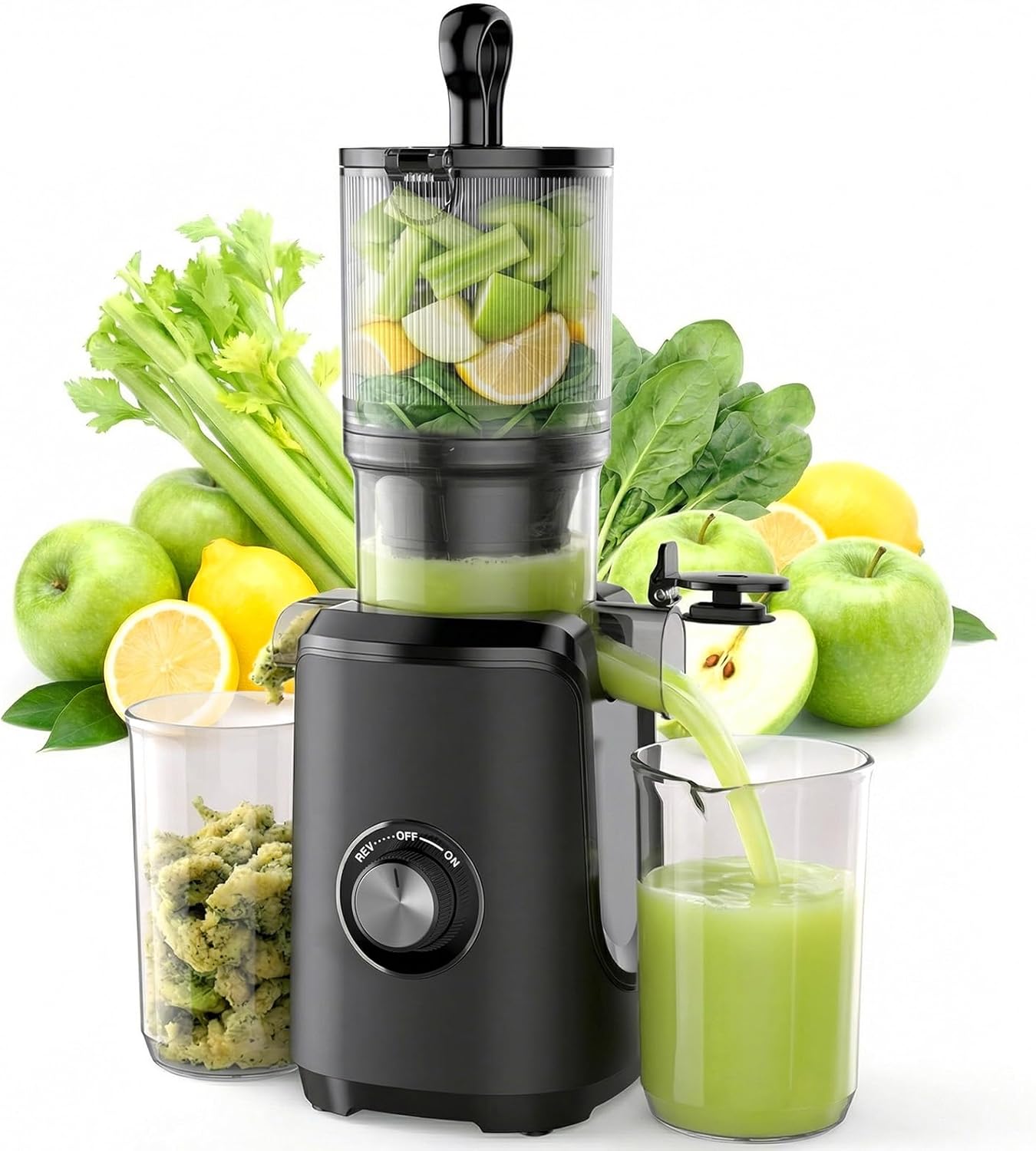
| Wattage | 200 watts |
|---|---|
| Voltage | 120 volts |
| Special Features | Easy to Clean, Masticating, Quiet Motor, Safety Lock |
| Material | ABS, PC, Silicone, Stainless Steel |
The NEWBULIG Cold Press Juicer is a single-auger masticating machine designed for everyday home juicing of fruits and vegetables. It uses a low-speed 200-watt motor and a 4.25-inch feed chute so you can feed larger pieces or whole produce with less prep, and the reverse function clears clogs quickly when fibrous ingredients bind in the auger. The slow masticating action reduces heat and oxidation compared with centrifugal juicers, which helps preserve nutrients and yields smoother juice from leafy greens. Disassembly is straightforward and the unit ships with a cleaning brush, though the parts are hand-wash only. Safety features include a blade-free design and an automatic safety lock that stops operation when opened. Expect quieter operation than high-speed models and solid juice quality for daily use, but be prepared to rinse and scrub removable parts rather than using a dishwasher and to take slightly longer to extract juice than with centrifugal machines.
Best for: Buyers looking for an affordable slow juicer that prioritizes nutrient-rich extraction and minimal produce prep for everyday home use.
Less Ideal for: Those who need the fastest possible throughput, want dishwasher-safe parts, or plan heavy commercial use should consider other options.
- 4.25-inch feed chute accepts larger pieces and reduces prep time
- Slow masticating motor minimizes heat and oxidation for better nutrient retention
- Reverse function clears clogs without full disassembly
- Easy to disassemble and comes with a dedicated cleaning brush
- Safety lock and blade-free design enhance household safety
- Parts are hand-wash only and not dishwasher safe
- Lower speed means slower juice output compared with centrifugal juicers
Verdict: A budget-friendly slow masticating juicer that delivers higher-quality, nutrient-preserving juice with minimal prep thanks to its wide feed chute and reverse-clearing function.
anybear Cold Press Juicer SJ054C
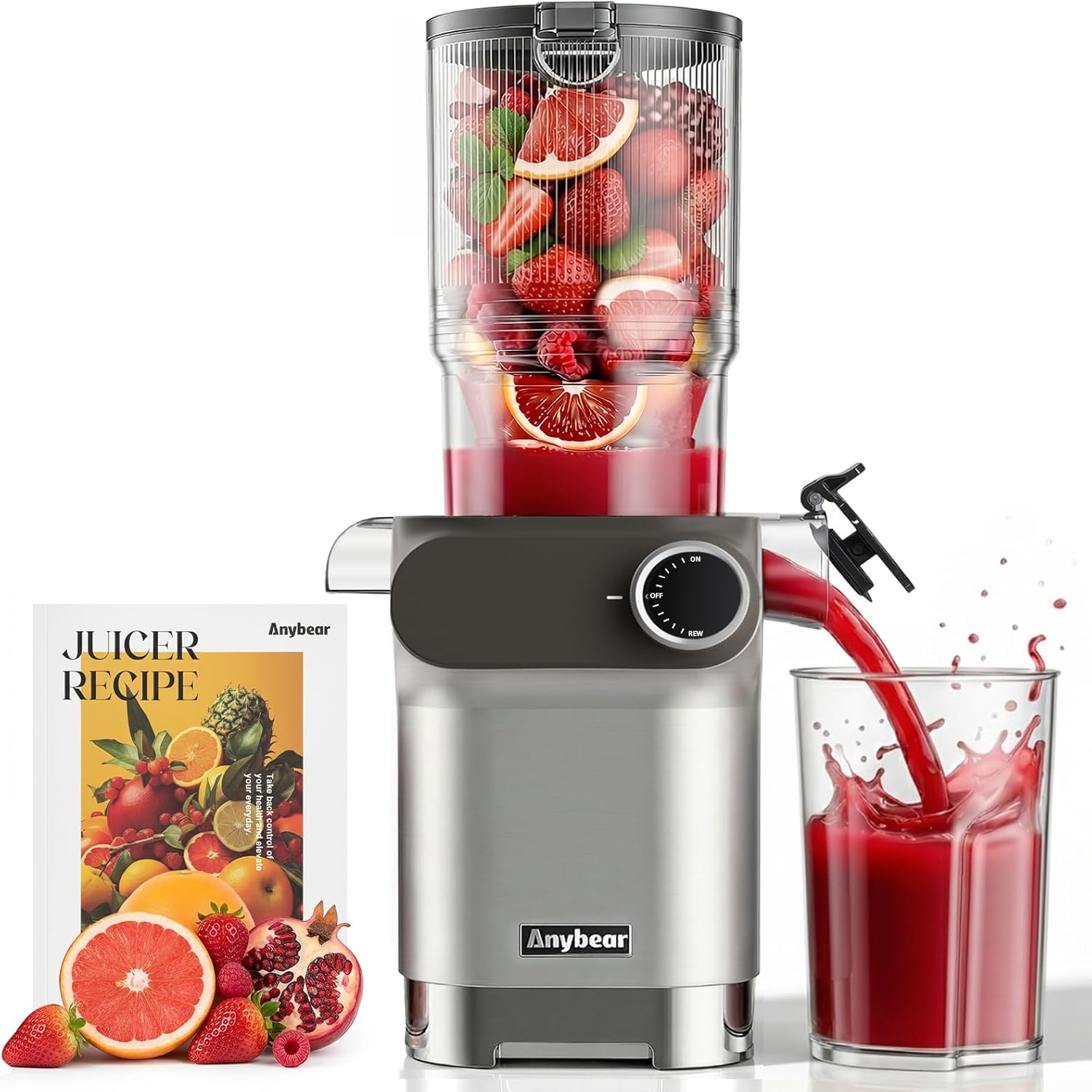
| Maximum Power | 200 watts |
|---|---|
| Wattage | 200 watts |
| Voltage | 110 volts |
| Special Features | Easy to Clean |
The anybear Cold Press Juicer is a slow masticating machine that extracts juice from whole fruits and vegetables using a 200W, high-torque motor running at about 65 RPM. It is used by feeding produce through the large 4.3-inch chute so you can often skip chopping, then the heavy-duty auger crushes and presses at low speed to reduce oxidation and improve yield. Notable features include a one-piece stainless steel filter that simplifies cleaning, Tritan feed-chute parts that are marketed as food-grade, and a compact vertical design that fits on most counters. Practical benefits are higher juice yield and fresher taste thanks to slow extraction, easier prep for bulky produce, and straightforward teardown for rinsing with the included brush. Important limitations are that the unit requires hand washing rather than being dishwasher-safe and the 200W motor, while efficient for cold pressing, is slower than centrifugal models so batch times are longer. For buyers prioritizing reliable, low-oxidation juice at home, this unit balances performance and maintenance without complex bells and whistles.
Best for: Home juicers who want a dependable cold-press machine that emphasizes consistent, low-oxidation extraction and minimal fuss during regular use.
Less Ideal for: People who need very fast, high-volume juicing or who prefer appliances that are fully dishwasher-safe and require minimal manual cleaning.
- High-torque 200W motor gives steady low-speed extraction for better juice yield
- 4.3-inch wide feed chute reduces prep time by accommodating larger produce
- One-piece stainless steel filter simplifies cleaning and reduces parts to handle
- Feed-chute components made from Tritan, a baby-food-grade material
- Requires hand washing and is not dishwasher-safe
- Slow extraction means longer juicing sessions compared with centrifugal models
Verdict: Buy this juicer if you want a reliable slow masticating machine that maximizes juice quality and yield with minimal daily maintenance.
ACOQOOS AMJ-90 Slow Juicer

| Maximum Power | 350 watts |
|---|---|
| Number of Speeds | 60 |
| Material | ABS, BPA-Free |
| Capacity | 100 OZ hopper |
The ACOQOOS AMJ-90 is a single-auger cold press juicer aimed at batch juicing and multi-use kitchen tasks. It accepts whole fruit through a 6.5-inch extra-wide chute into a 100 oz gravity-fed hopper, so you can load multiple ingredients and let the machine feed itself while you do other things. Running at 60 RPM with a 350-watt motor, it prioritizes nutrient retention and claims high yield and dry pulp, and included accessories and a cleaning brush make short work of disassembly and dishwasher-safe parts. The unit also offers a preset pre-cut/self-feed system and basic thermal protection to reduce motor stress. Practical limits are typical for slow juicers: it will be slower than centrifugal models for single-glass jobs and needs care with hard pits and seeds to avoid damage. Build materials are BPA-free ABS plastic rather than metal, so countertop durability and long-term commercial use may be more limited. For buyers who value large-batch, nutrient-focused cold press juice plus occasional sorbet and nut milk, this model is a useful all-in-one home appliance.
Best for: Buyers who prioritize nutrient-rich juice and batch convenience and want a single appliance that also makes sorbet and nut milk, supported by visible user feedback and practical features.
Less Ideal for: Those who need a heavy-duty, metal-built machine for frequent commercial use or who want ultra-fast single-glass juicing without load-and-wait batch workflows.
- Large 6.5-inch feed chute and 100 oz hopper let you load whole fruit and batch-juice with less prep
- 60 RPM cold-press auger designed to maximize nutrient retention and produce dry pulp
- 3-in-1 capability (juice, sorbet, nut milk) reduces the need for separate appliances
- Detachable BPA-free parts are dishwasher safe and come with a cleaning brush for faster cleanup
- Mostly plastic construction may feel less durable than metal-bodied slow juicers
- Not suited for hard pits or seeds without prior removal to protect the auger
Verdict: If you want a versatile, batch-focused cold press juicer that also handles sorbet and nut milk, this model delivers convenient loading, high yield, and easy cleanup for home use.
EanOruus 3-in-1 Cold Press Juicer E-18

| Maximum Power | 250 watts |
|---|---|
| Power Source | ac |
| Voltage | 110 volts |
| Capacity | 100 fluid ounces |
The EanOruus E-18 is a single-auger masticating juicer designed for home users who want versatile cold-press performance. It accepts whole fruits through a 6.5-inch wide chute into a 100 oz hopper so you can process large batches with minimal chopping and fewer refills. The included juice and sorbet strainers let you switch between extracting nutrient-rich juice, making creamy nut milk and producing frozen fruit sorbets, while an AC high-torque motor and auto-reverse help handle fibrous ingredients and reduce clogging. Detachable parts and a detachable pulp outlet simplify cleanup, and built-in overheat protection protects the motor during extended use. Practical downsides are the hand-wash-only parts and the unit's plastic components, which may feel less premium than all-metal models, and its 250 W motor is powerful for home use but not intended for commercial heavy-duty workloads. For household juicing, batch prep, and occasional nut milk or sorbet, it offers strong capacity and convenience.
Best for: Home cooks who prioritize convenience and batch juicing with minimal prep and who prefer a quiet, versatile machine for juice, nut milk, and sorbet.
Less Ideal for: Commercial users or kitchens that need an all-metal, heavy-duty juicer for continuous high-volume operation should look elsewhere.
- Extra-wide 6.5-inch chute reduces prep time by allowing whole fruits and large pieces
- Large 100 oz hopper supports batch juicing for families or meal prep
- 3-in-1 capability with interchangeable strainers for juice, nut milk and sorbet
- Auto-reverse and overheat protection reduce jams and protect the motor
- Detachable pulp outlet and removable parts make cleaning and maintenance easier than sealed designs
- Removable parts must be hand washed, which adds cleanup time
- Major components are plastic rather than metal, which may affect perceived durability
- 250 W motor is designed for home use and not heavy commercial workloads
Verdict: Choose the EanOruus E-18 if you want a high-capacity, quiet cold-press juicer that handles whole fruits and doubles as a nut milk and sorbet maker for home batch juicing.
Choosing the Right Slow Fruit Juicer: Key Factors to Consider
Juice Yield & Extraction Method
How much liquid the juicer produces from a given amount of fruit directly affects running costs and convenience. Slow fruit juicers use a low-speed auger to press pulp and separate juice with minimal heat and aeration. A higher yield means less leftover pulp and fewer batches to process, which is particularly important if you make juice daily or prepare batches for the week.
Look for descriptions of cold-press or masticating extraction and consider feed-throat size and auger geometry. These details influence how efficiently the machine handles different fruit types, from soft berries to denser apples.
Ease Of Cleaning And Maintenance
Cleaning time often determines whether a juicer becomes part of your routine or an occasional appliance. Models with tool-free disassembly, smooth surfaces, and dishwasher-safe parts save significant time. Pay attention to filters or strainers that trap fine particles, as these can be the hardest pieces to clean.
Routine maintenance also includes inspecting seals and screens for wear. Easier access to these parts reduces the effort needed to keep the machine hygienic and performing well over months and years.
Build Quality And Materials
Durable construction affects longevity and safety. Look for food-contact components made from BPA-free plastics or stainless steel and a robust motor casing that resists wobble under load. Metal augers or high-strength polymers tend to last longer than thin plastic components.
Consider the warranty and whether the design allows for part replacements. Solid build quality reduces vibration and helps maintain consistent extraction performance over time.
Noise Level And Daily Use Comfort
One advantage of slow juicers is quieter operation compared with high-speed machines, but noise and vibration still vary. If you juice early in the morning or in small living spaces, quieter motors and stable bases matter. Excess vibration can mean more cleanup and potential movement during operation.
Check for features like rubber feet, sound-dampening housings, and low-RPM motors. These elements improve comfort and make it more likely you will use the juicer regularly.
Feeding Versatility And Output Consistency
Different fruits present different challenges: soft berries can clog, while fibrous pineapple and whole apples need sufficient torque and throat size. A versatile slow fruit juicer accepts a range of produce sizes with minimal pre-cutting and produces consistent juice clarity and pulp dryness.
Consider whether the model includes accessories or adjustable settings for soft versus hard produce. Consistent output matters if you rotate between citrus-heavy recipes, leafy blends, and denser fruits.
Cold Press Benefits And What To Expect
Cold-press extraction minimizes heat and oxygen exposure during juicing, which helps preserve delicate flavors and some heat-sensitive nutrients. Expect thicker mouthfeel and often a slightly brighter flavor compared with high-speed centrifugal juicers.
Because the process is slower, plan for longer batch times. You will generally get less foam and clearer juice that separates more slowly, which can be an advantage if you store juice for a day or two.
- Lower oxidation means better short-term nutrient retention
- Less foam and clearer juice appearance
- Longer extraction times per batch compared with centrifugal machines
Preparing Fruit For Best Results
Proper preparation reduces clogging and improves yield. Trim tough stems, remove large pits, and cut fruit into sizes that match the juicer's feed throat. Softer fruits benefit from being combined with firmer produce to help push pulp through the auger.
Peeling is optional for many fruits but helpful when skins are waxed or bitter. For leafy greens, rolling or compacting them before feeding helps the auger process them more consistently.
- Cut dense fruits into chunks about 1 to 2 inches if the throat is small
- Alternate soft and firm pieces to maintain auger momentum
- Pre-wash thoroughly to reduce cleaning time
Managing Pulp And Using Leftovers
Dry pulp indicates efficient extraction and can be used rather than discarded. Leftover fiber is useful in baking, smoothies, composting, or savory recipes. Dry pulp also reduces spoilage risk compared with wetter residues.
If pulp texture matters for your recipes, choose models with finer or coarser strainers accordingly. Some users find it worth running pulp through a second press pass to extract remaining liquid for maximum yield.
- Repurpose pulp in muffins, crackers, or garden compost
- Drier pulp signals higher extraction efficiency
- Consider a second press pass for stubborn produce
Storage And Freshness Tips
Fresh cold-pressed juice oxidizes over time. Store juice in airtight containers and refrigerate immediately to slow degradation. Using narrow-neck bottles with minimal headspace reduces contact with air and helps preserve flavor for longer.
Consume most cold-pressed juice within 24 to 48 hours for best taste and nutrient retention. If you plan to keep juice longer, prioritize machines that yield clearer juice with less foam, as these tend to hold up better in storage.
- Use airtight, narrow-neck containers
- Refrigerate immediately and consume within 48 hours
- Shake bottles gently before drinking to reincorporate separated juice
Countertop Footprint And Kitchen Fit
Slow fruit juicers vary in footprint and weight. Larger models often have wider throats and more torque but need counter or cabinet space. If you have a compact kitchen, prioritize compact designs or units that store vertically.
Consider where you will disassemble and clean the unit. If sink space is limited, a design with fewer parts or dishwasher-safe components will make the process easier and keep the machine on the counter for frequent use.
- Measure available counter or storage space before choosing
- Check for parts that store on or inside the unit
- Lighter units are easier to move but may sacrifice some torque
How We Chose the Best Slow Fruit Juicer
We shortlisted products that deliver reliable slow-speed extraction for home kitchens and that emphasize juice yield and user experience. Our selection filters favored models with robust auger design, consistent low-RPM operation, and good feed-throat sizing for common fruit types. We prioritized durable materials and serviceability, including tool-free disassembly or straightforward parts access for cleaning. Noise level and motor cooling were considered to ensure comfortable daily use. We excluded high-speed centrifugal machines and novelty single-use devices that do not offer true cold-press extraction. Evaluation criteria focused on measurable, buyer-relevant dimensions: extraction efficiency, cleaning and maintenance, build quality and materials, noise and vibration, and continued reliability under typical household loads. These criteria map to how a slow fruit juicer performs week to week and how much time and effort owners will spend to get fresh juice consistently.
Our full evaluation process is outlined in our review methodology.
FAQ
How much prep does a slow fruit juicer require?
Preparation depends on feed-throat size and the produce. Expect to cut larger fruits into manageable pieces and remove large pits. Soft fruits usually require minimal prep beyond washing.
Will a slow juicer handle leafy greens well?
Many slow juicers process leafy greens effectively, but performance varies. Packing leaves tightly or alternating with firmer produce can help the auger extract more liquid from greens.
How long does cold-pressed juice stay fresh?
Cold-pressed juice stored in airtight containers and refrigerated typically stays best for 24 to 48 hours. Clarified juice with less foam may hold up a bit longer, but flavor and some nutrients decline over time.
Is a slow juicer harder to clean than other types?
Cleaning can take longer because of fine strainers and multiple parts, but models with tool-free disassembly and smooth components are much easier. Routine care and prompt rinsing reduce residue buildup.
Can I juice whole apples or do I need to core them?
Most home slow juicers require apples to be quartered or halved, depending on throat size. Removing large pits or hard stems helps protect the auger and improves extraction.
Final Verdict
Choosing the right slow fruit juicer comes down to balancing extraction efficiency, cleaning time, and how the machine fits your daily routine. Prioritize a model that delivers high juice yield and easy maintenance if you plan regular use. If countertop space or noise is a concern, favor compact, quiet designs with straightforward disassembly. Consider the tradeoffs between throughput and ease of cleaning. Focusing on the factors outlined here will help you pick a slow fruit juicer that matches how often you juice and the types of produce you prefer, so you can enjoy fresher juice with minimal hassle.