
Note: This article contains affiliate links. If you click on these links and make a purchase, we may earn a small commission at no extra cost to you. This helps support our research and content. Read our full affiliate disclosure here.
If you want more nutrition from leafy vegetables, the right slow juicer for greens makes a measurable difference in yield and nutrient retention. Greens are fibrous and often low in juice volume, so machines designed to extract from leaves, wheatgrass, and herbs deliver stronger results and less waste than general-purpose juicers. This guide spotlights the top shortlisted slow juicers for greens, explaining the practical tradeoffs—extraction efficiency, cleaning effort, and motor stress—that matter most to regular green-juice drinkers. Read on to see the criteria we used to select these top picks and how each choice fits different green-juicing routines.
Top Picks at a Glance
| Best Overall The best all-around choice for most situations | Omega Cold Press 365 H3000RED |  |
| Best Quality Built to a higher standard if you want something more solid | Hurom H330 Slow Juicer |  |
| Best Value The sweet spot between price and what you get | TUUMIIST Cold Press Juicer TM-580SJ |  |
| Best Budget The cheapest option that still gets the job done reliably | KMFurnila Slow Masticating Juicer |  |
| Top Rated A top-rated pick with lots of positive feedback | ECOSELF Cold Press Juicer |  |
| Most Popular A crowd favorite that many people choose with confidence | Ninja NeverClog Cold Press Juicer JC151 |  |
| Best Seller A high-volume bestseller chosen again and again | EanOruus 3-in-1 Cold Press Juicer |  |
Omega Cold Press 365 H3000RED

| Wattage | 150 watts |
|---|---|
| Power Source | Corded Electric |
| Voltage | 120 |
| Number of Speeds | 1 |
| Capacity | 0.5 liters |
The Omega H3000RED Cold Press 365 is a horizontal masticating juicer that runs at about 90–110 RPM to minimize heat and oxidation while extracting juice from fruits, vegetables, wheatgrass, and leafy greens. It uses a three-stage auger and offers both fine and coarse screens so you can target higher yield or pulp-free juice depending on produce and preference. The unit is corded electric with a single speed and a 150-watt motor, which keeps operation quiet and simple for everyday batch juicing. Most removable parts are top-rack dishwasher safe, and stainless steel cutting components help with durability. Practical limits include a modest 0.5-liter capacity and single speed operation, so it is best suited for short batch sessions rather than continuous commercial use, and larger families may need to run multiple cycles. Overall it delivers nutrient-preserving, high-yield juice from leafy greens and firm vegetables with straightforward cleaning and reliable, quiet performance.
Best for: Buyers who want a reliable, nutrient-focused slow juicer for regular home use, especially those prioritizing leafy green and vegetable juice yield and ease of cleaning.
Less Ideal for: Those who need large-capacity or continuous commercial juicing or who want adjustable speed settings for finer control should consider different models.
- Low 90–110 RPM masticating action minimizes heat and oxidation for nutrient retention
- Triple-stage auger improves juice yield from greens and fibrous produce
- Includes fine and coarse juicing screens to control pulp level
- Quiet operation and simple one-speed control for easy daily use
- Most removable parts are top-rack dishwasher safe for easier cleanup
- 0.5-liter capacity is small for large batches
- Single speed limits control compared with multi-speed models
Verdict: Choose the Omega H3000RED if you want a quiet, nutrient-preserving slow juicer that maximizes greens yield for everyday home juicing.
Hurom H330 Slow Juicer

| Capacity | 2 liters |
|---|---|
| Auger Speed | 50 RPM |
| Power Source | Corded Electric |
| Material | Plastic; stainless steel blade |
| Special Features | Self-feeding hopper; Easy to Clean |
The Hurom H330 is a single-auger cold press juicer built for batching leafy greens and whole fruits with minimal prep. Its 2‑liter self-feeding hopper accepts whole apples, carrots, celery, and many greens so you can load a recipe and walk away while the 50 RPM auger gently compresses produce to reduce heat and oxidation. The unit includes fine and coarse strainers for low-pulp or fuller-texture juice, and it can also make nut milk and smoothies with accessory strainers. Practical benefits include quiet operation suitable for early mornings, quick disassembly for a faster clean, and a safety shut-off that stops the motor if the hopper lid opens. Materials are BPA-free Tritan and stainless steel components, and the motor is detachable for neat storage. Important limitations are its size and weight for some kitchens and the need to hand-wash parts, which may be inconvenient for buyers wanting dishwasher-safe cleanup. For green juice lovers focused on yield and nutrient retention, the H330 delivers professional-style cold-press performance in a consumer-friendly package.
Best for: Buyers who prioritize extraction efficiency and nutrient retention for leafy green and whole-produce juicing and want a machine that handles larger, unattended batches.
Less Ideal for: Those who need a compact, lightweight countertop juicer or who prefer parts that are dishwasher-safe for minimal post-use cleanup.
- Large 2‑liter self-feeding hopper lets you batch whole produce without chopping
- 50 RPM slow-squeeze auger minimizes heat and oxidation for better nutrient retention
- Includes fine and coarse strainers for adjustable pulp levels and versatile recipes
- Quiet operation and safety shut-off make early-morning use and family kitchens easier
- Quick-disassembly removable parts speed up hand-cleaning and maintenance
- Parts are hand-wash only rather than dishwasher-safe
- Relatively heavy and wide footprint may be bulky for small counters
Verdict: If you want high-yield, nutrient-preserving green juices from whole produce with minimal babysitting, the Hurom H330 is a performance-focused cold-press juicer built for batch use.
TUUMIIST Cold Press Juicer TM-580SJ
| Wattage | 300 watts |
|---|---|
| Number of Speeds | 55 RPM |
| Power Source | AC |
| Special Features | No Mesh Filter, Whole Fruit Processing |
| Capacity | 3.8 pounds |
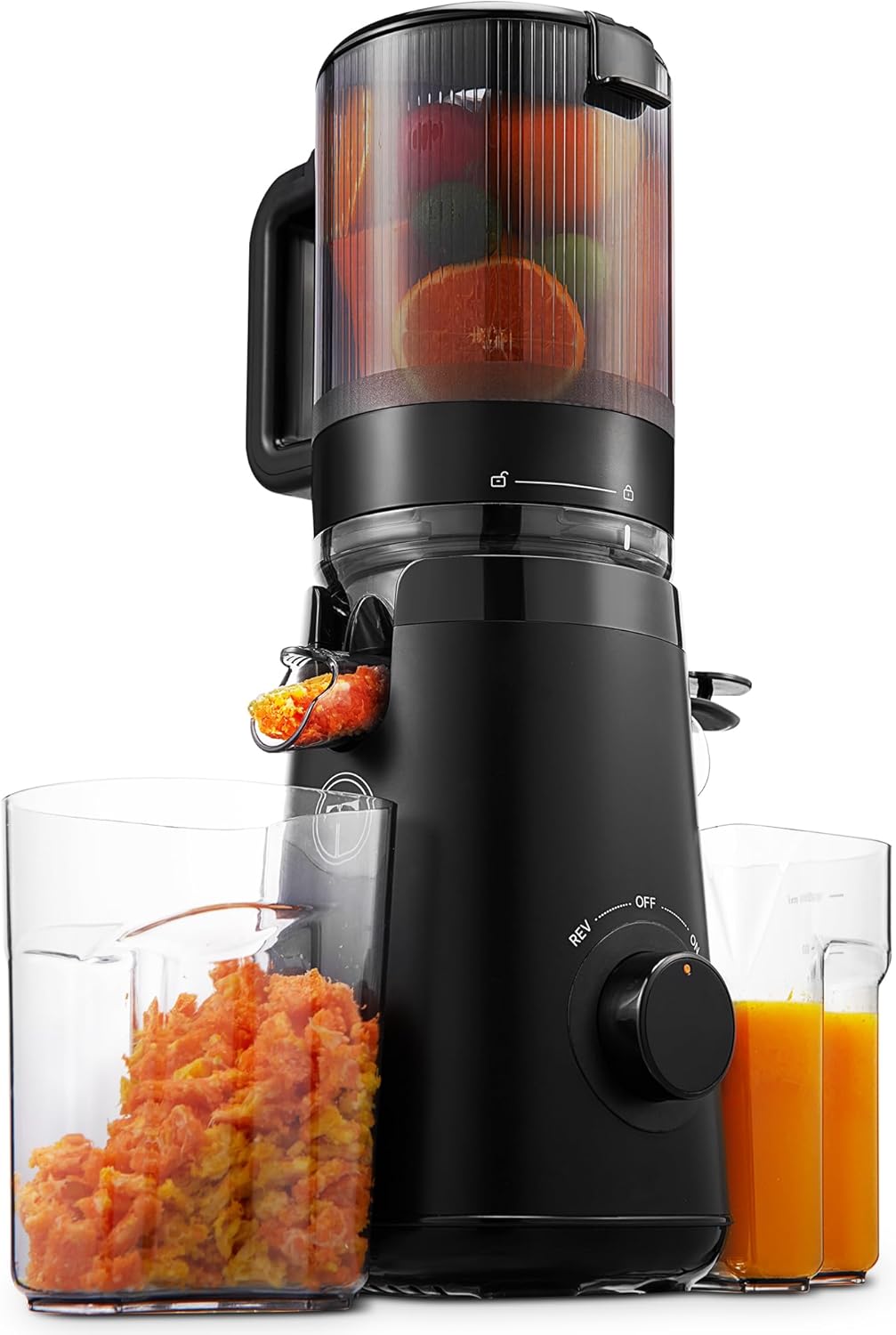
The TUUMIIST TM-580SJ is a masticating cold-press juicer built to squeeze high juice yield from whole fruits and vegetables. It uses a slow 55 RPM auger and a 300-watt motor to mimic hand squeezing, which helps preserve nutrients and produce smoother juice that separates less over time. The 5.8-inch feed chute accepts larger pieces and reduces prep time, while the one-piece assembly and included cleaning brush make disassembly and cleaning straightforward. It includes a juice cup and pulp cup for continuous juicing and is made from BPA-free ABS plastic. Practical buyers will appreciate the no-mesh-filter design that simplifies cleanup and the focus on preserving nutrients for green juices. Limitations are the plastic construction, which may feel less durable than metal alternatives, and the relatively modest motor power that could struggle with very fibrous greens in large batches; expect slower processing when feeding dense leafy loads. For routine home use and weekday green juices the TM-580SJ is an efficient, low-fuss option.
Best for: Buyers who want a practical, low-fuss cold-press juicer for regular green and mixed vegetable juices and value nutrient retention and easy cleaning over premium materials.
Less Ideal for: People who need a heavy-duty commercial machine or want a metal-bodied high-torque juicer for frequent large batches of very fibrous greens.
- Slow 55 RPM extraction preserves nutrients and reduces oxidation
- Extra-large 5.8" feed chute accepts whole or large pieces to cut prep time
- No-mesh-filter and simple one-piece design speeds cleaning
- Includes cleaning brush, juice cup, and pulp cup for continuous juicing
- ABS plastic construction may feel less robust than metal-bodied juicers
- 300W motor may be slower with very fibrous leafy greens or large batches
Verdict: A practical cold-press juicer that saves prep time and preserves nutrients, making it a smart choice for regular at-home green juices.
KMFurnila Slow Masticating Juicer

| Maximum Power | 200 watts |
|---|---|
| Wattage | 200 watts |
| Power Source | Corded Electric |
| Voltage | 120 volts |
The KMFurnila slow masticating juicer is a compact cold-press machine geared toward everyday home juicing, especially leafy greens and fibrous vegetables. It uses a 200W motor and slow single-auger action to reduce heat and oxidation, which helps retain more vitamins and enzymes compared with high-speed centrifugal models. The 4.25-inch feed chute accepts larger chunks so prep time is reduced, and the reverse anti-clog function clears blockages without disassembly—useful when juicing celery, kale, or wheatgrass. Its blade-free design and safety lock make it safer around kids and the included brush plus removable parts simplify cleaning, though parts are hand-wash only. Practical limits are its modest 200W power, which can be slower on very tough produce and requires more time for batch juicing, and the unit is relatively tall on a small footprint so counter space should be considered. For buyers prioritizing nutrient retention and gentle extraction on a budget, this delivers strong everyday performance for greens and mixed produce.
Best for: Buyers looking for an affordable cold-press juicer focused on retaining nutrients in greens and everyday fruits who want a safe, easy-to-clean machine without premium pricing.
Less Ideal for: Users who need very fast high-volume juicing or fully dishwasher-safe parts should consider higher-powered or commercial models instead.
- Slow masticating action preserves nutrients and reduces oxidation
- 4.25-inch feed chute reduces prep by fitting larger pieces
- Reverse anti-clog function clears blockages without disassembly
- Blade-free design with safety lock improves user safety
- Removable parts and included brush make cleaning straightforward
- 200W motor can be slower with very tough or large batches of fibrous produce
- All removable parts require hand washing rather than dishwasher-safe
Verdict: A budget-friendly slow juicer that preserves nutrients in greens with a wide feed chute and anti-clog reverse function, making it a practical choice for daily home cold-press juicing.
ECOSELF Cold Press Juicer

| Special Features | Easy to Clean; High Juice Yield; Reverse Function; Low Noise Motor; Self Feeding; Wide Feed Chute |
|---|---|
| Material | Acrylonitrile Butadiene Styrene (ABS) |
| Item Dimensions | 7.68"D x 13.66"W x 14.96"H |
The ECOSELF Cold Press Juicer is a slow masticating single-auger machine designed to extract juice from whole fruits, vegetables, and leafy greens with minimal prep. Its wide feed chute and self-feeding hopper let you drop in larger pieces and use the auto-feed feature for mostly hands-free juicing, which speeds up morning routines. The low-speed cold-press method and upgraded auger aim to reduce heat and oxidation, producing smoother, pulp-reduced juice and higher yield; the listing claims up to 99% extraction. Practical touches include a one-touch rotary control, a reverse function to clear clogs, and an included cleaning brush with an integrated filter that simplifies assembly and cleanup. The ABS construction keeps the unit lightweight but means it is not all-metal. While marketed for high juice yield and quiet operation, expect longer cycle times than centrifugal machines since it is a slow juicer, and tougher leafy blends can still require some manual feeding to maintain flow. For those prioritizing consistent, nutrient-preserving cold-pressed greens juice, this model offers dependable features without complicated controls.
Best for: Buyers wanting a reliable, low-oxidation slow juicer for daily greens and mixed produce who value hands-free feeding and straightforward controls over speed.
Less Ideal for: People who need very fast, high-throughput juicing or prefer heavier all-metal construction should consider other types of juicers.
- Wide feed chute and auto-feeding design reduce prep and enable mostly hands-free juicing
- Slow masticating extraction preserves enzymes and reduces oxidation for smoother juice
- Reverse function helps clear jams and maintain continuous operation
- Included brush and integrated filter make assembly and cleaning quicker
- Plastic (ABS) construction rather than metal may feel less durable long term
- Slower processing speed than centrifugal juicers, so batching takes more time
Verdict: Choose this ECOSELF cold press juicer if you want a dependable, hands-free slow juicer that maximizes juice yield and preserves nutrients for leafy greens.
Ninja NeverClog Cold Press Juicer JC151

| Maximum Power | 150 watts |
|---|---|
| Number of Speeds | 2 |
| Capacity | 24 fluid ounces |
| Power Source | Corded Electric |
The Ninja NeverClog JC151 is a slow masticating juicer built to handle fibrous greens and dense produce without frequent clogging. Its 150-watt high-torque auger extracts juice at low speed, which helps preserve nutrients and reduce foam, and two interchangeable pulp filters let you choose between smoother juice or a thicker, fiber-rich result. One-touch controls include a reverse function to clear jams and boost extraction, and the larger 24 oz juice jug with a 36 oz pulp bin supports batch juicing for multiple servings. The unit is compact enough for most countertops and uses dishwasher-safe parts for quicker cleanup compared with many centrifugal models. Practical limitations include a modest motor compared with heavy-duty commercial units and a single-speed design beyond the two simple program buttons, so extraction times are slower than high-power alternatives. For home users focused on leafy green juices and everyday batches, the JC151 balances ease of use, pulp control, and straightforward maintenance.
Best for: Buyers who want a reliable home cold-press juicer that tackles leafy greens and fibrous produce with easy pulp control and simple, low-effort maintenance guided by solid user reviews.
Less Ideal for: Users who need a commercial-grade, high-capacity machine or advanced speed/setting customization should consider more powerful, feature-rich models.
- High-torque 150W auger designed to handle fibrous greens and dense produce with less clogging
- Two interchangeable pulp filters let you control juice texture from smooth to pulpy
- Large 24 oz juice jug and 36 oz pulp container support batch juicing
- Reverse function and one-touch controls simplify clearing jams and operation
- Dishwasher-safe juice-contact parts make cleanup easier
- Single motor speed and basic controls limit fine-tuning of extraction
- 150W motor is adequate for home use but not as powerful as commercial slow juicers
Verdict: A user-friendly cold-press juicer that reliably processes greens and fibrous produce with easy pulp control and low-maintenance cleanup, making it a strong home choice for daily green juice.
EanOruus 3-in-1 Cold Press Juicer

| Wattage | 250 watts |
|---|---|
| Power Source | ac |
| Voltage | 110 volts |
| Capacity | 100 fluid ounces |
The EanOruus 3-in-1 cold press juicer is a single-auger masticating machine designed for home use and larger batches. It accepts whole fruits and vegetables through a 6.5-inch wide chute into a 100 oz hopper so you can load multiple ingredients without constant refilling, and it runs on a 250 W AC motor intended to crush fibrous produce at low speed for higher yield and nutrient retention. Two interchangeable strainers let you switch between juice and sorbet or use the included parts for nut milk, and features such as auto-reverse and overheat protection reduce clogging and motor stress during long runs. Most removable parts are hand-wash only but are designed to disassemble for cleaning, and the plastic/polycarbonate construction keeps weight and cost down. Limitations to consider are the plastic blade/materials and the need to hand-wash components, which may feel less premium than metal alternatives, and its larger footprint compared with compact slow juicers. For someone who wants quiet, continuous cold-pressed juice and occasional nut milk or sorbet, this unit delivers strong capacity and practical anti-clog features.
Best for: Buyers who prioritize reliable, low-speed cold-press extraction for greens and larger batch juicing and want a machine that minimizes prep and clogging during regular use.
Less Ideal for: Those who need a compact, lightweight travel-friendly juicer or who prefer stainless-steel components and dishwasher-safe parts should look elsewhere.
- Extra-wide 6.5-inch chute reduces prep and fits whole fruits
- Large 100 oz hopper supports batch juicing for families or meal prep
- Auto-reverse and overheat protection help prevent jams and protect the motor
- Includes interchangeable strainers for juice, sorbet and nut milk preparations
- Removable parts require hand washing rather than dishwasher-safe cleaning
- Mainly plastic construction and plastic blade material may feel less durable than metal components
Verdict: Choose this juicer if you want quiet, high-capacity cold-press extraction with anti-jam features for frequent greens and batch juicing.
Choosing the Right Slow Juicer for Greens: Key Factors to Consider
Extraction Yield on Leafy Greens
How much liquid you get from spinach, kale, wheatgrass, and herbs matters because greens are low-yield by volume. Higher extraction yield reduces waste and gives you more juice per bunch, which lowers the time and cost of sourcing produce. Yield depends on auger design, rotational speed, and the fit between the screen and the press chamber.
When evaluating yield, think about both immediate volume and the texture of the spent pulp. Drier, tighter pulp indicates efficient fiber compression and better liquid recovery. For regular green juicing, prioritize machines that demonstrate consistent leafy extraction rather than peak output on high-water fruits.
Motor Torque and Continuous Duty
Leafy greens create resistance, and a motor that stalls or overheats will struggle with repeated leafy batches. Torque is more important than raw wattage for slow juicers used with fibrous material. Look for designs that emphasize low-speed, high-torque operation and have thermal protection or duty-cycle ratings.
A motor that can maintain slow, steady RPMs without generating excessive heat preserves nutrients and prevents burn on delicate produce. If you plan to run multiple batches back-to-back, choose a model rated for sustained use rather than intermittent juicing.
Ease of Cleaning and Maintenance
Cleaning frequency is a major factor for green-juice habit sustainment. Juicers intended for leafy greens often trap fibers in narrow channels, so tool-free disassembly, accessible screens, and included cleaning brushes save time. Dishwasher-safe parts are convenient but verify which components are safe to avoid warping.
Routine maintenance also includes inspecting seals and gaskets for clogs and replacing worn screens. If cleaning feels onerous, usage tends to drop off, so prioritize models with simple disassembly and clear cleaning instructions.
Pulp Dryness and Separation
How dry the spent pulp is indicates how thoroughly a juicer separated liquid from fiber. Drier pulp means more efficient extraction and often a clearer juice with fewer suspended solids. For greens, look for machines that produce tightly packed, barely wet pulp.
Pulp separation also affects downstream tasks like composting or repurposing fiber. Better separation reduces drip mess and makes handling spent pulp neater.
Noise, Vibration, and Kitchen Fit
Many green-juicing routines happen early in the morning or in compact kitchens, so noise and vibration are practical concerns. Low-speed slow juicers are generally quieter than high-speed centrifugals, but construction quality influences how much vibration transfers to the countertop.
Consider both decibel impact and physical footprint. A quieter, stable unit is easier to use without disturbing others and fits more comfortably on limited counter space.
Durability and Warranty Support
Frequent use with tough leafy material puts extra wear on augers, screens, and seals. Durable materials, reinforced housings, and a clear warranty indicate the manufacturer expects regular use. Warranty terms and included spare parts can reduce long-term ownership friction.
Also consider the availability of replacement screens and gaskets. A model that is easy to service or has accessible parts will stay functional longer under heavy leafy-juicing conditions.
Why Low-Speed Extraction Matters for Greens
Low-speed, high-torque extraction preserves fragile enzymes and reduces heat buildup that can negatively affect flavor and nutrient profiles. For leafy greens, the gentler crushing and pressing action separates liquid from fiber without emulsifying chlorophyll into a cloudy mix.
Slow juicers also tend to create drier pulp and higher yields from the same amount of produce. That means fewer trips to prep more greens and less leftover waste to handle.
- Lower RPMs reduce heat and oxidation
- Gentle extraction improves juice clarity
- Drier pulp indicates efficient fiber compression
Preparing Greens for the Best Results
Proper prep increases yield and reduces strain on the machine. Remove thick stems from tougher greens when possible, and loosely bundle herbs or microgreens before feeding them into the chute. For very fine materials like wheatgrass, use a dedicated nozzle or smaller feed adapter if available.
Wash greens thoroughly to remove grit that can abrade screens. Pat leaves dry or spin in a salad spinner to avoid excess surface water, which can dilute juice and change extraction dynamics.
- Trim stems for uniform feed
- Bundle fine greens to avoid clogging
- Pre-rinse to reduce grit and wear
Cleaning Routines That Save Time
Clean immediately after juicing to prevent dried fibers from clogging the screen. Start by rinsing large bits of pulp, then use the included brush to clear mesh and auger channels. A short follow-up soak in warm soapy water loosens residual chlorophyll and makes a final rinse easier.
For frequent juicers, keep a small sink basin or dedicated bucket nearby to pre-rinse parts. Label which components are dishwasher-safe and avoid high-heat cycles that can warp plastic screens.
- Rinse parts right away to prevent clogs
- Use included brushes for narrow channels
- Soak stubborn residue before scrubbing
Common Tradeoffs When Choosing for Greens
Designs that maximize leafy yield may be slower to feed and require more prep. Narrow auger paths compress fiber better but can be prone to clogging if produce is overpacked. Higher-torque motors handle tougher leafy loads but add weight and cost.
Consider where you place ease of cleaning against extraction efficiency. If daily convenience is crucial, a slightly lower-yield model with easy cleanup could be a better fit than a high-yield unit that demands intensive maintenance.
- Higher yield can mean slower throughput
- Powerful motors increase weight and noise
- Simplicity in design often eases cleaning
How to Evaluate Pulp to Judge Performance
Examine spent pulp after a standard batch. Look for tightly packed, mostly dry pulp with minimal dripping. If the pulp remains visibly wet or pulpy, the machine likely left usable juice behind.
Also check the juice clarity. While some cloudiness is normal with greens, excessive foam or emulsified bits suggest the machine is shredding rather than pressing, which can affect flavor and shelf life.
- Dry, compact pulp indicates efficient extraction
- Excess foam or wet pulp signals inefficient pressing
- Use a consistent test batch of greens to compare models
How We Chose the Best Slow Juicer for Greens
We focused on features that directly affect how well a slow juicer performs with leafy greens and similar low-moisture plant material. Key evaluation criteria included extraction yield on leafy vegetables and microgreens, the juicing mechanism and screen design that influence fiber separation, motor torque and heat management for continuous leafy workloads, and ease of cleaning for frequent use. Durability and warranty coverage were considered to gauge long-term reliability under routine green-juicing. We also looked at footprint and noise because many users run juicers in small kitchens or early mornings. Products were excluded if they lacked clear design elements intended for leafy material, such as narrow augers, specialized screens, or published yield data. We avoided machines that rely primarily on centrifugal force, since those tend to perform poorly with greens. The result is a list of slow juicers that prioritize leafy yield, manageable upkeep, and robust motors suited to regular green-juice preparation.
Our full evaluation process is outlined in our review methodology.
FAQ
Can I juice any leafy green in a slow juicer?
Most slow juicers handle common leafy greens like spinach, kale, and chard well. Very fibrous stems or excessive bundles may need trimming. Extremely fine materials such as wheatgrass sometimes require a dedicated attachment or smaller feed port for best results.
How often should I clean the juicer when juicing greens daily?
Rinse components immediately after each use and perform a thorough clean at least once daily if you juice every day. Quick rinses prevent fibers from drying into tight clogs and make deeper cleaning faster.
Is a higher-watt motor always better for greens?
Wattage alone is not decisive. Torque and low-speed stability matter more for leafy extraction. A lower-watt motor designed for high torque and continuous duty can outperform a higher-watt motor with poor torque characteristics.
Will juicing greens damage the machine over time?
Regular juicing of leafy greens increases wear on screens, seals, and auger surfaces but should not damage a unit designed for that use. Choosing models with robust construction and accessible replacement parts reduces long-term maintenance concerns.
How can I get the most juice from soft herbs and microgreens?
Bundle small herbs or microgreens into a denser plug before feeding them to the juicer, and run at the recommended low speed to allow the auger to compress instead of shredding. Using a smaller feed adapter when available helps maintain consistent pressure.
Final Verdict
For regular green juicing, prioritize machines that deliver high leafy yield, strong low-speed torque, and straightforward cleaning. Expect tradeoffs between extraction efficiency and ease of maintenance; choose based on whether you value maximum juice from each bunch or faster cleanup for daily use. Focus on dry pulp, consistent motor performance, and accessible spare parts to ensure long-term satisfaction with a slow juicer for greens.