
Note: This article contains affiliate links. If you click on these links and make a purchase, we may earn a small commission at no extra cost to you. This helps support our research and content. Read our full affiliate disclosure here.
If you need a compact, easy-to-fit printer for a home office, dorm, or tight desktop, choosing the right small printer matters. A cramped workspace does not mean you should sacrifice print quality or running efficiency. The right small printer will deliver sharp documents, acceptable photo output, and manageable operating costs without dominating your desk. This guide shortlists the top small printers across common user needs and evaluates each against portability, print quality, and ongoing cost. Read on to find compact models that fit limited space and everyday printing demands.
Top Picks at a Glance
| Best Overall The best all-around choice for most situations | Epson Expression Premium XP-7100 |  |
| Best Quality Built to a higher standard if you want something more solid | Epson EcoTank ET-2800 |  |
| Best Value The sweet spot between price and what you get | Brother HL-L2405W Laser Printer |  |
| Top Rated A top-rated pick with lots of positive feedback | Canon PIXMA TS6520 |  |
| Most Popular A crowd favorite that many people choose with confidence | Canon PIXMA TR4720 |  |
| Best Seller A high-volume bestseller chosen again and again | TATTMUSE A285M Portable Thermal Printer |  |
Epson Expression Premium XP-7100

| Printer Type | Inkjet |
|---|---|
| Maximum print Resolution Color | 4800 dpi |
| Maximum Copy Speed Black and White | 15.8 pages_per_minute |
| Maximum Sheet Capacity | 30 |
| Printer Connectivity Type | Wireless |
The Epson Expression Premium XP-7100 is a compact all-in-one inkjet aimed at home users who want both document productivity and photo-quality prints. It prints, scans and copies, includes a 30-sheet automatic document feeder for multi-page jobs, and supports automatic two-sided printing to save paper. Photo features include borderless printing up to 8 x 10 inches and a five-color Claria ink set for richer color and sharper photo detail, while a 4.3-inch touchscreen, SD card slot and USB access make printing directly from cameras and cards straightforward. Connectivity includes wireless printing and an Ethernet port for a stable network connection. Practical limits are its modest color page speed and relatively small input capacity, which make it better suited to light to moderate home or small-office use rather than heavy daily volume. Cartridge compatibility is restricted to Epson Genuine cartridges, which helps quality but raises ongoing ink costs compared with refillable or third-party options.
Best for: Buyers who want a small, versatile home printer that can handle family photos and everyday documents with easy direct-print options and simple network setup.
Less Ideal for: Users who need high-volume office printing or the fastest color throughput should choose a higher-capacity, throughput-focused model instead.
- Five-color Claria inks and 4800 dpi resolution for high-quality photos and detailed color prints
- 30-sheet Auto Document Feeder and automatic duplex printing for time-saving document workflows
- 4.3-inch touchscreen plus SD card and USB slots for easy, computer-free photo printing
- Wireless and Ethernet connectivity including Wi‑Fi Direct for flexible printing from phones and tablets
- Slow color page throughput, so larger photo or color print jobs take time
- Small paper capacity limits heavy daily printing
Verdict: A compact, photo-capable all-in-one that balances print quality and home-office convenience for buyers who need both documents and occasional high-quality photos.
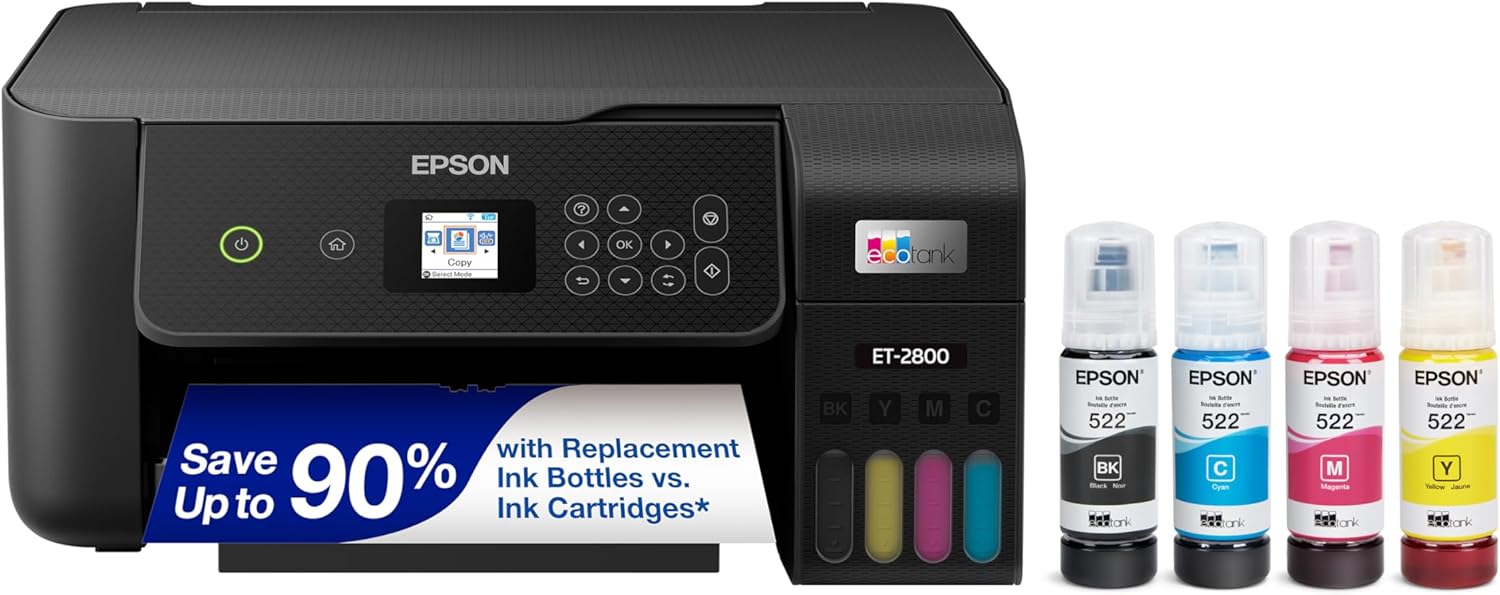
Epson EcoTank ET-2800
| Printer Type | Inkjet |
|---|---|
| Printer Connectivity Type | USB, Wi-Fi |
| Color Pages per Minute | 5 pages_per_minute |
| B&W Pages per Minute | 10 |
| Maximum print Resolution Color | 5760 x 1440 dpi |
The Epson EcoTank ET-2800 is a compact all-in-one inkjet that replaces cartridges with refillable high-capacity ink tanks, letting you print long runs without frequent replacements. It prints, copies, and scans, connects via Wi-Fi or USB, and supports mobile and voice-activated printing for quick jobs from phones. Print quality is strong for everyday documents and photos thanks to PrecisionCore/Micro Piezo technology and high maximum resolution, while its 10 ppm black/text speed handles medium-size tasks efficiently. The included ink yield is marketed to cover thousands of pages, which lowers running costs and reduces waste compared with cartridge models. Practical trade-offs are modest paper handling and simplex-only output—the single 100-sheet capacity and lack of automatic two-sided printing limit heavy office workflows—and its photo speed and advanced finishing are not aimed at pro photo users. Setup and tank refills are straightforward, and the color display and app controls make routine tasks easy to manage at home.
Best for: Buyers who prioritize low long-term operating costs and steady performance for home or small-office document and occasional photo printing will appreciate this unit.
Less Ideal for: Users who need heavy-duty paper handling, frequent duplex jobs, or pro-level photo finishing should consider larger office or dedicated photo printers instead.
- Cartridge-free EcoTank system with high-capacity refillable ink tanks for long print runs
- Low running costs and large ink yield included in the box
- Wireless, mobile and voice-activated printing for convenient remote jobs
- High optical resolution for detailed text and color prints
- Compact all-in-one design with flatbed scanner and simple color display
- Single-tray 100-sheet capacity limits large batch printing
- No automatic duplex (two-sided) printing
Verdict: Choose the ET-2800 if you want a small, cartridge-free all-in-one that delivers solid everyday print quality with much lower ongoing ink costs.
Brother HL-L2405W Laser Printer

| Printer Type | Laser |
|---|---|
| Printer Output Type | Monochrome |
| Maximum Copy Speed Black and White | 30 pages_per_minute |
| Maximum Print Resolution Black and White | 1200 x 1200 dots_per_inch |
| Printer Connectivity Type | USB, Wi-Fi |
The Brother HL-L2405W is a compact monochrome laser printer built for small desks and home offices that need straightforward, reliable black-and-white printing. It prints one-sided documents at up to 30 pages per minute with a 250-sheet tray to reduce refills, and includes a manual feed for envelopes and specialty paper. Dual-band Wi-Fi and a USB 2.0 port let you connect phones, tablets, and computers, and Brother Mobile Connect provides remote printing and supply management from a phone. Print quality is sharp at the listed 1200 x 1200 dpi resolution, and Brother genuine toners are available in standard and high-yield sizes for lower running costs. There is no automatic duplexing or scanning/copier functions, so this is strictly a print-only device, and initial toner yields are modest compared with high-volume office models. The machine's small footprint and accessible tray make it a practical choice when you prioritize speed, simplicity, and a low desktop profile over multifunction features.
Best for: Buyers who want a no-frills, space-efficient printer that delivers fast, reliable black-and-white pages for a home office or small workspace and value simple wireless setup and app-based management.
Less Ideal for: People who need color printing, automatic duplex printing, or an all-in-one scanner/copier should look at multifunction or higher-capacity models instead.
- Fast monochrome printing up to 30 ppm for quick document jobs
- 250-sheet input tray reduces how often you reload paper
- Dual-band Wi‑Fi plus USB connection for flexible device printing
- 1200 x 1200 dpi resolution yields crisp, readable text
- No automatic duplexing or multifunction scanning/copying capabilities
- In-box toner yield is limited compared with higher-volume printers
Verdict: A compact, fast single-function laser printer that suits home offices and small workspaces needing reliable, high-speed black-and-white printing.
Canon PIXMA TS6520

| Printer Type | Inkjet |
|---|---|
| Duplex | Automatic |
| Printer Connectivity Type | USB, Wi-Fi |
| Display Type | OLED |
| Color Pages per Minute | 9 pages_per_minute |
The Canon PIXMA TS6520 is a small, user-friendly all-in-one inkjet that balances everyday document and photo printing with simple scanning and copying. It uses a two-cartridge hybrid ink system to deliver sharp black text and reasonably vivid color prints, and its auto 2-sided printing helps reduce paper use on multi-page jobs. Setup and mobile printing are straightforward via Wi‑Fi, the Canon PRINT app, AirPrint, or Mopria, and the 1.42" OLED provides quick status at a glance. The flatbed scanner handles occasional scans well, though there is no automatic document feeder for high-volume copying. Print speeds are modest but acceptable for home and student use, and the compact footprint fits easily on a desk or shelf. If you need a basic, reliable machine for schoolwork, recipes, and occasional photos, the TS6520 covers those needs without unnecessary complexity, but power users who print large batches or need an ADF should look elsewhere.
Best for: Buyers who prioritize a dependable, easy-to-use small printer for everyday home, student, or hybrid-work tasks and want straightforward wireless setup and duplex printing.
Less Ideal for: Users who frequently scan or copy multi-page documents, or who need a high-volume workhorse with very fast throughput and low per-page costs.
- Automatic duplex printing saves paper and speeds two-sided jobs
- Compact footprint that fits small home workspaces
- Reliable wireless and mobile printing with dual-band Wi‑Fi and app support
- Two-cartridge hybrid ink system delivers crisp text and decent color photos
- No automatic document feeder for multi-page scanning or copying
- Starter ink tanks mean higher running costs until full cartridges are installed
Verdict: A compact, reliable all-in-one that delivers straightforward wireless printing and automatic duplexing for everyday home and student use.
Canon PIXMA TR4720

| Printer Type | Inkjet |
|---|---|
| Print Resolution | 4800 x 1200 dpi |
| Print Speed B&W | 8.8 pages_per_minute |
| Print Speed Color | 4.4 pages_per_minute |
| Connectivity | USB, Wi-Fi |
The PIXMA TR4720 is a compact 4-in-1 inkjet aimed at home and small-office use. It handles everyday document and photo printing, scanning on a flatbed, copying and faxing, and includes a 100-sheet front tray plus an automatic document feeder for multi-page jobs. Wireless and USB connectivity work with Canon's Print app so you can print from smartphones and cloud services, and automatic two-sided printing helps save paper. Image quality benefits from Canon's hybrid ink system and the printer supports borderless photos up to letter size. In practice it is easy to set up and fits in tight spaces, but it is not built for high-volume throughput — black text speed is roughly 8.8 ipm and color is slower — and replacement cartridges follow Canon's CL-276/PG-275 lineup. The 2-line LCD and simple buttons keep basic tasks straightforward, though advanced users may miss larger touchscreens or faster color printing found on higher-end models. For buyers wanting a small, capable all-in-one that covers printing, scanning and faxing without a big footprint, the TR4720 is a solid practical choice.
Best for: Buyers who want a compact, do-it-all printer for home or a small office and value easy mobile setup and reliable everyday printing backed by many user purchases.
Less Ideal for: Not a good fit for high-volume color printing or photo professionals who need faster output, advanced color controls, or a larger touchscreen interface.
- Small footprint suitable for limited desk space
- Automatic duplex printing reduces paper use
- 100-sheet front paper tray with automatic document feeder for multi-page scanning and copying
- Wireless mobile printing via Canon Print app and USB connectivity
- Hybrid ink system produces sharp black text and borderless photos up to letter size
- Modest color print speed compared with higher-end models
- Basic 2-line LCD and controls lack advanced touchscreen features
Verdict: A compact, easy-to-use all-in-one that delivers reliable home and small-office printing, scanning and faxing with convenient mobile connectivity.
TATTMUSE A285M Portable Thermal Printer

| Printer Type | Thermal |
|---|---|
| Maximum Media Size | 8.5 x 11 inch |
| Connectivity | Bluetooth, USB |
| Print Resolution | 203 dots_per_inch |
| B&W Pages per Minute | 7 |
The TATTMUSE A285M is a small, battery‑powered thermal printer designed for on‑the‑go black‑and‑white printing. It uses heat‑sensitive thermal paper so there is no ink, toner, or ribbon to replace, and it supports several paper widths including US Letter and A4 as roll, folded, or single‑sheet thermal media. Typical uses are printing receipts, invoices, packing lists, boarding passes, and short documents from a phone via Bluetooth or from a laptop using a USB‑C connection and a downloaded driver. The unit is lightweight and built for portability with a built‑in paper bin and app control for iOS and Android, and it runs roughly at seven pages per minute with up to 203 dpi resolution for readable text and simple graphics. Important limits are that it prints only monochrome on thermal paper and requires specific thermal media rather than regular copy paper, and PCs need a driver install for USB printing. For buyers wanting a compact, low‑maintenance travel or field printer, it delivers practical, cost‑saving inkless output; users needing full‑color prints or standard paper handling should look elsewhere.
Best for: Buyers who want a low‑maintenance portable printer for travel, field work, or occasional office tasks and prioritize reliability and minimal upkeep over color or standard paper printing.
Less Ideal for: People who need color output, standard copy paper feeding, high‑volume office printing, or a plug‑and‑play USB experience without driver installs.
- No‑ink thermal printing eliminates cartridges and reduces maintenance
- Supports multiple thermal paper sizes including US Letter and A4
- Bluetooth for phone/tablet printing and USB‑C for laptop connections
- Compact and lightweight for travel with a built‑in paper bin
- App control for iOS and Android simplifies setup and print options
- Prints only black‑and‑white on thermal paper, not regular copy paper
- Computer printing requires downloading and installing a driver
Verdict: If you need a reliable, low‑maintenance portable printer for black‑and‑white documents on the go, the A285M is an economical and compact choice.
Choosing the Right Small Printer: Key Factors to Consider
Print Quality
Print sharpness, resolution, and color accuracy determine whether a small printer produces acceptable documents and occasional photos. Higher DPI and better color management matter for presentations and images, while crisp black text depends on the print engine and toner or ink formulation.
Consider how often you print photos versus plain text. If most output is text, prioritize models that render small fonts legibly and handle duplexing without smudging. For mixed use, look for reasonably consistent color output and photo modes that avoid oversaturation.
Operating Cost
Running cost influences the long-term value of a small printer more than the upfront size. Measure operating cost by cost per page estimates and typical cartridge yields. Some small printers use high-yield cartridges or optional refillable tanks that lower costs for frequent printing.
Factor in the total cost of consumables and how easy they are to replace. Less expensive printers can become costly if they require frequent cartridge changes or proprietary consumables that have low yields.
Footprint and Portability
A defining trait of small printers is a compact footprint that fits on shelves, desks, or in dorm rooms. Measure required desk space, whether the printer needs clearance for paper trays, and if it folds or compacts when idle. Portability matters if you plan to move the device between rooms or take it to temporary workspaces.
Also consider weight and whether the device requires stable surface placement for reliable feeding. Smaller printers may trade paper capacity and advanced paper handling for compactness, so choose based on how much paper you typically keep on hand.
Connectivity Options
Connectivity affects where and how you print. Common options include Wi-Fi, Wi-Fi Direct, Bluetooth, and USB. For home and small-office setups, reliable wireless printing and mobile printing support are valuable. Look for straightforward setup and strong network performance to avoid frequent dropouts.
If you plan to print from multiple devices, check for multi-platform driver support and easy sharing features. Some compact printers also support cloud or app-based printing, which can simplify printing from phones and tablets.
Paper Handling and Capacity
Paper handling determines how convenient the printer is day to day. Small printers often have limited input trays and fewer paper-size options. Evaluate the maximum input capacity, whether the printer supports automatic duplex printing, and the types of media accepted, such as envelopes or photo paper.
If you print intermittently, a smaller tray may be acceptable. For repeated short runs, look for models that minimize paper jams and that make it easy to load and switch media.
Ease Of Maintenance
Maintenance affects uptime and the hassle of ownership. Consider how easy it is to access and replace ink or toner, clear paper jams, and perform routine head cleaning or firmware updates. Clear user interfaces and well-documented procedures reduce frustration.
Some small printers have replaceable maintenance parts or user-replaceable pads. For low-effort upkeep, prioritize models with intuitive error reporting and accessible support resources.
Choosing the Right Size for Your Desk
Measure the space you plan to use and allow for paper trays and an operating clearance. Compact printers can vary significantly in depth and height, so a seemingly small footprint may still require extra space when trays are extended.
If you need portability, look for models that are light enough to lift and that have a design that protects output trays in transit. For a permanent desktop unit, prioritize stability and enough surface area so the printer does not wobble during operation.
- Check both idle and open dimensions
- Confirm weight if you plan to move it often
- Account for power and cable routing in tight spaces
When a Built-In Scanner or Copier Is Worth It
Small multifunction printers add scanning and copying without a lot of extra space, but they can increase complexity. If you frequently scan documents for email or need copies, an MFP saves you from buying separate devices. The tradeoff can be slightly higher operating complexity and sometimes higher replacement part costs.
Assess how often you will use scanning features. For occasional use, a basic flatbed scanner feature suffices. For regular multi-page scanning, opt for models with automatic document feeders, keeping in mind that ADFs add to height and weight.
- Flatbed only for occasional scanning
- ADF recommended for multi-page jobs
- Consider scanning resolution and color depth
Connectivity and Mobile Printing Tips
Set up and test wireless printing in the location where the printer will live. Walls and distance can affect signal strength more than you expect. For consistent results, connect to a stable home network and enable any firmware updates that improve wireless reliability.
Take advantage of mobile printing features if you often print from phones or tablets. App-driven printing can simplify photo and document handling, but verify that the app supports the file types you need and provides clear status feedback.
- Test Wi-Fi performance in final location
- Use USB as a fallback for reliable single-computer setups
- Review mobile app capabilities before relying on them
Balancing Photo Capability With Everyday Use
Some small printers offer decent photo printing for casual snapshots, but they rarely match larger dedicated photo printers. If you occasionally print photos, look for higher color resolution, dedicated photo modes, and support for photo paper sizes. Keep expectations realistic for color fidelity and archival permanence.
For mostly document-centric tasks with occasional photos, prioritize document fidelity and cost per page while accepting modest photo performance.
- Check supported paper sizes for photo printing
- Look for dedicated photo ink channels if color is important
- Expect tradeoffs between color accuracy and cost
Installation, Setup, and Firmware
Installation should be straightforward for a small printer, but tiny units sometimes have cramped access to ports or trays. Follow setup instructions closely and allow time for initial calibration and firmware updates before relying on the device for important prints.
Keep firmware updated to maintain security and connectivity. Good manufacturers provide clear firmware update paths through desktop utilities or mobile apps.
- Allow time for calibration at first use
- Register the device for firmware and driver updates
- Keep setup documentation accessible for troubleshooting
How We Chose the Best Small Printer
We shortlisted small printers that meet the needs of users who prioritize compact footprint without sacrificing essential capabilities. Our evaluation prioritized units with proven print engine reliability, clear text and photo output, and efficient ink or toner usage. We looked for devices that offer straightforward connectivity options suitable for home and small-office setups, including reliable wireless and USB interfaces. Paper handling and media flexibility were considered to ensure the printer works for common paper sizes and light specialty printing. Usability and maintenance were weighed, focusing on intuitive controls, easy consumable replacement, and routine upkeep. We excluded large-format, high-volume office machines and specialty production printers that are not intended for small-space environments. Our filters removed devices with poor print-resolution specs, absent basic connectivity, or poorly documented maintenance procedures. The deciding dimensions were print quality for text and photos, operating cost per page, footprint and portability, connectivity options, and ease of maintenance.
Our full evaluation process is outlined in our review methodology.
FAQ
How much should I expect to pay in consumables for a small printer?
Consumable costs vary widely depending on cartridge yield and whether the printer uses high-yield or refillable options. Expect lower upfront costs with some models but higher per-page costs over time. Check estimated cost-per-page figures and typical cartridge yields for realistic budgeting.
Are compact printers durable for regular daily use?
Many small printers are designed for light to moderate daily use. For heavy daily printing, choose a model rated for higher monthly duty cycles. Durability often correlates with the printer's internal build and the quality of paper handling.
Can I print photos on a small printer without special paper?
You can print casual photos on standard paper, but photo paper produces better color saturation and sharpness. For archival-quality photos, use dedicated photo papers and ensure the printer supports the needed color profiles.
Is wireless printing reliable on compact printers?
Wireless reliability depends on network conditions and the printer's wireless chipset. Many compact printers offer solid wireless performance, but placement near the router and firmware updates improve reliability. USB remains the most consistently reliable single-computer option.
How important is duplex printing in a small printer?
Duplex printing reduces paper use and is convenient for multi-page documents. If you print reports or multi-page documents regularly, automatic duplexing is a valuable convenience. Manual duplexing is possible but slower and more error-prone.
Final Verdict
For small printers, prioritize the features that match your daily workflow: print quality for documents, operating cost for frequent use, and a compact footprint for limited space. Decide whether multifunction features or better photo handling justify slightly larger dimensions or higher maintenance demands. Balance expected monthly volume against consumable yields to avoid surprises in running cost. Ultimately, choose a model that delivers the paper handling and connectivity you need without unnecessary extras. That approach helps you get a compact, reliable printer that fits your desk and your budget with predictable operating costs.