
Note: This article contains affiliate links. If you click on these links and make a purchase, we may earn a small commission at no extra cost to you. This helps support our research and content. Read our full affiliate disclosure here.
Choosing the right thermostat for a 2-stage furnace matters because staging changes how your heating system cycles and how comfortable your home feels. With a properly matched thermostat you get smoother temperature transitions, fewer short cycles, and better efficiency. This guide covers seven shortlisted thermostats chosen for compatibility with two-stage equipment, straightforward setup, and meaningful control features. Below we summarize why each option made the list and outline the evaluation criteria you should consider when matching a thermostat to a 2-stage furnace. Use the picks and the buying guidance to find a balance between simple staging support and the control features you need.
Top Picks at a Glance
| Best Overall The best all-around choice for most situations | Honeywell Lyric T6 Pro TH6220WF2006 |  |
| Best Quality Built to a higher standard if you want something more solid | Google Nest Thermostat |  |
| Best Value The sweet spot between price and what you get | Riseem STN615 Programmable Thermostat |  |
| Best Budget The cheapest option that still gets the job done reliably | Mroinge M711 Thermostat |  |
| Top Rated A top-rated pick with lots of positive feedback | Honeywell Home RTH7600D Thermostat |  |
| Most Popular A crowd favorite that many people choose with confidence | Sensi Smart Thermostat ST55 |  |
| Best Seller A high-volume bestseller chosen again and again | Riseem S3001 Nonprogrammable Thermostat |  |
Honeywell Lyric T6 Pro TH6220WF2006

| Connectivity Technology | Wi‑Fi |
|---|---|
| Controller Type | Amazon Alexa, Apple HomeKit |
| Power Source | Ac/dc |
| Specific Uses For Product | Heat Pump |
| Number of Batteries | 2 AA batteries required. |
The Honeywell Lyric T6 Pro is a wall‑mounted Wi‑Fi programmable thermostat designed for homes with up to 2‑stage heating and 1–2 stage cooling systems, including heat pumps. It connects to your network so you can set schedules, change temperature remotely via the companion app, and enable geofencing to reduce run time when the house is empty. The unit supports Alexa and Apple HomeKit and uses simple controls and a clear display for local adjustments; it runs on AC power with two AA batteries for backup. For installation a professional can configure stages and system type, and once set up the thermostat maintains set schedules and offers basic energy savings features. Limitations include a manually oriented display rather than a full touchscreen and a relatively straightforward feature set compared with higher‑end learning thermostats, so buyers seeking advanced adaptive learning or highly granular HVAC diagnostics may want a different model.
Best for: Buyers who want a reliable, networked thermostat that handles two‑stage heating systems and integrates with common smart home platforms while keeping setup and daily control straightforward.
Less Ideal for: Users who want an auto‑learning thermostat with extensive diagnostic tools or a large touchscreen interface should consider higher‑end smart thermostats instead.
- Supports up to 2 heat stages and multiple cooling configurations suitable for two‑stage furnaces
- Wi‑Fi connectivity with app control and geofencing for remote adjustments and energy savings
- Works with Amazon Alexa and Apple HomeKit for voice and smart home integration
- AC powered with battery backup so settings persist during brief power interruptions
- Display is manual/physical rather than a full touchscreen
- Does not include advanced adaptive learning or extensive HVAC diagnostics found on some premium models
Verdict: A practical Wi‑Fi thermostat that reliably supports two‑stage heating and smart home control for buyers wanting straightforward, connected HVAC management.
Google Nest Thermostat
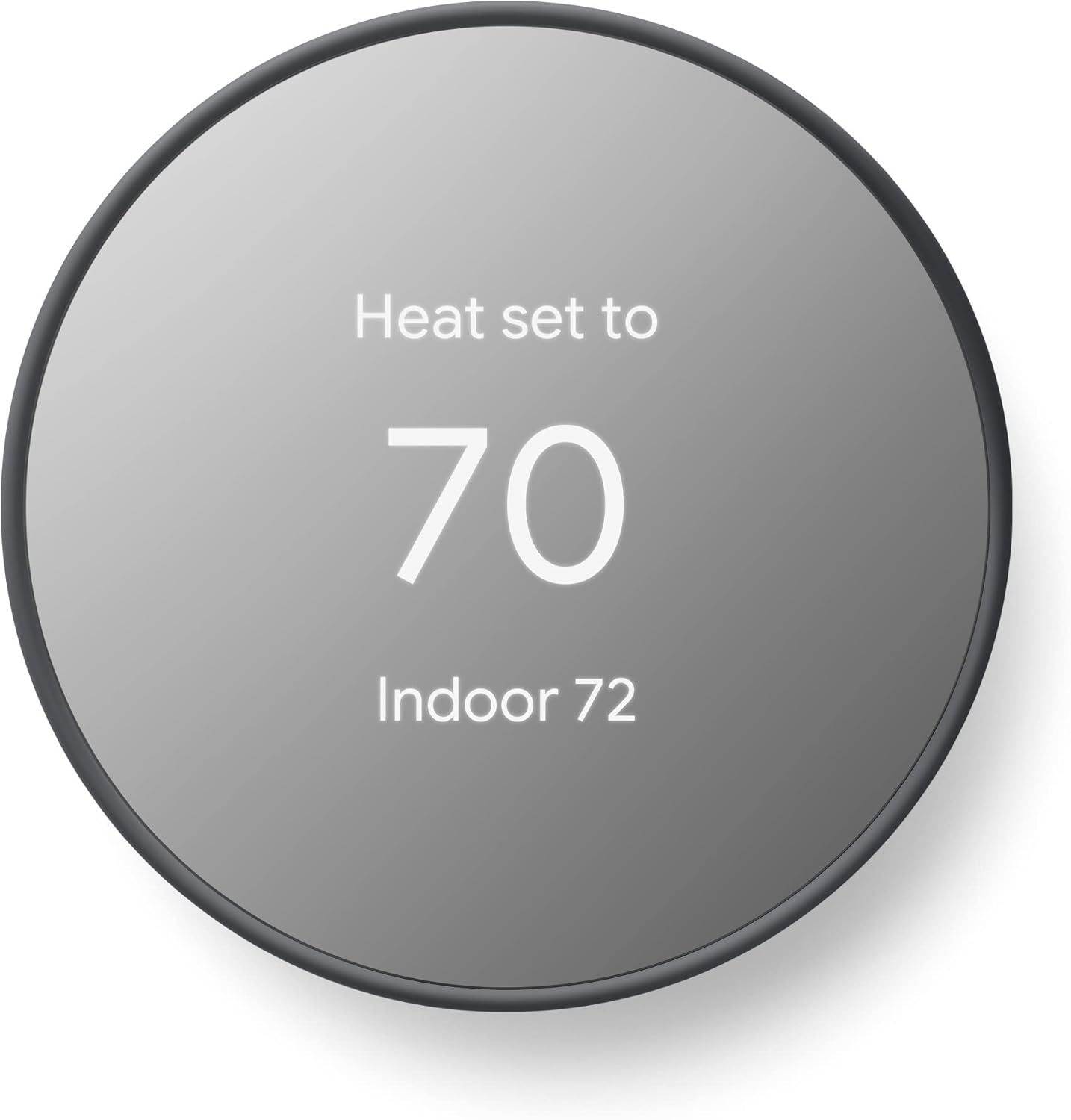
| Connectivity Technology | Bluetooth, Wi-Fi |
|---|---|
| Power Source | Battery Powered |
| Display Type | LCD |
| Control Type | Remote Control, Voice Control |
The Google Nest Thermostat is a compact smart thermostat designed for easy self-installation and everyday energy savings. It connects to 2.4 and 5 GHz Wi‑Fi and Bluetooth Low Energy so you can control temperature from the Google Home app or with compatible voice assistants, and it supports programmable schedules and remote control. Practical features include Savings Finder suggestions, HVAC monitoring that sends alerts if the system appears to need attention, and an Eco Temperature mode that lowers output when the house is empty. The unit is battery powered and usually works without a C wire, which simplifies installation in many homes, though some heat pump or zone systems may still require a C wire or power accessory. The simple side touch bar and 2‑inch LCD make local control straightforward, but advanced users seeking deep, installer-level configuration or detailed multi-stage furnace diagnostics may find the Nest less configurable than higher-end models. For typical homeowners who want app and voice control, energy hints, and basic system monitoring, it delivers a convenient, compact solution.
Best for: Homeowners who want an easy-to-use smart thermostat with app and voice control that helps reduce energy use and gives basic HVAC alerts without a complicated setup.
Less Ideal for: Those who need deep, installer-level control or specialized diagnostics for complex multi-stage furnace systems should consider a pro-grade thermostat instead.
- Wi‑Fi and Bluetooth connectivity with Google Home and voice assistant control
- Savings Finder and Eco Temperature help reduce energy use automatically
- HVAC monitoring provides alerts for potential system issues
- Designed for simple DIY installation and works without a C wire in most homes
- Limited advanced configuration for detailed multi-stage furnace tuning compared with pro-level thermostats
- Battery powered design may require a C wire or power accessory on some systems
Verdict: A simple, app- and voice-enabled smart thermostat that brings energy-saving automation and basic HVAC monitoring to most homes with minimal installation fuss.
Riseem STN615 Programmable Thermostat

| Temperature Control Type | 24V Conventional Multi Stage Thermostat |
|---|---|
| Power Source | Dual Power Supply |
| Display Type | LCD |
| Number of Batteries | 2 AAA batteries required. |
This Riseem STN615 is a straightforward programmable thermostat for homes with conventional 24V systems including multi-stage furnaces and forced-air HVAC. It offers 5-1-1 day programming, a backlit LCD, push-button controls, and selectable features like compressor delay protection and adjustable temperature differential to help optimize system runtime. Installation is simplified by a universal sub-base and large terminal blocks, and it can run on 24VAC or two AAA batteries so a C-wire is not required in most setups. The unit supports separate heating and cooling swing settings and includes a low-battery indicator and temperature calibration option. Limitations to note: it is not compatible with heat pump systems that require auxiliary/emergency heat, line-voltage or 110–240V electric baseboard heat, mini-splits, or 12V RV systems, and it lacks smart Wi-Fi connectivity or remote control. For buyers who want a reliable, programmable, factory-style replacement for a two-stage furnace without smart features, this model is practical and easy to install.
Best for: Buyers who prioritize reliable, programmable control for a conventional multi-stage furnace and want an easy DIY install without needing smart features.
Less Ideal for: Users who need Wi-Fi connectivity, remote app control, or compatibility with heat pumps that require auxiliary/emergency heat should look elsewhere.
- Supports 24V multi-stage systems and common forced-air furnace configurations
- 5-1-1 day programmable schedule for weekday/weekend customization
- Dual power option (24VAC or 2 AAA batteries) so most installs do not require a C-wire
- Universal sub-base and large terminal blocks simplify installation
- Adjustable swing, compressor delay protection, and temperature calibration for energy optimization
- Not compatible with systems that require auxiliary/emergency heat or line-voltage heating
- No Wi-Fi or remote control capability for smartphone scheduling
Verdict: A practical, easy-to-install programmable thermostat that gives precise control for conventional two-stage furnaces without smart features.
Mroinge M711 Thermostat
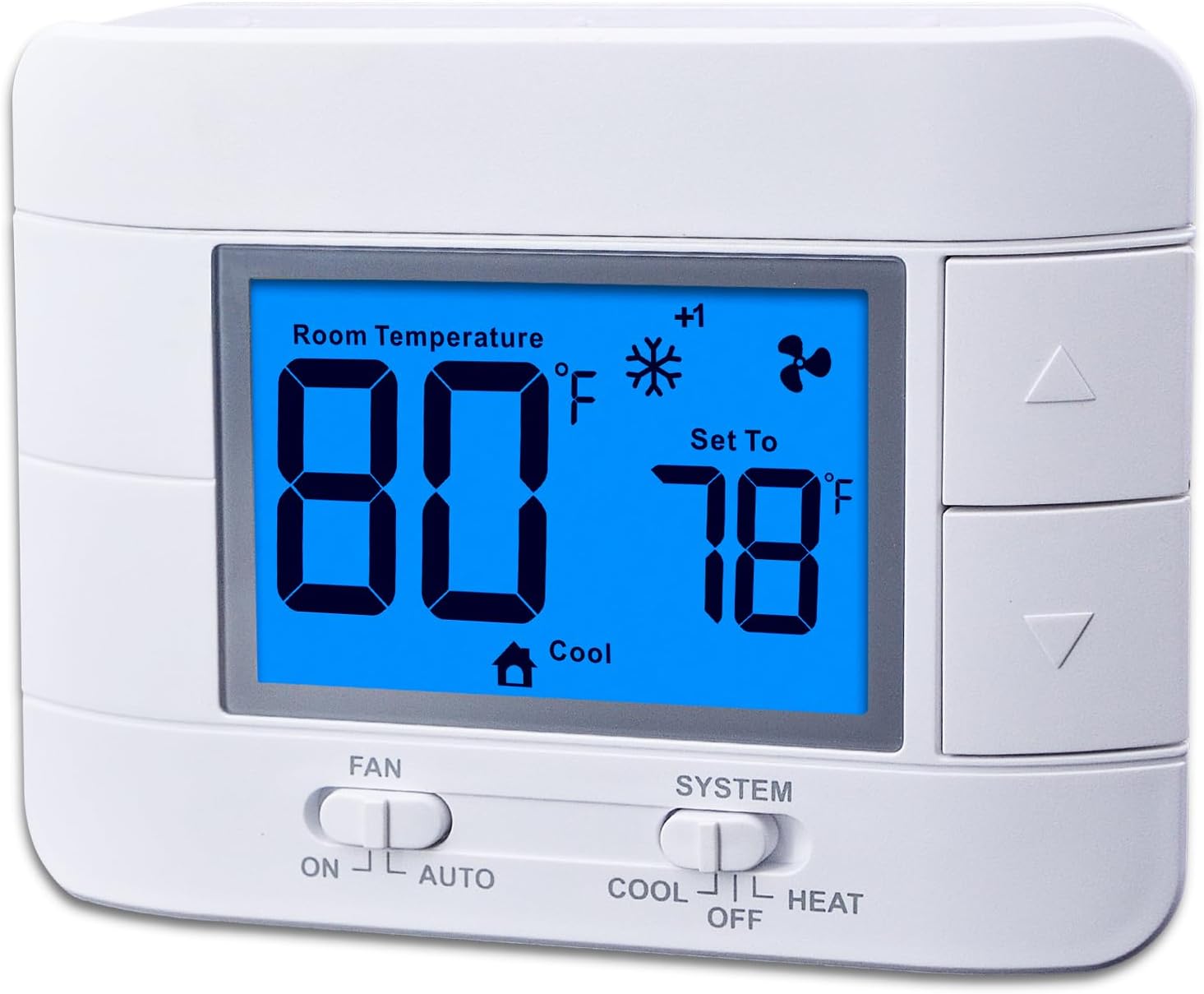
| Power Source | 24VAC or 2 AAA batteries |
|---|---|
| Stages | 2H/2C (multi stage) |
| Display Type | LCD with blue backlight |
| Control Type | Push button |
The Mroinge M711 is a straightforward non-programmable thermostat built for simple manual control of 2-stage heating and 2-stage cooling systems. It installs on a standard wall mount and accepts 24VAC power or two AAA batteries, so it can replace many existing residential thermostats without needing a common wire. The large backlit LCD shows room temperature and humidity clearly and the unit offers temperature calibration and a compressor delay to reduce short cycling. Controls are button-based and easy to operate, which makes the M711 suitable for users who prefer set-and-forget manual adjustment rather than scheduling. Limitations include no programmable schedules, no Wi-Fi or smart home features, and explicit incompatibility with heat pump, auxiliary/emergency heat, RV, and line-voltage baseboard systems, so it is only appropriate for conventional gas, oil, or electric furnace setups. For buyers after a basic, budget-friendly replacement for a 2-stage furnace, this model provides the core features without extras.
Best for: Buyers seeking an inexpensive, no-frills replacement thermostat for a conventional 2-stage gas, oil, or electric furnace who prefer simple manual controls over programmable or smart features.
Less Ideal for: Users who want scheduling, remote control, smart-home integration, or support for heat pump and auxiliary/emergency heating configurations should consider other models.
- Supports 2-stage heating and 2-stage cooling for multi-stage furnace systems
- Large backlit LCD clearly displays temperature and humidity
- Can be powered by 24VAC or two AAA batteries so common wire is not required
- Built-in compressor delay protection to prevent short cycling
- Non-programmable with no Wi-Fi or smart integrations
- Not compatible with heat pumps, auxiliary/emergency heat, RVs, or line-voltage baseboard systems
Verdict: A budget-friendly, easy-to-install non-programmable thermostat that provides reliable manual control for 2-stage furnace systems without smart features.
Honeywell Home RTH7600D Thermostat

| Controller Type | Touch |
|---|---|
| Temperature Control Type | Heating and Cooling |
| Power Source | Battery Powered |
| Display Type | Digital |
| Connectivity Protocol | BACnet MS/TP |
The Honeywell Home RTH7600D is a wall-mounted 7-day programmable thermostat with a large backlit touchscreen and menu-driven scheduling for four periods per day. It is designed to learn how long your heating or cooling equipment takes to reach set temperatures using Smart Response Technology, so programmed setpoints are reached at the expected times. Typical use is installing it in a central living area and programming weekday and weekend temperature schedules to reduce runtime when you are away or sleeping; it supports temporary and permanent holds as well. The unit offers auto changeover between heating and cooling, a filter replacement alert, a compressor delay to protect equipment, and both battery and wired power options. Limitations include its wired, non-smart design with no Wi‑Fi or smartphone control and a basic plastic build without advanced connectivity or multi-zone features, so it is best when you want straightforward reliable scheduling rather than remote or app-based automation.
Best for: Buyers who prioritize dependable, easy-to-program temperature schedules and equipment protection over remote control and advanced smart features.
Less Ideal for: If you want smartphone control, voice assistant integration, or multi-zone smart features, choose a modern Wi‑Fi thermostat instead.
- Large, backlit touchscreen with intuitive menu-driven programming
- Smart Response Technology that learns system run times to hit setpoints on schedule
- 7-day programming with four periods per day plus temporary and permanent hold options
- Auto changeover and compressor delay protect equipment and simplify operation
- Includes filter replacement alerts and installs with either battery or wired power
- No Wi‑Fi or app connectivity for remote control or smart-home integration
- Plastic construction and basic feature set compared with modern smart thermostats
Verdict: Choose the RTH7600D when you want a reliable, schedule-first touchscreen thermostat that keeps your system protected and on time.
Sensi Smart Thermostat ST55

| Connectivity Technology | Wi-Fi (2.4 GHz) |
|---|---|
| Controller Type | Amazon Alexa, Apple HomeKit, Google Assistant, SmartThings, Vera |
| Temperature Control Type | Programmable, Smart/Remote |
| Power Source | Corded Electric (2 AA batteries included) |
| Specific Uses For Product | Air Conditioner, Boiler, Furnace, Heat Pump |
The Sensi ST55 is a straightforward smart thermostat designed for DIY replacement of standard wall thermostats and for remote control of home HVAC systems. It connects over 2.4 GHz Wi‑Fi and pairs with Alexa, Google Assistant, Apple HomeKit, SmartThings and other platforms so you can change schedules or temperature from the app or by voice. The unit supports common HVAC systems including air conditioners, furnaces, boilers and heat pumps and provides usage reports, smart alerts and filter reminders to help track system performance. Installation is aimed at nonprofessional installers with a built-in level, wire stickers and step‑by‑step app guidance, and it usually does not require a common wire in many setups. The LED display and button controls keep operation simple, while battery backup is provided by two included AA cells. Limitations to note are its basic display and button-driven interface compared with larger touchscreen models, and Wi‑Fi must be stable for remote features and reports to work reliably.
Best for: Buyers who want a proven, easy-to-install smart thermostat that integrates with popular voice assistants and prioritizes energy tracking and privacy.
Less Ideal for: Shoppers seeking a large color touchscreen or advanced on-device controls should consider higher-end models with more extensive local UI features.
- Supports major smart platforms (Alexa, Google Assistant, Apple HomeKit, SmartThings)
- ENERGY STAR certified with usage reports and scheduling for energy savings
- Easy DIY installation with built-in level, wire stickers and app guidance
- Provides smart alerts and filter reminders to monitor HVAC health
- Basic LED and button interface lacks the richer controls of color touchscreens
- Remote features depend on reliable 2.4 GHz Wi‑Fi connection
Verdict: A reliable, energy‑focused smart thermostat that is simple to install and integrates with major smart home platforms, making it a safe choice for 2‑stage furnace setups that need trustworthy remote control and reporting.
Riseem S3001 Nonprogrammable Thermostat

| Controller Type | Push Button |
|---|---|
| Temperature Control Type | Conventional Single Stage Systems |
| Power Source | 24 volts AC or 2 AA batteries |
| Display Type | LCD |
| Connectivity Technology | Wired |
The Riseem S3001 is a straightforward wall-mounted thermostat for single-stage heating and cooling systems. It provides a clear backlit LCD, button controls, and a simple push-button interface that makes setpoints easy to change. Installation is intended to be DIY-friendly thanks to a universal sub-base with large terminal blocks and included screws and anchors, and the unit can run on 24VAC or two AA batteries when a common wire is not present on most systems. The thermostat offers separate heating and cooling swing adjustments for finer cycle control and claims +/-1°F accuracy for steady comfort. Important limitations: this model only supports single-stage systems and explicitly excludes multi-stage furnaces, heat pumps, mini-splits, and electric baseboard or hydronic setups, so it will not work for two-stage furnace systems targeted in this article. It lacks programmability and smart or remote connectivity, so scheduling and remote control are not possible. For a homeowner who needs a simple, reliable room thermostat for a compatible single-stage system, the S3001 is a practical, no-frills choice; buyers needing multi-stage or smart features should look elsewhere.
Best for: Buyers who prioritize a reliable, easy-to-install manual thermostat for a conventional single-stage furnace or cooling system and who prefer simple controls over smart features.
Less Ideal for: Anyone seeking a thermostat for a two-stage or multi-stage furnace, a heat pump, or someone who wants scheduling and remote control capabilities.
- Easy DIY installation with a universal sub-base and large terminal blocks.
- Dual power options: 24VAC wiring or two AA batteries for systems without a C-wire.
- Clear backlit LCD and simple button controls for straightforward operation.
- Separate heating and cooling swing adjustment for finer cycle control.
- Claims accurate temperature control to about +/-1°F.
- Only supports single-stage heating and cooling systems and is incompatible with multi-stage furnaces.
- No programming, Wi-Fi, or remote control features.
- Not compatible with heat pumps, mini-splits, or line-voltage electric heating systems.
Verdict: Choose the S3001 if you need a straightforward, reliable wall thermostat for a conventional single-stage system and value simple installation and operation.
Choosing the Right Thermostat for 2-Stage Furnace: Key Factors to Consider
Staging Compatibility and Terminal Support
A thermostat must explicitly support two-stage heating to drive both the first and second stages of your furnace. That means it should provide terminals for two heat stages (commonly labeled W1 and W2 or 1 and 2) and document how it sequences stages. Without native terminal support you may need relays or adapters, which adds complexity and potential points of failure.
Beyond terminals, check the thermostat's stated staging behavior. Some units switch to the second stage only after persistent temperature deviation or after a timed delay. Others use demand-based logic that measures runtime and indoor temperature trends. Match the thermostat's sequencing approach to how your furnace and ductwork respond to avoid frequent short cycles or delayed heat delivery.
Wiring, Installation, and Installer Options
How the thermostat wires into your system determines installation complexity. Look for clear wiring diagrams that include two-stage furnace setups and label which terminals to use for common accessories like humidifiers, zone controls, or outdoor sensors. If your home lacks a dedicated common wire, consider how the thermostat handles power—whether it needs a C wire, supports power steal, or provides an adapter.
Consider whether you will install the device yourself or hire a technician. Units with guided setup screens, terminal detection, and clear on-screen prompts reduce the chance of miswiring. For pro installation, compatibility with standard furnace control boards and a predictable wiring map helps installers complete work quickly and reliably.
Control Logic and Cycle Management
Two-stage furnaces rely on a thermostat that manages stage transitions intelligently to avoid short cycling and unnecessary wear. Evaluate whether the thermostat uses adaptive recovery, staged setpoint thresholds, minimum run-time enforcement, and anti-short-cycle delays. These controls help the furnace achieve even temperatures while preventing rapid on-off patterns that reduce efficiency and lifespan.
Also consider how the thermostat measures demand. Some use simple temperature differential thresholds, while others incorporate runtime history, outdoor temperature, or humidity to make staging decisions. The more context-aware the logic, the better it can match staging to real-world conditions in your home.
Programmability and User Interface
A user-friendly interface makes it easier to configure staging behavior and daily schedules. Evaluate whether the thermostat offers multiple scheduling styles (weekday/weekend, 7-day, or smart adaptive schedules), easy temporary hold functions, and straightforward access to staging settings. A clear display that reports active stage, call for heat, and system status helps you verify correct operation.
For households with multiple occupants or varied schedules, flexible programming options reduce manual overrides and keep the system running efficiently. If you prefer minimal interaction, look for units with effective auto-schedule or learning features that manage setbacks and recovery without frequent input.
Connectivity, Remote Control, and Integration
Connectivity can add convenience through remote monitoring, alerts, and firmware updates, but it should not be the primary reason to pick a thermostat for staging performance. If you value remote access, choose a thermostat with stable app connectivity and clear information about its security and data handling. Check for integration with home systems you already use, such as voice assistants or home automation hubs, when that matters to you.
Keep in mind that networked features may require periodic updates and can change over time. Prioritize a thermostat whose core staging and safety functions operate locally even if network services are unavailable.
How Two-Stage Furnaces Use Thermostats
Two-stage furnaces have two levels of heat output. The thermostat's job is to decide when to call for stage one and when to escalate to stage two. Proper staging keeps temperature swings smaller and lets the system run longer at low capacity for efficiency.
Understanding the typical triggers for stage change helps when configuring or troubleshooting. Some thermostats use fixed temperature differentials, while others consider run time or recovery needs. Knowing which approach your thermostat uses helps set expectations for how quickly your home reaches setpoint.
- Stage one runs for smaller corrections or mild outdoor temperatures.
- Stage two engages for larger heat deficits or faster recovery.
- Smart staging minimizes short cycles by enforcing minimum run times.
Signs Your Thermostat or Staging Settings Need Adjustment
If you notice frequent short cycling, inconsistent room-to-room comfort, or the furnace immediately jumping to high output for small temperature changes, the thermostat staging thresholds or minimum runtime settings may need tuning. Proper adjustments reduce wear and improve comfort.
Use the thermostat's status display or app to monitor active stage calls and run times after making changes. Small incremental adjustments to staging sensitivity or minimum runtimes are safer than large changes.
- Excessive short cycles suggest too-sensitive staging or insufficient minimum runtime.
- Long delays before stage two may cause prolonged discomfort on very cold days.
- Unexpected stage changes can indicate wiring issues or incorrect system type settings.
Installation Tips for Reliable Staging Performance
Mount the thermostat away from drafty locations, direct sunlight, or heat sources so its temperature readings reflect the occupied space. Poor placement can cause incorrect staging calls and uneven comfort.
Verify wiring twice against the furnace control board diagram. Use labeled terminals and test the thermostat in each stage to confirm the control board receives the correct signals. Document any nonstandard wire color usage to help future troubleshooting.
- Place the thermostat on an interior wall about five feet above the floor.
- Avoid locations above heat registers or near frequently used appliances.
- If uncertain about wiring, consult a qualified HVAC technician.
Balancing Remote Features with Local Reliability
Networked features are convenient for monitoring and scheduling, but the thermostat should maintain core staging control without relying on cloud services. Confirm the thermostat can operate fully offline if the network drops.
Consider how firmware updates are handled and whether the manufacturer provides clear change logs. Remote diagnostics can speed troubleshooting, but prioritize devices with transparent local status indicators for on-site verification.
- Check that the thermostat displays active stage and call-for-heat status locally.
- Prefer units that allow manual overrides and local schedule changes without an app.
- Ensure the app presents clear historical run-time data if you plan to use remote diagnostics.
How We Chose the Best Thermostat for 2-Stage Furnace
We prioritized thermostats that explicitly support two-stage heating control and have documented staging logic or wiring that matches common 2-stage furnace configurations. We evaluated interface clarity and setup workflow because correct wiring and straightforward configuration reduce installer errors and ensure the system actually uses staging. Compatibility and wiring options were another filter, including support for conventional 2H/2C terminals and common accessory connections used with typical furnaces. Control features and programmability were weighed to score how well a thermostat can manage multi-stage cycles, including advanced scheduling, adaptive recovery, and setback behavior. Connectivity and remote control were considered for users who want app-based monitoring, but we did not favor connectivity over solid local staging function. Reliability of control logic and reporting of system state were included so the thermostat can reliably command stage changes without excessive short-cycling. We excluded devices that only support single-stage heating, require proprietary wiring adapters for basic staging, or lack clear documentation on 2-stage configuration. We also filtered out models with limited thermostat terminal support that would force workarounds. The final list reflects balance across compatibility, setup friendliness, staging control, user-facing features, and long-term reliability.
Our full evaluation process is outlined in our review methodology.
FAQ
Can I use any thermostat with a 2-stage furnace?
Not every thermostat supports two-stage heating. You need a unit that provides two heat stage terminals and documents how to configure staging. Using a single-stage thermostat will force the furnace to operate only in its primary stage or require additional hardware.
How do I know if my thermostat is calling for stage two?
Most thermostats clearly indicate active stage on their display or in their app, showing whether W1 or W2 is engaged. You can also observe furnace behavior and listen for changes in fan or burner output, but a status readout is the most reliable indicator.
Will a learning or smart thermostat manage staging automatically?
Some learning thermostats include adaptive algorithms that can manage staging, but implementations vary. Verify that adaptive behavior explicitly supports two-stage systems and that the device documents how it decides to escalate to the second stage.
Do I need a common wire for a 2-stage thermostat?
Requirement for a common wire depends on the thermostat model, not the staging itself. Many advanced thermostats prefer a C wire for stable power, though some offer power-stealing or include adapters. Check the installation requirements for the specific thermostat you choose.
Can incorrect thermostat settings damage my furnace?
Incorrect staging thresholds or very short minimum run times can increase wear from frequent cycling, which may shorten component life. While a thermostat rarely causes immediate damage, improper settings can accelerate wear over time and reduce efficiency.
Final Verdict
For a 2-stage furnace, prioritize a thermostat that explicitly supports two-stage control, provides clear terminal wiring, and includes robust cycle-management features. Balance ease of installation and a clear local interface with remote connectivity only if it does not compromise core staging behavior. Focus on reliable staging logic, minimum runtime enforcement, and straightforward configuration to achieve steady comfort and efficient operation. In short, pick a thermostat that matches your furnace wiring and control expectations, then tune staging sensitivity and runtimes to your home. That approach delivers the best balance of comfort, equipment longevity, and energy performance.