
Note: This article contains affiliate links. If you click on these links and make a purchase, we may earn a small commission at no extra cost to you. This helps support our research and content. Read our full affiliate disclosure here.
Picking the right thermostat for an apartment changes daily comfort and energy use more than many renters expect. Apartments often have constraints such as limited access to HVAC wiring, shared systems, or landlord rules, so your choice should prioritize easy installation, clear scheduling, and reliable temperature sensing. This guide lists seven shortlisted thermostats suited to apartment living. Each pick was chosen for practical renter needs like simple setup, noninvasive mounting, and strong energy-tracking features. Read on for how we evaluated these options and the criteria that matter when you shop for an apartment thermostat.
Top Picks at a Glance
| Best Overall The best all-around choice for most situations | Sensi Touch ST75 Thermostat |  |
| Best Quality Built to a higher standard if you want something more solid | Google Nest Learning Thermostat (4th Gen) |  |
| Best Value The sweet spot between price and what you get | Honeywell Home X2P RTH22B |  |
| Best Budget The cheapest option that still gets the job done reliably | Honeywell Home CT30A1005 Thermostat |  |
| Top Rated A top-rated pick with lots of positive feedback | Heagstat H701W Single-Stage Thermostat |  |
| Most Popular A crowd favorite that many people choose with confidence | Google Nest Thermostat |  |
| Best Seller A high-volume bestseller chosen again and again | Amazon Smart Thermostat |  |
Sensi Touch ST75 Thermostat

| Connectivity Protocol | Wi‑Fi (2.4 GHz) |
|---|---|
| Control Method | App, Touch, Voice |
| Display Type | LCD color touchscreen |
| Power Source | AC/DC (C‑wire required) |
The Sensi Touch ST75 is a wall‑mounted smart thermostat built for straightforward DIY installation and daily remote control of home HVAC systems. It connects to 2.4 GHz Wi‑Fi and pairs with Alexa, Google Assistant, Apple HomeKit, SmartThings and other platforms so you can change schedules, set temperatures, or use voice commands from a phone or smart speaker. The color touchscreen and app provide scheduling, usage reports, and maintenance alerts such as filter reminders, which help track energy use and plan service. Installation is designed for homeowners comfortable with basic wiring; the thermostat requires a common wire and includes illuminated terminals and mounting hardware to simplify the job. Practical limitations include the C‑wire requirement and reliance on 2.4 GHz Wi‑Fi rather than 5 GHz, which can matter in apartments with limited wiring or crowded networks. For apartment residents who want a modern display, remote access, and energy reporting in a compact unit, the Sensi Touch covers the essentials without extra complexity.
Best for: Someone living in an apartment who wants a compact, easy‑to‑use smart thermostat with remote control, voice assistant support, and energy reporting to manage comfort and costs.
Less Ideal for: Renters without a C‑wire or people who cannot modify existing thermostat wiring should consider battery‑powered or HVAC‑friendly alternatives instead.
- Clear color touchscreen and readable menus for everyday adjustments
- Works with major smart platforms and voice assistants for remote and voice control
- Energy Star certification plus scheduling and usage reports to help reduce HVAC energy use
- Designed for DIY install with illuminated easy‑click terminals and included mounting hardware
- Requires a common (C) wire so not plug‑and‑play in all apartments
- Only supports 2.4 GHz Wi‑Fi, which may be limiting on some home networks
Verdict: A compact, apartment‑friendly smart thermostat that delivers remote control, voice assistant compatibility, and energy reporting for buyers who can provide a C‑wire.
Google Nest Learning Thermostat (4th Gen)

| Connectivity Technology | Wi-Fi |
|---|---|
| Control Method | App |
| Display Type | Touchscreen |
| Power Source | Corded Electric |
| Number of Batteries | 1 CR2 required (included) |
The Nest Learning Thermostat (4th gen) is a feature-rich smart thermostat designed to learn your habits, suggest schedule tweaks, and help reduce heating and cooling energy use. It installs on standard 24V HVAC systems and pairs with the Google Home app for remote control and voice commands through Alexa, Siri, or Google Assistant, while also supporting Matter for smart-home integration. The unit includes a Nest Temperature Sensor to target hot or cold spots, and Dynamic Farsight and a larger touchscreen make readouts visible from across a room. Practical benefits include automatic Eco modes when you leave, adaptive adjustments based on outdoor conditions, and system health alerts that flag potential HVAC issues. For apartment use the compact wall-mount design and app-based scheduling let you manage comfort without frequent manual adjustments. Limitations to note are the requirement for a compatible 24V system in some setups and the fact that advanced energy-saving features rely on cloud connectivity and app notifications, so privacy-conscious buyers should review account settings.
Best for: Apartment dwellers who prioritize precise temperature control, energy savings, and seamless smart‑home integration with remote and voice control.
Less Ideal for: People who prefer a fully local, offline thermostat or who have nonstandard HVAC systems that are incompatible with 24V smart thermostats.
- Learns schedules and suggests energy-saving adjustments automatically
- Includes a remote temperature sensor to manage hot or cold spots
- Large, clear touchscreen with Dynamic Farsight for easy visibility
- Works with Google Home app, voice assistants, and Matter for smart-home control
- Requires a compatible 24V HVAC system for full functionality
- Some advanced features depend on cloud connectivity and app notifications
Verdict: Choose this Nest thermostat if you want a smart, learning thermostat that delivers precise, app‑driven temperature control and energy-saving automation for an apartment setting.
Honeywell Home X2P RTH22B

| Scheduling | 7 day, 5-1-1, 5-2 or 1 week |
|---|---|
| Compatibility | Up to 2H/2C conventional or up to 2H/1C heat pump |
| Power Source | 2 AA batteries |
| Display Type | Backlit LCD |
| Energy Certification | ENERGY STAR Certified |
The Honeywell Home X2P RTH22B is a straightforward programmable thermostat intended for conventional and heat pump HVAC systems. It offers multiple scheduling options (7 day, 5-1-1, 5-2 or 1 week) or a non-programmable mode, making it easy to match daily routines. The large backlit LCD and clear font simplify setpoint changes and daily viewing, and interchangeable accent pieces let it blend into different decors. Installation is battery powered with 2 AA cells and it supports common system configurations up to 2 heat/2 cool conventional or up to 2 heat/1 cool heat pump, plus basic reminders like filter change alerts. Practical users will appreciate the energy-star certified efficiency and the UWP wall plate that eases wiring and future upgrades. It does not support electric baseboard systems and lacks advanced smart features like integrated Wi-Fi control, so it fits renters or apartment residents who want reliable programmable control without needing app connectivity or a smart-home setup.
Best for: Apartment residents who want a reliable, easy-to-use programmable thermostat to reduce wasted runtime and set consistent schedules without requiring smart-home features.
Less Ideal for: Users who need remote control, voice assistant integration, or support for electric baseboard heating should look at Wi-Fi or specialized models instead.
- Flexible scheduling options to match varied routines (7 day, 5-1-1, 5-2 or 1 week)
- Large backlit LCD and clear font for easy daily use
- Compatible with common conventional and heat pump systems up to multi-stage limits
- Interchangeable accent pieces let it match apartment decor and the UWP wall plate simplifies installation
- No built-in Wi-Fi or remote app control for smart-home integration
- Not compatible with electric baseboard heating systems
Verdict: A practical, programmable thermostat that gives apartments reliable schedule-based control and easy installation without smart-home complexity.
Honeywell Home CT30A1005 Thermostat

| Controller Type | Hand Control |
|---|---|
| Specific Uses For Product | Furnace |
| Power Source | Low Voltage Control |
| Display Type | Manual |
| Mounting Type | Wall Mount |
The Honeywell Home CT30A1005 is a basic mechanical thermostat that provides straightforward temperature control for heating-only systems. It uses a bimetal temperature sensor and a snap-action magnetic switch operated by a dial, so setting and adjusting room temperature is immediate and intuitive without menus or power-dependent displays. Installation is DIY-friendly: the unit is wired, includes a decorative backplate and mounting hardware, and does not require leveling. Because it is non-programmable and manual, it is best for renters or apartment rooms where a simple, durable thermostat is needed rather than advanced scheduling or smart features. Important limitations are clear: it controls heat only, is not compatible with heat pumps or electric baseboard systems, and offers no digital readout, Wi-Fi, or energy-saving programming. For someone seeking a low-cost, no-frills replacement or a reliable manual control for a single-zone heating setup, this unit delivers practical, dependable performance.
Best for: Apartment residents or budget-focused buyers who need a low-cost, durable manual thermostat to control a single heating zone without programming or smart features.
Less Ideal for: Users who want programmable schedules, remote control, smart home integration, or compatibility with heat pumps and electric baseboard systems should look elsewhere.
- Very simple to use with a dial and bimetal sensor for immediate adjustments
- Includes decorative backplate and mounting hardware for easy DIY install
- Mercury-free mechanical design offers long-term reliability without batteries or displays
- Heat-only function — will not control cooling or heat pump systems
- No programmable schedules or smart connectivity for automated energy savings
Verdict: A pared-down, budget-friendly manual thermostat that gives reliable, straightforward heating control for single-zone apartment setups.
Heagstat H701W Single-Stage Thermostat
| Controller Type | Non-Programmable |
|---|---|
| Power Source | AC, Battery Powered |
| Display Type | LCD |
| Connectivity Technology | Wired |
| Screen Size | 4.5 inches |
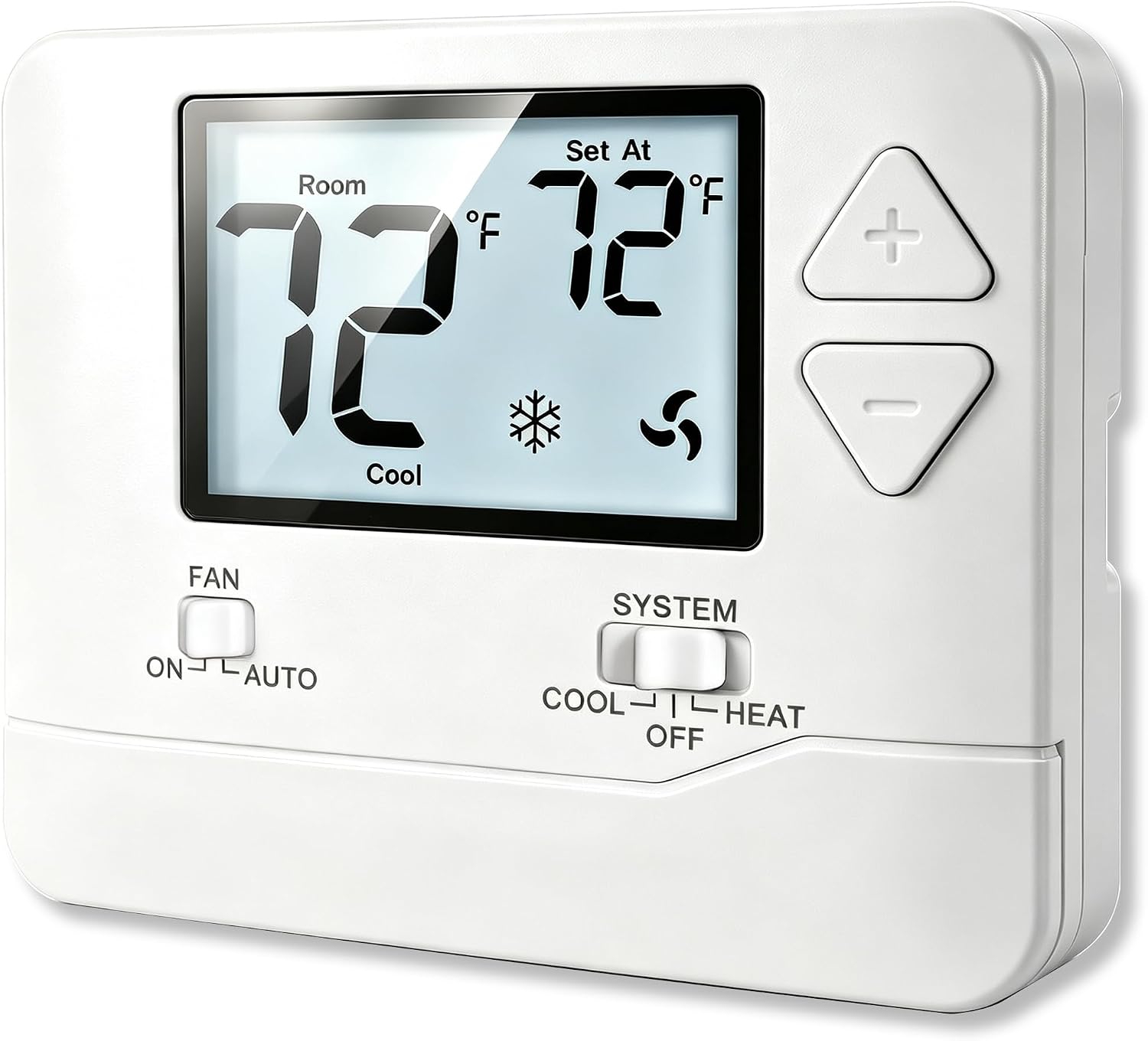
The Heagstat H701W is a straightforward nonprogrammable thermostat intended for conventional single-stage forced-air systems. It offers manual Heat/Off/Cool operation on a clear 4.5-inch backlit LCD, and supports either 24VAC wiring or two AAA batteries for homes without a common wire. Installers will appreciate standard terminals for RH/RC, W, Y, G and C and selectable 5-minute compressor delay protection to protect condensers. The thermostat also includes temperature calibration, adjustable cycle swing, and a low-battery reminder for reliable day-to-day control. Because it lacks scheduling and smart features, it is best used where simple, dependable temperature control is preferred over automation. Buyers should check compatibility carefully since it does not support multi-stage systems, heat pumps, or certain specialty terminals, and it requires basic wiring knowledge for correct installation.
Best for: Apartment dwellers or landlords who want a simple, reliable manual thermostat for a conventional single-stage heating and cooling setup and prefer straightforward operation over smart features.
Less Ideal for: People who need programmable schedules, Wi-Fi/remote control, or compatibility with multi-stage systems and heat pumps should choose a different model.
- Works with 24VAC hardwiring or two AAA batteries for homes without a C-wire
- Large 4.5-inch backlit LCD that is easy to read in low light
- Standard RH/RC, W, Y, G, C terminals for common single-stage HVAC hookups
- Selectable 5-minute compressor delay protection to prevent short-cycling
- Temperature calibration and adjustable swing let you fine-tune comfort
- No programmable schedules or smart/home integration
- Not compatible with multi-stage systems, heat pumps, or many specialty terminals
Verdict: A reliable, no-frills manual thermostat that gives clear, precise control for single-stage apartment HVAC systems without the complexity of smart features.
Google Nest Thermostat

| Connectivity Technology | Wi‑Fi |
|---|---|
| Power Source | Battery Powered |
| Temperature Control Type | Heating, Cooling |
| Number of Batteries | 2 AAA batteries required. (included) |
The Google Nest Thermostat is a compact smart thermostat intended for easy DIY installation and everyday climate control in apartments. It connects to your Wi‑Fi and the Google Home app so you can change temperature remotely, set schedules with Quick Schedule, and use Savings Finder suggestions to reduce energy use. The device is battery powered and designed to work without a common C wire in most homes, and it offers basic HVAC monitoring that can send alerts if the system shows potential issues. Controls include a side touch bar and voice control via compatible assistants. Practical benefits for apartment dwellers include simple wall mounting, remote access from a phone, and automatic Eco Temperatures when the unit senses you are away. Limitations include the small 1.07‑inch screen that keeps the interface minimal and the occasional need for a C wire or power accessory on some systems, and advanced features like Nest Renew or certain alerts require additional account setup or regional availability.
Best for: Apartment residents who want a compact, app-controlled thermostat that is simple to install and focuses on saving energy with automated schedules.
Less Ideal for: People who need a large on-device display or advanced, pro-level HVAC diagnostics and controls should consider higher-end or professional thermostats instead.
- Easy DIY installation with included mounting hardware
- Remote control and scheduling via Google Home app
- Works without a C wire in most homes
- Energy-saving features like Savings Finder and Eco Temperature
- Voice control compatibility with Google Assistant and other Matter-certified assistants
- Small screen limits on-device interaction and detailed menus
- Some HVAC systems may still require a C wire or power accessory
Verdict: A compact, easy-to-install smart thermostat that gives apartment users remote control and energy-saving automation with minimal setup.
Amazon Smart Thermostat
| ASIN | B08J4C8871 |
|---|---|
| Works with | Alexa and Ring |
| C-wire | Required |
| Manufacturer tech | Honeywell Home |
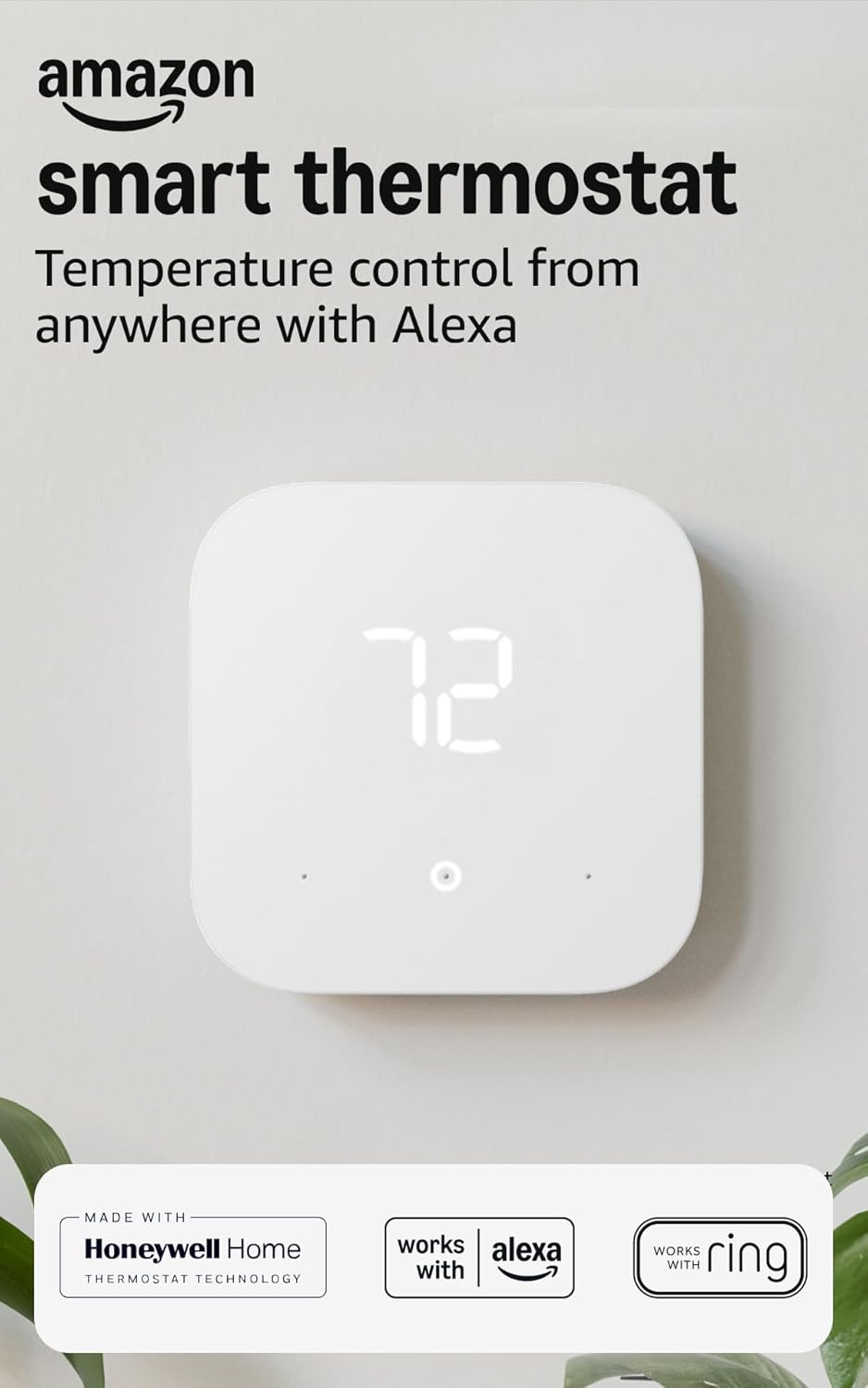
The Amazon Smart Thermostat is a straightforward Wi‑Fi thermostat built for easy installation and Alexa integration, aimed at replacing basic manual thermostats in apartments. It guides you through DIY setup in the Alexa app, supports scheduling and presence-based adjustments through compatible Alexa devices, and lets you control temperature remotely. The unit uses Honeywell Home thermostat technology under the hood and links with Alexa+ features so you can create routines and combine temperature control with other smart home actions. Practical benefits include potential energy savings from programmable schedules and simplified voice control for renters or busy households, plus email follow-up about local rebate opportunities. Limitations are that it requires a C-wire and leans heavily on the Alexa ecosystem for advanced features, so users who prefer other smart platforms or need a battery-only option may find it less flexible.
Best for: Apartment dwellers who want a reliable, low-friction smart thermostat that prioritizes energy savings and simple voice/app control within the Alexa ecosystem.
Less Ideal for: People who cannot provide a C-wire, prefer non-Alexa smart platforms, or need a thermostat that operates fully without hub or cloud services.
- Easy DIY installation guided in the Alexa app
- Direct integration with Alexa and Ring for voice and presence-based control
- Remote monitoring and scheduling via the Alexa app
- Built with Honeywell Home thermostat technology for reliable temperature control
- Requires a C-wire which may need extra wiring in some apartments
- Advanced features are tied to the Alexa ecosystem rather than platform-agnostic options
Verdict: A no-frills, Alexa-first smart thermostat that makes upgrading an apartment thermostat easy while helping reduce energy use.
Choosing the Right Thermostat for Apartment: Key Factors to Consider
Installation Flexibility
Apartment residents often cannot access or modify HVAC wiring or make permanent wall changes. Thermostats that support battery-only operation, use existing wiring without rewiring, or include adapter plates and adhesive mounts are far easier to install and remove at lease end. Also check whether the thermostat offers a wallplate or spacer to cover old holes and whether it can be mounted without drilling.
Flexible installation reduces the risk of needing landlord permission or paying for professional installation. It also makes it simpler to take the device with you when you move.
Compatibility With Shared or Limited HVAC Control
Many apartments use building-managed systems or have limited local control, such as carrier units, hydronic heat, or electric baseboard heat. Confirm that the thermostat supports the control method in your apartment—line-voltage, low-voltage, or simple on/off relays. A model that supports multiple control types or has clear instructions for common apartment systems will avoid surprises.
Compatibility matters because a thermostat that cannot interface correctly can leave you with little control or cause improper cycling. When in doubt, verify wiring labels against the thermostat documentation before purchasing.
Ease of Use and Local Controls
For renters, daily convenience is as important as advanced features. A thermostat should offer straightforward local controls so you can adjust temperature without opening an app. Large, legible displays, simple dial or button controls, and quick-access temporary hold features reduce friction for everyday use.
Good local controls are also crucial when the network is down or when guests need to adjust comfort settings. Balance touchscreen or app-centric designs with easy manual override options.
Remote Access and Scheduling
Remote control and scheduling let you manage comfort and energy use when you are out of the apartment. Look for thermostats that provide reliable Wi-Fi connectivity, intuitive scheduling interfaces, and support for multiple daily temperature zones. Vacation hold and geofencing features can help minimize wasted heating or cooling when the apartment is unoccupied.
Consider whether the app ecosystem syncs settings across devices and whether schedules are stored locally as a fallback if cloud services are interrupted.
Energy Monitoring and Reporting
Energy-tracking features show how thermostat settings translate into actual consumption. Good reporting helps you identify high-usage patterns, adjust schedules, and verify that efficiency strategies are working. Look for models that present clear, actionable data rather than dense graphs.
Accurate reporting matters for renters trying to lower bills or justify conversations with landlords about system efficiency.
Security and Privacy
Thermostats connected to home networks can expose data about occupancy patterns. Evaluate the device's security posture: does it support secure Wi-Fi connections, regular firmware updates, and local control without mandatory cloud accounts? Privacy-conscious renters may prefer models that allow anonymous setup or local-only operation.
Consider the vendor's update policy and whether the device provides easy controls to opt out of data collection.
Common Apartment HVAC Types and What They Mean
Apartments can use a variety of HVAC setups, from centralized building furnaces to individual electric baseboard heating or mini-split systems. Each type affects thermostat choice because control signals and wiring standards vary. Identifying your system early prevents buying an incompatible thermostat.
If you are unsure which system you have, check the existing thermostat wiring or ask building management. Note whether the system seems to require a line-voltage thermostat, a low-voltage control, or a simple on/off switch, and gather the labels on the current thermostat wires.
- Centralized boiler or chiller systems often limit tenant-level control.
- Electric baseboard heaters usually use line-voltage thermostats.
- Ductless mini-splits may require the manufacturer remote or compatible thermostats.
Noninvasive Installation Tips for Renters
For many renters, noninvasive installation is the deciding factor. Use adhesive cable covers, paintable wall plates, or mounting adapters to hide old screw holes. Battery-powered models avoid the need for a C-wire and reduce the chance you will need landlord approval.
Document the original thermostat and wiring with photos before making changes. That makes it easier to restore the original setup when you move out and demonstrates that no permanent modification was made.
- Bring a screwdriver and label any wires before disconnecting.
- Keep the original thermostat and screws for reinstallation.
- Use removable wall anchors and adhesive covers when drilling is not allowed.
Balancing Smart Features With Simplicity
Smart thermostats add convenience through remote control, adaptive schedules, and energy reports. However, more features often mean a steeper learning curve and potential reliance on cloud services. Renters should weigh whether app-based automation offers enough benefit to justify complexity.
A practical approach is to prioritize reliable core functions: straightforward scheduling, a responsive local interface, and basic remote control. Advanced integrations can be a bonus but should not undermine everyday usability.
- Verify whether the thermostat requires a cloud account to function.
- Check if schedules can be edited directly on the device.
- Look for simple guest or temporary access controls if others will adjust settings.
Managing Energy Use in a Shared Building
In buildings where heating or cooling is centrally controlled, individual adjustments may have limited effect. Still, optimizing in-apartment thermostats, using smart scheduling, and improving insulation are practical ways renters can improve comfort and reduce energy waste.
Keep expectations realistic when the building HVAC limits temperature ranges. Focus on local strategies like programming setback schedules, using fans or supplemental heaters appropriately, and monitoring energy reports to find small wins.
- Use setback schedules to avoid conditioning an empty apartment.
- Pair thermostat scheduling with window coverings and fans for improved efficiency.
Troubleshooting Common Setup Issues
Common problems include incompatible wiring, missing common wires, or unstable Wi-Fi. If the thermostat cannot detect the HVAC type during setup, stop and verify wiring labels rather than forcing a configuration.
Battery-powered thermostats often provide clear error messages about wiring and power. For persistent connectivity issues, try a guest network or a different router band. Always consult building management before performing changes that could affect shared systems.
- Confirm the presence of a C-wire if the model needs constant power.
- Restart your router and thermostat during troubleshooting.
- Refer to the device diagnostics before contacting support.
How We Chose the Best Thermostat for Apartment
We focused on features and limitations that matter most in apartment settings. Key evaluation criteria included installation flexibility, compatibility with common apartment HVAC setups, ease of use for renters with limited control over building systems, and energy-monitoring capabilities to help reduce utility bills. We also assessed physical footprint and noninvasive mounting options, since many renters cannot modify existing walls or wiring. Connectivity and app quality were considered to ensure remote control and scheduling are practical for people who are often away from home. Products that required professional HVAC rewiring, permanent wall modification, or that offered only minimal scheduling were excluded. We prioritized thermostats that provide clear diagnostics and fallback manual controls if network features fail. Our selection emphasizes practical tradeoffs: simplicity versus advanced automation, battery-powered options versus hardwired models, and the presence of renter-friendly installation accessories. The resulting list highlights thermostats that fit the realities of apartment living while delivering meaningful temperature control and energy feedback.
Our full evaluation process is outlined in our review methodology.
FAQ
Can I install a thermostat in an apartment without a C-wire?
Often yes. Several models support battery-only operation or include power-extender kits that work with common wiring setups. Verify the product documentation to confirm battery operation and check the current thermostat for evidence of a C-wire before deciding.
Will a smart thermostat work with electric baseboard heating?
Not necessarily. Electric baseboard systems typically require line-voltage thermostats that differ from low-voltage smart models. Look for thermostats explicitly stating compatibility with line-voltage systems or choose a model designed for that control type.
Is landlord permission required to swap a thermostat in an apartment?
It depends on your lease and the building rules. Simple, reversible changes such as using adhesive mounts or battery-powered units often do not require permission. For hardwired replacements or changes to shared systems, check with management first.
How can I measure whether a new thermostat actually saves energy?
Choose a thermostat with built-in energy reports or exportable usage data, then compare consumption or bills before and after a consistent schedule change. Look for clear daily or weekly summaries that show run time rather than only temperature logs.
What if my apartment is on a building-wide heating schedule?
If the building controls the system, your thermostat may only allow limited adjustments. Focus on maximizing comfort within allowed temperature ranges, use programmable setbacks, and employ local measures like fans, curtains, and door seals to improve perceived comfort.
Final Verdict
Choose a thermostat for apartment living by prioritizing installation flexibility, compatibility with the building HVAC, and straightforward controls. For most renters, battery-powered or noninvasive options with solid scheduling and basic energy reporting deliver the best balance of convenience and control. Weigh the tradeoffs between advanced smart features and simple reliability. If you need remote access and detailed reports, pick a model with proven connectivity and clear diagnostics. If you expect to move frequently or cannot alter wiring, favor removable, battery-powered units that are easy to uninstall and take with you.